Categories
general

The death of Pair

I recently moved this site. It’s still at rumored dot com, of course. And it’s hopefully somewhat of an invisible transition. But it was pulling teeth there for a bit. Let me explain.

I first registered this domain on November 16, 1998. Prior to that, this blog (which wasn’t called a blog yet, because that term barely existed) lived over at Speakeasy, the hosting provider that was previously an internet cafe in Seattle. In 1998, I registered for a hosting account at Pair dot com, probably because Michael was using them for his site. I also registered the domain rumored dot com. The site went through various iterations of a static site, eventually using a static site generator I wrote before static site generators were A Big Thing, and then eventually it ended up in self-hosted WordPress.

That was going okay for decades I guess. I’d get a big bill every November, I’d pay it, and I’d have somewhat average service for the next 12 months. Pair was never blindingly fast or very leading-edge on their offering, but it worked reliably, and there was little fuss. Using some new wiz-bang hosting thing like Vercel or whatever would give me one-click whatever and the latest stacks and toys and apps and whatnot. But for just straight-up Apache/PHP/MySQL and no complications, Pair worked.

For a while, this was slightly frustrating because I was working with Ruby on Rails, then learning way more PHP, and I had grandiose ideas of doing the Next Big Multimedia Thing somehow, writing a database-backed CMS that had some weird image component or collaborative wiki something-or-other. And I’d write Rails stuff on my home machine and then not really have a way to deploy it to Pair. Or I’d come up with some PHP behemoth and then copy it over, and it would constantly time out on their machines. I gave up on that eventually. WordPress more or less worked. I thought about moving to Ghost or some real CCMS system, but once you get well past a thousand entries into a WordPress blog, moving it elsewhere is like moving houses when you have more than 20,000 books. You can’t do it on a whim.

So life went on. And then this year, my annual bill went up like 75%, to $455, and was promptly autocharged to my card without me thinking about it. My fault for not paying attention, I guess. But then I went to dig into exactly which plan I had, and it turns out I was grandfathered into an ancient plan that didn’t exist anymore, and was stuck on some old hosting system or something. Like I was paying something like $42 a month, and a $5.99 a month plan on their pricing page touted like ten times the disk space and bandwidth I was throttled down to. Also, $42 a month isn’t your annual bill. These are GrubHub prices; order a $5 hamburger and a $5 drink, and your total after all the chickenshit fees is $47.

Pair used to be a great independent company, and they got bought and then sold and bought again, and they’re now owned by some Dutch company who has an About Us page that looks like it was written by ChatGPT. My billing inquiry was answered accordingly, and instead of any attempt to work with me or give me a slight discount, I got a big cut and paste of a press release or something, and was informed I could move my stuff to another hosting system, which see above about moving a giant site. And why should I reward this place with my business for running in this fashion?

I told S about this and she mentioned working on a marketing project for a large bank who shall go unnamed (they have “of America” in there somewhere) and when she asked why people would stay even thought they planned on screwing up rates and terms, the bank’s one-word answer was “inertia.” I felt the same way when a savings account I had for twenty years was suddenly paying a fifth the interest as an account that any new customer would get. In that case, I just opened a second account and moved my money over. But that didn’t involve a maze of redirected URLs, byzantine scripts I wrote ten years ago and have completely forgotten about, and a gigantic MySQL database.

Anyway. I looked at my options, and chose the path of least resistance. I went over to AWS and spun up a Lightsail WordPress instance with something like 40x as much disk space and who knows how much faster for $7 a month, and the first three months were free. I exported the old WP instance, imported it to the new one, and after maybe a few hours of futzing, I had it more or less working the same. So I pointed the domain to the new one, and that’s that.

There are a few things that did not make the move, which is fine. I had a bunch of loose pages outside of WordPress for books that aren’t even published anymore, and those are gone. The old Paragraph Line web site that has zero traffic is dust. I think there are some little theme-based things that may be off, but it’s all mostly fine. HTTPS was a brief bump in the road, but it’s now working. The Lighthouse score is about 5 higher, and the rest of that is the fault of WordPress. And if I ever decide I need another site or a CDN or any of the other 863 things AWS does, it’s a click or three away.

A side note I almost forgot about: email. Pair has a system for putting a bunch of email addresses on the domain. There’s a largely useless webmail page and a completely useless spam filtering system, so I was just routing all of it to a free gmail account. Setting up an mx rule at the domain level to send all of the email to Google was a problem (I forget why) and shopping for some other place to handle my email was a nightmare. I could definitely throw fifty bucks a month at some SaaS Solution For Your Enterprise Email Needs. It was far easier to hold my nose and sign up for a Google Workspace account and point Rumored at that. I ran into some circular argument auth crap when I set this up, trying to keep jkonrath@gmail alive and point jkonrath@rumored at it, but I eventually got that figured out. This $7 a month is $7 more than 0, but it increased my disk space from 15 to 60GB and added a whole suite of Google apps I will probably never use.

There is some nostalgic thing about walking away from something you’ve used daily for 27 years. The Pair account reminds me of the start of my writing in Seattle, and all the years I blogged in New York, and the various book sites and other schemes I ran from that host. It makes me reminisce about the era when PHP was king and I was struggling to learn more about it. It was a constant through many moves and cities and eras and lifetimes. But, it’s just a host, I guess. I’m still sitting at a Bash prompt when I ssh to the new place. I’m still typing into the same WordPress editor as I write this. Everything’s changed, but nothing’s changed.

Anyway. I’m out that $455, which is stupid. If I get time, I’ll start doing more new stuff with the new hosting, maybe. Or maybe I’ll start actually posting here more next year.

Categories
general

107

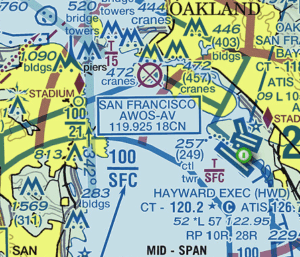
SFO sectional mapSo, I’m now officially, according to the FAA, a remote pilot, with an sUAS rating. I just passed my Part 107 exam and got my license in the mail yesterday. I’d had a Temporary Airman Certificate since last month, but I now have the real FAA card in my wallet.

Flying drones in controlled airspace involves a few hurdles, depending on what you’re doing. The FAA is not keen on a few pounds of plastic and metal getting ingested into a 737’s engine on takeoff, so they’ve established rules you’re supposed to follow, and the technology forces the issue a bit. Drones that weigh more than 250g now require something called Remote ID, which broadcasts the drone’s location, altitude, and speed, plus the operator’s position. And drones have to be registered by the FAA, which requires the operator to take a 20-some question multiple-choice test online.

If you do that, you can fly recreationally, which means you can’t perform any commercial missions, like making real estate videos or shooting a movie or anything else. This also (arguably) includes posting content on monetized social media platforms, although this is a gray area. Most people do this anyway, but there was a high-profile case in 2020 where someone was fined $200,000 for repeatedly breaking this rule. They were a high-profile influencer, and were also flying recklessly and breaking a bunch of other rules, but still.

There are a bunch of other rules, of course. You can’t fly above 400 feet AGL; you can’t fly in low visibility; you have limitations based on the controlled airspace above you; you are the lowest level of right-of-way in the sky; and so on. But the biggest one is intent. And I didn’t plan on getting a job doing aerial building inspections, but the whole thing is a challenge, and I’ve always thought I should study and take the Part 107 exam ever since I first flew a drone in 2020. So…

I bought a couple of books on Amazon a while back, and thumbed through them but never committed to studying anything. And after I finished my MSML degree in 2023, I bought an online course at pilotinstitute.com with hopes of completing all the video lessons and then taking the test, and of course that didn’t happen. I’d barely even been flying since 2023, and had a total lack of inertia on any of this.

Back in October, I started flipping through one of the test prep books one night, and decided I needed to just force the issue. I went to the FAA web site, looked up how to register for the Part 107 exam, and booked a date ten days later. Now I’d have to force myself to study, or lose the $175 fee.

The FAA’s Part 107 exam is a 60-question multiple-choice test that takes two hours, and you’re required to score 70% or higher. The test encompasses about a dozen different areas of knowledge, from airspace regulations to reading maps to weather systems knowledge to emergency procedures to those little signs on the side of the runway that tell your pilot where that taxiways are at an airport. The test is in some ways a subset of the Part 61 exam you take as a private pilot, and for both, you study from the Pilot’s Handbook of Aeronautical Knowledge, a 522-page behemoth of a manual that covers all of this and more.

The funny part about the Part 107 test is there’s a lot of stuff you’re tested on that doesn’t entirely apply to drones. For example, you’ll need to know about radio communications, but you can’t transmit and don’t need to announce your actions over the radio. You need to learn all about airport operations, but you for the most part can’t operate at an airport. You need to know all about weather and how to decrypt a METAR report, but the bottom line is you’re probably going to fire up an app to take a glance at the forecast, and if it’s anything but nice outside, you won’t fly. A lot you need to study won’t apply to you when flying drones, but I guess if you have an intellectual curiosity around this, it’s interesting to read about it.

There’s a whole cottage industry of classes, videos, books, and web sites on passing the 107, many of them somewhat dubious, and all of them highly variable depending on how you learn. Here’s basically how I studied:

  • The Pilot Institute course was great, but incredibly detailed, and it felt like it would take me months to watch all the videos. I worked on that, but seriously, it’s like 322 videos and quizzes, and I think I finished 40% of them.
  • I also watched some YouTube videos that were like an hour long and a total overview. These varied greatly in quality. I won’t link to specific examples, but they’re out there.
  • I think I read five or six different books, plus the PHAK, the FAA test supplement book, and the FAA’s Remote Pilot Study Guide. The ASA Test Board guide was the one most helpful to me, and it also gave me a set of practice tests online which were helpful.
  • https://free-faa-exam.kingschools.com/drone-pilot is the most helpful practice test site. You can pick how many questions and which of the six big categories they are from. What I did after a week or so of deep study was to take 20 questions a day, then write down every single thing I missed and go back and research them.
  • I also created a note in Apple Notes that was basically an abbreviated list of everything on the test, including various mnemonics and things I had to be careful to remember. (I.e. the controlled airspace classes are Above, Busy, Crowded, Dinky, Everything else, and Go for it.) I looked at these notes constantly, any time I had my phone out.
  • Although I don’t 100% trust it, ChatGPT was pretty good at answering basic questions or listing information on the test. Like if I had some meteorological question about cloud formation or I wanted an explanation of a symbol on a chart, it was pretty good at giving me an answer.
  • Another random tip: when you take the test, they give you a book called the Airman Knowledge Testing Supplement for Sport Pilot, Recreational Pilot, Remote Pilot, and Private Pilot. It’s a bunch of examples and diagrams, so on the test, they can ask “On Figure 20 Sectional Chart Excerpt, what is…” You can buy or download the book on your own. There is a legend at the front of the book which basically describes every item that appears on a sectional chart. I was trying to memorize all of these symbols and lines. You don’t have to; just look them up.

I continued on this, but during my first week, Squeak died, and that threw off the whole thing. Also, I was taking these practice tests and kept getting hung up on questions, especially ones that required a lot of memorization. I pushed out my exam date by two weeks, and kept going on my study.

There’s a small maze of logins and applications you have to do to take the test. You create an IACRA login. You apply for an FTN number. You create a PSI login. You apply for a test date. You pay for the test. I think there was a login.gov step in there. All of these sites are different than the FAA site where you register a drone, the third-party site where you took that 20-question TRUST test for recreational flying, or the FAA site where you request flight authorization in controlled airspace via LAANC. All of these web sites look like a DMV web site from 1997. Bookmark everything, take notes on what logins you used where, and don’t do what I do and use two different emails. Also, check your spam folder regularly, because all of these confirmations get flagged as spam.

I finally took the test early on a Saturday morning. It was at a nondescript four-story office building out by what used to be Candlestick Park. It looked like a typical office park thrown down in the early 80s on the peninsula during that particular tech boom, and the inside lobby definitely had that vibe. I sat in my car and did some last-second cramming on my phone before I went inside. I wish I could have taken pictures, but I was not allowed to even bring in my phone.

The security situation was bizarre. No phone, no watch, no coat, no jacket. I had to take off my hooded sweatshirt, empty all my pockets, put everything in a locker. They checked my glasses, patted me down, checked underneath the cuffs of my pants, and did everything but made me disrobe. I was allowed to bring specific things in; they gave me a copy of the testing supplement and a pencil. I was allowed to bring in a four-function calculator, a magnifying glass, and a clear magnifying ruler. I didn’t know if those rules were from 1974 or if I really needed that stuff, but why not.

This was a third-party test site, and I guess I assumed it was only pilot testing, but I guess they do all sorts of secure exams, like for pharmacists and TSA workers and whatever else. I think I was the only one taking a pilot’s test, because I was the only person with the test supplement and an armful of rulers and calculators and junk. They brought me in to a room of study carols, each with a computer. The test fired up on there, and it was a typical DMV-style online exam thing, with the worst interface imaginable. It also had an insane number of pre-test things you had to accept and calibrate and click OK on, the worst LMS setup imaginable. After what seemed like 20 minutes of prep, I started on my questions.

The test questions were pretty much like the practice tests. Actually, some of the questions were exactly like the ones on the practice test. I read through them carefully, to make sure they didn’t add a “not” or something and change an answer. The other anomaly is you get a few “test” questions that don’t count, like maybe they are trying out a new question. And one of these specifically was wrong. It asked a question about an airport on a sectional, and that airport was completely not on the map; it was a map for a totally different part of the country. On any question, you could report a problem, so I put that in and hoped I wasn’t just looking at it wrong.

I had two hours to take the test, but I swear they were far easier than the practice tests I took. I think it took me 20 or 30 minutes to go through all 60-some questions, so I went back to the start and examined every question a second time. Then I finally submitted everything, and got up and left. In the reception room, I handed over my stuff, and the attendant went through this big spiel about how if I had any issues I could go to the FAA site and blah blah blah and all I’m thinking is DID I PASS. Finally, he handed me a piece of paper and I looked at it: 93%. I did.

Of course, here comes the fun part. You aren’t immediately handed a license like you’re at the DMV. You are given an exam ID, and you have to go back to the IACRA site and submit an 8710-13 with the 7-digit FTN and 17-digit exam ID. Then you get a TSA background check. Then it goes to the FAA. Then after processing you can log into the IACRA and get a temporary license until they mail you. Problem was: the government was shut down. The FAA was (sort of) keeping flights in the air, but nobody was in the office, so I had no idea how long any of this would take.

That IACRA stuff worked, but I sat and waited on the TSA thing. I could officially fly 107 flights, but it took a total of five weeks end-to-end until I actually had a license.

In the meantime, I ended up buying another drone, the DJI Mavic Air 3S. I had to re-register my old drone and the new one so they had hull numbers I could use for 107 flights. That’s all automated, and wasn’t a problem.

Anyway, no idea what’s next, except I can post video now. I’ve got a YouTube playlist that I’ll start using, and I am posting some pictures and videos in the usual places. Should be fun. Of course, all of this isn’t writing, and I need to get back to that.

Categories
general

Loca

My cat Loca died two weeks ago. I don’t even know what snippy trite introduction to say about this post, because the whole thing is so horrible, especially after just losing Squeak, and I’m still trying to get past it, and it’s not easy.

Like I mentioned in my previous post about Squeak, we got both cats in 2007 from Humane Colorado, and Loca was the more outgoing alpha of the two, and a year older. She was a black Turkish Angora, an absolutely beautiful animal. She was very social, vocal, playful, active, and crazy, hence her name. In many ways she was a cat’s cat, and loved to eat, hunt, play, be brushed, and get her way about everything. In other ways, she was very non-cat like, more like a dog. I think because I worked from home so much, she became very attached and would follow me everywhere, and demand everything according to her schedule. She also slept far less than other cats. Squeak would be out for 18 or 20 hours of the day, spending the other time transitioning between sleeping spots. Loca probably slept only eight hours a day, and most of it very lightly, as she always had to be aware of everything going on.

Squeak’s health was a long, slow decline. Pretty much for the last two years, we watched her weight drop and her mobility become more of a problem, and wondered how much time she had left. Loca’s health was never a question. She never got fat, always stayed active, and never had any major issues other than hairballs and general fussiness about food. She did start to have hyperthyroidism and a slight weight drop a few years ago, but medication seemed to stop that. I had a lot of worries that Loca would not be able to cope as a single cat after Squeak was gone, but she seemed to be making the adjustment. I knew this was not going to go on forever, but she was still running and playing and eating, and I thought we had a few more years with her.

This all happened quickly. She was very on and off with her food, and would have these coughing episodes that we assumed were hairball-related, but she’d never throw up and no amount of hairball medication or cat grass would help. I came home from work on a Monday and found she hadn’t eaten at all and was doing more of the coughing and brought her to the ER, fearing the worst.

I don’t want to get into the blow-by-blow details, but it was chronic heart failure, and we thought we had a few weeks to make her comfortable, and I had to quickly change that to a few days. On Saturday, we had Lap of Love come over.

Loca’s birthday was a week before, on Halloween. We have one of those Womb chairs in the living room, and right before dinner, I was sitting in the sun, looking at my phone, and Loca crawled up unprompted, stretched out on my chest, and sat there for twenty minutes, purring and looking at the sunlight. I knew this was a core memory that would be burned into my head forever, even though I did not know it was her last birthday.

On Saturday the 8th, I sat in the Womb chair again and she died in my arms. I cannot put into words how horrible this felt. I am glad it was this and not an agonizing end while I was asleep and she was suffering. I’m glad I was able to take a few days off and spend them with her, even if she was now unable to climb stairs and we had to set up camp in the middle of the living room with pillows and food and a heating pad and a litter box. But this was my familiar, my best friend. I’d spent a third of my life with her, 18 years. I worked from home almost the entirety of her life, and talked to her every day. I’ve had many rough years in the last decade, and spent a lot of time thinking I was completely alone, but Loca was always there. Now she’s not.

Two things happened at the very end that were quintessentially Loca. When the doctor came on Saturday and Sarah went downstairs to let her in, Loca got up from her bed, went to the bowl, and pigged out on Churu, her absolute favorite food. It was hilarious that we spent all this time worrying about her food and getting her to eat, and here she was, two minutes before her end, chowing down on this smelly chicken goo in a tube that she loved so much.

The other thing. When they do this, they give a first injection of ketamine, and then after a few minutes when the cat is calmed down, they give them the big shot. With Squeak, Sarah was holding her when she got the ketamine, and she just stayed in her arms and relaxed. With Loca, the vet came over to her on the floor and gave her the first shot. And instead of sitting there waiting for me to pick her up, she had to get up, do a lap of the room, then go under the kitchen table and stare at me, telling me that I had to come to her. She would do this diva stuff all the time: beg for attention, then when you came to give her attention, she would walk away and say, “No, you follow me.” I absolutely love and cherish that she had to do this one last time. She was Loca until the end.

I am suddenly not a pet owner. There has been this awkward transition because now we realize every piece of furniture we own is either cat furniture or has been damaged by cats or is covered in cat hair. And I can’t bear to do a full sweep of the house and dump it all in the garbage. The food and the medicine all got donated. The litter boxes are gone. Her favorite toys are sealed in plastic and packed away. But it’s so absolutely quiet now. I wake up in the morning to feed them and… fuck. It’s been hard.

I know there will be others. I think we’re waiting until after the holiday travel and then we’ll find two more. But we got damn lucky when Loca came in our lives, and it’s a monumentally huge hole to fill.


Categories
general

Squeak, writing, drones, walled cities

Been a while. Various things have been up, and I’ve completely lost the thread here. I always feel a need to get back to the blog and start posting regularly, but getting the first post down after a month or so sets the tone, and I have no idea what the tone is, so here goes.

First major thing was that my cat Squeak died. We got both of the cats 18 years ago in Denver, and she was maybe six months old then. So she had a good run, and she’s had various medical stuff for a while. She kept going a lot longer than expected, but the last year or so has been rough. It was still an incredibly hard decision to let her go, and a month and a half later, I’m still upset about it. This was compounded by the fact that I spent most of that 18 years working from home, and a heavy part of my routine was seeing what was up with her during the day. I was going to write more about this, but I can’t. Extremely grateful for Humane Colorado for the start of her journey and Lap of Love for the end.

Second… I guess writing got away from me for a bit. My next book is possibly too political, and I now have many fears about publishing this in the current climate. Aside from all my other fears about writing and publishing, I also don’t want to suddenly not be able to get back in the country on my next time I go on vacation.  So I lost maybe a month there before I was able to get back to it.

There are a lot of various concerns about persona and the type of writing I will do in the future. I think I waver between wanting to do something “serious” or complex, like some David Foster Wallace magnum opus. Or I want to do basically a performance art piece of wild and crazy absurdism. And I think whichever one I do, I have to sort of “become” that person to the public. I think of how I was always posting over-the-top memes and crazy stuff ten years ago, and how that dovetailed with my writing at the time. I ran into a wall with that whole thing, and I don’t know what the answer is here. (And I’m not looking for one.) This is probably the subject of another essay. Regardless, I’m writing, and that’s all I really care about.

Third (why am I still counting) – I have been busy trying to get my remote pilot license, the FAA Part 107. I’ve been hemming and hawing about taking this test pretty much since I started flying drones in 2021, and I’ve bought numerous books and video courses and flash cards and whatever else, but never got it together to take the test. Finally, I said screw it, went to the FAA, and registered for an exam last Friday. After a week or so of cramming, I realized there’s no way I would be ready, so I pushed it out two weeks. I’m still working through a course, flipping through flash cards, and trying to remember when you use CTAF versus UNICOM at a towered airport after hours to self-announce traffic advisories. (And that whole thing is stupid, because I have to know all of this stuff for the 107, and then the very last rule is, “sUAS PICs cannot communicate on CTAF.”

Aside from writing and studying, I’ve been wasting a lot of time building book nooks. A book nook is a sort of diorama about the size of an unabridged dictionary with a glass front and a very detailed scene inside. I have built four of them now, and the one that got me hooked was the Kowloon Walled City 2049 kit. Of course I feel a need to customize these things and have fallen down this rabbit hole of paints and plastics and accessories and lights and scratch-building new details. All of this is questionable because the one thing I don’t have is shelf space. But it’s been a fun distraction.

Work is work. Had a brief staycation because I canceled a trip due to all the Squeak stuff. My only other travel plans in 2025 are Christmas and the Midwest, although I’m thinking about another crazy trip for my birthday. More on that when I figure it out.

Categories
general

85-0813

Yesterday, I drove out to Atwater to the Castle air museum. I’d been there almost ten years ago, but wanted to go back to see a recent acquisition sitting in their restoration hanger: an F-117A stealth fighter.

I know, the F-117 isn’t really a stealth “fighter” – it’s really more of an attack aircraft. And the ones going out to museums aren’t really stealth anymore. The Air Force is demilling the planes as they usually do when they go to museums, but on the F-117 it involves tearing off the radar absorbent skin, plus any other still-classified bits. But still, I’d never seen one in person, and I had the day off, so I decided to take a two-hour drive out to see it. And of course the whole thing became an exercise in deep thought and wondering what the hell I am doing with my life. Bear with me here.

* * *

I have an odd relationship with military aircraft. I was born on a SAC base similar to the former Castle AFB, where B-52s loaded with nuclear weapons waited for the end of the world to start so they could fly over the north pole and make their contribution. But my dad finished with the service when I was a baby, and I have no recollection of living on base. He also seldom talked about his service working on bombers when I was a kid. This isn’t how these planes got loaded into my brain.

When I was in junior high, I started learning more about planes from my friend Derik. I’d built model railroads for a while, and shifted to planes. I became completely obsessed with 1/48-scale plastic kits of various military aircraft, from WW2 fighters to modern jets. All of my lawn mowing money went to the Kay-Bee toys in the Concord Mall, where I bought as many Testor’s paints and Revell planes as I could get my hands on. I probably was stuck in model building mode far too late into my teens. I think at the age when I probably should have been interested in sports and girls, I was burning my hours on models and computers. Getting an actual car and having to move to 1:1 sanding and painting on my bondo-laden Camaro pretty much broke me out of it, though.

I have very fond memories of spending hours and hours in my basement sitting at a card table, cutting pieces from plastic sprue, listening to Rush albums on repeat, and inhaling fumes from glue and paint. There was something meditative about it, I now realize. Mindfulness is now a billion-dollar industry, filled with apps and motivational speakers and self-help books and seminars promising to get us back to the place I was at in 1985 with an F-15 kit sitting on the table. Everyone’s knitting and doing puzzles and painting, and every doctor I go to tells me I need to do something to calm the hell down. So I think about that time a lot. But I also feel a certain shame in building model planes, because I don’t want to be a fifty-something dude obsessed with what’s the best Tamiya scale aircraft, especially when the military is patrolling our domestic streets. Models also take up space I don’t have, and I never have time to do anything anymore. But all of this is still bouncing around the back of my head, making me think too much.

* * *

The drive to Atwater took about two hours. It’s funny because once I start to approach Modesto, the scenery reminds me a bit of Indiana. It goes from densely-populated city to rolling suburbs to almost nothing but farms. Driving on the two-lane California-132 through farm fields and long rows of crops looks so much like the grid of roads in unincorporated Elkhart County, an unnamed road every mile separating the farms. The one difference is it’s not corn and soybean here; it’s almonds, olives, or grapes. But it still feels like it’s the late Eighties and I’m cruising around for no reason, or maybe driving down to Bloomington. I have a 1989 playlist on my phone, which is an absolutely embarrassing list of tunes I would have been listening to at that point in time. I put that on, and even though it was almost 40 years later and I was in car with rear-view mirrors that have more computing power than most companies had back then, it still felt like I was back there.

* * *

Castle has a nice collection of planes. Some of them are pretty faded and worn by the winds and sun of the central valley. They’re trying to get the money together to build a large indoor facility for some of their collection, but until that happens, many of the exhibits are pretty beaten down by the elements. One of my favorite planes ever is the SR-71, the black stealth-looking super-fast spy plane that looks more UFO than jet. They have one at the front gate, and it’s restored and in decent shape, but it does collect dirt and mud from the storms and general agricultural debris that floats around the central valley. The other thing I wanted to get a shot of was the B-52D they have there, but it’s currently being repainted. The plane was pretty faded out when I saw it last in 2016. Right now, it’s sanded and a mix of primer, bare metal, and little bits of stray paint, and is getting redone in stages. Glad they’re getting it done again, but no photo ops yesterday.

It was oppressively hot yesterday, in the 90s but the sun made it seem even worse. I did a quick loop and took some pictures, but there wasn’t much time to loiter. I asked the people in the gift shop about the restoration facility that contained the F-117, and they gave me directions; it was in a hanger in another part of the former base.

Castle got BRACed in 95, but you can still see the remnants of the old SAC base: a giant parade ground in the middle; streets named after bombers in one direction, plane parts in the other. Stratofortress Drive has a big county human services building on it; Turbine Drive has remediated concrete pads on either side of it. Early 80s base housing that looks incredibly like early 80s base housing now contains a Korean Airlines pilot school. One runway remains, with a Christmas tree apron from when SAC had nuke B-52s on call hanging off one end. But half of the jetways are now set up for Google to test Waymo cars, this track with a maze of little loops on it, all marked with various lines the robot cars can read, I guess.

I drove to the restoration hanger, a giant WW2-looking building with room for maybe four big planes inside. It’s not open like the museum, but it’s vaguely open to the public. I talked to a guy who seemed a bit guarded about me visiting to take pictures, but we chatted for about an hour about the situation with the F-117, and how the restoration is going.

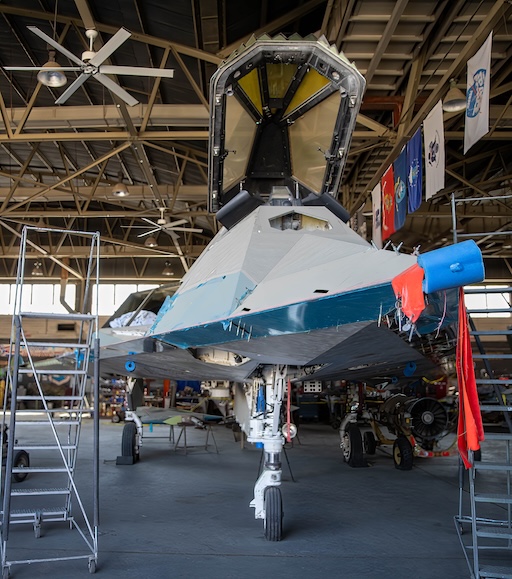
First impression: the F-117 is much bigger than I expected. I thought it was a little sportscar thing like an F-16, but it was parked next to a giant flying brick of a Navy F-4 and it felt almost comparable. It sits very high up on the gear, which are borrowed from the A-10. The museum’s plane had all of the skin stripped, the tails removed but sitting next to it, one of the engines on a cart. The leading edges and engine inlets were all gone, with the start of reconstructed pieces and cleco temporary fasteners temporarily holding them in place.

The plane looked both futuristic and but also very dated. The outside lines were all sharp and the design looked very Star Wars, but one look in a landing gear door or open panel and I could see this was straight-up 70s tech, wiring and hydraulics that were all lifted from old F-16s or F-18s. The really touchy stuff like the IR targeting gear were all missing. They had the actual canopy, which has some weird gold layer in the glass to bounce radar waves, and they got a weapons bay trapeze, which nobody else has. Their cockpit is largely intact, at least from the outside. But the secret guts inside were all missing.

This particular plane had done two missions in Just Cause and then 35 in Desert Storm. They had a sign set up by one of the two weapons bays with various pictures and autographs of pilots. 85-0813 was nicknamed “The Toxic Avenger” and had an art plaque for that. It obviously wasn’t panted on the outside of the stealth plane, on the absorbent skin. I looked inside a weapons bay and could stand on the ground upright without hitting my head. The inside looked like the guts of a late-seventies F-15A, with conventional wires and hydraulic lines mounted to the dull gray riveted skin inside. The bays also seemed shockingly small when I was up close. They typically carried only two bombs and no advanced pods or radars like modern planes. Apples to oranges, but that little sports car F-16 I mentioned could easily haul three times as much weaponry plus a gun and loads of advanced avionics and targeting systems. Sure, maybe no stealth, but it was strange to actually see the size comparison.

* * *

Another odd callback to my model airplane days. Back when the stealth fighter was a known thing but nobody had seen it yet, Testor’s came out with a model kit of it, and it was in a Tom Clancy book and a popular video game. There was this rumor that the stealth fighter was called the F-19, because McDonnell Douglas came out with the F-18, and then Northrop built the prototype F-20, so obviously F-19 was skipped for the secret plane. It wasn’t, and the Testor’s kit was just a made-up plane that looked little like the actual F-117, with smooth manta-ray wings like a sci-fi spaceship. Of course I bought one and built it, and that was the stealth fighter in my mind. When the plane was first unveiled four or five years later, I was shocked that it was the same plane, or that it even could fly. It was so surreal to come back to this 40 years later and actually touch one of them, albeit with the matte black skin missing.

* * *

On the drive home, I thought about this visit a lot, and about my obsession with this stuff. It pains me to write about this, because I’m stuck between two things here, and don’t belong to either. I mean, I spend a lot of time wandering around closed military bases for some reason, and a part of me thinks about how we spent trillions of dollars in the last 80 years, and for what? To tear it all down and leave behind superfund sites in the middle of nowhere? There’s the argument about deterrence, or projection of power, or “bringing freedom” to places like Vietnam, Iraq, or Afghanistan, which are all currently not very free.

I can’t really talk to my leftist friends about any of this. To them, these are all machines that were made to kill. America has spent 25 trillion dollars since the end of World War 2, building up a massive nuclear force that was later dismantled; invading countries that were later abandoned; stockpiling weapons for a Soviet invasion that never happened. It’s hard for me to argue against that, but it’s even harder for me to fetishize these machines when I’m talking to these people.

On the other hand, I feel like I can’t talk about that side of things with right-leaning folks, because it feels like betrayal. I feel like, according to them, I’m supposed to have unwavering loyalty to the military and to the government. And I generally feel a respect for those who served. But I don’t fully support what we’ve done or what we’re doing, especially with what’s going on now.

And I think the bigger thing I can’t talk about is that this money wasn’t wasted per se. The military is a great social experiment in a way the right won’t freely admit. It’s an experiment in socialized medical care, desegregation, a shared housing system, a government system that feeds, clothes, and educates six or seven million people. Although I’m sure the top end of companies like Raytheon or Lockheed get the bulk of the trillion dollars a year spent on building arms, but some amount of it eventually trickles down to the factory workers assembling the stuff. None of this justifies overthrowing countries or killing people. But it shows that there is the capability to spend massive amounts of taxpayer money on actual things to provide for people.

Anyway, all of this makes me think about hobbies and what I do and what I waste my time on. And I think there needs to be some change at some point. But I also realize how burned in this stuff is, and how I can’t wake up one day and say, “OK I like trains now.” Not sure what to do about that.

Categories
general

Mongolia, Hong Kong

Spent the first week of August in Mongolia with a brief stopover for dinner in Hong Kong on the way back. I had a cold on return and didn’t have the energy to get together a trip report. I’ve got a longer actual story about the trip underway, but I’ve also been hot on Atmospheres 2 which needs to get done pronto.

Anyway, before this totally gets away from here, here’s a quick bulleted list on the trip. Also, some photos are on Flickr.

  • Yes, Mongolia. It’s the giant country between Russia and China. Not to be confused with Inner Mongolia, the big chunk at the top of China. Not a former Soviet republic either, although they were obviously tight back then.
  • Everyone asks “why Mongolia” and the only real answer I have is I haven’t been there, it was not terribly expensive, I didn’t need a visa, and I knew everyone would ask “why Mongolia.”
  • Left at midnight after being awake since 4am. 14 hour flight to Hong Kong and I slept maybe 4 or 5 fitful hours in a premium economy exit row. Had a seven hour layover in HK where I wandered the airport at 5 in the morning in a state of delirium.
  • MIAT, the flag carrier of Mongolia, has a fleet of nine threadbare Boeings. I’ve never been in a more minimalist 737; I sat down and my knees were against the seat in front of me. At least they stopped flying the secondhand Antonov turboprops they kept crashing.
  • Landed and completed my longest multi-segment trip ever: 1d 1h 40m.
  • Had a driver who immediately asked me if I liked metal, even though we could only communicate with each other through translator apps. He then put on some Mongolian folk metal, which was a new one for me. (Throw “The Hu” in YouTube if you’re into that sort of thing.)
  • The airport is about 50km south of Ulaanbaatar. That will take you either an hour or five to drive, depending on the number of yaks crossing the highway.
  • Cars drive on the right side like the US, but they’re all right-hand drive, from Japan or Korea. Almost everything is a Prius with off-road tires and a three-inch lift. Imagine being awake for 40 hours and sitting in the driver’s seat of your last car, but then you realize you don’t have controls in front of you.
  • The area between the airport looked a lot like the area outside Denver: giant grass-covered plains, with mountains in the distance. I also didn’t realize we’d be at altitude – maybe 4400 feet – so it had that big sky look with giant clouds seemingly five feet above.
  • Stayed at a five-star that was a Best Western. Not a bad setup, actually. No complaints except the whole room had a single outlet, and I couldn’t get a straight answer on what power or plugs they use there. Everything online says “well, whatever.”
  • I had a rough time with food. I brought a case of Clif bars and a bunch of protein gel, expecting to be unable to eat. I could not parse any of the food options and there’s very little American chain food, so I couldn’t just go to a TGI Friday. I ate a lot of junk from a convenience store next to the hotel, which wasn’t good.
  • Mongolia has its own language, but uses the Cyrillic alphabet for the most part. Old people know Russian, and Chinese and Korean are sort of prevalent. This is probably the lowest amount of English comprehension of any country I’ve visited. This freaks some people the fuck out when I mention it, but it’s their country, and I can deal with being in a place and not knowing the language. I know probably ten words of Mongolian and could fake the rest.
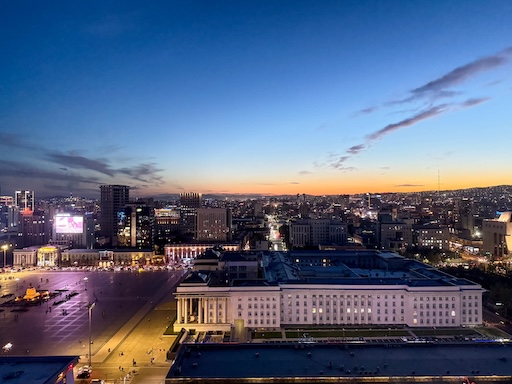
  • The city looks like if Anchorage was built by the Soviets in 1961. Lots and lots of poured concrete and Khrushchevkas. Every sign on top of a building was in Cyrillic. I was across the street from a central square and a parliament that looked like it probably had a gigantic bust of Leonid Brezhnev in it until the mid-90s when it was melted down for scrap or sold to some hipster in Seattle for an art project. The city is powered by a gigantic coal plant that’s right on the edge of downtown, and the air quality is not great from that.
  • Poured rain the first day and I had no rain gear, just a down jacket that immediately absorbed five gallons of water and never dried again. I went to a Chinese tower mall, found a Sports Annex-like place and bought a far too elaborate rain jacket. I could not figure out the exchange rate and had this inch-thick fist of bills from pulling 80 USD from an ATM. I gave them a credit card and said “whatever” and I think it was like a million MNT. Got home and realized I spent like $250, which means every time you see me in the next ten years, I’ll be wearing a Mongolian raincoat.
  • I’ve said this before, but these communists love their malls. I mean, communism ended a bit ago, but if you want to see a high-end mall with zero vacancies and completely full shelves, go to a place that’s still got Stalin on the money. I grew up with these horror stories about almost empty communist stores where you have to pay a week of salary to get almost nothing, and it turns out that describes a Target in 2025.
  • Day two, I went on a big van trip with six or eight other people, like a twelve-hour junket through the Gorkhi Terelj national park. Highlights of this included a ten-story statue of Ghengis Khan on a horse where you climbed up into his head, holding an eagle, shooting a bow and arrow, camel rides (which I did not do, I’ve broken my arm enough times), visiting a nomad and drinking fermented camel milk (once again, nope), and eating lunch in a Ger (aka a yurt.)
  • Once again, I did not eat much because – well, they love horses in Mongolia, and not just riding and racing them. I absolutely did not eat any meat that wasn’t chicken on this trip. Nice people at the restaurant, but no.
  • We also went to the Aryapala temple, which involved walking up many steps and was incredibly beautiful and peaceful. Also near there, we climbed this giant granite rock formation called Turtle Rock, which I did not realize involved actual climbing climbing and going through tunnels like that one where James Franco had to cut his arm off with a pen knife.
  • On the drive home, some truck hit a cow or something and the road completely shut down. When this happens, people just start driving next to the road in the dirt. When that line of traffic stops, people drive next to them, etc. So at one point, there’s like six or eight lanes of traffic crawling through the mud and dirt completely randomly. Total chaos. The 40km drive home took about five hours.
  • The nomadic guy – Mongolia is about the size of Alaska, but with only three million people. Maybe half of that live in Ulaanbaatar, and about half are totally nomadic. They set up their ger in a random steppe and raise their livestock, then when the grass gets low, they move to another.
  • Wednesday, I had a driver who brought me to the Mini Gobi desert, just me, him, and all my camera junk in a Land Cruiser. The drive took about 14 hours round trip. Lots of mountains in the distance. Lots of livestock on the road. Stopped at what looked like the Mongolian Costco to get supplies. Also stopped at a place that looked like the Mongolian Old Country Buffet, with three dozen steam trays where you pointed and they scooped a mystery meat onto a tray with beets and rice. I had the chicken, I think.
  • Mini Gobi was cool, but honestly not 14 hours of small talk cool. We’re talking about the size of Warren Dunes on Lake Michigan, but instead of hot dog stands, there were camel rides for the kids and tourists. We also went to a small temple up in the mountains which was very quaint and also beautiful, but not like a tourist place. About half of our driving was off-road, which was pretty daunting.
  • I bought a cashmere scarf for S at the temple. There’s a lot of cashmere for sale there. A lot.
  • Picked up a horrible cold and I had to cancel a street photography tour. I’m glad I brought NyQuil/DayQuil because I went to a drug store and the closest I could find was a jar of some stuff with a horse on the label and it may have been made from snake venom or whale penis. Google Translate was useless for this.
  • I wandered the city a few times, taking some pictures. There’s the occasional brand new Chinese or Korean high-rise, a tower mall or hotel. Infrastructure in the town is fair to poor, with lots of tore-up stuff and roads that inexplicably close for no reason. Traffic is pretty horrible, and there’s no great urban planning around this. Some of the smaller side streets with shops and open markets were pretty nice though, and they do have some parks and green spaces that they’ve been very intentional about and they look beautiful.
  • I’d default to wandering around the central square, which wasn’t that heavily populated, but one day I went and there were a dozen different weddings going on. Each one had dozens of people in the party, dressed in traditional clothes, with pro photographers and selfie sticks and drones weaving everywhere chaotically. I shot some video of that and it was great fun to watch.
  • The last night, I went for a long walk in the city and was sort of bummed that I didn’t get to do more and that the cold basically shut down the end of the trip. Shuffled around and ended up in a vacant Burger King where I ate a junior whopper. BK is airport-quality. No McDonald’s; no Taco Bell; no 7-Eleven. There’s a KFC/Pizza Hut but it makes it apparent this isn’t a country with many fresh vegetable choices.
  • On the way back, same driver. He brought me to the airport and I realized this place was smaller than the South Bend airport, but every flight out of it was international. Saw horse jerky at the duty-free and yeah, no.
  • On the way back, I stopped in Hong Kong and had eight hours, so I left the airport for the first time. My luggage was checked through, so I had nothing to carry, and I didn’t need a visa as long as I didn’t go to the mainland. I took a train to Kowloon, and the whole experience was absolutely surreal. The second I landed, my iPhone asked me if I wanted to buy a virtual Octopus card, which lets you use any transit and shop at many stores and restaurants. Five minutes after leaving customs, I was on a futuristic bullet train where one could probably perform surgery on the carpeted floor without cleaning it first. I went to Kowloon and was in the bottom floor of this gigantic mega-mall of super high end stores and it took me like 45 minutes to reach the surface. It looked like a Star Wars city, with glass towers of skyscrapers and immaculately groomed greenways and paths to fancy restaurants and coffee places. Everything was in Chinese but honestly the people in Hong Kong speak English better than Americans. I grabbed a kobe beef burger at this place and then hurried back to the airport, hoping customs would not be insane.
  • Customs was completely automated, no questions, no lines. Amazing.
  • 13 hour flight home. It was weird because I got to the airport on Saturday, technically left on Sunday morning, flew 13 hours, then landed Saturday night. Got my luggage, caught an uber, and actually got home on Sunday morning.

Fun stuff. I’ve still got to deal with pictures and videos, but I wasn’t terribly happy with anything I captured. There’s a lot for context, but few real bangers. Still, a very interesting trip. That’s four new countries this year for a total of 24 now. Probably no more international travel this year, but I’m already thinking about the next birthday trip.

Categories
general

The death of the prince of darkness

So, Ozzy Osbourne died on Tuesday. I’ve been thinking about this all week, because these celebrity deaths are increasingly odd to me as they become more frequent. And Ozzy’s a weird one, because of his intersection with culture and life in general.

I was too young to be into Black Sabbath as a kid. Their first two albums were released before I was born, and I think I was in the first grade when Ozzy’s first tenure with the band ended. I didn’t have an older brother who could have turned me onto them, and our town didn’t have an AOR radio station, so I had zero exposure to even the basics like “Iron Man” or “Paranoid.” As his solo career unfolded, I also had no exposure to his music. When Blizzard of Ozz and Diary of a Madman hit, my local Top 10 station (the only non-country/non-religious FM station in the area) was probably pumping out Men at Work or Phil Collins.

My first memory of Ozzy was during CCD classes at my Catholic church, where I was relegated during Sunday mornings to prepare for first communion. One of the kids in my class was explaining Ozzy to us: the long hair, tattoos, running around without a shirt and maybe some horror movie makeup on. He bit the head off a bat, or maybe a dove. I was fascinated by this, even though I didn’t know a note of his work. It was similar to how I was amazed by the band Kiss, not because I liked the music, but because of the costumes, the makeup, the pageantry of the whole thing. It was more like a cartoon than music, and at the age of nine or ten, that was awesome. I remember sitting in class, sketching out pictures of Ozzy biting the heads off of birds, done entirely from this other kid’s description, without having actually seen any album covers or live footage.

We got MTV a bit after that, and Ozzy entered the general zeitgeist, although I don’t exactly remember any of his music or videos. He played at the big spectacle of the Us Festival, and maybe his antics were covered by Kurt Loder in news segments. I can’t remember them actually playing any Ozzy or Black Sabbath videos – they were probably too busy with Michael Jackson and John Cougar Mellencamp – but it seemed like Ozzy was ever-present anyway.

I don’t remember actually listening to a Sabbath or Ozzy album until I started hanging out with Jim Manges in maybe 1986 or 1987. His parents were evangelicals who forbade him from any hard rock or heavy metal, and he’d often stash tapes or D&D books at my place. He was also very into the “satanism” of early Sabbath, although it was mostly a reaction against his parents, and Black Sabbath wasn’t really satanist. We used to listen to tapes of Sabbath a lot when driving around in my car, although it was often “nice price” tapes instead of the big albums. One in particular was the Live at Last album, which was a horrible near-bootleg released without the band’s permission, an odd mix of poorly-recorded tracks and an album cover that looked like it was done on a Commodore VIC-20.

In high school, I fell into early thrash metal, and stuff like Metallica, Megadeth or Anthrax seemed like a generation past that of Ozzy’s solo stuff, and at least two beyond Black Sabbath. It’s odd for me to listen to Bark at the Moon and then Master of Puppets back to back and they seem twenty years apart, but it was more like three years. I was too obsessed with “new” stuff and didn’t have the time or funds to go backwards through the older Sabbath catalog when I was a teenager.

When No Rest for the Wicked came out in 1988, it was a bit of a twist. At that point, Ozzy seemed like a bit of a relic, but No Rest had a fresh sound, catchy tunes, and this amazing new guitar player Zakk Wylde, who was some kid genius, only a few years older than me. That album got some heavy play in my last year of high school, even though it was competing against Metallica’s And Justice For All and the first Guns ‘N Roses album in my tape player. Same goes for 1991’s No More Tears, which featured a ton of songs written by Lemmy from Motorhead. But aside from this brief blip, I mostly thought of Ozzy as this elder statesman in the world of metal, and focused most of my attention on death metal or whatever else I was obsessed with in the mid-90s.

* * *

Fast-forward to 1996. I’m in Seattle by that point, and Ozzy was mostly off my radar. He’d “retired” and he had an album or maybe two I’d never even heard. Black Sabbath was fully in the back of my head, having listened to the first six albums pretty repeatedly over the years. But I did not keep track of anything of Ozzy’s solo career in years.

It’s a Friday, and I’m at work. There’s some ship party going on, free champagne, catered appetizers. This was at the point in tech where this happened like every week. I’m not a fan of champagne and the food was usually crap, but it meant I could waste an hour of time doing nothing. I was talking to a few people about how Ozzy was playing at the Tacoma Dome that night. The general discussion was “Ozzy is touring? I thought he retired? He’s still alive, right?” We all joked about going, in the same way one would go to a monster truck rally at the Kingdome as a goof, just to see who would show up.

Later that night, I was sitting around trying to write, and thought maybe I should go. Ozzy wasn’t going to be around much longer, right? I figured his career was beyond over, and I’d never get to see him again if I didn’t go. I called the Tacoma Dome to see if there were still tickets – you couldn’t look it up online and had to actually call the box office, and they said sure, tons of tickets. So I got in my car, hit I-5, and headed down there, well after the first opening band started.

This tour was sort of a mini-festival with three opening bands, all of them notable: Biohazard, Sepultura, and Danzig. I got to my nosebleed seat maybe during Biohazard’s last song. Sepultura was decent. I always joke that Danzig opened and closed with “Mother” because he was at that point in his career, but he was decent. And then, Ozzy.

I didn’t really know what to expect. I thought this might be the dreaded “rock star karaoke” performance where he stumbled through the lyrics on a teleprompter with a completely disconnected live band, and then after maybe a few greatest hits, we’d get hit with the “here’s a song from my new album” and have to struggle through 45 minutes of that before an encore of a Sabbath tune or two. This was absolutely not what happened.

First off, Ozzy’s band was tight as hell. Joe Holmes from David Lee Roth’s solo band was there, a very underrated guitarist. Mike Bordin from Faith No More was on drums, and future Metallica bassist Rob Trujillo rounded out the lineup. The band was not only totally together, but it was very energetic and not phoned in at all. Bordin is an incredibly kinetic player and frantically banged through the set at combat power. Both Holmes and Trujillo jumped all over the stage, climbing up on amps and coming back down again to the front. The playing was incredibly tight, and they pushed ahead at a fast tempo through the whole set.

Second, Ozzy really put on a show. The stage had two giant video walls and before they started, there was a video montage that put Ozzy in various movies, like a parody of Pulp Fiction, then him interviewing Princess Diana, then him in the Beatles, then him and John Travolta in a Saturday Night Fever/Crazy Train mash-up, then him in a duet with Alanis. (There’s a fan-shot video of this here.) They then did a montage of Ozzy videos and live footage that completely pumped up the audience, and by the time he finally hit the stage and the lights came up, everyone was on their feet screaming.

Did he play old songs? He played no new songs. After screaming for everyone to go crazy, they immediately launched into a blistering version of “Paranoid” and it went on from there. He played a half-dozen Black Sabbath songs: “Sabbath Bloody Sabbath,” “Iron Man,” “Sweet Leaf,” basically an entire greatest hits album. “War Pigs” was absolutely awesome, the last song in the main set. Video footage of Vietnam choppers over jungles played on the big screens, spotlights going across the crowd, 20,000 people all singing, and Ozzy basically doing calisthenics on stage, screaming at everyone to get out of their fucking seats while he was doing jumping jacks and running laps to this absolutely frenetic version of the song.

I can’t find an exact setlist, but looking at ones online, he only played the song “Perry Mason” from his last album, then a dozen of the biggest songs from his solo career: old stuff like “Crazy Train,” “Bar at the Moon,” and newer hits like “No More Tears” and “Mama, I’m Coming Home.” (The setlist was different than the video above.) What was amazing is how into the performance Ozzy was. I mean, if I was him, I absolutely would not want to play “Iron Man” for the ten millionth time, especially after having like 20 albums after that. But he was absolutely elated that 20,000 people showed up to see him, and we were all doing him a favor by being there. He was more than happy to play the classic hits everyone wanted. Between every song, every chorus, every verse, he was telling everyone how much he loved them, how much he wanted us to get crazy. He had squirt guns and buckets of water, and everyone got drenched like it was a Blue Man Group show. He mooned people and ran around like a madman, dumping bucket after bucket of water on people in the front rows.

The show was absolutely incredible, by far the best live event I’d ever see. Ozzy was just such a showman and made every person there feel like they belonged. It was so high-energy, it was absolutely infectious.

* * *

That wasn’t his retirement tour, obviously. That format of multiple opening bands became the Ozzfest, which went on for decades. A few years later, he gained a completely different audience and morphed personas with his family’s reality show. He had a second (or third, or fourth) life in the 00s and later.

I guess what I find odd about all of this is how Ozzy has this ability to be ever-present and weave his way through life without being directly in it. I can’t remember the last time I bought an Ozzy album, but when I searched my books, he’s mentioned dozens of times. It’s very similar to when I drew that picture of him without actually seeing him. The title “Ozzmosis” is very apt in a way. And that makes it harder to imagine that he’s gone. It’s a lot like how David Lynch is gone, but he’ll never feel gone, and that makes it both easier and harder to reconcile his death.

Anyway. I got a big smile watching that old concert footage, and that’s all that matters. Glad he went out on top, and was able to make so many people happy like that.

Categories
general

My first CD player

I had to rip a few CDs last week, which is a rare occurrence these days. I don’t even have a CD player at this point, and have to dig up an external optical drive for my Mac once or twice a year when this happens. It had me thinking about the rise and fall of CDs in my life, which brought me back to my first CD player ever, the Toshiba XR-J9.

So, 1987. The Compact Disc was released in Japan five years before, and audiophiles had been buying them in the US, but not so much in Elkhart, Indiana. The whole idea of digital audio was a thing of awe, total science fiction. Lasers! The ones and zeroes captured in the studio remained ones and zeroes until right before they hit your ears, with no degradation, no distortion, no mangling through resistance-bearing wires and analog amps. Some magazine article said if you dubbed a cassette from a CD, your copy would sound better than the professionally-duplicated one you bought in a store. I can’t even remember the first time I actually heard or touched a CD, and didn’t know anyone who had a player. I had to have one, of course. But I couldn’t spend a grand on a Sony home player, and didn’t really have the stereo to match, which would cost a few thousand more.

At that time, I had a Soundesign stereo, probably from Wards or Sears, which had tower speakers, sat in a wood rack with glass doors on the front, and was a single piece for the receiver, EQ, and double tape deck, but had grooves in the plastic face so it looked like a stack of individual components. It wasn’t exactly high fidelity, but it was better than the Sears all-in-one I had in grade school and junior high. And it had a pair of RCA connectors for Aux In, tempting me to add more.

I was out of the house more than I was in it back in high school, so cassette was my primary medium. In my pedestrian days, I ran through $20 Walkman clones on a regular basis, whatever I could pick up at Osco Drugs on a discount. Once I graduated to a car, it had a no-name tape deck in it. For a while, I would buy vinyl and record them to tapes, but I mostly bought cassettes, or dubbed friends’ albums onto blanks.

Every time I went to any store with audio gear, I’d ogle the various components, thinking about how someday when I was out of college and rich, my first priority (aside from a Commodore Amiga) would be to buy some esoteric system with gigantic speakers, two dozen bands of EQ, a DAT digital tape deck (what happened to those?), and of course a reference-quality CD player. There was a store in the Concord Mall called Templin’s that was half instruments, half audio gear. (Oddly, they also sold Atari home computers.) This was the place where they had separate listening rooms where you could go in and see full setups like the one in American Psycho, thousands of dollars of gear that was absolutely unobtainable to me.

In the summer of 1987, I started working my first “real” job at the Taco Bell across the highway from the Concord Mall. And right around then, CD player prices started dropping. They were like $1000, then hit $500, then $400 or $300. And around the time my first paycheck hit my pocket, I was in the K-Mart across the street from my ‘Bell, and there was this CD player that was a hundred dollars. I absolutely had to buy in, and I did. (For reference, $100 in 1987 is about $285 now. I made $3.35 an hour dealing with drive-through abuse and refried bean cooking at TB.)

The XR-J9 was an odd little beast. It was about twice the size of a battery-powered Sony Discman of that vintage, but way smaller than a component home CD player. It was a weird mix of the two, though. Like a Discman, it was a top-loader; you popped open a lid and put the disc directly on a hub, then closed the door to get the laser to start. (Laser! I now owned a Class 1 laser! 3-beam pickup, whatever that means! It even had a warning label on the bottom!)

Unlike the portable Discman, the Toshiba ran on mains only, with no provision for a battery. It also had a fixed set of RCA cables coming from the back, which would plug into a home receiver. It also had a headphone jack and volume slider on the front, but unless you had a Honda generator with you, it was in no way portable. And those cables weren’t removable, which bugged me.

The controls were spartan: a power button on the front; the usual play, pause, forward, and back buttons. You pressed in a corner of the lid and then it unlatched and popped open. It also had a Display button, which I think toggled the time versus the time remaining that showed on the small LCD display. Some buttons had multiple functions. If you pressed Forward once, it would skip a track; hold it and it would fast-forward through the track, playing a sliver of sound every five seconds. This was amazing coming from the tape world, because I swear I spent half my batteries jumping around tapes, and this was instant. Random access! There was also some elaborate combination of buttons you could mash to access a “memory” mode where you could program up to 16 tracks in any order to get a custom playlist, which was a huge pain in the ass to do, and then it immediately went away when you opened the player. I would very occasionally do this when listening to The Police – Synchronicity so I could skip track 4 (“Mother”) because I never felt like it matched the rest of the album. (Now I think it’s the best track.)

The obvious problem after sinking a whole paycheck into this thing was that I now needed music. I think at that time, a tape was like $7.99 and an LP was $9.99, but a CD was $15.99. Each title was an investment. I went to Super Sounds, my favorite record store ever in the Concord Mall, and went A-Z through their three or four racks of CDs, trying to figure this one. (At that time, CDs were in “long boxes” which were the same height and half the width of an LP, so stores could use the same vertical racks for the new format.)

My first purchase was the most recent Iron Maiden album, Somewhere in Time. I was way too into Maiden at the time, and this album was a perfect storm for me: it was Iron Maiden; it had this futuristic cyberpunk theme; it was what I thought at the time was super-modern, ultra-technical sounding; it was digitally mastered; it was Iron Maiden; it was loud, but precise. It was also almost an hour long, so it was like twice as long as if I’d just bought a Boston album or whatever. I remember bringing the CD home, listening to the whole thing on headphones, and there was this one part on the song “Deja-Vu” where Nicko McBrain is playing this snare volley right before the chorus comes back in, and I could suddenly hear that he was also tapping out time on the hi-hat, which wasn’t audible on the cassette. It absolutely blew my 16-year-old mind.

Of course, I had no more money, so I had to go sling tacos and wait two more weeks to get something else. I don’t remember why, but I got the ELP album Trilogy next. A headphone listen also bewildered me. The first song starts with a beating heart, then Emerson doodling away on keyboards, which sounded incredibly crisp, compared to a muddy cassette. After two minutes, the rest of the band suddenly came crashing in, and the dynamic range demonstrated by the sudden change was incredible.

I can’t remember what was the third disc, but I did waver on whether I wanted the high quality of a CD or having twice as many at-bats by sticking to tape. By that fall when I started working at Wards and moved to weekly paychecks, I vowed to myself that I’d buy a tape every week, if not more. I pretty much stopped buying CDs for a while, until maybe my senior year, when I discovered the Columbia House and BMG CD clubs.

About twenty years later, the CD thing came to an end, with just shy of a thousand titles in my collection. I’d slowly been ripping things to MP3 when the 21st century started. Once the iPod hit, CDs became a temporary medium I used until I could rip the tracks to a hard drive, then became a backup in storage in case my computer died. On November 22, 2005, I made my first purchase on iTunes, and that was the beginning of the end. Now, almost everything is added from Apple Music or bought from Bandcamp.

(Oddly enough, the first track I ever bought online was Harry Nilsson’s “Remember.” The reason I suddenly needed to hear it again was a memory of the Michiana student TV show Beyond Our Control, which closed each episode with the song.)

That Toshiba lasted until maybe 1992, when it mysteriously died, stopped loading up discs. I bought a Kenwood portable player that summer (this was described in Summer Rain) and that unit suddenly became my main CD player for a few years until I bought a Kenwood 6+1 changer at the start of 1994. The Kenwood portable never really got used as a portable, because it drained AA batteries so fast, and this was before the anti-skip memory thing was out, so it was fairly useless on the go. I never considered CD as a portable medium, using the MiniDisc from the late 90s until the iPod showed up. I didn’t own a car with a CD player until 2007, when the format was dead. My 2014 car had a CD player that I think I used once. I honestly could not remember if my 2025 car even has one, and I guess it doesn’t.

All of this is so strange to think about, because that 1987 dream of someday having a gigantic reference system in my home is long gone. (So’s that desire for a new Amiga, but that’s another story.) MP3 wasn’t even a dream back then. I listen to 99% of my music on AirPods these days. I don’t have a room full of racks of CDs. I could afford to go buy any stereo I want, but what would I even buy? I bought a pair of near-field monitors for my desk literally a month before the pandemic started and I had to go to pure headphones for the locked-in-the-same-apartment 24/7 thing. I think I have two different Kenwood receivers in storage, and use a $200 sound bar in the living room for the TV. Music is still important, and I’m listening to stuff every day. But the technology has changed and the meaning of where it is in my life has too. Is that good or bad?

Categories
general

Cleveland

I took a quick trip to Cleveland this weekend, to see a few old friends and headline a book reading. The trip was over before it started, it felt like. Anyway, let me rush through the usual summary.

Reason one for the visit was that my company gives us Juneteenth off, which was a Thursday. So I added the 20th and made it a nice four-day weekend. I feel some need to take more short trips like this between my longer journeys, so this looked like a good spot to do it.

The big reason for the trip was John Sheppard moved to Ohio recently, and just bought a house and got settled in near where he spent his childhood. I haven’t seen him since he retired, and wanted to check out his new place. The other big reason was that I haven’t seen Michael Stutz in a long time, and I wanted to see his record store and his house. Also, I twisted his arm a bit and the three of us set up a book reading at the store.

The trip out was easy enough. I booked a direct flight from SFO to CLE, and left at 9 in the morning. It was a bit clogged getting to the airport at rush hour, and I had to jump over to terminal 2 to get through security fast, then jog back to terminal 3. Not a major problem, though. It was about four and a half hours in the air, which I mostly spent messing around on my laptop. It was raining and thundering heavily in Cleveland all day, and while en route, there was argument over if we’d be coming in early or late, but we landed a bit early. John picked me up and we headed over to his place.

I haven’t spent time in Ohio probably since 1999. I stayed in Berea a few days on my moving trip east from Seattle to New York, at Michael’s old place. Also had a funeral later that same year in Cincinnati, and maybe an airport layover here or there. But I’ve met a lot of people in Ohio online since then. I didn’t really have a strong feel for what it would be like, especially because Ohio has become a bit of a punchline in recent years, but has also been going through a lot of upheaval. I wanted some face time with a few people, but I also just wanted to see what things were like these days.

Me and John stopped at his place to drop off luggage, and he’s got a nice setup, a 3br/1ba on a quiet cul-de-sac, basement, yard, detached garage in the back. He just moved in, so the furniture is minimal and he’s just started settling into the place. It’s got a big upstairs with a low ceiling that’s completely empty, but will make an excellent writing cave in the future. He set me up in the Ohio Room, this monument to Ohio sports teams that’s borderline disturbing and hilarious, with a neon OHIO sign on the wall, bright red Ohio State bedding, and hanging flags for the Tribe, the Browns, and the Cavs.

We headed out to Angelo’s in Lakewood to split a pizza, then drove out to Edgewater Park to see the lake and take the requisite picture in front of the big Cleveland sign. Also stopped at a giant grocery to get some supplies, and wandered around a bit before heading back to the house for a few hours of talk that evening.

Friday morning, we got up and running, then headed over to see Bailey and son over in Lakewood. It’s always interesting to meet up with someone who’s been a friend online for like a decade who I’ve never seen face-to-face. Social media’s created this odd parallel universe where you can talk to people every day but not really “know” them – or do you? Anyway, it was cool to chat for a few hours and see the neighborhood where she now lives, and the weather on Friday morning was not bad at all for hanging out outside.

For lunch, we headed over to Canary’s, which was a family restaurant. John was sure the place used to be a Pizza Hut way back when, stripped down to the studs and redone as a diner. It was the type of place with the paper mats advertising local businesses in Comic Sans, cleaning agencies and painting services and cash-for-gold shops. Lots of old folks in the booths, and we got giant menus with 167 items in them. I got pierogis, and when I asked if it came with a vegetable, the waitress said “it has onions on it.” Good food, but a bowl of cheese soup and a dozen cheese pierogis was a bit much. John got an open-faced meatloaf sandwich that looked absolutely crippling. It reminded me of the many places I’d either end up in after a church service as a kid or during a late night with two or three other juvenile delinquents.

We spent the afternoon driving between malls. I don’t give a shit about mall stuff anymore, but it seemed like we had to check out one or two while I was in Ohio. We first went to Great Northern, which looked large but beaten and half-empty. We then went to SouthPark Mall, which is much larger and seemed to have more higher-end stores open. Neither mall was particularly busy on a Friday afternoon. I didn’t pay much attention to the exact layout or details, because I had bigger things to worry about that night.

After chilling out for a bit at home, we headed over to The Current Year, Michael’s record store. It’s in the same building in Parma as Rudy’s, a Polish bakery. The store is a great little space that’s crammed with a large variety of heavily curated albums, from rare records to yacht rock to psychedelic to mood music. There are lots of books (including mine) and collectibles and rarities all over the place. It’s the kind of place that simultaneously makes me wish I collected vinyl and had a turntable, and made me glad I didn’t, because I’d spend way too much money there and quickly form A Bad Habit.

Anyway, it was great catching up with Michael and his wife Marie. He has a small room for readings or bands, and two other themed side rooms for different music collections, plus several warehouse rooms filled to the brim with music and movies and things to be sold. I got all the gear set up and we ate some good Lebanese food Marie ordered, then got ready to roll.

Oh, gear for this trip: the Canon R10 for stills, with a Sigma 18-50; the DJI Pocket 3 for video; two DJI Mic2 wireless mics; and those were fed to a Zoom H5. The store also had a PA system with mic, and both me and Michael were recording on phones.

We only had a couple people show for the reading, but that was expected. This was mostly about recording and hanging out. Michael opened and read some haiku, a bit from Circuits of the Wind, and some of a newer thing he’s working on about Treasure Island. John then read the first chapter from Small Town Punk. And then I read.

I don’t do readings. I don’t like public speaking, and I don’t exactly write the kind of zingers you can rattle off to an audience. The last time I read was in 2005, in Boston, and that was an event where I co-headlined and only read a single non-fiction story from my old book Dealer Wins.  So headlining an event was a bit much. I wasn’t sure what to read, and didn’t know what the audience would be like. I don’t know how I did, and of course feel like I didn’t do well at all. But I think I survived. I read a chapter from my next book, Atmospheres 2, and the last chapter of Decision Paralysis. I also did a story from Vol. 13, plus some short bits from Book of Dreams and Ranch: the Musical. I think my total was about 45 minutes, which is probably 35 minutes longer than my longest reading ever.

Anyway, we hung out a bit more and I signed stuff, then we went outside in the night. It was strange to feel the cool air and look up at the Rudy’s sign with RUMORED TO EXIST on it. There’s something about the midwestern night in the summer that’s an immediate time machine for me, and being out after the reading in the darkness reminded me of that.

Saturday: me and John went downtown, which was almost empty, and started at the Science Center. My main goal was to see the Apollo capsule they had there, which is the one from Skylab 3. We also hung out and took a guided tour of the Mather, a 600-some foot long century-old freighter. And we wandered around the area by the stadium and the Hard Rock. Later we went further downtown to see the Arcade, a totally empty and Shining-looking shopping center, and Tower City Center and Terminal Tower. We also poked in the library downtown.

I think my general feel for Cleveland was that it reminded me of Milwaukee with the Wisconsin removed, or maybe the suburbs of Chicago without the Chicago. I liked that, the way it had lots of varying food and good infrastructure, without a lot of traffic. There were the pockets of rust belt abandonment, but there were also some pretty well-restored areas downtown, and clean suburbs that seemed pretty walkable.

But… we picked a bad weekend for walking, because it was insanely hot out, maybe the mid-90s and humid as hell. We got home and I tried to take a quick 20-minute nap before dinner. The second I passed out, the power went, taking the AC with it. That rolling blackout/brownout thing kept going as more and more people put their air on high. I’ve been to some fairly hot countries in recent years, but the sweltering midwest summers are definitely a flashback for me, back to the days when you searched the subdivision for a buddy with a pool.

We went over to Michael and Marie’s place for dinner, and they grilled hamburgers on the patio as we talked forever. Michael gave us a full tour of the upstairs of the house, which is amazing. I can’t do justice to it with a full explanation, but this was a heavy early-60s vibe, a ranch belonging to a former NASA scientist, and it’s carefully laid out from stem to stern with a collection of furniture, appliances, and collectibles that perfectly encapsulate the space age.

After dinner, Michael was ready to give us the full tour of Sunken Studios, his basement lair which is a tribute to several Tiki bars and beaches from the past. This was absolutely mind-blowing. Michael and Marie have spent decades collecting things from Tiki bars, visiting them across the country, documenting and researching and planning, then spent the last dozen years meticulously recreating it underneath his house. I really can’t do justice for the thing Michael has created, but I felt like I’d been stuck in the center of his brain, completely entangled in this world of beaches and Polynesian memories and relics. Absolutely amazing.

Sunday was pretty sedate, and a travel day. Me and John wandered around a bit, and went to another family restaurant called Gene’s Place. It was in a strip mall, and after we headed to a boutique donut place called Peace, Love, and Little Donuts. John bought a dozen of the mini-donuts, and even though I can’t really do donuts anymore, I tried one and they were great.

Most of my luggage on the way out was books I left for Michael, so it was easy to pack up everything and head out. Trip back was a bit of a pain because of a bunch of dumb little things: someone taking up half my seat, charged twice for Wi-Fi that didn’t work, videos didn’t work in my seatback thing. Got back late and exhausted, and had to turn it around and get to work early Monday. But it was a good weekend, a good break, and I’ll have to get out there again soon. Not next, though. Big trip in August, and it’s definitely not Ohio. Stay tuned.

Categories
general

State of the cameras update

I already did a post in February about the current camera situation. That’s still evolving, and I’m procrastinating on my real writing, so let me ramble a bit.

First, the Sony a6400 ended up going off to KEH, as did all the lenses. End of experiment there. I know people love Sony, but it just did not work for me. At least I did not get completely swindled on the trade-in. (Thanks to KEH on that.)

The Canon R10, I think I’m largely settled in on it. My only big complaints were lack of GPS and lenses. The GPS part: I was able to get the camera to talk to my phone and automatically grab GPS data and reset its clock when I change time zones. That’s handy, because I always forget, and end up with a swath of pictures that are out of sync with my phone pics. As far as lenses, I picked up Canon’s 16mm f/2.8 and Sigma’s 18-50mm f/2.8 Contemporary, both in RF mount. The 16 is very small and decent but the 18-50 has pretty much stayed on the camera full-time since I got it a few weeks ago. I didn’t want to invest in a ton of RF glass that I can’t use with my other cameras, but I also didn’t want to drag around giant pro lenses plus the adapter, and it looks a bit silly hanging off of such a tiny camera.

I’ve been shooting more film as of late. That slowed down after Iceland, but I’ve got a hoard of at least 50 rolls of film I should probably burn off. I shot a few rolls in Cambodia with the Olympus XA-2, which is such a great little camera. It’s pocketable, dead simple to use, and shoots amazing photos. I put a quick album of the Cambodia snaps over on Flickr. Only regret there is I didn’t take more pictures. I’ve also been dragging out the EOS 620 a bit more. I have the Canon 35mm f/2, which is incredibly sharp and has IS, but is a bit of a beast. Works great on this camera. Even better is when I drag out the 16-35mm f/4 L. That lens has such an amazing look when I’m using it wide open on a beach or mountain, just amazing dreamy vibes.

And yeah, I’m back on Flickr I guess. I nuked all my old albums and started fresh. There’s one album of my favorites from Iceland, but I’ve got to start over, basically. I burned a lot of cycles going back and forth on what to do about public photo hosting, and gave up. There’s not much of a community on Flickr anymore, but it’s one of the easiest ways to share out of Lightroom without sinking even deeper into the Adobe ecosystem, which I want to avoid. I’ll add more albums as I clean up and keyword old trips, which will happen most likely never, given current time constraints.

For some dumb reason, I thought it would be fun to try Kodak’s new half-frame camera, the Ektar H35N. It’s a “vintage look” point-and-shoot that shoots in portrait orientation, so you get 72 half-sized shots from a 36-shot roll. I got it, and it’s absolute junk. It’s roughly the same quality as a disposable camera, without the cardboard sleeve on the outside. Fixed shutter speed; fixed aperture; a built-in flash that might or might not work correctly. I loaded a roll into it, shot a dozen shots, and the dial was still reading S. I figured the film didn’t grab the teeth and wasn’t advancing, so I popped the door, and of course it was a dozen shots in and I ruined the roll. So this is going straight into the bin.

The other camera I got – and yes, why am I buying all these cameras? – is the Fujifilm Instax Mini EVO. This is a bizarre little thing, a “vintage looking” camera that’s really a combination of an Instax mini printer and a 2010-era 5MP digital camera. You point and shoot digitally, writing the images to a mini-SD card like you’re using an old Powershot, and you can spray-and-pray as many pics as you want without burning film. Later you review your takes, find the perfect shot, and flip the “film advance” thumb lever; the image gets printed on the mini-instant film. I’ve got an older Instax, and the usual drill is I take ten shots to burn up a pack of film, and maybe three are okay. Now I shoot twenty, thirty, and print the couple of keepers. And if I want to hand a copy to someone, I print two.

It shoots slightly better than the dumb version, but you also have a screen on the back to line up shots, instead of straining to look through a plastic-lens viewfinder. The camera also has ten film effects and ten lens effects, so you get a sort of cheap version of the Fujifilm emulation you’d find in an X100. I’d say there are maybe three of each that are acceptable, and it’s definitely not an Instagram-killer. You can also digital zoom a bit and play with the exposure compensation, the latter which is useful. It’s got a flash, too.

What is neat to me is that if you have the app on your phone, you can use the camera as a photo printer. Find a picture on your phone, and you can zap one or more copies straight to the camera and print them. This is an awesome feature, because I can take a super-sharp picture from the iPhone and it will make an amazing print on the white-border instant film. It’s both a modern not-plastic-lens shot and has the dreamy analog feel of instant camera film.

The Evo is slightly corny, and it’s slightly too big to be pocketable. Using it as a travel camera would be problematic, because it has this certain “look at me, I shop at Urban Outfitters” vibe to it, and I wouldn’t want it hanging around my neck all day, but it’s too big to stuff in a jeans pocket. Also, I’d expect any Instax film to get destroyed by TSA. “You can get them to hand-check your film” is right up there with “the airline will get you a hotel if you’re delayed” and “the free market will sort out retirement accounts.” Instax film packs are ISO 800, and the new stronger CT scanners are showing up everywhere. Of course, I could pop in a Target if I’m traveling domestically and buy some new film, or pack a lead bag with film packs. Or I guess I could just shoot away for a week and print what I want when I get home. But by that logic, I could just leave the whole thing behind and shoot on my phone.

Next two trips are booked. One is a quick one domestically in two weeks. The other is a much bigger thing in August. Stay tuned.