The Wrath of Kon

Dispatches, thoughts, and miscellanea from writer Jon Konrath

2012

Twenty years of e-publishing
xenocide

I have been e-publishing for just a few days shy of twenty years.  Not twenty months.  Twenty years.

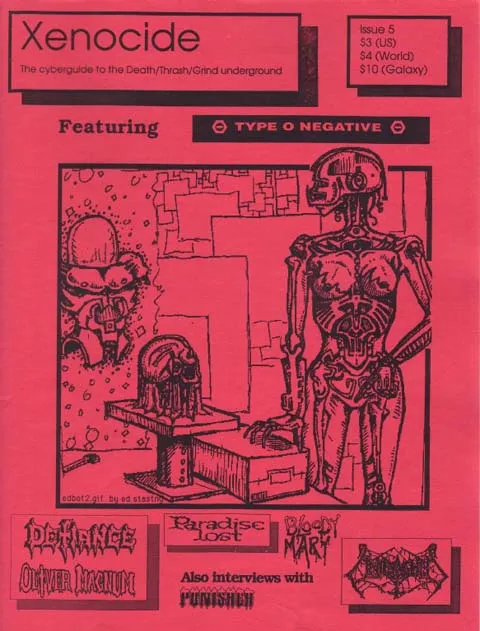
Back in 1989, my friend Ray started a zine.  We listened to a lot of obscure metal, thrash and death metal, and you could barely find Metallica tapes in northern Indiana back then, let alone underground music.  Ray scoured the earth for this stuff, and started writing letters to weirdos in Sweden and Germany and Japan, trying to trade tapes or score free shit, and he eventually started writing reviews and printing a little homemade magazine that he gave away at record stores and sent to record labels to get free stuff.  He eventually got me to start writing for him, too.

(Various things we did not know at the time: these “major labels” like Earache and Nuclear Blast America and Roadrunner were run out of tiny closets of offices; the people in “signed” bands like Napalm Death probably made less money than I did washing dishes in college; there was a whole universe of zines outside of the arena of death metal that was about to explode; there was a whole world outside of Indiana that was infinitely more interesting, too.)

Ray handled all of the business issues with the zine, which was great because his mom ran a business that did some mail-order stuff, and things like postage rates and bulk-ordered envelopes and offset printing quirks were totally within his wheelhouse.  And so was finding all of this unknown metal music and talking to record labels and getting people to buy ads.  I never could have started a zine like this, because I wasn’t plugged into any of this, and this was long before the days of google, where you could just put “where can I find a printer that’s not totally into jesus” or “what the fuck is media mail” in a search engine and get your results.

I have no idea what it would take to publish a real magazine, but even publishing a zine was an arduous process.  Once you actually got all of the reviews and interviews done, you had to put them in a word processing program.  I knew a little about this, but Ray was the one that actually owned a computer, and he used some weird program called GeoWorks to get all the fonts done correctly.  When you had the actual pages done, you had to go to a printer and get a thousand or two of them printed at once, which cost hundreds of dollars.  (You could photocopy, but then each issue would cost two or three times as much, and look like garbage.) Then you had to sell those, and pay postage to get them all out to people.  All told, it didn’t seem like you could really do a zine for under a couple of thousand dollars, although once you made the nut on the printing, you could use the proceeds from orders to cover the postage.  But issues that went to trades or to record labels or otherwise as promotional fodder would come out of your own pocket.  You’d never print a thousand copies and sell exactly a thousand copies.

I went back to college in Bloomington in 1991, and this major revolution in publishing was about to happen, and I didn’t realize it.  First, I spent all day fucking around on usenet news, and found some heavy metal newsgroups where I actually found other people who listened to bands like Carcass and Unleashed.  Sure, this was interspersed with a whole bunch of people who wouldn’t shut the fuck up about Guns N’ Roses or that new Metallica album Smell the Glove, but making fun of them was almost as fun as finding out about that new Entombed album before it came out.  This was as cool as writing to some freak in Denmark who knew all about the cool bands, except it didn’t cost a bunch of money in postage, and it was instantaneous.

This got me thinking: what if you did a zine where the whole thing was just a text file that you posted on usenet or emailed to people?  You could put in the latest news, maybe interview some people, review stuff, have addresses or ads for bands trying to sell tapes, and tell people to email in their news or band info.  There was no way to sell issues like this, and you couldn’t include any artwork or band logos or photos.  You also needed a computer to read it, along with a way to get email, and this was before AOL was everywhere, when a new PC cost four or five grand and a 2400-baud modem would run you a hundred more bucks. But it would be free to “publish”, and people would be able to write back right away if they liked it.

Ray came down to Bloomington in February, to sleep on the floor of my tiny apartment and hang out for a long weekend.  The band Prong was in town, and while they were not super high on our list of most extreme bands ever, but we got maybe one cool show a year in town, and tried not to squander it.  It was right after Valentine’s day, and I had been whatevering with this girl for a week or two and went straight from third base to the friend zone, so I was insanely depressed and in need of loud music and fun.  Me and Ray stayed up late every night, and talked about this zine thing, and whether it would work or not.  Late one night in one of the computer clusters, we typed something up, and I posted it online.

That was February 18, 1992.  Here is the original post.  It is somewhat horrible, far more than cringe-worthy, filled with typos and stupidity and corny fake satanism.  But it’s been there for almost twenty years.

This was insanely confusing to people at record labels.  My main goal was to get them to send me free stuff, and it was like explaining the Kindle to a geriatric.  Nobody had email then, and I tried printing out some copies and mailing them in, but that confused them even more, and defeated the purpose.  I thought about eventually doing both the electronic version and a print version, something whipped up in WordPerfect with some nice fonts and a few pictures and whatnot, and by the 4th issue did that, but I also wanted something out of a god damned Bruce Sterling cyberpunk story, a computerized mind-meld of text and music and artwork and interactivity.

There was a lot of disparate pieces of technology that weren’t linked together that offered pieces of what I envisioned. There was this thing just starting to show up called Gopher, a hypertext system that let schools and libraries publish linked documents on the internet.  It didn’t really have graphics, and only big institutions had servers running, without an easy or obvious way to publish your own info, unless you ran a university science lab somewhere, or worked at NASA.  We swapped a lot of text on the web in usenet and email, but just very unstructured stuff, with no real centralized organization.  Those of us in the know used FTP servers to look at pictures, mostly porno stills that would take hours to download and then offered blocky pixelated images.  And you could digitize music to .au files, which were gigantic, but could sound great.

Later that year, some people at CERN came out with a great improvement on gopher, that let you post pictures and sounds and let almost anyone make their own pages.  I quickly created a thing called a hyplan that played a sound clip from a Cannibal Corpse song, but didn’t envision that this would take off to the point where anyone in the world would use it to read zines online.  But of course, that’s basically what happened.

My little zine only lasted five issues.  Ray’s zine, Metal Curse, is still around today.  I didn’t make any money, although I got some free tapes and met some cool people and interviewed a couple of  decent bands.  More importantly, this put this idea in my head to write creatively, which eventually led to stories, and then to books.  And it instilled some DIY ethic in me, which made me start another zine, and then decide to publish my own book in 2000.

I have not made millions self-publishing.  (Someone with a name similar to mine has.  That’s not me.)  I think that aforementioned dishwashing gig brought in more money than all of my books combined.  The internet thing did land me a career doing technical writing, though.  I think if I added up all of my paychecks from when I started doing that in 1995 to today, it’s in the seven figures, and it gave me free health insurance and paid vacations, but also involved a lot of dumb meetings and things that make TPS reports look like a god damned Tolstoy masterpiece. But self-publishing gave me the ability to do what I wanedt, to not have to worry about changing me by changing my writing because Rumored to Exist doesn’t contain enough vampires or teenaged wizards to sell enough copies to keep a roof over my head.  It hasn’t been easy, but it’s been fun.

So here I am, 20 years down, 40,000 words into the next big book, and wondering what the next 20 will bring.
More Scrivener Tips

Screen-Shot-2012-03-24-at-9.20.34-AM

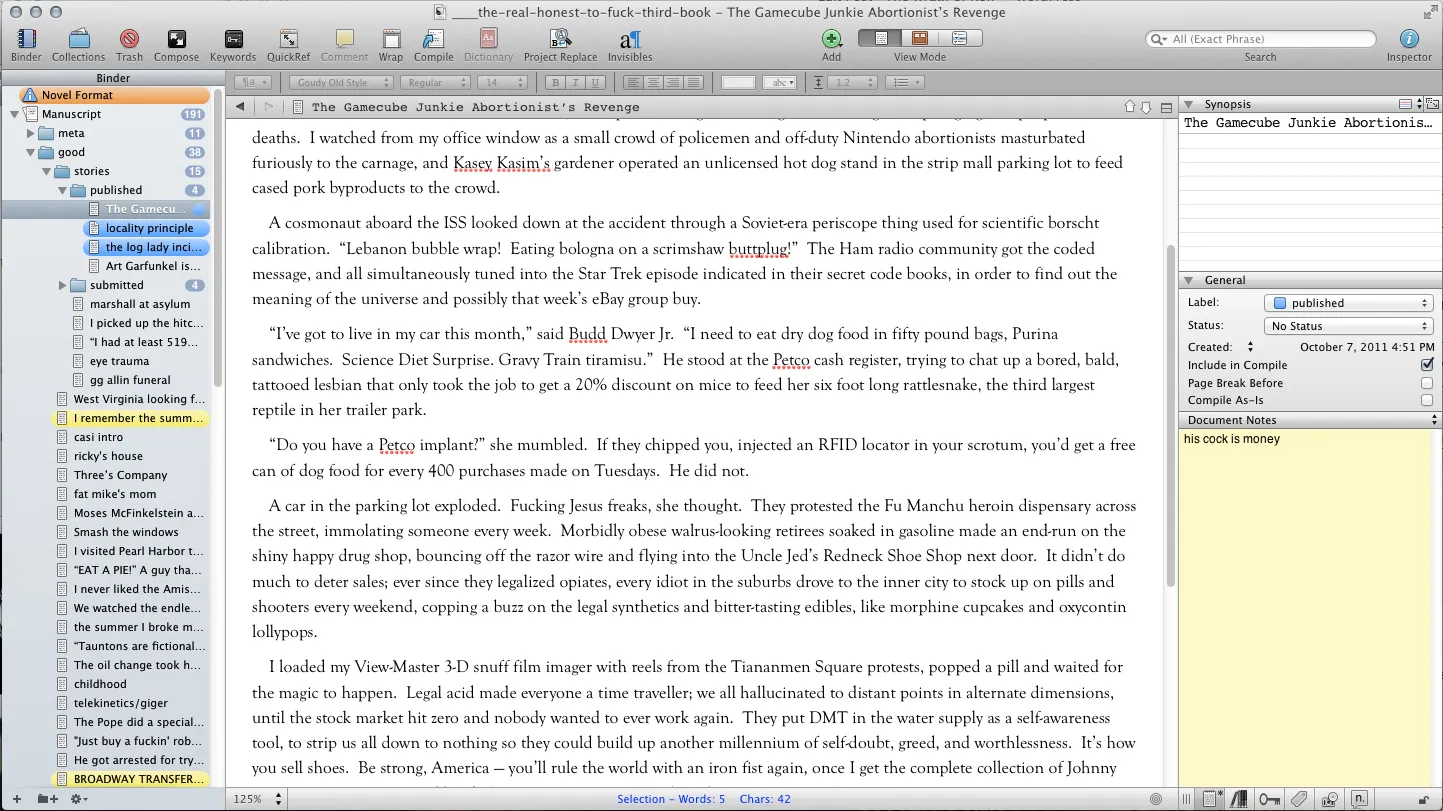
I switched to using Scrivener as my full-time writing tool last year, and still love it.  I always had a lot of trouble coming up with a good way to seamlessly manage a bunch of little chunks of writing, and now I have a perfect way to do that.  And it’s not trapped in a weird proprietary format; I can easily export it into different forms. Since last April, I’ve used it to put out two books (Fistful of Pizza and The Earworm Inception) and re-release Rumored to Exist as a Kindle book. I’ve also been using it for other ongoing projects, and have been pulling in all of my old books and writing, with eventual hope of either rereleasing them or cannibalizing them for parts.

One thing about Scrivener is that a program this feature-rich is going to either have a huge learning curve, or a lot of features you’ll  never figure out, or both.  And while Scrivener comes with a huge 446-page manual, I’m often googling away to find the solution to some issue.

So here are a few things that I’ve found that were not amazingly clear in the docs.  Part of my reason for posting these is to help out other Scriveners, but I’d be lying if I didn’t say that I just posted this crap here so I’ll remember it six months from now after I’ve forgotten it, because apparently now that I’m on the north side of the 40 year mark (and I’ve spent a lifetime drinking out of aluminum cans), that happens.

OK, here goes:

  1. Every word processor has its own little shorthand to enter stuff like returns and tabs and other invisible characters into the find and replace dialog boxes.  And Scrivener doesn’t use the typical ^t or \t.  Instead, when you’re doing a find or replace, hold down the Option key and type your special character.  (Your Option key is also known as the Alt, depending on your hardware and key setup.  No idea what it should be on a PC.)  The characters are not shown in the dialog box, but you’ll know you entered them because the little X to clear a field will be visible, showing you’ve got some text in the blank.
  2. If you’ve imported or pasted a bunch of text that was originally a text file, it may have a hard return at the end of every line, like around the 70 to 80 character mark. The way to drive yourself insane fixing that is to move to the end of each line, hit the delete key, enter a space if needed, move down a line, repeat 9374 times.  Don’t do that.  Open a find/replace, and put an Option-Enter in the find box, and a space in the replace box.  You might first have to search for each double enter and replace them with qqqqqqqq, then replace the single enters with spaces and the qqqqqqqqs with enters.  Same for enters followed by tabs.
  3. You can drag and drop text files into the Scrivener binder (that collection of file pieces on the left side.)  But you can’t drag and drop HTML into your Manuscript.  Why?  I don’t know; the docs say you can.  What you can do is drag and drop into any folder other than the Manuscript.  For example, you can drag and drop a web page into the Research folder.  (This is actually a good way to keep a bunch of research material handy.  If you’re offline and you need to get at that wikipedia page about some historical figure or space program or whatever, you can keep it handy within your project.)
  4. If you do the above, you’re left with an uneditable page that can’t be put in your manuscript.  To edit it and move it to the manuscript, do a Documents > Convert > Web Page to Text.  It can’t be undone, and you’ll lose some formatting, but it will become a fully editable text document.
  5. Composition mode.  You know that wave of full-screen, no-distraction writing programs?  No need to buy anything else; just do a Command-Shift-F.  I bump up the width and font, and have a nice picture of Venice Beach in the background, but do whatever brings you to your happy place where you can write.
  6. Typewriter Scrolling lets you change scrolling so your current line is in the middle of the screen, which works great in Composition mode.  Unfortunately, if you set this by using the menu option of Format > Options > Typewriter Scrolling and you’re not in Composition mode, it doesn’t work.  And if you’re in Composition mode… you can’t see the menus.  Solution?  Do a Command-Shift-T when you’re in Composition mode, and it’ll toggle this on.
  7. Labels are neat, but I find the default settings useless.  (They’re stuff like “chapter” and “scene”, but those are things I group with folders and documents, so who cares.)  Status is also neat, but there’s not an easy way to see status in the project binder.  So I edit the labels and change them to stuff like “Needs work”, “eh”, “golden”, “garbage”, and so on.  Then I go to View > Use Label Color In and pick Binder.  Then all of these status colors are shown in the binder, and I can easily find what needs work.
  8. This isn’t a Scrivener tip, but it is an iPad tip that helps when you’re releasing on Kindle.  If you need to see what your mobi file looks like in the iPad Kindle app, go to iTunes, click on your iPad, go to Apps, and scroll down to the File Sharing heading.  Click on the Kindle app, and click Add, and you can copy your mobi file to the Kindle app and proof away on the device without sending anything to the KDP store.
  9. (Not relevant anymore; macOS now does this by default.) If you don’t have it, get Growl and configure it to your liking.  It’s a universal notification system that a lot of different apps can use to send status updates in little popup alerts on your screen, sort of like how Outlook tells you about new mail messages.  You can turn on Growl support in Scrivener and it will open a popup when you’re saving or when you hit your target count.  Also, Growl may prevent you from going to your mail program every damn time you get a new email, if you get a popup and can see it’s only junk mail and you don’t need to stop writing.  And a Growl hint: if you get a ton of popups, Option-click one and they will all vanish.
  10. I use a Scrivener project called “plotomatic” as a catch-all for all of my notes, unexplored ideas, and leftovers.  It’s much easier than having a scattering of notes in ten different places, and it’s easily searchable.  Think about an easy way to do something similar, to limit the amount of searching you have to do for old stuff.

Hope this helps. Happy Scrivening, and please get in touch with any of your favorite tips!

Longest Novel Ever

I’ve been vaguely thinking about scraping some of the old essays I’ve posted here and turning them into a book, so I imported all of my old entries on rumored from 1997 to present into Scrivener just to see what it looked like.  It turns out I’ve written about 650,000 words here, which means if I trim out the 90% I don’t like anymore, you still get a decent-sized manuscript.

A book of this size is difficult to manage. It’s big enough that Scrivener stutters a bit when you try some intensive operations, like if you select all of the text and reformat it in one pass.  (And this is on a relatively fast machine with 8 gigs of RAM).  I also got enough shit when I released my first book, Summer Rain, which was about 220,000 words.  That translated into about 650 pages, which I think is perfectly readable, but that was ten years ago, and now people tune out in the middle of a 140-character twitter update.  But printing a 650,000-word book presents challenges other than attention span.  CreateSpace can’t even handle a single volume that big; unless I made some creative font and margin choices, that would most likely take three books.

I am not sure if I’ll actually pursue this, because I really need to be writing new stuff, and even if I did, it would be some kind of best-of with a couple hundred pages, max.  But I was googling around and looking for the relative sizes of various books (Infinite Jest, War and Peace, etc.) and I found a guy who wrote a seventeen million word book.

Check it: http://marienbadmylove.com - it’s by a guy named Mark Leach.  It sounds interesting, a B-movie romp through time travel and UFOs and all sorts of things, but it also looks like it’s more performance art than readable fiction.  I mean, even if it was the best damn stuff in the world, it would require a year’s sabbatical from life and a forklift to handle all of the possible volumes.  But it appears he’s done a lot of Burroughsian experimental stuff, like using the cut-up method, to generate that much text, so this isn’t like sitting down to a Dan Brown novel.

This makes me think I should take all of those out-at-third-act novels I never finished, dump it into a big cut-up tool, and mix it down into some gigantic sick and twisted mess of a book.  It’s a thought.

The Allure of Used Media

I was just reading today about some rumors surrounding the system that’s being called, for lack of a better name, the XBox 720.  It’s supposed to be coming out in late 2013 or 2014, which is bad for a couple of reasons.  One, if they screw the pooch and don’t get it to hit that magical pre-holiday season shopping surge, they’re dead.  Second, the entire console gaming industry could be as lively in 2014 as the current 8-track tape industry is today.  But that’s not what shocked me about the news; neither was the fact that they’re moving to BluRay discs for their format.  What threw me is the announcement that the new system won’t let you play used games.

This hasn’t been entirely clarified, but I’m guessing that games will force you to do some sort of online activation scheme, or otherwise be bound to your Microsoft ID.  If you can’t beam home and lock that copy to your ID, you can’t play.  This would probably be swaddled in some distraction, like saying “I’m going to go online now and download all of your COOL NEW GIANT BONUS GUNS!!” and then lock down the game while pulling down updates.  The DIVX DVD player from a decade ago had a similar system, and failed miserably.  It used a phone line to connect back to the mothership, like an old-school cable box did for PPV purchases, but now that every home (in theory) has wifi and ethernet and broadband, that part of the equation is less of a big deal.

I was just reading a J.G. Ballard interview where he talked about the influence of used book stores when he was younger, how he’d dig around these places after some old geezer kicked the bucket and his widow hauled off a century’s worth of book hoarding for six pence a title, and find among the pulp paperbacks the occasional gem.  I used to do the same thing, partly because the prices were always good, but partly because the only other book stores around were Walden’s-type places that didn’t stock anything interesting, or maybe the occasional Border’s that would have the last one or two of an author’s works, at full cover price.  I spent so much time poring over titles in basement stores, taking home books that looked cool, and occasionally stumbling onto something life-changing.

I did the same thing with CDs and music, too.  I mean, I worked both sides of the deal, dragging a backpack of the lowest-rated titles from my collection every time I was broke and had to pay a massive phone bill or buy enough groceries to coast into next payday.  But I’d often spent hours going from A to Z in those used CD places, trying to find something obscure, or just looking for bands I’d never heard, so I could try them out for half the price of a retail CD.  I buy 100% of my music digitally now, and that experience is completely gone now.  I can listen to 30-second clips of an artist’s songs in the iTunes store, and that’s helpful, but the entire tactile situation of running my fingers over five thousand plastic spines on jewel cases to find some obscure d-list band on Earache is gone.

I don’t know how big the used game market is these days, although at the height of my PlayStation 2 days, I’d frequently turn in the duds in my collection for store credit.  I was always the kind of gamer that would be stuck on a single title for weeks and months on end, instead of having to get the latest games as they came out and then immediately solve them.  I am guessing if you’re that kind of gamer, you probably use one of those Netflix-like game rental services, although this begs the question if they will also be screwed by a one-player-per-title system.

The main thing killing the console game system is another reason why the game-ownership system makes less sense.  When you play something like Mafia Wars, you don’t buy the game; the client is your browser, and you “own” your online account.  You don’t spend money buying a physical disk; you buy game currency or points or guns or upgrades or whatever else.  I think more games will follow this WoW model where the client is either free or cheap, and you either pay for upgrades or pay per month or hour or whatever.

I’m also wondering if this will cause a “dark ages” in collecting of systems in the future.  I can hop on eBay and hoard away any number of Atari 2600 titles.  But will there be a point in ten or twenty years when the then-middle-aged person goes to buy all of the XBox720/PS4 games they didn’t have as a kid and be as screwed as that guy who built a replica Cray supercomputer and can’t boot it because nobody has an OS for it?

41

I turn 41 today.

Five years ago, I ate dinner at Per Se in New York.  I had a twelve-course meal that cost something like $750.  Then I went home and watched the movie Idiocracy.  Then my iTunes library crashed, and I spent the next day restoring it, so a huge chunk of my songs say they were imported on 1/21/07.

Ten years ago, I went to Las Vegas with Bill (who shares my birthday), Lon, and Todd, starting a long tradition of going to Sin City for our birthdays. Todd took pictures of me sodomizing pretty much every statue on the strip.  While we were in town, I bought 40 acres of land in the mountains of Colorado, starting that whole obsession.  I also shot a full-auto M-16, bought this ridiculous Coke jacket, and made far too many references to Fear and Loathing over the weekend.

Fifteen years ago, my uncle died from brain cancer on my birthday.  I lived in Seattle then. I went out the weekend before, with a bunch of people from Spry (Bill, Todd, others) and I bought a new bed, but I spent the actual day of my birthday at work.  A somewhat boring and introspective day, but those are good too.

Twenty years ago, I turned 21 and could legally drink.  Me and Bill went to Kilroy’s, the dumb jock bar in Bloomington, to get our free drink.  I still have the glass.  Then I went to a liquor store to buy something with more octane than the fruity drink with ten drops of rum in it, and the fuckers didn’t even card me, which pissed me off.

Twenty five years ago, I turned 16 and hit the age when I could get my driver’s license.  I didn’t get it for a few months, but that was the first big step in escaping orbit.  I think my obsession at that time was Iron Maiden.

Thirty years ago, I think I had a Superman cake.

Forty years ago, I was in Edwardsburg, Michigan and I still have the picture of me putting my hands in the chocolate cake that pretty much everyone has from their first birthday.

It’s now 8

, and at 8
, I officially turn 41. I’m still in bed, plinking at the laptop, enjoying a day off.  Later, I will go to Denny’s.  Not really thinking about my own mortality or where the time went or any of that stuff.  Just thinking about pancakes.

Anyway, thanks to everyone for everything in the last year.  I hope the next one is even better.