The Wrath of Kon

Dispatches, thoughts, and miscellanea from writer Jon Konrath

October 2012

The perks of being a blocked writer

Okay, in my last post, I alluded to being stuck between two places writing-wise, and I didn’t get into that.  So, now I will.  But of course, I’ll go off on another tangent first.

I saw the movie The Perks of Being a Wallflower this weekend, mostly because I heard Cloud Atlas was a disaster.  I wasn’t entirely sure I would like the movie, partly because I thought it was completely out of my demographic, and partly because I’ve read the book at least twice and don’t remember a damn thing about it.  But I went, and I actually liked the movie a lot.  I liked it so much, I came home at ten at night, picked up the book, and plowed through the whole thing before I went to bed.  And then, as I went to bed and after I got up in the morning, I felt… I don’t know.  Maybe a mix of depression, nostalgia, enthusiasm, and dread, the emotional equivalent to when you get a fountain beverage and randomly fill it with a mix of every flavor, a Pepsi-Mountain Dew-rootbeer-orange-Sierra Mist-tea.  And it’s hard to describe it, because there were a few different things going on, and I’d have to explain every one of them to cover this.

First off, Perks had the typical high school coming-of-age tropes in it, opposites-attract, she’s-out-of-my-league, grass-is-greener, self-medication with drugs, rock-will-save-us-all, early-90s-are-the-new-80s, and about 17 more.  It’s all weaved together well, and maybe I feel bad for liking such commercial dreck.  It did contain enough emotional context that linked to my own teen experience, though, that it made me really enjoy and envy it.  The envy part is the big problem.  The reason I avoid reading these kinds of books now is that when they’re good, I want to write them.  And I’ve proven to myself that I can’t, and I shouldn’t.  But should I?

My last three books have all been a sort of mix of lowercase-b bizarro and absurdist humor.  I think they’re pretty damn close to my voice, and I think any of you who have read these books and have known me in person would agree.  Throw Rumored at the front end of that trio, and you’ve plotted a glide slope that pretty much defines who I am or who I will be as a writer.  It’s a solid 750 pages or so of work that very much describes what’s going on in my mind and sets the pace for what my next books should be.  After I finished Sleep Has No Master a few months ago, the plan was to write a Rumored 2 of sorts, maybe a different structure or gimmick, but a full-sized, nonlinear hunk of absurdity that did what Rumored did ten years ago.  I’ve even got a publisher that’s basically waiting for me to write the next book, so they can put it out.

But then, I sort of locked up.  Part of that is the reception of the last book, which has been piss-poor at best.  I think it’s a damn good book, but it’s been sort of lost in the mix.  Maybe the title and cover make no sense, or it’s the fact that it just doesn’t easily plug into a genre.  But it hasn’t sold, and it’s always hard to get working on something new when the last thing didn’t entirely work out.  There’s also the fact that I essentially put together three books in a period of just over a year, and the well is kinda dry.  I really wanted to push and get another book done by the end of the year, but I’m finding myself stumbling on ideas.

The other issue is that I don’t entirely know where I fit in.  I said lowercase-b bizarro because the more I read from the Bizarro movement, the more I think I don’t slot into it very well.  Most Bizarro is this sort of Troma film horror-comedy stuff, and I don’t really do that.  But I also don’t fit into the experimental or absurdist worlds, either, which seem to be the PhD-dominated academic community.  And forget the mainstream scifi community.  I probably spend too much time thinking about community and where I fit in and all of that shit, and I guess I’ve always worried about that, even before I was a writer.  But I can’t shut it off, and I don’t have easy answers, and it can become enough of a distraction to block me.

And… sorry, another tangent… okay, I read this biography of David Foster Wallace, and it talks about how he thought Mark Leyner was the antichrist because his satiric writing wasn’t sincere, or something like that.  And when I read that, it sort of pissed me off, because I love Leyner’s writing, and it made DFW sound like a blowhard.  But with all of this stuff in my head, it started to make sense.  I love writing the stuff that I have written in the last couple of years, but if I had to capture and dump the emotions I felt during this film and book, I think it would be completely out of scope of this absurdist humor thing.  I mean, I could start to throw down a coming-of-age tale, but it would be about a kid who goes to high school to learn how to anally insert DMT into zoo animals from his teacher, Lyndon LaRouche.  (Wait, gotta write that down in the idea book…)

I’ve tried this kind of sincere, modernist, realist writing.  I’ve had some success at it in short stories; if you’ve read my story “Burial Ground,” I think that’s pretty spot-on of what I can do.  And some of you (okay, three of you) may have read Summer Rain.   I have two other books up on blocks in the yard like the trailer park Trans Am with no motor or wheels, one about high school, and another about college.  Summer Rain was the best of the three; the other two, there’s about 150,000 words of nothing.  Every now and again, I think about going back and trying to duct tape enough crap onto either of those manuscripts to get them out there, but Summer Rain itself isn’t selling.  I think I’ve learned a lot more about plot and character since I tried writing these other two books, and when I see them, I do see what’s wrong with them, and think about how I could restructure or rewrite them so they would fit.  But part of me thinks this would be a huge step backwards.  And it’s a tough wall to beat against.  It’s also depressing to think that even if I did manage to turn out a stellar coming-of-age book about growing up in the 80s in Indiana, I would have a tough road ahead of me in the marketing and sale of the thing.

So, caught between two worlds.  And this is why practicing bass instead of writing has been very helpful lately.  I have 40,000 some words written of this Rumored 2 project, and it makes absolutely no sense right now.  I know I will have to eventually knock back into it and come up with a structure and get the thing done, but it’s tough.  Playing major scales against a metronome until my fingertips look like ground hamburger is much easier.
Back to bass

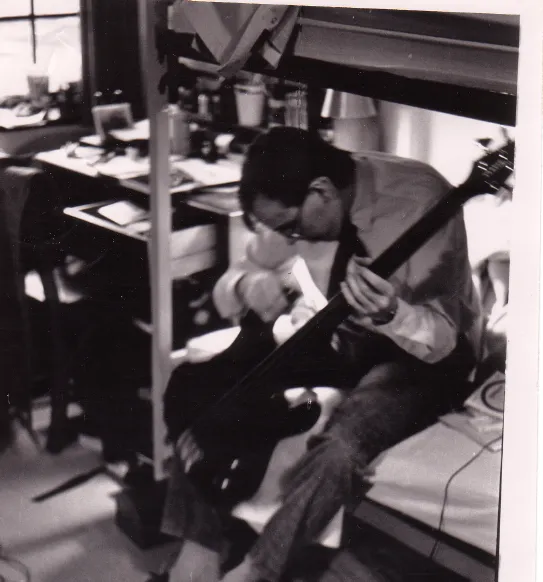
me-fretless-1990

I have not been writing.  I’m sort of stuck between two places.  More on that in a bit.

I went into my usual writer’s block mantra of “I wish I did something other than write”, which motivated me to go to our storage locker and pull out my bass guitar and amp.  Before I put pen to paper, I used to play bass.  I sold my first bass when I left Bloomington, and in a strange act of serendipity, I saw a used bass exactly like my first one the week I left Seattle, and had to buy it.  I think I played it a total of five times before it went into storage forever, because I was too busy writing books and had all but forgotten how to play.

And I’ve dragged the thing across the country 19 times or whatever, and have not touched it since probably 1999.  But like I said, I had this urge to go buy a guitar or learn to paint or draw or do anything other than write, and I had this thing sitting in storage, so I brought it home, and thought if people who have strokes can re-teach themselves how to talk at the age of 80, I can re-teach myself how to play bass at 41.  Right?

I have this Cort headless bass. A cheap cousin to the Steinberger bass, it screams 1980s in a way big hair never could.  It’s got bad tone and a little fret buzz and the pickups need to be adjusted and I can’t get them right, because the E string is way louder than everything else.  But it’s still in once piece, and it works, and it was a number of Franklins cheaper than going to Guitar Center and buying a new one.

My original Cort was actually my second bass.  My first one I bought from the JC Penny catalog towards the end of my senior year of high school.  It was all plastic and China and stayed in tune for about seven minutes in a row, if you didn’t touch it.  My high school graduation present to myself was this Cort bass, which I saw used at a store in South Bend on a day I happened to have all of this graduation money in my pocket.  The electronics were stripped out of it, just the pickups and bare wires, no back cover and three holes where knobs were supposed to be.  I never really got the thing wired well, and always had problems with RF interference.  I got it refretted when I was a freshman in college, and traded that JC Penny bass for the fret job from a luthier student named Dorian.  (Never asked if he had brothers named Mixolydian, Locrian, etc.)

I’ve forgotten almost everything about music.  And my fingers are doing even worse.  I started trying to play scales and whatever little riffs I could remember, and my digits are nowhere near close to being in the right places.  Every other note is early or late or buzzing or uneven.  I wasn’t really sure how to proceed, so I started googling, and got information overload.

When I first learned to play the bass, it was 1989.  We did not have youtube.  I can now pull up instantly any number of instructional videos and pause and rewind and watch these guys explain and play and theorize and show off.  We had VHS back then, but that sucked.  I had a dub of a Stu Hamm instructional video, but one of my sisters recorded over it, and you couldn’t pause and rewind like you can now with DVDs.  I think our old VHS was one of those pieces of shit where hitting pause and then rewind took 19 seconds, and it made all of these clunking noises like a big block chevy running with no oil in the pan.  That’s all changed.

When I used to want some tab to learn new songs, I would have to walk to the music store (uphill, both ways) and get some shitty Mel Bay book that would have tab for “When The Saints Go Marching In” or whatever.  Now, there are a million web sites that have tab for days that you can download and print at home.  And there’s a site that plays the tab like a player piano, playing the guitar and drums so you can practice along with it.

The internet has also changed how you shop.  Nothing beats going to a guitar store and trying everything out, but when I was a kid, the music stores in Indiana were shit, and had the bare minimum of stock, all marked up to hell.  When I had to get strings for my headless bass — it takes strings with a ball on each end — I had to drive to Chicago, and pay something like $50 for them.  Now, Amazon, one click, done.  In and out for $25.  And ebay — jesus.  Put “Fender Jazz” into ebay and see where all of my time on the couch in front of the TV is going.

I can also plug my bass into my computer now, which is freaky.  It used to be you would save up a paycheck or two for one of these PortaStudios, which were really finicky about what kind of tapes you used and how often you cleaned them, and would lose quality after each generation of recording, and you still had to deal with a running tape and punching in at the right time and all of the hassles of analog.  Now, I fire up garage band, drop in some loops, and click to my non-linear heart’s content.  It’s very amazing.

Things are slowly coming back to me.  I’m obsessed with practice.  I’ve promised myself that for every hour I practice, I have a dollar to spend on a new bass.  I practiced five hours yesterday, and my left fingers are hamburger.  My technique has a long way to go, but I’m remembering theory, slowly.  It’s been a lot of fun.  It’s a lot more fun than banging my head against the wall because I can’t write.

About that, I guess I mentioned at the beginning of the post that I would talk about that.  But I’m out of time and this is a thousand words already, so maybe next time.

The Recognitions by Steve Urkel

The Recognitions, published in 1955, is American author William Gaddis’s first novel. The novel was poorly received initially, but Gaddis’s reputation grew, twenty years later, with the publication of his second novel J R (which won a National Book Award), and The Recognitions received belated fame as a masterpiece of American literature.

Steve is the epitome of a geek/nerd, with large, thick eyeglasses, “high-water” or “flood” pants held up by suspenders, multi-colored cardigan sweaters, and a high-pitched voice.[6] He professes unrequited love for neighbor Laura Winslow, perpetually annoys her father, Carl, and tried to befriend her brother, Eddie. Amongst the rest of the family, Harriette, Rachel, and “Mother” Estelle Winslow are more accepting and caring of Urkel.

The story loosely follows the life of Wyatt Gwyon, a Calvinist minister’s son from rural New England. He initially plans to follow his father into the ministry, however, he is inspired to become a painter by The Seven Deadly Sins, Bosch’s painting in his father’s possession. He leaves and travels to Europe to study painting. Discouraged by a corrupt critic and frustrated with his career he moves to New York. He meets Recktall Brown, a capitalistic collector and dealer of art, who makes a Faustian deal with him. Wyatt creates paintings in the style of Flemish and Dutch masters (such as Hieronymous Bosch, Hugo van der Goes, and Hans Memling), forges their signature, and Brown will sell them as newly discovered antique originals. Soon Wyatt is discouraged, goes home only to find his father converted to Mithraism and losing his mind. Back in New York, he tries to expose his forgeries, then travels to Spain where he visits the monastery where his mother was buried, restores old paintings, and tries to find himself in his search for authenticity. At the end, he moves on to live his life “deliberately”.

Throughout the series’ run, Steve is central to many of its recurring gags, primarily gratuitous property damage and/or personal injury as a result of his inventions going awry or his outright clumsiness.[7] He becomes known for several catchphrases uttered after some humorous misfortune occurred, including “I’ve fallen and I can’t get up!” after he accidentally got drunk in one episode and fell off the edge of a building, “Did I do that?” (previously used by Curly in the 1934 Three Stooges short Punch Drunks), “Whoa, Mama!” and “Look what you did” (if, rarely, someone else caused the damage). Additionally, he frequently insinuates “You love me, don’t you?” to Laura Winslow, the usual object of his affection.

Interwoven are the stories of many other characters, among them Otto, a struggling writer, Esme, a muse, and Stanley, a musician. The epilogue follows their stories further. In the final scene Stanley achieves his goal by playing his work at the organ of the church of Fenestrula “pulling all the stops”. The church collapses, killing him, yet “most of his work was recovered …, and is still spoken of, when it is noted, with high regard, though seldom played.”

Steve Urkel first appeared on the twelfth episode of the first season, “Laura’s First Date”, as a nerdy young boy who took the character of Laura Winslow out on a date, where he appeared as being madly in love with her, but in an example of unrequited love, Laura did not return these feelings because of Steve’s nerdy, infuriating personality. Although intended to only appear once, White’s portrayal was very popular for his humorous, geeky antics. After appearing on other episodes, he joined the main cast.[8] All throughout the course of the series, Steve maintains his extreme infatuation with Laura and regularly invites himself over for unwanted visits to her house, much to the annoyance of the Winslows. Among Steve’s other famed character traits include his exceptional scientific skills, crafting devices that would be impossible to construct in reality, his absurdly destructive clumsiness, and his kind heart.

Gaddis spent seven years writing The Recognitions. The novel began as a much shorter work and as an explicit parody of Goethe’s Faust. During the period in which Gaddis was writing the novel, he travelled to Mexico, Central America and Europe. It was in Spain in 1948 that Gaddis read James Frazer’s The Golden Bough. Gaddis found the title for the novel in The Golden Bough as Frazer noted how Goethe’s Faust originally came from the Clementine Recognitions, a third-century theological tract (See Clementine literature). It was from this point on that Gaddis began to expand the novel. The novel was completed in 1949.[3]

Steve is commonly known and respected by other characters for his kindness to others, his never-ending love and loyalty for those he holds dear, and, alongside with Harriette, his position as a voice of reason and source of wisdom for the often bickering members of the Winslow family, all of which are the redeeming qualities for his generally unwelcome or tolerated presence. He always cares for and means well for other people, but is often the misunderstood victim of the Winslows’ anger and rejection, especially of Carl, Eddie and Laura, who all struggle to see through his clumsiness and annoying behavior and to understand and appreciate him for his positive traits.

The character of Esme was inspired by Sheri Martinelli and Otto has been described as a self-deprecating portrait of the author.[6] “Dick,” a minister, is a reference to Richard Nixon.

Stop bath acid memories

I

save0179

n my freshman year of college, my classes were mostly at Ballantine hall, which was rumored to be built from all the money IU made off of the fluoride patent they sold to the Crest toothpaste people.  The morning stumble from Collins to Ballantine for an 8

German 100 class took maybe five or ten minutes, but I somehow decided that I’d die of exposure, so over the holiday break, I became obsessed with the idea of heated socks.  I somehow thought a pair of wool footwear impregnated with electrical coils would be the difference between Rolls Royce comfort and dying like those soccer players in the mountain plane crash who had to eat each other’s dead bodies.

I went to K-Mart back in Elkhart, and bought a pair of these magical socks in the hunting department.  They were brown with olive drab green trim on the toes, and a little plastic compartment for a C-cell battery in the top cuff.  I brought them back to school, put in a set of duracells, and within two minutes, it felt like a case of thermonuclear athlete’s foot, like the Vonnegut character that sealed his feet in clear plastic toxic waste.  And then two weeks later, it was suddenly 78 degrees outside, and people were sunbathing at the end of January.  I practiced cello outside the IMU on the bank of the Jordan river and got my picture in the school paper.  It must have been a slow news day.

That was my second cello.  I had to leave my first cello in the dorm over the holiday break. They ran the steam heaters full blast, so I locked the cello in the closet with a bucket of water, two drenched towels, and two humidifiers in the f-holes.  When I came back three weeks later, it was all bone dry, and the cello had a huge crack in it.  It was a rental, so I brought it back and exchanged it for another one.  I never really knew how to play; I just took a semester of lessons in some fit of stupidity, the same kind of spontaneous freedom that causes a person to buy a pair of heated socks at K-Mart for a five-minute walk in 38-degree weather.

I also purchased a 35mm camera that break, although I don’t think it was from K-Mart.  It was one of those fixed-focus point-and-shoot things, all plastic and manual.  I think I got maybe three rolls of film through it before the film spool broke, and I could not fix it.  I took a few good pictures of the campus, though.  And even though it had a plastic lens and no motor drive and no zoom or anything like that, it took pictures better than any camera I’d had before that.

My prior photographic history resembles a list of every failed film technology invented.  My parents had a 135 camera, and then I got a 110, and we also had a Polaroid one-step, and later graduated to a disk camera.  I don’t know if they ever got one of those APS models, but I wouldn’t doubt it.  We’d take about a roll of pictures a year, and then throw all of the rolls in the junk drawer and never develop them.  On the rare occasions when a roll got processed, the pictures went in a sticky-paged album with a faux leather cover, which would then reside in this hexagonal end table in the living room, to be produced each time I was stupid enough to bring a prospective girlfriend home to meet my parents.

It’s depressing that people will soon forget the extreme frustration of living in the film age, of having to bring film to the drug store, needing to buy those flash cubes or flash strips that exploded in bright light with the faint smell of burning electronics, like igniting a dollar bill every time you pressed the shutter.  You’d worry about the film getting exposed to light and destroyed, the possibility of a door opening or a case splitting, exposing everything and fading the captured images to nothingness.  Unless you owned an expensive camera with a motor drive, you’d follow some ritual of ratcheting a thumb wheel to advance the film from one reel to another, hoping you didn’t crank it too far and miss a picture, or you’d forget to turn the wheel, and when it was time to snap the shutter, the mechanism would deny you until it was wound further.  And then you’d wait a week or a month or a year and get the prints and realize everyone had their eyes closed or you were too far away or the shot you thought was perfect didn’t frame up anything like the crappy little viewfinder convinced you it would.

I developed film once.  A girl I dated that freshman year found some old 35mm film at her parents’ house, the aforementioned spools of film in a junk drawer for decades.  Her dorm had a darkroom, and she knew someone who took photography classes or worked for the school paper or something, a guy with the knowledge of all of the various chemicals and trays and tools and red-filtered lights.  We unrolled this ancient spool while hiding out in this little closet of a lightproof room, breathing chemical fumes and watching the pictures slowly appear.  It felt like when you make the Paaz easter eggs as a kid, when you scribble on the eggs with white crayons and then dip them in the bowls of dye and watch the inverse of your writing slowly appear in color.  We watched these pictures of Toledo fade into view, images of a lake shore now covered in condos and strip malls, but then barren.  I don’t remember how the process worked, except it seemed magical to me.

I keep thinking about buying a film camera for kicks, an old East German plastic-lensed thing that hipsters use to take pictures of skateboarders and graffiti and abandoned buildings.  I know I would never use it; I almost never use my real digital camera.  But there’s something enticing about it, like any of my other craft-related obsessions I avoid because they are money drains.  I still obsessively google old camera pages, and think about Super-8 and Polaroid film.  I know I’d have to pay more per picture, and then I’d have to scan those pictures, and I have boxes of thousands of pictures I will never scan, and I’d only end up with more blurry pictures of my cats laying on the same furniture.   But the process of it all makes it hard to shake.  I should probably start by actually scanning the old pictures I do have, before I sink any money into this.

Mission

save0129

There is a level in Modern Warfare 3 called “Mission” and everybody seems to love it, because every time I’m playing and “Mission” and any other level other than “Terminal” or “Dome” comes up, everyone votes for “Mission.”  (“Dome” is one of those tiny levels where everyone shoots everyone and the maximum score limit is reached in about 122 seconds; “Terminal” is from MW2 and everybody’s memorized the map very well and knows where to stand and snipe and camp and plant claymores.)  I personally hate “Mission” and I don’t know why.

The word “Mission” reminds me of two things.  One is the song “The Mission” from the Queensryche album Operation: Mindcrime, which I pretty much memorized in 1988.  It has this weird chanting part, and one time my mom ran downstairs and told me to shut it off because it “sounded like Satanism.”  The other is The Mission, as in the neighborhood in San Francisco, which I only knew about prior to moving here because of the concept of mission-style burritos.

I don’t know what legally constitutes a mission-style burrito.  In college, there was this place on the second floor of a building on Kirkwood that made alleged mission-style burritos, which they advertised as “burritos as big as your head.”  I don’t think they were technically as big as your head in a volumetric sense.  They were potentially as long or wide as your head, but not as big as your entire skull, at least not mine.  (Of course, I have a giant head, and the biggest fitted cap you can buy at an MLB ball park barely fits me.)  I never ate there much, but a few of the people that spent all of their time at Lindley Hall used to eat there constantly, and I went a few times.

One night, I was leaving for Canada, and my roommate came home from the burritos as big as your head place as I was packing, and took a shit that filled the townhouse like a tear gas grenade thrown in your face at a protest.  We had to open the windows and it still felt like getting hit in the face with pepper spray.  I threw everything in my bag as fast as possible so we could hit the road, leaving town for another country at nine or ten at night, going to one of those stupid programming contest things where we always thought we’d smoke the other teams, but we ended up maybe finishing one of the twenty programs and wasting our time and money and effort, but at least we’d end up getting blotto in some new town.

I sat in the back of this Bronco truck, still depressed over some breakup that happened a week or two before, one of those relationships I thought was perfect and pure and forever until it got up to speed and then exploded like a car with no oil in the crankcase.  Leaving for another country with promises of exchanging funny money for many alcoholic beverages was just the thing for this kind of funk, except I knew that it never really worked.

We raced across Indiana and Michigan, hoping to outrun a snowstorm, and got to the border in Windsor some time after midnight.  The customs agent asked if we had any guns, and I yelled from the back, “WHAT DO YOU NEED?”  They still didn’t search us, and we drove into the great white north.  Hours later, we stayed at one of the worst hotels imaginable, and I slept on the floor of a closet, wooden paneling everywhere, a crying clown painting on the wall, the smell of mildew and dust mites everywhere.

I don’t think we ate any burritos in Canada.  I drank too much, mostly Molson.  We did not answer any of the problems.  I wonder if any of the people who did solve the problems ended up working on any of the Modern Warfare video games.  I don’t know.  All I do know is that I feel like a sober alcoholic at a liquor store every time I boot up that game, wasting away my hours trying to get to the next level instead of writing, or thinking of writing.  If writing were as addictive as video games, I would be Leo fucking Tolstoy at this point.  I am not.