The Wrath of Kon

Dispatches, thoughts, and miscellanea from writer Jon Konrath

December 2011

Things I Learned in 2011

IMG_4000

Okay, so how does one write a post that summarizes the year without A) listing all of the books you read that year, which honestly nobody gives one flying fuck about; B) see A, except with music, which is problematic because I don’t think I bought a single goddamn album actually released in 2011; C) giving a giant list of “resolutions” which you will promptly forget about by January 7th.

I’d like to think in the last 365 days, I have become wiser.  I’ve definitely become older; unrelated: looking for reviews and advice on picking the correct shade of Just For Men hair color.  But here’s the laundry list of life lessons I may or may not have learned in 2011.

  1. Get an Amazon rewards card, then make every single purchase of your life using the card instead of cash, down to paying for a $2 parking fee with your Visa.  Then, pay the entire bill at the end of the month.  Also, buy every damn thing possible from Amazon so you get triple points.  I bought everything from birthday gifts to toilet paper to deodorant to computer supplies from Amazon instead of battling the idiots at the grocery store.  You save time, but most importantly, you end up with hundreds of dollars of free books by the end of the year.
  2. Paying any attention whatsoever to the Apple versus Android arguments online is a total waste of time.  Buy what you want and stop reading the comments in engadget or gizmodo posts.
  3. Sync a notes file on your phone with a gmail account and write down every single idea for a story or character or scene the second it crosses your mind, because it’s a lot more efficient than trying to actually think of ideas when you need them.
  4. Don’t read more than three Philip K. Dick novels back-to-back while on cold medication.
  5. Scrivener is the best writing tool imaginable, at least for me.
  6. You can either spend a lot of time arguing politics with people who will never change, or you can learn how to block people on facebook and actually get shit done.
  7. When you’re trying to read something on the web and you see a link to something else, instead of falling into a giant wormhole, just add the link to Safari’s Reading List and then when you’re eating lunch or stuck in line somewhere, read those articles later.  I have this horrible issue where I start searching for how to change the font in my mail program, and suddenly it’s two hours later and I’m reading the entire history of the Gemini space program and I have no fucking idea why.
  8. Get a Kinesis Advantage keyboard, and learn to touch-type.
  9. Stretch.  If you don’t know how, go to a chiropractor and ask.
  10. Write what you want to read.  Read what you want to write.

Here’s to 2012.  No resolutions, no predictions.  I’ve got two books in the hopper and need to kick ass on getting stuff done and out, so stay tuned.


You Can Never Go Back

IMG_0207

I am home.  My last ten days: Oakland to Chicago to South Bend to North Liberty to South Bend to New Buffalo to South Bend to North Liberty to Elkhart to South Bend to Indianapolis to Bloomington to South Bend to Elkhart to South Bend to Elkhart to South Bend to Milwaukee to Chicago to Oakland.  I did all of this except the Oakland-Chicago flight in a bright mustard yellow Ford Fiesta, fighting with Ford Sync to try and get the voice control to play songs on my phone, most of it in the rain.  But the driving and the subcompact and the junky Ford transmission were the least of my worries.  My big problem was the ghosts.

I don’t go home much anymore.  I don’t even know where ‘home’ is; I’ve spent more time out of Indiana than I lived there.  Home is probably where the mortgage is, and Elkhart is nothing but a distant memory.  And when I go there, that’s what always gets me: the nostalgia, the distant memories of the time I spent in that little town, when it was my entire world, and the coasts and cities and states outside of the 46516 were nothing but fictional entities on a TV screen.

This trip was particularly hard, for some reason.  I’ve been trying to foster stronger friendships with old friends and family, because I feel like my life’s been on autopilot, and if I don’t put in the effort to see people, it’s suddenly twenty years later and they are all strangers to me.  But when I went back, it seemed like everyone was in some kind of crisis or despair. Everyone’s getting older; everything’s falling apart.  People are unemployed and underemployed and oversubscribed and overextended.  Nobody’s happy.  Everyone’s unable to move, and tells me I’m lucky I escaped.  And I did escape; I do have a job.  I’m mostly healthy, I’ve got a house and a wife and two cars in the garage and food in the fridge and cash in the bank.  But that doesn’t make me happy.  I’ve struggled a lot in the last year or two with what I should be doing, the big picture stuff, and I haven’t always been happy with the results.  So it makes me uncomfortable when others look to me as a person who’s “made it”, and I have no business telling them what they need to do to get out of their own rut.

When I do return to Indiana, I find it amazing that I drive places without even thinking about directions or maps or GPSes.  I think about going somewhere, a mall or store, and find myself driving there on autopilot.  I drove a lot of my old routes: the IUSB to Elkhart path I took every day for year; the River Manor to Concord Mall trip I drove a million times in the 80s and 90s; the south-bound US-31 jump across the middle of the state to Indianapolis to Bloomington I drove every holiday I came back from school.  As a whole, the state’s in sad shape.  So many businesses are closed, homes foreclosed, factories shut down, strip malls empty, old malls bulldozed.  Roads are potholed and unkempt.  Of course, every other abandoned movie theater or grocery store has become some kind of evangelical church, and those continue to thrive.  But I felt such an overwhelming sadness driving those same old routes and seeing total devastation.

I went to my old hangout, the Concord Mall, to see how it was doing.  I spent my childhood going to this four-spoked shopping center, walking the concourses and buying toys and records and books.  I later worked there, at Montgomery Ward, mixing paint and selling lawn mowers and Christmas trees.  Concord Mall has been utterly decimated.  I went a couple of days before Christmas, and I’ve seen more people in the mall back in the Eighties two hours before opening.  My old Wards store died ten years ago, and has been split into pieces, now a hobby shop for scrapbookers and packrats, a discount appliance store, and a family dentist.  Most of the stores are now gone; the Osco drug where I used to spend hours at the newsstand reading magazines got turned into a food court; every single stall is currently shuttered except for a Subway.  The Walden books where I got every book that influenced my writing as a teen is now a bizarro used book store with old, beaten religion books.  The MCL cafeteria Ray dragged me to almost every week is boarded shut.  Both record stores are gone.  The only surviving store was the GNC where my first girlfriend worked.  I think it does brisk business in energy drinks and herbal stimulants for the few remaining factory workers.

IMG_0242

I went to my old house in River Manor, which was absolutely heartbreaking.  It was foreclosed upon a couple of months ago, and was devastated.  The big TV antenna tower was bent at a 30 degree angle and falling over, and the roof was covered with a blue tarp, probably with some kind of wind or storm damage.  Several of the windows were broken and boarded over; the screen door was ripped off of the front, and the patio door in the back was broken and boarded shut.  The grass died; trees were missing or dead and the landscaping was entirely fucked.  Doors and windows were secured with impromptu padlocks and riddled with legal postings from sheriffs and maintenance services.  I looked in the windows, while trying to remember any of my old teenaged egress methods that could have been used to gain entry, and the inside was filled with garbage, old boxes and trash, and storm damage.

I have no love for Elkhart, and absolutely no desire to return.  But part of me wished some REO website had the house listed for ten grand, just so I could either restore it (which would probably cost more than the hundred grand it’s “worth”) or bulldoze it and put it out of its misery.  I walked the perimeter and thought of a million memories, all of the hot summer afternoons I paced every step of the lawn with a mower; all of the times me and my sisters set up our kiddie pool or played with the dog or built snow forts in the winter.  I thought about the year I returned in college and lived in the basement, stuck between a life of return and escape.  I went to all of the places in the yard where we buried childhood pets, under trees that were no longer there.  I spent a decade and a half calling this white tri-level home, and now it looked like one of the abandoned buildings outside of Chernobyl.  The entire visit completely gutted me.

One of the mixed positives about the trip was going to University Park Mall.  We first went on a Sunday night, at about 9

, and the place was absolutely packed.  The mall looks like it has doubled in size, not even including all of the outlying big box stores that appeared on the perimeter.  I walked the concourse, and examined all of the stores, which have been replaced with more upscale items.  The place even has an Apple store now, which amazed me.  When I was a teenager and first got a license, I made the pilgrimage to this mall whenever I could, going with Tom Sample just to dig through the import records at Camelot and maybe see girls that didn’t go to our high school.  Almost every single store has changed, but the hallways are still the same, and I took a few laps, just looking for any reminder of my past, something that hadn’t changed.

I thought a lot about what would have happened if I never left Indiana, if I graduated from IUSB and got some middle management job at a bank or insurance company and stayed behind.  I think I would have descended into this world of retail therapy, buying a house with a giant basement and buying every Star Wars collector item I could find at the mall.  It seems like everyone in Indiana retreats into this kind of womb of consumerism, filling a house with big screens and bigger collections of media or whatever else.  The whole time I was in town, I wanted to buy something, and didn’t know what.  I felt this low-level depression, and my first response was either to eat something, or go to Best Buy and get something rack-mounted with lots of watts and inputs that would make me think of something other than life.

I’m home now.  I feel like throwing out everything I own, keeping the computer and maybe a dozen books.  It is so good to sleep in my own bed and use my own shower.  But I still feel strange and bad and conflicted with the trip, and I don’t know how to reconcile that.

Fistful of Pizza review at Metal Curse

cover

I hope all of you had a happy Firestorm, or whatever religious holiday you celebrate this week.  I’m currently reporting from the city where Jeff Dahmer did all of his work twenty years ago, the land of cheap beer and plenty of cheese.  I spent almost a week in what’s left of the land where I grew up, which is now overrun by meth labs and dollar stores.  While it was good to see some people from the past, it will be nice to be back in my own bed tomorrow night.

Speaking of the hell that is Indiana, I spent some time with long-time buddy and editor of Metal Curse zine, Ray Miller.  There’s a new review of my book Fistful of Pizza up there today: http://metalcurse.com/index.php/reviews/jon_konrath_-_fistful_of_pizza/. If you got a brand-new kindle for the holidays (or an iPhone or iPad or iPod or whatever else can read Kindle books) and you’ve got 99 cents burning a hole in your pocket, go check out the book.

There’s a new Kindle Fire in the family, and although it is not mine, it looks like a neat toy.  Personally, I will be hauling about ten pounds of dead wood through the airports, and seeing how much of that Steve Jobs bio I can burn through while waiting for flights and trying to avoid airborne contagions.  Good stuff.

Comment of the day

I forgot to post this, but I had the comment of the day in the Seattle Weekly, which is ironic (in an Alanis sort of way) because I used to live in Seattle, and because I try to avoid newspaper comment sections, seeing as they consist of nothing but people bitching about how the War of 1812 was Obama’s fault.

Anyway, complete story here:

http://blogs.seattleweekly.com/dailyweekly/2011/11/comment_of_the_day_horse-carca.php


TL;DR summary: the paper ran a story about some freak who took some hipster snapshots of a girl inside a horse carcass, and I of course find a Star Wars inconsistency in their story.  Enjoy.

Life and death of the Game Boy

IMG_0163

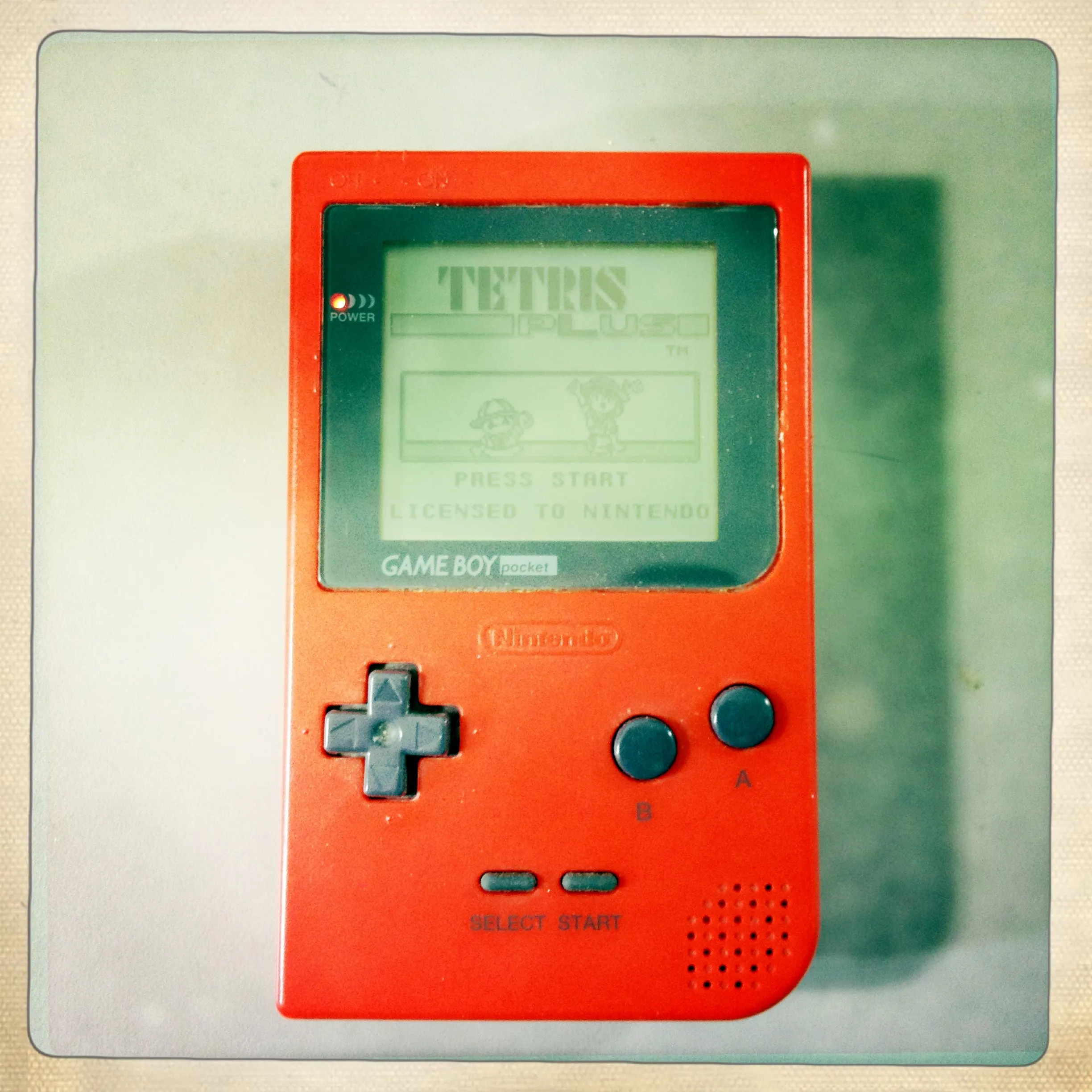
When the Game Boy first came out, I was infatuated with Tetris, still a new disease to me.  I could spend any amount of money playing Tetris in 1989 or 1990, until I had nightmares about falling blocks and that stupid song stuck in my head.  So when the Target stores started putting display units of Game Boys chained to a glass countertop in the electronics department, I’d spend hours mashing that little grey cross and the two red buttons to drop tetronimos on its pea-green LED display.  I lusted after the Game Boy, even though I didn’t even have a home computer at the time, and if I had the money for Nintendo’s portable game system, I would’ve had half the money for a cheap Amiga.

There’s something pervasive about handheld game systems.  All through the 80s, the systems grew in complexity, starting with those addictive football games that were nothing but a series of rows of LEDs, or the Simon-type games, things that just beeped and bleeped to get you to mash buttons and eat through nine-volt batteries, spending more of your time learning how to put the two terminals of a square battery on your tongue to gauge how much juice it still contained.  I had a few of these games, like this D&D game where you had to move through a maze and not get clobbered by these little LCD sprites, something I got for $20 and played the hell out of until it became boring.  I enjoyed the games, but the cost proposition was too high to fully embrace the format.

But there was always something intimate about the little pocket games, like a secret drug addiction you could slip into and avoid life.  The console systems, the pongs and 2600s and NESes, always seemed a more public affliction, something you’d set up in your living room and inflict on the entire family.  Maybe it’s because they involved a TV set, and this was a time when there were more American homes than TV sets.  But the pocket systems involved a personal closeness, something that was instantly on, always there, a tiny screen only you could see.

The mixed curse to these is they only played one game.  When you got the pocket Space Invaders game, it only played Space Invaders.  Sometimes, you could toggle a switch to get a different difficulty, or change your tennis game to play handball instead, but the units were almost entirely dedicated to that single pursuit.  A huge advantage to that is every game had its own controls, its own button layout and size and feel and placement and color.  When you played the aforementioned Space Invaders game, those buttons, along with the unique display elements, the custom LED or LCD panel, were your direct connection to that game; your pocket Pac Man or handheld Galaga had a completely different set of controls and look and feel, and was a different drug entirely.

(That’s my chief complaint about the Kindle.  I love it, and use it when I travel, but I don’t like that every book has essentially the same look and feel because I’m reading it on the same sized screen and holding the same exact weight in my hand and pressing the same exact buttons, regardless of author or title.  When I read a paper copy of a Philip K. Dick book, the binding and size and font and smell of the pages dictate a completely different experience than when I’m reading Freakanomics. But on the Kindle, there’s some latent similarity in the experience, which bothers me.)

Of course, the big advantage to a one-system-plays-all approach like the Game Boy is that you bought one system, then bought a bunch of cartridges and had a whole library of titles to play.  Unfortunately, it never worked that way for me.  I got the Game Boy Pocket in 1996, a gift from my girlfriend at the time, something I could use to whittle away the hours while sitting in airports on a long and tortuous holiday trip back to Indiana.  The Pocket is an often-forgotten model, an incremental redesign of the original, smaller, using fewer batteries, but otherwise the same unit.  They quickly came out with a color unit, and I felt deceived in that way that happens when your top-of-the-line electronics purchase is suddenly old hat.

My first game purchase was, of course, Tetris plus, a version of the original Russian plague with some additions, like if you cleared special bonus blocks, you could drop bombs and blow up pieces.  I played the living shit out of that cartridge.  The Pocket used dual AAA batteries, good for ten hours at a clip, and I went through many sets of Duracells for that machine. I spent late nights seized by writer’s block, sitting in bed in the darkness, a single halogen nightstand light trained on the not-backlit LED screen, trying to beat my high score on the little red plastic box.  I didn’t have a home video game system, and this was long before phones with games, so this was a unique addiction to me.

But I couldn’t really find any other games as prevailing as Tetris.  I think I bought one or two new cartridges, including a Star Wars platform game with horrible graphics; I got stalled trying to navigate through the Death Star and couldn’t go any further.  I also went to my favorite used record store in Seattle on University, and went through their stack of loose and book-less cartridges, trying to find anything interesting.   I found a Boggle game, which was completely useless with no keyboard, and a Mahjongg game which caused migraines because the tiles were so unreadable on the low-resolution screen.  For whatever reason, Tetris was not only the killer app for the system; it was the only app.  Everything else was either too graphics-intensive or needed more CPU or didn’t work well on a cartridge or begged for network connectivity or needed different controls.  Tetris was the One True App for the system.

Nintendo has gone through two major iterations (GBA, DS) and many minor upgrades of the system, and I never got onboard with any of them, although there were moments, usually during fire sales of obsolete systems or fits of extreme boredom stuck in airports, that I considered it.  But then the Palm came along, and now phones can play games almost as well as the handheld systems.  This is ultimately Nintendo’s doom, just like how the emergence of home computers killed dedicated video game systems in the 80s.  Why spend hundreds on an Atari 5200 and an Atari 800 when you can get an Atari 800 and play games plus “learn computers” and do educational stuff? Never mind that the 800’s games were a slight step behind the 5200’s, or that 99% of the people never did any educational shit on home computers, regardless of the huge revolution that was promised back then.

It’s the same way now.  Why buy a Nintendo 3DS for $200 and then buy a laptop or iPad for “educational” stuff, when you could just buy the tablet or PC, and play Angry Birds on that?  There are several minor holes to shoot in that argument - I think the MSRP on a 3DS got dropped for the holidays; the 3DS is a better “true” game machine and has better tactile buttons and 3D technology blah blah blah.  But parents don’t shop for toys based on vertex performance of the GPU; they go on groupthink, and that says that if you buy your kid an iPad, they will “learn computers” and become a genius, case closed.

But there’s something about that tactile relationship to the Game Boy or the older pocket games that Nintendo could exploit, and I don’t know how.  Maybe Nintendo will need to fail, maybe there’s a need for a huge video game crash like 1984 all over again, and another company will have to rise from the ashes to convince people that something other than Farmville is the future to gaming.  But what will that be?