The Wrath of Kon

Dispatches, thoughts, and miscellanea from writer Jon Konrath

July 2012

The Feel of a Book

I really do wish I could switch to an all-digital book library, buy every print book in this house in some e-book format, and haul all of this shit to the goodwill, or sell it in the Amazon used section.  Someday, books will kill me, and I’m not talking about being buried alive via hoarding.  I mean, these books are all collecting dust mites, and I’m horribly allergic to dust mites, and I’m sure ten out of ten allergists would tell me, “well, just get rid of all of your books and watch more TV.”  And of course, 87% of the books I have here aren’t available on the Kindle, and even if they were, the second I’d buy all of them, they’d change the Kindle format to some incompatible thing and force me to re-buy everything, just like the whole vinyl > 8-Track > Cassette > CD > MiniDisc > DVD > BluRay > whatever trail of tears.

I tried remembering when my whole relationship with books started, and of course, I can’t.  My parents started buying me books before I can remember, those “I Can Read” books like Danny and the Dinosaur that you got from the grocery store or some mail-order club.  I remember being in the Weekly Reader book club, getting these corrugated cardboard mailers every week or two, containing another few hardcover books, each one getting progressively more advanced.  I thankfully learned to read before I started school.  I lived in a tiny village in Michigan with no kids as neighbors, in an age before cable, when an endless amount of adjustment to a set of rabbit ears got you four or maybe five channels of TV, so those books were my lifeline.

In thinking about this, I think one of the reasons I like to collect books is their physicality.  I’ve still got a couple of these Weekly Reader books, from almost forty years ago, and I loved the oil paintings in color on the cloth-bound hardcovers, a square spine and a design that is obviously very pre-Photoshop. Some books had spine lettering faintly embossed in a metallic gold color, and looked distinguished and official.  Some were paperbacks, the Choose Your Own Adventures and Encyclopedia Browns and pocket editions that felt the perfect size in your hand.  I devoured all of these books, and no matter how many of them showed up in our rural route mailbox, I always wanted more.

I always got locked into these series books, things like junior encyclopedia, where they’d sell the first volume at Kroger and then swindle you into mailing away for the next twenty.  I remember this junior history series I had, an endless collection of books on American events like the construction of the White House or the battle of Iwo Jima.  My parents would sometimes go to a friend’s house to play euchre, plop us in front of a TV in their living room, and hope we’d fall asleep eventually.  I would always drag along a huge collection of these books, so that instead of watching a Love Boat re-run, I could read the illustrated history of the Washington Monument or the D-Day invasion.  And I would always have to bring an entire armload of them, partly because I felt a need to always have access to every volume (this predates Wikipedia by a few decades) but also because I enjoyed the physical feeling of having all of these books, the weight and feel of these perfectly square books filled with illustrations and maps and pages that smelled like fresh paper and ink.

I always wonder about this with kids that are being born right now and handed an iPad thirty seconds after they leave the womb.  There’s something magical about being able to zap an animated book filled with background music and hyperlinks to your kid, but are they missing something by not having an actual, physical book in their hands?  A device that plays Angry Birds and shows videos is pretty cool, but do you miss out on something that you get by hoarding these little bits of dead tree?

I do like loading up my Kindle with books before I get on a plane.  And most of the books I sell are on the Kindle.  But it doesn’t feel like I’ve “bought” a book unless I have it sitting on a shelf, and I like the physical rituals of either going to stores or having a delivery person hand me a cardboard mailer filled with books.  I also don’t like that I always hold the same device when I’m reading different books, the same size and weight and thickness, and I’m even deduced to the same exact font and margins. I’m not pro- or anti- on the e-book, but it makes me hesitate before I buy anything, and I end up purchasing the best stuff twice.  I can’t seem to fully jump on either bandwagon, which means I probably will either be buying a spacesuit to keep out the dust mites, or googling away to find clinical trials of some new steroid treatment to keep my eyes from swelling shut.
The Loudness War

The loudness war is a weird k-hole I recently fell into, trying to find out more information about a Stooges remaster.  Let me explain.

Okay, have you ever owned some album, and listened to a song a million times, and then heard the same song on an FM radio and it somehow sounded different?  It was probably because the station used dynamic range compression in their outbound rig.  Here’s my best attempt at a no-math explanation of compression.  Let’s say a sound wave is a bunch of waves, ranging in strength from 0 to 11.  (I was going to say 10, but, Spinal Tap.)  So a song, in some greatly simplified form, would be something like this:  “0 8 11 8 10 2 3 7 7 8 11 0 10 7 2 4”.  If you wanted to make the song sound way louder, the obvious way to do it would be to change that to “0 16 22 16 20…” and so on, but 11 is the most you can get.  But what you can do is boost the lower numbers, and keep the higher numbers the same, and the song will “seem” louder.  So, you’d run it through some magic digital box and it would change to something like “0 8.5 11 8.5 10 7 7.2 8 8 8.5 11 0 10 8.5 7” or whatever.  It basically smooshes the lower end frequencies, and makes the song seem louder at the same volume, although this sacrifices some of the sound quality, which isn’t as big of a concern when you’re just schlepping pop music across the airwaves and you want your station to get the most attention when someone is flipping through channels.

The loudness war started back in the days of jukeboxes, because you the consumer can’t change the volume on a jukebox, and everyone wanted their 45 record to sound the loudest.  On a digital CD, that magic number 11 I mentioned above is called “full scale”, or the point where signal has reached as much as it can go.  A measurement called dBFS, or decibels relative to full scale, is used to measure levels, where -6 dBFS is 50% of full scale.  Most albums were mastered with -14dBFS being used as the highest peak level of the album, or what used to be the “red zone” of an analog record.

At some point in the 90s, the thinking changed on this, probably around the time record companies started re-releasing old albums, so if you bought that Iron Maiden album on CD in 1988, you suddenly had to buy the remastered version in 1996.  Yes, they would fiddle with bonus tracks and new artwork a fake gold CD and yes Ray, they included that fourth side of the Live After Death album you bitched about for twenty years, but they also fiddled with the mastering so the “hotter” album would make the old master sound wimpy.  And new albums started getting massively over-compressed in this loudness arms race.

I started googling all of this because of the 1996 Columbia remaster of the Stooges album Raw Power.  When recorded in 1972, Iggy Pop did the initial mastering himself, and through the magic of heroin, decided to put all of the instruments on one side and the vocals on the other, and do all kinds of weird shit with the tone.  The record company refused to release it unless it was remixed, and got David Bowie to spend a single day in a crappy studio, getting the album to sound mostly normal.  For the 1996 re-release, they gave Iggy free reign to go back and remaster the album, and his response, in an attempt to bring back the raw aggression of the original recording, was to completely turn every knob to 11.

I don’t know if this is still the case, but when I bought the 1996 remaster on CD (back when people bought CDs), it had a huge warning label on it, saying the CD did not meet the Phillips Red Book standard and could destroy your equipment.  I thought that was cool, threw it in the player, and set my volume at something marginal, like 5 out of 10.  “Search and Destroy” came on, and it sounded like someone had replaced my speakers with those paper-cone things you got with the stock Delco stereo on the AM radio of a 1981 Chevette, except with pencils jabbed through them.  Within ten seconds, my receiver SHUT OFF with a strange error message on the display, and I had to unplug it from the power, wait the longest 60 seconds of my life before restarting it, almost certain I’d bricked my stereo.  I was only able to listen to the CD by ripping a copy to MP3 first, which I guess just clipped the hell out of it in the computer’s digital-to-analog conversion.  Still a great album, though.

Another Stooges fun fact:  if you really like the album Fun House, you can go over to iTunes and pick up a complete collection of everything they recorded for the album.  It’s a 142-track “album” that contains every take of every song, plus all of the studio dialogue recorded - basically everything that ran through the sound board back in 1970.  At $99.99, it’s definitely in the “do not accidentally click purchase” category for iTunes.  I haven’t bought it - I think if it was $30, I would be tempted, but I know I would only listen to it once or twice.

Listicles Are A Window Into The Soul

I am stuck in that “what do I post here” mode lately, so it’s time for another big long list of random stuff.

  • I’ve been re-reading Douglas Coupland’s Microserfs, a book I think I haven’t read since 1995.  It has not aged well, for two reasons.  One is that the technology is obviously obsolete.  It talks about using a modem to dial into the Information Superhighway; the main character calls a travel agent to buy a plane ticket; people still use fax machines; Microsoft releases products people buy.  The other is that in 1993, a peek into the working day at Microsoft was revolutionary to straight America.  Now, every company from here to Kansas has tried to replicate their corporate culture, so much so that it’s incredibly cliche to have free soft drinks and ask interview candidates why manhole covers are round.  It’s still an okay read though, although it’s more of a glimpse into the distant past for me.
  • Two new donor Commodore 64s arrived via UPS today.  Both are missing a couple of keys; one is missing a couple of chips.  I plan on building a computer inside of a C-64 case, ala the x64, but for several hundred dollars less.
  • Allergy season is full tilt right now, and I’m contemplating a move to northern Alaska.  It’s been almost two years of allergy shots with very little improvement, plus my allergy clinic is dropping my insurance this fall, so I’ll need to find a new one.  I don’t know if switching doctors and trying something more drastic will help.  I’ve already tried OTC meds, prescription eye drops, nasal spray, inhalers, and pills, acupuncture, and allergy shots.  I’m thinking if there’s a stem cell therapy treatment, I’d be willing to sink five or ten grand into trying it.
  • I have not been watching baseball this year.  The Rockies have something like a dozen position players on the DL right now.  I heard the other night, one of their backup infielders went on the disabled list because of an infection he got from his watch.
  • I haven’t been writing much since the last book came out.  This is always the most depressing time for me, and it takes a lot of effort to get a good idea percolating, which is where I’m at.
  • I helped my brother-in-law buy a new TV the other day, and we went to Best Buy to look at their selection.  That place is seriously circling the drain.  There was almost nobody there on a Sunday afternoon, and their TV selection was worse than what they had at Target.  They were also fiercely pushing their “TV calibration” service, which as far as I could tell, involved paying hundreds of dollars to have a high-school dropout set the brightness and contrast on your new set.  Do people seriously pay for this?
  • I went through all of my old books and pulled all of the bookmarks out of them.  I usually use business cards, but I extricated this stack of store bookmarks (Elliott Bay, Morgensterns, Title Wave in Anchorage, Coliseum) and a bunch of receipts and bank slips, some of which were humorous.  Like I found a grocery receipt from Mr. D’s groceries in Bloomington from 1994 that was nothing but candy bars, TV dinners, and beer.
  • I have somehow become addicted to the show Friday Night Lights.  These things would not happen if it were not for Netflix streaming.
  • I am trying to avoid Benadryl, because it messes with my sleep schedule too much.  I don’t dream correctly when I take it, and then I’m hung over the next day.  I’m taking Allegra instead, although it doesn’t knock it out as well.

OK, that’s all for now.

Snowcone and Haystack

I didn’t remember it until this morning, but today is the anniversary of the first moon landing.  It’s hard to imagine it was 42 years ago (mostly because I was -1 years old at the time) but it’s also hard to fathom that it’s been something like 33 years since Skylab fell back to Earth, and I actually remember that one happening.

Space exploration in general is a huge k-hole for me, and I can burn up unlimited amounts of time by googling the Apollo missions or the Mir space station or the Space Shuttle.  I got knocked back into this last weekend, because we saw Apollo 13 at the Paramount Theater, and that got me thinking and reading Wikipedia and researching how exactly that tank explosion happened and who was originally supposed to fly that mission and all that.

A great lull in manned space flight, at least from the US perspective, happened when I was a child.  The last Apollo mission happened in 1975, with the Apollo-Soyuz test project. I was four then, and shortly after was when I got into space exploration trivia and started poring over encyclopedias and searching every garage sale for one of those GI Joe Mercury capsules.  The US didn’t fly into space again for six years, and it seemed like back then, the Soviets were sending up guys every other week, and keeping them in orbit for weeks and months at a time.  I couldn’t confirm this though, with a lack of internet connectivity and an impenetrable Iron Curtain preventing the free flow of information on the Russian space program.  There were those Mars probes, and Voyager and other unmanned stuff, but aside from an occasional reference on a PBS program, this stuff got almost no mention in our Indiana newspaper.

That meant that before they sent up the first Space Shuttle, I memorized everything I could find on Apollo.  I knew about Apollo 13 before there was a Tom Hanks movie on it; I could tell you about the 1967 pad fire, and explain translunar injection, and tell you all about lunar landers and lunar rovers and lunar life support backpacks and lunar samples and how Wally Schirra was a lunar asshole when he got sick on Apollo 7.

The technology of the Apollo program amazed me as a kid, because it seemed like the future, like we’d be going back to the moon any time now, that the Space Shuttle program would flourish, and they’d start cranking those things out like Boeing puts out 737s, until pretty much everyone hitched a ride into space like most of us have flown an MD-80 from one regional airport to another.  In the 70s, computers were rapidly getting smaller, and it only seemed logical that we’d all be astronauts in a couple of decades.

Now, Apollo seems astounding to me because it was so low-tech.  The computer they carried in the command module and lunar module had roughly the same amount of processing power and memory as an Atari 400.  (Luckily, it had a better keyboard.)  The command module talked to the Earth at a fast rate of about 50 kilobits/second.  And not only were all of those checklists analog printed material (this was long before the iPad could have made them obsolete), a lot of the calculations done by the crew were made with an analog computer, aka a slide rule.  I’ve seen a couple of the command modules at museums, and the interiors resemble a low-end Volkswagen from the 70s more than a high-tech interplanetary space vehicle.  It’s simply amazing that people would climb into these tin buckets, strap on a million horsepower of explosive rocket power, and aim for the moon.

It’s also odd to me that thirty years after sitting on the floor of my grade-school library poring over every book about space, I’m now just a couple of miles from Alameda, which is now home to the USS Hornet.  When Apollo 11 returned and splashed down in the Pacific, the Hornet picked up the crew and capsule, and then quickly ushered them off into a converted Airstream trailer, where they sat in quarantine for 21 days, to make sure they weren’t carrying any moon viruses.  I’ve been to the Hornet a few times; the trailer is still there, as is an early test capsule and lots of patches, photos, and other assorted stuff from the program.

Now we’re back in one of those lulls.  There’s no Space Shuttle, and I guess there’s people going up to the ISS on Russian rockets.  There’s also China’s space program, which has been successful as of late. But it feels like it did back when America didn’t really have a space program, except this time, there’s no Shuttle plans in the future to look forward to. There’s a lot of talk about privatized space travel, and maybe that will be the future, but I probably won’t be driving out to SFO and buying a ticket on Delta to go into low earth orbit.

Oh well.  Maybe I can scrape together my cash and try to build a working rocket for one of those GI Joe capsules, like this guy did.  I see much eBay sniping in my future.

Calculator K-Hole

smd10882

Something I sometimes do when I don’t have time to waste but still want to lock into some useless pursuit that will eat up hours is to try and find various things I owned as a kid.  The other day, I started thinking about old calculators, and went on an endless search to find some of the ones I used in high school and college.

It’s odd to even think about a time when people used calculators.  Now, when I want to figure out if an actress is 18 yet by subtracting her date of birth from the current year, I either use the calculator app on my computer or my phone.  I also have an actual four-function solar calculator I stole from my job’s office supply closet in maybe 1996, which was useful when I used to balance my checkbook, back when I actually wrote checks and couldn’t just look the crap up on my phone.  But the calculator on my iPhone is generally easier to use, and I know where it is at any given point.

I recently had a discussion with my sister about old calculators.  When we grew up, our parents had some old TI calculator, from maybe 1975, which had a hundred buttons and a flickering red LCD display and took a giant 9-volt battery.  We had no idea what TAN or SIN meant, so we’d randomly hit the buttons, trying to get the machine to print out some cool stuff.  We also had one of those Little Professor calculators, which had a face on the front of it (which always looked like an owl to me) and would print an equation like “7 + 9” and then wait for an answer, printing EEE when you entered an incorrect answer.

Calculators weren’t allowed in school for years, because when you’re supposed to be learning how to multiply single-digit numbers, a pocket calculator was as unfair as having a multiplication table in your hand, if not worse.  And then when I got to high school, this completely reversed, and some classes required you to have a calculator.  In a physics or trig class, the ability to quickly multiply and divide was a requirement, and we were suddenly allowed to use these electronic devices.

Something I never thought about, though: I was probably the first generation to have this luxury. When I was born in 1971, the first solid-state calculators were being manufactured.  In 1965, Sharp introduced the CS-10 calculator, which weighed 55 pounds and cost $2500.  By the end of the decade, they were fitting in shirt pockets (like those big Android phones “fit” in a pocket) and cost more like $500.  When I started grade school, you could probably get a good four-function calculator for $50, but minimum wage was also something like $1.60.  Prior to my generation, the only way you could “cheat” on math was maybe writing the answers down beforehand, or using a slide rule, which was probably more difficult than just memorizing stuff.  When I started high school, did they change lesson plans to accommodate the ubiquitousness of digital calculators, or did math suck that much more before then?

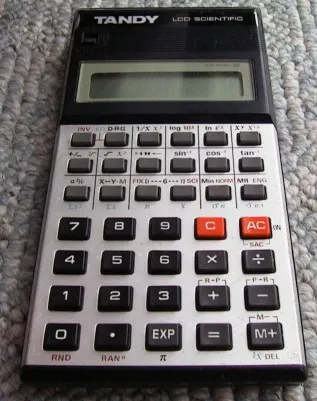
I took an electronics class in my freshman year, and we were told to buy a scientific calculator.  I don’t remember the requirements we were given, but I know it was something beyond the level of the crappy calculator you’d get for free at a Shell station with the purchase of a tank of premium.  I got a Radio Shack EC-4006, which at the time was a pretty amazing machine.  It ran on two AA batteries, and had a ten-digit display.  It could convert hex to decimal and display (some) letters on the screen, plus it handled negative numbers, trig functions, and had some amount of basic programmability.

What I remembered most about calculators back then was nobody had the same make and model.  There were dozens of different permutations of the basic calculator from TI, Casio, Radio Shack, Sharp, and lots of no-name or knockoff brands.  The cream of the crop was the HP, which were incredibly expensive and used RPN.  Someone in my class had one of these, and it looked nice, but I could never get the hang of entering all of the numbers and then entering an operator.  I also remember Ray having some high-end Radio Shack that unfolded and had the display and main keys on one side, and a set of advanced function keys in the inside lid.  Any time anybody touched it, he gave a twenty minute lecture about how you weren’t supposed to bend open the cover all the way, or it would stretch and break the microscopic conductive traces between the two halves.  (This meant that everyone would try to take his calculator when he wasn’t looking and vigorously fold open the cover as far as it would go.)  But we were all, in some sense, defined by the calculators we used and carried.  Some of us took great pride in the calculators we used, while others were ashamed of their hand-me-down crappy drugstore ripoff version that couldn’t even do exponents.

I think I kept the same calculator until my second year of college, when I replaced it with this Casio graphing calculator, the fx-7000G.  I still have that one in storage, although I don’t have batteries for it.  (It used flat watch batteries.)  That one had a 96x94 pixel screen and could be programmed in a crappy version of BASIC, although it had a whopping 422 bytes of memory.  I remember spending the Christmas of 1990 at my then-girlfriend’s parents’ place in Toledo, trying to write a chess game in BASIC on that thing, which of course was impossible, as was actually saving anything with no disk drive or printer.  My math career didn’t last much longer than that year, and I never had a good reason to carry around a graphing calculator, so I didn’t use it after that.

What’s astounding to me is how familiar the key layout of that Radio Shack calculator looks to me now.  I carried that thing around for years in my book bag, toiled away on those chicklet-style keys, and spent many a boring lecture trying to spell out 7734-derived numeric sequences that, when the display was flipped, would spell out words.  The layout of those grey and orange keys is burned into my head, and reminds me instantly of when I was hacking out story problems back in 1987.

What’s also amazing is how collectible some of the old calculators can be.  I was looking to see if I could score one of those old HP calculators on eBay, and even the most basic of the RPN scientific calculators are untouchable for under a sixty or eighty bucks.  HP, after twenty years of not releasing them, brought them back in limited editions, and you can get a brand new HP 15C for about $99.  There are scores of web sites with pictures of old eighties calculators, just like the obsolete computer museums you find online.  I don’t foresee myself doing anything more complicated than calculating interest on a loan, and it’s probably easier to use one of those online calculators for that, so I probably won’t be buying one.  But it’s neat to see that people are still into it.