The Wrath of Kon

Dispatches, thoughts, and miscellanea from writer Jon Konrath

June 2011

My new book, Fistful of Pizza, is available now

cover

I am happy to announce that my new book, Fistful of Pizza, is now available at the following places:

  • On the Kindle for only 99 cents here.
  • In print at Lulu.com for $8.74 here.
  • In print at Amazon.com for $12.99 here.

Here’s the answers to some questions about this:

What is it?

Fistful of Pizza is a collection of short stories and flash fiction including ten pieces that have appeared in other publications and were otherwise unavailable until now.  I wanted to make the book as cheap as possible; actually, I wanted to make it free on the Kindle, but I can’t do that because I’m not a big publisher, so instead it’s the cheapest price they will let me.

What if I think the Kindle is stupid?

I also did a print version, which is a 150-page pocket-sized book.  Feel free to read it on the beach or lend it to your friends or drop it in the tub or burn it or do any of the other things that people who complain about the Kindle say you can’t do with the Kindle.

Why is the print version so expensive?

Because of the whole tree thing.  I could do what big publishers do and make the eBook version cost $8.74, or do what the biggest publishers do and make the print book $8.74 and the eBook $21.99.  $8.74 was about the cheapest I could go on lulu.

Can I get a preview?

If you have a Kindle, or have a PC/Mac/tablet/phone with the Kindle software, you can get a preview of the book for free.  Go to the Amazon page here and click on the Send Sample Now button.  This will send the cover and the first two and a half stories to you.

Does this include that one story where the guy flies a jet into a Wal-Mart in order to obtain an erection?

Yes, it does.

Why does the print version cost more on Amazon?

Because Amazon hates you.

Is this book suitable for my kid?

Any book is a children’s book if you teach your kid to read early enough.  Whether or not your child should read a book in which Richard Nixon pisses into someone’s gunshot wound is really your call, though.

What is a pocket book?

It’s a 4.3 x 6.9” book.  It’s roughly the size of one of those drug store paperback books.  I think it’s a neat size and have wanted to do one of these for a bit.  I have no idea why it’s that exact size; it probably has something to do with a fraction of a standard size of sheep used for its skin in England or something stupid like that.

What 19th-century French civil engineer who specialized in hydraulics is one of the 72 names inscribed on the Eiffel Tower?

Jacques Antoine Charles Bresse.  It’s the fifth from the left on the northwest side.

Why is there a picture of you sodomizing a wax figure of Tiger Woods on the last page of the book?

The Sean Connery figure was out for maintenance at the time.

I’ve been your pal forever and would really like a copy of this book for free.  Can you give it to me?

If you drop me a line and tell me how you’ll help me sell copies to all your friends, sure.

Thanks for the support, and I hope you get a chance to read the book!

Random bitching about Lulu, and why print is dead

4.25x6.87_Front_EN

I am publishing a book of short stories momentarily.  [Edit: I just did.  Go here to check it out.] The initial thought was to pull together a bunch of the stories I’d published elsewhere, and make a nice little 99 cent download on the Kindle.  And I’d make that a free download on the Kindle, but you can only do that if you’re a publisher, and even though Bowker thinks I’m a publisher, Amazon doesn’t.  Fair enough.  But I also have this strange affinity for dead trees, and I gauge my success as a writer by the number of books on the Konrath shelf of my library, so I wanted another volume in there.  Also, enough luddite contrarians have bitched about my last eBook release that I thought I’d throw you all a bone and do a print version, too.

So I just switched to using Lightning Source for print-on-demand.  But that costs money in setup fees, and I didn’t want to pay a ton up front and then have to spend the next three months hustling copies to break even, especially if the print edition wasn’t my target in the first place.  So I decided to go back to lulu for this one.  And man, I forgot how much I hate lulu.

Here’s a list of the various annoyances I had putting this one together:

  • First of all, Lulu’s web site sucks.  It took me roughly 20,000 clicks to find out how their ISBN/distribution options worked, and each page load takes as much time as it took me to download those Cindy Crawford Playboy GIFs back in 1996 on my 14.4Kbps modem.  They could solve all of this with the one-two punch of some content delivery network like Akamai and a real CMS like Jive.  But they won’t.
  • There’s always the decision between a one-piece and a three-piece cover.  Their new three-piece cover wizard is garbage, but they’re honest enough to almost cop to this and give you the option of using their old wizard.  With that, you can just upload PNGs of the front and the back cover and be done with it.  What you can’t do is upload an image of the spine, which means you’re stuck with their fonts on the spine, and you can’t do something like put your publisher logo on there.  I get it, the spine thickness varies, but you know the number of pages and thickness, so why not just tell me, “upload an image that’s x by y pixels” and let me do it?  So I decided to do a one-piece cover, which I’ve never done before with Lulu.
  • If you do a three-piece cover, they give you templates for the front and back cover, and they have guides for the bleed and trim and usable space and all that jazz.  If you do a one-piece cover, they give you vague instructions of what pixel rows and columns these are.  So yeah, I took 9th grade geometry and can figure this out, but it would be much nicer to have a solid PSD template with all of this predefined to make sure I don’t screw it up.
  • There are two fundamental changes in this book over the others I’ve done on Lulu: I’m using Scrivener for the source, and I’m doing a pocket book, which is an oddball size, or at least not 6x9.  And I struggled on how to get this laid out correctly.  I normally would use FrameMaker to belt out a 6x9 book, and maybe export the Scrivener into RTF and paste it in and go.  So I designed a 4.25” x 6.88” book in Frame, but could not figure out a way to get the Scrivener-generated RTF into Frame without losing all of the character-level markup, like italics and bold.  The problem is, Scrivener doesn’t export those as character styles, they do it as font property changes.  So when I exported, pasted, and changed the fonts, I lost all of the character style stuff.  Which means I had to, ugh, I don’t even want to say it…
  • I ended up using Word to lay out the inside of the book.  Word is not a publishing platform; anything longer and more complex than a grocery list in Word quickly becomes a world of hurt.  But lulu has a template for Word for their pocket book format, so after some gymnastics with pasting the Scrivener RTF into a third Word document to knock it down and strip out half of the font stuff, I got it into Word.  I then spent the next seven hours trying to figure out how the hell to get the page numbering and section breaks and paragraph styles and everything else to behave.
  • There’s also this issue that Mac-produced PDF may or may not work with Lulu.  Of course, there’s no information about this on the Lulu site, or if there is, it’s buried and mixed together with out-of-date information from 2004.  You can do a google search on it, but the top hits are wives’ tales from a half-decade ago, and very little solid information.  The Mac uses Quartz to produce PDF natively, and not Acrobat.  So it might embed fonts correctly, it might not.  And I’m using a weird font for headings, so that’s a big deal to me.
  • A site told me to download the actual capital-a Acrobat reader from Adobe, uncheck the “use local fonts” option, and look to see if all of my special fonts suddenly looked like Klingon.  They didn’t.  But, and this is much worse, I had to install an Adobe product on my system.  This means that even though I checked the box that said “DO NOT INSTALL THIS SHIT IN MY BROWSER YOU DOUCHEBAG”, the next time I opened up a PDF in Safari, it sat for a long Adobe minute, churned and beachballed, and I got the ugly Adobe bar and crap display.  And of course, now every time I get up from my computer to get a drink of water and come back, there’s a notice on my screen asking if I want to install the latest Acrobat update.
  • Okay, so now I’ve got a one-piece cover and a PDF.  I go to lulu, upload everything, and step one of the wizard says “do you want an ISBN?  you can totally add it later if you like.”  And I say no, add it later.  Rookie mistake.
  • I get all the crap in, and then order a proof copy.  $7.50 for a 150 page book; it would have been $2.85 to order it on Lightning Source.  But Lightning Source has the setup fees.  And they don’t have that wonderful cover wizard I avoided like the plague.
  • The worst part is $3.99 shipping on a $7.50 book for the slow-boat-to-China USPS shipping.  Amazon Prime has spoiled me.
  • So then I decide to add that ISBN like I mentioned.  One click done, right?  No.  There’s no option.  There’s no help.  There’s nothing, and I finally just say fuck it and delete the whole thing and start over to see why it won’t let me add it.
  • Turns out that if you do a one-piece cover, you have to select that ISBN option, download a bar code, and add it to your cover; it will only overlay the bar code if you did your cover with the wizard.  Fine, I’ll download it and add it.
  • I download the PDF of the bar code block.  Lulu insists on 300 dpi covers, which is par for the course, but this PDF is 72 dpi.  If you import it into a bitmap editing program like Pixelmator and jack it up to 300 dpi, it becomes all blurry.  I thought about just leaving it like that because, seriously, every brick and mortar bookstore with a scanner is going to be out of business by the time I get to step 5 of the wizard.  But I play nice and spend an hour fucking with this thing until I realize that GIMP handles EPS natively and let me easily blow up the size without distortion.  I think Photoshop does that too, but until one of you pals of mine with an educational discount sends me a $5 copy of CS5 for the Mac in exchange for a bunch of books in trade (hint), I don’t have Photoshop.
  • Click, click, click, and we get to pricing.  Um.  To make a long story short, I had to price the book at $12.49 retail so Lulu could pay the Amazon tax, then set a 30% discount on Lulu.  That means if you buy the book on Lulu (which nobody ever does, because of their shipping and that involves three clicks instead of one), it’s $8.74.  On Amazon, $12.49.  On Kindle, $.99.  BUT WHAT IF YOU DROP YOUR KINDLE IN THE BATHTUB?  WHAT IF YOU WANT TO BUY A USED COPY OF A BOOK?  WHAT IF BLAH BLAH DRM GEORGE ORWELL AMAZON IS HITLER GLGLGLGLGLGL.
  • I then had to order a second proof, so another $11.49 there.

OK, end of bitchfest.  More details on the book when I get a proof in the pony express mail, which will be in 5-244 days.

[Note: The book is done.  It’s called A Fistful of Pizza, so go read about it and check it out!]

Thoughts on a random picture: The Student Building

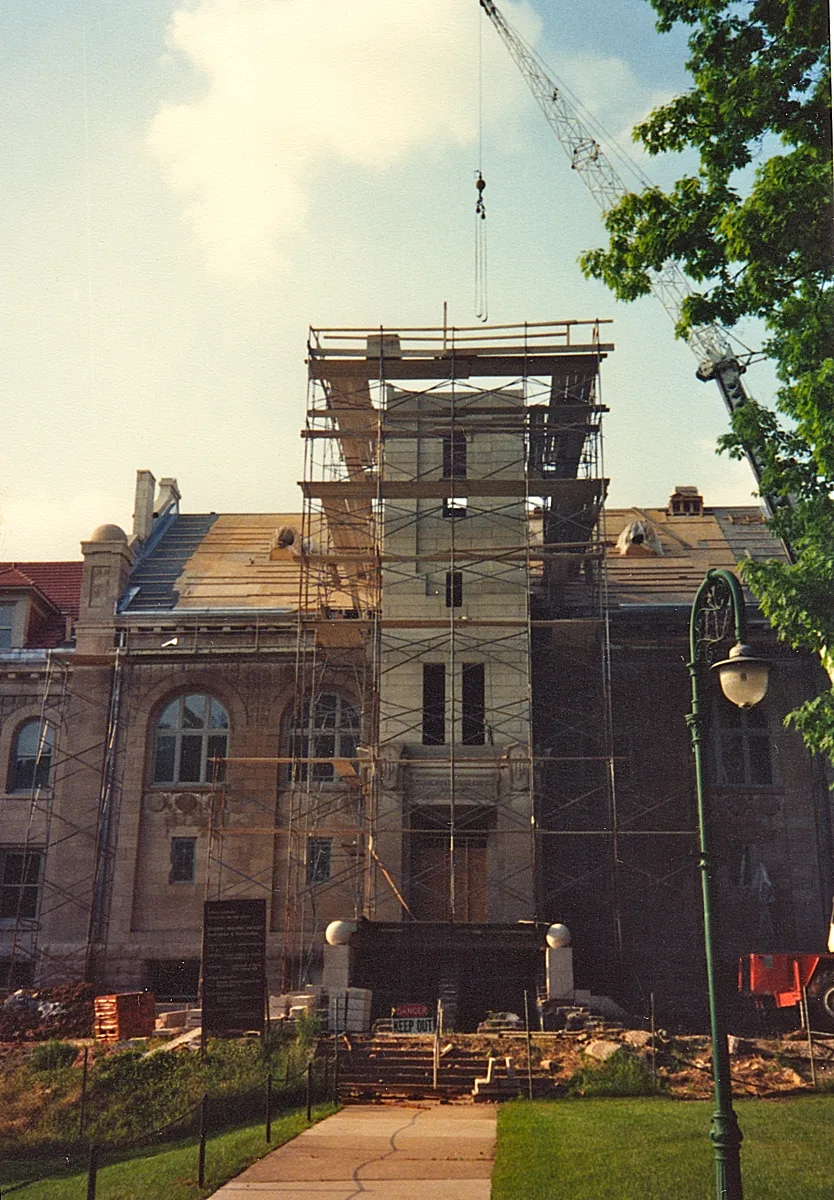
I went back to storage the other day and dug out two books of prints, most of which were unscanned.  There’s still at least one box of prints somewhere in there that I didn’t find, and I have no time to scan more of them, but here’s an interesting one I found.

student-building

This is the Student Building on the IU Bloomington campus.  I can easily date this as the summer of 1991, although that’s perplexing because I didn’t live in Bloomington that summer, and I didn’t own a camera then.  That means I must have been in town visiting the person Ray refers to as “the za chick” (long story) and I must have been using her camera.

The Student Building was a total shithole when I was a freshman.  I remember going there for a meeting with some alcohol counseling group.  I was a militant non-drinker as a freshman, which I now realize was stupid, and I probably just should have drank everything offered to me, if only to take the edge off of the unfurling mania that kept me awake for weeks at a time.  But I had some vague interest in finding out about this group that sponsored all of these non-drinking dances and whatnot, and I met with them once and then probably got bored of the whole thing and shifted obsessions to learning all of the bass lines from the first four Black Sabbath albums or whatever.

Anyway, the meeting was in the basement of the Student Building, and at that point in 1989, the place was practically on the verge of collapse, and looked like an East German department store in the mid-70s.  There were flickering fluorescent lights, dark passages, plywood over walls, wires hanging from ceilings, and cracking plaster everywhere.  I don’t remember thinking anything about whether or not the place should be restored or preserved; I’m sure I just thought “man all of these buildings are old… hey, there’s a new Steve Vai album I have to memorize…”

The renovations were underway on the 1905 building in late 1990 when there was an electrical fire that December and the place burned down.  I often say “electrical fire” because it was a strange coincidence that the iconic clocktower building was shut down and emptied and just happened to burn, probably collecting a huge insurance check and an even bigger inflow of contributions from alumni.  Even more amazing is the fact that it takes roughly 8 years to fix a pothole in Bloomington, but they had this thing from gutted and charred shell to completed construction in roughly nine months.

That summer, I lived in Elkhart, but started dating the aforementioned girl over the Memorial Day weekend (20 years ago - jesus christ) and I came down to visit pretty much every weekend I could.  I’d just bought this VW Rabbit diesel, which got something like 50 miles per gallon, and diesel was a dime a gallon cheaper than regular gas, so I could make the 500-mile round trip on ten bucks of gas.  I worked at this copper and brass pipe fitting factory on second shift, and would rush home at midnight on Friday, take a quick shower, then drive into the darkness, cutting across the state on US 31, pulling into Bloomington just as the sun rose.  I missed the Bloomington campus so much during my year of exile up north, and deeply cherished the brief 48-hour visits to see the old limestone buildings again.

By the time I returned to Bloomington in 1991, the Student Building was complete.  Most of the building belonged to the Anthropology department, but UCS outfitted most of the second floor with the latest computer toys, and I spent some time there when I couldn’t get a spot in the IMU or Lindley.  I didn’t work there much as a consultant (most of my shifts were in the Library the fall semester, and all of them were in the IMU that spring) but some of my friends like Bill did.  I always dug the interiors of that building: high ceilings, those giant curved windows, and massive wood trim everywhere.  They mixed that 1905 elegance with 1991 high-tech, with a whole room of NeXT workstations and color printers and flatbed scanners and dual-monitor Macs.

I remember spending a lot of time playing with this brand new program that just came out the year before, called Adobe Photoshop.  The 1.0 version was pretty rough, but let you take GIF images and alter them, changing colors and editing details and doing stuff that people used to do with razor blades and paint.  Today, every single picture we see online is photoshopped, but in 1991, this was still the stuff of science fiction.  Terminator 2 had just come out in theaters, and the idea of CGI and digital effects was brand spanking new, but here I was in the middle of Indiana, surrounded by machines that could do the same damn thing, free for me to use (provided some dork wasn’t parked there using a $10,o00 computer to chat on the VAXPhone to the person two rooms away.)

I spent a lot more time in the Student Building in the 1992-1993 school year.  I briefly had a second job with the UCS education department, helping teach the JumpStart classes, which were these free “WordPerfect in 60 minutes” sort of things.  They also taught these longer seminars on a fee basis to other departments, so if you needed all of your office workers in Parking Enforcement to learn DBase, you paid a few hundred bucks and sent everyone off to a three-hour class.  A lot of these were taught in the Student Building, probably because it was easier to reserve a block of computers for a half day.  I never taught these classes, but was always the assistant, meaning when someone fell behind during a lecture, I’d run up and guide them through the lesson.  I also did all of the pre-class stuff, like going around and wiping out and restarting Quattro Pro on 38 machines, or setting up template files from a server.  It wasn’t exactly my calling, but I was desperate for hours, and that gave me shifts.

The Student Building gradually lost that New Building Smell, and those cutting-edge NeXT machines quickly became boat anchors and eventually got replaced with a cluster of SGI workstations.  (“Wow!  These are the same computers they used to make Jurassic Park!”)  But that building, and all of the postcard-picture scenery in the old crescent of campus, always reminded me of that idealistic summer of 1991, when I so desperately wanted to be back, and the fall of 1991, when I finally made it.

10 things I learned from the Lemmy documentary

motorhead

I’ve been a fan of the band Motörhead for over 25 years now.  When I was a freshman in high school, I used to watch the British comedy show The Young Ones on MTV, when they used to show it late Sunday nights, and one week, this weird metal band came on that sounded cool as hell.  I asked my friend Ray about it, and he told me their lead singer Lemmy was god, and then proceeded to make me a dub of the No Remorse double album collection, which I promptly burned into my brain with roughly 40,000 repeat listens over the next few months.  Over the years, I’ve collected their albums, and although I’m not as militant about it as Ray, they’ve been one of the bands in a constant rotation in the player.

I heard about this documentary, simply called Lemmy, also the stage name of one Ian Kilmister.  He’s been the one constant member of the band since 1975, singing, playing bass, and writing songs.  I didn’t rush to the theater to see it, but I filed away a mental note to look for it when it came through on NetFlix or whatever, and it popped up on cable recently, so I DVRed it and got a chance to watch it last night.

I had mixed feelings about the movie.  It was executed well, and wasn’t just a typical rehash of everything I already knew about the guy, which was a huge plus.  But it was also somewhat depressing, because it showed this human side of the legend, and it was a somewhat sad scene of this guy who’s instantly recognizable, but ultimately alone.  I could write more about that, but I’d rather summarize the movie by mentioning the new things I learned that were shown by Greg Olliver and Wes Orshoski’s work.  Here goes.

1) Lemmy lives in a shithole

This is the most popular takeaway from the movie.  Most people think rock stars live in giant mansions, and that is reinforced by all of the reality TV showing guys like Ozzy in giant 29-bedroom castles with indoor basketball courts and gold-plated crappers.  In reality, Lemmy’s lived in this completely shitty two-bedroom apartment in West Hollywood for over twenty years, apparently never cleaning it during that time period.

Now, I’m not expecting him to rent some huge penthouse like P. Diddy would hang out in, with chrome-plated everything and an indoor swimming pool.  But seriously, when I lived in LA, my apartment was at least seven orders of magnitude nicer than this place.  It’s like a scene from a Bukowski book, with the two-burner range from 1947 and a metal sink that’s been painted white a thousand times since World War II.  The outside courtyard is not bad looking, but it’s that generic two-story apartment building you see all over Los Angeles, the kind that looks like a motel built in the 1950s and never renovated.

All of you who have lived in New York City are probably a step ahead of me on this one, by asking, “well, how much is he paying, though?”  LA is rent-controlled, meaning his rent can only go up 6% a year.  He mentioned he’s paying about $900 a month in rent for a two-bedroom, which isn’t bad for LA.  (A quick google shows that the average 2011 rent for an apartment that size is around $1700.  I paid more than that in 2008, but my old apartment compared to Lemmy’s is about like comparing the Bellagio to one of those downtown Vegas motels where you shoot a snuff film.)  Of course, if the stories are true that he drinks a fifth of Jack Daniel’s a day, he’s probably spending a grand a month on booze.

2) Lemmy is a hoarder

The shocking part of the footage of Lemmy’s apartment is that every square inch is filled with Stuff.  There’s the usual rock start stuff, like gold records, trophies, and plaques, but there are also tons of Motörhead items, like records, posters, license plates, stickers, action figures, and pretty much any other thing carrying his personal brand.  There’s also wall-to-wall randomness, video tapes and albums that are completely unrelated to him.  And this isn’t one of those OCD collections where everything is perfectly lined up on identical racks, in dust-proof, airtight mylar bags.  There’s stuff strewn around like a crime scene, things stacked on top of other things, shit everywhere.

One complication is that Lemmy’s not being whisked to gigs in hermetically sealed limousines with a team of bodyguards and handlers; he’ll talk to pretty much anyone who comes up to him, sign anything, and is infinitely approachable.  And he has legions of loyal fans.  That means he’s got people at every show giving him paintings and figurines and demo tapes and macrame Ace of Spades murals.  And he seems to hang onto all of this stuff, which is somewhat endearing, although at some point, I would have either rented a storage unit or opened a Motörhead-themed bar with all of the stuff in glass cases.  The man is in serious need of an archivist.

3) Lemmy is into a lot of non-metal music

The movie starts with Lemmy going to Amoeba Records (I used to go there!) in search of the mono version of the Beatles box set.  (And he’s correct: fuck the stereo mix; get the real deal.)  He talks about seeing the Beatles back when he was a teen in Liverpool, and also discusses his love of Little Richard during a couple of different conversations.  (Billy Bob Thornton and Dave Grohl, in two different bits, talk about meeting LR, and Lemmy enjoys those stories immensely.)

He also plays in a band called The Head Cat, which is a rockabilly supergroup with Slim Jim Phantom of the Stray Cats.  It is seriously surreal to see Lemmy, the guy usually belting out songs like “Killed by Death” and “Deaf Forever” knocking out the Carl Perkins song “Matchbox” while a bunch of old people dance at some random casino in upstate Wisconsin.  (Go here to listen to some of this.)

Henry Rollins (seriously, there are so many god damn appearances by people in this movie!) sums up the whole thing by mentioning that Lemmy was around before there was rock and roll; he grew up listening to Rosemary Clooney records, and then one day, these four kids from Liverpool and this hip-swaying dude from Memphis blew the doors wide open.  And it’s true that the best music ever is the first music you hear, the stuff you lock into when you’re a teenager, and for him, that isn’t the Sex Pistols or Elvis Costello or Velvet Underground; it’s Buddy Holly and Eddie Cochran and Johnny Cash.  I really dug the hell out of Lemmy being so into the classics like that; it shows that he loves music, and he’s not just into this to be another SKU number in a database.

4) Lemmy has diabetes

The movie shows Lemmy drinking, smoking, and eating fried foods.  It starts with a scene of him meticulously slicing potatoes into fries (he probably calls them chips) and deep frying them in a pan.  It doesn’t show him doing drugs, but implies that he does.  And then in a later scene, he’s taking some pills in a recording studio, and when the producer asks if they’re drugs or vitamins, he says they are medications for diabetes and blood pressure.

This shows the odd paradox that he’s like Keith Richards and Ozzy in the sense that he’s spent the last 50 years shoveling down all things bad for your body, with almost no tangible effect on his longevity or ability to churn out a new album every year and play in 200-some odd cities.  But it shows the twist to this, the human side, of a guy who’s well past the halfway mark and will someday soon be staring down the grim reaper.

This also conjures up strange images of Lemmy at a doctor’s office, paging through a years-old People magazine, waiting for an internist, who then asks him all of the typical questions about diet and exercise.  My health is not at Charles Atlas levels,  and I can’t go to a foot doctor about a hangnail without getting a prescription for Lipitor and a scathing 40-minute lecture about how I’m supposed to exercise 9 hours a day and eat less than 9 grams of fat a month.  I can’t imagine the dressing-down he must get every time he comes in to get his scripts refilled.

5) Lemmy practically lives at the Rainbow

One of the other reasons Lemmy’s got the shithole apartment is that it’s stumbling distance from the Rainbow Bar on the Sunset Strip.  And apparently, he’s always there, sitting at the bar playing one of those video trivia machines.  The Rainbow is a big rock hangout, and has been forever.  And you always hear about how back in the day, it was stylish for these non-music Hollywood types to make their token “I’m a bad boy” appearance there.  But you know how some dive bars always have that one creepy old guy that sits at the bar and stares at the wall for dozens of hours at a time, eating peanuts and nursing beer after beer?  Well, at the Rainbow, that guy is Lemmy.

6) Lemmy has a kid

He’s probably got more than one kid, but the movie features Paul Inder, who is his adult son.  He mentions that Paul’s mom Patricia was some kind of groupie who had dated John Lennon before she knew Lemmy, which is a pretty odd connection.

What’s strange is how close Lemmy appears to his son.  When he’s asked what his most valued thing in the apartment is, he says it’s Paul.  Although Lemmy apparently had never seen the kid for the first six years of his life, the two seem like the best of friends now.

7) Lemmy is obsessed with gambling

There’s a scene showing Lemmy parked at a slot machine, and someone talking about how he’d sit in front of the one-armed bandit all day, compulsively pulling the lever, over and over.  In fact, it’s rumored that he got the name Lemmy because he was always asking people “Lemme have a fiver” to pay off his gambling debts.

It’s a bit of a recurring theme; he’s either hunched over a gambling machine or a trivia game or a video game system at several points in the film.  It makes me think he’s got one of those OCD personalities where he gets locked into stuff like this and can’t put it down.  I sure hope he doesn’t get an iPhone with Angry Birds installed, or we may never see another new Motörhead album again.

8) Lemmy’s stepdad was a football player

I don’t think this was mentioned in the movie, but I was cruising wikipedia as I was watching and saw this.  His dad was an RAF chaplain and split when he was three months old, and he was largely raised by his mom and grandparents.  But when he was ten, his mom remarried to George Willis, who played soccer (football) for a decade or so in the 40s and 50s.

9) Lemmy roadied for Jimi Hendrix

He actually used to live with bassist Noel Redding, and roadied for the Experience back when they were London-based, in 1967-1968.  He tells a story about how he used to score drugs for Jimi, and he would take acid daily.

The story of him being a roadie also shows how much he loved music back as a teen.  When he couldn’t be the one making or playing the music, he was just has happy lugging gear for the people who did.

(Also not mentioned: Lemmy was also a roadie for The Nice, which was Keith Emerson’s band that was the forerunner to ELP.)

10) Lemmy is obsessed with Axe body spray

Maybe obsessed is a strong word, but there are multiple times that show him dousing himself with the stuff.  And it’s not just any cologne spray — the film is careful to display that it is specifically Axe body spray, the spray of the douches.  I’d expect the guys in Maroon 5 or Nickelback or something to be frequent users, but not Lemmy. He seems like the kind of guy who maybe uses some Old Spice (one of the original scents, not the new trendy crap), or just goes around reeking to high hell.  I’d expect him to smell like stale Marlboros, burned motor oil, and old leather, not Intense Phoenix or some shit.

Overall, this was an interesting movie.  I mean, the day-to-day stuff was a good look at the man’s life; the endless line of celebrities fawning over him got a little old, but emphasized the point of his importance in the metal world.  But like I said, it ultimately saddened me to some degree.  It made me hope he’s happy with what he does, because he’s not reaping huge financial or material rewards, and although he’s got a certain amount of respect and admiration, it’s not like he’s going to cross over and become known for anything other than being what he is.

The pros and cons of storage

IMG_0651

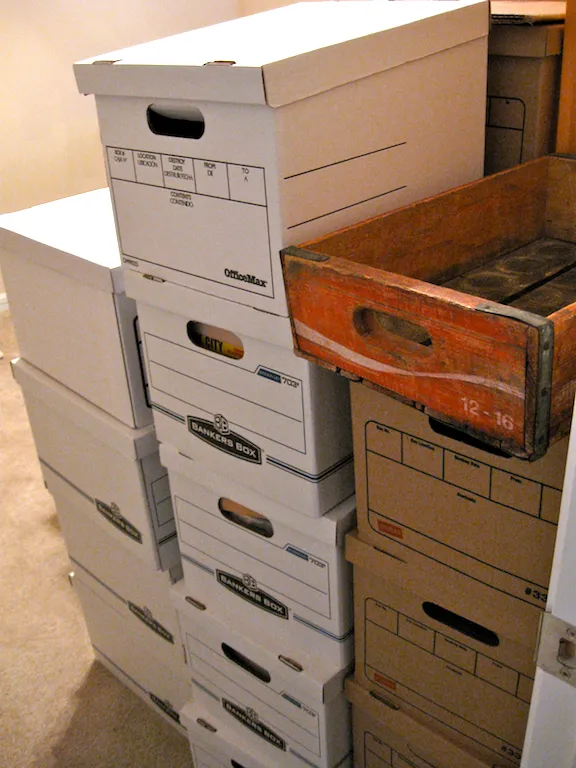
I went to my storage locker the other day, to drop off one of those plastic tupperware bins filled with old 8-bit computer pieces and a half-dozen MiniDisc players in varying states of decay.  I have this locker that’s about 4 by 8 feet and maybe five feet high, on the top floor of an ancient warehouse in our neighborhood, the kind of place that always reminds me of that scene in Indiana Jones where they file away the Ark of the Covenant in a crate in the secret government warehouse.  It has this smell to the place that reminds me of the smell deep within any large military watercraft, which I can’t really identify and is probably either the scent of infinite coats of lead paint or some government-strength rodenticide, either of which is probably eating away my brain as we speak.

Nobody I knew had storage spaces when I grew up.  That’s because everyone in Indiana had a basement and an attic, and both of those filled up with the overflow of holiday decorations and second refrigerators and unplayed board games and excess patio furniture.  If you lived in a trailer or in a house with a slab foundation, you’d get one of those Wal-Mart 10x8 metal sheds.  While I knew nobody in my childhood that itemized their taxes and needed to keep ten years of receipts in boxes, I knew plenty of borderline hoarders who absolutely needed to keep every limited-edition Long John Silver’s Joe Versus the Volcano collector’s cup, patiently awaiting the eventual invention of eBay to justify holding onto all of this crap.

Since graduating high school, I’ve moved 15 times, with four of those being cross-country or across a good chunk of the country.  Each time, my collection of various memorabilia gets compressed and rehashed, and I change my mind about just how important it is to keep zines I haven’t read since 1994 or printouts of rough drafts of books I’ve long ago published.  But from each era, some pieces still remain, and when I shift through these boxes and bins, there’s a pattern, like an archaeologist digging through layers of an old swamp to find fossils of a certain epoch.  I used to keep these crates in a closet or spare room, but when we moved to this open plan loft condo, I don’t have an area for this crap, which is why I rented the storage unit.

The main advantage to keeping this stuff off-site is it’s much harder for me to revisit it.  I have an entire internet’s worth of distractions to keep me from writing; having boxes of old high school journals and letters from college is pure danger for my work ethic.  I can easily open any of these boxes and waste infinite amounts of time getting nostalgic about some past period.  Now, I have to drive my car there during business hours, remember my code to get into the building (I always forget it, and have to look it up on my phone), and climb four flights of stairs in a non-air-conditioned building, which is enough of a deterrent that I only get over there a few times a year.

I generally think two things when I look at all of this old crap.  One, I have a lot of letters and I used to write and receive a ton of paper mail.  I don’t know the last time I got an actual piece of paper mail other than a bill, a greeting card, or some piece of paper spam because some douche got the public record of everyone who paid property tax in Oakland and blasted out a form letter disguised as a tax document.  It’s odd to think that people used to communicate through messages written on paper, and that this has been entirely replaced by electrons blasted across fiber optic cables.  I try not to dig through these too much, because it’s hard for me to read just one letter without reading all 8,732 letters I have in this plastic bin, and that gets depressing fast, especially knowing that at some point in maybe 1997 or 1998, this form of communication completely dried up for me.

The other thing is I have this container of old photos, and I always wish I would have taken more or better photos way back when.  Back in the days of film cameras, I’d maybe shoot a few 24-exposure rolls a year, because of the cost of film and developing.  There’s also the issue that I can see pictures now right after I take them, so I take way more of them, and if I screw one up, I can retake another one.  With film, if my finger was over the lens or the light wasn’t right, I wouldn’t know it for weeks or months.

When I was writing Summer Rain, I would have killed for a few dozen 1992-era photos of the Bloomington campus, or my old house on Mitchell Street, or some of the people I wrote about.  But I didn’t even own a camera then.  I have a couple of shots of the house as I was moving out, in 1993.  And I shot a few rolls of film that summer, some stuff of me and Ray at the Milwaukee Metalfest, and me and Tom screwing around at Ox Bow Park.  I think I have a handful of pictures I took at the start of the summer of 1992, probably with my mom’s camera, but that’s it.  I’ve taken more pictures in the last week with my phone than I did in that entire year.

A recent internet find that really pained me about this was at How to Be a Retronaut, which was a photo essay on a bunch of shopping malls in 1990.  Oh man, that set of pictures brings back so many memories of that era, of when I used to work in a mall back then.  It’s so strange that 1990 does not seem that long ago to me, but when you look at these pictures, some of it seems so distant and so different.  I don’t want to go back to 1990, but I wish I had bought or borrowed or stolen a nice SLR camera and passed as many rolls of 35mm as possible through the gates and taken pictures of every square inch of the Concord Mall and Scottsdale Mall and every other place I wasted time as a kid.  Of course, if I did, I’d be burning hours and weeks and months of time trying to scan and crop and upload all of this crap to the web, and it still would not be enough.

Well, before I start trolling eBay motors looking for 1974-1977 Camaros, I should end this.