The Wrath of Kon

Dispatches, thoughts, and miscellanea from writer Jon Konrath

Tag: self-publishing

Why I love analog

Scan-10

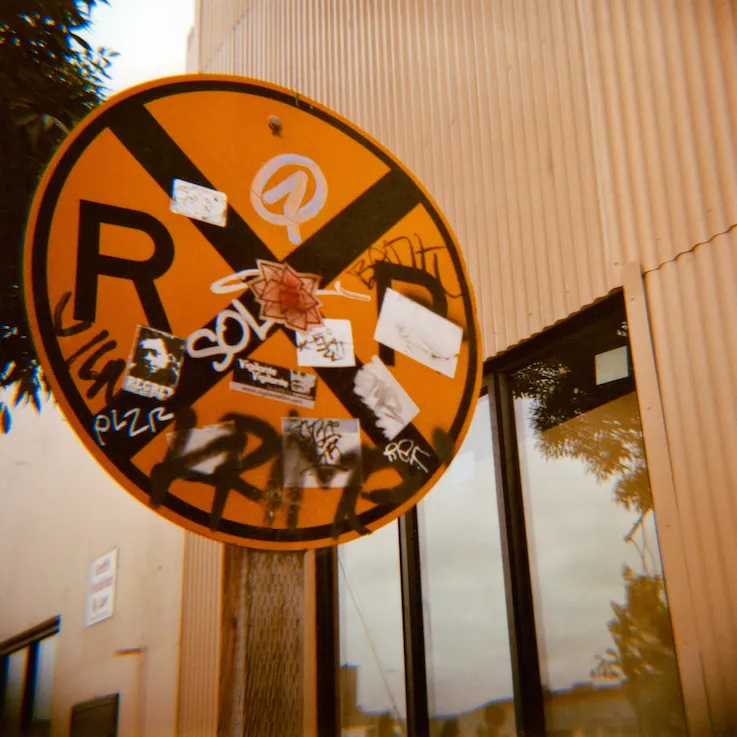
After shooting some 25,000 digital photos in the last decade and a half, I finally did something I never thought I would: I started shooting film again.

In a fit of boredom, I bought a Lomography Diana F+ camera. It’s a 40-buck plastic toy camera that shoots 120 roll film, with manual everything and a plastic lens that takes hipster-esque Instagram-y pictures. I took it out and ran three rolls through it, just to see what it would be like. It was tough, clunky, and awkward, but I loved it.

I haven’t shot film since 2000.  I got my first digital camera, a 1-MP Olympus point/shoot, at J&R Electronics in New York at the very end of that year.  I remember this well, because I had to take a bunch of use-it-or-lose-it vacation and essentially split work very early in the month of December for the rest of the year, and I got really sick on the first day off. I spent the whole vacation in a NyQuil daze, sleeping for 30 hours, waking up in the middle of the night to order hot and sour soup by the gallon from the crap Chinese place down the street, then going back to bed.  I eventually got ambulatory enough on the day after Christmas to brave a snowstorm that dumped a few feet of fluffy white snow over the island. I took the N train down to the City Hall stop to go into the electronics superstore that stood near the foot of the mighty twin towers of the World Trade Center.  I bought the camera, stumbled home, and took a bunch of shots of my kitchen and bathroom, amazed at how they instantly showed up in the tiny LCD screen.

Digital changed my life.  I didn’t have to go to labs, didn’t have to wait to see if a shot worked, and didn’t have the nagging self-censorship that a flunkie working the film counter at Osco’s would be looking at my prints. I took a ton of pictures with that little junk camera, and then moved on to a series of better point/shoots through the 00s before graduating to a DSLR in 2010.  I love shooting with the big Canon, but I still take more pictures with my iPhone. Both are fast, easy, and cheap.

But, there’s a disconnect. I average a few hundred shots a month, although it’s in fits and spurts; I will take out the DSLR for vacation or a baseball game and run a few thousand shots, but then it goes back to the shelf; the iPhone grabs a funny picture or something interesting maybe a few times a week, mostly snapshots of the cats or stupid products in stores. Sometimes these go to flickr, endless galleries of vacation shots that nobody looks at. Hell, I don’t look at them half the time.  I enjoy going back to remember something from ten years ago, but my least favorite part about vacation is trimming a thousand pictures down to a hundred and trying to caption them.  I wish there was a program that would do it automatically, as I’ve said before, but that’s a ways off.

I think that disconnect between us and what we capture, the intermediary of the digital screen and the promise of quick/easy/cheap causes us to produce things we don’t care about.  I don’t give a shit about most of those 25,000 shots I have in Aperture. Maybe 100 are really good works of art, and maybe 1000 of them are things I want to remember. And everyone is that way. Everyone with a digital camera has a million shots and nowhere to put them.  And nobody likes looking at them, except people you don’t want prying into them, like stalkers and annoying relatives. Nobody creates with a camera anymore; we capture, hoping it will help us remember what we quickly forget in our fast-paced world, but we never go back to look at it, and none of it matters. It’s something we feel we should do, like when people take a thousand pictures an hour when they have kids, but nobody’s going to cherish those pictures. They’re probably going to be gone in a dozen years, from a dead hard drive or some new change to formats that will make them all obsolete.

So the first reaction from anyone I told about this new camera is “why the hell are you shooting film?  Don’t you have an iPhone?”  And the answer is that the lack of immediacy, the fact that I need to think because each shot is costing me a buck and I won’t see it for two weeks, makes me more cognizant of what I’m doing. It gives me more of a relationship with what I’m creating. I mean, my iPhone is still taking better pictures, but there’s something about the process of going to the photo shop and talking to the clerk and being handed that envelope of prints and negatives, and then the surprise of opening it and going through to see what worked and what didn’t. I enjoy the process, even if it takes longer.

It reminds me of the days of going to a real record store, talking to the people there about what’s new and what’s cool, flipping through the stacks, looking at the artwork, smelling the vinyl in the air and seeing the other people there.  The whole ritual of going there is something I painfully miss, and buying albums made me more aware of them.  It’s damn convenient to go to iTunes, listen to a few samples, and click the buy button to instantly have it on your computer. But I buy stuff and don’t even listen to it, forget about it, and have to force myself to use playlists and rate things to find them and get into them.  I’m not aware of the music I have anymore.

It’s also the same with books.  Everyone is into the Kindle, and I sell more ebooks than paper these days.  But I download Kindle books that go free, or things I see online, and I never, ever read them.  I have hundreds of Kindle books I will never in a million years open. I read 100% of everything on paper, and I love collecting books. I cherish the print copies of things I really dig, and nothing beats the hypnotic experience of holding a dead tree in your hands and flipping through the pages.  Yes, it’s easier to search through a tech manual or textbook and find what you need on a Kindle or in a PDF. But the relationship between the reader and the work is much more solid on paper.  Will the Kindle disrupt publishing?  Sure.  The CD disrupted the production of vinyl. But people who love music are back to buying it.  Books are the same thing.

Anyway, the first film came out okay.  It’s going to take some practice to get into it, and I probably need a cheaper 35mm to do some learning. Here are the first shots. It’s a fun distraction, so I’m going to keep at it. I’m still shooting as much or even more digital, but there’s just something about analog I can’t shake.
I do not give a god damn about the book industry

I often get dragged into discussions about the book industry, mostly because people are too stupid to know the difference between Jon and Joe and blindly throw a @jkonrath into a tweet about how publishing is dying or some dumb company is fleecing even dumber authors who did the equivalent of paying $10,000 cash for head shots.

(Side note: It’s somewhat ironic that the term for this kind of shit is “joe job” given the name of the other person involved here.)

This is annoying on many levels, mostly because it distracts me from what I’m really trying to do.  But more than that, all of this talking head parroting sometimes makes me wonder why I don’t keep up with what’s going on in the publishing world.  I don’t read trades or spend time on publishing news sites, throwing down my opinion on whatever catastrophe is currently making the rounds.  I don’t take sides on publishers versus “indies” or who signed with who or who decided to leave their publisher and self-pub or what the guy who wrote Wool ate for lunch or any of that.  I don’t care.

I do not give a fuck about the book industry.  I mean, I like to read books, and I publish the final output of my work so you can see if you want to read it.  But I am a writer.  I’m not a shameless self-promoter, and I’m not an industry insider.  And I don’t want to be.  I don’t write books for maximum profits.  I write books because they’re trapped in my soul and need to be excised like the pus from a wound.  I know it sounds pretentious to pull the “I’m an artist” card, but I’m definitely not a businessman, and I do not care about any of it.

I recently read a book called Post-Digital Print, which was one of the most inspiring books I’ve read in a long time.  It outlines every “publishing is dying” screed that has happened since 1894, and I guarantee you that about a dozen of them are things you’ve never heard about.  Almost every one was invented by a company that wanted you to buy their shit instead.  Did you know that people thought radio would replace printed books?  At the turn of the century (or a couple of decades later, I guess) part of the population thought books were turning everyone blind.  It probably had some causal relationship to the rise in optometry technology at the time, and everyone was getting glasses, whereas before that only rich people got monocles, and everyone else squinted.  Anyway, some industry geniuses said that radio would replace “the burden of reading” and save everyone’s eyesight.  And we know how that turned out.

I’m not saying print isn’t suffering.  But it’s not going away, either.  There’s going to be a whole generation of artisanal printing, letterpress chapbooks and boxed sets of limited edition prints with high-end art book covers and over-designed interiors in esoteric fonts that makes Helvetica look like Comic Sans.  Look at what happened with vinyl records.  The 8-track was supposed to kill them, then the cassette, then the CD.  There are now vinyl-only stores, limited-edition LPs with extra tracks and slick printed gatefold sleeves encasing art books and 45-remastered dual discs on 200-gram virgin vinyl.  Yes, the airport reader is going to gobble down murder mysteries on their kindle, but book collectors aren’t going to be forced to shred everything and go to e-format.

What I am saying is that these talking head industry-mongers are not authors - they are inflating their own egos for their own industry, which is fear-mongering and hand-wringing. It doesn’t help your writing.  They’re the people selling the ten dollar loaves of bread to the people who showed up late to the gold rush.  It’s all bullshit.  It’s all inconsequential.

Speaking of, gotta get writing - trying to finish the next book.  I’ll end with a quote from my buddy George Carlin that pretty much sums it all up.

I figured out years ago that the human species is totally fucked and has been for a long time. I also know that the sick, media-consumer culture in America continues to make this so-called problem worse. But the trick, folks, is not to give a fuck. Like me. I really don’t care. I stopped worrying about all this temporal bullshit a long time ago. It’s meaningless.

-George Carlin

Mandelbrot and Genre Writing

A5200_Rescue_On_Fractalus

I’ve been in the post-book-release period of my writing cycle where I don’t know what I’m doing next, and I don’t know what I should be reading, so I start poring over non-fiction, usually some junk science book.  Specifically, it’s that James Gleick book Chaos, which is about chaos theory and the butterfly effect.  I mostly read stuff like this to pour random facts into my head with hopes that I’ll go off on a tangent in some wikipedia-reading frenzy and end up finding the pieces of my next short story.

Part of the book talks about Benoit Mandelbrot, who once said this:

Science would be ruined if (like sports) it were to put competition above everything else, and if it were to clarify the rules of competition by withdrawing entirely into narrowly defined specialties. The rare scholars who are nomads-by-choice are essential to the intellectual welfare of the settled disciplines.

That got me thinking about genres, and writing.  I’ve been knocking against this invisible wall with regard to genres, because I don’t really fit into any one category.  And every self-publishing make-money-fast scheme online talks about how you need to market yourself by finding your niche and building your platform to sell to that slice of the reading public.  Every person out their schlepping their own advice on publishing will tell you about the importance of hitting up the forums relevant to your category.

When I’m depressed about not having stellar book numbers, this feeds into a horrible cycle of negativity.  I don’t sell books because I don’t market.  I don’t market because I can’t find the people to market to.  I can’t find the people to market to, because I don’t know how to categorize my work.  And I don’t know how to categorize my work because I don’t really like any of the categories.

That’s a big part of the problem.  I don’t read a lot of straight genre fiction, because it bores me.  While I like picking at the edges of the science fiction genre, I find the die-hard stuff to be so goddamn serious.  I can’t stand fantasy.  And romance and thriller aren’t even on my radar.  The books I like are combinations of different things, or aren’t representations of the category as a whole.  Vonnegut wasn’t a science fiction writer per se; he sometimes fell into that category, but his stories had a humor you aren’t going to find in the typical outer space robot book.  Burroughs had the same distinction.  Was Hunter S. Thompson a journalist or a humorist or an essayist or what?  And Mark Leyner wasn’t literary fiction, but he wasn’t general fiction, either.

The big issue is that when you define success as straight-up numbers, nothing but copies sold and dollars taken in, you’re competing more than you’re creating.  You’re not going to push boundaries or do what you truly want; you’re going to stick to that same narrowly-defined plot structure that everyone uses to maximize the number of readers you can satisfy.  You’re going to think of how to market a book and then write it, instead of creating what you truly need to create as an artist.  It’s like the difference between a painter like Jackson Pollock laying his soul and his inner demons onto the canvas, versus someone being handed an RFP by a hotel chain for a thousand identical paintings that meet certain requirements.  When you write for the market, you may sell, but you probably won’t innovate.

I don’t want to dole out yet another hero’s journey monomyth novel because I can plug it by saying “it’s like but with ”.  I feel like I need to continue down the path I’ve followed with the last few books, but I also feel like it’s okay if I suddenly want to write some non-fiction, or a book of essays, or whatever else.  I’d hate to wake up someday and be told I can only write dystopian literary occult police procedural fantasy fiction, or that I couldn’t do what I want because it won’t sell.  Life’s too short to back yourself in a corner like that.

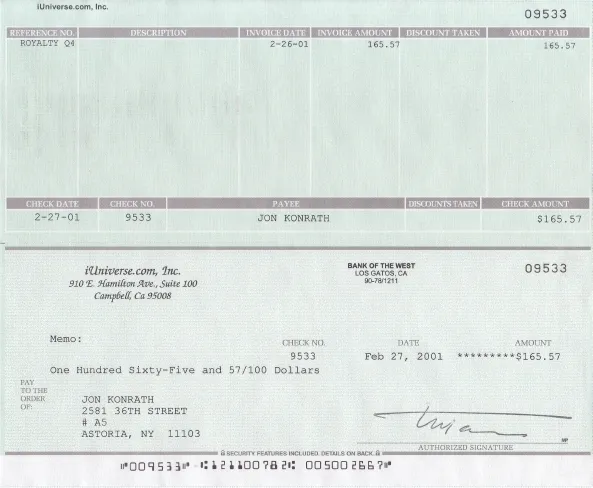
Goodbye, iUniverse

first-royalty

No, iUniverse isn’t going out of business.   (Well, maybe they are - I haven’t checked.)  I’ve just decided to pull my books from iUniverse.

I’ve done three books with them, and the idea of print on demand radically changed my writing career.  I mean, I have not made millions from it, but prior to the advent of PoD, I thought the only way I’d ever hold a printed copy of my book in my hands would be if I wrote a million agents and publishers and found one willing to print it, or if I payed thousands of dollars to fill my garage with a short print run, or maybe if I went to Kinko’s and printed my own copy.

Someone told me about iUniverse back in 99 or 2000, and this was around the time Summer Rain was close to done.  It was an incredibly revolutionary idea back then, this thought that I could get real copies of my book, and get them in Amazon and other book stores, and even have it so brick-and-mortar book stores (remember those?) could order copies through Ingram.

There were a couple of issues with PoD back then.  One was cost.  Summer Rain was incredibly expensive compared to the per-unit cost of offset printing a few thousand books.  There wasn’t the setup, and you didn’t have to produce a bunch of books at once and then warehouse them, which was awesome.  But selling a paperback book for thirty bucks was never easy.

The stigma was the worst part.  Back in 2000, everyone looked down at PoD as hackneyed and just another extension of vanity presses.  The party line was that real writers don’t self-publish, and you weren’t shit unless you had a book deal.  The irony of this is that the proponents of this attitude are the same people who can’t shut the fuck up about the kindle revolution.  (You know who I’m talking about.)  To some extent, this didn’t matter to me; I had a copy of my book on my shelf at home, and friends could buy it and read it, and people enjoyed the work.  That’s all that ultimately matters to me, but there was still a nagging feeling in the back of my head when the “real” writers talked shit about self-publishing.

I also didn’t have high hopes that PoD publishing would reap all of the rewards that getting a book deal with a Big 6 publisher would.  There was a lot of PoD backlash from people who dumped a book onto a PoD publisher, and then bitched and moaned when it didn’t take off.  I never saw iUniverse as anything more than a printer, and didn’t expect them to do anything more than fulfillment.  But some people thought you would just upload your PDF and your book would suddenly take off like a Dan Brown release.  Truth is, PoD involves just as much hustle as printing off copies yourself and trying to sell them one by one.

So, why am I dumping iUniverse?  A few reasons:

  • When I first started, there was almost no initial setup fees - I may have paid some trivial amount, like a hundred bucks, but it wasn’t much.  This fee went up and up, and after my third book, Lulu came on the scene with no setup fee, and that was the end of the line for me and iUniverse.  Now, their most basic package is $899, and the “Book Launch Premier Pro” is a whopping $4499.
  • All I really wanted was fulfillment and distribution.  iUniverse tried to differentiate themselves with all of this “value add” stuff that was mostly useless.  I have no need for bookmarks, press releases, book signing kits, or other crap I could get online for a dollar.  (Vistaprint is your friend.)
  • Without asking, iUniverse decided they would create e-book versions of my books and price them the way they wanted to price them.  And they made it damn near impossible to remove those versions.  So while I made a new version of Rumored to Exist for the kindle and priced it at $2.99, they made a crappy version and priced it at $3.99.
  • The per-unit pricing was too high.  Summer Rain was $29.99 on iUniverse.  The lulu version was $14.99.  The createspace version will be $13.99.  My profit is roughly the same on all three.
  • All of the processes at iUniverse are antiquated.  To find out your royalties, you have to wait for the next month’s statement.  To pull a book from publishing, you have to write them a god damned letter.  Ugh.
  • One of the things iUniverse had over createspace was that createspace is part of Amazon, which meant you wouldn’t get into B&N or brick-and-mortar stores.  With iUniverse, you could get into anyplace that used Ingram’s database.  In practice, 99.99999% of my book sales are through Amazon.  I don’t know if I’ve ever sold a book through a brick-and-mortar store.

So I wrote a letter to iUniverse and pulled my books.  (Seriously, a letter?)  There are currently only three books on there: Summer Rain, Rumored, and Tell Me a Story About the Devil, which is a journal archive from 97-99 that none of you ever bought.  The first two are already moved to Amazon/createspace.  The last one can die on the vine.  If you’re really desperate to get any of the iUniverse editions before they go away, I think you probably have a few days to grab them.  But the newer versions are not only better, but cheaper.

Next up will be hemming and hawing about what to do with all of my books on lulu, and if they should also get moved.  I should probably stop screwing with all of this and actually write new books, though.

Self-publishing

I’ve been thinking more about this whole self-publishing thing. Printing copies of Rumored and selling them wouldn’t be much of a paradigm shift over when I printed copies of Xenocide and sold them from my apartment. It would cost about a jillion times more - actually, it wouldn’t cost that much more, since Xenocide 5 had a color cover and was photocopied 50 issues at a time, it cost about $2 per copy. To print 1000 books with a softcover and a square binding would cost somewhere around $2-$5 depending on pages, shipping, etc etc etc. So it’s more money initially, but not more money per capita.

The main thing about selling books vs. selling the death metal zine was that there was a whole underground network to sell the zine. There are a lot of dedicated fans of extreme metal music, and they are all pen pals and write each other and send everyone’s fliers for zines, demos, CDS, shirts, etc to each other. And there are many zines who will trade ad space for nothing or sell you a back cover ad for only a few bucks. With Xenocide, I just printed the zines, printed a bunch of fliers, and pretty much waited for the checks to come rolling in. I wish there was such a fanatic group of book buyers out there. With this project, I’ll really have to scrape to find small bookshops that are willing to pick up books on consignment. That’s the real pain in the ass. My only relief is that if I do sell Rumored and just sell copy by copy in all of these mom and pop stores, I will have a good database compiled by the time I try to do the second book.

The editing of Rumored is going okay. I broke down a task list of what I want to accomplish over the next month or two. The first task, which is underway, is just a line-by-line read of the whole thing, to fix the obvious and remove the idiotic. As of last night, I am 1/3 through that. Then it goes to a harder edit, where I completely scrutinize each little piece and spend a lot of time finely molding each word. Then I make a pass where I arrange things (the current order is arbitrary) and cut things that I don’t like. Through these three steps, I might add more stuff as I’m going. If I feel like 100% new writing, I will do that.

And now that I’m thinking of the followup to Rumored, I wonder if this book should be all of the freak-out stuff, with more of the personal stuff in another book. I thought about writing a book that’s just 10 or 20 long, personal narratives - each like a 10,000 word short story or something. It would still have some experimental aspect of it - sort of like that Hubert Selby Jr. book where it was a bunch of short stories and each guy had the same name but otherwise they were radically different. I love that kind of thing. But I am thinking about the next book and how it will happen. Mostly, I just want to produce another great vehicle that people will love and that I can finish fast. I don’t want to do this Summer Rain meets War and Peace 12000 page monologue with nothing grabbing in it, just for the sake of remembering my past. I’d love to do that stuff someday, but I guess it’s something you belt out later in your career. I mean, Kiss spent a few years belting out these kick-ass stadium-destroying power albums before they started doing the weird experimental shit and the solo albums. You can’t hit off right away with a novel that’s about a bath towel or something. I want to start out with a roar and then work my way to a gentle glow. But who knows, I change my mind every 10 seconds with this shit…