The Wrath of Kon

Dispatches, thoughts, and miscellanea from writer Jon Konrath

Tag: self-publishing

About Atmospheres 2

Atmospheres 2 book cover

Ninja weapon shortage. College football shoe scandal. Record humidity — supersaturation — dew point of complete absurdity. A group is claiming they have the legal constitutional right to storm the cockpit of any commercial flight and take over the controls of the jet because Jesus said you can in the new American edition edible picture Bible. On some Sunday morning talk show, an old man in a Punisher muscle shirt pointed at the fine print on the back of a yellowed Hooters Air ticket, interspersed with the same commercial for a meat gun filled with liquid bacon the station played every 90 seconds. A few days from now, seventeen flights would get emergency diverted, two shot down by F-22 interceptors. A thousand deaths, eight million dollars of AIM-120 AMRAAM missiles in action, who knows how many insurance settlements for families of the deceased. People don’t know when to say when anymore.

Atmospheres 2 is out now in print and on Kindle. There’s not much more than the back cover description out there, so I thought I’d talk a bit more about the book.

Atmospheres 2 is an experimental novel that’s about living in an apocalyptic world where reality is no longer real, or it’s impossible to separate reality from several chaotic monetized alternate realities that people think are real. Sound familiar? It’s not a conventional high-concept sci-fi thriller with a solid plot device to carry you through a precise three-act arc where the anti-hero saves the day. It’s a full-on barrage of absurdity, a collage that covers several distinct themes throughout the book.

When I say experimental, what I mean is there isn’t a conventional narrative, but instead a series of loosely interconnected stories with recurring characters and motifs that follow a through line through the book. It’s 100 segments, arranged in three acts, each segment a thousand-word world of its own. Half of them are third-person and half of them are first-person, following an unnamed Trusty Narrator through the chaos. At one level, it’s like flipping through a hundred random channels of cable TV, tuning in to a specific story or scene, then changing the channel. But sometimes an idea appears, vanishes, and comes up later in an altered form, consistently poking at the question, “What is reality?”

The book takes place in a near-future reality, a shifting landscape of corrupt corporate America, dead malls, abandoned cities, desolate highways, anonymous hotels, and the debris of a failed society that’s been pumped full of stimulants and electrons of every format. Aside from the interleaving pieces jumping between the Narrator and reality, the book shifts from conversation to road journal to cable news to corporate press release to cultural criticism to disaster reporting.

There are three distinct acts in the book, and they help define the different themes that run through the entire novel:

  • Act 1 - Atmospheres focuses on the alteration of perception by technology. Social media, fake news, corporate prestidigitation, and manufactured celebrity are all explored. I know this can be trite and overplayed these days, and everyone’s writing about enshittification and why kids need to get off their damn phones. I think like the other themes in the book, I don’t lean in too hard on one side of the issue, but just show the absurdity and madness. This questions whether reality is real or just an unstable simulation built from brands, sound bites, manufactured media, and algorithms.

    I write a lot about the hellscape of unchecked corporate consolidation. It’s a world 99% owned and operated by the Fortune 5, where the same hedge fund that owns Arby’s, NASA, and Comcast also has control of the Air Force Global Strike Command and 2/3s of the American nuclear triad. Amtrak is now owned by Chuck E. Cheese, which is owned by Fairchild Aircraft, which is a division of Amazon. Pfizer bought Jack in the Box so they could sell their own customers heart medication. Boeing (which is a divsion of McDonald’s) had their sister company Northrop Grumman buy Proximo Spirits to distill fuel for their space program’s rockets. It’s all unregulated. It’s all for sale. It’s all completely absurd, but at least three times in the last two years of writing this book, I had to completely change a major plot line because something actually happened in real life. (Pizza Hut really got bought by a private equity firm that sells coffins? Yep.)

  • Act 2 - Nightmares is about how this altered reality surfaces as violence and chaos. The main theme in this part of the book is “the cruelty is the point.” Corporations monetize suffering; authority turns to brutality to feel powerful; politics becomes completely corporate, only existing to turn resentment and loathing into common identity. The spectators of this reality watch on the sidelines until the sidelines collapse into disasters, plagues, and a catalog of horrors.

    The Narrator experiences what I feel every day: how do you navigate this when you don’t feel like either side? When nothing is real anymore, what is your reality? When the corporate ladder collapses leaving nothing to climb, what do you do in life? Does this hyper-reality of artificial identity mean you’re locked into the identity you formed with your social media, online purchases, and corporate history? Or does everyone’s obsession with this chaos and your lack of importance in the world mean you have total freedom?

  • Act 3 - Visions is where the book turns much more surreal and dreamlike, where time loosens and reality completely collapses on itself. No spoilers here, but as the outside world turns to a complete apocalypse, the Narrator’s inner world drifts into a place where memory, fantasy, and experience completely melt into each other.

Oh, and it’s a comedy. Many LOLs ensue, trust me.

This book is probably more political than any of my other ones, but I don’t lean heavily into hack political satire. It’s also, despite everything that happens on the surface, probably one of my most deeply personal books. It’s about aging, regret, resentment, depression, and mortality. It’s about attempting to escape, be it with work, travel, addiction, food, or nostalgia, and how none of those provides a real exit.

Like I said previously, it took me almost 12 years to write this book. It constantly mutated as I changed and the world changed. I don’t feel I could ever really finish it, so I’m happy I was eventually able to reach a stopping point and present this to you. I hope you get a chance to read it.
Out now: Atmospheres 2

Atmospheres 2 book cover

I’m happy to announce that my twentieth book, Atmospheres 2, is now available on on Rumored Books.

TL;DR:

Atmospheres 2 is an experimental novel about living in the chaos of a world where reality has become impossible to separate from the machinery that creates it. It’s a panorama of anxiety and existential dread set in a chaotic place where corporations and politics have become intertwined to the point of absurdity. The three acts of the book follow an unnamed character simply called Your Trusty Narrator, as he stumbles through an alienated life of corporate underemployment and altered reality. He struggles on a Sisyphean journey to find meaning in an existence that is quickly collapsing on itself, wondering if he’s the only person who notices.

This book is a sequel to my 2014 book Atmospheres, although it’s not a direct sequel with the same cast of characters, continuing the last book like a Spider-Man movie. It’s the same world, some of the same settings, the same general tone and philosophy. It’s also made of 100 segments arranged in three acts, alternating between first-person and third-person. But it’s more than twice as long (544 pages versus the original’s 242 pages), and I think the writing is a bit more dense, so there’s a lot going on. I think many readers will think the book is entirely plotless, but in some ways, it has a stronger underlying plot than most everything else I’ve written.

I’d like to think I write fiction, but I don’t even know at this point. It’s hard to be an absurdist when the actual news is far more ludicrous than anything I could write. This book is more political than anything I’ve done before, but it’s not a politics book. It captures a lot of the Kafkaesque inanity and dread about having politics devolve into a fully corporate swindle. But I think the main theme here is dancing around the larger question of identity a world where attention, self-identity, and reality has been completely strip-mined for monetization.

I started this book in 2014, and struggled for years to land it. It’s very much a “kitchen sink” book like Atmospheres and Rumored to Exist are, but I think it’s a distinctly different thing. It’s always a challenge to throw tons of everything into a manuscript and then try to arrange it with a through line, make everything jam with everything else. Coming up with the strategy of the whole thing and sticking to it was the hardest part to turn around, but like its predecessor, a lot of this is focused on the tactical level of having each segment be its own thing. I think a lot of people didn’t read Atmospheres straight through, but would open it to a random page and read one or two segments and enjoy them. I’m doing the same thing here, but it’s also something that someone invested in the book could read from 0 to 100 as a novel.

No, I did not use AI to write the book. I think I got a full manuscript done maybe five years before GPT-2 was even announced. I have a lot more to say about this, but I’ll save it for another post.

This is the longest I’ve ever worked on a single manuscript. It was interrupted by a lot of things: a pandemic, two graduate degrees, nine other books, two broken arms, and everything else in life. I keep a journal of notes in each book I write, and the one in this book is absolute madness. 24 hours of writing in Singapore, thousands of words of notes taken at the Ho Chi Minh airport, a bunch of editorial changes done while in Ulaanbaatar, Mongolia. There’s a lot more to say about the general history of this book and how it radically changed over the years. Something else to write about later.

Anyway, the book’s out. Hope you get a chance to check it out.

Out now: Atmospheres second edition!

Atmospheres cover

I’m happy to announce that I’ve re-released my 2014 book Atmospheres on Rumored Books.

TL;DR:

This was an interesting one. I am approaching the end of writing Atmospheres 2 and figured I should probably have the original one in print too. I dusted off the old Scrivener file from twelve years ago and gave it a quick editing pass. (I didn’t change content, and mostly fixed dumb comma usage and a few typos.) I also finally ditched that stupid CreateSpace-generated cover.

In doing this, I dug around for old drafts and tried to research the genesis of this book. The original was published on March 2, 2014. Because I write in Scrivener and constantly refine a single document, I don’t really generate discrete versions or drafts. I knew I did have working drafts I sent to someone in PDF format from October 2013 and January 2014. But when looking through old email, I was astonished to find a May 2013 draft I sent to Ray Miller, when the book had just been named and was only 5,000 words long. It amazes me to read those early snippets, really just bursts of ideas with absolutely no structure or routine.

I combed through the six drafts I found, and wrote a bit about the development of the book, my process, and how the drafts mutated into what I ended up publishing. I’ve also included some never-seen-before outtakes from the early drafts, including a bunch of that email to Ray, plus a few segments that were dropped from the first edition. It’s about 40 pages of new material.

Atmospheres is one of my favorite books, along with Rumored to Exist. I think it’s one of my most “Konrath” books, and I can still turn to a random page, read a few lines, and find something hilarious I completely forgot about. I’m glad to have it back in print on Rumored Books. And I can’t wait to finish the sequel.

If you’re new here, maybe I should back up and explain this. Here’s the post I originally made back in 2014.


About a year ago, I started writing this experiment, which was a collection of almost ambient scenes, brief snippets of no story, just outbursts of emotion or scene. I wanted to eventually link them together in some way, but it became more important to simply generate the pieces each day. When I worked on finishing Thunderbird and doing all of the steps of publishing it, I needed to continue writing something, and that’s where the beginning of Atmospheres started.

I’ve always had a minor obsession with Jim Jarmusch, and I often listen to the soundtrack to Broken Flowers when I’m writing.  One of the songs on there is an edited clip of the Sleep song “Dopesmoker.” I’d been vaguely familiar with them from a million years ago when I used to write about death metal, but wasn’t fully aware of that particular album. I’d read an interview with Jarmusch where he talked about being preoccupied with that song, so I got a copy, and then I became locked into it.

If you haven’t heard it, the album is one song, a 63-minute stoner metal number that’s essentially a single heavy riff played over and over, while talking about a caravan of weed-priests crossing the desert to Jerusalem with their magical hashish. The lyrics are corny, but the song itself is an hour of pure hypnotic sludge, and puts you in a trance mode. And while I did not imbibe in the titular substance discussed in the song, I made it part of my process. I’d sit down every day, put the song on repeat, and completely lose myself in it, writing about whatever escaped from my subconscious thought onto the page.

Within a few months, this brought out an incredible pile of 500 word chunks, some perfect stories, some absolute junk.  But it amazingly brought out some common threads through the manuscript when I pushed them all together.  There’s a scene in the Naked Lunch movie where Ginsberg and Kerouac (or facsimiles thereof) go to Interzone to visit Bill, and  find an apartment filled with scattered random notes (and heroin), and that’s what the book read like before I started editing.

This is by far the most challenging read of any of my books.  It has a story arc in three acts, but it doesn’t have a conventional plot, which will throw a lot of people.  But it contains a lot of brutally honest writing that cuts deep, and it was a lot of fun to write. If I had to compare it to anything I’ve done, it’s a lot like Rumored to Exist in ways, but I think the pieces are darker with a lot more thickness to them.

This is my tenth book, which is a strange milestone to reach.  And every time I finish one of these, I fall into a deep depression and a brief panic, first as I wade through all of the production steps of releasing one of these things, and then as I try to start the next project.  And I have no idea how to sell this book or what’s next, so I’m not prepared for this. But, I need to keep working, so I will.

Anyway, check out the book, and let me know what you think.

Out now: Statue of Limitations

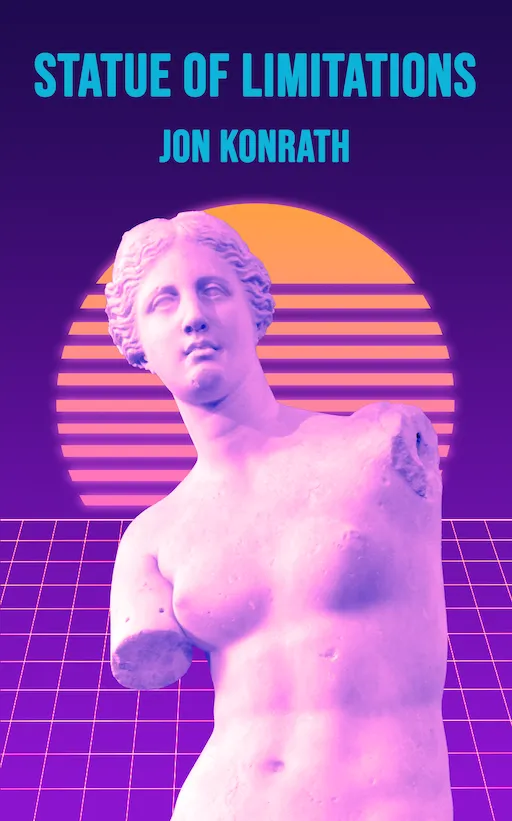
Statue of Limitations book cover

I’m happy to announce that my new book Statue of Limitations is out now!

TL;DR:

  • Kindle
  • Print
  • It’s 978-1-942086-23-9 if you want to order it from anywhere that does Ingram

This book is a collection of 30 stories, flash fiction, and other fragments and zine articles and stuff. It’s similar in theme to my 2019 book Ranch: The Musical, and a bit more lightweight than last year’s Decision Paralysis. I’m happy I was able to get this one in right under the wire in the last few hours of 2025, so I can clear the deck and start working on something new.

I spent most of 2025 trying to land a sequel to Atmospheres and got pretty close, but life sort of fell apart for a minute back in September, and I probably lost a good month there. I can’t remember when I wrote down this title, but I started throwing various zine articles that were never published, dream journals, listicles, and parts of stories into a draft towards the end of October, with a goal of getting a 20,000-word quickie done in 2025.

This is the third time I’ve done this, and it’s sort of akin to the Agile development process. Ship early, ship often; I do these much more lightweight books that are cheap and can be written fast, read fast, published fast. I hate to use the term “punk rock” to describe anything, but the idea here is that instead of spending years chipping away at an 800-page tome that eventually nobody will read, I’d rather push out these quick DIY dispatches and keep the river flowing. Maybe they aren’t perfect; maybe they’re filled with typos or dead ends. But the goal is to keep them going and constantly improve, get the next one slightly better than the last.

On October 19 (my anniversary), I had a new project with 14 documents, 11,000 words and a potential title but no story for it. I think by Thanksgiving, I’d broken 25,000 words, and it got up to 30K shortly after that. The word count is deceptive, because maximalist writers like David Foster Wallace will have sentences that long, but this writing is so dense and concentrated, a 500-word story can have a ton of work in it.

I took two weeks off in December, and hoped I could catch up a bit. November was rough because of the death of Loca, but I kept at it, chipping away. My hope dwindled on getting it done by the 31st, but I trudged on, thinking at least I could wrap it up by the end of January. I got almost no work done on the trip to Wisconsin and Indiana, and when I got back, I opened the manuscript and just stared at it, thinking it would take me a week or two to get moving from a dead stop.

I don’t know what happened, but I woke up at five in the morning on the 31st and thought, “I have to finish this today.” I spent the next twelve hours at full combat speed, rushing through each piece, writing what needed to be finished, junking a couple of stories and rounding as many corners as possible. I had to do the Kindle layout, which required a Scrivener upgrade that I thought for sure was going to doom me. I decided to defer the print version and my usual “long last look” pass just to get the Kindle draft out, knowing I could do another editing pass and get the wraparound cover and print layout done on the first. At 0500 I didn’t even have the titular story started. By dinner time, the book was submitted.

rumored-books-transparent

Another quick announcement I’ll get into later: this is the first book on a new imprint called Rumored Books. I’ll use it going forward for my stuff. I don’t know what else I will do with it or how I’ll market it. You’re looking at the URL for it (rumored.com) although I’ve got rumoredbooks.com registered and it’s pointed here for now. Maybe I will spin up a fancy site nobody will read for the imprint. Maybe it will become a different blog. Maybe I will publish other stuff. More on this later I guess.

What I do know is I have to keep going. This is my 19th book, and I have at least two dozen ideas, half-done manuscripts, and other things up on blocks right now, so I have to keep the river flowing. Stay tuned.

Vol.13, Revisited

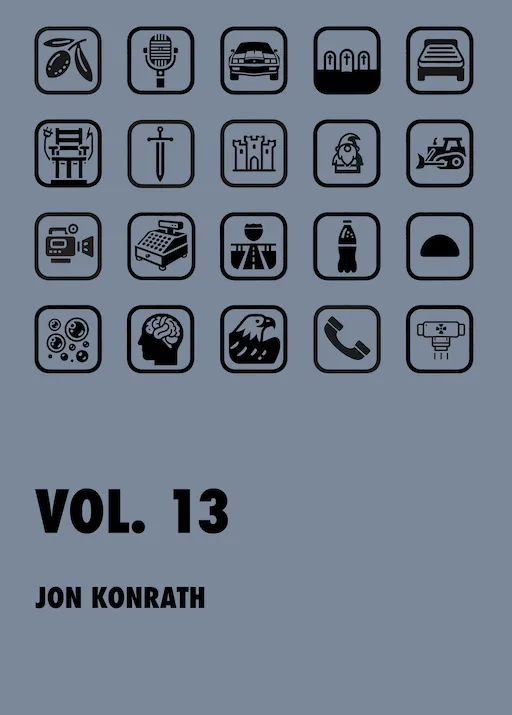
vol13-v2-cover-kindle-small

Vol.13 rides again. I’ve revisited and republished my 13th book from 2016.

Let’s cut to the chase with the Amazon link: https://amzn.to/4e81lyi

For those who don’t remember, this was a book of 20 short stories and flash fiction pieces. It included two things that were in other zines, and three stories that were in my own zine, Mandatory Laxative #14.

Let’s ask the KonGPT what it was about:

Vol. 13 by Jon Konrath is an eclectic, absurdist work that blends surreal humor with societal satire. The collection of short stories and essays addresses a wide array of random yet often connected topics, including pop culture, existential musings, and sharp critiques of consumerism and modern life. With chapter titles like “Mariah Carey Is Punk as Fuck” and “The Kansas City Tofu Firebombing,” the content explores bizarre scenarios filled with dark humor. The chaotic narrative jumps from one vignette to the next, portraying a disjointed, almost hallucinogenic journey through a world where everything is skewed to the point of absurdity.

Konrath’s writing style is frenetic, with a voice that mixes cynicism and wit while layering in cultural references ranging from fast food chains to forgotten celebrities. The underlying tone is rebellious, subversive, and at times grotesque, capturing the disillusionment with American culture in the early 21st century. The stories invite the reader to experience a twisted version of reality where logic breaks down, leaving behind a vivid, often unsettling commentary on the absurdities of daily life .

As I did with The Failure Cascade and Book of Dreams, this re-visit involved a quick edit to fix minor typos. If you already own the book, you’re not getting any new content here, but if you look hard enough, you’ll find some questionable use of commas quashed. This publication was mostly a long-tail effort to get old writing back out there.

The original cover was a play on the Black Sabbath album Vol.4. Back in 2016, I labored to get the font and the look of it right. The curse was the use of “The Picture” which seemed like a good idea at the time, the height of that dumb meme. I won’t get into the exact details, but that meme is dead and I’m scrubbing it from everything possible. There was something great about having a piece of branding like that, but it also very firmly painted me in a corner persona-wise, and I’m happy to abandon it. I like the new cover a lot, and it was neat to make. Finding an icon for each story was a fun project. Is it weird to have this book sort of named after the Black Sabbath album and not have the cover? Whatever.

I previously said I like Book of Dreams like 95% and Failure Cascade maybe 75%. I would honestly say I like Vol.13 maybe 80%. There are a few cringe bits here, and I do fall into some of the same Konrath tropes that I repeat far too much. (Me and Fat Mike go to the 7-Eleven; someone babbling about something at a fast-food restaurant; I’m at a Kroger talking to some weirdo; a military strike in everyday life.) There are certain callbacks that I used to make as part of my “brand” that have been driven into the ground that I can’t erase: Mariah Carey, Lunchables, NyQuil, etc. I’m done (or trying to be done) with writing like that, but I can’t erase all of it.

There are some stories in here that I absolutely love. “The Metaphor of Poundcake” is one of my favorite stories ever, and has two threads that weave together perfectly. “#JustKilldozerThings” has some absolutely fabulous lines and exchanges in it. While most of my flash fiction hovers around 1000 words in this era, there are a lot of stories that stretch out for two or three times that. It’s similar to Failure Cascade (and my next book) in that the stories almost get too long to be flash, but still feel like exactly the right balance between punchiness and story.

Anyway, there it is. Now, on to the next one.