Age of Aquarius
I’ve talked a few times about my old Commodore 64, but this wasn’t my first computer. I actually owned a much weaker computer for about a year before the C-64: the Mattel Aquarius. I thought I’d told the story before, but looking through the archives here, I didn’t find much. So here’s the deal.
The personal computer pretty much started happening when I was in grade school. I guess before that, you could solder together your own Altair, but in about the 5th grade, these platinum-cased Apple II computers showed up, and I learned how to do the 10 PRINT "HELLO" thing on one of those green-screen monitors. If your parents had money, you could get one of these things in your home, but with an original 1977 list price of $1298 for the 4K model (plus monitor, plus disk drive, plus software), there was no way in hell I’d ever own a computer. But as the 70s became the 80s, an explosion of cheaper machines hit the market. Atari came out with their 800, which listed for about half the price of an Apple, and then the C-64 machine started selling at $595. There were also some cheap-o machines with more anemic specifications, like the VIC-20, which dropped to near $100, and the Timex-Sinclair, which was even cheaper.
At the beginning of 1984, my parents split up, right around the time of my 13th birthday. I didn’t know the political angle of being a child of divorce, and I didn’t consciously want to pit one parent against the other, but getting a computer was stuck in the front of my head. I needed one of these things. There was no world wide web that I needed to browse, and I didn’t need to type papers or balance spreadsheets. I just needed to be able to hack at a machine and write programs and develop games. I’d taught myself BASIC, writing programs on paper and getting to try them out on friends’ machines or with the very narrow slivers of time afforded to me with the school’s few Apples. I wanted to be able to waste all of my copious amounts of free time writing some kind of Dungeons and Dragons game on the computer.
And right around then, the Kay-Bee toy store at the mall by my house started selling these bundled computer systems from Mattel. And they were only a hundred bucks, and included games and joysticks and the whole nine yards. I didn’t know anyone with one of these machines, and this was long before I could plug this into wikipedia and look up the specs. But I needed one, and $100 was an easier target to reach than the $200 or $300 price of a Commodore, so I begged and pleaded, and before I knew it, at the end of one of those “every other Sunday” visitations, I had this big huge box full of computer, ready to hook up to the TV set’s antenna screws.
The Mattel Aquarius has a strange history, one that I didn’t know for decades. Mattel made the Intellivision video game system, and promised in ads and brochures that they’d come out with a magical keyboard that would plug in and turn the thing into a real computer. This was a big deal back then, because if you were already dropping a few hundred dollars on a video game system, there was a certain enticement in being able to avoid spending another grand on a home computer. Problem was, they didn’t have this computer expander system ready. They turned to the manufacturer of their Intellivision, Radofin in Hong Kong, and they had a low-end computer system of their own, which they rebadged as the Aquarius.
The Aquarius was quite likely the worst home computer of the 80s. It was based on the Z80 processor, which was used in a lot of other systems, and it ran it at 3.5 mHz, which wasn’t horrible for the time. But it came with 4K of RAM. Once you booted the system, the screen memory, other buffers, and the BASIC interpreter took up most of that, leaving behind just over 1K. That’s a K and not an M; we’re talking about just over a thousand of characters of memory. This blog post is twice as big as the available memory on an Aquarius. There was a very rudimentary sound generator, and support for an 80x25 screen with no real graphics.
The BASIC was a version of Microsoft’s, and it was a fairly rudimentary implementation. If you programmed BASIC back in the day, you may remember that there were good BASICs and bad BASICs. Like the Commodore V2.0 BASIC didn’t have an ELSE statement for IF-THENs, which meant a lot of spaghetti IF-THENs that were an eyesore in a language with no indentation. And the CBM version didn’t have any sound or graphics functions, even though its chipset supported decent functionality; you’d have to PEEK and POKE to do anything cool, or spend some cash on Simon’s BASIC or some other extension of the language. The Aquarius BASIC, most likely because of the memory issue, was even more crippled than the Commodore version, with an extremely limited subset of commands.
Design-wise, the Aquarius was a fairly tiny machine. It came with a 48-key chicklet keyboard, these little rubber keys spaced far apart, and the machine wasn’t much bigger than the keyboard. The keyboard was essentially what they give you to type when you go to hell for eternity. A few other machines came with a membrane keyboard (the Atari 400, and the Timex) which was pretty bad, but these rubber keys were the worst. You could not touch type in any way, not only because of the keyboard’s spongy feel, and because it had a substandard layout. For example, it didn’t have a space bar; there was a a space key off to one side. The one saving grace was that there were keyboard shortcuts you could use when typing, so if you needed to type GOTO, you could use a function key and hit G or something like that. Cartridges usually came with these two-piece keyboard overlays, thin pieces of plastic embossed with all of the special functions for the program. There was almost no extensibility to the machine, either. It came with plugs for a printer and a cassette recorder, plus the RCA plug for the TV set. It had no other plugs; even the power supply didn’t have a plug, and the cord and power brick were permanently attached to the back. It did come with a single cartridge slot, which accommodated these weird wedge-shaped cartridges that matched the angle of the top half of the console.
The Aquarius was a huge flop, and was discontinued after a few months. Most of them sold were bundled with accessories for liquidation, which is where I got mine. My system came with four games, and a thing called the “Mini Expander”, an oversized cartridge that plugged into the machine and hung off the back end, providing two cartridge slots (so you could plug in a program cart and a memory expander), two joysticks, and the three-voice sound chip from the Intellivision. The joysticks were similar to the Intellivision, those weird disc controllers that were almost unusable, with a set of six chicklet buttons on the top of the controller, and no other fire buttons. (I think the Intellivision joysticks were actually better than the Aquarius ones.)
One of the huge issues with the Aquarius was that it was somehow perceived as a sibling to the Intellivision, but it was more like a second cousin by adoption, and even though some assumed it could play Intellivision games (which were generally better than Atari 2600 games), the gaming support was fairly horrible. In fact, the joke was that Mattel used to put programmers on the Aquarius team as a punishment. The games couldn’t use high-res graphics, and had to resort to using the machine’s extended character set to draw stuff on the screen. (The machine did have some cool characters in the extended character set though, like little explosions and running dudes and aliens.)
I got four games with my system, in order from best to worst:
- Dungeons and Dragons: Treasure of Tarmin: This game was actually awesome. You moved through a maze, Doom-style (but with much worse graphics), with the right third of the screen an inventory list of the couple of items you could pick up and carry, including swords, bows and arrows, potions, and keys. You crawled through the levels of this massive dungeon, and when you ran into a dragon or orc (all drawn with this random collection of ASCII art, like prehistoric emoticons), a round of combat would ensue, with fireballs being traded and hit points lost. There were supposed to be 99 levels of this dungeon, or if you killed the white dragon, you’d win. Despite the sub-par graphics and sound, this was an incredibly playable game.
- Snafu: You and another player had these ever-growing lines on the screen, sort of like the Tron light cycle game, and you could not collide with the other person’s line. This was pretty fun if you had another player, but it was otherwise very basic.
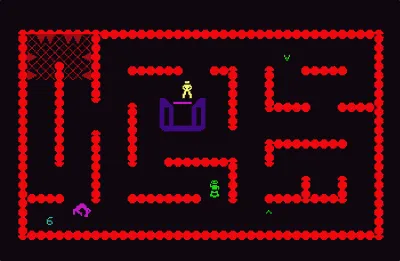
- Night Stalker: This was a Pac-man style maze, there were no dots to be eaten; you just wandered around while alien dudes tried to shoot you. This could have been a much cooler game if it had more levels or mazes, but we’re talking about 4K of RAM here.
- Tron Deadly Discs - This game was straight-up worthless. It wasn’t really a Tron game; it was just two emoticons throwing chunks of ASCII at each other. I would play it about once a month just to see if there was something I missed, but within five minutes, I’d realize how I was duped.
The worst part of the Aquarius was that Mattel Electronics went bust about 15 minutes after I got the system, so there was absolutely no support. The market exploded with add-ons for the Apple and Atari; the Commodore could use Atari joysticks, and you could buy tons of games, or buy any of the dozen or two magazines like Compute! and type in your own games. But there was no support for the Aquarius, and I could not buy any software or accessories. And this was long before you could hop on Amazon and search for stuff to buy. Aside from the lack of games, I did not have a disk or tape drive to save my own programs, and I couldn’t even print out my stuff to a printer. Every once in a while, I’d see the Aquarius mentioned in a computer magazine, but it was always a “what happened here?” takedown piece.
The biggest pain point to the whole thing is that Mattel had released a bunch of cartridges, including an extended BASIC and memory expansion, and planned even more stuff. The box for the system showed all of these unavailable items, and then had some black stickers covering pictures of vaporware items, like a master expansion chassis that would sit under the unit and provide a disk drive. There was also an Aqaurius II that was very briefly sold, that had a real keyboard and the extended BASIC built in.
My tenure on the Aquarius was brief; by the next Christmas, the Commodore 64 was on my list, and I graduated to its much roomier 38,911 bytes free and full-motion keyboard that wasn’t designed like a calculator you got for free at a Shell station when you bought a tank of gas. But we did play the hell out of those four games, though. And now my daily driver is a machine that has two million times as much RAM available. But that Aquarius is an interesting little footnote in my computing history.
And some linkage for you:
- http://www.vdsteenoven.com/aquarius/ is probably the best site out there for the Aquarius.
- http://www.reocities.com/emucompboy/ has an emulator.
- http://youtu.be/Tvmkpx9is1A - A video of the D&D game.
- http://youtu.be/cc7_yLdBPGI - The Tron game.
- http://www.intellivisionlives.com/bluesky/hardware/aquarius_tech.html - The Blue Sky Warriors, the team that developed for the Mattel systems.