The Wrath of Kon

Dispatches, thoughts, and miscellanea from writer Jon Konrath

Hello from Reno

It’s two days before thanksgiving, and I find myself in a deluxe suite at a casino in downtown Reno, which is roughly like staying at the standard room in one of the third-tier off-strip places in Vegas, but it’s not bad. Reno’s like a 1970s Vegas, one you can traverse without a car or fear of heatstroke, one where all-you-can-eat buffets are still a novelty. If you need a social and economic barometer to the climate here, this hotel has a free wifi connection that did not require me to provide an email address, retina scan, or colonoscopy to log in. It didn’t even ask me to check a box saying I agreed to their terms. That’s saying a lot, although I don’t exactly know what.

I ate dinner at a strange Basque restaurant that looked like a tavern in a gold mining town, where a heavily tattooed woman didn’t even ask for our order, just started bringing out trays of food. We’re here to see relatives, my wife’s relatives, but also to escape the ghetto and enjoy a few days of different scenery, a different bed, a different set of cable channels. There are no real plans, aside from the usual caloric marathon, and I will probably end up at every pawn shop downtown, looking for that elusive vintage Fender bass that someone’s accidentally priced at twenty dollars, which will never happen.

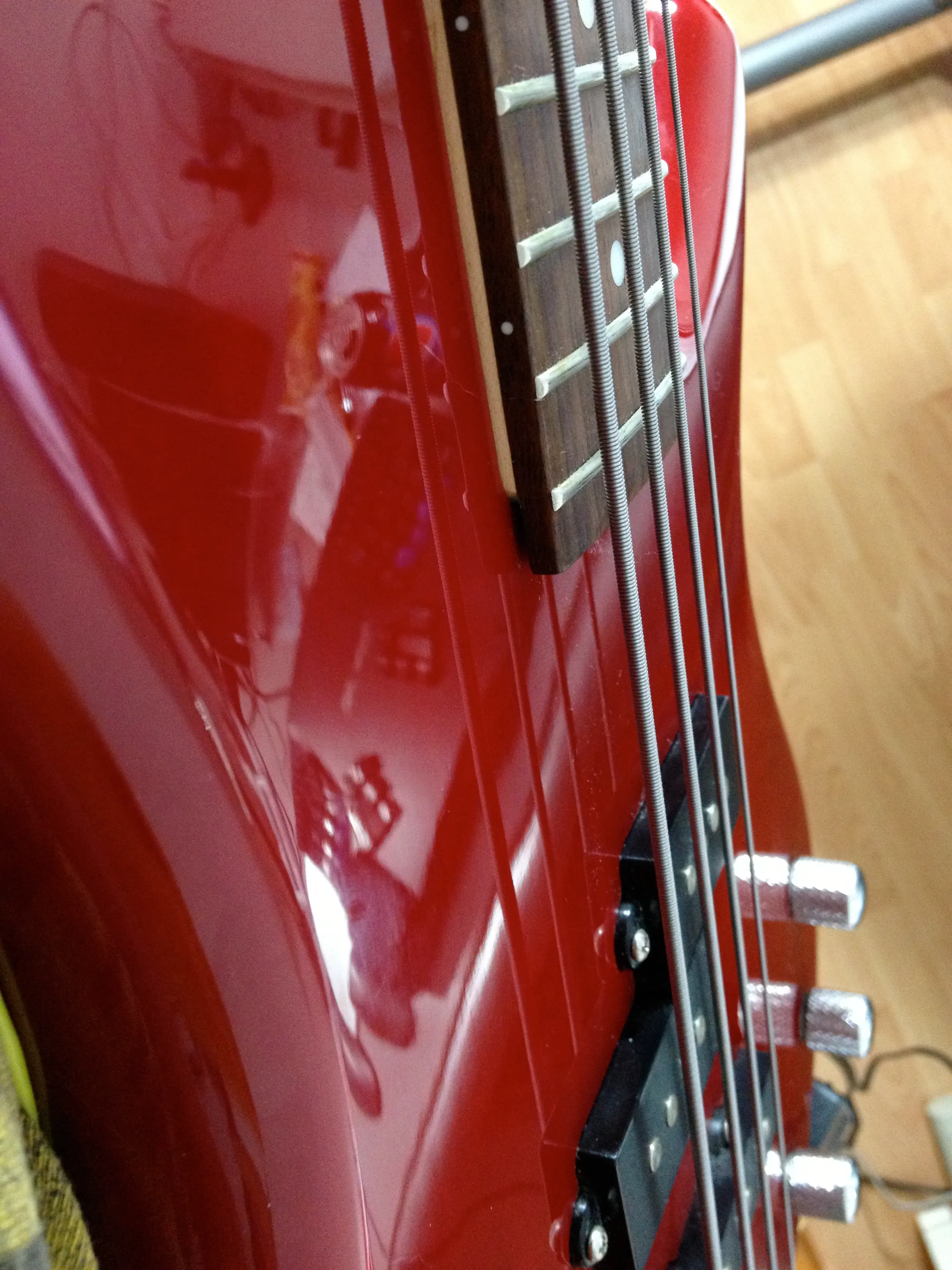
I haven’t been writing lately, but I’ve been playing bass almost constantly. I’m not any good, but the fingertips are toughening, and I feel like I’m more serious about it this time around. During my first tenure on the four-stringer back in the late 80s, I don’t remember ever practicing like this. I log the hours, use a metronome, play the scales, do the chromatics, stretch the fingers. F to A#. 123-234-456-654-543-432-217-1. Over and over and over. I’ve been playing Rocksmith, playing on Songsterr, playing through an instructional book. I want a new bass, but I’ve told myself I have to keep at it to justify the purchase. Until then, I cycle through eBay incessantly. This holiday will mean four days away from it, which seems like four days too long.

When we get back, a month of 2012 remains. I am maybe halfway through the next book, still untitled, still chipping away. I didn’t bring the book with me, didn’t bring my computer with me. I’m chipping away at this on my iPad, with my little bluetooth keyboard, which actually works well. I might try to free-write some of the crud out of my subconscious into the little screen while I’m here, and maybe something worthwhile will land here.

I’m avoiding the casino, not that much is happening down there. It’s very quiet, almost nobody around. A skeleton crew works the floor and the front desk, bored kids stuck in town, acting far too nice and being far too helpful. I think we paid $40 a night to stay here. It’s newly renovated, very modern and corporate and not at all like what you’d expect from an old Johnny Cash song about the place. Most of Reno has that look to it, that sense of despair, the motels with weekly and monthly rates, the beat places that will loan you enough money to do your laundry if you sign over your car’s pink slip. There’s a lot of “the dream is dead” if you travel a very short distance from the neon of downtown, but of course the scenic view of the river from the deluxe rooms screens that away a bit.

Anyway, it looks like it will be an interesting turkey day.

Movie reviews: Flight, End of Watch

I go to the movies every damn weekend, and I see some occasional good movies, a lot of okay ones, and a fair number of bad ones.  I never write this shit down, and maybe I should.  I just don’t want to turn into a movie reviewer and have to remember how many stars I gave what; I just want to remember that I saw a movie in the theater so I don’t rent it six months later and then find out ten minutes and six dollars later that I already saw and hated the damn thing.

Here’s the last couple of weeks:

Flight

Denzel Washington is an alcoholic airline pilot who manages to land a crashing plane without killing every person on board, antics ensue.  This movie was a straight down the middle C for me, because it had some suspense, but it was so goddamn formulaic, it was ridiculous.  Also, it made me go home and fall into a deep k-hole reading NTSB incident reports, which probably wasted a week of my time.

Denzel is a good actor, but I wouldn’t call this performance mind-blowing.  The theater was crowded as hell though, the temperature was 96 degrees, and they must have shown 90 minutes of trailers.

I heard little about this movie going into it, and expected more involving the plane crash, but that part of the movie ends quickly, and you go into this long-form alcoholic denial trip, which was okay, but I’ve already seen that after-school special.  I’d give this a strong three and a half stars out of five, and it’s a good rental, but you probably won’t catch this one on the plane.

End of Watch

There was nothing to watch this weekend, so we went and saw this.  I hate to harp on a movie for being plotless, since I basically write plotless books, but this was a plotless movie.  It’s basically a character study about these two cops driving around south central LA, with a lot of detail about their respective wife/girlfriends, a small amount of detail on inter-office politics at a police station, and a largely wooden story about Mexican cartels.  The whole thing is shot to look like it was taped on video cameras as part of a school project, like a “found footage” thing.  But this combined with the generic suspense of the story made me feel like I was doing tape tracking of raw footage for COPS episodes.  Seriously, about an hour into it, I got this weird disassociated feeling, and thought “am I still watching a movie?”  It sort of felt like I was sitting through a TV show I had no interest in.

Takeaways to this: Jake Gyllenhaal could totally play Paul Ryan in a biopic if he got the right hairpiece.  Anna Kendrick looks suspiciously like Adam Scott (Ben on Parks and Rec) and that always bothers me.  I won’t spoil the ending, but it’s stupid.  2/5.

The perks of being a blocked writer

Okay, in my last post, I alluded to being stuck between two places writing-wise, and I didn’t get into that.  So, now I will.  But of course, I’ll go off on another tangent first.

I saw the movie The Perks of Being a Wallflower this weekend, mostly because I heard Cloud Atlas was a disaster.  I wasn’t entirely sure I would like the movie, partly because I thought it was completely out of my demographic, and partly because I’ve read the book at least twice and don’t remember a damn thing about it.  But I went, and I actually liked the movie a lot.  I liked it so much, I came home at ten at night, picked up the book, and plowed through the whole thing before I went to bed.  And then, as I went to bed and after I got up in the morning, I felt… I don’t know.  Maybe a mix of depression, nostalgia, enthusiasm, and dread, the emotional equivalent to when you get a fountain beverage and randomly fill it with a mix of every flavor, a Pepsi-Mountain Dew-rootbeer-orange-Sierra Mist-tea.  And it’s hard to describe it, because there were a few different things going on, and I’d have to explain every one of them to cover this.

First off, Perks had the typical high school coming-of-age tropes in it, opposites-attract, she’s-out-of-my-league, grass-is-greener, self-medication with drugs, rock-will-save-us-all, early-90s-are-the-new-80s, and about 17 more.  It’s all weaved together well, and maybe I feel bad for liking such commercial dreck.  It did contain enough emotional context that linked to my own teen experience, though, that it made me really enjoy and envy it.  The envy part is the big problem.  The reason I avoid reading these kinds of books now is that when they’re good, I want to write them.  And I’ve proven to myself that I can’t, and I shouldn’t.  But should I?

My last three books have all been a sort of mix of lowercase-b bizarro and absurdist humor.  I think they’re pretty damn close to my voice, and I think any of you who have read these books and have known me in person would agree.  Throw Rumored at the front end of that trio, and you’ve plotted a glide slope that pretty much defines who I am or who I will be as a writer.  It’s a solid 750 pages or so of work that very much describes what’s going on in my mind and sets the pace for what my next books should be.  After I finished Sleep Has No Master a few months ago, the plan was to write a Rumored 2 of sorts, maybe a different structure or gimmick, but a full-sized, nonlinear hunk of absurdity that did what Rumored did ten years ago.  I’ve even got a publisher that’s basically waiting for me to write the next book, so they can put it out.

But then, I sort of locked up.  Part of that is the reception of the last book, which has been piss-poor at best.  I think it’s a damn good book, but it’s been sort of lost in the mix.  Maybe the title and cover make no sense, or it’s the fact that it just doesn’t easily plug into a genre.  But it hasn’t sold, and it’s always hard to get working on something new when the last thing didn’t entirely work out.  There’s also the fact that I essentially put together three books in a period of just over a year, and the well is kinda dry.  I really wanted to push and get another book done by the end of the year, but I’m finding myself stumbling on ideas.

The other issue is that I don’t entirely know where I fit in.  I said lowercase-b bizarro because the more I read from the Bizarro movement, the more I think I don’t slot into it very well.  Most Bizarro is this sort of Troma film horror-comedy stuff, and I don’t really do that.  But I also don’t fit into the experimental or absurdist worlds, either, which seem to be the PhD-dominated academic community.  And forget the mainstream scifi community.  I probably spend too much time thinking about community and where I fit in and all of that shit, and I guess I’ve always worried about that, even before I was a writer.  But I can’t shut it off, and I don’t have easy answers, and it can become enough of a distraction to block me.

And… sorry, another tangent… okay, I read this biography of David Foster Wallace, and it talks about how he thought Mark Leyner was the antichrist because his satiric writing wasn’t sincere, or something like that.  And when I read that, it sort of pissed me off, because I love Leyner’s writing, and it made DFW sound like a blowhard.  But with all of this stuff in my head, it started to make sense.  I love writing the stuff that I have written in the last couple of years, but if I had to capture and dump the emotions I felt during this film and book, I think it would be completely out of scope of this absurdist humor thing.  I mean, I could start to throw down a coming-of-age tale, but it would be about a kid who goes to high school to learn how to anally insert DMT into zoo animals from his teacher, Lyndon LaRouche.  (Wait, gotta write that down in the idea book…)

I’ve tried this kind of sincere, modernist, realist writing.  I’ve had some success at it in short stories; if you’ve read my story “Burial Ground,” I think that’s pretty spot-on of what I can do.  And some of you (okay, three of you) may have read Summer Rain.   I have two other books up on blocks in the yard like the trailer park Trans Am with no motor or wheels, one about high school, and another about college.  Summer Rain was the best of the three; the other two, there’s about 150,000 words of nothing.  Every now and again, I think about going back and trying to duct tape enough crap onto either of those manuscripts to get them out there, but Summer Rain itself isn’t selling.  I think I’ve learned a lot more about plot and character since I tried writing these other two books, and when I see them, I do see what’s wrong with them, and think about how I could restructure or rewrite them so they would fit.  But part of me thinks this would be a huge step backwards.  And it’s a tough wall to beat against.  It’s also depressing to think that even if I did manage to turn out a stellar coming-of-age book about growing up in the 80s in Indiana, I would have a tough road ahead of me in the marketing and sale of the thing.

So, caught between two worlds.  And this is why practicing bass instead of writing has been very helpful lately.  I have 40,000 some words written of this Rumored 2 project, and it makes absolutely no sense right now.  I know I will have to eventually knock back into it and come up with a structure and get the thing done, but it’s tough.  Playing major scales against a metronome until my fingertips look like ground hamburger is much easier.

Back to bass

me-fretless-1990

I have not been writing.  I’m sort of stuck between two places.  More on that in a bit.

I went into my usual writer’s block mantra of “I wish I did something other than write”, which motivated me to go to our storage locker and pull out my bass guitar and amp.  Before I put pen to paper, I used to play bass.  I sold my first bass when I left Bloomington, and in a strange act of serendipity, I saw a used bass exactly like my first one the week I left Seattle, and had to buy it.  I think I played it a total of five times before it went into storage forever, because I was too busy writing books and had all but forgotten how to play.

And I’ve dragged the thing across the country 19 times or whatever, and have not touched it since probably 1999.  But like I said, I had this urge to go buy a guitar or learn to paint or draw or do anything other than write, and I had this thing sitting in storage, so I brought it home, and thought if people who have strokes can re-teach themselves how to talk at the age of 80, I can re-teach myself how to play bass at 41.  Right?

I have this Cort headless bass. A cheap cousin to the Steinberger bass, it screams 1980s in a way big hair never could.  It’s got bad tone and a little fret buzz and the pickups need to be adjusted and I can’t get them right, because the E string is way louder than everything else.  But it’s still in once piece, and it works, and it was a number of Franklins cheaper than going to Guitar Center and buying a new one.

My original Cort was actually my second bass.  My first one I bought from the JC Penny catalog towards the end of my senior year of high school.  It was all plastic and China and stayed in tune for about seven minutes in a row, if you didn’t touch it.  My high school graduation present to myself was this Cort bass, which I saw used at a store in South Bend on a day I happened to have all of this graduation money in my pocket.  The electronics were stripped out of it, just the pickups and bare wires, no back cover and three holes where knobs were supposed to be.  I never really got the thing wired well, and always had problems with RF interference.  I got it refretted when I was a freshman in college, and traded that JC Penny bass for the fret job from a luthier student named Dorian.  (Never asked if he had brothers named Mixolydian, Locrian, etc.)

I’ve forgotten almost everything about music.  And my fingers are doing even worse.  I started trying to play scales and whatever little riffs I could remember, and my digits are nowhere near close to being in the right places.  Every other note is early or late or buzzing or uneven.  I wasn’t really sure how to proceed, so I started googling, and got information overload.

When I first learned to play the bass, it was 1989.  We did not have youtube.  I can now pull up instantly any number of instructional videos and pause and rewind and watch these guys explain and play and theorize and show off.  We had VHS back then, but that sucked.  I had a dub of a Stu Hamm instructional video, but one of my sisters recorded over it, and you couldn’t pause and rewind like you can now with DVDs.  I think our old VHS was one of those pieces of shit where hitting pause and then rewind took 19 seconds, and it made all of these clunking noises like a big block chevy running with no oil in the pan.  That’s all changed.

When I used to want some tab to learn new songs, I would have to walk to the music store (uphill, both ways) and get some shitty Mel Bay book that would have tab for “When The Saints Go Marching In” or whatever.  Now, there are a million web sites that have tab for days that you can download and print at home.  And there’s a site that plays the tab like a player piano, playing the guitar and drums so you can practice along with it.

The internet has also changed how you shop.  Nothing beats going to a guitar store and trying everything out, but when I was a kid, the music stores in Indiana were shit, and had the bare minimum of stock, all marked up to hell.  When I had to get strings for my headless bass — it takes strings with a ball on each end — I had to drive to Chicago, and pay something like $50 for them.  Now, Amazon, one click, done.  In and out for $25.  And ebay — jesus.  Put “Fender Jazz” into ebay and see where all of my time on the couch in front of the TV is going.

I can also plug my bass into my computer now, which is freaky.  It used to be you would save up a paycheck or two for one of these PortaStudios, which were really finicky about what kind of tapes you used and how often you cleaned them, and would lose quality after each generation of recording, and you still had to deal with a running tape and punching in at the right time and all of the hassles of analog.  Now, I fire up garage band, drop in some loops, and click to my non-linear heart’s content.  It’s very amazing.

Things are slowly coming back to me.  I’m obsessed with practice.  I’ve promised myself that for every hour I practice, I have a dollar to spend on a new bass.  I practiced five hours yesterday, and my left fingers are hamburger.  My technique has a long way to go, but I’m remembering theory, slowly.  It’s been a lot of fun.  It’s a lot more fun than banging my head against the wall because I can’t write.

About that, I guess I mentioned at the beginning of the post that I would talk about that.  But I’m out of time and this is a thousand words already, so maybe next time.

The Recognitions by Steve Urkel

The Recognitions, published in 1955, is American author William Gaddis’s first novel. The novel was poorly received initially, but Gaddis’s reputation grew, twenty years later, with the publication of his second novel J R (which won a National Book Award), and The Recognitions received belated fame as a masterpiece of American literature.

Steve is the epitome of a geek/nerd, with large, thick eyeglasses, “high-water” or “flood” pants held up by suspenders, multi-colored cardigan sweaters, and a high-pitched voice.[6] He professes unrequited love for neighbor Laura Winslow, perpetually annoys her father, Carl, and tried to befriend her brother, Eddie. Amongst the rest of the family, Harriette, Rachel, and “Mother” Estelle Winslow are more accepting and caring of Urkel.

The story loosely follows the life of Wyatt Gwyon, a Calvinist minister’s son from rural New England. He initially plans to follow his father into the ministry, however, he is inspired to become a painter by The Seven Deadly Sins, Bosch’s painting in his father’s possession. He leaves and travels to Europe to study painting. Discouraged by a corrupt critic and frustrated with his career he moves to New York. He meets Recktall Brown, a capitalistic collector and dealer of art, who makes a Faustian deal with him. Wyatt creates paintings in the style of Flemish and Dutch masters (such as Hieronymous Bosch, Hugo van der Goes, and Hans Memling), forges their signature, and Brown will sell them as newly discovered antique originals. Soon Wyatt is discouraged, goes home only to find his father converted to Mithraism and losing his mind. Back in New York, he tries to expose his forgeries, then travels to Spain where he visits the monastery where his mother was buried, restores old paintings, and tries to find himself in his search for authenticity. At the end, he moves on to live his life “deliberately”.

Throughout the series’ run, Steve is central to many of its recurring gags, primarily gratuitous property damage and/or personal injury as a result of his inventions going awry or his outright clumsiness.[7] He becomes known for several catchphrases uttered after some humorous misfortune occurred, including “I’ve fallen and I can’t get up!” after he accidentally got drunk in one episode and fell off the edge of a building, “Did I do that?” (previously used by Curly in the 1934 Three Stooges short Punch Drunks), “Whoa, Mama!” and “Look what you did” (if, rarely, someone else caused the damage). Additionally, he frequently insinuates “You love me, don’t you?” to Laura Winslow, the usual object of his affection.

Interwoven are the stories of many other characters, among them Otto, a struggling writer, Esme, a muse, and Stanley, a musician. The epilogue follows their stories further. In the final scene Stanley achieves his goal by playing his work at the organ of the church of Fenestrula “pulling all the stops”. The church collapses, killing him, yet “most of his work was recovered …, and is still spoken of, when it is noted, with high regard, though seldom played.”

Steve Urkel first appeared on the twelfth episode of the first season, “Laura’s First Date”, as a nerdy young boy who took the character of Laura Winslow out on a date, where he appeared as being madly in love with her, but in an example of unrequited love, Laura did not return these feelings because of Steve’s nerdy, infuriating personality. Although intended to only appear once, White’s portrayal was very popular for his humorous, geeky antics. After appearing on other episodes, he joined the main cast.[8] All throughout the course of the series, Steve maintains his extreme infatuation with Laura and regularly invites himself over for unwanted visits to her house, much to the annoyance of the Winslows. Among Steve’s other famed character traits include his exceptional scientific skills, crafting devices that would be impossible to construct in reality, his absurdly destructive clumsiness, and his kind heart.

Gaddis spent seven years writing The Recognitions. The novel began as a much shorter work and as an explicit parody of Goethe’s Faust. During the period in which Gaddis was writing the novel, he travelled to Mexico, Central America and Europe. It was in Spain in 1948 that Gaddis read James Frazer’s The Golden Bough. Gaddis found the title for the novel in The Golden Bough as Frazer noted how Goethe’s Faust originally came from the Clementine Recognitions, a third-century theological tract (See Clementine literature). It was from this point on that Gaddis began to expand the novel. The novel was completed in 1949.[3]

Steve is commonly known and respected by other characters for his kindness to others, his never-ending love and loyalty for those he holds dear, and, alongside with Harriette, his position as a voice of reason and source of wisdom for the often bickering members of the Winslow family, all of which are the redeeming qualities for his generally unwelcome or tolerated presence. He always cares for and means well for other people, but is often the misunderstood victim of the Winslows’ anger and rejection, especially of Carl, Eddie and Laura, who all struggle to see through his clumsiness and annoying behavior and to understand and appreciate him for his positive traits.

The character of Esme was inspired by Sheri Martinelli and Otto has been described as a self-deprecating portrait of the author.[6] “Dick,” a minister, is a reference to Richard Nixon.