About Atmospheres 2
Ninja weapon shortage. College football shoe scandal. Record humidity — supersaturation — dew point of complete absurdity. A group is claiming they have the legal constitutional right to storm the cockpit of any commercial flight and take over the controls of the jet because Jesus said you can in the new American edition edible picture Bible. On some Sunday morning talk show, an old man in a Punisher muscle shirt pointed at the fine print on the back of a yellowed Hooters Air ticket, interspersed with the same commercial for a meat gun filled with liquid bacon the station played every 90 seconds. A few days from now, seventeen flights would get emergency diverted, two shot down by F-22 interceptors. A thousand deaths, eight million dollars of AIM-120 AMRAAM missiles in action, who knows how many insurance settlements for families of the deceased. People don’t know when to say when anymore.
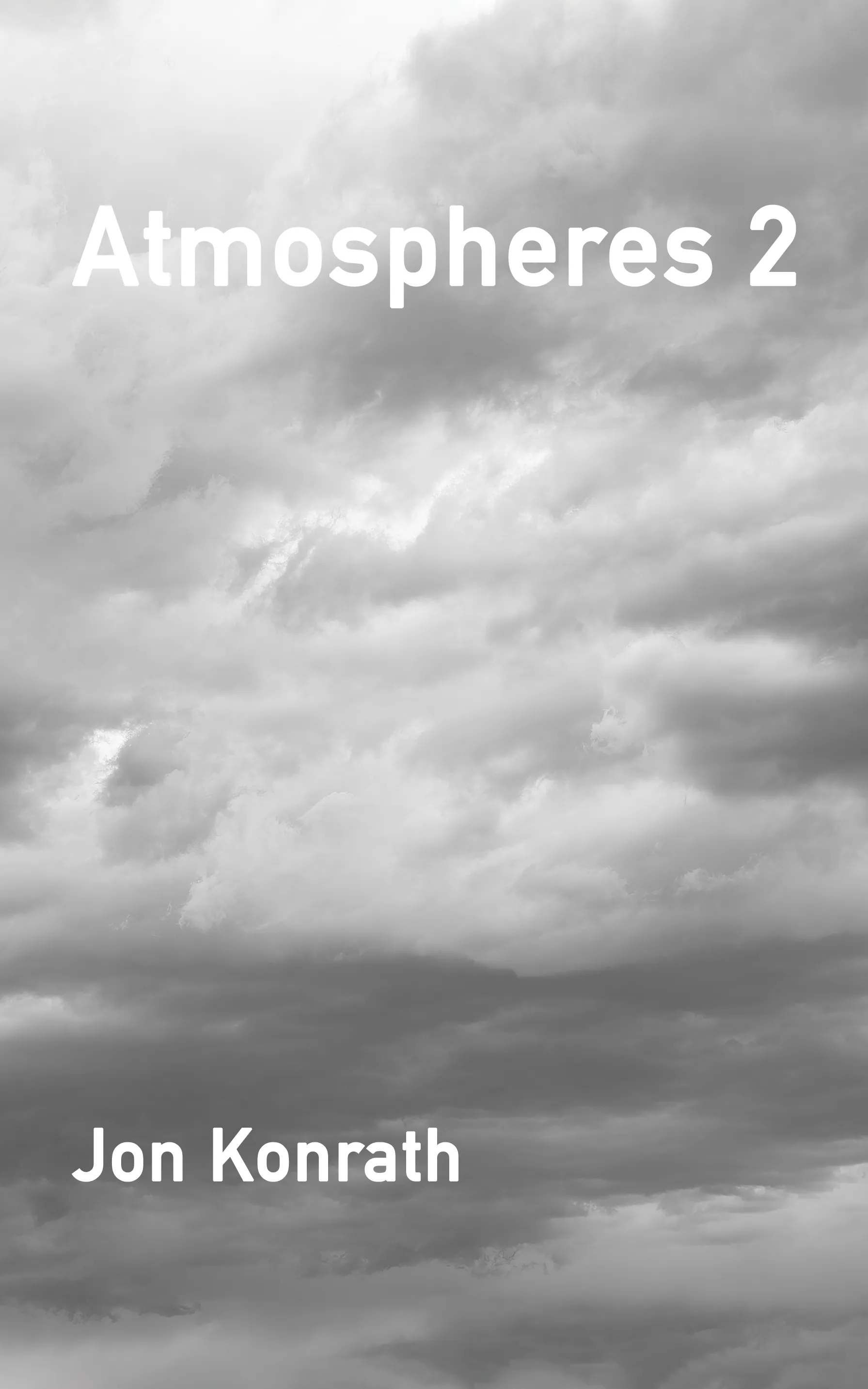
Atmospheres 2 is out now in print and on Kindle. There’s not much more than the back cover description out there, so I thought I’d talk a bit more about the book.
Atmospheres 2 is an experimental novel that’s about living in an apocalyptic world where reality is no longer real, or it’s impossible to separate reality from several chaotic monetized alternate realities that people think are real. Sound familiar? It’s not a conventional high-concept sci-fi thriller with a solid plot device to carry you through a precise three-act arc where the anti-hero saves the day. It’s a full-on barrage of absurdity, a collage that covers several distinct themes throughout the book.
When I say experimental, what I mean is there isn’t a conventional narrative, but instead a series of loosely interconnected stories with recurring characters and motifs that follow a through line through the book. It’s 100 segments, arranged in three acts, each segment a thousand-word world of its own. Half of them are third-person and half of them are first-person, following an unnamed Trusty Narrator through the chaos. At one level, it’s like flipping through a hundred random channels of cable TV, tuning in to a specific story or scene, then changing the channel. But sometimes an idea appears, vanishes, and comes up later in an altered form, consistently poking at the question, “What is reality?”
The book takes place in a near-future reality, a shifting landscape of corrupt corporate America, dead malls, abandoned cities, desolate highways, anonymous hotels, and the debris of a failed society that’s been pumped full of stimulants and electrons of every format. Aside from the interleaving pieces jumping between the Narrator and reality, the book shifts from conversation to road journal to cable news to corporate press release to cultural criticism to disaster reporting.
There are three distinct acts in the book, and they help define the different themes that run through the entire novel:
-
Act 1 - Atmospheres focuses on the alteration of perception by technology. Social media, fake news, corporate prestidigitation, and manufactured celebrity are all explored. I know this can be trite and overplayed these days, and everyone’s writing about enshittification and why kids need to get off their damn phones. I think like the other themes in the book, I don’t lean in too hard on one side of the issue, but just show the absurdity and madness. This questions whether reality is real or just an unstable simulation built from brands, sound bites, manufactured media, and algorithms.
I write a lot about the hellscape of unchecked corporate consolidation. It’s a world 99% owned and operated by the Fortune 5, where the same hedge fund that owns Arby’s, NASA, and Comcast also has control of the Air Force Global Strike Command and 2/3s of the American nuclear triad. Amtrak is now owned by Chuck E. Cheese, which is owned by Fairchild Aircraft, which is a division of Amazon. Pfizer bought Jack in the Box so they could sell their own customers heart medication. Boeing (which is a divsion of McDonald’s) had their sister company Northrop Grumman buy Proximo Spirits to distill fuel for their space program’s rockets. It’s all unregulated. It’s all for sale. It’s all completely absurd, but at least three times in the last two years of writing this book, I had to completely change a major plot line because something actually happened in real life. (Pizza Hut really got bought by a private equity firm that sells coffins? Yep.)
-
Act 2 - Nightmares is about how this altered reality surfaces as violence and chaos. The main theme in this part of the book is “the cruelty is the point.” Corporations monetize suffering; authority turns to brutality to feel powerful; politics becomes completely corporate, only existing to turn resentment and loathing into common identity. The spectators of this reality watch on the sidelines until the sidelines collapse into disasters, plagues, and a catalog of horrors.
The Narrator experiences what I feel every day: how do you navigate this when you don’t feel like either side? When nothing is real anymore, what is your reality? When the corporate ladder collapses leaving nothing to climb, what do you do in life? Does this hyper-reality of artificial identity mean you’re locked into the identity you formed with your social media, online purchases, and corporate history? Or does everyone’s obsession with this chaos and your lack of importance in the world mean you have total freedom?
-
Act 3 - Visions is where the book turns much more surreal and dreamlike, where time loosens and reality completely collapses on itself. No spoilers here, but as the outside world turns to a complete apocalypse, the Narrator’s inner world drifts into a place where memory, fantasy, and experience completely melt into each other.
Oh, and it’s a comedy. Many LOLs ensue, trust me.
This book is probably more political than any of my other ones, but I don’t lean heavily into hack political satire. It’s also, despite everything that happens on the surface, probably one of my most deeply personal books. It’s about aging, regret, resentment, depression, and mortality. It’s about attempting to escape, be it with work, travel, addiction, food, or nostalgia, and how none of those provides a real exit.
Like I said previously, it took me almost 12 years to write this book. It constantly mutated as I changed and the world changed. I don’t feel I could ever really finish it, so I’m happy I was eventually able to reach a stopping point and present this to you. I hope you get a chance to read it.