The Wrath of Kon

Dispatches, thoughts, and miscellanea from writer Jon Konrath

Tag: books

My new book Decision Paralysis is out now

Decision Paralysis book

I’m very happy to announce my 18th book, Decision Paralysis, is out now.

TL;DR: Amazon print and Amazon kindle links.

I did not think I was ever going to write another book. I quit writing completely in 2021, and spent at least a year 100% away from it, not even calling myself a writer, not sure what to do with my life except work, eat, and sleep. But I’ll always be a writer. I could not quit. And I needed to tell myself that I had to write the next book, even if nobody read it, even if the market had completely vanished and would be replaced with dumb AI-generated murder mysteries that end on a cliffhanger with a link to buy the next of 29 books in the series. The algorithm has killed everything, but it has not killed me.

I spent the first few months of 2024 knocking around a few other projects before I got to this. On 5/27/24, I started this book in earnest, with only a title and about 8,000 words of scraps. By the end of July, I had the idea that this book would be the spiritual successor to The Failure Cascade, which I’d re-released a few months prior. I wanted longer stories, more bleak, more introspective, and with a thickness and depth I wasn’t getting in the short micro-fiction or flash I’d been doing in the last decade.

Aside from telling myself “just write,” the biggest change in my work habits was moving my writing time to mornings. Waking up at 3:45 and sitting in my office in darkness for a few hours listening to weird ambient music put me in a different headspace and made the words start to add up. I think in early August, I crossed the 50,000 word mark, and that was the original intention. I’d originally had these short flash interstitials between stories, and at some point, I pulled all of them out and focused just on the stories. I also started footnoting things, which may be devisive, but I had fun with it.

A bit of an easter egg and a change is that the titles of each story are latitute/longitude coordinates. They have meaning; that’s all I’ll say. I’ve had a very specific format for titles that I think were funny, but as I am battling this persona problem, I think I got backed in a corner with them. I found that the people who thought the goofy titles were haw-haw funny were also the ones who basically didn’t get what I’m trying to do with my writing. So, clean break from that.

It’s also always bugged me when my stuff was too short, or perceived as such. I mean, some of the books are; The Failure Cascade is 37,565 words. Any time someone told me, “It was so great because I could sit down and read it in one sitting” it was a bit of an insult, especially when that was basically my annual output of 2020. So I purposely went maximalist on some of the stories here. The best/worst example is the titular story of the book, which is 16,000 words. For comparison, 2017’s Help Me Find My Car Keys And We Can Drive Out! — the entire book — is 30 stories that total 15,848 words. That story is like “The Aristocrats” in that it was long and essentially useless (at it’s core, it’s about someone trying to buy lunch who can’t find anything to eat) and at like 3,000 words, I thought it was getting excessive; at about 5,000 I thought “I should just make the whole book this story” and it quickly shot up to 10,000 words. It took another 6,000 to finish the thing, and it’s about everything but ordering food now.

This book was therapeutic to me. I think I was able to explore a lot about why I’m here and what I’m doing. I’ve struggled a lot in recent years with the big dillema of what I am and how I’m supposed to finish the rest of my years. I have no children and no legacy, and there’s honestly no hope that any of this writing exists beyond me. I could write a lot more about this, but the TL;DR is that I covered some of it here, and I probably need to do more.

Final tally: 20 stories; 412 pages; 101,834 words; 249 footnotes.

The description from the back cover:

Euthanasia drug MLMs. Deep-fried lard rumored to have mystical healing properties sold at pirate-themed restaurants. Existential crises about dollar-menu tacos and light therapy. Is this your average terror nightmare, or just another Thursday where mind-reading dolphins are dialing 1-900 numbers to spill secrets about how DARPA taught them to master Minesweeper?

Decision Paralysis by Jon Konrath is a surreal and darkly comedic exploration of absurdity and modern disconnection. The book plunges into a fragmented narrative where dystopian satire meets introspective nihilism. Inside, you’ll find twenty deranged tales of John Denver Illuminati theories, Taco Bell stealth tanks, Cambodian pizza chains that secretly sell time machines, and bitter online arguments about whether Norwegian timber tariffs of the 1800s ruined Chicago deep dish forever. The chaotic tales, blending dystopia and the grotesque, offer sharp humor and biting commentary, leaving readers grappling with questions of meaning, choice, and the absurdity of existence.

A biting critique of consumer culture, decision fatigue, and the search for identity in a fractured world, Decision Paralysis is both a satire and a deep dive into the human psyche. Fans of sardonic humor, speculative fiction, and offbeat storytelling will find much to enjoy in Konrath’s latest offering, which deftly combines outrageous comedy with an undercurrent of raw, philosophical truth. This is a book that will leave readers laughing, thinking, and questioning their own paths through the maze of modern existence.

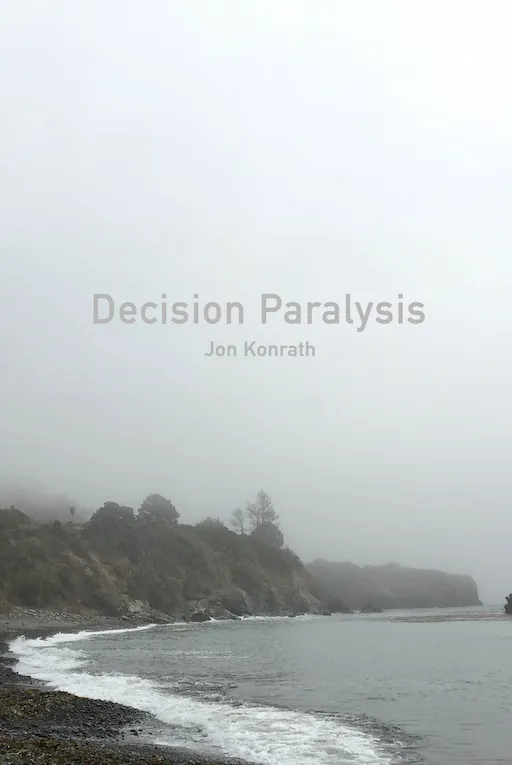
The cover: it’s from Van Damme Beach just south of Mendocino. Failure Cascade’s cover was shot on the same 2017 trip, about three miles north. It was a color image that was filtered down to black and white; this image is color, but looks almost monochromatic. I love when a photo ends up like that.

Anyway, that’s that. I hope you check it out. I am not sure what’s next, but I have a list of stuff to do, and two big books past the first draft stage, so we’ll see what 2025 brings.

Reading

EK_0001

I have to admit, I have not done any reading for pleasure since I quit writing in 2021. I have completely lost the plot, so to speak. I have been reading, but it’s either books for work, school, or self-help stuff, none of which I would want to review here. (TL;DR read Measure What Matters, High Output Management, and Radical Candor for the first one.) And when I am on a trip, I usually grab the latest copy of The Economist and read it cover to cover, which might not be your cup of tea.)

Ignoring those books, here’s a rough list of what I did manage to read since the fall of 2021. This doesn’t include re-reads, of which there were a dozen or so. (A bunch were mine, and I re-read Small Town Punk every other year or so.)

Predator: A Memoir, a Movie, an Obsession by Ander Monson

I read Monson’s book Vanishing Point: Not a Memoir back in 2020, and it was the kind of book I loved because it was such a great reading experience and hated because I wish I would have thought of the idea first, and now feared I would subconsciously copy when trying to write something out. It could be classified as perfiction ala Raymond Federman, but the voice of it was nothing like Federman and was more contemporary, yet still a bit weird. Predator, which is a memoir this time, is a strange combination of a film studies book and a memoir, in a different style than the previous, but still weaving between the two, and also something I wish I would have thought of first.

The bullet is that Monson was obsessed with the movie Predator as a kid, and watched it constantly, until it bled into the fabric of his early life. I did the same thing with a few movies, most notably RoboCop, so I get it. But Monson also had a traumatic childhood, losing his mother at an early age, bopping around as a borderline truant in the upper peninsula of Michigan with friends who would later join militias, then getting in trouble for computer hacking. I think that Midwestern not-the-cool-kid thing resonates with me, which is what drew me in to this obsession.

He claimed to have watched the movie 146 times, and practically dissects it frame-by-frame. While he covers the surface themes quickly, like the general zeitgeist of 80s action movies with tough guys (who might or might not be gay) he stumbles upon several interesting angles. One is that the quickie novelization of the book was written by Paul Monette, who is better known for winning the National Book Award for his nonfiction memoir about growing up in the closet. Monette died of AIDS in 1995, and published Borrowed Time: An AIDS Memoir the year after the Predator novelization. The book details his own experience and the loss of his long-time partner, who passed from the disease in 1986. Most people would posit that these muscle action movies were secretly homoerotic, which juxtaposes oddly with the fact that the book was written by a gay man. That’s one of about 17 different tangents that Monson goes off on as he goes through the film, and all of them are equally as interesting.

The book is simply amazing in how it weaves these contrasting narratives together, each which is interesting, but all together made it even more engrossing. This is by far the best book I’ve read in a while.

The Nineties: A Book by Chuck Klosterman

Chuck Klosterman is another author who writes these things with incredible resonation with me, and make me upset I didn’t write the same damn thing first. I think I’ve had a 90s book sitting on my hard drive for years and can’t pull it together, but Klosterman did, so. There are a lot of rants in here that I’ve similarly covered here in the blog or on my old podcast, and I think one of the common threads is that GenX is largely forgotten because the generations before and after us won’t shut up, and we didn’t live up to our catchphrase slogan as “slackers” because we actually got jobs and did stuff.

There were a few things he undersold or theories I found to be off. Like he largely dismisses Y2K as a big nothingburger, but as a person in tech who probably sat through a cumulative year of meetings about it starting in like 1993, it was a big thing to some of us. (Aside: I think I tried explaining Y2K to one of my teachers in the late 70s and they wanted to put me in therapy.) I think one of the most frustrating things about Klosterman’s books is I always wish they were a conversation and I could add more to it. I could blog about them here, but then it would look like I’m ripping him off.

Good book, though. It does peter out towards the end, but so did the Nineties.

LaserWriter II: A Novel by Tamara Shopsin

Multiple people told me I had to read this. I did, but it didn’t click for me. As a person who lived in New York in the late 90s and spent a big chunk of time unjamming LaserWriters for a living, it seems like it should. I barely remember this book, so let’s move on.

Lago by Ron Jude

This is an incredible photo book where Jude goes back to his childhood home of the Salton Sea area in the desert of Southern California to try to do the detective work to find out who he is. The photos are absolutely mesmerizing, a contrast of tack-sharp focus and minimalist detail, wandering a palette of browns from the sand and desert vegetation. The landscape is familiar to me, but the composition and grouping resonates in amazing way. It’s like his lens for looking at the scrub brush of Salton City is captured in such a way that I can imagine looking at my own childhood landscape in the same way. This wasn’t a cheap book, but I come back to it constantly, and it was worth it.

Stephen Shore: Uncommon Places: The Complete Works by Stephen Shore

Stephen Shore was a New Yorker who had never seen the country, and decided to drive across it with a large-format camera in tow, and find beauty in the obscure and forgotten areas between the two shores. He absolutely preserved the history of this time not by taking pictures of events or famous architecture or the usual landscapes, but by wandering roadside motels and tiny towns and gas stations. In some ways, the subject matter at first glance might be the kind of thing you’d quickly shoot with your phone and forget: a plate of pancakes, a parking lot, the back side of a brick warehouse. But when you look closely, the composition is absolutely perfect, the way your eye wanders through the pieces of the puzzle. The more you examine each picture, the more details you see, the more things captured. The faded tones and the sepias play wonderfully against the old cars and wood-panel hotels. Like Jude’s book, it’s less about the content in the picture and more about the filter in Shore’s brain that put the content there and what it tells us. It’s an absolutely wonderful book, and probably my favorite photo book I come back to constantly.

Novelist as a Vocation by Haruki Murakami

I have to admit that after getting through 1Q84, I was pretty much done with Murakami. But this book is more memoir, and a very inspirational one. He details his road to writing, how he writes, his rituals and how he comes to ideas. This is a series of essays and not so much a how-to book, but there are many good ideas to be gleaned from it. I think he is pretty polarizing about certain things, and it’s definitely not “I can write and after reading my book, so can you!” But it was an interesting read.

I think one of the things he mentioned that rang true to me is that being a career writer is less about writing one or two books, but about having the endurance to keep writing books year after year. And maybe that hit me because I read this after quitting writing, and maybe I need to take his advice.

Strange Circumstances: 34 Stories by Keith Buckley

The weird thing about reading Keith’s stuff is that this is his second book, but I’ve been reading him for thirty-some years in discussion boards and internet posts, so any of his writing immediately has a decades-old familiar voice to me. Full disclosure: I helped him publish his first book, The Orphic Egg Caper, which was a surreal pulp crime novel, of which the biggest crime is that nobody read it and they really should. Strange Circumstances is a collection of shorter stories and flash fiction, ranging from pulp to absurd sci-fi to satire. This is a great introduction to the weirdness to be found in his work. The kicker is I know he’s sitting on thousands of pages of this stuff that needs to get out, and I wish he could get to a bigger audience to put some sense of urgency on him that he needs to keep editing and stop spending all day generating AI images of Cthulhu getting a high colonic and messaging them to me.

The Failure Cascade, revisited

failure-cascade-kindle-cover-small

So, much like I recently did with Book of Dreams, I recently re-read my 2020 book The Failure Cascade, and made the decision to republish it.

TL;DR - here: https://amzn.to/3JwiUu7

My description of this book from a long-deleted post:

This is […] a bit of a departure because although it contains a few super-short flash pieces, there are also four much longer stories. I felt a need to stretch out some stories a bit, and spend more time in them, so instead of a bunch of sub-thousand word things, there are some that go beyond the 3000-4000 word mark.

This isn’t like a major departure from what I’ve done in the last few books, but it is starting to move away from it. For almost ten years now, I’ve tried this absurdist/gonzo thing, and I feel like I’ve painted myself in a corner a bit. I’ve burned a lot of cycles creating a persona I now can’t stand. I’m not exactly ready to go off and write murder mysteries or tales of martians or anything, but I feel like the part of my personality I’ve mined for stories in all of my books in the 2010s has been stripped away, and I need to start doing something else. I write about this a bit in the title story of the book.

This was a difficult book to pull together. I mean, the problem was this year, 2020, and everything shitty that happened to all of us. I took a little break after Ranch, and when I went off to Vegas in the first week of March, my goal was to hole up in a suite and spend seven days starting to build out this work-in-progress which was to become Atmospheres 2. And just as I got into that, the whole world ended and we got locked down and… well, you know the rest of that story, and it’s still ongoing. As the pandemic built, I worked on the book, and got it above 100,000 words. (The original was 60,000.) But the more I got into it, the more it didn’t make sense. And the idea of writing a manic book of post-apocalyptic non-linear madness wasn’t that appetizing, especially since I was spending most of my day doom-scrolling through a reality that was that but worse. So I set that book aside a couple of months ago, and started collecting together the core bits for this book.

Of course, I never finished Atmospheres 2. After about nine months of beating my head against the wall, I gave up writing entirely. But now, it looks like I’m back.

While I like Book of Dreams like 95%, I like Failure Cascade maybe 75%. It’s too “Konrath” and some of the structure isn’t as good as I’d like it. Not a ringing endorsement, but it’s going in the right direction. When I read through the book, I found maybe a dozen typos, and corrected those in the new version. If you already have this book, you don’t need to buy it again. I didn’t want to do anything more than fix the obvious typos, so I didn’t. Chances are, you didn’t buy this book, because almost nobody did. The Amazon algorithm does not work for me. Oh well.

I love the cover of this book. I took the picture in Mendocino, California, from a 2017 trip up there. It’s at Point Mendocino, looking out at Portugese Beach and Mendocino Bay. There was a really good taco place behind another restaurant there, and I can’t find it on the map anymore. I’ll have to go back at some point. I think probably three of my favorite twenty pictures I ever took are from that trip.

Anyway, it’s live now, so check it out. Now I’ve got to figure out what’s next.

Book of Dreams revisited, writing un-retirement

book-of-dreams-ebook-crop

So, in 2021, I unpublished all of my books and stopped writing. There were a few reasons for this. Maybe there’s a post in that. Bottom line though is that I’ve been trying to get back out of that and write again. And as I do that and try to figure out what to write, I’m trying to figure out what to do with the 17 books I’ve published since 2000. I have 1073852 words and 3649 pages in purgatory right now, and probably the same amount in never-published projects.

I’m slowly trying to work through this. In reading a few of my old books and thinking about it, one bit of low-hanging fruit is 2018’s Book of Dreams. When I gave it a quick read, it was 99.9% solid for me. I didn’t find it particularly problematic for me, especially when it comes to persona and general flow or structure of the book. I love the cover, done by Casey Babb. And when I read through the whole thing, I found maybe a dozen bone-headed typos or little nits that could be fixed in three keystrokes, but no major issues.

I mentioned this in my original announcement for the book:

I think this book is slightly less “Konrath” than my last few books. It’s not as manic or as fast-paced. NyQuil and Mariah Carey are not mentioned. It still has the same kind of humor; it just doesn’t lean on the persona as much, if that makes any sense.

I think that’s the key. And the fact that it’s all dreams is a big point for me. I write down my dreams a lot, whenever I can remember them, and I always find great stuff in them. I’ve snuck dream journals into a lot of zines and small collection books, and I use them as parts of ideas for stories.

Anyway, the book is live here. It’s in print and kindle. If you already have the 2018 version, there is no need to get this. The only thing that has changed are a few stealth edits, and a ”, 2023” on the copyright page. Same ISBN, same page length. The price is slightly higher for print. $9.99 is not the end of the world. I’m done trying to competitively price my books at 7 cents more than the print cost. Publishing is dead and I don’t care if it sells. That’s not why I do this.

I need to go through the rest of the books. I really wanted to do some special edition of Rumored because I love that book, and then I was reading through it last October on vacation and thought, “oh shit, that’s getting me cancelled” about 19 times in the first 20 pages. I don’t know what to do about that. (I’m not asking for advice. I’m never asking for advice.)  Dealer Wins is out because it’s 100% obsolete, and was largely filler in the first place.   The Necrokonicon (aka “the glossary book”) is more of the same. Memory Hunter - nobody got the joke, and I wrote my most structured book ever and people bitched about the lack of structure, so that one is dead.

I have a sequel to Summer Rain in my head that would probably mean a quick edit to the original and both of them going out at once, but that sequel has been languishing for years. I also have a sequel to Atmospheres in its fourth draft, which is roughly twice as long. I would love to fix the cover of the first one, do a new layout, add some bonus material, and release it at the same time. That’s a plan, but an uphill battle. The sequel needs maybe a year of full-time work, and I’m not working on it right now.

I reread He and thought it was horrible. It has incredibly inconsistent and cringey writing, and nobody got the concept (which came from a Hubert Selby book.) All the “little” collection books (Ranch, Help…Thunderbird, etc.) have good and bad stuff. Maybe a bunch of that could be rolled into one omnibus. Maybe not. Maybe I should be writing new material instead.

Failure Cascade is probably the next-closest to being republishable. I like the cover, and I gave it a re-read and it was decent. I think almost nobody read this book, and it died right out of the gate. I’ll need to read it again with a thing of sticky flags and see what it will take to get it in shape.

I’m reluctant to write about exactly why I quit writing, but maybe I need to get that off my chest soon.

Save the Cat

I don’t think I’ve talked about Save the Cat here yet, and how I used it to structure a book. This isn’t a “learn to write so you can make millions like me” blog, so I don’t know how important or useful it is for me to document this. And spoiler alert, the book I wrote using this method did not sell a million copies. But as I’m thinking about book ideas now, I keep coming back to this. So here goes.

Save the Cat! is book by screenwriter Blake Snyder, which describes his method of structuring and outlining a screenplay for maximum impact. It’s essentially a refinement or maybe simplification of the Syd Field “paradigm” or three-act structure, mixed with a healthy dose of the Joseph Campbell hero’s journey/monomyth thing, which has been beaten to death by any number of screenwriting gurus/hacks such as Christopher Vogler, George Lucas, and anyone who has ever made any money for Pixar.

There’s a lot covered in Snyder’s book, but if you’re writing a screenplay using his method, you basically follow these steps:

  1. You create a logline. This is an elevator pitch, or a one-sentence explanation of exactly what happens in the movie. What’s important is that you start by writing the logline. You don’t write it after you’ve written the book. If you can’t explain the movie in a sentence, you can’t sell it, and you might not even be able to write it. It’s also important that the logline says what the movie is and not what it’s about, or where it’s set, or how it feels, or anything else. But most importantly, you need to get a logline that works before you do anything else. If it doesn’t work, you need to keep at it until it does.

A good exercise is to sit down and write the loglines for a bunch of existing movies. Three groomsmen go to Las Vegas and lose their about-to-be-married buddy in a blackout drunken bender, and have to retrace their steps to find him. An off-duty NYPD cop goes to LA to visit his estranged wife and her office building is taken over by terrorists, which he must stop. A captain is sent up the river in Vietnam to assassinate a colonel who has gone crazy, or is the war what’s really crazy? A rich guy meets a prostitute with a heart of gold and falls in love. Whatever. 

  1. After you get the logline, you come up with a title. Maybe the title changes later, but you do this first. It’s part of the refinement process, making a logline that summaries everything and making a title that explains it. So if, for example, if you pick a stupid title like The Journal of the Whills, and everyone you pitch it to thinks it’s stupid, you might want to keep hacking at it until you come up with something better, like Star Wars.

  2. Snyder says there are ten different plots, and everything falls into one of those ten buckets. Anyone can argue it’s really 20 or 12 or 2, but he has ten. He has a sequel to the first book that goes through a ton of Hollywood movies and says which of the ten it falls into. Like the logline exercise, a good practice item is to learn the list of ten, and then go through existing movies and determine which plot they use. (There’s an entire message board where people argue about this.)

I’m not going to explain all of plots, but the ten include stuff like Monster in the House, Dude with a Problem, and Superhero. The categorization isn’t always obvious, and it’s not strictly by genre. The movie Jaws is a Monster in the House even thought it isn’t in a “house” per se. Alien is also a Monster in the House, but the house is a spaceship. You have a monster, you put it in the house, you put people in the house, you somehow piss off the monster with a Sin — something monetary or greed-based is always good — and then the people have to either get the hell out of there or somehow stop the monster.

  1. One of the core tenets (and points of criticism, but I’ll get to that later) is that Snyder has a really specific 15-step outline that every screenplay should use. And each step takes up a specific number of pages. The fifteen steps form a three-act structure with the first act taking up 25% of the script, the second act 50%, and the third act 25%. I’m not going to dump his fifteen steps here; if you’re curious, google “Blake Snyder Beat Sheet” and you’ll find them. If you follow the book, your plot should not only hit each of the marks in the list, but it should spend the specific amount of time on each step. If it doesn’t, it means (according to him) that something’s wrong with your plot, and you need to brainstorm it a bit more. 

A quick example is how he beats out Act One for a script. The first beats in his outline are Opening Image, Theme Stated, Setup, Catalyst, Debate, and Break into Two. Basically, you’ve got some guy in an office/kid in a space desert/private dick hired for a job. You open with some first-impression image of their dull office park/a monstrous castle in the distance/a dreary factory/a beat-up frathouse. You spend about ten pages describing the “before” and their everyday drag. Somewhere in there you state the theme, like in Office Space, the theme of “every day is worse than the last.” And then on page 12, some catalyst appears, like the droid your uncle bought shows a hologram of a princess asking for help. Or Captain Willard is given a mission. (Every military movie has someone being given a mission on page 12.) But you don’t take the mission right away; you burn the next dozen pages in conflict, because your uncle wants you to work on the dirt farm and you’ve got shit to do. Or you’re not sure you’re supposed to use your superpowers for good, because you’re just a kid in high school. At the Break into Two moment, the protagonist basically choses that he’s got to get off his ass and launch into Act Two. Luke’s Aunt and Uncle get turned into charcoal and he tells Obi-Wan they need to sell the landspeeder, find a dodgy pilot, and find this princess. Peter doesn’t go into work on Saturday and do his TPS reports. John Connor has to bust his mom out of the loony bin and stop the bad Terminator. The monster enters the lair. The protagonist’s life suddenly turns upside down.

One important thing about this formula is you have to hit each of those five parts, in that order, with those page lengths. If you cold open the movie with Luke and Han racing toward Alderaan, you miss all the foreplay of building Luke into this boy-turned-hero. If you don’t have the period after the Catalyst where Luke isn’t sure what to do, it’s not as exciting when he does decide to do it. There’s similar structure defined for all fifteen points in his outline.

  1. You divide a board into four strips, one for each quarter of the movie (act 1, act 2 part 1, act 2 part 2, act 3) and you get 40 index cards, one per scene. You outline each scene on the cards. There’s some junk about putting the emotional change and the conflict of each scene on each card. The basic goal though is that each card has a purpose, contribututes to the rise, has its own conflict. None of the cards are “spend five minutes showing cool stuff for no reason/” When you lay out the cards, you pace yourself and avoid overloaded acts and black holes. A lot of writers have an Act 3 problem, where a ton of stuff happens in Act 2, and then Act 3 has a giant “and stuff happens” black hole between the turning point and the resolution. So you’re supposed to use this board with index cards to identify the cards clumping together and the empty spaces with no cards and adjust accordingly.

  2. Once you have the 40 cards and the number of pages from the 15-step outline, you start typing. I used Scapple to make my virtual cards, then imported them into Scrivener, and was able to use that to create all the blank documents I then filled in with actual writing.

The book also has a bunch of sloganized rules on writing that might be helpful, but read the book if you want to get into that. One example is the title of the book: Save the Cat. You want your protagonist to do something in the beginning to make everyone want them to win. Another one is Double Mumbo Jumbo, which is the argument that you can get the audience to believe one bit of magic, but it’s hard to get them to believe two. You can have zombies, and you can have hobbits, but if you put both together, people won’t buy it. But he states this example, and then gives several counter-examples that have made billions of dollars. Like Spider-Man has the kid getting bit by an atomic spider and turning into a wall crawler. But at the same time, it has the Green Goblin dicking around with chemicals that spill and turn him into a monster. By his rules, this is too much suspension of disbelief. But every superhero movie is going to have Double Mumbo Jumbo, so… whatever. 

There are a lot more rules, many having to do with developing your good guy or your bad guy. One that I found useful was Six Things That Need Fixing. You give your hero a laundry list of problems, which sets them up so there’s payoff when the things happen. He’s stuck in a small town, his parents are assholes, he can’t get laid, his friends are losers, his job is stupid, he wants to go to college and can’t afford it. Then when the catalyst comes, you have these various goals adding to the conflict, and when the journey starts, he can start ticking off boxes from this list. Lots of other little tricks like that exist, some that work, some that don’t. The important thing though is the logline, the genre, and the 15 steps. 


OK, so why did this interest me? I don’t write formulaic fiction, and I definitely don’t write movies. I write a lot of nonlinear fiction, plotless fiction, gonzo fiction. Unlike every book reviewer on Goodreads, I don’t think there is a problem with plotless fiction. I believe anything experimental is important, and I think a lot of the tools mainstream writers use daily evolved out of people pushing the form in experimental writing. Telling writers they have to adhere to plot is like telling painters they have to paint pictures that look like they popped out of a Polaroid camera. The fact that there isn’t more plotless fiction is honestly a travesty, but that’s probably another post.

It bugs the shit out of me that people dismiss my writing because I often don’t use plot or follow formula. After Atmospheres came out in early 2014, I fell into a deep depression because it was my favorite book I’d ever written, and it didn’t sell, and the only real feedback I got were from people who weren’t the target audience for the book immediately dismissing it with the word “plotless” and that was it. And that made me really want to write something that was so insanely plotted, there was no way somebody could say that it wasn’t. I wanted to write a book with a bulletproof plot, just out of spite. So I studied plot, and I read dozens of books, and I ended up getting hung up on the Snyder book.

Save the Cat isn’t really meant for fiction. Books aren’t film, and there’s a lot more room for more complex narrative, things that couldn’t be shot, things that can develop in a reader’s head. That said, very formulaic fiction is totally like film, so StC can easily be used for writing this.

As I was studying StC and thinking about a possible idea for this next book, I watched a bunch of movies and carefully outlined and summarized them as I wrote them, trying to find the StC plot points. I also logged the times in the movie when these events happened. This completely validated Snyder’s formulas. I did this with three movies: The Maltese Falcon, The Big Sleep, and Blade Runner. All of them hit the exact points in Snyder’s 15-step beat sheet within a few minutes of accuracy. (All three of these were what Snyder calls a “whydunit,” which is basically a whodunit except you already know who, and you want to know why. Every crime noir is a whydunit. Every whydunit has a protagonist get knocked unconscious by a hitman at exactly the 90 minute mark, denoting the start of Act Three. It’s uncanny.)

I then went back and read Falcon and some other Dashiell Hammett hard-boiled fiction, and it more or less followed the same outline. The only issue with fiction is you have to fiddle with the page numbering. A script is 110 pages; a detective novel is about 200. So your first act is going to end at about page 50; you reach your All is Lost moment at page 150, and so on. And obviously writing fiction is more verbose than screenwriting; you’re going to end up with more words on the page in prose form, rather than the fancy indenting and whitespace you get out of Final Draft.

(I actually just looked this up again, and in 2018, a YA author wrote an official franchised book on using StC for novels. I haven’t read it, and this was released years after I did this. From the Amazon reviews, it sounds like it’s a rehash of the first StC book, but for novelists. So, I guess some people are doing this.)


There are many criticisms of Snyder’s book. One is that Snyder is a hack, in the “those who cannot do, teach” way, because he only wrote two released movies that were not exactly masterpieces, and a few loose episodes of a kids’ show. (He also died at age 51, so maybe with more time, he would have had his Citizen Kane. Or maybe he would have just churned out a StC sequel book every year.) 

The main criticism of the method is his strict adherence to specific page numbers for each transition in the movie. Your script must be 110 pages. The catalyst must happen on page 12. The finale must start on page 85. Because of this, the adherence to the ten genres, and the same basic tools for problem-solving means that, according to some critics, all StC scripts are basically the same. I agree with this assumption, and it’s a problem.

There are a lot of devout followers to Snyder’s rules, and this is pretty obvious in Hollywood. I know I will get a lot of shit about this, but I personally feel like every Marvel or Pixar movie follows this strict structure religiously, and that’s turned every summer blockbuster into a Mad Libs-like script where the only things that change are what’s filled in the blanks. Yes, every one of the 167 Spider-Man reboots drastically changes something about his powers or his origin story or how hot his aunt is, but go back to what I said about loglines a while ago — you’re changing the how or the where. You can change Bruce Wayne to be more edgy or more campy or more cartoony or more 21st-century or a metaphor for why we shouldn’t be in Iraq, but you’re still following the same outline. His parents will always get killed on page 25. And if you wrote a script for Marvel that didn’t have ten pages of origin story right after the theme was stated, comic book fans from around the country would flock to your house and beat you to death with collectible figurines and drag your corpse through the streets like you were the deposed leader of a third-world country. It Absolutely Must Happen according to template.

There’s a vicious cycle with this, because when producers and yes-men are trained to recognize this structure, and see this form making money, they will only green-light movies that match the formula exactly, and then we only see movies with this outline, which means in the future, the only movies that get financed… well, you get the drift. If you’re tasked to write this year’s Batman reboot and you turn in a 450-page script that burns 87 pages pondering Bruce’s childhood before even talking about his parents getting killed, you’re going to get a ton of red pen on your pages, and see very little movement in your bank account. Stick to the formula. And if you want to write some Richard Linklater Slacker movie that doesn’t follow the curve in exactly 110 pages, you can fuck off to indie-land, deliver pizzas to make the nut on your film stock, and release direct to video somewhere. 

This is an unpopular opinion, but I have the same feeling about best-selling kindle books. Writers structure page-turners in a very specific format, and readers are placated when they hit the same plot points at the same marks, and are pissed off when the Act 3 collapses too quickly or whatever. Books that meet this exactly are reviewed higher, which pumps the Amazon algorithm and spurn higher rankings. And then the sequels have the same structure to promote more sales. This is a race to the bottom, and it’s not art. It’s how people sell vitamins and energy drinks. I know, sour grapes, my writing sucks, and I’m a shithead for saying Marvel movies are formulaic. But something is getting lost by people feeling they need to match this formula. Every book is quickly becoming the same.


Despite the arguments against it, I tried the StC method, and I wrote a book using it. (This was six years ago. I won’t even mention which book, but you can figure it out.) There were some good things to the process. One is that I often don’t title my books until the end, and my book descriptions are almost an afterthought. Starting with those made me much more confident about the direction I was going. And the 40-card process made me figure out a few dead ends before I started writing. I have a bad habit of coming up with a great idea, writing a ton, and then the whole thing falls apart when I get into Act 2. With this, I knew exactly what would happen before I even started writing. That made the writing happen much faster, and I was much more confident about what was hapening. It was easier to keep on track, and figure out exactly what I had to do on each page.

One misconception with any of these Lego-like writing systems is that they don’t do all of the work for you. There’s a lot involved in figuring out exactly what the logline should be, who the characters are, and how it should all go together. You can’t take an idea like “guys selling drugs” and plug it into a mad lib template and have Pulp Fiction pop out of it. Mining and working ideas is hard; this system only really defines the pacing of how they work out.

I went into the process with a basic setting, an idea of a main character, and an idea. The beat sheet gave me a transformation or an application of that idea, how the protagonist struggled with the idea, and it forced me to use a certain number of characters to move the protagonist through the outline. It helped me develop my protagonist, and differentiate the other characters, not only to make them more interesting, but to make them more integral to the movement of the plot.

Another big thing this helped me with is the dynamics of the plot, the movement. Snyder has this saying, “Turn Turn Turn,” which is that a plot doesn’t just have to move, it has to intensify at each step. And this helped me a lot in my Act 2 to Act 3, which is what I always screw up in a book. I was able to raise the stakes through the plot in exactly the right proportions, but it also made it so my chases were more than just moving from point A to B really fast; it gave meaning to the chase, which brought the reader through the outline.


I really enjoyed writing the book, and I liked the structure of it. It developed well, and the experiment was a success in that way. But short story long, it did not sell. My faithful readers thought it was way too off-brand. “Serious” science fiction readers didn’t get it, and nitpicked the plot. (There are some other factors involved, and maybe I’ll write about that someday.) I proved to myself I could do it, but that I didn’t need to. I went back to writing weird non-linear stuff that doesn’t sell, and I guess that’s my lot in life. I sometimes think if I had the perfect idea, I’d do this again, but I think a lot of dumb things.

Anyway, this is the most I’ve ever written about plot, so I better get back to writing without it, before someone takes me seriously.