The Wrath of Kon

Dispatches, thoughts, and miscellanea from writer Jon Konrath

July 2012

New Tires

IMG_0369

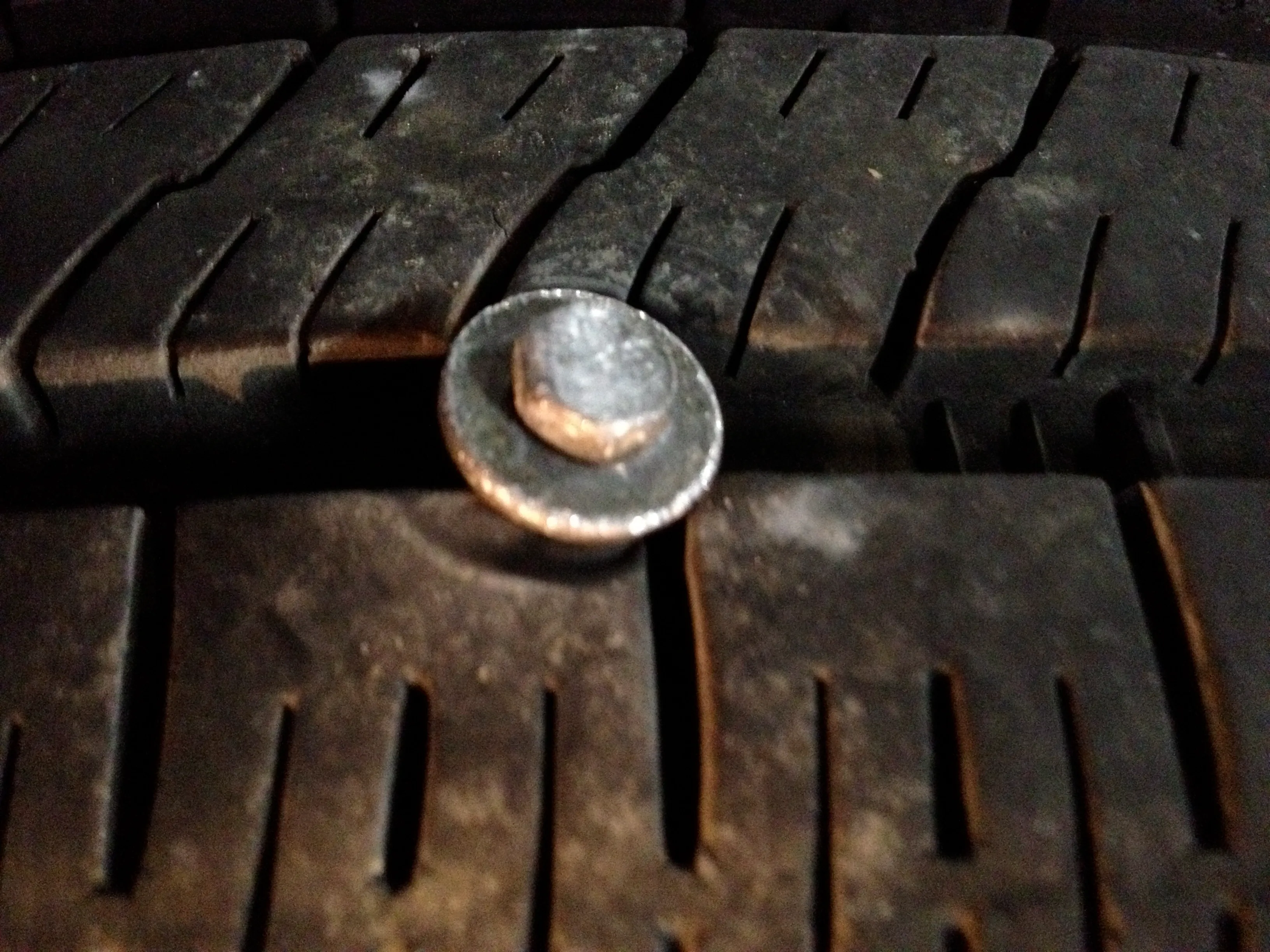
I bought new tires the other day.  I got one of them patched a few months ago, after attracting a nice bolt into the tread, and the TPMS light flickered alive last week, signaling a slow leak either in that plug, or from something else.  And my car, after almost five years and just shy of 50,000 miles, still sports the factory rubber, and although I don’t drive too much anymore, I felt a need to get a fresh set of tires.  So I went to this local tire place, a hole-in-the-wall run by this Mexican guy who’s far more honest than the corporate-owned tire hacks that would probably look at me and see their next four boat payments, pushing all sorts of extensive warranties and protective coatings and laser alignments with stories of catastrophic failure and imminent death if I did not comply. Also, the guy working there pronounces the Yaris “Jar-ees” which I find hilarious.

I was also distracted during the read, as some guy talked far too loud about his MG convertible.  And then at the corner of Market and Grand, some kind of protest started, one of these “let’s end violence by shouting violently at traffic” things I did not fully understand.  Shortly after I finished the book, I got my keys back to the Jar-ees and took off, my wallet $320 lighter, but once again feeling a solid 11/32” of tread.   Awesome.

Re-reading Infinite Jest, part 2 of 863

So I’m now just shy of 300 pages into my re-read of Infinite Jest, which is just over 25% of the way through according to the Kindle, although I think it’s closer to 1/3 done when you consider the last hundred-some pages are all endnotes.  Here are more random observations as I continue:

  • I think reading it on the Kindle does make it seem to go faster than print.  I don’t know the exact numbers or metrics, but it seemed like one print page of the hardcover contained something like 1200 words, where a normal trade paperback contained something like 250-300 words, meaning each page of IJ seemed four times longer.  With the Kindle, each screen has the same number or words, more or less, as any other book I read, be it Vonnegut or George Carlin or Tolstoy.  This makes it seem like the pages are going by faster, although it obviously takes several page turns to get through a single virtual “page”.
  • The endnotes don’t seem to be as much of a pain in the ass as they were back in 1996.  Part of that may be that they lend themselves to hypertext much more, and the Kindle’s links are more convenient than flipping between two bookmarks.  Or it could be that if (and once again, numbers are bogus) there were two endnotes per printed page, and there were six page turns per printed page, it would seem like there were three times fewer endnotes per “page”.
  • It’s so interesting that Wallace created this near-future world that happens in what others have determined to be 2009.  I’ve always disliked when near-future books predict worlds of jetpacks and robot butlers in the year 1991, like pretty much every Philip K. Dick book or 60s pulp Scifi novel.  DFW managed to create a world that largely felt like 1996, except for tiny changes in things like video conferencing and politics and TV media formats.  And that’s pretty much what has happened.  Granted, teleconferencing is just starting to take off because of Facetime, and the DVD and later BluRay were the displacing technologies of video entertainment, but his Boston of the late -00s is pretty close to the Boston of 1996, which I enjoy.
  • There is, however, the issue that this near-future now takes place in the past.  When it was supposed to be 13 years in the future, there was much more license for suspension of disbelief.  Now that it’s three years after the events should have taken place and the futuristic film cartridge system has not been invented, you need to not think about stuff like that.
  • I notice that in some ways Wallace can out-Leyner Mark Leyner.  I never fully understood the relationship between the two, and thought DFW eclipsed Leyner in greatness and popularity, but it also seems that Wallace admired or looked up to Leyner’s work prior to his own fame explosion.  I’ve always thought Leyner had no real peers in his absurdism and almost sketch comedy approach to writing, and always thought DFW was less ha-ha funny and more NPR/Franzen funny or whatever.  But then I see some carefully-placed reference or innuendo in part of IJ that would seem even too absurd for Leyner’s humor.
  • It amazes me how IJ pads itself with pretty much every inside joke or urban legend that Wallace heard over the course of a decade, but manages to pull it off so all of this stuff is an integral part of the story.  At points, it’s almost like he was looking for some excuse to kill pages, like he was getting paid by the word, and said “aha!  I’ll recycle the Jamaican Toothbrush Bandit story, and make it part of Gately’s back story - that should eat up a good 5000 words.”  But of course, it always works.
  • I have the unfortunate issue that whenever I read about Orin, in my mind I envision CJ, the punter who was on Real World: Cancun.

That’s all for now. I’m keeping track of my page count over on goodreads, if you want up-to-the-minute (or -day) tallies.

Patents, Apple, Whatever

There’s been a lot of coverage in the news about Apple’s various patent wars against Samsung and others, and the gist of the coverage is that the patent system was 100% fine up until Apple woke up one morning and decided to destroy anyone making a rectangle-shaped touchscreen phone.

I have no real arguments for or against the system, but one argument I keep hearing is “well what if someone patented the car?”  Funny thing is, someone did.  Check it:

http://en.wikipedia.org/wiki/George_B._Selden#The_Selden_patent and the patent itself: http://www.s363.com/selden/549160.pdf

George Selden was granted a patent for his “road locomotive”, and forced all other car manufacturers to license it, for a .75% royalty.  Ford later fought this in court, and lost; it was only on appeal that they were able overturn the patent.  The eight year legal battle almost bankrupted Ford.  This happened, by the way, over 100 years ago.

Another example of the fact that the patent system wasn’t all rainbows and unicorns until the invention of the iPhone: did you know that the Wright brothers were awarded a patent on the airplane?  More specifically, it was a patent on flight controls in all three axes, but they vigorously fought (and initially won) a huge lawsuit against Curtiss. It effectively blocked the building of airplanes in the US until the first World War, when the government stepped in and formed a patent pool.  (More info: http://en.wikipedia.org/wiki/The_Wright_brothers_patent_war)

There have been countless patent battles in the last century, and this Apple/Samsung thing is just the latest iteration.  I think it’s different now because people have such an attachment to their devices, that their brand loyalty becomes the newest us versus them.  Look at the comments on any of these news blogs from the Apple or Android or Microsoft fans (or whatever pejorative term you prefer) and you’ll find a level of hate and vitriol usually seldom found outside of a political news web site.  And in the days of page count-generated revenue, it’s far too easy for the gizmodos and engadgets of the world to throw up a daily article saying “is the new XYZ an iWhatever killer?” and let the ad imprints roll.

I am an Apple user, and that obviously influences my opinions.  But I also worked at a Samsung R&D lab, and saw things internally that strengthen those opinions. I should probably go back and re-read my NDA and exit papers before I say anything about Samsung and their design aesthetic.  I wouldn’t want Samsung to send me to prison for libel.

Anyway, the patent system may be horrible and broken, but the idea that it suddenly happened recently is off by a century or so.

Re-reading Infinite Jest, part 1 of ?

Okay, I gave in and started re-reading Infinite Jest the other night.

I’m 8% finished as of last night, which is roughly like running the first two miles of a marathon.  It’s enough that I’m getting some momentum, but so little that I feel like it could take me a while.  I dug through my 1996 paper journal last week and found that it took me something like 20 days to read it last time.  Of course, I did not have a TV, was single, had no social life, and this was before Facebook, Twitter, and a million other things were invented.  In fact, I think I was still dialing in at 14.4K back then, and my computer was a Linux machine that wasn’t running X, just a naked command line prompt on a 12” monochrome monitor.  The closest thing I had to a tablet computer was made by Mead, spiral-bound and college ruled.

My first strategic move on this attempt was to eschew the print edition.  The only print copy of the book I own is a hardcover first edition, signed by the author with the “smiley face” next to his name, which might or might not be more rare or indicative that he was in a good mood when he read in Seattle.  The print copy killed my wrists last time around, and this was long before I’d developed all of my wrist, back, neck, and other chiropractic RSI issues.  When I read in bed, I tend to hold the book with three fingers and my thumb on the cover, and my pinky under the book, as a sort of stand.  This means when a book weighs any tangible amount, it strains my small fingers, and if that book is a thousand pages long, it starts to feel like they’ve been slammed in a car door.

So I went with the kindle ebook.  This solves another problem, the “how many bookmarks do I use?” issue.  Unless you memorize page numbers in some Rain Man-esque fashion, you’re going to use at least one bookmark on a read of the paper edition.  Most people agree you should use two, with one marking where you are in the body of the book, the other marking where you are in the endnotes.  Some people also advise you to keep a bookmark on the page describing the Subsidized Time timeline.  Nobody ever told me about that, but there weren’t web pages about how to read IJ in 1996.  That said, there also wasn’t a wikipedia page I could reference instead of using a third bookmark.

In the kindle edition, endnotes are hyperlinked.  And thankfully, there’s a “return to text” backlink after each endnote, so you can quickly get back to the text.  The only issue with this is that the kindle software will return you with the line containing the endnote reference at the top of the screen.  So, for example, if you’ve got 30 lines per screen (arbitrary - I didn’t count) and on line 16, there’s endnote 44, you can click that, read it, click “back”, and that line will now be at the top of the screen, not on line 16.  That means you lose some context and might need to back up a page, depending on how you read.

I started reading on my iPad, and then switched to my actual Kindle.  The advantage to the real Kindle is that it’s paper-white on the e-ink display, and it doesn’t have Facebook, Twitter, and a bunch of games on it.  But I ended up going back to using the actual iPad.  Why?  Because it’s a bigger screen, and because clicking on endnotes is much easier.  I have the keyboard Kindle, which requires you to navigate around with the little stub of a joystick to get to an endnote and click on it.  Then you have to wait a second for the screen to refresh, and then you have to repeat the procedure.  It’s much faster and less of a hassle to do it on the iPad.

Another huge advantage to reading on the Kindle is that I can click a word and the definition pops up.  I’m finding that Mr. Wallace has a much more, um, big vocabulary than me.  I don’t know if looking up definitions like this is teaching me new words, but I’m much more likely to click on a word rather than dig out a copy of Webster’s.

I’m finding that this time around, it’s been much easier for me to get in the swing of things, but I don’t know if this is because I already know the general plot of the thing.  When I read it in 1996, I didn’t know a single other person trying to read it, and there was no wikipedia to help me.  I am avoiding any secondary reading during this pass, though.  I’m not looking at any of the blogs or fan sites, and I haven’t bought Elegant Complexity or any of the other reading guides.  No sherpas, no supplemental oxygen on this climb up Everest.

My impression so far is that the book is reminding me so much of 1996 and the events around then.  I had a horrible time of it back then, something I’ve alluded to on here, but something that was incredibly painful to read about when I dug around my paper journals back then.  I was about a year into my stay in Seattle, a year removed from my college life.  I hadn’t seriously dated anyone since the end of 1993, and was certain I never would.  I had some kind of stomach disorder going on and was certain it was gall bladder cancer or unchecked appendicitis (it wasn’t), and I seriously didn’t know what the fuck I was doing with writing.  I now look back at Rumored as my favorite book I’ve written, but back then, I spent all of my energy trying to convince myself I needed to stop working on it entirely.  All of this influenced my perception of the book, and now as I navigate his prose, it brings back a lot of those memories, which is both good and bad.

I don’t have any other great insight at this point, but I felt that if I kept mentioning the reading project on here, I’d stick with it.  So, there you go.