The Wrath of Kon

Dispatches, thoughts, and miscellanea from writer Jon Konrath

Tag: apple

Ode to a 2020 MacBook Pro
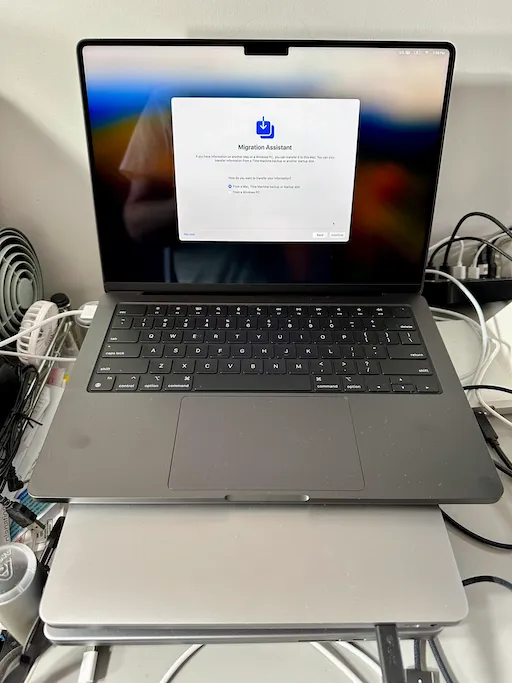
mbp-2024

Time for another one of these posts. This upgrade is not as catastrophic as a battery explosion like last time. It does have a slightly dumb story to it, though.

So yesterday, I was supposed to fly to New Orleans. If you’ve known me for a few years, you know Louisiana is one of the last states I have to visit, and I’ve been trying to go there for a while. And every time I book a ticket to New Orleans, something catastrophic happens. The first time I tried to visit, I booked a ticket on September 10th, 2001. That obviously didn’t work out. Then I tried booking a trip in the summer of 2005, and that August, Katrina showed up, and I had to cancel again. This time, it looked like we were going to make it, but Sarah caught COVID last week, and I had to cancel a third time.

I’ve wanted to update this 2020 Mac for a while, but also didn’t want to, because it’s an Intel, and I don’t know what software on this machine requires an Intel processor. I know VMWare does, but I haven’t used VMWare in forever. It seems like every time I fire it up, they’ve upgraded a major version and mine doesn’t work anymore and I have to give them another hundred dollars. Meanwhile at work, I’ve been on Apple Silicon for a year and a half with no problems and a decent speed increase. And the 2020 has been slowly aging out. Firing up Photoshop or Lightroom almost always kicks in the fans, and even basic Safari usage is getting pretty sluggish. So I’ve wanted to make the switch, but I keep dragging it out. But with a huge negative balance on my Amex and a week of staycation where I’ll be confined to my office, it felt like now was the time.


Whenever I retire a machine, I always think back to what I got accomplished with it. And this machine is somewhat depressing, because a good chunk of its tenure was when I “quit” writing. The Failure Cascade is the only book I released while on this Mac. There were also two zines, and a bit of writing that was unreleased. During the time I wasn’t writing fiction, I did finish two master’s degrees, and that required a ton of writing. And since I “unquit” writing, I’ve done a fair amount of fiction writing, and hope to get something released soon.

This laptop did travel a lot more than any of my other machines, even though there were a few years at the start of the pandemic where it never left my desk. But since 2022, it’s been to Sweden, Iceland, the UK, Qatar, India (twice), the UAE, Poland, Singapore, Hong Kong, Vietnam, Taiwan, Switzerland, and Spain. In the US it went down to LA twice, Reno, Vegas, Indiana, Illinois, and Wisconsin. Hauling a full-sized 15-inch laptop (and sometimes two of them) wasn’t pleasant. But it was nice to have everything with me when I was on the road.

I still wish I would have gotten more writing out of this machine, though. I guess that gives me a goal for the next one.


I went on the Apple store online on Friday night to do the deal and go buy a new MacBook Pro, but they did not have one in a store with a 2TB drive. I ordered a custom build, and it said it would take two weeks. Today I was at the mall-not-mall in Emeryville for lunch and decided screw it, I’ll just get the 1TB version.

The latest iteration is the 14-inch Nov. 2023 MacBook Pro. It’s the Space Black model, with the M3 Pro 12-core CPU/18-core GPU. It has 18GB unified memory and the 1TB drive. I decided on the 14-inch after hauling around a 16-inch on all those long trips. I think I can sacrifice a little bit of screen size for a much easier haul. The new one is almost a pound lighter, and maybe two inches of width and an inch of depth smaller.

So the upgrades on this machine… aside from the architecture change (I’ll get to that), there’s a display that’s twice as bright with a higher refresh rate; an HDMI jack; the return of MagSafe, with its own port; the ports go from Thunderbolt 3 to 4; a built-in SD card reader; a better camera; better WiFi; real function and Esc keys; the ability to do Spatial audio; and a huge increase in battery life. (It says “up to 11 hours” on the old one and “up to 18 hours” on the new one.)

Missing on the new model: the Intel chip; the AMD Radeon Pro GPU; the Touch bar (good riddance), and one Thunderbolt port. The HDMI port is on what I consider the wrong side, since I keep the thing sideways on the left side of my desk. Same with the headphone jack, although I seldom use it these days. (It’s nice to have, though.)

The compute stuff is huge. Looking at the Geekbench score, it’s between double and triple the performance. GPU performance is also doubled. But the ML inference score, the ability to run data points into a machine learning model, is insanely improved, something like twenty times faster. I don’t even know or understand exactly what the Neural Engine or the Media Engine do, except my old machine didn’t have them. And now I have the ChatGPT app on the Mac, which I can use for my KonGPT.


Of course, the upgrade was a major pain in the ass. I always forget this, but you need a real, honest-to-god Thunderbolt cable, and Thunderbolt != USB-C. I spent hours churning away on various iterations of upgrading the old machine, updating the new machine, doing backups to disk, and trying to get an Ethernet cable to work. It turns out that trying to migrate from an external drive is roughly as fast as trying to type in all your old documents by hand. Using Wi-Fi is an order of magnitude slower than that. I eventually did some magic dance between the two machines to get Ethernet running directly between the two, and then it took about two hours to pull over everything. I also bought a real Thunderbolt cable for next time, although I’m sure I will lose it.

The new machine is humming away. I’m actually on it now. It’s always strange to swap in a new machine, but I’m at the old screen, old keyboard, old trackball, and the same background images and icons and junk on the desktop.

I haven’t taken it through its paces yet, and I’m still solving little problems one by one. But even saying the word “Lightroom” in the same room as my old computer would make the fans jump to life. Now, going to a photo in Lightroom instantly generates the preview from RAW without any hesitation.

Sarah’s testing negative and is mostly better. I’ve got a week of staycation. I need to get back to writing today. In July, I managed to write and hit my quota every day, so I’m getting back to it.

Book layouts in Apple Pages

Gutenberg_bible_Old_Testament_Epistle_of_St_Jerome-scaled-1

I do my book layouts in Apple Pages. Yes, I should be using InDesign. No, I don’t want to pay $35/month for something I use once a year. Apple Pages worked okay for layouts until version 5.0 came out in 2013, when they tried making the OSX and iOS versions have parity with each other, at which point they removed hundreds of features from the desktop version and said, “everything in the desktop version works on your iPhone!” (This, coupled with the move away from Intel, makes me fear the future, when there is no real Mac anymore, and they just have expensive iPads with keyboards, and they are useless for real work. That’s another rant.)

Anyway, Pages has evolved in the last seven years, and now I don’t have to keep an antique copy of Pages 4 to do layouts. I’ve done two books this year, mine and Keith Buckley’s, and Pages has more or less worked for them.

Here are my tips on how to lay out a book in Pages. This is not a complete guide, but maybe it will help you avoid any problems.

Basics:

  • I write in Scrivener, then either copy/paste all of the text into Pages, or export to a .DOCX and open that in Pages. I’m sure you could write the whole thing in Word or Google Docs or even in Pages. Whatever works.
  • I usually set everything to Body (see below on setting it up) and then go back and fix headings and first body paragraphs and such.
  • After you do this once, make a template of that doc with all of the text scraped out and use that next time.
  • I lock down all of my text before it comes to Pages. The spelling/grammar in Pages is better than Scrivener, but it’s still pretty piss-poor. I hate to endorse this, but Google Docs has a far better spellcheck because it’s constantly being trained on millions of words of text per second. I usually paste my locked text into Google Docs, do a check, and reconcile everything in Scrivener.

Numbering and sections:

  • Document (the upper right corner button) > Document > Facing Pages gives you different left and right page layouts, which is what Pages broke forever.
  • Always use section breaks, not page breaks. (It’s a bummer there’s not a keyboard shortcut for this.)
  • In Document go to the Section tab, and set Section starts on to Right Page. (If you set this once before you change your page breaks to section breaks, it will ripple through the rest of the book. If it doesn’t, you might need to set this manually in every section.)
  • You’ll have a bunch of front matter sections (title, copyright, TOC) and then the actual chapters. In the section where chapter 1 starts, set that to start at page 1. The first page of the first chapter should be 1. Leave page numbers off of every section before this. (Technically, the cover page should start with i, then go ii, iii, iv, etc (lowercase) through all the front matter, but you don’t need to get cute and show those numbers unless this is an academic journal.)
  • In each section on Document > Section, it should be Match previous section and numbering should be Continue previous section. You should also set Left and right pages are different, and Hide on first page of section.
  • Also on the above, you should set Section starts on to Right Page. This will result in every odd page being on the right, and every even page being on the left. This also means every chapter starts on the right page, with an odd number. Yes, this will result in blank pages. Books have been printed this way since the sixteenth century. Pick up any book that wasn’t self-published by someone in MS Word and look at the right page number. Trust me on this.
  • …But, if you have a blank left page, this will screw everything up in Pages, of course. Blank left pages won’t count against numbering. So page 15 has text, page 16 is blank, and the next chapter starts with page 16 on the right.
  • To fix this, you need to restart numbering with the correct number of the left page on the first page of the chapter. Don’t do this until your book is fairly locked down, because you’ll just have to redo it every time you add or delete a page.
  • [2025 note: this magically worked this time around, and I didn’t have to restart numbering and manually add a number for each chapter. Maybe they fixed it? If so, feel free to disregard the last two bullets.]
  • I always create a Header & Footer - left and Header & Footer - right and assign them accordingly. Put author name in the left header, title in the right. I’ve also seen book title left, story or chapter title right.
  • I usually left-justify the left page number and right-justify the right. Marie, if you’re reading this, feel free to tell me I’m wrong here. I just noticed every David Foster Wallace book you designed centers them, and every one before you doesn’t. Maybe left/right went out of style in the early 00s and I didn’t get the memo.
  • By the way, my “bunch of front matter” (and everyone else’s) is the following sections:
    1. A right page that’s just the book title and nothing else.
    2. An “also by” section on the back of that page.
    3. A right page that’s just the book title and author name. Maybe your press name and logo, but whatever.
    4. On the back of that, the copyright info and notice.
    5. Starting on a right page, the TOC.
    6. Also starting on a right page, any introduction, publisher’s note, preface, dedication, or whatever else. (Nobody ever reads any of this, so don’t waste your time. Trust me, I wrote book introductions.)

For the Title style used at the start of chapters:

  • Delete any blank body paragraphs above or below the title. Each chapter should start with a single Title paragraph, then the body text. Don’t add a bunch of blank paragraphs to add space.
  • Click on a Title. In Format (upper right button) go to Style tab, and set After Paragraph to the point size of your Body style (probably 11 or 12). Or you can make this 48 or 64 if you want a big gap between the title and the first paragraph.
  • The Before Paragraph doesn’t work for the first paragraph in a section. (But you can use Pages on your phone! It’s great!)
  • A hack to fix this: Go to Layout tab. In Borders & Rules, set a top border of a single line. Make it 70 pt wide, then set its color to white. Select the top position, then put in an offset of 50pt. (If you could simply make this offset 130pt, that would be great, but you can’t for some damn reason.)
  • After fixing the title once, make sure to update the Title style (a button will appear next to it when you make changes) so changes percolate to the rest of your Titles.
  • I shouldn’t need to tell you that your titles should be sans fonts and your body text should have serifs.

Body text stuff:

  • Go to an indented (i.e. not-first) paragraph and update Body so that’s the default style for all of your body text.
  • Set that style to use justified text.
  • Make a Body-first style based on Body that has no indent. Use that for the first paragraph of each chapter.
  • I always assign a shortcut to that style to make it faster to use. I usually set Title to F1, Body-first to F2, Body to F3, and a Body-centered to F4.
  • I’m not into Drop Caps, but if you like having the first letter or first word of your chapter four or five lines tall like a Gutenberg bible, they finally fixed this in Pages. Go to Format > Style and there’s a Drop Cap option. Pick a style and set this in your Body-first style.

I’m probably forgetting stuff. And I’m sure I’ve pissed someone off by saying not to use a sans font for the body text. Also, I wrote this at the end of 2020. [Note: I did a quick pass on 1/1/26 and this is still largely correct.] If you’re reading this in 2027 and none of it works anymore, it’s because Apple has changed everything seven times. Anyway, hope this helps.

Day 167

I don’t really know how many days into the lockdown we are. I suppose I could figure it out. I also suppose I could update more here, instead of just when something breaks. But there’s not a lot otherwise going on.

So remember last year when my iPhone 8 blew up? Almost exactly a year later, the replacement started swelling again. I wasn’t planning on upgrading for a while because I was fully paid up on the old one, and I figured the year-old replacement would last until Apple came up with a reason for me to get a 12 or a 13 or whatever. Well, there’s my reason. I bought an iPhone 11 Pro, and paid far too much for it. The Apple Store near me is open in a limited fashion now, so I did an in-store pickup, where I showed up at an appointment time, stood out on the sidewalk, and got the phone brought out to me. I bought it straight-up instead of dealing with any of AT&T’s byzantine payment plans. That part was easy enough.

The migration, which is supposed to “just work” did not work. It took me four tries, about a half day. I thought I’d just sync the old phone to my Mac, then plug in the new phone and restore to it. I don’t know why it took so many tries to get this to work. One thing I noticed after my first fail is that the cable I bought a year ago and the cable that came with the phone were different. They are both Thunderbolt (aka USB-C) to Lightning, but there’s some internal difference. The same thing happened with the laptop last May. There’s some subtle difference between USB-C and Thunderbolt, or there’s some difference between data cables versus charging cables versus fast-charging cables versus… whatever. And of course all of the cables are white, and look identical. I found out that some of the newest cables have a very light gray number on them, like instead of the RGB value of #FFFFFF for white, it’s #FEFFFF, and you need a jeweler’s loupe to read it, and then you have to google the value, and it’s on the seventh page of results because the first six are rumors about the next iPhone or something.

The new phone has a larger screen, but is about the same size. It has Face ID, which is fairly useless. First, it can’t identify me with no glasses, or with a mask on. Also, I’m in the habit of grabbing my phone and unlocking it while it’s still in my pocket or on the way up, and that’s impossible now. I also can’t unlock it while it is on the dashboard of my car. Also, I bought the battery case, so the phone is far too heavy and thick. I am almost sure I will drop it in the near future. And the gestures to use it with no home button are annoying.

The new camera is interesting. It has a portrait mode, which simulates a low depth-of-field lens, which is nice. It also has a wider lens, which is good for landscape photos. There is a night mode, which might be useful if I ever leave my house at night again, which won’t be any time soon. Overall, the camera stuff is neat, but for this price, I could have bought a nice DSLR or mirrorless camera.


Another Apple semi-fail is that the Airport Extreme I bought a few years ago was showing its age, or maybe having Sarah work upstairs full-time was requiring better WiFi coverage. I have bad luck with routers and they always seem like a perishable product; after two or three years, they just go rotten, and no firmware update or restore will make them better. Apple doesn’t make routers anymore, so after much research, I ended up with a Ubiquiti Amplifi HD. It works, but I’m not in love with it. First, it took a few tries to get it started. (They insist that you reboot your cable modem during setup, which makes no sense, but it didn’t work until I did, so I guess that’s my fault.) It uses a cutesy phone app for all configuration, and I’d rather have an actual browser-based admin. I also wouldn’t mind better logging or something (I’ll get to that in a second) but it seems to work fine. I have the router downstairs, and the mesh stations in the living room and upstairs, and it has roughly doubled performance up there, so mission accomplished.


On to the next problem. Right after I got the new phone set up, Comcast started complaining that we were close to our data cap of 1.25 Terabytes. They’ve waived the cap for the last few months because of COVID-19, but now that COVID is completely cured and everyone has returned to the office, they’ve started charging people for going over again. Wonderful.

This started the anxious exercise of trying to figure out how we’re using so damn much bandwidth. Of course, plugging in a new phone meant it automatically had to redownload every app and a bunch of big updates, so that’s probably fifty gigs. And as I looked at my machine, I realized my Backblaze cloud backup was then uploading that fifty gigs of updates, so I got double-taxed on it. I installed a copy of Bandwidth+ and Little Snitch to try to figure out where all of my data usage was coming from, and man that is horrible.

First of all, Apple is downloading monster updates constantly. Every little point release of iOS or MacOS is at least five gigs of data, and on my desk, I’ve got three different devices. And like I said, those are all getting backed up. (I stopped doing that, so that’s some savings.) But it’s also amazing how much a Mac will change over the course of a day. I started scheduling my Mac to back up at midnight, and it would send a few gigs of data up. Then I’d wake up, do nothing for nine hours, and Backblaze would say it had a half-gig of updated files ready to back up. I’d look, and it was all crazy iCloud stuff, the Mac recording Siri suggestions even though Siri was deleted, tons of deltas on files in the calendar and email programs that had been doing nothing. I have no idea how to stop any of this, but with two Macs in the house doing this, there’s like ten percent of the 1.25 TB right there.

Another thing with Little Snitch - ok, so this is a program that will fire up an alert every time anything tries to make an internet connection, and then you can set up automated rules to allow or block certain things. It also shows you what programs are using the internet, and tracks their usage. (My router problem: I wish I could do this for every machine in my home, like at the router level. I know if I spent two grand on a pro Cisco router, I could do this. But my little consumer one won’t.) Anyway, it is amazing how much some programs hit the outbound connection. Like if someone in my house even says the word “Adobe” I get a dozen outbound connection requests. Creative Suite is basically a piece of malware that happens to have an image editing program in it.

Facebook is also particularly bad. Even though I think I’ve disabled whatever video auto-play is in FB, it will hit this one video CDN continually, preloading things it isn’t showing me, to a tune of a gig per every few minutes. I know, quit Facebook. But it’s amazing how blocking that CDN saved me a ton of grief. Even better, I spotted the CDN that auto-loads those annoying videos that pop up any time you go to any news web site. Life is much better after I blocked that thing.

Oh, about the data cap. After much research, I found there are a few options to remove the cap. One is to straight-up pay them $30 a month. The other is to lock into their new xFi router ecosystem, and rent a new modem, and they will remove the cap for $25 a month. I currently rent an older modem of theirs for $14 a month, so they sent me a new router, which I will immediately put into bridge mode and ignore all of their new features, which probably don’t work. I hate to pay that $11 a month, especially with how high the bill is already, but $11 versus obsessing over this every time I launch my browser is worth it.


Not much else is up. I’ve spent a lot of time walking at NAS Alameda and have a ton of photos I should probably organize someday. Other than that, it’s been work, work, work. I have another “vacation” coming up, so maybe I can do something productive that week.

Ode to a 2017 MacBook Pro

IMG_2472

So I was in a meeting yesterday, looking over at my Mac, and the lid didn’t seem to be closed all the way. My only thought was the usual “Apple doesn’t make them like they used to” and I ignored it. A few hours later, at the end of my work day, I went to unplug the laptop and go sit on the couch and write, and I noticed the side of the laptop was popped open, and the battery was swollen.

God damn it.

I got this machine at the very end of 2017. At the time, it was the top-of-the-line 15-inch MacBook pro you could buy from the Apple Store inventory without a custom order. It was great and slim and bigger than my last one, and way too expensive. I moved everything over, went on a trip for Christmas, and when I got home, it was completely 100% dead. No battery, no lights, no plugging in a different power cord, no magic reset NVRAM bullshit, it was flat out DEAD. I went to the store and after much bitching, a manager gave me a brand new one, and a “sorry, that happens.”

I’ve never been 100% on this machine. It had the magic touchbar thing, which is completely useless, except there were no function keys or escape key anymore, so I had to use it. I shut off the other shit, because I constantly hit it while typing. And the typing is bad, too. In the quest to make it thinner and cooler, they put in this dud keyboard that felt like typing on an Atari 400, and even a piece of dust would break a key. There was also the lack of any ports other than TB3, which required a new set of dongles. The machine always felt creaky and weird, like I’d accidentally bend it at some point. I also had some random weirdness with macOS High Sierra, and never dared move up another version.

So anyway, swollen battery. I looked up how to replace it, and it’s a 58-step procedure that involves a heat gun and re-epoxying parts and brain surgery-level disassembly. Nope. Normally, this is where I’d cart it off to the Apple Store, since it’s still under warranty. Not an option during SIP. I called Apple, and my only option is to mail it in and wait a week or ten.

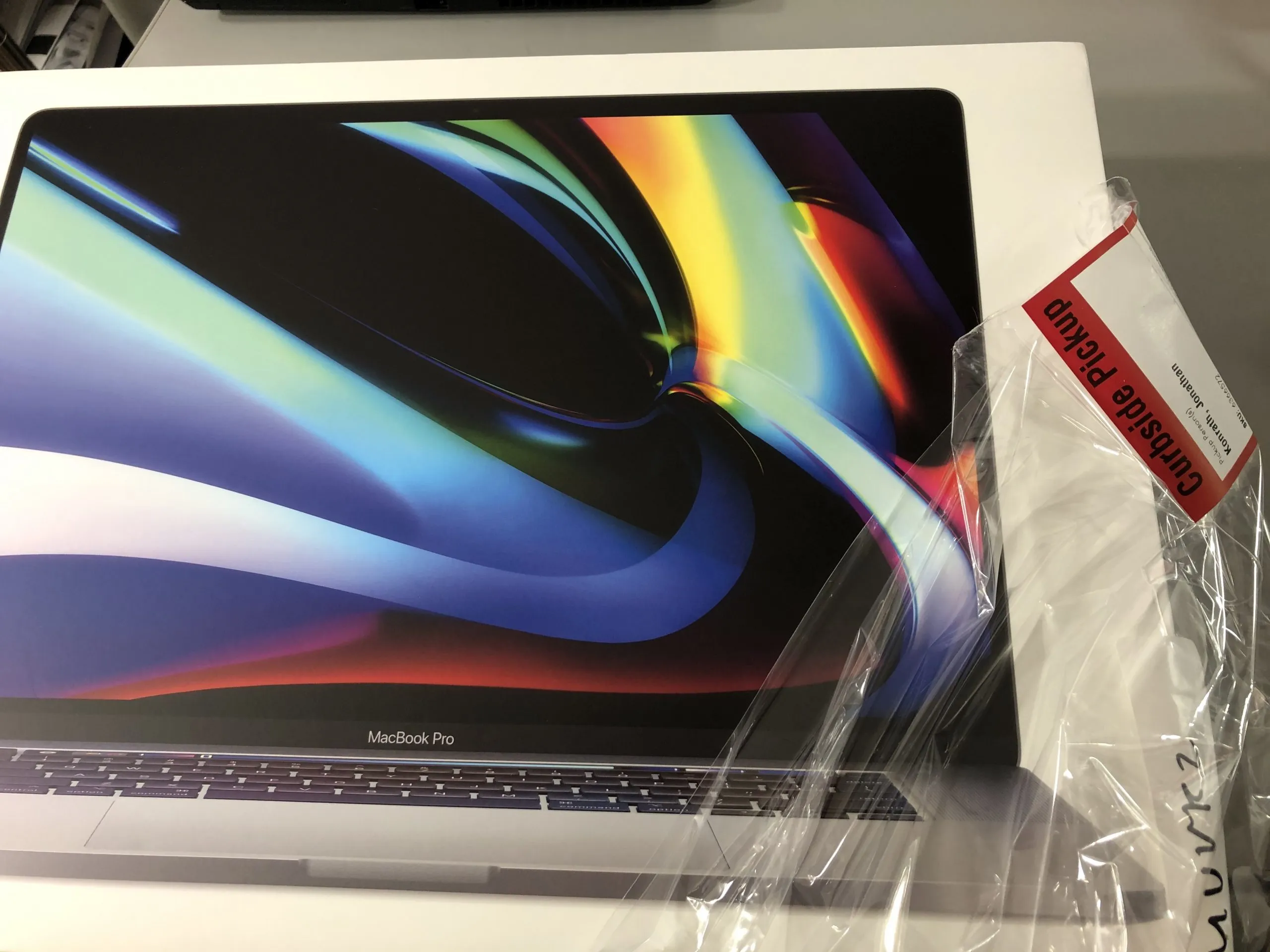
I didn’t want to upgrade. I was hoping to get at least three years out of this machine. But I needed a computer immediately. I ended up going to Best Buy’s web site and buying a new machine, then driving out to Pleasant Hill and doing the weird touchless curbside pickup. You reply to a text to tell them where you’re parked, and a gloved and masked worker comes to your car, looks at your ID, then puts the box in the trunk. Very weird.

The migration went predictably bad. The old and new machines couldn’t see each other on WiFi. Using the Thunderbolt cable to connect the two computers doesn’t work, because there are 167 different types of cable with the same exact connectors, and the “power” version of the cable isn’t data-ready or something. I thought I should just use the backup drive, but before I could do that, the system said it needed to download ten gigs of updates, and it futzed with that for an hour. I plugged in my CarbonCopyCloner bootable clone of the old drive, and it sat for six hours, then crapped out in the middle of the night because it was trying to copy the entire backup, including every file I’ve changed or deleted in the last three years. I restarted it, and six hours later, the files were more or less there.

Then began the real problems. First, I jumped forward to macOS Catalina, which means every 32-bit app on my machine is now broken. Then the barrage of “xyz wants to use your address book” and “abc wants to write to the hard drive” and “123 wants to see your location.” Some damn thing kept asking for my keychain password. It took seven tries to get iCloud to log in. I couldn’t get it to “trust” my iPhone. Adobe’s app manager got stuck in a login loop until I completely uninstalled everything Adobe and started over. The IR remote receiver I have didn’t work anymore. Etc etc etc. I think I’m about halfway stable now, but expect at least a week of fuckery until this calms down.

I seriously think this might end up being the last Mac I buy. We’re entering a dark period like the mid-90s, when Macs were twice as expensive, twice as slow, didn’t use any standard peripherals, and crashed constantly from a bloated OS. The current macOS keeps getting more and more stupid, as they try to unify with the mobile OS and push services more. Rumor is strong that Apple will dump Intel in the near future and move to their own ARM processor, which will be just like the PowerPC days, making Windows emulation impossible.

The problem is, what do I buy instead? I’m too tightly coupled to my other mobile devices. And Windows is horrible - I use it every day on my work machine, and it’s not an option for me. Going back to Linux seems unspeakable at this point. I almost feel like buying a typewriter at this point.

The new machine seems okay so far, now that it is stabilizing. The keyboard is improved somewhat, and feels closer to my 2014. The screen is slightly bigger. The build quality feels a bit better. Same drive size, same memory. More CPU, more cores, and I think the battery is better, but I haven’t gotten that far into it yet. I’ve got to figure out what to do with the old one, when the world is normal, or I give up and mail it in.

And usual reminder: BACK UP YOUR MACHINE. It saved my ass this time, yet again. CarbonCopyCloner, external drive. Anyway, let’s see if I can get more stuff done on the new machine.

iPhone grenade; Sundays; the life and death of long reads, etc

This week’s excitement was that my iPhone 8 blew up after about a year and a half of service. I’d noticed a bit ago that the 3D touch feature wasn’t consistently working, especially on the left side of the screen, but chalked it off to the fact that iOS has far too many tricky gestures and oddities where if you don’t click exactly at the right thing in the right direction for the right fraction of a millisecond, instead of fast-opening two apps, you delete one, or open the camera, or start playing music, or whatever. And the battery did slowly lose its mojo, but that’s every product with a battery these days, and I have a battery case, so it didn’t bother me.

Well, suddenly the other night, the phone doubled in thickness, like a double-stuff oreo, and the screen split from the rest of the case. The phone still worked, but my immediate fear was that it would catch fire or grenade. I was out when it happened, so I powered down, drove home, carefully fired it up, and then backed it up to my machine. I went to the Apple store (with a paperback book to kill time) and within an hour, they replaced it with an identical model. The swap and restore seems to get less and less painful each time I upgrade, and the only pain was copying over 120 gigs of music, which took a few hours, along with other sync and backup activity.

A few takeaways: before I drove to the mall, it was impossible to get ahold of anyone at the store on the phone. You have to go through a ridiculous phone tree for support; you can’t make an appointment online, at least within fifty clicks. I put the phone on speaker, and after saying “manager” a dozen times, the phone rang for five minutes straight. Once a human answered, mentioning the battery situation got me in fast, though.

The other takeaway is that it seems that as Apple products are in this war to get as thin as molecularly possible, they have developed some serious reliability issues. It’s all anecdotal, and I’m sure Apple’s annual reports to investors show that 99.9% of people have no problems. But I had a brand spanking new MacBook Pro fail, and my iPhone 6s had a slow battery death, and now this. This is timely with the departure of Jony Ive, who was apparently the one responsibility for this thinness race. I honestly wouldn’t mind a phone or laptop a few millimeters thicker, if it meant it would not bend in half under minor use.

(And yeah, “BUY A REAL COMPUTER SHEEPLE.” Whatever, grow up, etc.)


It’s Sunday, which is always depressing. I’m not sure why half of my weekend is always spent in a dour mood over why I’ve wasted half of my weekend. I also get into this bad cycle of thinking I need to majorly course-correct everything, usually on Sunday night. I need to get off my ass and devote my life to learning (guitar | some programming thing | a writer’s works | obscure history of film | electronics | how to fly a jumbo jet | whatever). I wish instead of Sunday, I could have two Saturdays. There must be some mindfulness technique to fix this. Maybe lobotomy. (Do they still do those? Great, I’m going to fall down a k-hole researching this.)

I was thinking about this, because my Sunday routine used to be much different when I was in college, or just after. I used to make a lot of phone calls on Sunday nights after dinner, usually because that was when people were around the most. And I used to love the phone, to a fault. My long distance bill, back in the pre-cell days when that was still a thing, would end up being a colossal amount, catching up with people across the country.

I also have this strange little gap between maybe three and five, when I’ve already written in the morning and finished my errands in the early afternoon, and I feel some overwhelming need to do something in that time period, but I’m never motivated to do anything. The answer is that I should write more then, but I never can. And doing anything else — taking a nap, playing video games — makes me feel completely unproductive and horrible. I’m not sure if it’s my anxiety of the upcoming work week, or the fact that I never use the phone any more and my only human interaction is clicking a screen that causes my current dread routine. Or maybe I need to eat probiotics. Whatever.


Not much else here. I fell down a Chuck Klosterman rabbit hole in anticipation of his next book, and ended up re-reading almost all of his output. It sort of amazes me how it feels like Grandland was around forever, but it only lived between 2011 and 2015. Much shorter than The Awl’s almost-ten year run, but same thing — they came out of nowhere, got huge, and died. Meanwhile, I’ve been plugging away here for decades, with no ideas, no traction, etc. Anyway, I read like four or five of the Klosterman books, which led me to reading music critic Robert Christgau’s memoir, which is… interesting. I guess he sums it up himself at the start of the book by saying most biographies are about astounding people or people who have some trick to sell or some story of overcoming adversity, and he doesn’t, but here you go, let’s get into 200 pages of his unremarkable childhood. It’s still interesting to me, but holy shit, people on Amazon hated it. Anyway, we’ll see if I can finish this one up without coming up with the stupid idea that I need to start writing record reviews again.