The Wrath of Kon

Dispatches, thoughts, and miscellanea from writer Jon Konrath

August 2011

No patience for technical support

I had to go to Target at 8

last night and buy a new wireless router.  Okay, “had” is a strong word, but I got to the end of my patience, and was fortunate enough to recognize that and throw this stupid Netgear piece of shit I just bought a few months ago into the garbage and start fresh with new gear from a different vendor.  This is typical behavior, and the reason why I don’t spend any free time screwing with Windows machines, because I simply don’t have the patience to fuck around with reconfiguring IRQ interrupts and re-flashing BIOSes every time I want to print double-sided pages.

My own tech support flowchart typically goes like this:

  1. Power it off and then on.
  2. Unplug everything but the bare minimum of what needs to be plugged in.
  3. Check the power supply and that I didn’t plug it into one of the god damned outlets that are connected to a wall switch and/or start flipping wall switches that don’t do anything.
  4. Do whatever you have to do to reset the whole fucking thing to the default factory configuration.
  5. Throw it in the garbage and buy a new one.

And this is the point when half of you start in with the “huh huh, I have a perfectly good router I found in the garbage,” and other various comments about how I’m a dumbass for paying someone else to change the oil in my car blah blah blah.  That’s not the point.  The point is, I used to change my own oil and spend way too much time screwing around with my /etc/modules.conf file to get it so my soundblaster card wouldn’t crap out every time I triple-clicked my mouse button, and now I don’t.  Even more, I used to answer the phone for people who would call me because they couldn’t find the “any” key on their keyboard, and spend hours trying to walk them through how to use the vi editor over the phone.

How the hell did I ever do that?  I mean, I remember first getting a job as a computer consultant, and it wasn’t because I had an innate desire to help people.  It was because I knew some amount about computers, and it beat my previous campus job, which involved scraping uneaten food off of cafeteria trays and wearing a hairnet and a stupid smock probably manufactured by inmates at an insane asylum somewhere north of Indianapolis.  Making fries at McDonald’s paid $4.25 an hour, and answering people’s questions about WordPerfect 5.1 paid $6.10 an hour, so it was a no-brainer.  And once I got my foot in the door, the goal was always to get better at it, or at least good enough that I could take another baby step up the ladder and find another position inside the UCS system that involved more computer and less people.

But in between my departure for Seattle in 1995 and my very first consulting gig in 1990, I must have burned through several lifetimes full of patience.  I mean, at IUSB, we had these stupid piece of shit Leading Edge Model D PC clones, which even in 1990 were so behind the curve, I think the main campus had sold them for scrap and the South Bend campus quickly put them back into service.  We’re talking a Daewoo-manufactured machine that originally came out in ‘85 as a low-end clone, with a 4.77 MHz 8088, 256K of RAM, and a built-in video card that pushed out 640x200 video.  Our units didn’t even have hard drives; they came with a set of two 5 1/4” floppy disks, which lead to many stupendous problems as a consultant.

First, a machine with no hard drive can’t boot, unless you put a bootable floppy in the A: drive.  We had a vague system of letting people check out bootable WordPerfect disks to people. Or when you took C101 or whatever, your instructor would probably format one of your disks (or most likely, your only disk) so it would boot.  These were the days before Windows, or at least before this campus would see it, so re-formatting a disk wasn’t a matter of right-clicking or just inserting a blank and clicking OK when it asks you if you want to format it.  It involved booting into DOS and doing a FORMAT /S.  More importantly, it involved every third question out of people being something like “I PUT A BRAND NEW DISK TAPE IN THIS MACHINE AND TURNED ON THE POWER AND IT WON’T START.”

Anyway, nobody at IUSB knew anything about viruses.  When I was at the IUB campus, they ran Norton or whatever, and when you booted from the hard drive and put in your floppy, it got scanned.  Here, you had everyone booting from their own floppy, or booting from one of the lab’s boot disks with WordPerfect on it.  So one genius brings in a floppy with whatever virus was new in 1990, and it’s suddenly spreading across every damn person’s boot floppy like HPV in a Thailand whorehouse.  I printed up a bunch of signs telling people to stop booting from their own disks and let me scan them on the consultant’s computer, and when that didn’t work, I called someone at the student newspaper (this 8-page free thing they handed out in the cafeteria) and dictated to them verbatim this diatribe about how viruses were all over the god damned place, and if you didn’t stop booting from your floppy, a computer like the one from WarGames was going to swoop in and launch every nuke at our own cities and blame the whole thing on your good buddy George HW Bush.  (I think the reporter misspelled or misquoted every seventh word, so I’d love to see this piece of journalism today.)  This eventually slowed down the spread of the virus, but it also meant that instead of spending my four-hour shifts telnetting into different BBSes trying to pick up chicks (that were probably morbidly obese dudes) in Iowa, I had to sit around and scan everyone’s floppy disks on the consulting machine, and it wasn’t like I could just minimize my telnet window and email window, because this was DOS which didn’t have windows, and you’re talking about a machine with so little memory, loading the text of a shopping list would cause a meltdown.

Here’s another funny floppy thing that happened that demonstrates that at one point in time I had way more patience than I do now.  I’m helping a real professor teach one of those intro to business computing classes, where you learn how to run the spellcheck in WordPerfect and how to print a spreadsheet in Lotus 1-2-3, and some middle-aged housewife on the forever plan came up and told me she put her disks in the computer and they vanished.  (The forever plan: when someone takes one class a year with hopes of finishing their bachelor’s degree about two years before the sun supernovas, which I think is going to happen six billion years from now.)  So I go to investigate, and there are no floppies in the machine.  You can’t just put floppies in the machine and have them get “eaten” in the back, because the back of the drive is sealed or something.  And then I take another look and see the problem:

She had crammed two floppy disks into the narrow crack between the top and bottom floppy drive, turned on the power, and then sat there for 45 minutes, wondering why the hell her spreadsheet didn’t load.

I’m not typing this from prison, which shows you I had an infinite amount more patience back then.  I think I even managed to somehow MacGyver a couple of paperclips into the narrow gap and pull out her disks, because of course the machines were all security cabled down and I didn’t have an awesome tool set like Jeff Spiccoli’s TV repairman dad.  And something like this happened pretty much every day I consulted, so five years of that shit is infinitely more trying than a piece of garbage Netgear router that inexplicably refuses to acquire an IP address anymore on day 91 of a 90 day warranty.

The new router’s nice.  It says “best in class” on the box, so I’m hoping it lasts me at least until Christmas.
The Busses of Perception

IndianaUniversity6344-5-1996-e1313539095536

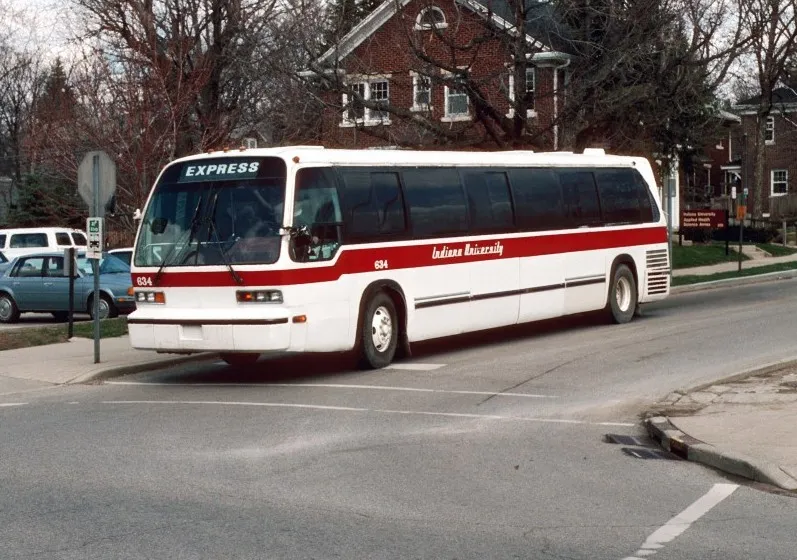
When I first visited New York in 1998, one of the things that struck me, an odd connection to the past, were the city busses.  I don’t even remember if I rode on one - I never really figured out the schedule, and it was usually easier to walk to a subway stop - but they looked exactly like the same busses we had in Bloomington when I went to school there.  It freaked me out at the time, because I couldn’t think of two more disparate worlds than the late-eighties IU campus, this few hundred acres of green grass and the occasional limestone castle of a classroom building, and the concrete jungle of Manhattan in the late nineties.

Both IU and the MTA had these busses, built by GMC, which upon further research were called the GMC Rapid Transit Series II. The RTS looked like a giant pack of gum, a squarish tube with a flat front end and a slightly futuristic look, in the same way a Disney monorail looks futuristic.  I grew up as a captive in those standard Blue Bird school busses, the kind that could be from 1997 or 1947, with the little square windows you could use to watch the suburbs scroll by on your way to and from your classroom of doom.  But the RTS had these giant rectangular tinted windows, and inside, almost every vertical surface was transparent to the outside.  Both IU and NYC’s busses were mostly white, with a small bit of accent color on them, a crimson stripe or an MTA blue bar, respectively.  I always remember that the difference reminded me of George Lucas’s treatment of the R2 droids in Star Wars; they were mostly white and chrome, but those little blue accent panels on the R2-D2 got swapped out for orange ones so it could look like a different droid.

I only really rode IU’s bus during the fall semester.  They ran a couple of bus lines, denoted by letter (and color) almost like the New York subway system, with the A bus making a loop around campus, and the C and E continuing out toward the campus mall.  When I first arrived in Bloomington, I was convinced it would take me hours to traverse the campus, and bought a bus pass.  They had two options: a full-time pass, which cost a few hundred dollars, and a night/weekend plan that cost something like $53, which is what I chose.  Two years of driving everywhere in rural Indiana reinforced the belief that you had to have a car to live in the Hoosier state, and I feared that first time I’d need to get to the mall to buy something important and I’d have to ride my rusted ten-speed the grueling 1.2 mile distance.  By the time I moved off-campus in 1991, I’d walk absolutely anywhere, in any weather, provided I had enough juice in my walkman to power a tape for the whole journey.

I have very distinct memories of riding that loop around campus.  There were these rubber pneumatic strips on the vertical pillars, and you pushed them to ding a bell and alert the driver you needed to exit at the next stop.  I’d look up at the glossy white ceiling and gaze at the emergency exit hatch worthy of a space capsule, wondering what kind of catastrophic failure would require egress if the bus never really got above ten miles an hour.  I’d sit in on the molded plastic seats, and I’d watch the green campus crawl by.  And I remember many a long wait at the mall, sitting at the corner in front of the Sears, waiting for one of the big white rectangles to cruise down the road and stop with a pneumatic hiss and open its doors for our return to campus.

The campus bus was also this connection back to my first visit alone to Bloomington.  I remember having a very different perception of the campus, before I started classes, before I really settled in.  I think it was my view of the institution of college in general, as seen from the eyes of a high schooler.  I didn’t spend decades planning on attending IU - I didn’t have any family members or friends who went there, and I thought I’d end up at Ball State, until maybe the January of my senior year, when I changed my focus.  I did that parent weekend visit, where you show up with your folks and the school tells you how great it is and how you should really give them your money (red carpet days?) and it all looked so hallowed and distant to me.  All of the students there looked a decade older, even though most of them were mere months ahead of me.  My perception of college life was formed by 80s movies like Breaking Away or Revenge of the Nerds, and I thought everyone was a rich jock or a supermodel-to-be, and it was all very intimidating to me.

But aside from the people, I had this perception of the campus as this hundreds-of-years-old institution, with the ivy-covered buildings and towering library and these bars and hangouts like Garcia’s Pizza and Nick’s and Kilroy’s.  And part of this perception was that the campus was immense.  When I visited that summer before my first semester, I drove down from Elkhart and stayed at Foster quad, which is on the north side of campus.  And they had some special shuttle bus set up to haul everyone from Foster down to the old crescent of campus, to Franklin Hall to meet with advisors and take placement tests and register for classes and do other things involving many scantron forms and number two pencils.  And I remember taking one of these RTS busses for the slow crawl around the campus, down Jordan and across the long stretch of Third Street filled with greek houses and old buildings, and then around the corner by the Law School and up Indiana to the division between the old original campus and the downtown.

I walked past all of these little stores, like the White Rabbit place where you got rugs and posters for your dorm room, and Discount Den, where they sold used CDs and everything imaginable with an IU logo on it.  That stroll around the Kirkwood Avenue buildings, eventually culminating with a lunch at Garcia’s Pizza, is where my perception started to change, from the campus being this distant Hollywood-formed entity to being my home for the next half-decade.  I didn’t know this change in perception had started, but that first glimpse of my new life is what I always remembered every time I got on one of those busses.

And then, a decade later, I’m in the same exact bus, with a different color stripe.  Except instead of being the A bus lumbering past the Arboretum and toward a giant limestone library, it was the M60 going from Harlem, across the Triborough bridge and into Queens.  Even though the lush green lawns got replaced with block after block of graffiti-covered buildings climbing into the sky, I still remembered that July day in 1989 when one era ended and another one began.

On Mix-tapes, floppy disks, and gopher

SharpElectronicOrganiser-open

When we were out for dinner last night, I was talking about the AT&T “you will” ad campaign.  It seems like this happened ten minutes ago, but it was twenty years ago.  I don’t entirely know why I remember these ads, since I didn’t have a TV at the time, and downloading a ten-second 320x200 MPEG would take you half a day, so I’m sure I didn’t watch it online.  But the commercials featured a bunch of far-future technology, which now either exists (the ezpass, telemedicine, RFID, sending PDFs from your phone) or is so stupid we’ll never have it (home automation, robot butler crap.)

What amazes me, thinking about this, is all of the technology that was ubiquitous twenty years ago that a kid today would totally not understand.  I wrote about floppy disks yesterday, but here’s a few more off the top of my head that are dead forever:

  1. Pay phones.  I guess they exist now, in a very limited form, but I remember when even in rural Indiana, you could find a pay phone almost everywhere.  My dorm had a bank of pay phones in these little wooden booths with glass doors, I guess from the days when the dorm rooms didn’t have phones, or maybe for when you wanted to have a private conversation without disturbing your roommate.
  2. Cassette tapes.  Vinyl’s making a comeback, but tapes are dead.  I would probably have an extra year of life if I could get back all the time I spent re-winding fucked up tape back onto the tiny reels with a pencil, or untangling a long strand of tape that vomited out of the little holes on the bottom of the norelco shell and into my walkman.  Which reminds me of…
  3. Walkman.  I guess capital-W Walkman was the registered trademark of Sony, but everyone called every portable tape player that ran off of AA batteries a walkman.  I guess now people call every portable digital player an iPod.
  4. Ghetto blaster.  Is that a politically incorrect name for a portable stereo?  I don’t know, but when I googled “jambox”, I got some bluetooth wireless speaker.  I’m sure someone will come out with a “throwback” version marketed toward people who like hip-hop music and see the old ones in Spike Lee movies, but it seems like a dead format right now.  Now when you want to annoy everyone around you and look cool, you play your music through the crappy little speaker on your phone, which should be punishable by, at the very least, a kick to the balls.
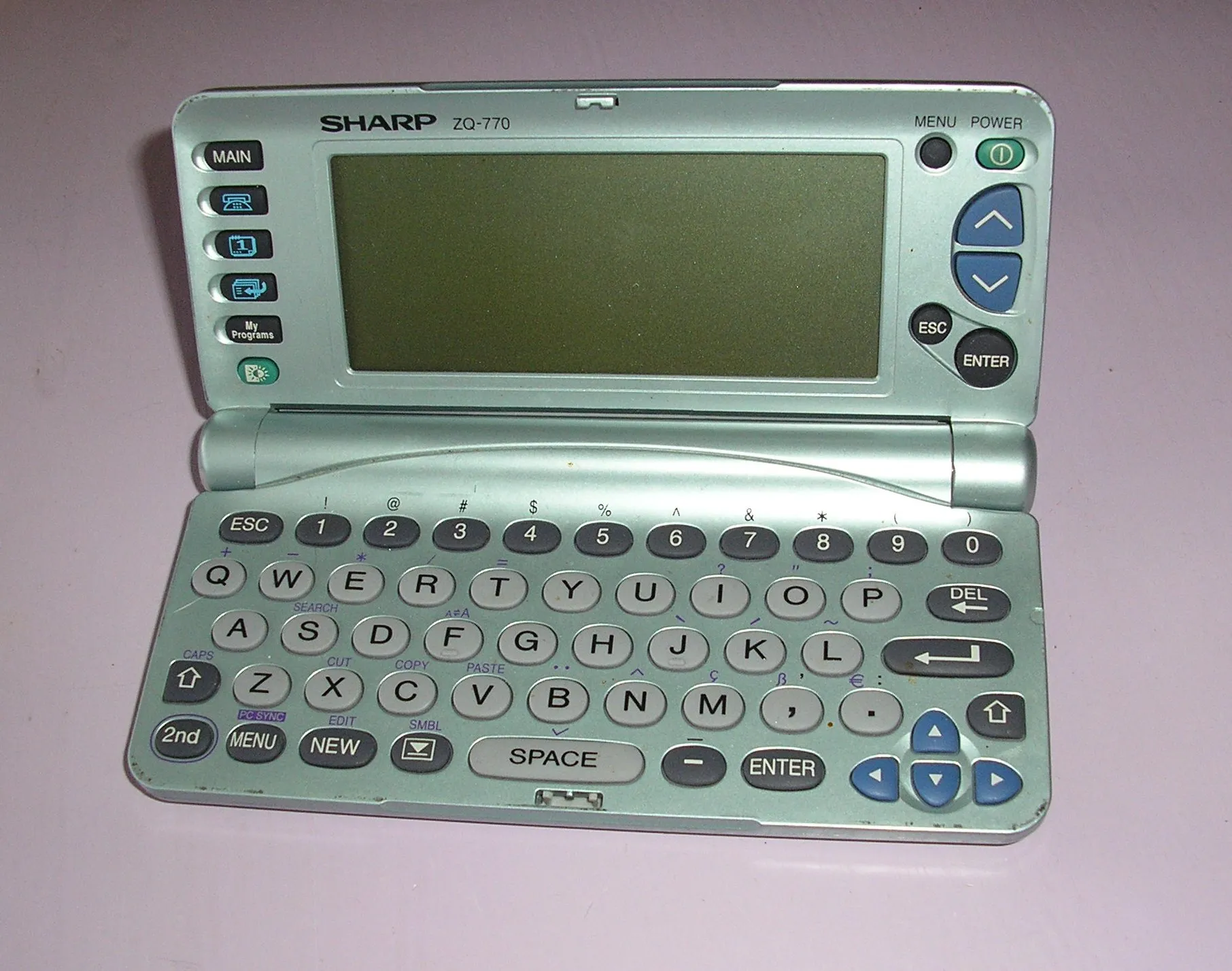
  5. The Wizard.  In the days before iPhones synched contacts, there were these bastardized calculators that would store names and phone numbers.  There was no way to sync or back them up, and they all had horrible chicklet or membrane keyboards.  I got one in the late 80s, either as a holiday gift or when one of my parents got one for opening a checking account or something and couldn’t figure it out.  It was so painful to enter in any phone numbers, and by the time I did, the battery would die and I’d have to start over.  I did my own poor man’s wizard, which was a sheet of paper folded up in my wallet, which I guess now I could call a “hipster organizer” and start a whole web site about.
  6. Floppy disks.  I talked about this yesterday.  It also reminded me of the whole cottage industry of plastic holders for floppy disks, the various clamshells and rolodexes and plastic cubes and whatnot.
  7. Zip disks.  These had a brief window of maybe five years of popularity, somewhere between hauling around fifty floppy disks and just burning a CD-ROM.  All I remember about these is they had this “click of death” issue, and would suffer from catastrophic failure, which almost always caused the owner to freak the fuck out because they didn’t have a backup, because the Zip disk was the backup.
  8. SyQuest drives.  You need to dig deep to find someone who remembers these, but we had a bunch of SyQuest drives on the IU campus in the early 90s.  They were basically a removable hard drive, a 5.25” plastic cartridge that held a hard drive platter and was nowhere near as sturdy as a floppy.  I never had one, because they were not cheap; I think they cost like a hundred dollars for a 44MB cartridge, and $100 was like a month of beer in 1992.
  9. Film cameras.  I guess they still exist, but unless you are an artist or hipster, you aren’t dropping off an armful of black plastic spindles at the local Osco’s to wait and see if the pictures you took last week were fucked up or not.
  10. Gopher.  Almost nobody remembers it, but it was a brief precursor to the world wide web.  You used a browser program to look at servers, but there was no real page layout, just menus that went to documents.  You couldn’t really publish your own gopher page, but for about ten seconds in 1991, every big university or government office had a gopher server, and it was so cool to browse through links and find text documents up to eight times faster than just FTPing there.  Then the web came out later that year, and we all forgot about gopher.

I think it’s easy to come up with a list of predictions for stuff we’ll have in 20 years.  What’s harder is to come up with a list of the stuff we use every day today that will be obsolete in 20 years.  Here’s my stab at a list of stuff that will go away by 2031:

  1. DVDs.  Probably Blu-Ray, too.  I think either everything will be streamed/downloaded, or maybe there will be some successor for optical media that’s smaller and stores more, maybe with some read/write capability.  I’m also certain that all of the optical media you buy today will be dead by then, either from some defect in manufacturing that will cause the discs to oxidize/disintegrate/fall apart, or because nobody will have the players anymore.  (How many of you still have a Jaz drive laying around the house?)
  2. GPS. I mean the TomTom unit you stick on your windshield with a suction cup.  I think this functionality is going to be built into cars for the most part.  I doubt we’ll get to fully automated driving in 20 years, but I think by then, high-end cars will have some sort of autopilot functionality in bigger cities.  Of course, that means every square inch of Japan will be wired for it, and we’ll see it in parts of New York and LA.
  3. Incandescent light bulbs.  Sorry tea party, but within five years, LED light bulbs are going to be cheap, low-watt, dimmable, smaller, way less fragile, and have no flicker.  That probably means the compact fluorescent ones will die too, if that makes you feel any better.
  4. USB.  It might exist in name only, but I think that some descendant of the optical version of the Light Peak/Thunderbolt interface is going to eventually kill USB, DVI, and HDMI.  I see two stumbling blocks with it: one problem is you can’t power a device over an optical interface, and the other is the endless pissing contest that happens when anyone wants to introduce a new interface format and everyone else doesn’t want to be the next betamax.
  5. Console gaming systems.  A big part of the market is going to mobile phones and tablets as we speak, and we’re just about to reach a massive crash in console sales.  The other thing is that TVs are getting smarter, and you’ll see a point where your TV is the client for the game, and some server out in the ether will do all of the processing.
  6. Printers.  Tablet-type systems will be everywhere and paper-thin, so you’ll just shoot documents back and forth like that.  If you’re one of those “I can only work on stuff that’s printed out” people, you’ll either be dead or blind in 20 years.
  7. Terrestrial radio.  I’m not sure why it hasn’t collapsed by this point, but I expect some combination of right-wing deregulation and greed over those coveted frequency bands to cause the entire system to get shut down and repurposed for commercial long-distance baby monitors or digital parking meter uploads or something else.
  8. Von Neumann architecture computers.  We’re at the point where you can’t fit any more crap on an integrated circuit, and CPUs aren’t going to get any faster.  In the next few years, it’s going to be all about adding more cores and more processors and more GPUs and coprocessors, but that’s all eventually going to go sideways.  Someone will get serious about using optical interconnects at the chip level, and when that happens, they’ll look at stuff like neuromorphic computing, emulating neuron networks, or something.
  9. Pretty much every web site you use today.  Facebook, twitter, and google will all be five iterations gone.  How many of you still use AltaVista?  Friendster?  Something new will always come along.
  10. Microsoft.  If you asked me 20 years ago about IBM, I would have predicted they would run the world.  Now, what do they even do?  I think they do consulting?  And maybe mainframes?  Microsoft is going to go through this 1-2-3 of a CEO change, a collapse of their long-term ponzi scheme of running a constant loss in their online divisions, and probably some major split or sell-off or restructure.  I’m sure there will be a Microsoft in 20 years, but I’m also sure it won’t be ever-present in every corner of your life unless you work there.

I guess I forgot to mention the death of the VCR, so maybe that’s another later post.  I also wonder if DVRs will still be around.  Seems like it would be much more efficient if the cable company stored copies of everything and you browsed them like the web, instead of trying to “catch” the recording and store it on your end, and then if you miss setting the recording or the stupid thing ends 90 seconds after the 30 minute mark, you aren’t screwed.  Why don’t the do it that way now?

It has been a decade since I've seen a sector not found error

pile-of-floppy-disks

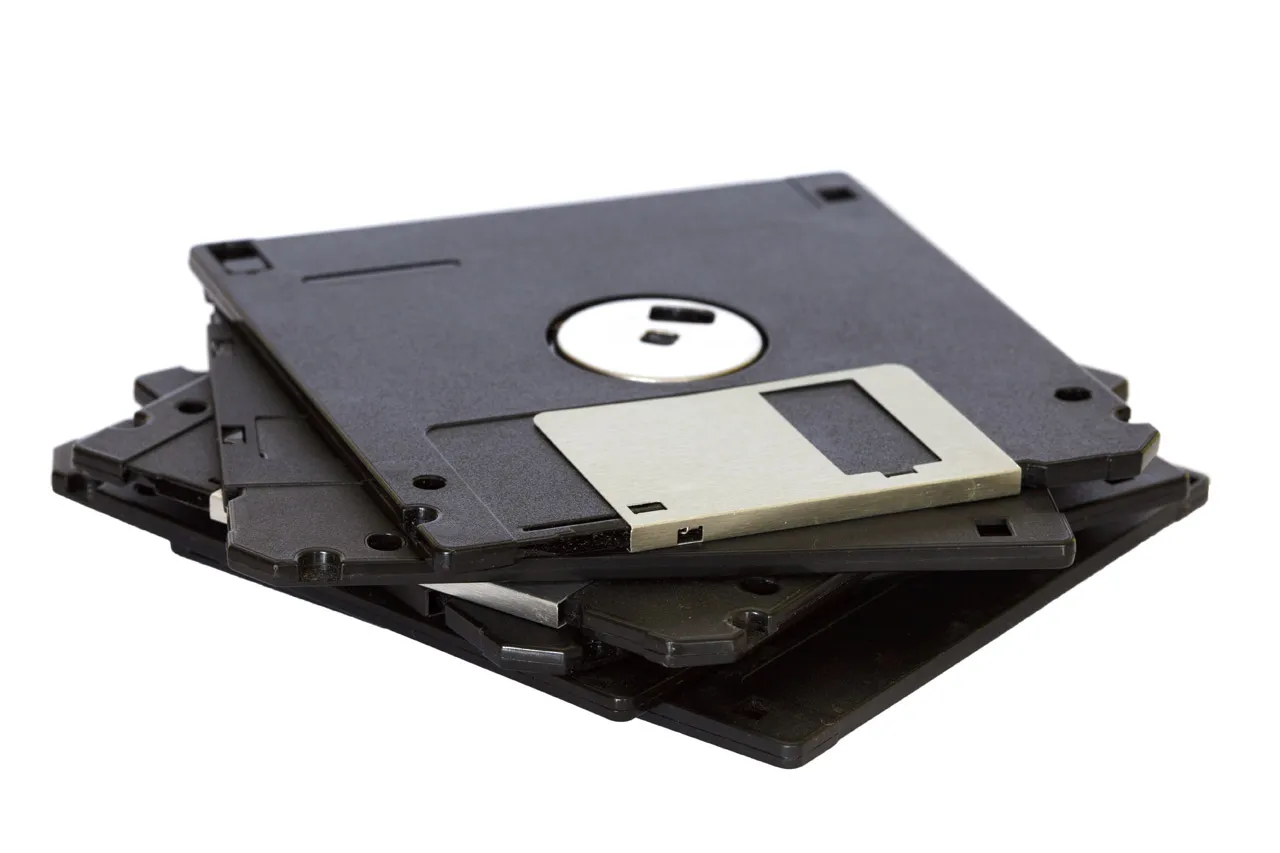
Someone recently posted a sort of call-to-arms for people to dig up their old floppy disks and back them up immediately, because it would only be a matter of moments before the magnetic media would flake away and vanish forever.  I remember hearing scare stories way back when, that after some huge amount of time like ten years, disks would simply fall apart and vanish, and I thought, “shit, 2002 is like forever away, so nothing to worry about - better get back to flaming this idiot on alt.rock-and-roll.metal.heavy about why Entombed is going to always be the best band ever.”  Now, I don’t even know where the hell my floppy disks are - I think they’re in my storage unit, but they could be in a box somewhere in the house, or they could have all ended up in the garbage in one of the last dozen moves I’ve made.

I remember the first floppy disk I ever had.  It was in maybe 1985 or so, a 5 1/4” Memorex single-sided disk I had to buy for a computer programming class.  There was no real difference between single and double-sided disks except for a little notch on one of the sides, and you could use a hole punch or x-acto knife and carve out that little hole and you’d magically have twice as much storage.  There was some urban legend or unverified factoid (this was way before google or snopes.com) that the disks that didn’t pass some quality test on both sides became single-sided disks.  And they sold some little device in the back of Compute magazine that punched the hole for you, but why pay for it when you can just use a knife for free?  I saved all of my Apple II BASIC programs on one side of the disk, and then used the back side to save all of my Commodore stuff when I was using my friend Matt’s computer to play games.  I had a Commodore 64, but never got a floppy drive, so I never amassed a huge number of disks like some of my friends did.

I came up on computers around the time when two formats dominated: the 5 1/4” floppy disk, and the 3 1/2” not-as-floppy disk.  When I went to school in Bloomington in 1989, I saw both of these in the wild, and it was always this curse that if you chose a 3.5” disk, you might go over to a friend’s or some off-the-beaten-path dorm computer lab and find they only had the 5 1/4” drives.  If you used a Mac, you didn’t have this issue, but you had to actually find a Mac on campus, which meant waiting in a Cedar Point-length line for a seat, or spending the cost of a decent car for your own home computer.  And these were the days before “the cloud”, or where “the cloud” meant an account on a VAX machine where you could store maybe a four-page paper, if you could wait an hour to upload it over your 2400-baud modem.

The format also caused great confusion when I started consulting, because people thought “hard disk” meant the plastic-encased 3.5” disks, when it really referred to a high capacity fixed-platter device.  I probably spent at least a month of my life on the phone with someone playing this “who’s on first” game of trying to determine what the hell they were talking about.

I bought a ten-pack of those 3.5” disks in my freshman year, but when I returned to IUSB for my sophomore year, the newer and smaller drives were nowhere to be found.  I bought a ten-pack of 5 1/4” disks every payday, and would promptly fill them up with stuff I downloaded from the internet, old issues of Phrack magazine and pieces of pascal code, images from wuarchive and shareware games that never worked right on the school’s crap computers.  I never labelled anything, and within a year, forgot what was on almost every single one of these disks.  When I built my first PC in 1991, it had both sizes of drive on it, but I eventually phased out the use of the 5 1/4” disks.  I think my last “big” drive stayed in the tower for a long time though, until the top two wide slots in the case were populated by a CD-ROM and CD-R drive.

My first hard drive doesn’t really count - it was this 5 MB winchester drive that I swear dimmed the lights in the whole damn house when it spun up.  It wasn’t until 1993 that I bought a proper IDE drive, a whopping 40 MB drive for $100.  But floppies were still very much in play.  Every time I wanted to reinstall the latest Linux on my machine, I would haul out a pile of 20 or 30 floppy disks, go to campus, and start downloading.  Of course, I’d always get home and the install would crap out because disk B7 had errors, and I’d have to start over.  I had an endless supply of disks though, because when I worked in the labs, the lost and found bins would fill with disks that were left behind, and after a semester, they would end up in consultants’ pockets.  There were also plenty of disks that came with hardware, install disks for bulk-purchased software that were never used, and promotional things that would end up in my collection.  I had many a disk that had a glossy Quattro Pro or Microsoft Sound Card sticker that was crossed out with marker and sloppily labelled “SLS 1.02 X7/10”.

Apple was the death of the floppy to me.  I mean, I had a Dell laptop I bought in 2001 that had no internal floppy, but it had this external caddy that held either a CD or a floppy drive, and I had both.  But when I switched over to the Mac Mini in 2005, it had no floppy disk drive, and no provision to hook one up, unless I went and bought a USB one.  By then, everything was on my hard drive, and if it had to be portable, I’d either burn it to a DVD or upload it to 34.216.9.77/.  I still had the PC tower, and it still had the floppy drives, but after I got the Mac up and running, I powered off the PC, and only powered it back up maybe two or three times.  And that PC ended up getting left in the trash room of my LA apartment when we split for SF.

I don’t know where those last few floppies are, or if any archaeology is needed to recover them.  I think most of the writing I want to keep ended up on this hard drive, and an installer to Epyx Summer Games for the PC isn’t useful to me anymore.  But I do miss the format in some strange way.  It’s entirely useless in the era of thumb drives and SD cards and DVD-Rs, but it’s a token back to the brief time between garage computers as big as a tank that involved soldering and toggle switches, and the era of ubiquitous computing, when there are more computers than people in the country.

All That is Golden

Simms had a hard-on for Kubrick. I’m suddenly reminded of this because of an excellent documentary on the making of The Shining, as filmed by Stanley’s daughter Vivian. Go watch this immediately.  This is required.

http://video.google.com/videoplay?docid=-4745727919325920852

Simms had these insane theories that Kubrick was obsessed with the Golden ratio.  I’d never heard of the concept, that one plus the square root of five divided by two appears all over the place in art and nature.  1.618 is everywhere, from Greek temples to da Vinci’s paintings to the endoskeletons of shellfish.  Simms argued that 2001 must have been recut before release, using a computer that counted frames and trimmed things according to this mathematical equation.

I remained skeptical of all of this, until he brought me to a midnight showing of The Shining at the student union.  We sat in the front row, and Simms kept whispering at me, “look - look!”, pointing out the framing of shots.  And I’ll be damned, every scene, the hallways of this haunted hotel scrolling by the little kid on a bike, the tracking shots of people running through frozen mazes, everything was blocked and composed with this magic ratio in mind.

This short documentary contains some amazing little things, like a few sneaking glances of a Steadicam in operation, in the making of the film that would become an integral part of the device’s history. And there’s shots in the maze, of the little Danny Lloyd being told to run away from Jack in the snow.  Plus you see all of this behind-the-scenes coverage, of amazing stuff like Kubrick banging away on a portable typewriter at a kitchen table, while Nicholson marks off his lines in a script, using some technique that he claims he learned from Boris Karloff.

But the amazing takeaway of this doc is the glimpse of Nicholson as a working actor, and not the caricature that he has become after decades of every single white male hack comedian on the continent Doing Jack.  You see this charming young man joking with the crew, looking debonair, brushing his teeth before a take.  And then he hops up and down a few times to get the adrenalin going, and BAM, he instantly transforms into the demon-possessed Jack Torrance, wielding an axe and going into the windup to kill his wife.  And then cut, and then he’s Jack N again.  It’s truly amazing to see him switch on and off this role.

Now I’ve gotta go see if the original film is on Netflix or Amazon for streaming…

(Other unrelated trivia: the original hotel Stephen King wrote about is in Estes Park, Colorado.  That’s about 90 minutes away from… Golden, CO.)