The Wrath of Kon

Dispatches, thoughts, and miscellanea from writer Jon Konrath

Tag: memories

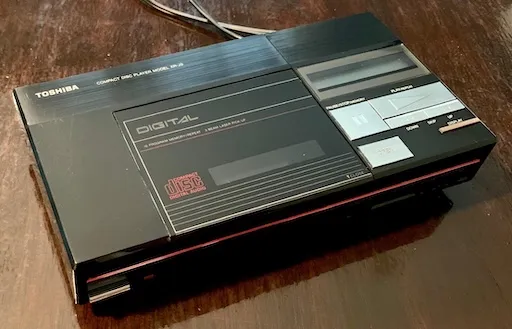
My first CD player

toshiba-xr-j9

I had to rip a few CDs last week, which is a rare occurrence these days. I don’t even have a CD player at this point, and have to dig up an external optical drive for my Mac once or twice a year when this happens. It had me thinking about the rise and fall of CDs in my life, which brought me back to my first CD player ever, the Toshiba XR-J9.

So, 1987. The Compact Disc was released in Japan five years before, and audiophiles had been buying them in the US, but not so much in Elkhart, Indiana. The whole idea of digital audio was a thing of awe, total science fiction. Lasers! The ones and zeroes captured in the studio remained ones and zeroes until right before they hit your ears, with no degradation, no distortion, no mangling through resistance-bearing wires and analog amps. Some magazine article said if you dubbed a cassette from a CD, your copy would sound better than the professionally-duplicated one you bought in a store. I can’t even remember the first time I actually heard or touched a CD, and didn’t know anyone who had a player. I had to have one, of course. But I couldn’t spend a grand on a Sony home player, and didn’t really have the stereo to match, which would cost a few thousand more.

At that time, I had a Soundesign stereo, probably from Wards or Sears, which had tower speakers, sat in a wood rack with glass doors on the front, and was a single piece for the receiver, EQ, and double tape deck, but had grooves in the plastic face so it looked like a stack of individual components. It wasn’t exactly high fidelity, but it was better than the Sears all-in-one I had in grade school and junior high. And it had a pair of RCA connectors for Aux In, tempting me to add more.

I was out of the house more than I was in it back in high school, so cassette was my primary medium. In my pedestrian days, I ran through $20 Walkman clones on a regular basis, whatever I could pick up at Osco Drugs on a discount. Once I graduated to a car, it had a no-name tape deck in it. For a while, I would buy vinyl and record them to tapes, but I mostly bought cassettes, or dubbed friends’ albums onto blanks.

Every time I went to any store with audio gear, I’d ogle the various components, thinking about how someday when I was out of college and rich, my first priority (aside from a Commodore Amiga) would be to buy some esoteric system with gigantic speakers, two dozen bands of EQ, a DAT digital tape deck (what happened to those?), and of course a reference-quality CD player. There was a store in the Concord Mall called Templin’s that was half instruments, half audio gear. (Oddly, they also sold Atari home computers.) This was the place where they had separate listening rooms where you could go in and see full setups like the one in American Psycho, thousands of dollars of gear that was absolutely unobtainable to me.

In the summer of 1987, I started working my first “real” job at the Taco Bell across the highway from the Concord Mall. And right around then, CD player prices started dropping. They were like $1000, then hit $500, then $400 or $300. And around the time my first paycheck hit my pocket, I was in the K-Mart across the street from my ‘Bell, and there was this CD player that was a hundred dollars. I absolutely had to buy in, and I did. (For reference, $100 in 1987 is about $285 now. I made $3.35 an hour dealing with drive-through abuse and refried bean cooking at TB.)

The XR-J9 was an odd little beast. It was about twice the size of a battery-powered Sony Discman of that vintage, but way smaller than a component home CD player. It was a weird mix of the two, though. Like a Discman, it was a top-loader; you popped open a lid and put the disc directly on a hub, then closed the door to get the laser to start. (Laser! I now owned a Class 1 laser! 3-beam pickup, whatever that means! It even had a warning label on the bottom!)

Unlike the portable Discman, the Toshiba ran on mains only, with no provision for a battery. It also had a fixed set of RCA cables coming from the back, which would plug into a home receiver. It also had a headphone jack and volume slider on the front, but unless you had a Honda generator with you, it was in no way portable. And those cables weren’t removable, which bugged me.

The controls were spartan: a power button on the front; the usual play, pause, forward, and back buttons. You pressed in a corner of the lid and then it unlatched and popped open. It also had a Display button, which I think toggled the time versus the time remaining that showed on the small LCD display. Some buttons had multiple functions. If you pressed Forward once, it would skip a track; hold it and it would fast-forward through the track, playing a sliver of sound every five seconds. This was amazing coming from the tape world, because I swear I spent half my batteries jumping around tapes, and this was instant. Random access! There was also some elaborate combination of buttons you could mash to access a “memory” mode where you could program up to 16 tracks in any order to get a custom playlist, which was a huge pain in the ass to do, and then it immediately went away when you opened the player. I would very occasionally do this when listening to The Police - Synchronicity so I could skip track 4 (“Mother”) because I never felt like it matched the rest of the album. (Now I think it’s the best track.)

The obvious problem after sinking a whole paycheck into this thing was that I now needed music. I think at that time, a tape was like $7.99 and an LP was $9.99, but a CD was $15.99. Each title was an investment. I went to Super Sounds, my favorite record store ever in the Concord Mall, and went A-Z through their three or four racks of CDs, trying to figure this one. (At that time, CDs were in “long boxes” which were the same height and half the width of an LP, so stores could use the same vertical racks for the new format.)

My first purchase was the most recent Iron Maiden album, Somewhere in Time. I was way too into Maiden at the time, and this album was a perfect storm for me: it was Iron Maiden; it had this futuristic cyberpunk theme; it was what I thought at the time was super-modern, ultra-technical sounding; it was digitally mastered; it was Iron Maiden; it was loud, but precise. It was also almost an hour long, so it was like twice as long as if I’d just bought a Boston album or whatever. I remember bringing the CD home, listening to the whole thing on headphones, and there was this one part on the song “Deja-Vu” where Nicko McBrain is playing this snare volley right before the chorus comes back in, and I could suddenly hear that he was also tapping out time on the hi-hat, which wasn’t audible on the cassette. It absolutely blew my 16-year-old mind.

Of course, I had no more money, so I had to go sling tacos and wait two more weeks to get something else. I don’t remember why, but I got the ELP album Trilogy next. A headphone listen also bewildered me. The first song starts with a beating heart, then Emerson doodling away on keyboards, which sounded incredibly crisp, compared to a muddy cassette. After two minutes, the rest of the band suddenly came crashing in, and the dynamic range demonstrated by the sudden change was incredible.

I can’t remember what was the third disc, but I did waver on whether I wanted the high quality of a CD or having twice as many at-bats by sticking to tape. By that fall when I started working at Wards and moved to weekly paychecks, I vowed to myself that I’d buy a tape every week, if not more. I pretty much stopped buying CDs for a while, until maybe my senior year, when I discovered the Columbia House and BMG CD clubs.

About twenty years later, the CD thing came to an end, with just shy of a thousand titles in my collection. I’d slowly been ripping things to MP3 when the 21st century started. Once the iPod hit, CDs became a temporary medium I used until I could rip the tracks to a hard drive, then became a backup in storage in case my computer died. On November 22, 2005, I made my first purchase on iTunes, and that was the beginning of the end. Now, almost everything is added from Apple Music or bought from Bandcamp.

(Oddly enough, the first track I ever bought online was Harry Nilsson’s “Remember.” The reason I suddenly needed to hear it again was a memory of the Michiana student TV show Beyond Our Control, which closed each episode with the song.)

That Toshiba lasted until maybe 1992, when it mysteriously died, stopped loading up discs. I bought a Kenwood portable player that summer (this was described in Summer Rain) and that unit suddenly became my main CD player for a few years until I bought a Kenwood 6+1 changer at the start of 1994. The Kenwood portable never really got used as a portable, because it drained AA batteries so fast, and this was before the anti-skip memory thing was out, so it was fairly useless on the go. I never considered CD as a portable medium, using the MiniDisc from the late 90s until the iPod showed up. I didn’t own a car with a CD player until 2007, when the format was dead. My 2014 car had a CD player that I think I used once. I honestly could not remember if my 2025 car even has one, and I guess it doesn’t.

All of this is so strange to think about, because that 1987 dream of someday having a gigantic reference system in my home is long gone. (So’s that desire for a new Amiga, but that’s another story.) MP3 wasn’t even a dream back then. I listen to 99% of my music on AirPods these days. I don’t have a room full of racks of CDs. I could afford to go buy any stereo I want, but what would I even buy? I bought a pair of near-field monitors for my desk literally a month before the pandemic started and I had to go to pure headphones for the locked-in-the-same-apartment 24/7 thing. I think I have two different Kenwood receivers in storage, and use a $200 sound bar in the living room for the TV. Music is still important, and I’m listening to stuff every day. But the technology has changed and the meaning of where it is in my life has too. Is that good or bad?

How to Rob a Bank

seattle

I saw a doc on Netflix the other night called How to Rob a Bank. It’s about Scott Scurlock, a bank robber who had a big run in Seattle in the mid-90s, hitting 18 (or 19) banks for a bit over $2M in 1990s money. It was a pretty generic doc, but had lots of footage of 1992 and 1993 Seattle that really brought me back.

I lived in Seattle starting in 1995, and the film ends in 1996. I honestly have no memory of this news story, but I didn’t have a TV or cable back then, and didn’t read a newspaper, so I totally missed it. But the stock footage, the establishing shots they used, that totally brought me back. It all looked like it was shot on a Hi8 camera, both a crummy quality but a way-too-bright color palette that makes it look far too sharp and vivid. I think I got a Sony Hi8 right around the time of the end of this movie - maybe the same month - and I regret not walking around Pioneer Square and shooting hours and hours of footage of everything and nothing.

Scurlock, aka “Hollywood,” habitually hit Seafirst bank, which was my bank. When I got my first real paycheck in 1995, I went downstairs from our office and walked in a Seafirst on Occidental and opened a checking and savings account. I got a special deal which was new back then: no monthly fees or minimum balance, but I had to pay to talk to a human. I could call their voice mail thing to hear my balance or make a transfer (this was before web banking), and I could use the ATMs or drop off a check. But for an introvert who hated lines, this was the perfect deal.

It also meant I was never standing in a bank lobby when a dude with a rubber nose and chin glued to his face jumped on a counter, waved around a Glock 17, and started screaming for the vault teller. This was a good feature to have, since Scurlock and crew used to repeatedly hit the Seafirst on Madison about a mile from my house, across the street from this classic red-roof Pizza Hut I would always visit when I needed a quick case of nostalgia and/or diarrhea.

The movie built up Hollywood to be this Robin Hood type who lived a vagabond lifestyle, traveling worldwide, living in a treehouse in the woods, writing poetry in his journals. What’s weird to me is he looked like someone I might know, like a friend of a friend of someone who went to Evergreen to study vegan architecture. He had this longish but not long hair, used to be a nudist and live in the woods near Olympia, but wasn’t like a hippy hippy. He seemed more like a weird libertarian guy who was a UNIX system administrator at Boeing and spent a lot of time on bondage groups in USENET news. I never really hung out with anyone like that, and he was a half-generation older than me, but I spent enough time in Belltown that I knew the type.

And I’m not saying I’m into a guy like this, but one of the reasons I’ve never gone back to Seattle is I’m sure Amazon has completely homogenized it, and the weirdo underbelly has all died out or sold out. I’m sure if I went to a cafe in  Fremont now, it would all be people talking about crypto or keto muffins or crossfit. In 1996, it would have been dudes in 79 different garage bands, perennially only two connections from making it. Like your refrigerator delivery guy was in a band that would share a practice space with an iteration of a band that split and half the members went to the first version of Lords of the Wasteland that later had a second iteration that became Mother Love Bone that became Luv C2 that became Mookie Blaylock that changed their name to Pearl Jam. Anyway.

It was also funny to see the doc throw in a quick grunge reference, even though Scurlock was probably totally unrelated to that scene. They spent about 90 seconds showing those crazy flannel kids, playing some unrecognizable music the film could clear without paying the Nirvana estate seven figures. “Hey, these kids hate corporate rock! They’re rebels! It’s the spirit up here!” Sigh.

Spoiler alert, Hollywood tried to go out big with a giant heist, and ended up in a firefight and chase, then killed himself before the cops could. It was on Thanksgiving in 1996. I was trying to remember where I was that Thanksgiving, and the funny thing is, I remember exactly where I was that day, because it’s one of my funniest meet-the-parents stories. I’ve always been hesitant to write about this publicly, but this was almost thirty years ago, and I have not talked to her in 25, so here goes.

I used to date someone who lived in a small town in Southwest Washington, a hundred miles south of Seattle, just before the Oregon border. This started in October, and we’d been trading off weekends, one of us driving to see the other. And Thanksgiving became the “let’s have dinner with my parents” weekend down there.

I’m always nervous in these situations, and this one was slightly amplified because she said her parents were very religious and pretty conservative, and I’m neither. We got there and they lived in a second-story walk-up at this boarding school where her dad worked, like a staff housing thing. Her dad was really nice, and the dinner was great, and I mumbled through saying grace, and then I answered the usual questions. Her mom was okay but sort of quiet, fair enough. She had two older brothers and they were cool, although I knew nothing about sports and sports was like their entire lives. I’d need to memorize some stats or figure out the name of the baseball team that played across the street from my apartment before I saw them again. (“Hey that Kevin Griffey guy, he’s like, pretty good, right?”)

After dinner, I got the big curve ball: her parents were moving. Tomorrow. And nothing was packed, and the house was crammed with decades of stuff and all the fixins from a big turkey dinner and a bunch of appliances that were going with them. And it was a second-floor walk-up. No elevator. And it all had to be moved and the apartment cleaned that Friday.

I’ve moved a bunch and I’ve helped people move, and I’ve been in some disorganized situations, but this was the most chaos I’d ever seen in this kind of operation. It’s impossible to help someone pack their stuff into boxes when you’ve known them a grand total of 37 minutes and you have no idea what is trash and what is treasure and there’s piles of stuff going back to like 1976. Hauling a fridge, a chest freezer, a stove a dishwasher, and a washer and drier down a set of exterior stairs was bad enough. But packing in all the assorted bric-a-brac was torture. They had a big U-Haul, like a 24-foot thing, and I think we filled it twice, plus a bunch of carloads of stuff.

They bought a new pre-manufactured home in a retirement community, which was pretty nice, although it made me wonder how much of it was assembled on a line in Elkhart. We got all the boxes off the truck, then realized the truck was parked in the yard in a small lake, except the lake was slowly getting bigger? We took a look and one of the sets of tires was parked directly over some main water connection to the entire little village, and had cracked it open. So their “Welcome, neighbors!” was getting everyone’s water shut off during Thanksgiving weekend. Fun stuff.

Anyway. Movie review concluded. Check out my Substack. Have a nice day.

Things change, pocket change

colonial-crest

Day off today - I took a four-day weekend, no reason - so I headed to the mall in Pleasanton to buy a pair of pants. I have a wedding next month, and every pair of dress pants I own is comically large at this point. I got to the mall at about 10:37, and didn’t realize that it wasn’t officially open until 11:00. I went inside anyway, because the concourse was open, but half the stores were just booting up, the gates halfway open, lights off, employees setting up signs or counting down registers. It gave me an intense nostalgia flashback, of every time I’d opened at Wards thirty-something years ago, the usual crew of people I knew at every other store setting things up for the daily grind, walking to the First National at the main entrance to drop off last night’s take, stopping at the MCL Cafeteria for a cup of coffee before 10:00 came. The general vibe of a pre-opening mall really threw me back to the summer of 1988. I almost expected to go back into the parking lot and find my rusted Camaro waiting for me.

I got in my walk. I did not get the pants. Everything is now “stretch performance wool,” which is essentially spandex. Also, Macy’s is now JCPenney. JCPenney is now K-Mart. K-Mart is now largely gone. I don’t even know what Sears is.


Speaking of “Amazon is taking over,” in some contrary news, it looks like Amazon is closing all of their brick-and-mortar stores. I actually liked the feel of the stores, mostly because they looked like a rip-off of Borders, albeit much smaller. I’m all but certain these stores were a sophisticated data mining experiment and nothing more. Even the stock on the shelves was a data-driven algorithm, which was bizarre and somewhat maddening for a person who doesn’t read Oprah books. I’m sure they’re doing a lot more of that with their Whole Foods stores now.

A happy coincidence: so, B&N in Walnut Creek closed around the same time the Amazon store opened. Now, Barnes and Noble is actually opening a new store in Walnut Creek right as Amazon is closing. They didn’t get the old location back, and I’m sure it’s a smaller footprint, but that will be nice to see. As I’ve said before, I used to think B&N was The Enemy, and it’s hard for me to root for them now, but I really don’t want to see the one by my house in Emeryville shutter.

Another odd coincidence, Morgenstern’s books reopened in Bloomington. I’ve written about my memories of Morgenstern’s a  while ago. It’s not in the same place anymore (I think the old strip mall location is now a FedEx) and Keith mentioned from his first visit that it’s nowhere near what the old one is. But at least there’s something, especially since the Borders and Barnes and Noble that jumped into town and killed the old location in the late 90s are now both gone.


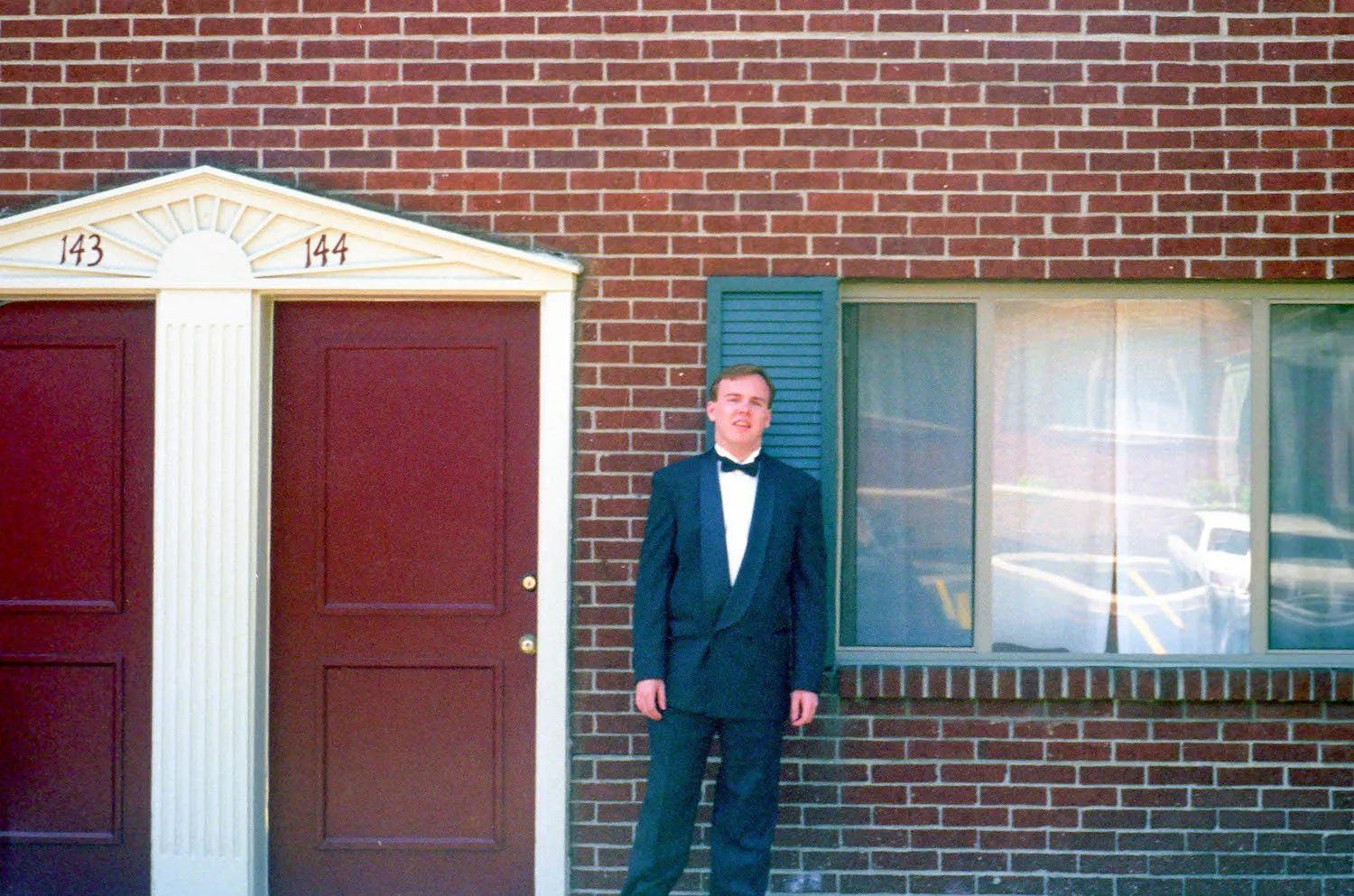
About the picture above: that’s from 1994, the day of Bill’s wedding. I’m standing in front of my old apartment at Colonial Crest, where I lived from 1993-1994. In another bit of dumb nostalgia, I just heard that Colonial Crest, which is now called The Arch, is being torn down and replaced with a new apartment complex, some 5-over-1 monstrosity with a dumb generic name and high rents for rich students.

I did some digging and what’s funny is that these apartments rent for only marginally more than I paid almost thirty years ago. I think we split a $500 rent on a 2br/1.5ba townhouse, and now they go for about $700. That’s saying a lot about the deferred maintenance issues of the place, because it was maybe about a C- in quality and value way back then. I’m sure the redevelopment is for the best, given the student population and need for housing and all that.

That said, I have a lot of strong memories of this place. Various pivotal relationship things happened here, and the start of my writing career happened here in apartment #144. I also didn’t have a car most of this year, and walked the two and a half mile route to school pretty much every day, rain sleet or snow. That long shot down Walnut or College is burned in my head, the zig-zag pattern I’d traverse to cross the northwest side of campus and get to Lindley Hall. All of this is different now. The computer science department has a new facility built where the old Brown/Greene dorms used to be. The long walk up to the UCS offices at 17th street where I worked used to be empty green fields; it’s now a giant dorm, built last year. The UCS office was completely redone into an alumni center. Everything has changed. Things change.


Another weird one: they are renaming everything named Jordan on campus. Turns out former university president David Starr Jordan was really into eugenics, segregation, and racial purity. Problem is, IU spent a century naming damn near everything after him: a biology building; a river; a main avenue cutting across campus; a northern extension to said avenue; a parking garage on that avenue; a bus route on that avenue; a shopping center. The street is now Eagleson Avenue, or David Baker Avenue for the northern part. (Named after the jazz great, not the architect who coincidentally designed my current home.) The river is Campus River; the Biology building is Biology Building. I think people expect everyone to take sides on the woke/anti-woke thing. I agree with the name change. It’s just interesting to me, given the number of times I reference Third and Jordan in my first book.

Things change. People change. Pocket change. It’s actually odd how I never have change in my pockets anymore. Anyway.

The Deal (2021 edition)

20050317-004

So. It’s time to write another post like this one from 2010. It’s not LinkedIn official yet, but I’m leaving my current job, and going to a new one. And that’s always a good way to rustle the various nostalgic bits of the brain, especially when as much time has passed as it has with the current employer.

I don’t like to cross the streams and won’t discuss the specifics of either job here. But the old gig is the one I started in September of 2010. And I did a previous tour with this company from 2001 to 2007. So that’s a grand total of almost sixteen and a half years of service between the two, which is insane.

This job started almost on a lark. I was working in Silicon Valley and doing the big commute and wasn’t entirely into my gig. Joel, my old boss, asked me if I wanted to come back. I said nah, I owned a house out here, wasn’t about to move back to New York. He said I could work remote. I said, okay let’s do this, and I was officially a full-time work-from-home worker, ten years before everyone else did the same.

There are two distinct eras to the job, and the nostalgia for the first half is much heavier. I really liked working on my old products, and loved working with Joel and the old crew. All of us who were there from the start-up days had basically gone to war together, and had an entire vocabulary of our own, plus total knowledge of what was where, how things worked, how to get stuff done. We were all introverts, and a decade before Slack became a thing, we all used an internal IRC server for air traffic control and general water cooler bullshitting. Nobody ever used the phone. I didn’t even have a phone; the company gave me one in the Palo Alto office, and then promptly gave my cube to someone else when I never came in. There was a lot of general insanity, a small company running within a giant one, but I really enjoyed that five year chunk of time.

I also liked that it was a strange virtual conduit back to my old life in New York. At that point, half of the team was still at our old office at Bleecker and Broadway, and the other half was up in Boston. But I worked in New York, from Oakland. I time-shifted three hours earlier to match their hours, and kept up with all of the gossip and the general zeitgeist of working for a New York company, even though I technically worked for a Palo Alto company. I went back to New York three times during that first few years, which was always a bizarre deja vu experience. Like the first time, I came into the office at 632, went right back to my old desk, and it had been vacant for the last three years. All of my old files were still in the filing cabinet. It was like I’d never left. And on another trip, I stayed at a hotel a few blocks from my last apartment. I’d walk the same exact route from the Lower East Side to the office, and it felt like I had traveled time back to 2006.

The parent company got bought out by venture cap, and everything shifted after that. Pretty much the entire team left. I got moved to another team in Palo Alto, and a new product, but I still had the old product. But we went through a big “push to cloud” where the old product was put out to pasture, and I spent much less time on it. I also started managing people, and working on this new cloud thing. I really missed my old team, and 2015 was an extremely depressing year for me.

I probably shouldn’t go into any details of the second half of my tenure. I started managing people, and loved doing that, up until the point when I had to start doing layoffs. That’s brutal, and the only thing worse than firing people who have been very loyal is getting invited to random meetings with HR and not knowing if it’s to fire people or to get fired yourself.

Anyway, don’t want to get into that stuff.

One of the things I have liked about my work situation is that the time-shifting means I have a few hours in the afternoon to write. And I pretty much floundered and was not consistent in my writing in the 00s, and figured I needed to focus and get more regular writing done after I took this gig. I’ve published twelve books in that time, and 30-some articles, plus everything written here and in other random places. I’m not sure what my work schedule will be like in the future, and I think I’m done with this constant grind of trying to publish a book every year.

The new job is in San Francisco, but given the situation, I’ll still be home until at least the fall, and I don’t think any of us are ever going to be back to five days a week in the office. (Famous last words.) The big weird thing about this job will be that I don’t switch desks. I’ll still be in my home office, have the same chair, same monitor, same keyboard. I’ll just be swapping out my old Lenovo for a new Mac. And what’s weird about that is it’s identical to the Mac I have at home.

What’s also strange is that in the pandemic, there’s no goodbye. I mean, no cake, no lunch, or anything else. I’m not big on goodbyes, and I’ve hated that I’ve have to force myself to end conversations this last week without saying “talk to you later.” But my boss is in the UK. My workers are in the midwest, the east, and India. My teams are scattered. There would be no lunch at Chotchkie’s and gift card to Starbucks, even if we were allowed to eat in restaurants. I just realized the other day that I have never physically met any of the people I currently manage. Sarah said the other day, “I feel so bad you talk about N__ and A__ every day and I never got to meet them!” And I said, “well, neither did I.”

Anyway. Old job ends on the 10th, and new one on the 15th. So I get a four-day weekend to FedEx computers back and clean out behind my desk to redo the cables and maybe sleep a bit. Then on to the next era. Should be fun.

The age of adapters

IMG_4371

Two disparate conversations got intermingled in my head this week. One was a long discussion about the days of AM radio and only AM radio in cars, and the other was a day where multiple people asked about various dongle issues, USB-C vs. USB3 vs. Thunderbolt or Thunderbird or whatever the hell Apple calls USB-C now. Anyway, both of these things make me think of how in general, we’re so adapter-free now, and can generally shoot music and videos and photos straight through the air at each other, at the cloud, at machines like TVs and printers and coffee machines. I promise this isn’t the usual “these damn kids don’t know what it’s like to hunt for the right DB-9 to DB-25 RS232 cable” old man rant, but these two things made me think of the ubiquity of adapters in the seventies and eighties as the landscape of tech rapidly changed.


Example one: car stereos. For decades, the standard was AM radio, and that’s it. In the US, the AOR FM stations started their reign in the late 60s, but it wasn’t until 1978 that there were more FM stations than AM, and a lot of them were simulcast stations of the same programming. I think by the time I was sentient enough to have my own radio and listen to my own music, the top-40 stations in my area were FM, but FM radios were still an upgrade option for most cars back then.

I remember my former stepdad had an old Buick, maybe a 71 or 72, and it had the stock AM radio. But he’d upgraded this for the bold new future of AOR programming by buying a little Radio Shack box, a Realistic FM tuner. It sat below the all-metal skull-crusher dashboard of this giant beast of a car, somehow spliced into the old wiring, so it would pump high-fidelity FM stereo sound into a single three-inch paper speaker. Seems like it would have been easier to rip out the stock radio and slap in a Krako tape deck with an AM/FM tuner, but maybe that cost an extra ten dollars. Also, leaving in the old radio wouldn’t lower the value of the vintage $500 vehicle, I guess.

Another big thing was that in the late sixties/early seventies, nobody could decide on what physical media format was the king of mobile applications. Spoiler alert: the cassette won, and there were suddenly millions of vehicles on the road that couldn’t play them. One “adapter” approach was to go to Radio Shack or K-Mart and pick up an under-dash tape player, much like the external FM tuner, and wire that up so you could play your Barry Manilow cassettes through your stock sound system.

What I always found funny, although I never saw one in person (I did read a lot of Radio Shack and JC Whitney catalogs as a kid, so I knew of them) were the 8-Track to cassette adapters. If you were an early adopter of the bigger and quickly obsoleted tape system, you could buy a plug-in adapter, which looked like a really long 8-Track tape, but the part that stuck out of the dash had a cassette player mounted horizontally in it.

(For a quick look at all of these options, take a gander at this 1976 Radio Shack catalog.)

I never really bought into this adapter madness — I either went to the junk yard and bought a tape deck out of a junked car for twenty bucks, or just brought a jambox and put it in the passenger seat. But that was when I was still spry enough to crawl around under the dashboard of a subcompact. Maybe I’d think differently now that my back is out, who knows.


Much later, the cassette was dethroned from the top of the heap of the physical media world, and then the argument resurfaced on how you get your various iPods and DiscMans and whatever to talk to your tape-only car stereo.

The very first time I bought a portable CD player in 1992, it actually shipped with the solution in the box: a little fake cassette with a cord dangling out of it that plugged in the headphone jack of the CD player. I used a system like this for years, first for that CD player, but later for the MiniDisc and iPod. I didn’t have a car during the heyday of in-car CD players in the early 00s, but I rented cars quite a bit on vacation. And of course, I’d always forget that damn adapter and would have to buy another one for twice as much at an airport. So I have a big collection of those things in storage somewhere.

There was also a much worse adapter for cars that didn’t have tape decks. It was basically a Mr. Microphone but it took the signal from a headphone cable and broadcast it over channel 88.1 with like a milliwatt of power, so you could tune in a car radio and magically listen to your CDs.

I got stuck with one of these when I was Hawaii in 2003. It was basically like this scene in Spinal Tap. I’d be driving around the island, happily listening to an album on MiniDisc, and I’d zip by some volcano park or whatever the hell that would blast out weather advisories at a million megawatts on the same exact channel as the adapter, interrupting my song for the next few minutes. I finally gave up and bought a Skynard CD at a gas station and listened to that for the rest of the trip.


The adapter thing was also big in the beginning of personal computers. Both Atari and Mattel had popular game systems, and then Apple and Commodore came out with home computers. The popular thinking of parents at that time was that kids needed to learn about computers so that by like 1995 when paper was obsolete and the world was run by artificially-intelligent mainframes, the kids would be able to get good jobs to afford flying cars and robot butlers. So why buy a gaming system and later buy a home computer, when you could take your existing gaming system and magically turn it into a home computer with a plug-in box like that FM radio tuner?

Atari had a few different approaches. They came out with a BASIC cartridge, which was laughably bad, given it could only use 64 characters of memory for programs, and you had to type in programs with gamepads. Next they tried to release the Atari Graduate for the 2600/VCS gaming console. It plugged into the cartridge port and had a membrane keyboard that sat on top of the 2600, adding 8K of RAM and the ability to hook up peripherals like a tape deck, a modem, and a printer. This was supposed to be a $79 add-on, but never shipped because (allegedly) of some arguments between Atari management and the third-party team developing it. There was also a third-party thing called the CompuMate that shipped, but didn’t take the world by storm, probably because you can’t do much with a 10x12 character screen.

Mattel was a bit more infamous about this, because they promised a computer add-on and never delivered, which got the FTC to slap a $10,000 a day fine on them, and lit the fire to for them to come out with anything that could legally be called a computer and dumped on a small test market at a loss, which is exactly what happened.

The Entertainment Computer System was an add-on home computer for the Intellivision, which was a small external chicklet keyboard and a box that plugged into the side of the Intellivision, and was probably 75% the size of the actual Intellivision, and had its own power supply. The thing added BASIC, 2K of RAM (but you couldn’t use all 2K for your programs), another sound chip, extra controller ports, and the interface for a cassette recorder. They also came out with an add-on synthesizer keyboard — this was the heyday of Mattel’s Synsonics instruments. The whole thing got the FTC off their backs, but didn’t entirely catch on, and then Mattel imploded a year later.

Coleco also did this with the Adam computer, which was available as a standalone or as an adapter that plugged into the ColecoVision console. I don’t know the architecture of the add-on or how well it worked, because the only things I ever heard about were the Adam’s other major shortcomings, like the gunfire-loud printer; the fact that the power supply was in the printer so when the printer died, the whole system died; and the slow cassette system built into the main unit, and a burst of EMF at start-up would nuke any tape in the drive, even though the instructions told you to put the BASIC tape in the drive when you booted.

The more interesting one was that Coleco came out with an adapter that would enable your ColecoVision to play Atari 2600 games. This wasn’t some kind of sophisticated emulator or anything; it was functionally an entire reverse-engineered Atari 2600 that hooked onto the front of the ColecoVision and used nothing more than the video connection and power from the ColecoVision. The expander has a 6507 CPU, memory, and the whole deal. You had to unplug your Coleco joysticks and plug them into the expander (or I guess buy some Atari sticks, if you wanted the same feel.) Coleco got sued by Atari about this and Atari lost.

Likewise, Mattel also had an Atari compatibility “adapter” that was also a near-complete 2600 that plugged into an Intellivision. And Atari did the same thing themselves with a near-complete Atari 2600 that plugged into the Atari 5200. These were major marketing coups in that they radically increased the other systems’ library size. The downside was they increased their libraries with really bad games. I don’t think people remember how bad Atari 2600 games were, even compared to the 5200 or Intellivision.

The whole thing is bizarre though. It reminds me of in the 1950s, the Air Force built this giant B-36 bomber, and when they decided there was no way to bolt enough guns onto the 200-ton behemoth, they thought, “hey, let’s just hang entire fighter planes on the big plane and have the best of both worlds.” (That never really worked out, BTW.)


Now we’ve solved the upgradeability problem: everything is sealed shut with glue, and when you want a better version with newer features, you throw the old one in a landfill. Sometimes I wonder if this adapter fetish of last century was some holdout to the days when a TV or a radio was a piece of furniture you kept forever and serviced with in-home repairmen, like a furnace or a car. Maybe people thought they would invest in a system and then it would slowly grow and evolve over time.

(Oddly enough, Apple embraced this for a time, and you could upgrade early Apple machines with an upgrade kit that replaced the logic board, but kept the old case. For example an Apple IIe could be upgraded to a IIgs, or a Mac 128 could be upgraded to a Mac Plus. I don’t know who did this, and you were basically replacing the entire machine but keeping the old yellowed case, so why not just pay more and get the whole thing. Maybe schools did it. I could see a school administration making a bone-headed investment like that. I bet I’m still paying off tax bonds from when my local school did this in 1977.)

I think these various false starts caused the adapter appeal to dwindle. The last one I really remember is the Sega 32X, which was a stopgap measure to put two high-speed CPUs, a GPU, and more memory onto the 16-bit Genesis, which allowed it to run… well, virtually no games, because nobody supported it. Anyway, it seems like now the thing is to own one of every console, or just run the things on your phone. People aren’t as up in arms about o “teaching computers” to kids like they did when they thought “computer technician” was a vocational skill like a cabinet maker or TV repair person. Everyone seems to know how to use a computer off the bat, or instinctively know how to move a mouse or swipe a screen. And our homes are filled with computers, whether we know it or not. The webcam sitting on my monitor probably has a CPU orders of magnitude faster than some of the mainframes I used in college. Just let the kid screw with the old iPad, and they’ll figure it out, I guess.


Anyway. Dongles: USB-C is a subset of Thunderbolt 3. They use the same size connector, but TB3 can be twice as fast and use half the power, depending on the device and the cable. That’s all. Enjoy not having to buy another device that costs 90% of your first device to play another manufacturer’s games.