The Wrath of Kon

Dispatches, thoughts, and miscellanea from writer Jon Konrath

Tag: bloomington

The backpack

backpack

My nephew is graduating high school and going to Indiana University to study computer science in the fall, which has set off all sorts of nostalgia triggers for me, as I think about when I made the same journey 247 years ago. My sister updates me on various registration and orientation events and visits and whatnot, asking questions on what dorms are better and where you’re supposed to eat lunch on campus and everything else. I love talking about this, although most of this has changed. Computer science is now in a new modern building that’s built where part of my freshman dorm was, and every restaurant and store I remember has closed or changed names ten times. But the bones are still the same. Kirkwood is still Kirkwood, even though Garcia’s, Spaceport, most of the record stores, and even McDonald’s are long gone.

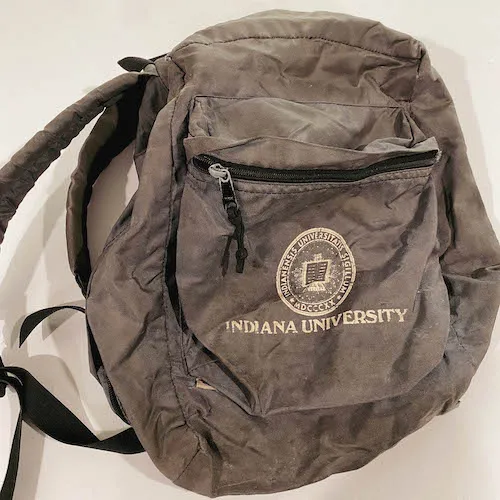
I was shopping for various graduation gifts, and one of them he wanted was a laptop backpack, which is my forté, given that I buy a new bag about six times a year (in the Before Times, anyway) and I’ve got travel coming up and I’m probably due again. But that got me thinking about my backpack I had for my entire IU journey, as pictured above. There’s a story behind it, of course, and I’ve probably told it nine times, so buckle up for #10.


OK, so when I was a freshman (and this still happens, apparently) there’s a series of events leading up to matriculation, culminating with class registration. That takes place in the summer, maybe in July. This is a bit of an evil trick by IU, because what happens is you go there and they reserve blocks of typical freshman classes, like all the hundred-level math, English, and foreign language classes. They run a special registration and hold your hand and you get all the classes and time slots you want, and it’s easy-peasey. Then when you have to register in the winter for the next semester, you find out that the entire process is horrible, and registration dates are based on how many credits you’ve completed, so you’re dead last in line, and every good class is taken and you end up with an 8am basket weaving class.

Anyway. I had to go down to Bloomington for this thing, and it’s usually a parent/child event, where your folks take you there, and they go to various orientation things that convince them it’s a good investment and their child is safe and whatever, while the new student goes through registration, takes any assessment tests to test out of foreign language or learn how much math they really know, and sits through some orientation things where guidance counselors tell you how important it is to study. Also, some people in specialized programs met with advisors, and music students did their auditioning.

I did not go there with a parent. Every time I write anything about my parents on here, I get in trouble about it, even though I have lived on my own for almost twice as long as I lived with them, so I’ll shut up about it, except to say I had to figure out how to go there by myself. I was 18 and had a car, so whatever.

IU had a deal for registration where they opened up Foster dorm like a hotel, and you could rent a room for some ridiculous amount, like eight bucks a day including food. So even though I had a day and a half of stuff to do, I rented a room on the top floor of Foster-Harper for the entire week. My plan was to drive down the four hours and change, get the registration over with on the first day, and then just hang out all week.

One thing that really stuck in my head about this visit is that it was the only time I had my old Camaro in Bloomington. The Camaro era and the Bloomington era had no overlap, except for that one week. Those are two heavy nostalgia eras, and it’s bizarre to me to think about driving around the IU campus and going to College Mall in that old car. It’s like thinking about Helen Keller and Jimi Hendrix hanging out together. (Technically possible, but I’m pretty sure it didn’t happen.) It was a bizarre colliding-of-worlds that really stuck in my head.

I loved that week. Bloomington in the summer is always awesome, and I got to explore all those record stores and restaurants and booksellers and everything else off campus, plus wander around the big limestone buildings and wonder what it would be like in a matter of weeks when this place would be my home. If I could re-live any part of my life to experience it again for the first time, I think it would be that week.

I met a lot of music majors during the stay in Foster, because they were all auditioning. That was great, because people come from all over the country to go to IU’s music school, so I was staying up late every night, sitting on the rooftop deck of this nine-story building overlooking the entire campus from the north. I met musicians from places I’d never been, from Boston and Vermont and California and Washington, and we’d stay up there in the cool summer air and wait until midnight when they would turn off the main library outside lights. I didn’t know if all of college would be like this, but I hoped it would be.

(And oddly enough, I had a brief but spectacular relationship with someone who lived on the same floor in Harper a few years later. Another colliding of worlds, and some late nights there, but I was too busy to watch the library lights.)


So during that visit, I was super amped to buy my books at the bookstore in the student union. I don’t know why, but I really wanted everything in hand and ready to roll for August. (I was the opposite later on, especially when those book costs added up. I remember taking this SPEA class on public management in 1993 and never buying the book.)

I went there with this new friend named Susan, from Dyer, Indiana. (It was always important to find out where people were from, and figure out where that was. “Oh, you’re from Auburn? Isn’t that right down the road from Kendallville? They have that speedway.”) I had my schedule, and could buy like half my books. And while I was at the store, I bought some other IU paraphernalia, like some notebooks and pens, and a backpack.

The backpack was this gray thing, with an IU logo on the front. It was made by Caribou, a company in Chico, CA that made bags for L.L. Bean and others. It was a bit of a knockoff of the JanSport bags that were popular in the 80s, made of 100% nylon. It had a single main compartment with a wraparound zipper, a smaller front zippered pocket, and a pair of very non-ergonomic, barely-adjustable shoulder straps with like a millimeter of padding in them.

Like I said, I used this backpack for the entire time I was at IU. It held maybe four or five textbooks, plus whatever I could cram in the front pocket. That usually held the cassettes I needed to get through the day in my walkman. I usually wore this slung on one shoulder, unless I was on a bike. It was one of my trademark items, as stupid as that sounds. I always had three things with me: my leather jacket, my walkman, and this backpack.

It’s odd to look at it now, compared to modern bags. It’s so small, with no organizational compartments or sleeves or dividers. This was the pre-laptop era, and it was meant to carry books, a few pencils, and nothing more. There were none of the creature comforts that backpacks developed in the 90s and beyond. There were no ergonomics to the straps; there wasn’t a side sling or any other handles; the bottom was not weatherproofed; there were no cell phone pockets or cord management solutions. There wasn’t a side pocket for a water bottle, because this was before we were told to always carry water, and before most people drank 300 ounces of soda a day. It’s so simplistic, and it’s amazing I used it for so long without complaint. It’s even more amazing it still exists.

I can’t think of the last time I actually used this bag. There was a gap of a half-decade between when I went to school and when I had to start carrying a laptop everywhere. By then, I was in New York, and messenger bags were a thing, so I moved on to one of those. I still have it for some reason, probably because I can’t throw it out. I have a lot of stuff like that.


Also, a spoiler alert. Another reason I am in this fit of nostalgia is I’m going back to school, starting this week. All virtual, so no backpack needed. More details on this later, although this might also mean my already scarce posting might get worse.

Things change, pocket change

colonial-crest

Day off today - I took a four-day weekend, no reason - so I headed to the mall in Pleasanton to buy a pair of pants. I have a wedding next month, and every pair of dress pants I own is comically large at this point. I got to the mall at about 10:37, and didn’t realize that it wasn’t officially open until 11:00. I went inside anyway, because the concourse was open, but half the stores were just booting up, the gates halfway open, lights off, employees setting up signs or counting down registers. It gave me an intense nostalgia flashback, of every time I’d opened at Wards thirty-something years ago, the usual crew of people I knew at every other store setting things up for the daily grind, walking to the First National at the main entrance to drop off last night’s take, stopping at the MCL Cafeteria for a cup of coffee before 10:00 came. The general vibe of a pre-opening mall really threw me back to the summer of 1988. I almost expected to go back into the parking lot and find my rusted Camaro waiting for me.

I got in my walk. I did not get the pants. Everything is now “stretch performance wool,” which is essentially spandex. Also, Macy’s is now JCPenney. JCPenney is now K-Mart. K-Mart is now largely gone. I don’t even know what Sears is.


Speaking of “Amazon is taking over,” in some contrary news, it looks like Amazon is closing all of their brick-and-mortar stores. I actually liked the feel of the stores, mostly because they looked like a rip-off of Borders, albeit much smaller. I’m all but certain these stores were a sophisticated data mining experiment and nothing more. Even the stock on the shelves was a data-driven algorithm, which was bizarre and somewhat maddening for a person who doesn’t read Oprah books. I’m sure they’re doing a lot more of that with their Whole Foods stores now.

A happy coincidence: so, B&N in Walnut Creek closed around the same time the Amazon store opened. Now, Barnes and Noble is actually opening a new store in Walnut Creek right as Amazon is closing. They didn’t get the old location back, and I’m sure it’s a smaller footprint, but that will be nice to see. As I’ve said before, I used to think B&N was The Enemy, and it’s hard for me to root for them now, but I really don’t want to see the one by my house in Emeryville shutter.

Another odd coincidence, Morgenstern’s books reopened in Bloomington. I’ve written about my memories of Morgenstern’s a  while ago. It’s not in the same place anymore (I think the old strip mall location is now a FedEx) and Keith mentioned from his first visit that it’s nowhere near what the old one is. But at least there’s something, especially since the Borders and Barnes and Noble that jumped into town and killed the old location in the late 90s are now both gone.


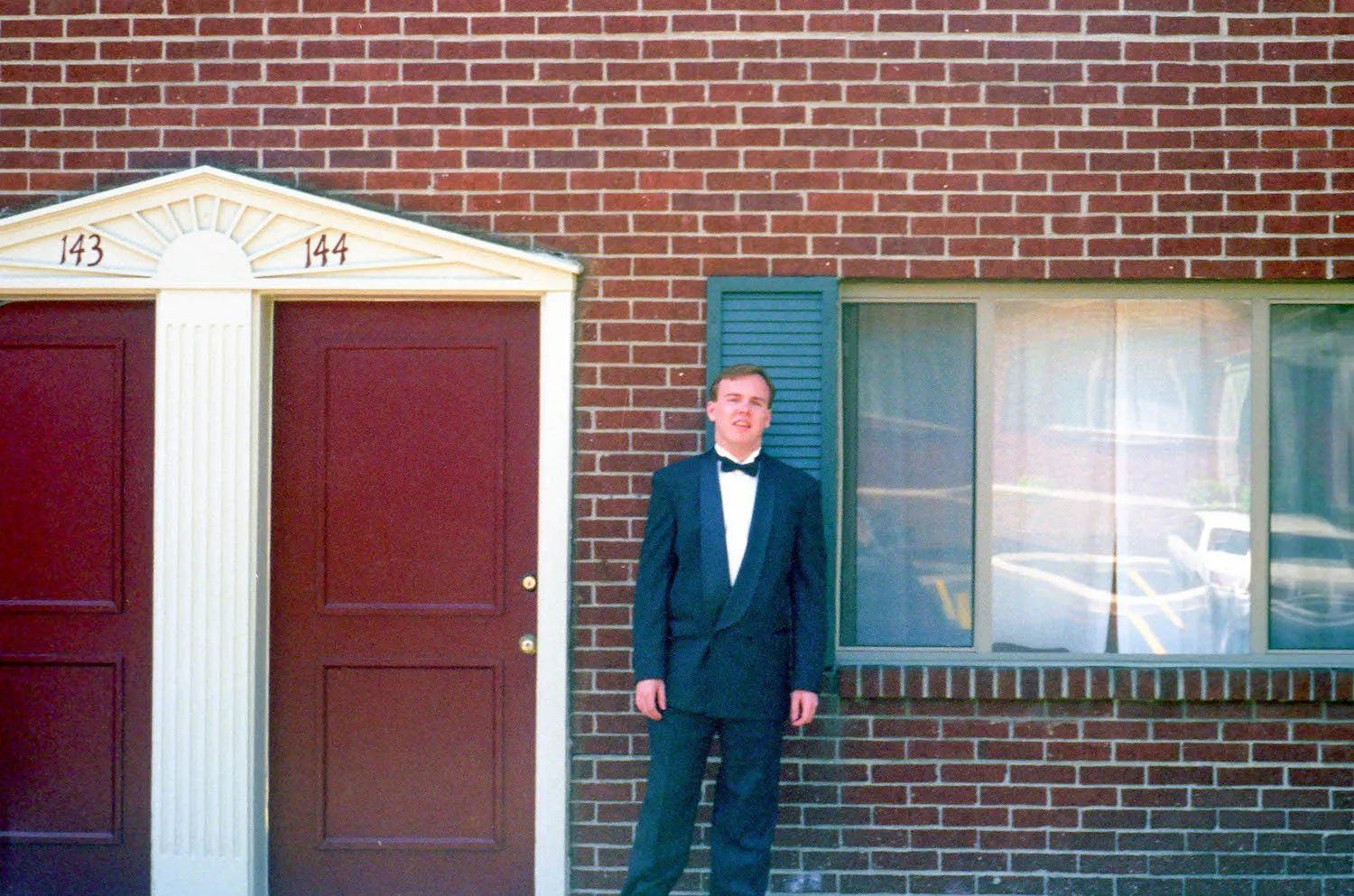
About the picture above: that’s from 1994, the day of Bill’s wedding. I’m standing in front of my old apartment at Colonial Crest, where I lived from 1993-1994. In another bit of dumb nostalgia, I just heard that Colonial Crest, which is now called The Arch, is being torn down and replaced with a new apartment complex, some 5-over-1 monstrosity with a dumb generic name and high rents for rich students.

I did some digging and what’s funny is that these apartments rent for only marginally more than I paid almost thirty years ago. I think we split a $500 rent on a 2br/1.5ba townhouse, and now they go for about $700. That’s saying a lot about the deferred maintenance issues of the place, because it was maybe about a C- in quality and value way back then. I’m sure the redevelopment is for the best, given the student population and need for housing and all that.

That said, I have a lot of strong memories of this place. Various pivotal relationship things happened here, and the start of my writing career happened here in apartment #144. I also didn’t have a car most of this year, and walked the two and a half mile route to school pretty much every day, rain sleet or snow. That long shot down Walnut or College is burned in my head, the zig-zag pattern I’d traverse to cross the northwest side of campus and get to Lindley Hall. All of this is different now. The computer science department has a new facility built where the old Brown/Greene dorms used to be. The long walk up to the UCS offices at 17th street where I worked used to be empty green fields; it’s now a giant dorm, built last year. The UCS office was completely redone into an alumni center. Everything has changed. Things change.


Another weird one: they are renaming everything named Jordan on campus. Turns out former university president David Starr Jordan was really into eugenics, segregation, and racial purity. Problem is, IU spent a century naming damn near everything after him: a biology building; a river; a main avenue cutting across campus; a northern extension to said avenue; a parking garage on that avenue; a bus route on that avenue; a shopping center. The street is now Eagleson Avenue, or David Baker Avenue for the northern part. (Named after the jazz great, not the architect who coincidentally designed my current home.) The river is Campus River; the Biology building is Biology Building. I think people expect everyone to take sides on the woke/anti-woke thing. I agree with the name change. It’s just interesting to me, given the number of times I reference Third and Jordan in my first book.

Things change. People change. Pocket change. It’s actually odd how I never have change in my pockets anymore. Anyway.

Coke Zero, Hybrid Failure, SR2, Etc

pc270015

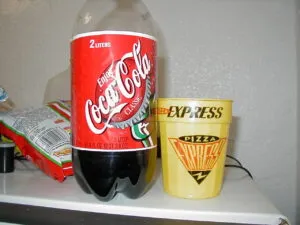
They recently changed the formula of Coke Zero to make it “more like regular Coke.” It tastes like a mix of Listerine and cloves now. The only thing is has improved is my ability to quit soda, which hasn’t happened yet, but probably should.

I would normally be more upset about this, but I ultimately have no time to care. I drank a case of it and can’t tell the difference now, so on to the next problem/outrage. I used to be much more upset when a company made a lame decision like the discontinuation of Surge, the dropping of the Taco Bell Mexican Pizza, or the fact that I’ve eaten the same exact oatmeal every morning for twelve years and they decided to stop selling in packets. Life is too short.


After dumping all the money into my car over the last month, I had a fun experience with it. I was driving off to the mall a week ago, and after I got up to highway speed on the 580, every warning light in the dash came on, and the info panel said “HYBRID SYSTEM FAILURE - PULL OVER IMMEDIATELY.” The dynamic braking stopped working, and the EV system went completely offline. There was a Toyota dealership just past the next highway exit, so I swung in there and dropped it off. They said they’d get to it on Monday.

This began a weekend-long spiral into figuring out if I needed to buy a new car. The hybrid system is still under warranty, so if it needed a $5000 battery, that’s covered. But I figured the dealership would add a $4000 spine reticulation charge or whatever the hell, or take six months to fix it. The car’s probably worth about $7000 in good condition. When the Yaris reached the end of the line in 2014 and had unknown wiring problems only fixable by a dealer, I brought it to the sales counter and they made me a good deal on the trade-in, so I figured I’d do the same. They don’t make the Prius C anymore, and the Camry and Corolla hybrids are honestly better cars than the Prius, so I burned a lot of cycles pricing this stuff out, trying to figure out what I wanted to pay, what I wanted to finance, etc etc.

Monday morning, they ran the diagnostic and said it was just the ECC lost communication with the system and threw a few codes, so it shut down the entire hybrid system. (If you stumble across this in a search, the DTC codes were U0140, U0073, and U0126.) The only obvious culprit was that I have a ScanGauge II plugged into the ODBII port. I have since I got the car; it’s a holdover from when I had the largely-gaugeless Yaris. I don’t really use it anymore, and the tech theorized that maybe the cable got bumped, or something else happened. He cleared the codes, unplugged the ScanGauge, and no problems since. No charge on the scan, either. So I saved $200 plus another $25,000 on a new car.


I’ve been having a lot of trouble getting anything going writing-wise. In a fit of “do something completely different,” I did a Ctrl-C Ctrl-V on the project file for my first book, and started on page 1, taking notes and editing things. I’ve had this stupid idea to write a thirty-years-later sequel of the book, and I thought I came up with a good gimmick to get it going, but I needed to go through the old draft, partly to get it all back in my head, and partly to George Lucas in a few minor changes to get the two books to line up correctly.

It’s an …interesting experience to read writing I haven’t touched in over twenty years, especially when it’s a radical departure from what I’ve been writing ever since. There’s obviously some very wooden writing, and little bone-headed typos abound. The usual complaint about the book is that it’s too long, and generally plotless. I could see trimming the book slightly, tightening up things. But for every subplot I would think about trimming, I think there’s another that could have been explored more. And it surprises me now that there are so many characters, so many subplots. It also follows an overall arc more than I thought.

After I got about a third of the way through it, I got disinterested with the idea, though. I can’t go too into it without revealing the gimmick, but I wasn’t interested in writing that book. And it’s been a long time since I’ve put a lot of focused thought into Bloomington. I haven’t spent more than a few hours in town since 1999 when I stopped there for a few days on my move east. Writing a sequel would need some solid reason to be there, and not just the main character wandering around having regrets about every person he dated a million years ago, and being amazed at how all of the stores at the mall closed. Maybe at some point I will visit again and get the spark to write this, but who knows.


Speaking of, I’m still on for the Seattle trip in two weeks. I have been working on a list of what to do, but I haven’t done any heavy research yet. I just now started thinking about what camera or cameras to bring, or if it’s time for a new one, and I need to shut down that conversation before it starts.

Distant summers

rabbit1-small

I realized the other day that the summer I fictionalized for my first book Summer Rain was twenty-five years ago. This should make me feel very old, except that it doesn’t seem like it was that long ago. I was twenty-one then, and in my mind, I’m the same person as I was then, but I realize I’m more than twice as old, and half a country away from Bloomington, and that’s depressing to me, that it’s an entire lifetime in the past for me.

When I’m not in the middle of writing something interesting, I often slip into this heavy, nostalgic, introspective thing, and burn a lot of cycles thinking about things that are long gone, like my time in Bloomington, the year I spent going to school in South Bend, even the time I was in Denver ten years ago, which seems like eons ago to me now. I try to remember the order things happened, the details of people and places I’d forgotten, and dwell entirely too much on things that happened, conversations I can’t fix, things I can’t take back. It’s unnerving that this stuff sticks with me, especially since I want to create things that aren’t my life, live in fictional worlds that don’t have to do with me. But the pull is so strong in old nostalgia, I can’t escape it.

There’s a certain draw to this near-era nostalgia that is completely addictive. Trying to find old images or articles or pictures of places I used to live or things I used to own is as compulsive as pornography, endlessly searching for the next thing to release some dopamine in the brain, give a tiny touch of satisfaction. I don’t know what I’ll find that will ever make things complete. And the draw of it is that so little of the early 90s, of my early 90s, is searchable or archived on the internet. Yes, I can go find a copy of that Nirvana album or the movie Singles or whatever, but try to find one picture of the IUSB lunch room where I spent every day of the 1990-1991 school year, and it’s impossible. I wrote some articles for that school’s newspapers that I will never find, unless I physically drive there and dig through their library. But I’ll still search, and maybe find a picture that reminds me of a computer lab where I used to work, a hint of what it used to look like, two renovations ago, when it still had PC-XTs and dot-matrix printers.

I keep thinking about writing something about this era again, another book. I thought about this a lot when I was in Indiana in 2015, in August. I’d never spent any time back in Indiana during the summer months, only returning for winter holidays, when everything was frozen over. And that feeling of summer, the hot days and air conditioning, then the cool nights and the sounds of crickets and clear sky and stars overhead made me think so much of the summer of my teenaged years, and made me think, “I have to write another book about this.”

I’ve struggled a lot with a book about the summer between high school and college, a fictionalized version of that summer in 1989. I think there’s a lot to write about: first love, first betrayal, leaving home, the big unknown of what happens next, and the beginning of a little bug in my head that would later develop into a crippling depression. There were also many things I didn’t know about at the time — I sat in northern Indiana in this pivotal time, the end of the Eighties, when the American Dream was quietly being led to slaughter. I only knew of life in that industrial bubble, the conservative bible-belt-meets-rust-belt pocket. Indiana never fully recovered from the early 70s recession when the early 80s one hit, and I graduated just as an expansion was about to burst. I didn’t know any of this at the time, but in retrospect, it sets an interesting stage for all of my personal garbage going on then.

I’ve written bits of this in stories over the years, and my completed 2008 NaNoWriMo project was an attempt at this book, which was finished but scrapped. I don’t feel like I was really able to nail it, to capture the feelings or set up a compelling structure to fit to this backdrop. It’s something I’ve wanted to revisit, but there are a bunch of things stopping me.

First, I don’t know how feasible this creative nonfiction stuff is in the era of Facebook and Google. I don’t think I could write Summer Rain now, because of the fear that a fictionalized person would find themselves and be angry that I was being unflattering, even if what I wrote was changed or masked or altered so it wasn’t true. I think just the fear of that would make me self-censor myself enough that I couldn’t operate. This is also entirely true of family members. I can’t write a first-person fictional book and get into it about the protagonist’s family, for fear that my own family would read this and think it was about them. I think Bukowski said he had to wait until his old man was dead until he started working on Ham on Rye.

But there’s also the conflicting fear that the longer I wait to write this stuff, the more it will fall out of my head. I find my memories fading of this era, and like I said, the physical relics of it are lacking. I took more pictures of my food this week than I took of anything in 1992. I archive all of my email now, although I get maybe five messages a week that aren’t garbage; I have almost no email saved from back then. There is a very real chance that if I wait until I retire or whatever and then decide to write this book, there will be none of it left in my head whatsoever.

And the biggest fear is that all of this is worthless to anyone but me. Summer Rain was not a big seller. Looking back, I can name half a hundred things wrong with the structure, content, characters, cover, blah blah blah, but there’s a horrible truth in that people like a book when they can identify with the main character, and if the main character is me and I’m ultimately an unlikeable person, people won’t like the book. I sometimes thing the current wave of nineties nostalgia could make a book set in that era appealing to people, but there’s a certain confidence thing there that I have to wrestle with, and it’s easier to put it off and go write about zombies or coprophagia or whatever.

During that 2015 trip, I started thinking about a sequel to Summer Rain, slightly informed by the John Knowles book Peace Breaks Out, which was the not-as-successful follow-up to A Separate Peace. The idea was that I had to return to Indiana twenty-five years later for some reason — dead parent, old friend, whatever — and I would see the contrast in all the changes (and non-changes) in the post-industrial wasteland. And I’d revisit all the characters, and what happened to them over time. One of the big themes in SR was the fork-in-the-road things, trying to decide on which way to go in life while in college. And in that book, every character subconsciously has a direction they were aimed, and one could predict the endings: this guy’s never going to leave town; this girl is going to burn through three husbands in ten years; this guy’s going to be a CEO before he’s thirty; this guy’s going to be found dead in five years. And one of the things I wanted to do was show how the unexpected happened with all of them, for better or for worse. And some people I know are still hopelessly stuck in this old era, never having moved past their high school or college self (much worse than I have it, even) and some people probably never think about the past at all.  I don’t know where I’d go with a book like this, but it’s something stuck in my craw.

I probably won’t do any of this, and will probably come out with another book of twenty stories or a hundred fragments of flash fiction about UFOs and sodomy, and nobody will read it.

Anyway, twenty-five years. That is really screwing with my head.

The Cloud, the Book, the Pissing Contest

I’ve been bitching and moaning about how Adobe decided to move all of their software to the cloud, and make people pay per month forever to use their stuff.  I’ve also been bitching about how Apple decided to kill off Aperture, which happened about ten minutes after I imported and tagged 50,000 pictures, and would probably require me to spend six months of my life migrating to Lightroom.

Well, fuck it, I decided to give up and get a Creative Cloud membership, while Adobe is trying to court Aperture users and is quoting a lowball price.  I joined with the photographer’s membership, which is ten bucks a month, and includes Lightroom, Photoshop, and 2GB of cloud storage.  There’s some other junk that I don’t need or understand (Typekit?  Bridge?)  and there’s a ton of “try this!” links everywhere, to get you to upgrade to a full-blown membership.  But I don’t need Illustrator or InDesign this second, so I’m fine.

I have not used Photoshop in a long time.  I’ve been using Pixelmator for a while, to do book covers and whatnot.  (Here is my latest.)  And I make endless stupid things like the above drawing I re-captioned.  But I haven’t used Photoshop in forever.  It’s interesting to see how much it changed.

Back in 1991 when I returned to Bloomington after a year at IUSB commuter college hell, they had a shit-ton of new computer gear, because they’d recently tacked on a technology fee to tuition and were in a mad rush to spend it. The Fine Arts college had this cluster of brand spanking new top-of-the-line Macs, which I think were the IIfx at that time.  Each one had a gigantic color monitor, probably 20 inches, but about a yard thick, plus a second paperwhite portrait screen, along with a scanner and a Jazz drive, which used those insanely expensive removable hard drives that could hold something like 100 Megs, which was pure science fiction at the time. Anyway, they had Photoshop 1.0. I recently found a color printout me and my buddy Ray did when he visited once, an Ann Geddes overhead shot of nine babies in a nursery, but we’d horribly mangled them all: one beheaded, another eating that head, one with a swastika on its forehead, one spitting blood, etc.

That was my first exposure to Photoshop, and the new version makes the 1.0 version look more primitive than MS Paint. I am absolutely amazed by all of the retouching and healing tools, and how you can do stuff like move parts of an image and it will automatically fix the background.  The $10 a month is well-spent on getting more book covers done.  (And of course, photoshopping dicks into the mouths of various Facebook friends.)

Speaking of books, I am almost done with the next one.  I’m in the last sprint of edits, and I have a roughed-in cover, and I’m maybe a week from entering production drudgery.  This book is so amazingly different from anything I’m written, I’m not sure what people will think.  It’s absurdist, but it has an incredibly plotted story, like Michael Bay plotted.  I think it will really show readers that I have the ability to do more than just stories about taking a dump at the county fair.  But, I’m anxious to get it done, so I can get back to writing stories about taking a dump at the county fair.   Anyway, stay tuned.

I wanted to write something about Amazon Unlimited, and about the huge pissing contest between Amazon and Hachette.  But I really do not have the energy to care.  It’s billionaires fighting billionaires, and every move Amazon makes to make you think they are on your side or they’re saving you money is really one they’re making to increase their monopoly.  Amazon Unlimited is nothing but a race to the bottom, creating the equivalent of a thousand-channel cable TV plan that will cause readers to read five pages of everything and enjoy nothing.  And Hachette charges too much for ebooks, but Amazon is only bringing that to your attention because they want more of your money.

It’s all bullshit.  I’m still selling on Amazon, but eventually, their monopoly will squeeze out small authors, and I’m waiting for the day when they start charging KDP writers insane prices to list their books, or drop their royalties, or start an inane approval process for self-pubbed books “to increase quality to customers” (i.e. make it impossible for anyone they don’t like to publish weird stuff.)  It will happen.  But I’ll still be here.  If I have to photocopy my books at the local Kinko’s and sell them out of the trunk of my car, I will.  If I have to memorize them and go town to town reciting them like one of those poor fuckers with The Iliad, fine.  If I was here to make millions, I would have started selling penny stocks back in 1997.

OK, back to editing.  What’s up with you?