The Wrath of Kon

Dispatches, thoughts, and miscellanea from writer Jon Konrath

Tag: nostalgia

Every day I don't delete this blog is a goddamn miracle

nevada-desert

I can’t believe there was a time I used to write here daily. I really can’t believe there was a time I used to write here daily, write in a journal, write books, plus write a dozen hours a day at my actual job.

Now I write here… checks posts… five times in 2022.

Why? Why is this so hard?


I keep meaning to write a post about “why blogs are more important than ever” or “why you should blog” or something like that. I actually have a draft post where I paste in the occasional thought blast or loose link I find about this topic, and keep meaning to structure this stuff into a cohesive manifesto of sorts.

But… life. There are only so many hours in the day, and by the time I sit down after a day of work, I’m usually completely strung out and exhausted. I consume so much caffeine to keep running at combat power for ten or twelve hours every day, that by the afternoon, I’ve overdosed to the point where I’m about to black out. I cannot focus on this stuff at all.

But when I started this thing back in 1996, the point of it was to not focus. I wanted to write just to write, dump a few hundred words into the void and keep my chops up. It was like jogging, running laps around the neighborhood, not to go anywhere, but to just run for 45 minutes. There was something liberating about posting the day-to-day in an unstructured format, without needing a genre or a “container” or a specific format to put things in. It was. Nothing more.

This was before Facebook, Twitter, and everything else lowered the bar on posting inane personal updates for no reason. This was before the term blog was even invented. It was before LiveJournal or MySpace. To people born after the year 2000 who doesn’t have the attention span to watch an entire TikTok video, these updates were probably like reading Leo Tolstoy do an hour-long jazz set on watching his lawn grow. But having that “container” to do this, without comparison to other platforms - that gave me the freedom to sit down and do this without being blocked on exactly what to do.


When I sit down to write on Rumored dot com, this is the thought pattern when an idea pops into my head that typically makes me give up and go waste two hours doom-scrolling investment news:

  1.  is boring. Who wants to read about that?
  2. You already wrote about in 2011.
  3. Nobody cares about that memory of going to the Scottsdale Mall in South Bend, Indiana on the morning of Friday, August 24th, 1990, buying a new car battery for your 1984 Turismo at Target, and then spending two hours playing Tetris on the Gameboy display because your shift at the English computer lab at IUSB didn’t start until noon.
  4. You can’t write about in a public place because some family member will see it and get pissed off, or it will come up in a search result five years from now during a job interview.
  5. is a disparate thought not connected to anything else, and what you really need is some SEO-friendly format, like only writing about pay phones or media trends or book reviews or… something, a format that will draw in people, one or two set things that I can focus on every time I write.

That last one is what kills me. I’ve complained about this a lot, especially during the “Golden Era” of blogs (which, christ, was 18 years ago now) when people suddenly decided blogs had to be “about something.” And that wasn’t because some grand arbiter of taste codified the online world and listed out what you could write about, and it wasn’t a tool limitation, like you had to choose one of five things when you created your account and you could only do those five things.

Like everything else, this was about money.

People suddenly realized that instead of blogging being like jogging on a treadmill but for writers, blogging became a stepping-stone in the world of publishing. Blogs with a cohesive vision became more trafficked, so once AdWords and affiliate links were a thing, the blogs with the most visitors rose to the top, and got more visitors, and became A Thing. Blogging wasn’t about writing about your feelings. Blogging was about producing some self-contained docudrama about your persona’s supposed life, and that was hopefully a launching pad to a book or movie deal. Or they were basically a self-produced magazine, about politics or news or whatever, and the line between mass-media and blogging became blurred until they basically became the same thing.

(I cannot count the number of times I wrote a thousand-word essay here off the cuff, just to burn two hours between work and dinner, and some other writer or random civilian emailed me and said “wow you should submit that at XYZ and sell it.” This always launched me into a white-hot rage. If I was trying to write puff pieces for McSweeney’s, I’d write them. I write here to write here, god damn it. If I was thinking about what markets would take my writing, I wouldn’t be writing. I could not walk 10,000 steps a day for exercise if I spent every waking moment wondering what media outlet would pay me for walking 10,000 steps. I walk 10,000 steps. God DAMN it why is this so hard for anyone to understand?)


(Stay with me here. I know I’m rambling.)

      • I’m not going to go old-man-yells-at-sky about how these damn kids don’t have an attention span to read anymore. They do if they want to; that’s not the problem. I think the dopamine-killing feedback loop of social media has fully been documented elsewhere, and people fail to factor in that people don’t have time and have too many other competing things to prevent them from sitting down and reading a series of 2000-word blog posts like we used to do during every office workday in 2003. I get it.

There’s a much more subtle thing that happened with this tool evolution, aside from the shortening of the media form. The “democratization” of tools like LiveJounal, then Facebook, then Twitter, then TikTok made it easier for anyone to journal their life in real-time. When I started this site, I had to write code by hand, telnet into a remote computer, and use unix commands on a terminal to publish each day’s page. Now, you get an app on your phone, press a button, and a video of your dance routine is live for the world to see, which is great. Anyone can do this.

But the issue is this has transformed the nature and value of the word “blogging.” It used to be that blogging was about constructing a text essay to post. Now the word is a generic verb used to chronicle something in any format online. Live-blogging used to be a CNBC journalist feverishly posting up-to-the-minute copy about the 1998 midterm elections. Now it’s someone taking pictures of their visit to the grocery store. Blogging has lost all meaning. There’s no way to give meaning to the term again.


I think the most frustrating thing with blogging is that if you search for the term “blog,” the first hundred results you find are people saying you need to create a “blog” to generate SEO for your dental practice or real estate venture. The Reddit group on blogging is filled with people “finding their niche,” which means drilling into a genre that can create a profitable drop-shipping business. People don’t blog to express anything. They use blogs to store marketing content to game search engines.

Because there’s no money in this, there are no successful blogging platforms anymore. They have all been overrun by people selling boner pills and work-from-home scams. Blog discovery is now impossible. Any mechanism to create a directory of blogs or link together similar blogs will quickly be exploited and gamed by vitamin tycoons and destroyed. And once any fun personal hangout where you can converse with authentic people gets overrun by sales bots peddling a revolutionary new mop, they leave. It happened to Blogger, to MySpace, to LiveJournal, and it’s currently happening to Facebook.

Case in point on the blog directory thing: I just searched for “blog directory” and clicked the first result, then clicked the first article shown, and it was “Great Ways To Increase Customer Engagement!” Stock photo of a bearded hipster guy at a Square point-of-sale in an all-white store, smiling at a smiling woman from a Gap ad. Exactly 600 words long. A listicle. Exactly four outgoing links. Textbook SEO. Garbage. This is where we are. This is the entire web. It’s all useless. Old man yells at sky.


There are like 17 other things in my list of reasons we got to this point. RSS died. Google Reader died. Wordpress is horrible. PHPbb is horrible. Blogger got bought and then left in the yard to rust. Every Tumblr in existence got banned for being NSFW. Everyone switched to reading on their phone, which left many sites unreadable. Video. Walled gardens. Privacy concerns. Whatever. I can go on forever. I’ll stop.

The truth is, I have a Notes document that has a list of URLs on it, of every blog I still like to read. Maybe once a month, I find a new one and paste it in there. Maybe six of them still post regularly. I revisit the other ones, read old posts, wish I could find more blogs about nothing.

Blogs are still important. Someone needs to figure this out. I need to stop caring about someone figuring this out and keep writing here. I don’t care if nobody reads it. There are 1,381 posts here. That’s a good start, but I need to keep going.

Things change, pocket change

colonial-crest

Day off today - I took a four-day weekend, no reason - so I headed to the mall in Pleasanton to buy a pair of pants. I have a wedding next month, and every pair of dress pants I own is comically large at this point. I got to the mall at about 10:37, and didn’t realize that it wasn’t officially open until 11:00. I went inside anyway, because the concourse was open, but half the stores were just booting up, the gates halfway open, lights off, employees setting up signs or counting down registers. It gave me an intense nostalgia flashback, of every time I’d opened at Wards thirty-something years ago, the usual crew of people I knew at every other store setting things up for the daily grind, walking to the First National at the main entrance to drop off last night’s take, stopping at the MCL Cafeteria for a cup of coffee before 10:00 came. The general vibe of a pre-opening mall really threw me back to the summer of 1988. I almost expected to go back into the parking lot and find my rusted Camaro waiting for me.

I got in my walk. I did not get the pants. Everything is now “stretch performance wool,” which is essentially spandex. Also, Macy’s is now JCPenney. JCPenney is now K-Mart. K-Mart is now largely gone. I don’t even know what Sears is.


Speaking of “Amazon is taking over,” in some contrary news, it looks like Amazon is closing all of their brick-and-mortar stores. I actually liked the feel of the stores, mostly because they looked like a rip-off of Borders, albeit much smaller. I’m all but certain these stores were a sophisticated data mining experiment and nothing more. Even the stock on the shelves was a data-driven algorithm, which was bizarre and somewhat maddening for a person who doesn’t read Oprah books. I’m sure they’re doing a lot more of that with their Whole Foods stores now.

A happy coincidence: so, B&N in Walnut Creek closed around the same time the Amazon store opened. Now, Barnes and Noble is actually opening a new store in Walnut Creek right as Amazon is closing. They didn’t get the old location back, and I’m sure it’s a smaller footprint, but that will be nice to see. As I’ve said before, I used to think B&N was The Enemy, and it’s hard for me to root for them now, but I really don’t want to see the one by my house in Emeryville shutter.

Another odd coincidence, Morgenstern’s books reopened in Bloomington. I’ve written about my memories of Morgenstern’s a  while ago. It’s not in the same place anymore (I think the old strip mall location is now a FedEx) and Keith mentioned from his first visit that it’s nowhere near what the old one is. But at least there’s something, especially since the Borders and Barnes and Noble that jumped into town and killed the old location in the late 90s are now both gone.


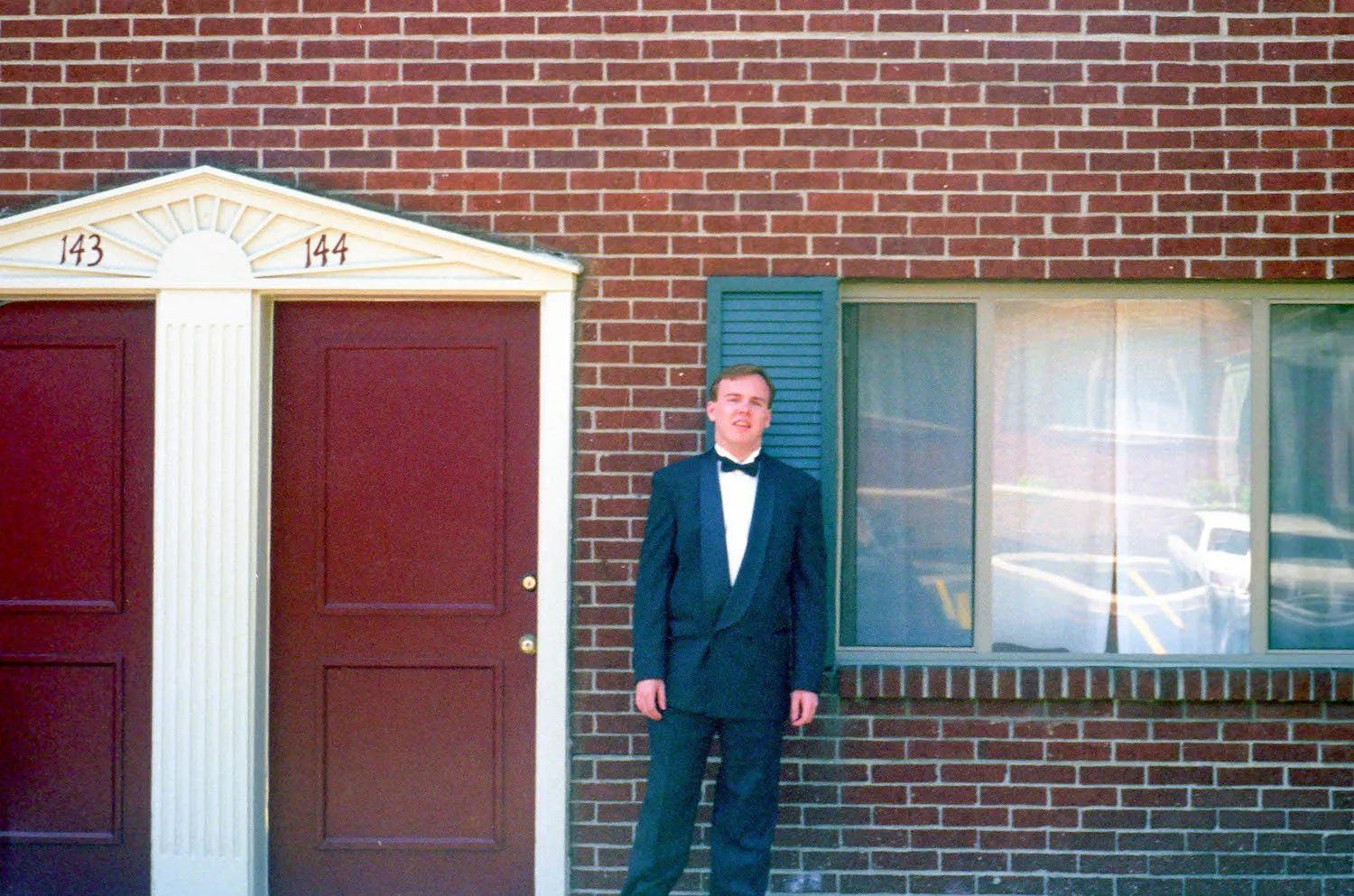
About the picture above: that’s from 1994, the day of Bill’s wedding. I’m standing in front of my old apartment at Colonial Crest, where I lived from 1993-1994. In another bit of dumb nostalgia, I just heard that Colonial Crest, which is now called The Arch, is being torn down and replaced with a new apartment complex, some 5-over-1 monstrosity with a dumb generic name and high rents for rich students.

I did some digging and what’s funny is that these apartments rent for only marginally more than I paid almost thirty years ago. I think we split a $500 rent on a 2br/1.5ba townhouse, and now they go for about $700. That’s saying a lot about the deferred maintenance issues of the place, because it was maybe about a C- in quality and value way back then. I’m sure the redevelopment is for the best, given the student population and need for housing and all that.

That said, I have a lot of strong memories of this place. Various pivotal relationship things happened here, and the start of my writing career happened here in apartment #144. I also didn’t have a car most of this year, and walked the two and a half mile route to school pretty much every day, rain sleet or snow. That long shot down Walnut or College is burned in my head, the zig-zag pattern I’d traverse to cross the northwest side of campus and get to Lindley Hall. All of this is different now. The computer science department has a new facility built where the old Brown/Greene dorms used to be. The long walk up to the UCS offices at 17th street where I worked used to be empty green fields; it’s now a giant dorm, built last year. The UCS office was completely redone into an alumni center. Everything has changed. Things change.


Another weird one: they are renaming everything named Jordan on campus. Turns out former university president David Starr Jordan was really into eugenics, segregation, and racial purity. Problem is, IU spent a century naming damn near everything after him: a biology building; a river; a main avenue cutting across campus; a northern extension to said avenue; a parking garage on that avenue; a bus route on that avenue; a shopping center. The street is now Eagleson Avenue, or David Baker Avenue for the northern part. (Named after the jazz great, not the architect who coincidentally designed my current home.) The river is Campus River; the Biology building is Biology Building. I think people expect everyone to take sides on the woke/anti-woke thing. I agree with the name change. It’s just interesting to me, given the number of times I reference Third and Jordan in my first book.

Things change. People change. Pocket change. It’s actually odd how I never have change in my pockets anymore. Anyway.

Death of the Tanforan Mall

tanforan

So, another one bites the dust. Tanforan Mall (aka “The Shops at Tanforan”) in San Bruno got bought for $328M recently, and will be razed to build a mixed-use biotech research campus and housing.

Tanforan has a weird history. It was a horse racing track at the start of the 20th century, and Seabiscuit used to race there. It was also occasionally used as an airfield. Then in 1941, they used it as an internment camp, housing Japanese Americans in the old horse stalls as an assembly center until they moved everyone to more permanent relocation centers in 1942. Then it became an Army camp, then a Navy base, then a racetrack that burned down, and then in 1971, it became a mall. It underwent a major reconfiguration and reconstruction in 2005, and they added a large movie theater in 2008.

I moved to South San Francisco in the fall of 2008, and for the year I lived there, this was my default mall. I drove past it every day on the way to work; I shopped at the attached Target pretty much weekly. The giant Barnes and Noble was the place for skimming computer books, and I bought my first iPhone there in 2009. My dentist was (and is) there, and the Petco was the usual place to grab cat food and litter on a regular basis. I also remember watching a ton of movies at the theater there.

It’s weird because the building itself is physically in great shape without the usual deferred maintenance problems you’d see in a shuttering mall. They basically rebuilt everything from the ground up except the anchors in 2005, and the structure, especially around the food court atrium, looks incredibly modern and new. But it’s not that physically big - the main concourse is maybe eight or ten shops long. And it’s had all the usual exits from national chain bankruptcy and degradation: Forever 21, Toys R Us, Old Navy, and most notably the death of their Sears, which was probably 30% of the total square footage of the place.

All of this area around South San Francisco is exploding with biotech campuses and identical-looking housing complexes. This mall is right on a BART train stop and very close to the confluence of multiple highways, so it’s super valuable land. This project won’t be one of the usual ho-hum de-mall jobs where they slap down a strip mall or a fake “town center” and then 95% of the stores sit vacant forever. I’m pretty sure that in a year, it will be crammed with science fiction buildings that sprouted up instantly, like the long stretch of glass towers of science lining the 101 now.

I was just in the old neighborhood last month, and it’s amazing how the bones are still there, but wide swaths of old sprawl have been instantly replaced with 5-over-one buildings with goofy names and slogans. (“Cadence apartments - where life, style, work, and play come full circle!”) We vaguely looked at buying a townhouse or condo in that area in 2009, and I can’t imagine what it would be like living there now.

It’s dumb and typical that a mall where I spent so little time has such a nostalgia hold on my brain. I’ll be sad to see this one go. Also, I need to find a new dentist now.

New Project: Random Life

Screen-Shot-2012-09-08-at-9.11.52-AM

I’m starting a new video project. It is called Random Life.

TL;DR: Random Life

The long story:

I have always been a fan of Structural films, or minimalist filmmaking. This started with Richard Linklater’s movie Slacker, which I always liked because it captured the zeitgeist of a college campus at the end of the 80s/start of the 90s. I think a lot of people like the funny characters and weirdos of the movie, and I appreciate that, and the non-linear-but-really-linear structure, which was a big influence for my second book. But what really got me was how it captured the atmosphere of being on a campus in the summer. It trapped in amber that feeling, the sparseness and the undertone of it, the wide shots of off-campus housing and dive bars and Texas landscape.

Go backwards a step and you get to his earlier self-produced film, It’s Impossible to Learn to Plow by Reading Books. This is a largely non-narrative movie he shot on his own, about 90 minutes of Super-8 footage of him taking a trip on Amtrak to Montana to hang out with some friends. This is like Slacker minus the plot gimmick, and most people would think this is like watching paint dry, but I’ve probably watched it a hundred times. I sometimes leave it on a loop while I’m writing. It documents that exact time in history perfectly, the way it looked in 1987 or so, living in the dregs of student/dropout life.

The commentary of that movie led me to Structural films, like Michael Snow or George Landow, and then thanks to Linklater, I fell down a deep wormhole on minimalist James Benning. There’s a lot to be covered there, and it gets a little too art-school, especially in how it’s framed and explained for galleries. But at least there’s a formal name for it, and it’s a thing.

Another thing: I love “slow YouTube.” This started with Astronaut.io, which I’ve covered before, but is a great way to watch short clips from an endless list of random, no-traffic videos. Then I got into long videos, things I could run in the background. A couple of my favorites were a guy in the middle of nowhere in Sweden, building a log cabin by hand and a seven-hour train ride from Bergen to Oslo, Norway. These have a specific audience, and probably aren’t great for folks who expect a Pixar-perfect plot line in everything they watch, or if you have zero attention span. But I love this stuff.

I also love videos that are documentation. The classic example is Heavy Metal Parking Lot, but there are so many other gems out there, like this video of a 7-11 at 2:30 in the morning in 1987. Or Lyle Hiroshi Saxon has a YouTube channel that has videos going back 30 years of him wandering around Japan for hours, capturing nothing in particular but everything. And my absolute favorite of this genre is Nelson Sullivan. He dragged a full-size VHS camera and shoulder-luggable deck through Manhattan in the 80s, capturing tons and tons of footage of the club, arts, and drag scene back then. It’s awesome that he captured and documented a large amount of musical performances and shows, but the stuff I love is when he’s randomly taking a beat-up subway to Coney Island in the 80s.

Vlogging is common now. But today’s influencers are chasing viral attention and endorsements. Their short action-driven bits about product placement are meant to draw people in quick. Everything is overproduced and a two minute video will have three minutes of ads. I have no use for that. I want raw footage that goes nowhere.


So, the project.

I bought a camcorder in 1996. I don’t know why, maybe I thought I would Kevin Smith a film, or maybe a bonus check burning a hole in my pocket. I shot some random stuff with it, and used it a lot on my 1999 trip across the country. It was a huge pain in the ass to lug around, and I didn’t vacation much. But I shot maybe a dozen and a half tapes in the 90s. I never did anything with them because they had no narrative, and they also didn’t look great: grainy, blown-out colors, too much vignetting in  the lenses. Of course, now people download apps to specifically get that nineties look, so that liability is maybe an asset.

There was a gap there, but then in the late 00s, my point-and-shoot camera could suddenly take videos. And then my iPhone could, and starting in 2014, my DSLRs could shoot movie-grade video. Anyway, I have a ton of old footage I’ve never used, never cut, probably never even watched. And I need to do something with it.

That’s where Random Life comes in. I’m starting to dig through this, and post regularly to that channel. I’ve already started uploading and scheduling daily video drops, and will hopefully keep things good and random. I’ll also start shooting more now. What I shoot now won’t be important, but in ten years, it will be.

The focus: I’m just trying to document. No narrative, no voiceovers, no music, no jokes, no storytelling. I don’t want to appear in the videos, and I don’t want to film characters. No voiceovers. Just footage. AND NO ADS. I’ll probably keep each video short. The goal is to have a full playlist you can put on random and flip through each of these minute-long videos aimlessly. That’s what I want, anyway.

I might quit this in a week, but we’ll see. I have no idea about branding and marketing this thing, and don’t care, but subscribe if you want and let me know what you think.

I would rather read my old LiveJournal than look at code I wrote in 1999

I’ve been digging around my machine trying to find any fun old projects I could throw on my GitHub page. What I’m mostly finding is how I get grandiose ideas for programming projects and then abandon them in a week. Some of the programming I did in college is absolutely laughable, but it’s also amazing how many things I’ve started that I’ve completely forgotten about.

I wrote a while ago about Nuke ‘Em, which is a dumb idea for a turn-based strategy game that I’ve chased every time I’ve moved to a new language or platform. I think the closest I’ve gotten to something running is a Ruby on Rails attempt I played with in 2008. But last night, I was digging through some C source code I wrote in 1999, trying to get a web based version of this going, and it was… interesting reading.

Looking at the code, it’s amazing how many ways I was reinventing the wheel, or painting myself into a corner. A few observations:

  • The project was a bunch of C source that would compile into a half-dozen CGI files that would then go onto a web server. When a user went to /user/login or whatever, that would run the login CGI binary. Why didn’t I just write a bunch of Perl scripts or some PHP for this? Well, I guess I already knew C, no use in learning something new and relevant.
  • Actually, some of the pages were generated by shell scripts which had forms where the action was to hit one of the binaries.
  • I doubt anyone would try to do something like use cURL to download the actual login binary, open it in a binary editor, and mess with it, right?
  • There was no templating system for generating web pages in 1999  (that I knew of; there probably was) so I had a routine to glue a head.html and tail.html template at the start and end of each generated page.
  • Part of the decision to do things this way was based on the limitations of my hosting provider, and part of it was price. I’m sure MS FrontPage would have made this all easier, but I think I was unemployed when I was doing this.
  • There is what I think is my first attempt ever at writing a Makefile from scratch. It shows.
  • The whole thing used a series of ndbm databases to store everything, including users, passwords, the map, and pending user turns. This databases were created in the /tmp directory and were world-writeable files. Nobody would think of looking around the /tmp directory of a public web server, so this was totally secure.
  • ndbm (or its predecessor NDBM) was basically like the first NoSQL database ever, sort of. (I would think a garage full of punchcards in random order would be the actual first NoSQL database, but whatever.) Anyway, it wasn’t relational, and didn’t have tables, so each “table” was just another file in the /tmp directory.
  • When you set up the world by creating initial users and making a terrain map and such, you would just run another binary which spat out the configured db files. Only an administrator could do this, because the files were different executables not installed in the hosted web directory. It didn’t check in any way if an admin was running the scripts, but it’s not like someone other than the admin would compile and run the source themselves and overwrite the world-writable files in the /tmp directory, would they?
  • There is a whole science to map-building, how to algorithmically scallop out water and land edges and mountains in some pseudo-random way to make a cool map of a world on the fly. This randomly generated a single-digit number for every square on the map and put that terrain in place.
  • For everything, and especially in the login, parameters like username and password are passed in the URL, because nobody would screw around and pass a bunch of garbage in URL parameters. And there probably weren’t search engines crawling and permanently storing parameterized URLs to do things like delete all users.
  • Oh, that password parameter is sent plaintext. It’s got to match the password in the publicly-readable database in the /tmp directory, which is also plaintext.
  • Players each have money they spend to build armies and buy missiles and stuff. Guess where that number is stored.
  • There is a separate library file (a .c and .h) that is chock full of dumb stuff that isn’t in the standard library, but I’m sure there are 863 different public libraries that do it, and if this was NodeJS or Ruby or Python, it would either be a built-in or it would be an npm/gem/library away. Like why did I write a routine to convert encoded URL parameters into arrays? Why did I write my own routine to convert ASCII strings into integers? Why didn’t I write something to encapsulate database calls, instead of pasting the same dozen lines across multiple files?
  • I don’t know why I did this, but the maximum length of a URL is malloc’ed to a size determined by reading an environment label, and I have no idea where that was set. (!?)
  • Not sure what C unit testing framework existed in 1999, but mine consisted of a file called test.c that ran a bunch of code and printf’ed the results to the console.
  • I never got to the point of putting in the turn-based logic, but my loose notes showed that I wanted to have a cron job that would fire every ten minutes (or whatever) and run a program that evaluated all of the turn moves and calculated out the combat losses and money spent and all that stuff.
  • No source control, of course. Lots of ~ and # emacs files, and lots of files copied with a .backup extension.

Sigh. Okay, a few bits of advice to myself twenty-some years ago:

  • The first is to learn PHP (ugh) or wait a few years and do it all in Ruby on Rails. I know Rails isn’t cool anymore, but it would have been so much easier to build models for all of the basic data types, then scaffold the whole thing, implement controllers for the bits of logic, and take the scaffold views and make them pretty. Of course I still can’t deploy Rails apps on my hosting provider, so that’s another issue.
  • Find public libraries to do the nasty stuff. It wasn’t as much of an option then, but it is now. The rub here is it never feels like I’m building things anymore; I’m just connecting together things that other people have built, and then trying to keep up with when libraries change or break. Having a solid ORM library, a templating engine, and something to deal with session persistence would have saved me a ton of time. (See also using Rails for this.)
  • Break things up into smaller tasks, like as MVPs for each piece. I sort of did this, looking at my notes, but I probably would have went deeper if I had really planned this a bit. I usually do it all seat-of-the-pants, and then get overwhelmed when I have nine different problems going on at once.
  • Think about security first. I know my thought was to have it all use no passwords or plaintext, and I’d lock it down after I got it running. I should have thought about that earlier, so I didn’t paint myself into a corner.
  • Source control, dummy. RCS was a thing then, and I was already using it for my writing. Check in often. It’s free.

(PS, I’ll probably start writing this same dumb game as an Electron app the next time I get bored.)