The Wrath of Kon

Dispatches, thoughts, and miscellanea from writer Jon Konrath

Tag: nostalgia

85-0813

f117

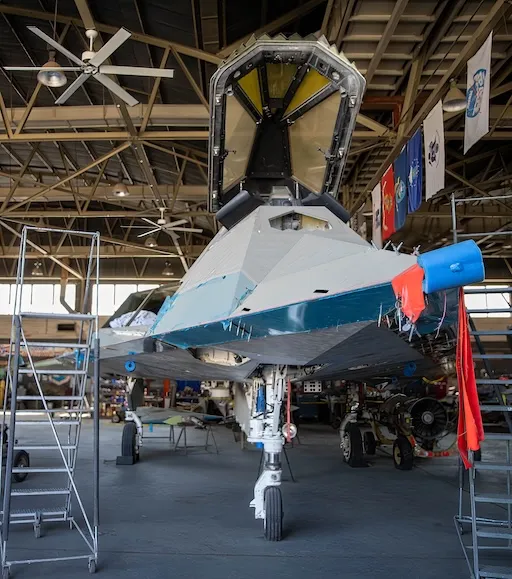
Yesterday, I drove out to Atwater to the Castle air museum. I’d been there almost ten years ago, but wanted to go back to see a recent acquisition sitting in their restoration hanger: an F-117A stealth fighter.

I know, the F-117 isn’t really a stealth “fighter” - it’s really more of an attack aircraft. And the ones going out to museums aren’t really stealth anymore. The Air Force is demilling the planes as they usually do when they go to museums, but on the F-117 it involves tearing off the radar absorbent skin, plus any other still-classified bits. But still, I’d never seen one in person, and I had the day off, so I decided to take a two-hour drive out to see it. And of course the whole thing became an exercise in deep thought and wondering what the hell I am doing with my life. Bear with me here.

* * *

I have an odd relationship with military aircraft. I was born on a SAC base similar to the former Castle AFB, where B-52s loaded with nuclear weapons waited for the end of the world to start so they could fly over the north pole and make their contribution. But my dad finished with the service when I was a baby, and I have no recollection of living on base. He also seldom talked about his service working on bombers when I was a kid. This isn’t how these planes got loaded into my brain.

When I was in junior high, I started learning more about planes from my friend Derik. I’d built model railroads for a while, and shifted to planes. I became completely obsessed with 1/48-scale plastic kits of various military aircraft, from WW2 fighters to modern jets. All of my lawn mowing money went to the Kay-Bee toys in the Concord Mall, where I bought as many Testor’s paints and Revell planes as I could get my hands on. I probably was stuck in model building mode far too late into my teens. I think at the age when I probably should have been interested in sports and girls, I was burning my hours on models and computers. Getting an actual car and having to move to 1:1 sanding and painting on my bondo-laden Camaro pretty much broke me out of it, though.

I have very fond memories of spending hours and hours in my basement sitting at a card table, cutting pieces from plastic sprue, listening to Rush albums on repeat, and inhaling fumes from glue and paint. There was something meditative about it, I now realize. Mindfulness is now a billion-dollar industry, filled with apps and motivational speakers and self-help books and seminars promising to get us back to the place I was at in 1985 with an F-15 kit sitting on the table. Everyone’s knitting and doing puzzles and painting, and every doctor I go to tells me I need to do something to calm the hell down. So I think about that time a lot. But I also feel a certain shame in building model planes, because I don’t want to be a fifty-something dude obsessed with what’s the best Tamiya scale aircraft, especially when the military is patrolling our domestic streets. Models also take up space I don’t have, and I never have time to do anything anymore. But all of this is still bouncing around the back of my head, making me think too much.

* * *

The drive to Atwater took about two hours. It’s funny because once I start to approach Modesto, the scenery reminds me a bit of Indiana. It goes from densely-populated city to rolling suburbs to almost nothing but farms. Driving on the two-lane California-132 through farm fields and long rows of crops looks so much like the grid of roads in unincorporated Elkhart County, an unnamed road every mile separating the farms. The one difference is it’s not corn and soybean here; it’s almonds, olives, or grapes. But it still feels like it’s the late Eighties and I’m cruising around for no reason, or maybe driving down to Bloomington. I have a 1989 playlist on my phone, which is an absolutely embarrassing list of tunes I would have been listening to at that point in time. I put that on, and even though it was almost 40 years later and I was in car with rear-view mirrors that have more computing power than most companies had back then, it still felt like I was back there.

* * *

Castle has a nice collection of planes. Some of them are pretty faded and worn by the winds and sun of the central valley. They’re trying to get the money together to build a large indoor facility for some of their collection, but until that happens, many of the exhibits are pretty beaten down by the elements. One of my favorite planes ever is the SR-71, the black stealth-looking super-fast spy plane that looks more UFO than jet. They have one at the front gate, and it’s restored and in decent shape, but it does collect dirt and mud from the storms and general agricultural debris that floats around the central valley. The other thing I wanted to get a shot of was the B-52D they have there, but it’s currently being repainted. The plane was pretty faded out when I saw it last in 2016. Right now, it’s sanded and a mix of primer, bare metal, and little bits of stray paint, and is getting redone in stages. Glad they’re getting it done again, but no photo ops yesterday.

It was oppressively hot yesterday, in the 90s but the sun made it seem even worse. I did a quick loop and took some pictures, but there wasn’t much time to loiter. I asked the people in the gift shop about the restoration facility that contained the F-117, and they gave me directions; it was in a hanger in another part of the former base.

Castle got BRACed in 95, but you can still see the remnants of the old SAC base: a giant parade ground in the middle; streets named after bombers in one direction, plane parts in the other. Stratofortress Drive has a big county human services building on it; Turbine Drive has remediated concrete pads on either side of it. Early 80s base housing that looks incredibly like early 80s base housing now contains a Korean Airlines pilot school. One runway remains, with a Christmas tree apron from when SAC had nuke B-52s on call hanging off one end. But half of the jetways are now set up for Google to test Waymo cars, this track with a maze of little loops on it, all marked with various lines the robot cars can read, I guess.

I drove to the restoration hanger, a giant WW2-looking building with room for maybe four big planes inside. It’s not open like the museum, but it’s vaguely open to the public. I talked to a guy who seemed a bit guarded about me visiting to take pictures, but we chatted for about an hour about the situation with the F-117, and how the restoration is going.

First impression: the F-117 is much bigger than I expected. I thought it was a little sportscar thing like an F-16, but it was parked next to a giant flying brick of a Navy F-4 and it felt almost comparable. It sits very high up on the gear, which are borrowed from the A-10. The museum’s plane had all of the skin stripped, the tails removed but sitting next to it, one of the engines on a cart. The leading edges and engine inlets were all gone, with the start of reconstructed pieces and cleco temporary fasteners temporarily holding them in place.

The plane looked both futuristic and but also very dated. The outside lines were all sharp and the design looked very Star Wars, but one look in a landing gear door or open panel and I could see this was straight-up 70s tech, wiring and hydraulics that were all lifted from old F-16s or F-18s. The really touchy stuff like the IR targeting gear were all missing. They had the actual canopy, which has some weird gold layer in the glass to bounce radar waves, and they got a weapons bay trapeze, which nobody else has. Their cockpit is largely intact, at least from the outside. But the secret guts inside were all missing.

This particular plane had done two missions in Just Cause and then 35 in Desert Storm. They had a sign set up by one of the two weapons bays with various pictures and autographs of pilots. 85-0813 was nicknamed “The Toxic Avenger” and had an art plaque for that. It obviously wasn’t panted on the outside of the stealth plane, on the absorbent skin. I looked inside a weapons bay and could stand on the ground upright without hitting my head. The inside looked like the guts of a late-seventies F-15A, with conventional wires and hydraulic lines mounted to the dull gray riveted skin inside. The bays also seemed shockingly small when I was up close. They typically carried only two bombs and no advanced pods or radars like modern planes. Apples to oranges, but that little sports car F-16 I mentioned could easily haul three times as much weaponry plus a gun and loads of advanced avionics and targeting systems. Sure, maybe no stealth, but it was strange to actually see the size comparison.


Another odd callback to my model airplane days. Back when the stealth fighter was a known thing but nobody had seen it yet, Testor’s came out with a model kit of it, and it was in a Tom Clancy book and a popular video game. There was this rumor that the stealth fighter was called the F-19, because McDonnell Douglas came out with the F-18, and then Northrop built the prototype F-20, so obviously F-19 was skipped for the secret plane. It wasn’t, and the Testor’s kit was just a made-up plane that looked little like the actual F-117, with smooth manta-ray wings like a sci-fi spaceship. Of course I bought one and built it, and that was the stealth fighter in my mind. When the plane was first unveiled four or five years later, I was shocked that it was the same plane, or that it even could fly. It was so surreal to come back to this 40 years later and actually touch one of them, albeit with the matte black skin missing.


On the drive home, I thought about this visit a lot, and about my obsession with this stuff. It pains me to write about this, because I’m stuck between two things here, and don’t belong to either. I mean, I spend a lot of time wandering around closed military bases for some reason, and a part of me thinks about how we spent trillions of dollars in the last 80 years, and for what? To tear it all down and leave behind superfund sites in the middle of nowhere? There’s the argument about deterrence, or projection of power, or “bringing freedom” to places like Vietnam, Iraq, or Afghanistan, which are all currently not very free.

I can’t really talk to my leftist friends about any of this. To them, these are all machines that were made to kill. America has spent 25 trillion dollars since the end of World War 2, building up a massive nuclear force that was later dismantled; invading countries that were later abandoned; stockpiling weapons for a Soviet invasion that never happened. It’s hard for me to argue against that, but it’s even harder for me to fetishize these machines when I’m talking to these people.

On the other hand, I feel like I can’t talk about that side of things with right-leaning folks, because it feels like betrayal. I feel like, according to them, I’m supposed to have unwavering loyalty to the military and to the government. And I generally feel a respect for those who served. But I don’t fully support what we’ve done or what we’re doing, especially with what’s going on now.

And I think the bigger thing I can’t talk about is that this money wasn’t wasted per se. The military is a great social experiment in a way the right won’t freely admit. It’s an experiment in socialized medical care, desegregation, a shared housing system, a government system that feeds, clothes, and educates six or seven million people. Although I’m sure the top end of companies like Raytheon or Lockheed get the bulk of the trillion dollars a year spent on building arms, but some amount of it eventually trickles down to the factory workers assembling the stuff. None of this justifies overthrowing countries or killing people. But it shows that there is the capability to spend massive amounts of taxpayer money on actual things to provide for people.

Anyway, all of this makes me think about hobbies and what I do and what I waste my time on. And I think there needs to be some change at some point. But I also realize how burned in this stuff is, and how I can’t wake up one day and say, “OK I like trains now.” Not sure what to do about that.

The death of the prince of darkness

ozzy

So, Ozzy Osbourne died on Tuesday. I’ve been thinking about this all week, because these celebrity deaths are increasingly odd to me as they become more frequent. And Ozzy’s a weird one, because of his intersection with culture and life in general.

I was too young to be into Black Sabbath as a kid. Their first two albums were released before I was born, and I think I was in the first grade when Ozzy’s first tenure with the band ended. I didn’t have an older brother who could have turned me onto them, and our town didn’t have an AOR radio station, so I had zero exposure to even the basics like “Iron Man” or “Paranoid.” As his solo career unfolded, I also had no exposure to his music. When Blizzard of Ozz and Diary of a Madman hit, my local Top 10 station (the only non-country/non-religious FM station in the area) was probably pumping out Men at Work or Phil Collins.

My first memory of Ozzy was during CCD classes at my Catholic church, where I was relegated during Sunday mornings to prepare for first communion. One of the kids in my class was explaining Ozzy to us: the long hair, tattoos, running around without a shirt and maybe some horror movie makeup on. He bit the head off a bat, or maybe a dove. I was fascinated by this, even though I didn’t know a note of his work. It was similar to how I was amazed by the band Kiss, not because I liked the music, but because of the costumes, the makeup, the pageantry of the whole thing. It was more like a cartoon than music, and at the age of nine or ten, that was awesome. I remember sitting in class, sketching out pictures of Ozzy biting the heads off of birds, done entirely from this other kid’s description, without having actually seen any album covers or live footage.

We got MTV a bit after that, and Ozzy entered the general zeitgeist, although I don’t exactly remember any of his music or videos. He played at the big spectacle of the Us Festival, and maybe his antics were covered by Kurt Loder in news segments. I can’t remember them actually playing any Ozzy or Black Sabbath videos - they were probably too busy with Michael Jackson and John Cougar Mellencamp - but it seemed like Ozzy was ever-present anyway.

I don’t remember actually listening to a Sabbath or Ozzy album until I started hanging out with Jim Manges in maybe 1986 or 1987. His parents were evangelicals who forbade him from any hard rock or heavy metal, and he’d often stash tapes or D&D books at my place. He was also very into the “satanism” of early Sabbath, although it was mostly a reaction against his parents, and Black Sabbath wasn’t really satanist. We used to listen to tapes of Sabbath a lot when driving around in my car, although it was often “nice price” tapes instead of the big albums. One in particular was the Live at Last album, which was a horrible near-bootleg released without the band’s permission, an odd mix of poorly-recorded tracks and an album cover that looked like it was done on a Commodore VIC-20.

In high school, I fell into early thrash metal, and stuff like Metallica, Megadeth or Anthrax seemed like a generation past that of Ozzy’s solo stuff, and at least two beyond Black Sabbath. It’s odd for me to listen to Bark at the Moon and then Master of Puppets back to back and they seem twenty years apart, but it was more like three years. I was too obsessed with “new” stuff and didn’t have the time or funds to go backwards through the older Sabbath catalog when I was a teenager.

When No Rest for the Wicked came out in 1988, it was a bit of a twist. At that point, Ozzy seemed like a bit of a relic, but No Rest had a fresh sound, catchy tunes, and this amazing new guitar player Zakk Wylde, who was some kid genius, only a few years older than me. That album got some heavy play in my last year of high school, even though it was competing against Metallica’s And Justice For All and the first Guns ‘N Roses album in my tape player. Same goes for 1991’s No More Tears, which featured a ton of songs written by Lemmy from Motorhead. But aside from this brief blip, I mostly thought of Ozzy as this elder statesman in the world of metal, and focused most of my attention on death metal or whatever else I was obsessed with in the mid-90s.


Fast-forward to 1996. I’m in Seattle by that point, and Ozzy was mostly off my radar. He’d “retired” and he had an album or maybe two I’d never even heard. Black Sabbath was fully in the back of my head, having listened to the first six albums pretty repeatedly over the years. But I did not keep track of anything of Ozzy’s solo career in years.

It’s a Friday, and I’m at work. There’s some ship party going on, free champagne, catered appetizers. This was at the point in tech where this happened like every week. I’m not a fan of champagne and the food was usually crap, but it meant I could waste an hour of time doing nothing. I was talking to a few people about how Ozzy was playing at the Tacoma Dome that night. The general discussion was “Ozzy is touring? I thought he retired? He’s still alive, right?” We all joked about going, in the same way one would go to a monster truck rally at the Kingdome as a goof, just to see who would show up.

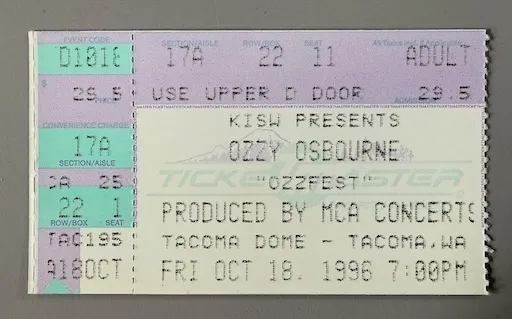
Later that night, I was sitting around trying to write, and thought maybe I should go. Ozzy wasn’t going to be around much longer, right? I figured his career was beyond over, and I’d never get to see him again if I didn’t go. I called the Tacoma Dome to see if there were still tickets - you couldn’t look it up online and had to actually call the box office, and they said sure, tons of tickets. So I got in my car, hit I-5, and headed down there, well after the first opening band started.

This tour was sort of a mini-festival with three opening bands, all of them notable: Biohazard, Sepultura, and Danzig. I got to my nosebleed seat maybe during Biohazard’s last song. Sepultura was decent. I always joke that Danzig opened and closed with “Mother” because he was at that point in his career, but he was decent. And then, Ozzy.

I didn’t really know what to expect. I thought this might be the dreaded “rock star karaoke” performance where he stumbled through the lyrics on a teleprompter with a completely disconnected live band, and then after maybe a few greatest hits, we’d get hit with the “here’s a song from my new album” and have to struggle through 45 minutes of that before an encore of a Sabbath tune or two. This was absolutely not what happened.

First off, Ozzy’s band was tight as hell. Joe Holmes from David Lee Roth’s solo band was there, a very underrated guitarist. Mike Bordin from Faith No More was on drums, and future Metallica bassist Rob Trujillo rounded out the lineup. The band was not only totally together, but it was very energetic and not phoned in at all. Bordin is an incredibly kinetic player and frantically banged through the set at combat power. Both Holmes and Trujillo jumped all over the stage, climbing up on amps and coming back down again to the front. The playing was incredibly tight, and they pushed ahead at a fast tempo through the whole set.

Second, Ozzy really put on a show. The stage had two giant video walls and before they started, there was a video montage that put Ozzy in various movies, like a parody of Pulp Fiction, then him interviewing Princess Diana, then him in the Beatles, then him and John Travolta in a Saturday Night Fever/Crazy Train mash-up, then him in a duet with Alanis. (There’s a fan-shot video of this here.) They then did a montage of Ozzy videos and live footage that completely pumped up the audience, and by the time he finally hit the stage and the lights came up, everyone was on their feet screaming.

Did he play old songs? He played no new songs. After screaming for everyone to go crazy, they immediately launched into a blistering version of “Paranoid” and it went on from there. He played a half-dozen Black Sabbath songs: “Sabbath Bloody Sabbath,” “Iron Man,” “Sweet Leaf,” basically an entire greatest hits album. “War Pigs” was absolutely awesome, the last song in the main set. Video footage of Vietnam choppers over jungles played on the big screens, spotlights going across the crowd, 20,000 people all singing, and Ozzy basically doing calisthenics on stage, screaming at everyone to get out of their fucking seats while he was doing jumping jacks and running laps to this absolutely frenetic version of the song.

I can’t find an exact setlist, but looking at ones online, he only played the song “Perry Mason” from his last album, then a dozen of the biggest songs from his solo career: old stuff like “Crazy Train,” “Bar at the Moon,” and newer hits like “No More Tears” and “Mama, I’m Coming Home.” (The setlist was different than the video above.) What was amazing is how into the performance Ozzy was. I mean, if I was him, I absolutely would not want to play “Iron Man” for the ten millionth time, especially after having like 20 albums after that. But he was absolutely elated that 20,000 people showed up to see him, and we were all doing him a favor by being there. He was more than happy to play the classic hits everyone wanted. Between every song, every chorus, every verse, he was telling everyone how much he loved them, how much he wanted us to get crazy. He had squirt guns and buckets of water, and everyone got drenched like it was a Blue Man Group show. He mooned people and ran around like a madman, dumping bucket after bucket of water on people in the front rows.

The show was absolutely incredible, by far the best live event I’d ever see. Ozzy was just such a showman and made every person there feel like they belonged. It was so high-energy, it was absolutely infectious.


That wasn’t his retirement tour, obviously. That format of multiple opening bands became the Ozzfest, which went on for decades. A few years later, he gained a completely different audience and morphed personas with his family’s reality show. He had a second (or third, or fourth) life in the 00s and later.

I guess what I find odd about all of this is how Ozzy has this ability to be ever-present and weave his way through life without being directly in it. I can’t remember the last time I bought an Ozzy album, but when I searched my books, he’s mentioned dozens of times. It’s very similar to when I drew that picture of him without actually seeing him. The title “Ozzmosis” is very apt in a way. And that makes it harder to imagine that he’s gone. It’s a lot like how David Lynch is gone, but he’ll never feel gone, and that makes it both easier and harder to reconcile his death.

Anyway. I got a big smile watching that old concert footage, and that’s all that matters. Glad he went out on top, and was able to make so many people happy like that.

My first CD player

toshiba-xr-j9

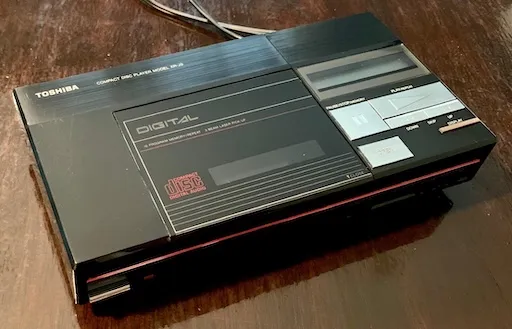
I had to rip a few CDs last week, which is a rare occurrence these days. I don’t even have a CD player at this point, and have to dig up an external optical drive for my Mac once or twice a year when this happens. It had me thinking about the rise and fall of CDs in my life, which brought me back to my first CD player ever, the Toshiba XR-J9.

So, 1987. The Compact Disc was released in Japan five years before, and audiophiles had been buying them in the US, but not so much in Elkhart, Indiana. The whole idea of digital audio was a thing of awe, total science fiction. Lasers! The ones and zeroes captured in the studio remained ones and zeroes until right before they hit your ears, with no degradation, no distortion, no mangling through resistance-bearing wires and analog amps. Some magazine article said if you dubbed a cassette from a CD, your copy would sound better than the professionally-duplicated one you bought in a store. I can’t even remember the first time I actually heard or touched a CD, and didn’t know anyone who had a player. I had to have one, of course. But I couldn’t spend a grand on a Sony home player, and didn’t really have the stereo to match, which would cost a few thousand more.

At that time, I had a Soundesign stereo, probably from Wards or Sears, which had tower speakers, sat in a wood rack with glass doors on the front, and was a single piece for the receiver, EQ, and double tape deck, but had grooves in the plastic face so it looked like a stack of individual components. It wasn’t exactly high fidelity, but it was better than the Sears all-in-one I had in grade school and junior high. And it had a pair of RCA connectors for Aux In, tempting me to add more.

I was out of the house more than I was in it back in high school, so cassette was my primary medium. In my pedestrian days, I ran through $20 Walkman clones on a regular basis, whatever I could pick up at Osco Drugs on a discount. Once I graduated to a car, it had a no-name tape deck in it. For a while, I would buy vinyl and record them to tapes, but I mostly bought cassettes, or dubbed friends’ albums onto blanks.

Every time I went to any store with audio gear, I’d ogle the various components, thinking about how someday when I was out of college and rich, my first priority (aside from a Commodore Amiga) would be to buy some esoteric system with gigantic speakers, two dozen bands of EQ, a DAT digital tape deck (what happened to those?), and of course a reference-quality CD player. There was a store in the Concord Mall called Templin’s that was half instruments, half audio gear. (Oddly, they also sold Atari home computers.) This was the place where they had separate listening rooms where you could go in and see full setups like the one in American Psycho, thousands of dollars of gear that was absolutely unobtainable to me.

In the summer of 1987, I started working my first “real” job at the Taco Bell across the highway from the Concord Mall. And right around then, CD player prices started dropping. They were like $1000, then hit $500, then $400 or $300. And around the time my first paycheck hit my pocket, I was in the K-Mart across the street from my ‘Bell, and there was this CD player that was a hundred dollars. I absolutely had to buy in, and I did. (For reference, $100 in 1987 is about $285 now. I made $3.35 an hour dealing with drive-through abuse and refried bean cooking at TB.)

The XR-J9 was an odd little beast. It was about twice the size of a battery-powered Sony Discman of that vintage, but way smaller than a component home CD player. It was a weird mix of the two, though. Like a Discman, it was a top-loader; you popped open a lid and put the disc directly on a hub, then closed the door to get the laser to start. (Laser! I now owned a Class 1 laser! 3-beam pickup, whatever that means! It even had a warning label on the bottom!)

Unlike the portable Discman, the Toshiba ran on mains only, with no provision for a battery. It also had a fixed set of RCA cables coming from the back, which would plug into a home receiver. It also had a headphone jack and volume slider on the front, but unless you had a Honda generator with you, it was in no way portable. And those cables weren’t removable, which bugged me.

The controls were spartan: a power button on the front; the usual play, pause, forward, and back buttons. You pressed in a corner of the lid and then it unlatched and popped open. It also had a Display button, which I think toggled the time versus the time remaining that showed on the small LCD display. Some buttons had multiple functions. If you pressed Forward once, it would skip a track; hold it and it would fast-forward through the track, playing a sliver of sound every five seconds. This was amazing coming from the tape world, because I swear I spent half my batteries jumping around tapes, and this was instant. Random access! There was also some elaborate combination of buttons you could mash to access a “memory” mode where you could program up to 16 tracks in any order to get a custom playlist, which was a huge pain in the ass to do, and then it immediately went away when you opened the player. I would very occasionally do this when listening to The Police - Synchronicity so I could skip track 4 (“Mother”) because I never felt like it matched the rest of the album. (Now I think it’s the best track.)

The obvious problem after sinking a whole paycheck into this thing was that I now needed music. I think at that time, a tape was like $7.99 and an LP was $9.99, but a CD was $15.99. Each title was an investment. I went to Super Sounds, my favorite record store ever in the Concord Mall, and went A-Z through their three or four racks of CDs, trying to figure this one. (At that time, CDs were in “long boxes” which were the same height and half the width of an LP, so stores could use the same vertical racks for the new format.)

My first purchase was the most recent Iron Maiden album, Somewhere in Time. I was way too into Maiden at the time, and this album was a perfect storm for me: it was Iron Maiden; it had this futuristic cyberpunk theme; it was what I thought at the time was super-modern, ultra-technical sounding; it was digitally mastered; it was Iron Maiden; it was loud, but precise. It was also almost an hour long, so it was like twice as long as if I’d just bought a Boston album or whatever. I remember bringing the CD home, listening to the whole thing on headphones, and there was this one part on the song “Deja-Vu” where Nicko McBrain is playing this snare volley right before the chorus comes back in, and I could suddenly hear that he was also tapping out time on the hi-hat, which wasn’t audible on the cassette. It absolutely blew my 16-year-old mind.

Of course, I had no more money, so I had to go sling tacos and wait two more weeks to get something else. I don’t remember why, but I got the ELP album Trilogy next. A headphone listen also bewildered me. The first song starts with a beating heart, then Emerson doodling away on keyboards, which sounded incredibly crisp, compared to a muddy cassette. After two minutes, the rest of the band suddenly came crashing in, and the dynamic range demonstrated by the sudden change was incredible.

I can’t remember what was the third disc, but I did waver on whether I wanted the high quality of a CD or having twice as many at-bats by sticking to tape. By that fall when I started working at Wards and moved to weekly paychecks, I vowed to myself that I’d buy a tape every week, if not more. I pretty much stopped buying CDs for a while, until maybe my senior year, when I discovered the Columbia House and BMG CD clubs.

About twenty years later, the CD thing came to an end, with just shy of a thousand titles in my collection. I’d slowly been ripping things to MP3 when the 21st century started. Once the iPod hit, CDs became a temporary medium I used until I could rip the tracks to a hard drive, then became a backup in storage in case my computer died. On November 22, 2005, I made my first purchase on iTunes, and that was the beginning of the end. Now, almost everything is added from Apple Music or bought from Bandcamp.

(Oddly enough, the first track I ever bought online was Harry Nilsson’s “Remember.” The reason I suddenly needed to hear it again was a memory of the Michiana student TV show Beyond Our Control, which closed each episode with the song.)

That Toshiba lasted until maybe 1992, when it mysteriously died, stopped loading up discs. I bought a Kenwood portable player that summer (this was described in Summer Rain) and that unit suddenly became my main CD player for a few years until I bought a Kenwood 6+1 changer at the start of 1994. The Kenwood portable never really got used as a portable, because it drained AA batteries so fast, and this was before the anti-skip memory thing was out, so it was fairly useless on the go. I never considered CD as a portable medium, using the MiniDisc from the late 90s until the iPod showed up. I didn’t own a car with a CD player until 2007, when the format was dead. My 2014 car had a CD player that I think I used once. I honestly could not remember if my 2025 car even has one, and I guess it doesn’t.

All of this is so strange to think about, because that 1987 dream of someday having a gigantic reference system in my home is long gone. (So’s that desire for a new Amiga, but that’s another story.) MP3 wasn’t even a dream back then. I listen to 99% of my music on AirPods these days. I don’t have a room full of racks of CDs. I could afford to go buy any stereo I want, but what would I even buy? I bought a pair of near-field monitors for my desk literally a month before the pandemic started and I had to go to pure headphones for the locked-in-the-same-apartment 24/7 thing. I think I have two different Kenwood receivers in storage, and use a $200 sound bar in the living room for the TV. Music is still important, and I’m listening to stuff every day. But the technology has changed and the meaning of where it is in my life has too. Is that good or bad?

How to Rob a Bank

seattle

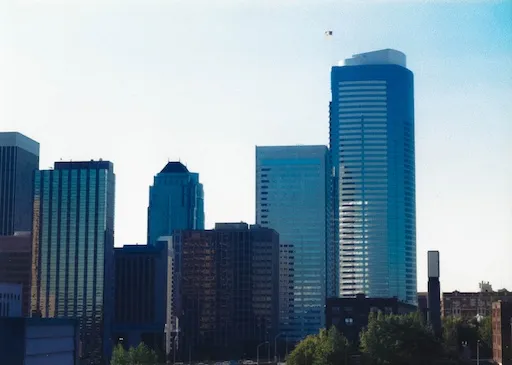
I saw a doc on Netflix the other night called How to Rob a Bank. It’s about Scott Scurlock, a bank robber who had a big run in Seattle in the mid-90s, hitting 18 (or 19) banks for a bit over $2M in 1990s money. It was a pretty generic doc, but had lots of footage of 1992 and 1993 Seattle that really brought me back.

I lived in Seattle starting in 1995, and the film ends in 1996. I honestly have no memory of this news story, but I didn’t have a TV or cable back then, and didn’t read a newspaper, so I totally missed it. But the stock footage, the establishing shots they used, that totally brought me back. It all looked like it was shot on a Hi8 camera, both a crummy quality but a way-too-bright color palette that makes it look far too sharp and vivid. I think I got a Sony Hi8 right around the time of the end of this movie - maybe the same month - and I regret not walking around Pioneer Square and shooting hours and hours of footage of everything and nothing.

Scurlock, aka “Hollywood,” habitually hit Seafirst bank, which was my bank. When I got my first real paycheck in 1995, I went downstairs from our office and walked in a Seafirst on Occidental and opened a checking and savings account. I got a special deal which was new back then: no monthly fees or minimum balance, but I had to pay to talk to a human. I could call their voice mail thing to hear my balance or make a transfer (this was before web banking), and I could use the ATMs or drop off a check. But for an introvert who hated lines, this was the perfect deal.

It also meant I was never standing in a bank lobby when a dude with a rubber nose and chin glued to his face jumped on a counter, waved around a Glock 17, and started screaming for the vault teller. This was a good feature to have, since Scurlock and crew used to repeatedly hit the Seafirst on Madison about a mile from my house, across the street from this classic red-roof Pizza Hut I would always visit when I needed a quick case of nostalgia and/or diarrhea.

The movie built up Hollywood to be this Robin Hood type who lived a vagabond lifestyle, traveling worldwide, living in a treehouse in the woods, writing poetry in his journals. What’s weird to me is he looked like someone I might know, like a friend of a friend of someone who went to Evergreen to study vegan architecture. He had this longish but not long hair, used to be a nudist and live in the woods near Olympia, but wasn’t like a hippy hippy. He seemed more like a weird libertarian guy who was a UNIX system administrator at Boeing and spent a lot of time on bondage groups in USENET news. I never really hung out with anyone like that, and he was a half-generation older than me, but I spent enough time in Belltown that I knew the type.

And I’m not saying I’m into a guy like this, but one of the reasons I’ve never gone back to Seattle is I’m sure Amazon has completely homogenized it, and the weirdo underbelly has all died out or sold out. I’m sure if I went to a cafe in  Fremont now, it would all be people talking about crypto or keto muffins or crossfit. In 1996, it would have been dudes in 79 different garage bands, perennially only two connections from making it. Like your refrigerator delivery guy was in a band that would share a practice space with an iteration of a band that split and half the members went to the first version of Lords of the Wasteland that later had a second iteration that became Mother Love Bone that became Luv C2 that became Mookie Blaylock that changed their name to Pearl Jam. Anyway.

It was also funny to see the doc throw in a quick grunge reference, even though Scurlock was probably totally unrelated to that scene. They spent about 90 seconds showing those crazy flannel kids, playing some unrecognizable music the film could clear without paying the Nirvana estate seven figures. “Hey, these kids hate corporate rock! They’re rebels! It’s the spirit up here!” Sigh.

Spoiler alert, Hollywood tried to go out big with a giant heist, and ended up in a firefight and chase, then killed himself before the cops could. It was on Thanksgiving in 1996. I was trying to remember where I was that Thanksgiving, and the funny thing is, I remember exactly where I was that day, because it’s one of my funniest meet-the-parents stories. I’ve always been hesitant to write about this publicly, but this was almost thirty years ago, and I have not talked to her in 25, so here goes.

I used to date someone who lived in a small town in Southwest Washington, a hundred miles south of Seattle, just before the Oregon border. This started in October, and we’d been trading off weekends, one of us driving to see the other. And Thanksgiving became the “let’s have dinner with my parents” weekend down there.

I’m always nervous in these situations, and this one was slightly amplified because she said her parents were very religious and pretty conservative, and I’m neither. We got there and they lived in a second-story walk-up at this boarding school where her dad worked, like a staff housing thing. Her dad was really nice, and the dinner was great, and I mumbled through saying grace, and then I answered the usual questions. Her mom was okay but sort of quiet, fair enough. She had two older brothers and they were cool, although I knew nothing about sports and sports was like their entire lives. I’d need to memorize some stats or figure out the name of the baseball team that played across the street from my apartment before I saw them again. (“Hey that Kevin Griffey guy, he’s like, pretty good, right?”)

After dinner, I got the big curve ball: her parents were moving. Tomorrow. And nothing was packed, and the house was crammed with decades of stuff and all the fixins from a big turkey dinner and a bunch of appliances that were going with them. And it was a second-floor walk-up. No elevator. And it all had to be moved and the apartment cleaned that Friday.

I’ve moved a bunch and I’ve helped people move, and I’ve been in some disorganized situations, but this was the most chaos I’d ever seen in this kind of operation. It’s impossible to help someone pack their stuff into boxes when you’ve known them a grand total of 37 minutes and you have no idea what is trash and what is treasure and there’s piles of stuff going back to like 1976. Hauling a fridge, a chest freezer, a stove a dishwasher, and a washer and drier down a set of exterior stairs was bad enough. But packing in all the assorted bric-a-brac was torture. They had a big U-Haul, like a 24-foot thing, and I think we filled it twice, plus a bunch of carloads of stuff.

They bought a new pre-manufactured home in a retirement community, which was pretty nice, although it made me wonder how much of it was assembled on a line in Elkhart. We got all the boxes off the truck, then realized the truck was parked in the yard in a small lake, except the lake was slowly getting bigger? We took a look and one of the sets of tires was parked directly over some main water connection to the entire little village, and had cracked it open. So their “Welcome, neighbors!” was getting everyone’s water shut off during Thanksgiving weekend. Fun stuff.

Anyway. Movie review concluded. Check out my Substack. Have a nice day.

27

Screen-Shot-2012-04-10-at-7.14.52-AM

This blog is now 27 years old. On April 11, 1997, I made my first post here. This seems like it was both 20 minutes ago and about 167 years ago. I know I burn a lot of cycles on anniversaries and numbers, but felt it might be a good time to riff on a few things.

This blog was originally called Tell Me a Story About the Devil, based on some dumb joke between me and Ray Miller. In 1997, I was only a few years into being A Writer, and spent most of my time scrawling in various spiral notebooks when I wasn’t either working or actually writing books. I spent all day in an office, scrolling through the nascent web, trying to find stuff to do when I wasn’t doing my job.

This was definitely in the era of Web 1.0, because the term Web 2.0 would not be coined for two more years. The Information Superhighway was still figuring itself out, and had not been completely destroyed by commerce yet. There were roughly a million web sites in existence. The term “blog” would not be invented for another eight months. Google was about a year away.

Back then, I would fixate on a few different sites like CNN, which I’d reload and reread a dozen times in a row. But I would also go into AltaVista (the Google before Google) and dig for content. A lot of definitions of Web 2.0 call it the “participatory” web, but if you were around last century, you might think of Web 1.0 as participatory, but just not by regular civilians. If you had something to say, you’d be on GeoCities or Usenet or hand-coding your own HTML. And people did. And I burned a lot of cycles searching for people who carved out their own personal sites. I loved it when I’d find a “web journal” where someone documented a long trip or pet project or the day-to-day in their life. Before blogs were blogs, this was the web.

And in 1997, I decided I needed to do this too. I mean, since 1992, when I first created what was then called a “hyplan” I tried to think of what cool stuff I could do on the web. Should I publish a magazine like the heavy metal zine I photocopied and mailed to people? Should I write a choose-your-own-adventure with hyperlinks between the pages? Was there some kind of hypertext novel in my future? I had the technology, but never had the idea or plan.

But I decided to chronicle my writing process, and maybe eat up my lunch time at work. I figured if I created a framework, I’d eventually hit a cadence with the thing. So I did.


What’s funny is that in the first implementation of this thing, I’d inadvertently invented the static site generator probably ten years before Jekyll existed. This was way before I could even think about database-driven CMSes. This is basically how it worked:

  1. I would telnet into Speakeasy.net, which was my dialup provider, which gave me a shell login.
  2. Fire up the emacs editor.
  3. Press Ctrl-x Ctrl-j, which ran a hit of elisp and opened up a text file in the right directory with the filename containing today’s date.
  4. Write. This was not done in HTML, and it was seven years before John Gruber started talking about Markdown. Just plain text.
  5. Save the file, and run a little C program, which would generate the index pages and other junk. The output directory was on the live host so there was no staging or mirroring or file transfer.

There are like 19 problems with what I just described. And there are at least two or three things I probably should have named, expanded, and sold.

Anyway, that was all fun, and I kept writing and publishing. The mechanics of the site slowly improved over time. I switched from plain text to HTML. I figured out a way to slap a commenting system on the site. I got rid of the frames layout (ugh, remember that junk?) and added rudimentary CSS to the thing. Finally in 2009, I gave up and moved to Wordpress.

What’s funny is I’m actually half thinking about moving back to a static site generator. I’m sick of Wordpress and I use Next.js at my real job. I keep thinking about making the change, but with so many posts here, it’s a monumental task. Yeah, I’m sure you Hugo apologists can break out a StackOverflow post from ten years ago that explains how to export WordPress to Markdown with a script written by a teenager in his mom’s basement in Latvia, and it will waste at least a week of my time and still mess up every post containing an image that was written on a Tuesday. I could do that, or I could sleep. I’ll think about it.


The thing about this blog is it’s still hard for me to explain what I do or don’t do here, and even with a million and a half words written over the last few decades, I still can’t. I rarely wake up in the morning with an idea of what to blog, and when I do, I often find I already wrote about the same exact thing ten years ago. Travel stuff is obvious, as are big life events. But there’s also a lot of self-censorship involved. I can’t talk about my job. There are people who I don’t want reading about my private life who militantly stalk me to find out about my private life. I have issues with persona. I have little interest in writing reviews. What do I write about?

I journal a lot, in a lot of places. I still write on paper every day, usually a page or two in a Moleskine diary. I use Day One pretty religiously for day-to-day stuff and dream journals. I use the Notes app to jot down ideas and things to do later. I freewrite and do the actual books-and-stories writing in Scrivener. None of those are public-facing, so where those end, this begins.

I think the thing I’m almost comfortable with now is this being about nothing. Part of blogs being essentially dead as an art form is nobody asks me anymore. In 2002, you had to focus your blog, have an elevator pitch, be niche, because everyone was chasing a book deal with their blog. I don’t know if people still do this. I don’t know if people who got seven-figure deals to turn their blog in a book had a one-and-done publishing career and owe seven figures of an advance. None of that was why I blogged, and none of that is why I still blog.

Anyway. Old man yells at sky. It’s been fun so far, and I’ll keep doing it. I’m not sure I’ll make it another 27 years, but we’ll see.