The Wrath of Kon

Dispatches, thoughts, and miscellanea from writer Jon Konrath

2011

List: 14 Product Variations That Never Got Past Focus Group Testing

  1. Cap’n Crunch Atlantic Cod Crunch Berries
  2. Olde English 800 Sport malt liquor with electrolytes
  3. Lego Postal Rampage playset
  4. The McDonald’s McHaggis, turnips, and fries value meal
  5. Old Spice Pure Sport scented enema
  6. The Capital One Planned Parenthood Abortion Rewards Visa card
  7. Clorox Cool Ranch Toilet Cleaner
  8. Prune Pepsi Max
  9. Taco Bell CrunchWrap de Tripita
  10. Smith and Wesson My First .357 Junior Revolver
  11. Little Debbie Purim Kreplach cakes with liver
  12. Sherwin Williams Your Mother’s a Whore house paint
  13. Hawaiian Punch Guava Bacon Crush
  14. Jello Pudding Contraceptives

World War Z

I just finished reading World War Z, which means I’m like three years late to the zombie party, right? Well, fuck you. I was like fifteen years early. I was memorizing the locations of balconies and gun-selling sporting goods stores in shopping malls in case of a Romero-like outbreak that would require me to hole up in the Scottsdale Mall probably around the time most of the country was still obsessed with the artistic masterpiece of Baywatch.

Really, it all started in high school with Faces of Death movies, and then segued into those classic Troma movies, Surf Nazis Must Die being a favorite, even though it wasn’t even a horror movie as much as it was a dystopian disaster movie filmed for like $17. (“Who rules the beaches?” / “The surfers!” / “Who rules the surfers?” / “The surf nazis!”) In college, I got into death metal, and every other letter I’d get from some freak in rural Georgia or Sweden or Japan would include a giant list of horror movies I was supposed to worship. So me and Ray spent a whole summer renting every conceivable horror movie we could find in our shithole Indiana town. This was limited somewhat by the fact that I worked two full-time jobs and during the week slept in two shifts of two hours each and pretty much walked around like a zombie, minus the brain-eating part.

Seems like some comparative lit class I took in college had a professor that told us that zombie movies were really about the communist scare. That still true? I don’t know. The Brooks book seemed to be pretty left-wing in some aspects, like the strange parallels between the zombie wars and Iraq/the war on terrorism. In both, you’ve got a military trained to fight the cold war in Germany, armed up for a giant thousand-tank battle, and a stealth bomber isn’t going to do much when you’re fighting an enemy with no radar, i.e. a zombie or an insurgent. But it’s appealing to right-wingers in the sense that it’s almost like military armament porn for chapters and chapters, descriptions of battles and weaponry and tactics and whatnot.

I don’t know why I didn’t become obsessed with zombies back in 1993 or whatever, but it’s probably because I’m always overly obsessed with things for a week and then it’s on to something else. I haven’t had my main computer for a week, and decided that would be a great time to take a writing holiday, partly because I’m burned out on this book I’m writing, and partly because I didn’t want to spend two weeks trying to recapitulate and resynchronize two computers’ worth of files and changes and additions and deletions after working on my spare computer for that week.

So I spent most of that time obsessed with the idea of building a PlayStation 2 portable. Not a PSP, but I mean buying a dead PS2 or ten, dremel-attacking the motherboard, scoring a surplus rear-view camera monitor from eBay, digging through my giant boxes of junk for some old camcorder rechargeable batteries I could repurpose, somehow duct-taping the whole business together into a little ball so I could waste infinite amounts of time playing SOCOM 3 instead of writing. A week later, and I realize this is the stupidest fucking idea I’ve had since I thought about building a serial killer-themed miniature golf course on my land in Colorado. Actually, that still sounds like a good idea. But you get the point here: I can only be gung-ho about this stuff for a week, maybe ten days. It’s why I don’t write five books a year.

I wrote a story about the zombie movie Burial Ground. It’s in Air in the Paragraph Line #13. I think it’s one of my best short stories ever. You have to go buy a copy to read it - I never put it anywhere else, and I haven’t posted a PDF of #13. If I had ten more stories like it, I’d bind them together in a little book and zap it straight to the kindle store. But I don’t, not yet anyway. But that movie, Burial Ground, is this bad/awesome Italian zombie movie that has a completely fucked and incomprehensible plot line, and although all of those horror movies have the one chick who somehow manages to get away, in this movie, the zombies totally win, and I like that.

Speaking of the dead rising, I’ve got new life and new batteries in the laptop. I’m writing this while sitting on the couch, and the battery is designed to hold 6900 mAh and it actually holds 7100. It was down to only holding 4800 and started freaking the fuck out and giving me a warning message that I should cut the shit and get to the Apple Store immediately. They sent my computer off to Tennessee (why? Apple’s just down the road.) and replaced the battery and the motherboard - I had a couple of random crashes, something with the video card. They don’t call it a motherboard anymore; they call it a “mainboard”. I think it’s some anti-sexism thing, like how you can’t say cables are male and female anymore, or how you can’t use master/slave in your tech writing. So I got freaked out by the whole thought of surrendering the machine and having it come back completely blank, but it’s fine now.

I remember one time in 1993, I stayed over at Ray’s when his parents were out of town, and we watched four or five zombie movies in a row, until they all melded into each other. (Actually, one was a vampire movie, called Vampyres, a bad 70s thing with some half-naked lesbian vampires that lured guys into their old house, then killed them and drank their blood. One of the dudes seriously looked like a late-70s David Letterman, and the movie used every conceivable excuse to get these two women out of their clothes and dyking out.  This was also before the whole vampire thing got co-opted by the cool kids and completely fucked over.  Go check it out on imdb and you can see a trailer that’s essentially three minutes of soft-core porn, prefaced by a stupid XBox ad.) Anyway, the next morning, Ray’s asleep and I knock open his door with my arms outstretched and walking slowly like I’m one of Romero’s Day/Dawn ghouls, and Ray wakes up and freaks the fuck out and immediately jumps out of bed and goes for a bat or a piece of wood or something he can use to bash my undead brains in with, until he realizes that the zombie apocalypse had not in fact arrived.

The only other time we got seriously freaked out by a movie was when we went to a midnight showing of Saw in the theater. I don’t know if it was because we went to the midnight show or because the theater was empty, but after the final credits rolled, the first words out of my mouth were “dude, we need to go to Wal-Mart and buy some guns and enough shit to board up every window of your house.”

One of the things I liked about World War Z was how the news of the living dead propagated around the world in such a distorted fashion. The whole book takes place as a series of interviews after the war is over, like one of those World War II/greatest generation books. And in every zombie movie, you’ve got this start-of-act-2 disbelief rap going on, like when the scientists land on the zombie island and the one idiot says, “what, is this a village of lepers?” and then gets eaten alive. There’s always that part where you are screaming at the screen “RUN YOU STUPID BITCH!” and you know if you were really there, you’d get the fuck up on the roof and nail shut every door and get the closest deer rifle and plant some 12-gauge slugs into the brains of the undead. But of course, you wouldn’t. You’d go to read what the hell happened on twitter to see if the zombie thing was real or just some viral social networking astroturf campaign to sell the new Nissan Sentra or some bullshit. News would get suppressed, or distorted, or spun. If the zombie apocalypse happened tomorrow, every idiot on Fox News would be blaming it on Obama. In WWZ, the outbreak spread through China because they kept their mouths shut. Israel was smart enough to close their borders, which of course made all of the Palestinians believe it was a big Jewish conspiracy. Etc. etc. It’s not like President Morgan Freeman is going to call a press conference to tell us all that we’re under zombie attack, and Bruce Willis is going to steer a nuke into the center of the zombies and save everybody as a shitty Aerosmith song plays.

So yeah, good book.  I was expecting something aimed at 14-year-olds, like a Mack Bolan book, but Brooks looked at a lot of different angles, and I enjoyed the hell out of that.  I’m not exactly going to retool and start cranking out genre fiction here, but I got at least a dozen good ideas thrown into the plot-o-matic over the whole thing.

Review: My War by Colby Buzzell

I wasn’t set to go down the military history wormhole and start reading books about Iraq, but while I was going through one of the Henry Rollins journal books, he mentioned Buzzell’s memoir, and I picked up a copy.  Going into it, I knew nothing about it, none of the background, his history, and I never read his blog.  I didn’t know if he was a staunch anti-war type, or a flag-waving republican.  I didn’t even know if he lost his arms and legs from a car bomb, or if he was now a regular commentator on Fox News.  All I knew was that Rollins liked him, and the book was well-blurbed.  Even Vonnegut gave it a good blurb.  So I was hoping for the best.

Then I started the book, and found out that he’d kept a blog during his time in Iraq, and this was a book made from the blog, and my heart sank.  I hate when people repackage blogs into books.  One reason is that blog to book people rarely repeat their performance; they’re almost always one-shot wonders.  And I love to be proven wrong by this, but it’s just an issue with the format.  You put your all into a blog, every part of your life, and you only have one life, so you only get the one book.  Sometimes you get a follow-up, but it’s always the same book, the confusion and the grind of the post-blog-book world, dealing with publishers and press and all of that junk we don’t care about.  I especially don’t like the blog-to-book when I’ve already read the blog in question.  It’s like getting a greatest hits album from a band that’s got every single song you already have from them, and maybe a shitty live version of the one song you can’t stand to listen to anymore.

And yeah, part of my hatred for this is jealousy.  I’ve been blogging since 1997 here.  I did put out a book of the first three years of blog posts here, and nobody bought it.  I think I could probably get a decent book out of the thousand or so entries I have completed here, but I doubt it would sell.  And yeah, you’re saying, “but Jon, you didn’t go to Iraq and get shot at.”  No, I didn’t.  But it isn’t about the action as much as it is the character presenting it.  Buzzell presents himself in a way that makes him very likable to a certain segment of the population, and that translates into a story that people can relate to and that people will follow.  My likability… we’ll leave that for another discussion, although I think you know what my perception of that is already.

All that aside, the book is interesting because it’s hard to figure out who Buzzell is.  He’s this sort of boomerang kid, a former skate punk not into going to college and not into the popular scene like the rest of his high school.  He’s not pro-war or anti-war, but decides to enlist because it’s better than sitting on his parents couch or doing a data-entry job for nine bucks an hour.  You get the idea now that anyone volunteering for the army at a time when it was almost a guarantee to get sent into war was some bible belt Republican who loved God, guns, and George Bush.  And Buzzell shows that this isn’t entirely true, that you could come from some other background.

The story continues through basic training, on to a Stryker brigade at Ft. Lewis, up near Seattle.  A Stryker is a big 8-wheeled combat vehicle, way bigger and more armored than a Hummer, but not as heavy or treaded like a tank.  He worked as an M-240 machine gun operator, first as the guy hauling the ammo, then working up to the guy actually firing the thing.  Buzzell’s writing is solid; his two main influences are Bukowski and Hunter Thompson.  He only has some of the fluid poetry of Bukowski at his best, and it’s not the kind of rapid-fire manic energy Thompson wields, but fans of both authors would settle in well with his prose.  I think the unfortunate part of this blog-t0-book thing is that his earliest posts were not as polished or refined.  It seems like he just started to find his voice by the end of his time in Iraq.  So the additional stuff he wrote afterward, and any articles you find of his post-book are much more excellent in style and quality.  But the writing is solid enough, and it reads fast, so I appreciated that.

The politics of the book are mixed.  In some ways, it seems like Buzzell would be the typical W-following line-toter.  In other ways, you’d think he was some Berkeley radical anarchist more interested in throwing the system.  It’s hard to tell where his loyalties lie, and I have no problem with that, because I’m the same way.  I think if you adhere to the far left, you’re going to have problems reading this, hearing about shooting people and the implied cultural insensitivity here, like Buzzell’s insistence on using the term hajii to refer to any Iraqi people, which some would consider derogatory.  It’s probably a bit too war-porn for the die-hard Nancy Pelosi fan.  On the other hand, it probably contains way too many f-bombs for those of you who read the bible six times an hour.  (That’s a constant complaint in other reviews, and I honestly don’t give a fuck if he uses the word or not.)

Probably the one criticism I had about the book was that in places, the writing just showed us things, and it didn’t tell us about it.  I mean, it seems like, as an Amazon reviewer put it, he started with 50 pages of blog posts and pushed it out to a 350-page book.  And that’s fine, but there were times when he could have told us more about how he felt, or how things really looked.  Like, in the epic firefight scene that’s the keystone to the whole book, there are monumental things described with a single sentence.  Like, “The Pepsi bottling plant across the street was all up in flames.”  That’s it.  You could write at least a paragraph if not ten about the surreal situation of growing up drinking soda and then having that childhood image of the Pepsi logo transplanted to this giant factory in flames, the sounds of the timbers crumbling, the glow of the glass and plastic melting en masse… whatever.  He did a good job of documenting what happened, but didn’t cover as much how those things made him feel.

And maybe that’s deliberate.  I mean, the picture he paints is that he’s this tattoo-covered, party lovin’ dude that uses blackout drinking as a stock response to almost anything, suddenly thrust into war.  Maybe having feelings about the action goes against this tough warrior persona.  And maybe that’s why people identify with it.  I mean, nobody asks Chuck Norris how he feels about punching a guy in the throat, and more than a few people love them some Chuck Norris.  But I look back to some of the military memoirs or creative nonfiction that I like - for example, Tim O’Brien - and they add this third dimension, which makes you feel more like you can relate to the tension and drama.  Maybe he hasn’t had time to contemplate what went on. O’Brien wrote his books years after returning from the shit, and he had the distance; he wasn’t liveblogging the Vietnam War as it happened.  That’s why I’m curious about Buzzell’s act two, what comes after this book.

And yeah, full disclosure: I published John Sheppard’s verisimilitude work, Tales of the Peacetime Army, which I liked a lot more for the depth of the writing, although it wasn’t about the war of the moment, which is probably why it didn’t sell.  (I’m not trying to snake-oil you into buying a copy - go read it for free at the above link if you want.)  John also wrote the most excellent In Between Days, a novel about returning from Iraq and dealing with PTSD and the bleakness of America these days, which I keep saying is one of the best books I’ve read in a long time.  But it also didn’t sell.  (Maybe John needs to get some tattoos and do some blackout drinking.)

All in all, this is a decent and quick read, although it made me have more questions than answers when I finished.  If you never read the blog, and you’re into reading military history, it’s worth a look.  It’s a good book.  Not great, but good.

Strange Nostalgia for Lost Electronics

I get a lot of shit for the “museum of obsolete technology” I have in our storage locker right now, the electronic toys I’m paying $30 a month to not see.  But I’ve pared down almost all of that inventory now, and it’s down to a single C-64 and 1541 drive, and a Sony Magic Link PDA that I bought on eBay and will probably never be able to connect to the internet.  I’ve given up on collecting, but I’ve still got that collector’s gene, and if I had unlimited space and unlimited budget, I’d probably spend all day and night on eBay, trying to buy back every piece of electronics I ever owned and every gadget I ever coveted, until eventually the hosts of Hoarders showed up at the house to film a two-part special on me.

I found this site a while back called Wishbook Web, and it’s extremely dangerous for me.  It’s scans of a bunch of department store catalogs, like Sears and Monkey Wards, which is great, because those things have largely been landfilled and there’s no archive of them anymore.  When I was a little kid, I would spend the entire year memorizing these catalogs, poring over the toy sections until the pages fell apart.  I guess now kids can just get on the web and go to Amazon and look this stuff up, but I would scrutinize these things like a NASA engineer trying to figure out why the latest Mars lander crashed.  Me and my sisters used to fight over who got to read each catalog, and instead of wish lists, my parents tried to institute some kind of system for us to denote what stuff we wanted that year.  It involved one of us putting boxes next to things, and the other annotating with circles, or maybe it was stars.  Anyway, I’d just mark the entire Lego section and any single thing that said Star Wars in it.  And of course, all new toys had come out before the actual holiday, and we’d have to revisit our greedy little lists based on the commercials shown during the Saturday morning cartoons.

So at least two of these catalogs came out during the prime of my childhood, and I can still tell you almost every damn thing on every page.  Going back to these again is like going back to a home town after twenty years and still being able to find your way around.  It’s also interesting to see how much the times have changed as far as copy goes, because I could write better stuff in my sleep.  Anyway, when I first found this URL, I went through every page, trying to find the stuff I used to own, and the things I really wanted but never got.

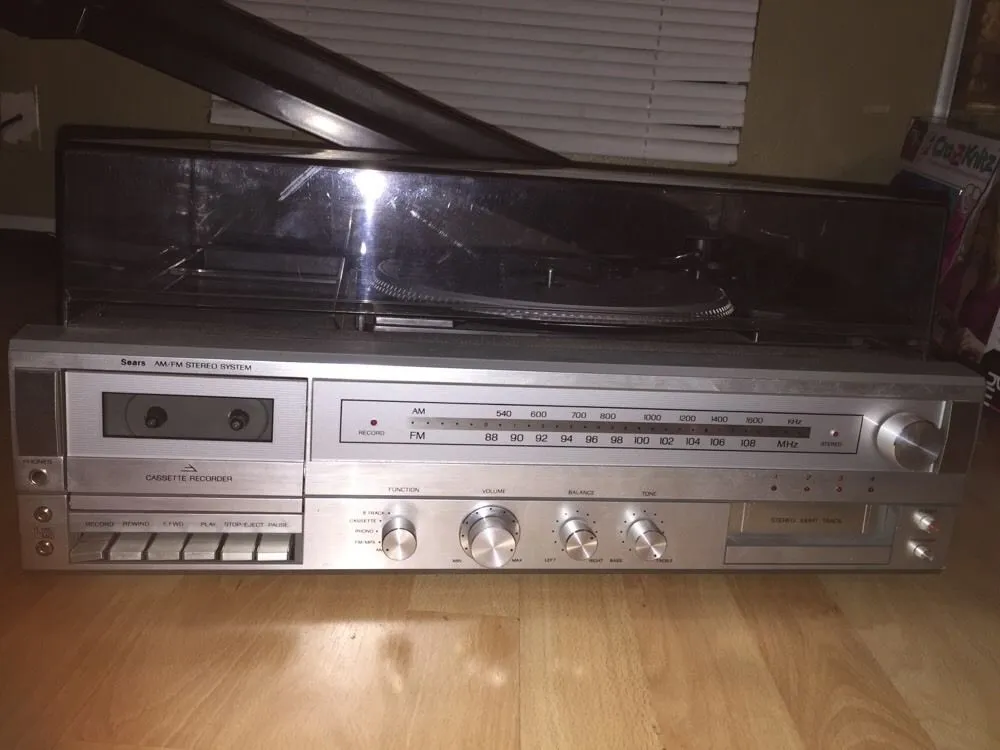
Here’s a good example of this: the stereo I had as a kid.

Sears stereo

When I was little, I had one of those crap record players with the removable lid and the plastic handle on the side, the kind with the speaker built into it.  My parents had a “real” stereo record player with separate speakers, but I had to listen to my read-along books and Disney records on this orange cardboard piece of shit.  When I was in maybe the 6th grade, I asked for a “real” stereo for Christmas, and I got item #2 from the picture above, taken from a Sears catalog.  And at the time, this was about as technologically advanced as the computers from Minority Report.  It had a record player AND a tape player AND a radio AND an 8-track.  Not only could I record songs off of the radio, but I could make tapes of albums.  And the speakers were separate, the kind of thing you plugged in and sat on shelves in the corners of the room.

The 8-track was a bit of an oddity; this was like the last death rattle of the failed format.  This stereo had a front-loader, and it had the program button, which jogged the tape heads sequentially across each of the four tracks of an album.  But it didn’t even have a fast-forward or rewind button.  Our family had no 8-track tapes, so we went to the Sears at Pierre Moran mall, and found them liquidating the remainder of their 8-tracks at some ridiculous price, like maybe four for a dollar.  These were all “cut-outs”, items with a groove cut in one side because they were returned or whatever, and they were pretty picked over.  I think I ended up getting a Steve Martin comedy album, a Ringo Starr solo album (I had no idea who the Beatles were, except in the most conceptual of terms), and a Jefferson Airplane album.  Much later, my mom’s second husband had a collection of a few 8-tracks, with the only notable ones being the first Cheech and Chong album, and Jethro Tull’s Thick as a Brick.  (Albums with only two side-long tracks didn’t work as well for a format where an LP was essentially divided into four; I’m not sure how they handled that.)

I had almost no budget for music, so I spent a lot of time trying to record songs off the radio, which was a maddening process.  I’d listen to U-93, the local top-40 radio station, and hope some song I liked would get played.  There were a whole slew of problems that would occur: the tape would not be queued to the very end and I’d erase some previously recorded treasure; the idiot DJ would babble on about being the 93rd caller for a set of free tickets to a monster truck rally; I wouldn’t recognize the song until 30 seconds in, and then only record half of it; the song would fade into some other stupid song I wouldn’t want, and I’d have a pristine copy of this Journey song I really wanted, except the last ten seconds would be fused to the beginning of a Toni Basil song.  (Yes, that song, which I won’t even mention by name or it will be stuck in your head forever.)  It would take me maybe a month or two of diligent listening to fill one side of a C-90 with useful tunes.

The big shortfall to this new hardware was that it only had one tape deck.  Most of the new stereos coming out had two decks: a play-only unit, and a player-recorder.  And my unit was a “closed” system, without an AUX input or any sort of input jacks.  Most of my friends would buy their albums on cassette tape, and I had no way of making copies of them.  My best hopes were either to have a friend that had a dual-tape deck who would be willing to make a dub for me, or find someone who bought everything on vinyl and would let me borrow their album.  Another problem was that I had no way of recording from the TV.  I watched an insane amount of MTV back then, and I would have given anything to capture some of their new music on cassette for repeat listens, especially since they played much cooler stuff than the behind-the-times station in my redneck Indiana town.  I remember trying to record a Genesis concert off of MTV by holding my sister’s little jambox up to the TV cabinet, which worked about as well as taking a picture of the night stars by dragging a photocopier outside and making a copy with the lid open.  (My sister later tried recording some song on MTV - that “don’t put another dime in the jukebox” song, and every time it would come on, I would yell at the dog and she’d start barking, totally screwing up the recording.)

It’s always interesting to me how we have such a tactile nostalgia for old technology like this.  Like I’ve got an old cell phone sitting on my shelf, a Windows Mobile phone I used for maybe six months before I wised up and got an iPhone.  And I hated that phone at the time, but it was my daily driver, and I used it constantly, for email, google maps, web browsing (or what approximated web browsing in a crippled version of pocket IE).  And I pick it up now, and its heft, and the feel of its keys, and the glint of its display remind me so much of that period in late 2008 and early 2009 when this thing was permanently attached to my hip.  And I get some of that when I look at pictures of old technology like this.  I remember the smell that stereo had, the new electronics smell of components heating up for the first time.  I remember the snap of the silver knobs going across their detents as I cycled through the inputs.  I remember playing with that tuning knob endlessly, trying to get a clear signal on WAOR so I could record Dr. Demento on Sunday nights.  I haven’t seen this stereo in at least 25 years, but I think if I found one at a garage sale, it would instantly transport me back to 1983 again.

Anyway, that’s my story.  Now I must go waste the rest of my writing time finding this stereo elsewhere on the web.  I’ve just found there are a ton of eBay sellers with demo videos of their wares on youtube, with many similar stereos.  Not sure which is worse, the waste of money and space hoarding this stuff, or the waste of time finding it.

Escape from Alcatraz

IMG_4775

Last night, we took the night tour at Alcatraz.  The night tour is the best time to go; it leaves the dock at about 6

, and they have more tour guides there, plus you get to see everything at night, or when the sun’s setting, which lends to some amazing views.  Unfortunately, we went during some horrible weather.  It was like 47 degrees, pouring rain, and extremely windy, and it got even worse when we were on this little clump of rock in the middle of the bay.  It’s hard to get tickets to the night tour, and we ordered ours months ago, so we bundled up and decided to power through it and go anyway.

Most of the tour itself is indoors, but we couldn’t spend any time wandering around the island itself.  Also, you get there at a dock at the low point of the island, but the cell block itself is at the top of the island, which means you have to climb up a steep switchback trail that’s the equivalent of hiking 13 flights of stairs.  And maybe that would be a decent workout, but not when you’re soaking wet and cold and being blown sideways by gale-force winds.  Even when we were inside, winds and rain whipped through the giant barred windows.  It’s not a climate-controlled resort, and you appreciate how miserable it must have been to do time there when the weather’s this bad.  And you know six months out of the year, it’s going to be this downcast at night.

The cellblock itself is a lot smaller than I imagined.  It’s really only four rows of cells, with one, the solitary wing, having cells on only one side.  I think the maximum number of people they ever had there was about 300, which was the size of our tour group.  There’s a library, a cafeteria, a control room and warden’s office, and not much more.  I guess there were some other buildings, like a place where they did work duty, but the other stuff was either closed off or is long gone.  A couple of the buildings burned down during the Indian occupation, and a couple were torn down when they were on the verge of collapse.

There’s also an apartment building, where workers lived, some with their families.  I never realized that kids actually lived on the island, and took a boat to school every day.  That seems unusual - now, nobody lives within miles of those supermax prisons, like it would be an amber alert field day, or a steady supply for hostage situations.  But I guess the families liked the small-town feel and the fact that they looked out at this incredible view of the city.

I wish I could have seen more of the history of the place.  It’s like New York City in the sense that it’s many-layered, hundreds of years of stuff built on top of other stuff, going all the way back to when it was a civil war fort.  There are areas that used to be moats and sally gates, and buildings built on top of the foundations of other buildings.  I guess when you have to haul in all raw materials, you tend to reuse things.  They tell the story of this at the various exhibits, but I wished it was a clear day so I could get some more pictures of this construction.

We also stayed for a presentation about the myths of Alcatraz, where they talked about how most of the stuff you see in movies is total bullshit.  Like, the whole system of tunnels under the island in The Rock does not exist.  And the myths about the man-eating sharks and impossible swim to the mainland are also just myths.  There are no sharks in the bay (other than little bottom-feeders), and a good swimmer could make it to the shore.  But if you spent your days rotting in a tiny cell with no exercise and no access to a YMCA pool and a daily diet of bulk-up powder, you probably couldn’t.

The trip was very cool, but it was photography hell, because of the low light and moisture.  The trip back was also not optimal - the ship was pitching and bobbing every which way, and water was splashing up over the boat as we crossed back.  I wasn’t sick, but a few people were, which wasn’t pleasant.  Anyway, I’ve posted the pictures to flickr here: http://www.flickr.com/photos/jkonrath/sets/72157626183337637/