The Wrath of Kon

Dispatches, thoughts, and miscellanea from writer Jon Konrath

2012

Age of Aquarius

mattel_aquarius_nightstalker_ss

I’ve talked a few times about my old Commodore 64, but this wasn’t my first computer. I actually owned a much weaker computer for about a year before the C-64: the Mattel Aquarius.  I thought I’d told the story before, but looking through the archives here, I didn’t find much.  So here’s the deal.

The personal computer pretty much started happening when I was in grade school.  I guess before that, you could solder together your own Altair, but in about the 5th grade, these platinum-cased Apple II computers showed up, and I learned how to do the 10 PRINT "HELLO" thing on one of those green-screen monitors.  If your parents had money, you could get one of these things in your home, but with an original 1977 list price of $1298 for the 4K model (plus monitor, plus disk drive, plus software), there was no way in hell I’d ever own a computer.  But as the 70s became the 80s, an explosion of cheaper machines hit the market.  Atari came out with their 800, which listed for about half the price of an Apple, and then the C-64 machine started selling at $595.  There were also some cheap-o machines with more anemic specifications, like the VIC-20, which dropped to near $100, and the Timex-Sinclair, which was even cheaper.

At the beginning of 1984, my parents split up, right around the time of my 13th birthday.  I didn’t know the political angle of being a child of divorce, and I didn’t consciously want to pit one parent against the other, but getting a computer was stuck in the front of my head.  I needed one of these things.  There was no world wide web that I needed to browse, and I didn’t need to type papers or balance spreadsheets.  I just needed to be able to hack at a machine and write programs and develop games.  I’d taught myself BASIC, writing programs on paper and getting to try them out on friends’ machines or with the very narrow slivers of time afforded to me with the school’s few Apples.  I wanted to be able to waste all of my copious amounts of free time writing some kind of Dungeons and Dragons game on the computer.

And right around then, the Kay-Bee toy store at the mall by my house started selling these bundled computer systems from Mattel.  And they were only a hundred bucks, and included games and joysticks and the whole nine yards.  I didn’t know anyone with one of these machines, and this was long before I could plug this into wikipedia and look up the specs.  But I needed one, and $100 was an easier target to reach than the $200 or $300 price of a Commodore, so I begged and pleaded, and before I knew it, at the end of one of those “every other Sunday” visitations, I had this big huge box full of computer, ready to hook up to the TV set’s antenna screws.

The Mattel Aquarius has a strange history, one that I didn’t know for decades. Mattel made the Intellivision video game system, and promised in ads and brochures that they’d come out with a magical keyboard that would plug in and turn the thing into a real computer. This was a big deal back then, because if you were already dropping a few hundred dollars on a video game system, there was a certain enticement in being able to avoid spending another grand on a home computer. Problem was, they didn’t have this computer expander system ready. They turned to the manufacturer of their Intellivision, Radofin in Hong Kong, and they had a low-end computer system of their own, which they rebadged as the Aquarius.

The Aquarius was quite likely the worst home computer of the 80s. It was based on the Z80 processor, which was used in a lot of other systems, and it ran it at 3.5 mHz, which wasn’t horrible for the time. But it came with 4K of RAM. Once you booted the system, the screen memory, other buffers, and the BASIC interpreter took up most of that, leaving behind just over 1K. That’s a K and not an M; we’re talking about just over a thousand of characters of memory. This blog post is twice as big as the available memory on an Aquarius. There was a very rudimentary sound generator, and support for an 80x25 screen with no real graphics.

The BASIC was a version of Microsoft’s, and it was a fairly rudimentary implementation. If you programmed BASIC back in the day, you may remember that there were good BASICs and bad BASICs. Like the Commodore V2.0 BASIC didn’t have an ELSE statement for IF-THENs, which meant a lot of spaghetti IF-THENs that were an eyesore in a language with no indentation. And the CBM version didn’t have any sound or graphics functions, even though its chipset supported decent functionality; you’d have to PEEK and POKE to do anything cool, or spend some cash on Simon’s BASIC or some other extension of the language. The Aquarius BASIC, most likely because of the memory issue, was even more crippled than the Commodore version, with an extremely limited subset of commands.

Design-wise, the Aquarius was a fairly tiny machine. It came with a 48-key chicklet keyboard, these little rubber keys spaced far apart, and the machine wasn’t much bigger than the keyboard. The keyboard was essentially what they give you to type when you go to hell for eternity. A few other machines came with a membrane keyboard (the Atari 400, and the Timex) which was pretty bad, but these rubber keys were the worst. You could not touch type in any way, not only because of the keyboard’s spongy feel, and because it had a substandard layout. For example, it didn’t have a space bar; there was a a space key off to one side. The one saving grace was that there were keyboard shortcuts you could use when typing, so if you needed to type GOTO, you could use a function key and hit G or something like that. Cartridges usually came with these two-piece keyboard overlays, thin pieces of plastic embossed with all of the special functions for the program. There was almost no extensibility to the machine, either. It came with plugs for a printer and a cassette recorder, plus the RCA plug for the TV set. It had no other plugs; even the power supply didn’t have a plug, and the cord and power brick were permanently attached to the back. It did come with a single cartridge slot, which accommodated these weird wedge-shaped cartridges that matched the angle of the top half of the console.

The Aquarius was a huge flop, and was discontinued after a few months. Most of them sold were bundled with accessories for liquidation, which is where I got mine. My system came with four games, and a thing called the “Mini Expander”, an oversized cartridge that plugged into the machine and hung off the back end, providing two cartridge slots (so you could plug in a program cart and a memory expander), two joysticks, and the three-voice sound chip from the Intellivision. The joysticks were similar to the Intellivision, those weird disc controllers that were almost unusable, with a set of six chicklet buttons on the top of the controller, and no other fire buttons. (I think the Intellivision joysticks were actually better than the Aquarius ones.)

One of the huge issues with the Aquarius was that it was somehow perceived as a sibling to the Intellivision, but it was more like a second cousin by adoption, and even though some assumed it could play Intellivision games (which were generally better than Atari 2600 games), the gaming support was fairly horrible. In fact, the joke was that Mattel used to put programmers on the Aquarius team as a punishment. The games couldn’t use high-res graphics, and had to resort to using the machine’s extended character set to draw stuff on the screen. (The machine did have some cool characters in the extended character set though, like little explosions and running dudes and aliens.)

I got four games with my system, in order from best to worst:

- Dungeons and Dragons: Treasure of Tarmin: This game was actually awesome. You moved through a maze, Doom-style (but with much worse graphics), with the right third of the screen an inventory list of the couple of items you could pick up and carry, including swords, bows and arrows, potions, and keys. You crawled through the levels of this massive dungeon, and when you ran into a dragon or orc (all drawn with this random collection of ASCII art, like prehistoric emoticons), a round of combat would ensue, with fireballs being traded and hit points lost. There were supposed to be 99 levels of this dungeon, or if you killed the white dragon, you’d win. Despite the sub-par graphics and sound, this was an incredibly playable game.

- Snafu: You and another player had these ever-growing lines on the screen, sort of like the Tron light cycle game, and you could not collide with the other person’s line. This was pretty fun if you had another player, but it was otherwise very basic.

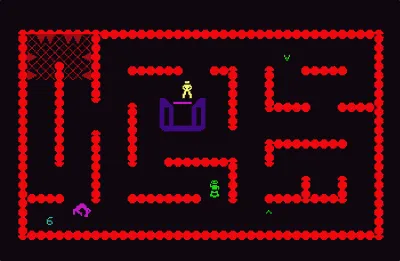
- Night Stalker: This was a Pac-man style maze, there were no dots to be eaten; you just wandered around while alien dudes tried to shoot you. This could have been a much cooler game if it had more levels or mazes, but we’re talking about 4K of RAM here.

- Tron Deadly Discs - This game was straight-up worthless. It wasn’t really a Tron game; it was just two emoticons throwing chunks of ASCII at each other. I would play it about once a month just to see if there was something I missed, but within five minutes, I’d realize how I was duped.

The worst part of the Aquarius was that Mattel Electronics went bust about 15 minutes after I got the system, so there was absolutely no support. The market exploded with add-ons for the Apple and Atari; the Commodore could use Atari joysticks, and you could buy tons of games, or buy any of the dozen or two magazines like Compute! and type in your own games. But there was no support for the Aquarius, and I could not buy any software or accessories. And this was long before you could hop on Amazon and search for stuff to buy. Aside from the lack of games, I did not have a disk or tape drive to save my own programs, and I couldn’t even print out my stuff to a printer. Every once in a while, I’d see the Aquarius mentioned in a computer magazine, but it was always a “what happened here?” takedown piece.

The biggest pain point to the whole thing is that Mattel had released a bunch of cartridges, including an extended BASIC and memory expansion, and planned even more stuff.  The box for the system showed all of these unavailable items, and then had some black stickers covering pictures of vaporware items, like a master expansion chassis that would sit under the unit and provide a disk drive.  There was also an Aqaurius II that was very briefly sold, that had a real keyboard and the extended BASIC built in.

My tenure on the Aquarius was brief; by the next Christmas, the Commodore 64 was on my list, and I graduated to its much roomier 38,911 bytes free and full-motion keyboard that wasn’t designed like a calculator you got for free at a Shell station when you bought a tank of gas.  But we did play the hell out of those four games, though.  And now my daily driver is a machine that has two million times as much RAM available.  But that Aquarius is an interesting little footnote in my computing history.

And some linkage for you:

The Death of Paper Notes

postcard-back

One of the changes in OSX Mountain Lion is that it has a dedicated Notes application.  It’s just a basic text editor, except it syncs with other Apple devices.  This isn’t entirely new; iOS devices have had a notes app for a while, and it would sync with an IMAP server and show the notes in the Mail application.  This meant I could create a set of notes that lived in my gmail account, and then edit them on my phone, my computer, or my iPad.  That was pretty much the end of trying to remember to carry around a little notepad or Moleskin or whatever, and now I just jot down any stray thoughts or ideas there, and they get synced in all three places.  And I guess in some extreme emergency where I didn’t have any Apple devices with me, I could always point a web browser at gmail and get at the notes there.

This new workflow saves me a ton of time, and avoids the issue that my handwriting is all but unreadable, even to me.  But one problem with it is that I don’t have a hardcopy of any of my notes about a book.  I was digging around for something else in my storage recently, and found a vinyl three-ring binder containing all (or most all) of the notes from Summer Rain and Rumored to Exist.  One of the first things I realized about this binder is that it’s actually from when I was a computer consultant for the school.  UCS had these beginning-of-year training sessions where they gave you a binder full of stuff you’d never read, and this happens to be one of those binders.  It was probably given to me in 1991 when I started working there, and after I chucked all of the lists of phone numbers and rules, I used it as a school folder.  It’s still got a couple of papers I wrote in it, including the two papers I wrote in the summer of 1992 that I mention in Summer Rain.  I can’t even try to read them though; I’m sure they’re horrible.  I distinctly remember losing the 3.5” floppy disk I used that summer for my WordPerfect files - I left it in a Mac in one of the labs.  Part of me wishes I still had those files for some sick reason, but I guess if I have the hardcopies, that’s just as bad.

A big chunk of the material in this binder is research material and notes on Summer Rain.  That book is fiction, but it’s based on fact, and I burned a lot of cycles trying to keep track of dates and times.  I’ve got an insane amount of post-it notes and scraps of paper reminding me of stuff like that Ray visited Bloomington on July 11, 1992 and I broke my arm on September 30th and I ate lunch at Burger King on August 7th.  There’s a bunch of report cards, a complete recapitulation of every bursar charge I had during my time at IU, and a small stack of snapshots of the campus in the early 90s.  And there are pages and pages of outlines.  I tend not to outline before I write; I usually write until I get stuck, and then I used to go back and write outlines of what existed, so I could navigate through all of the files without getting lost.  I have dozens of pages of these outlines, inventory sheets of what happens in what file.  There are punchlists from 1998 of what parts are missing from what chapter, and long essays to myself on 1996 on what direction characters are heading.  The 1998 notes even contain a combination of all of these, a list of chapters and what date they would have happened in real life.

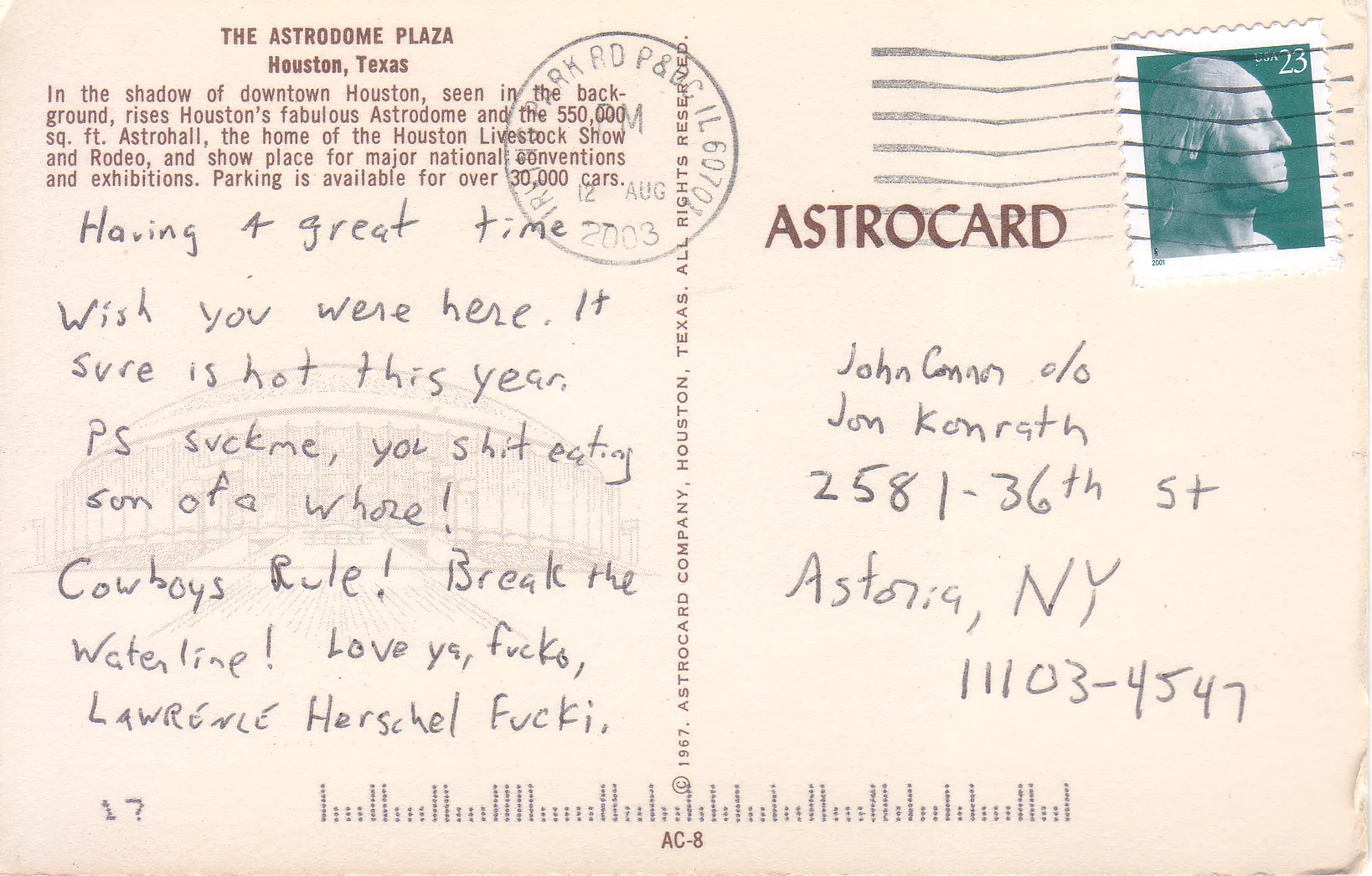
The notes from Rumored to Exist are also pretty interesting.  When I worked in Seattle, I would sit with a PC in front of me, a Mac Centris 660AV on my right, and a legal pad on my left.  I would write this online help on the PC, and then compile it on the Mac.  The Apple machine also served as my CD player.  But while I worked, I would write down any random nonsensical thought on the legal pad.  And by the end of the day, I’d have a page or two of these scribblings, random quotes and names of designer drugs and medieval weaponry and genetic disorders and long-forgotten TV shows, and all of these became raw material for what eventually became that book.  And I’ve still got a bunch of these, along with a post card from Larry from the Astrodome, which is something that appeared in the book, but that he later really sent me.  There’s a shot of all of this on the back of the now-out-of-print annotated version of the book, but I’ve also got all of it here.

There’s also a printout of a 1998 draft of Rumored here, one that I must have given Marie, that she marked up and sent back to me.  It’s so different than the finished book that it amazes me.  I still have a lot of these drafts in electronic form, because I’ll usually zip up a copy at a big logical stopping point, but it’s amazing to me to see it captured forever on paper.  When I moved to New York, I was almost to the point of quitting this book, and decided to start a new draft, a completely blank document.  I sifted through the old version, and only carried over the things I absolutely loved.  Everything else stayed behind, and I think I probably rescued maybe 80 pages.  But those old bits — I started writing this thing in 1995, so there were pieces that stayed in the draft for three years before being clipped.  It’s fun to see those bits again.

Now, I do all of this stuff online, and it’s much more efficient.  I can tear around in Scrivener and keep a digital outline and easily checkpoint documents to save old drafts.  I have no idea why I kept any of this old paper stuff — I think there was some assumption that I’d sell millions of copies of the book and some university library would want to purchase all of my letters and notes.  I mean, not really, but that’s a hoarder’s rationale.  Now, I wonder if any of the bits I threw out are worth publishing, but I’ve already done so many editions of Rumored, I’m in no hurry to rush out another one.

Mandelbrot and Genre Writing

A5200_Rescue_On_Fractalus

I’ve been in the post-book-release period of my writing cycle where I don’t know what I’m doing next, and I don’t know what I should be reading, so I start poring over non-fiction, usually some junk science book.  Specifically, it’s that James Gleick book Chaos, which is about chaos theory and the butterfly effect.  I mostly read stuff like this to pour random facts into my head with hopes that I’ll go off on a tangent in some wikipedia-reading frenzy and end up finding the pieces of my next short story.

Part of the book talks about Benoit Mandelbrot, who once said this:

Science would be ruined if (like sports) it were to put competition above everything else, and if it were to clarify the rules of competition by withdrawing entirely into narrowly defined specialties. The rare scholars who are nomads-by-choice are essential to the intellectual welfare of the settled disciplines.

That got me thinking about genres, and writing.  I’ve been knocking against this invisible wall with regard to genres, because I don’t really fit into any one category.  And every self-publishing make-money-fast scheme online talks about how you need to market yourself by finding your niche and building your platform to sell to that slice of the reading public.  Every person out their schlepping their own advice on publishing will tell you about the importance of hitting up the forums relevant to your category.

When I’m depressed about not having stellar book numbers, this feeds into a horrible cycle of negativity.  I don’t sell books because I don’t market.  I don’t market because I can’t find the people to market to.  I can’t find the people to market to, because I don’t know how to categorize my work.  And I don’t know how to categorize my work because I don’t really like any of the categories.

That’s a big part of the problem.  I don’t read a lot of straight genre fiction, because it bores me.  While I like picking at the edges of the science fiction genre, I find the die-hard stuff to be so goddamn serious.  I can’t stand fantasy.  And romance and thriller aren’t even on my radar.  The books I like are combinations of different things, or aren’t representations of the category as a whole.  Vonnegut wasn’t a science fiction writer per se; he sometimes fell into that category, but his stories had a humor you aren’t going to find in the typical outer space robot book.  Burroughs had the same distinction.  Was Hunter S. Thompson a journalist or a humorist or an essayist or what?  And Mark Leyner wasn’t literary fiction, but he wasn’t general fiction, either.

The big issue is that when you define success as straight-up numbers, nothing but copies sold and dollars taken in, you’re competing more than you’re creating.  You’re not going to push boundaries or do what you truly want; you’re going to stick to that same narrowly-defined plot structure that everyone uses to maximize the number of readers you can satisfy.  You’re going to think of how to market a book and then write it, instead of creating what you truly need to create as an artist.  It’s like the difference between a painter like Jackson Pollock laying his soul and his inner demons onto the canvas, versus someone being handed an RFP by a hotel chain for a thousand identical paintings that meet certain requirements.  When you write for the market, you may sell, but you probably won’t innovate.

I don’t want to dole out yet another hero’s journey monomyth novel because I can plug it by saying “it’s like but with ”.  I feel like I need to continue down the path I’ve followed with the last few books, but I also feel like it’s okay if I suddenly want to write some non-fiction, or a book of essays, or whatever else.  I’d hate to wake up someday and be told I can only write dystopian literary occult police procedural fantasy fiction, or that I couldn’t do what I want because it won’t sell.  Life’s too short to back yourself in a corner like that.

The Feel of a Book

I really do wish I could switch to an all-digital book library, buy every print book in this house in some e-book format, and haul all of this shit to the goodwill, or sell it in the Amazon used section.  Someday, books will kill me, and I’m not talking about being buried alive via hoarding.  I mean, these books are all collecting dust mites, and I’m horribly allergic to dust mites, and I’m sure ten out of ten allergists would tell me, “well, just get rid of all of your books and watch more TV.”  And of course, 87% of the books I have here aren’t available on the Kindle, and even if they were, the second I’d buy all of them, they’d change the Kindle format to some incompatible thing and force me to re-buy everything, just like the whole vinyl > 8-Track > Cassette > CD > MiniDisc > DVD > BluRay > whatever trail of tears.

I tried remembering when my whole relationship with books started, and of course, I can’t.  My parents started buying me books before I can remember, those “I Can Read” books like Danny and the Dinosaur that you got from the grocery store or some mail-order club.  I remember being in the Weekly Reader book club, getting these corrugated cardboard mailers every week or two, containing another few hardcover books, each one getting progressively more advanced.  I thankfully learned to read before I started school.  I lived in a tiny village in Michigan with no kids as neighbors, in an age before cable, when an endless amount of adjustment to a set of rabbit ears got you four or maybe five channels of TV, so those books were my lifeline.

In thinking about this, I think one of the reasons I like to collect books is their physicality.  I’ve still got a couple of these Weekly Reader books, from almost forty years ago, and I loved the oil paintings in color on the cloth-bound hardcovers, a square spine and a design that is obviously very pre-Photoshop. Some books had spine lettering faintly embossed in a metallic gold color, and looked distinguished and official.  Some were paperbacks, the Choose Your Own Adventures and Encyclopedia Browns and pocket editions that felt the perfect size in your hand.  I devoured all of these books, and no matter how many of them showed up in our rural route mailbox, I always wanted more.

I always got locked into these series books, things like junior encyclopedia, where they’d sell the first volume at Kroger and then swindle you into mailing away for the next twenty.  I remember this junior history series I had, an endless collection of books on American events like the construction of the White House or the battle of Iwo Jima.  My parents would sometimes go to a friend’s house to play euchre, plop us in front of a TV in their living room, and hope we’d fall asleep eventually.  I would always drag along a huge collection of these books, so that instead of watching a Love Boat re-run, I could read the illustrated history of the Washington Monument or the D-Day invasion.  And I would always have to bring an entire armload of them, partly because I felt a need to always have access to every volume (this predates Wikipedia by a few decades) but also because I enjoyed the physical feeling of having all of these books, the weight and feel of these perfectly square books filled with illustrations and maps and pages that smelled like fresh paper and ink.

I always wonder about this with kids that are being born right now and handed an iPad thirty seconds after they leave the womb.  There’s something magical about being able to zap an animated book filled with background music and hyperlinks to your kid, but are they missing something by not having an actual, physical book in their hands?  A device that plays Angry Birds and shows videos is pretty cool, but do you miss out on something that you get by hoarding these little bits of dead tree?

I do like loading up my Kindle with books before I get on a plane.  And most of the books I sell are on the Kindle.  But it doesn’t feel like I’ve “bought” a book unless I have it sitting on a shelf, and I like the physical rituals of either going to stores or having a delivery person hand me a cardboard mailer filled with books.  I also don’t like that I always hold the same device when I’m reading different books, the same size and weight and thickness, and I’m even deduced to the same exact font and margins. I’m not pro- or anti- on the e-book, but it makes me hesitate before I buy anything, and I end up purchasing the best stuff twice.  I can’t seem to fully jump on either bandwagon, which means I probably will either be buying a spacesuit to keep out the dust mites, or googling away to find clinical trials of some new steroid treatment to keep my eyes from swelling shut.

The Loudness War

The loudness war is a weird k-hole I recently fell into, trying to find out more information about a Stooges remaster.  Let me explain.

Okay, have you ever owned some album, and listened to a song a million times, and then heard the same song on an FM radio and it somehow sounded different?  It was probably because the station used dynamic range compression in their outbound rig.  Here’s my best attempt at a no-math explanation of compression.  Let’s say a sound wave is a bunch of waves, ranging in strength from 0 to 11.  (I was going to say 10, but, Spinal Tap.)  So a song, in some greatly simplified form, would be something like this:  “0 8 11 8 10 2 3 7 7 8 11 0 10 7 2 4”.  If you wanted to make the song sound way louder, the obvious way to do it would be to change that to “0 16 22 16 20…” and so on, but 11 is the most you can get.  But what you can do is boost the lower numbers, and keep the higher numbers the same, and the song will “seem” louder.  So, you’d run it through some magic digital box and it would change to something like “0 8.5 11 8.5 10 7 7.2 8 8 8.5 11 0 10 8.5 7” or whatever.  It basically smooshes the lower end frequencies, and makes the song seem louder at the same volume, although this sacrifices some of the sound quality, which isn’t as big of a concern when you’re just schlepping pop music across the airwaves and you want your station to get the most attention when someone is flipping through channels.

The loudness war started back in the days of jukeboxes, because you the consumer can’t change the volume on a jukebox, and everyone wanted their 45 record to sound the loudest.  On a digital CD, that magic number 11 I mentioned above is called “full scale”, or the point where signal has reached as much as it can go.  A measurement called dBFS, or decibels relative to full scale, is used to measure levels, where -6 dBFS is 50% of full scale.  Most albums were mastered with -14dBFS being used as the highest peak level of the album, or what used to be the “red zone” of an analog record.

At some point in the 90s, the thinking changed on this, probably around the time record companies started re-releasing old albums, so if you bought that Iron Maiden album on CD in 1988, you suddenly had to buy the remastered version in 1996.  Yes, they would fiddle with bonus tracks and new artwork a fake gold CD and yes Ray, they included that fourth side of the Live After Death album you bitched about for twenty years, but they also fiddled with the mastering so the “hotter” album would make the old master sound wimpy.  And new albums started getting massively over-compressed in this loudness arms race.

I started googling all of this because of the 1996 Columbia remaster of the Stooges album Raw Power.  When recorded in 1972, Iggy Pop did the initial mastering himself, and through the magic of heroin, decided to put all of the instruments on one side and the vocals on the other, and do all kinds of weird shit with the tone.  The record company refused to release it unless it was remixed, and got David Bowie to spend a single day in a crappy studio, getting the album to sound mostly normal.  For the 1996 re-release, they gave Iggy free reign to go back and remaster the album, and his response, in an attempt to bring back the raw aggression of the original recording, was to completely turn every knob to 11.

I don’t know if this is still the case, but when I bought the 1996 remaster on CD (back when people bought CDs), it had a huge warning label on it, saying the CD did not meet the Phillips Red Book standard and could destroy your equipment.  I thought that was cool, threw it in the player, and set my volume at something marginal, like 5 out of 10.  “Search and Destroy” came on, and it sounded like someone had replaced my speakers with those paper-cone things you got with the stock Delco stereo on the AM radio of a 1981 Chevette, except with pencils jabbed through them.  Within ten seconds, my receiver SHUT OFF with a strange error message on the display, and I had to unplug it from the power, wait the longest 60 seconds of my life before restarting it, almost certain I’d bricked my stereo.  I was only able to listen to the CD by ripping a copy to MP3 first, which I guess just clipped the hell out of it in the computer’s digital-to-analog conversion.  Still a great album, though.

Another Stooges fun fact:  if you really like the album Fun House, you can go over to iTunes and pick up a complete collection of everything they recorded for the album.  It’s a 142-track “album” that contains every take of every song, plus all of the studio dialogue recorded - basically everything that ran through the sound board back in 1970.  At $99.99, it’s definitely in the “do not accidentally click purchase” category for iTunes.  I haven’t bought it - I think if it was $30, I would be tempted, but I know I would only listen to it once or twice.