The Wrath of Kon

Dispatches, thoughts, and miscellanea from writer Jon Konrath

Tag: favorites

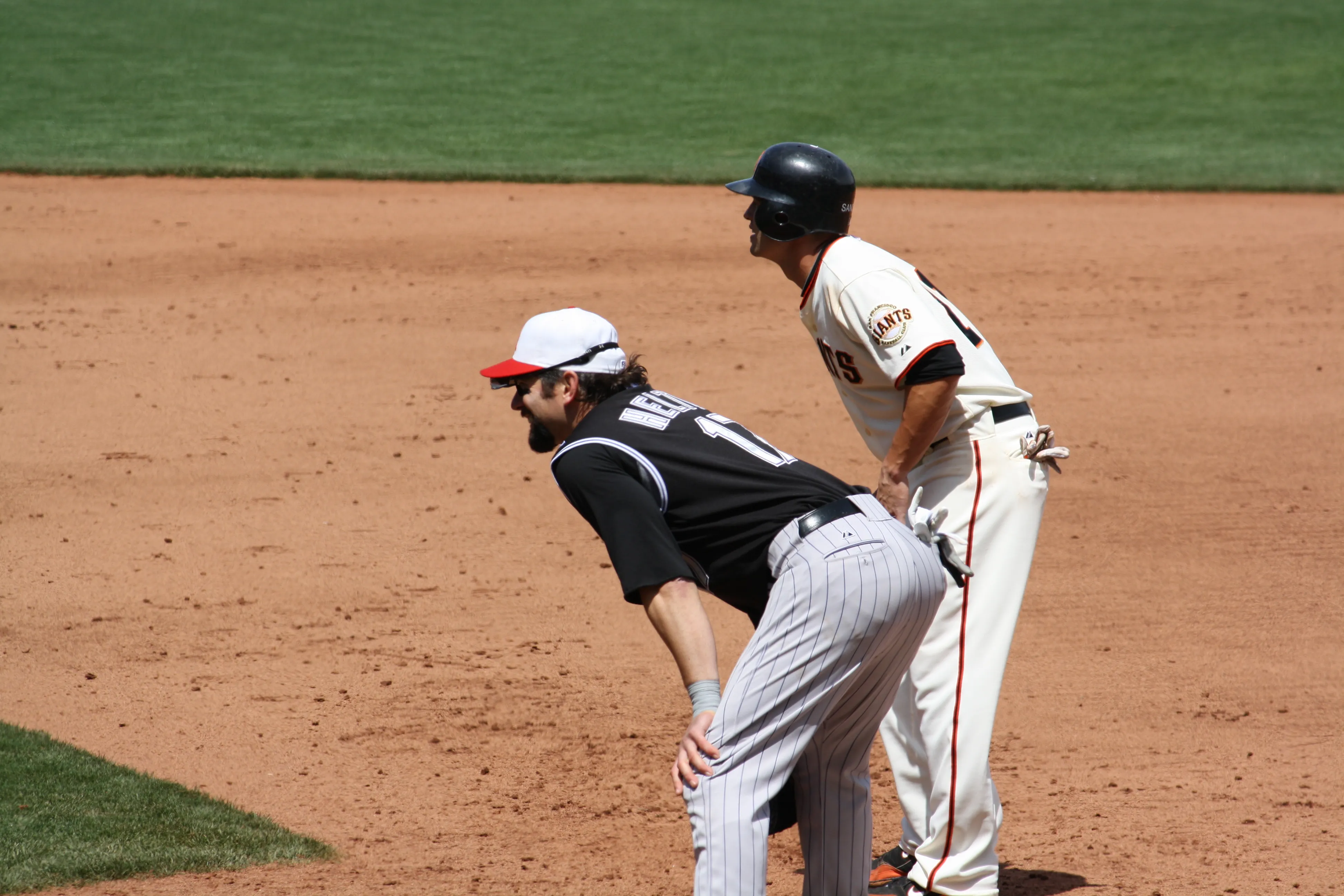
List: 30 Ways to Reach First Base
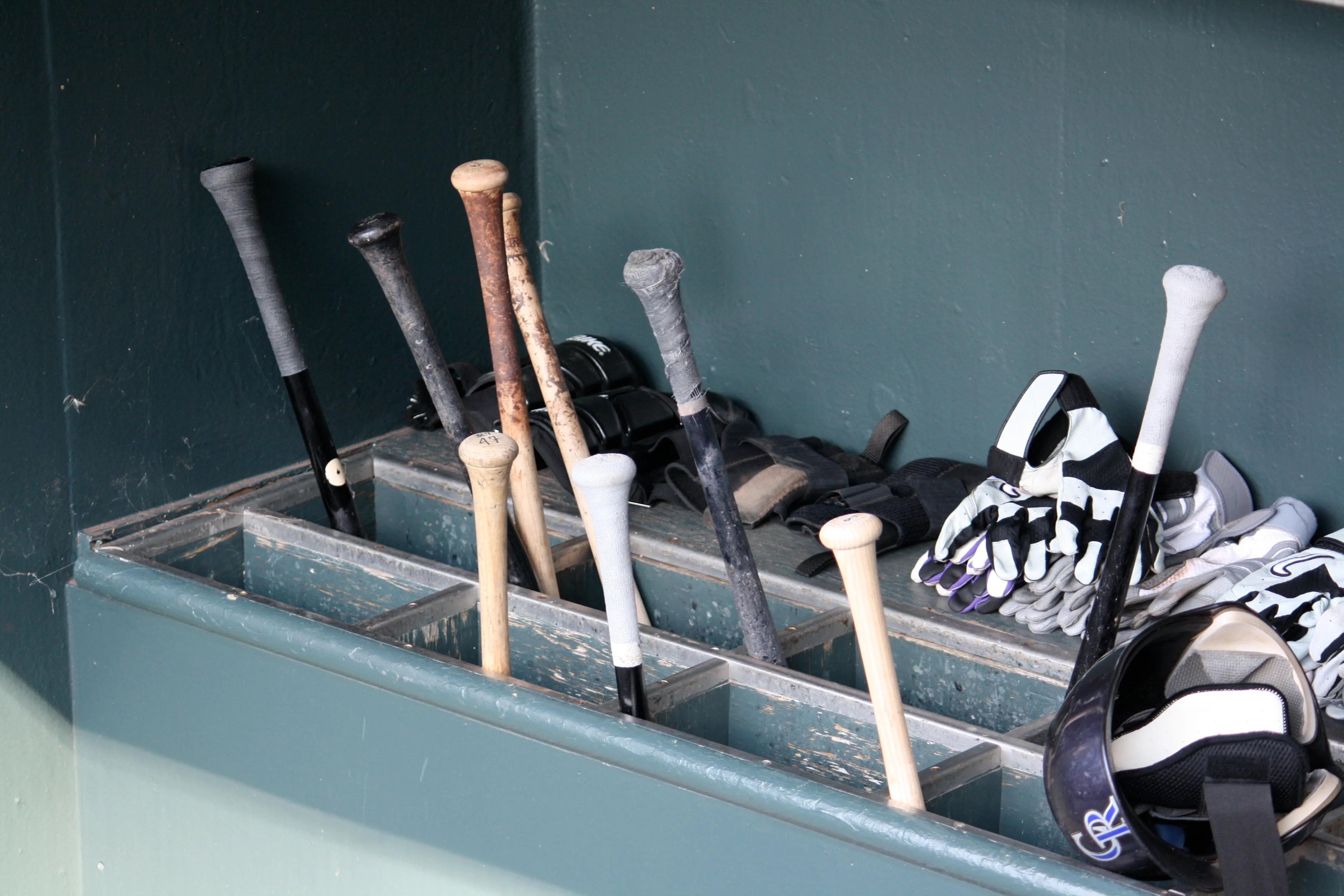
IMG_1899

  1. Hit a single.
  2. Reach on an error.
  3. Walk on four balls.
  4. Get hit by a pitch.
  5. Catcher drops the ball after the third strike.
  6. Fan interference.
  7. Catcher interference.
  8. A pitching infraction that results in a 4th ball.
  9. A pitched ball lodges in the catcher or umpire’s mask on the third strike or fourth ball.
  10. Replacing another player that just reached first base.
  11. Purchase failing MLB franchise, build new stadium, create a ground rule stating that a player with your exact name is awarded first base at each at bat regardless of the strike/ball count, add yourself to the 25-man roster.
  12. Star in a stupid movie based on a British book written about a different sport, run on field to chase romantic interest Jimmy Fallon.
  13. Take a 25% dose of the steroids normally used to hit home runs.
  14. Take 4 train from East Side or B/D train from West Side, stop at 161st St, enter at gate 6.
  15. Hire Uri Geller, learn secrets of hypnosis, hypnotize all defensive players and umpires.
  16. Jet pack.
  17. Time at-bat with zombie apocalypse, wait until all players are infected, have co-conspiritor drop large pile of human brains on the warning track by center field.
  18. Build time machine, send cyborg back in time to kill pitcher’s parents; repeat until you get a really bad pitcher you can easily hit.
  19. If you play first base, you will always reach first base nine times, provided you don’t leave the game early.  (Why isn’t this ever on any of these lists?)
  20. Have fans throw batteries at the head of the pitcher.  (Works best if you play for the Phillies and are at a home game.)
  21. Scout a pitcher born with phenylketonuria; feed him large amounts of aspartame prior to his start.
  22. After strikeout by a pitcher born outside of the United States, petition the United Nations Commission on International Trade Law for arbitration, arguing the pitcher’s work status is in dispute due to paragraph 9 of General Assembly resolution 2205 (XXI) of 17 December 1966.
  23. Up-down-up-down-left-right-left-right-A-B-Start.
  24. Either build a second moon, or move an asteroid into Earth orbit, with enough mass to change tidal patterns and conversely change barometric pressure to alter the pitcher’s ability to locate the ball correctly.
  25. Do not give the pitcher LSD (especially if it is Doc Ellis.)
  26. Start a facebook petition to put you on first base.
  27. Travel to bizarro alternate reality where you get to advance to first base after you swing at nothing three times.
  28. Send a photo of a gun to the pitcher’s cell phone. (This probably works best if you are Elijah Dukes.)
  29. Be the daughter of Bud Selig when he is on first base and suddenly needs it to look like he doesn’t own first base because he took a new job.
  30. Practice.

On writing tools

In my last post, I talked about my old standby writing tool, emacs, and how I’ve made a gradual break from it.  So here’s what I’ve been doing.

First, there was a recent stream of different full-screen writing tools dumped on the market.  It’s the latest fad: some program that closes off everything but a single window to write.  To me, that seemed largely stupid; you just expand your editor window full-screen and shut off your IM program, right?  Well, there’s more to it than that.

First, I have horrible ADD or ADHD or something.  Not diagnosed, no pills or doctors, but I - what was I talking about?  Seriously, I have a hell of a time focusing on writing these days, especially with all of the distractions out there in the internet world.  And writing involves a certain amount of self-hypnosis, that ability to suspend disbelief and not even think about writing, but still type it on the page and channel your subconscious and capture it into your work.  And it’s damn hard to do that when you can click on the other window to check your twitter feed and derail the whole thing.

For a while, I would either turn off my wifi, or I would use this program called Freedom, which completely locks your internet connection unless you reboot.  (And those of us who don’t use Windows aren’t in the habit of rebooting hourly, so this is a Big Deal.)  I know, I should just be able to shut off wifi, or just not click on that god damned browser window.  But I can’t.  It’s nice to be able to completely childproof the process.

I also experimented with trying to fake a full-screen writing program with emacs, adding some margins and pumping up the font size, so I could go full-screen and only have a nice blank page to stare at.  But one day, in a fit of writer’s block fury, I went to the app store and picked up a copy of OmmWriter.

Screen-shot-2011-04-17-at-10.49.49-AM

OmmWriter is pretty damn amazing. Basically, you start it, and it opens a text editor over your entire screen, plain and simple.  But the little details are what make it so slick.  First, it shuts off all notifications.  If you’re using Growl to sling popups when you get new mails and whatnot, those all get halted.  Next, it draws this background picture of a winter landscape that looks like some lost Tori Amos album back cover.  And as you start typing, the borders and minimalist menu buttons fade away.  The fonts are very readable and high-design typography too; no more Courier New or whatever the hell emacs uses by default.  There’s also a word count tally at the bottom of the resizable text area that will vanish as you get to work.  And there’s a choice of several mellow, new-agey ambient soundtracks that play in the background.  And all of this sounds hokey, like I’m about to talk to you about an opportunity to resell some healing crystals to your family and friends, but it seriously works.  I don’t know why, but it made it much easier to fade into the work.  It was awesome for journal entries and articles and brief bursts of automatic writing.  But it was not a full-fledged content management system; there’s no way I could write a book in this thing.

Side note: this thing uses OSX’s text editing widget or engine or whatever you call it.  And something I did not realize: most of emacs’s key shortcuts work in any program that uses this.  So if you reflexively use Ctrl-A and Ctrl-E to jump to the start and end of a line, that totally works, either in the Mac’s TextEdit, or a program like Ommwriter.

So I’ll cut to the chase: after a few other trials, I finally got into using Scrivener.  And it has completely changed the way I write, because it finally does what I need to keep organized.

One of the biggest things is I need a system that can deal with me writing in “chunks”.  There are other virtual index card systems, but they typically don’t let you meld the cards into one huge work.  And outline programs are great (I’m a long-time user of OmniOutliner) but I always hated trying to reconcile changes in the actual writing with changes in the outline and vice-versa.  I wanted a way to have the outline be the document.

Screen-shot-2011-04-17-at-11.14.24-AM

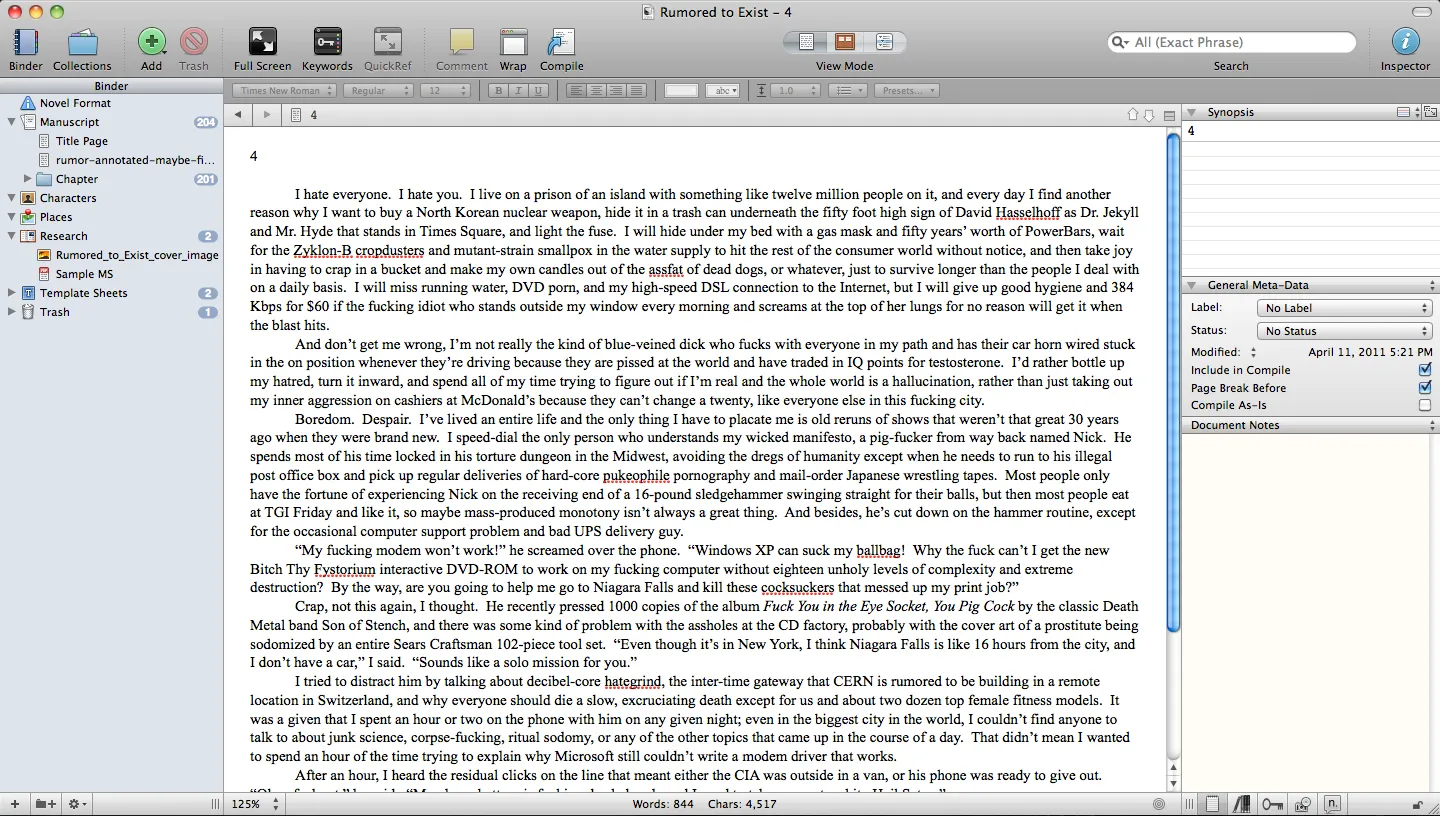
Scrivener is a lot like modern IDEs you’d use to write code: there’s a binder that’s a project-level collection of folders, with one folder being the actual manuscript, and the other folders being whatever the hell you want.  In a folder, you can create other folders, or you can create documents.  So let’s say my manuscript has a dozen chapters, I can make each of those a folder.  Then in each folder, I can have a bunch of text documents, one for each scene or paragraph or whatever the hell I want.  I can drag those around in any order, chop them into smaller pieces, merge them, add more, delete them, whatever.  Then when I click on my chapter folder in the left navigation pane, I’m presented with every piece in that folder, all glued together into one document.  Click at the root level, in the manuscript folder, and you’ve got your entire book.  It makes it very easy to write in fragments, and move things around easily.  This is pure magic for me.  I really wish I had a program like this when I wrote Rumored to Exist - it would have saved me at least a year of time.

Here’s the real beauty.  You like to work with index cards?  Each of these fragments has an associated title and page of metadata that you can see in the right pane inspector.  You can type in a little blurb of what happens in your fragment, or what needs to happen, or what you want to fix.  Then you click a button in the toolbar, and instead of seeing the text editor, you see a corkboard with a bunch of index cards, each one being that metadata for each text document.  If you don’t like the order, drag them around and make it work.  When you go back to the text editor, all of your pieces will be reordered.  You want an outline?  Click another button in the toolbar, and you see all of your documents and folders and stuff in an expanding/collapsing outline.

I take a lot of notes when I’m writing, and have all sorts of loose text documents and other crap associated with a project: loose wikipedia articles, jpeg images, maps, whatever.  Instead of throwing all of that in a directory on my hard drive, I can keep it all in a folder that resides outside of my manuscript.  And you can totally hyperlink this crap, too.  So you can have a page per character, with facts and stats about the person, a character sketch or notes or whatever else, and you can drop links in there to scenes where they appear.

There’s a full screen mode, too.  It’s not as pretty as the OmmWriter one, and it does not have any Brian Emo ripoff music playing, but it works.  It’s pretty easy to jump back and forth between the full screen and the three-pane mode, which is good for me; I can focus on inputting long passages of text, then jump back into org mode and move things around.  I’ve still got those emacs shortcuts too, because it uses that Mac text engine.

One of the big issues I had too was import and export.  I really can’t have my stuff locked into a proprietary format where I can’t get it to a publisher or to someone for review.  Scrivener has very good import and export functions; you can work in this weird nonlinear format, and when you’re ready to lock it down, you press a compile button and jet out a copy in RTF for your Microsoft Word-impaired buddies.  Need it in plain text, or Final Draft, or HTML, or PDF?  No problemo.  It gives you a fully submittable, standard format document that’s ready to go to the world.  And here’s something awesome: you can press a button, and it will spit out a perfectly formatted .mobi file, ready to submit to the Kindle store.  (It does .epub too, if you’re not down with Amazon.)  All of the exports are very configurable, too.  So if you need different headers or footers or page breaks or fonts or whatever, you can screw around with that stuff to your heart’s content.  You can also do weird stuff like import or export parts of your document automatically.  So you can do stuff like use a standard text editor to take notes on another computer or your phone, then dump that stuff into Dropbox or a shared directory, and Scrivener will pull those files into your binder, or vice-versa.

Screen-shot-2011-04-16-at-11.02.28-PM

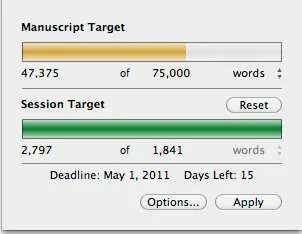
Another big thing for me is statistics.  I need to know at any given second how many words are in a project.  Whatever you have open in the text editing pane (chapter, fragment, manuscript, whatever) has a word count in the bottom bar.  But you can also do a quick Ctrl-Shift-T and get a word count for the project.  You can also set a goal date and count, and it will calculate how many words you have to write that day, and pop up a nice little reminder in Growl when you hit your target.

There are tons of other features I will never figure out.  It has comments, and little flags you can set to indicate if something is a draft or a revision, and snapshots, and citations, and tons of search and replace things I have not figured out.  But the ability to write in a completely nonlinear fashion is a big thing for me, and this works way better than any other system out there.

Anyway, if you’re in a similar predicament, check out their site and download the free trial.  The learning curve is steep, and I initially had a big freakout trying to figure out how to carve my next book project into the right type of pieces.  But I’ve got the next book underway and it’s motoring along fine.  And I’ve imported both Summer Rain and Rumored, and I’m vaguely thinking about dumping those to the kindle.

Enough babbling about tools.  Time to get back to work.

9 Tips on Surviving Your Fantasy Baseball Draft

IMG_2647

Forget Libya.  Forget work.  And forget anything you normally ignore, like family, friends, or the federal agents who have been sitting outside your house in an unmarked Crown Vic for two weeks. It’s time for all of us hardcore baseball fans to become obnoxious assholes and statistics wonks and get ready for The Draft.  Pitchers and catchers have reported to spring training; every lard-assed 5’-11, 330-pound designated hitter has declared that they lost between 30 and 50 pounds this off-season, which drops their body mass index from morbidly obese to obese.  It will only be a matter of time before you are eating $8 hot dogs and drinking $10 beers (unless you are a Phillies fan, in which case you will be vomiting $8 hot dogs and $10 beers onto the kid sitting in front of you.)

You have only matter of weeks to spend untold amounts on every Bill James-related annual book of figures and memorize a decade or more of two dozen statistics for a thousand players (minus the 40-man roster for the Pirates, because seriously, you aren’t going to pick a single one of those fuckers, especially when they’re playing for Clint “every plate appearance is a bunt opportunity” Hurdle.)  Time to try to remember how to calculate the career park-adjusted average cup adjustments per plate appearance (CPAACAP) and why it’s important when picking your second-string utility players.  And don’t forget you’ll need to go to all of the baseball reference sites to argue if MLB rule 7.08 (a) (1) applies if a batter reaches first base and then gets abducted by aliens, which would obviously skew a century of statistics on baserunning.

To some of us, the fantasy baseball draft is more important than Jesus, as it should be.  Because if you’re right about Jesus and the second coming and you’re one of the 16,000 who goes to heaven, it doesn’t mean shit if you aren’t able to rub it in the faces of your friends who get left behind.  Most of the appeal of fantasy baseball, aside from the ability to burn man-years of work at your desk while appearing to actually do work, is its power to humiliate and denigrate your peers when you win a bullshit statistical category like steals or saves by stringing together a bunch of has-been bench players who barely made the team in Kansas City, while your friend who got A-Rod in the first round of the draft gets to mope through the first two months of the season while he is benched for ‘fatigue’.  This is why it’s important to get the edge, to figure out ways to dominate the competition, and how to ridicule your friends by taunting them with pictures of multimillion dollar a-list players with genitals crudely sketched near their mouths and/or anuses in Microsoft Paint.

I’ll cut to the chase.  Here are a few things to keep in mind as you get ready for the draft.

  1. It’s important to remember that while MLB players are scrutinized with constant drug tests that can fire up a false positive if a fan in a five dollar bleacher seat happened to take a cold medication last winter, it’s completely legal for fantasy baseball managers to imbibe in any sort of legal or illegal theraputic or recreational drugs.  There are a whole new breed of powerful nootropic pharmaceuticals available over the internet, although garden-variety street hallucinogenics can do wonders for your memory retention.
  2. If your league’s software offers an auto-draft option that populates your roster based on the picks of every other person using the software, do not use it.  Auto-draft is for pussies and cowards.  You’re also basing your picks on what the majority picks, which is a lot like saying “I’m totally fine with George W. Bush serving another five terms, as long as a majority of mouth-breathers and idiots can agree on it, too.”
  3. Use all of the time allotted for your picks.  For example, if your software allows you two and a half minutes to pick, even if you have the name of a player right in front of you and it only takes a single mouse click to add them, wait until 2
    has elapsed on the clock.  This makes it much more of a urine retention showdown for the other players, especially if you’re drinking.  (I’m assuming you’re planning on either wearing a catheter or adult incontinence undergarment, which is what all good pro gamblers use when trying to wait out lesser-bladdered players at a casino table.)
  4. Most draft strategies have to do with filling your hitting positions first, then moving on to pitching.  Also, most so-called experts in the field will advise against picking closing pitchers until the end of the draft.  This means it’s typically very easy to fill all of your pitching spots with all of the best closers in the sport at the very start of the draft.  This kind of hoarding won’t help you in offense, but it means nobody else will get a closer, and you’ll be able to deal.
  5. Just like it’s possible for certain AL East teams to buy World Series wins, it’s completely possible for you to buy a fantasy baseball victory.  I was in a league that strictly prohibited monetary bribes, but found a loophole that enabled me to have both Cy Young winning pitchers and an all-Silver Slugger offense, simply by giving away 23 iPads during the course of the season.
  6. If you are in a league in which you don’t know the other players in real life and your main tactic is violence and intimidation, make sure your user ID is not linked in any way to your physical mailing address.  There’s nothing worse than threatening every other owner and then waking up to flaming bags of shit on your doorstep for the next three months.
  7. I publish a weekly newsletter for fantasy players that grades and orders each player’s propensity for going apeshit insane and losing games due to drug use, parole violations, Guitar Hero-related injuries, or DUIs.  It’s a must-have for planning ahead during the season.  Contact me for more details.
  8. For internet-based drafts, it’s absolutely imperative to have a backup internet connection and a UPS or backup generator, in case of any loss of connectivity.  I typically have a second OC-768 Optical Carrier connection installed the week before a draft to ensure I have a constant 39,813.12 Mbit/s connection to all of the statistics, video, and pornography I might need during a draft.
  9. Be prepared to ditch any planned strategy at a moment’s notice and blindly grab every player based on maybe hearing their name once on SportsCenter.  Even the best planned wars involve a complete breakdown in command.

Hopefully, these tips will help you form an iron-clad strategy for survival.  Let me know of any other strategies you may have developed, and I’ll see you on opening day.

The City of Lights and Massages

IMG_3832

I got in the cab after no line at all in front of McCarran airport, a first, even when I came out to Vegas a few weeks after 9/11, when people in rural Arkansas thought the Taliban would probably fly an Airbus into their grain silo Any Day Now.  The roller bag and new camera backpack went in the back of the minivan, and we headed off to the Planet Ho.

“Long flight?” the cabbie asked me.  He was one of those guys that was all belly and no neck, probably transplanted out to Nevada to avoid an alimony lawsuit.

“No, a couple hours, but they really cram you in there.”

“What you need is a good rub and tug,” he said.  “I know just the place.”

Ah, Las Vegas.  A city of subtleties.  How can I go a whole year in the land of fruits and nuts without time in a city where the number one occupation is handing out flyers for prostitutes?

So I turned 40.  I spent the morning fucking around with a radio-controlled helicopter whose battery would not hold a charge, then went to Denny’s for the annual cholesterol boost, got an allergy shot (not at Denny’s), and drove out to the former Oakland Naval Air Station, now known for cheap Southwest flights to all sorts of mid-sized towns across the country (provided you weigh less than Kevin Smith.)  Not a single TSA problem happened to me, although I did see them putting a beat-down on a tourist who did not understand the complexities of “liquids in a ziplock bag, you motherfucker”.  (I realize it is difficult for some people to remember if shampoo is a liquid, solid, or gas.  Certainly a valid reason for every single media outlet in the United States to spend roughly twenty trillion dollars of TV time lamenting over those jackboot thugs that won’t let you bring a machete in your carry-on luggage anymore.)  Did you know Amelia Earhart’s first attempt at her final flight took off from Oakland airport?  Also, did you know that Purdue paid for that plane?  And did you know her plane was taken by aliens and will re-appear in the middle of the shitty remake of Close Encounters that will probably come out in the next few years?  Actually, I don’t know that they’re remaking it, but they’re remaking everything else, so expect Will Smith to be building a giant Devil’s Tower in his living room any time now.

I used to know a bit about Vegas.  It was my default vacation, and I even wrote a book about it. But since I published that thing in 2004, damn near every thing I mentioned there has been imploded and replaced by a chrome and glass tower.  A big chunk of the strip used to be crappy t-shirt shops and places you could rent a high-test sports car from an Armenian illegal for cash on the barrelhead; now the whole stretch looks like some kind of futuristic spaceport in a Tom Cruise summer blockbuster.  Back in the day, I used to write these trip reports, bulleted lists of all the neato things I paid money to see.  Now I’m not into reports as much; I prefer manifestos, scathing diatribes on the cold burn of a multinational real estate project for the rich masquerading as an entertainment option by selling a $16 cocktail, especially the ones that won’t let me post a million to one bet on an earthquake or tsunami during the upcoming superbowl. Fuck all of them and their stupid corporate house rules - I want some real action, the kind I need to drive to some beaten whore casino and hardware store in the middle of the desert, the kind of place that sells dollar hot dogs and not at a loss, because the meat is from Costco.

I got to the Planet Ho (aka the Planet Hollywood, which used to be the Aladdin, which went under a rename after they realized a giant arab with a sword between his teeth isn’t the best mascot for a casino when you need to pull in red-staters to make the nut) and Bill already checked in a dozen hours earlier, the victim of a horrible plane schedule that only left a crack-of-dawn flight or a near-redeye his only options for the long haul out from Indiana.  I usually bunk with him on these trips, partly to save us both money, and partly because when I stay by myself, I tend to do things like drink Singapore Slings with mezcal on the side until I black out and kick in a toilet in the middle of the night.  (You didn’t read the book, did you?)  We both turned 40 at the same time, or rather him about an hour before me, which is probably why he’s a foot taller than me.

Everyone asks me what the hell I do on these trips, and the simple answer is that instead of gambling, soliciting the service of whores, or drinking my body weight in grain alcohol, I usually eat.  And now that I have lost a ton of weight and spend all day and night obsessing over the stupid Weight Watchers online app, my only desire in a place like Vegas is to run train on thousands of calories of Oprah-sized portions of grub.  And there’s no shortage of it; every ten yards is yet another opportunity to get large vats of deep-fried everything to go with your huge tub of whatever drink you’re downing.  The best way to raise house advantage in any game of chance is by diabetic coma.  Ask anyone waddling down the strip, and they’ll tell you all about their fifth or sixth meal that day.

We did other stuff, too.  Marc came into town from Seattle a bit later that night, carrying a deck of loyalty cards, with complex arbitrage plans that I think involved somehow getting rated at casino play from dental work paid for at high altitude with a Costco Amex card and then refinanced through a platinum MasterCard and turned into airline miles then exchanged for mortgage-backed securities.  (I may have missed part of that procedure.  I barely manage to remember to use my Safeway Club Card four out of ten times.)  Tom also arrived much later from Chicago.  I ate an entire fish and chips at one Irish pub, swapping out the chips for beer-battered onion rings, and then we ended up at another Irish pub, where I ate a dozen different appetizers while Bill and Tom found a little game where if you drank a pint of beer in under seven seconds, you got the drink for free.  Now, I’ve seen Bill drink an entire yard of Guinness in under seven seconds after eating a five-gallon bucket full of shepherd’s pie, so it was no surprise they could easily do the limit of two beers each, each day we were in town.

Andrew got into town the next day.  We split a townhouse out at Colonial Crest back in 93-94, but I hadn’t seen him since.  Within twelve hours, we had him on a mechanical bull in an imitation rock bar, while Bill entered some kind of redneck regression and started drinking Bud Lite.  But before that, there was a many-hundred dollar brunch where I ate a progression of Kobe beef sliders and wedge salad, and I took a bunch of pictures of lions at the MGM, which is pretty boring, but it beats losing $300 at blackjack in fifteen minutes flat, which is what Bill managed to do.

That night, we all went to La Reve, which is hard to explain except it’s one of those freaky acrobat musical numbers, where people are contorting in weird ways and flying through the air on wires.  This particular one, up at the Wynn, involved a huge theater in the round, with the stage actually consisting of a deep swimming pool and a series of raising and lowering rings and platforms.  There was once a time when I worked at heights, hanging stage lights from catwalks dozens of feet in the air, taking long naps behind followspots while waiting for my cue to launch a few thousand watts and lumens at a performer.  Now, I sit through shows like this wondering what they used to generate snow these days, and how they always hit their marks on these flips and dives and swoops and twists, especially when we could never get three rehearsals and two performances of a school musical run without some idiot tripping on a cable and knocking over ten thousand 1980s dollars of lights.

Of course there was a Mexican dinner before the show, and another dinner after, along with another round of “let’s drink all of the beers at this pub for free”, of which I did not participate, but it’s always fun to watch the disbelief involved.

IMG_0451

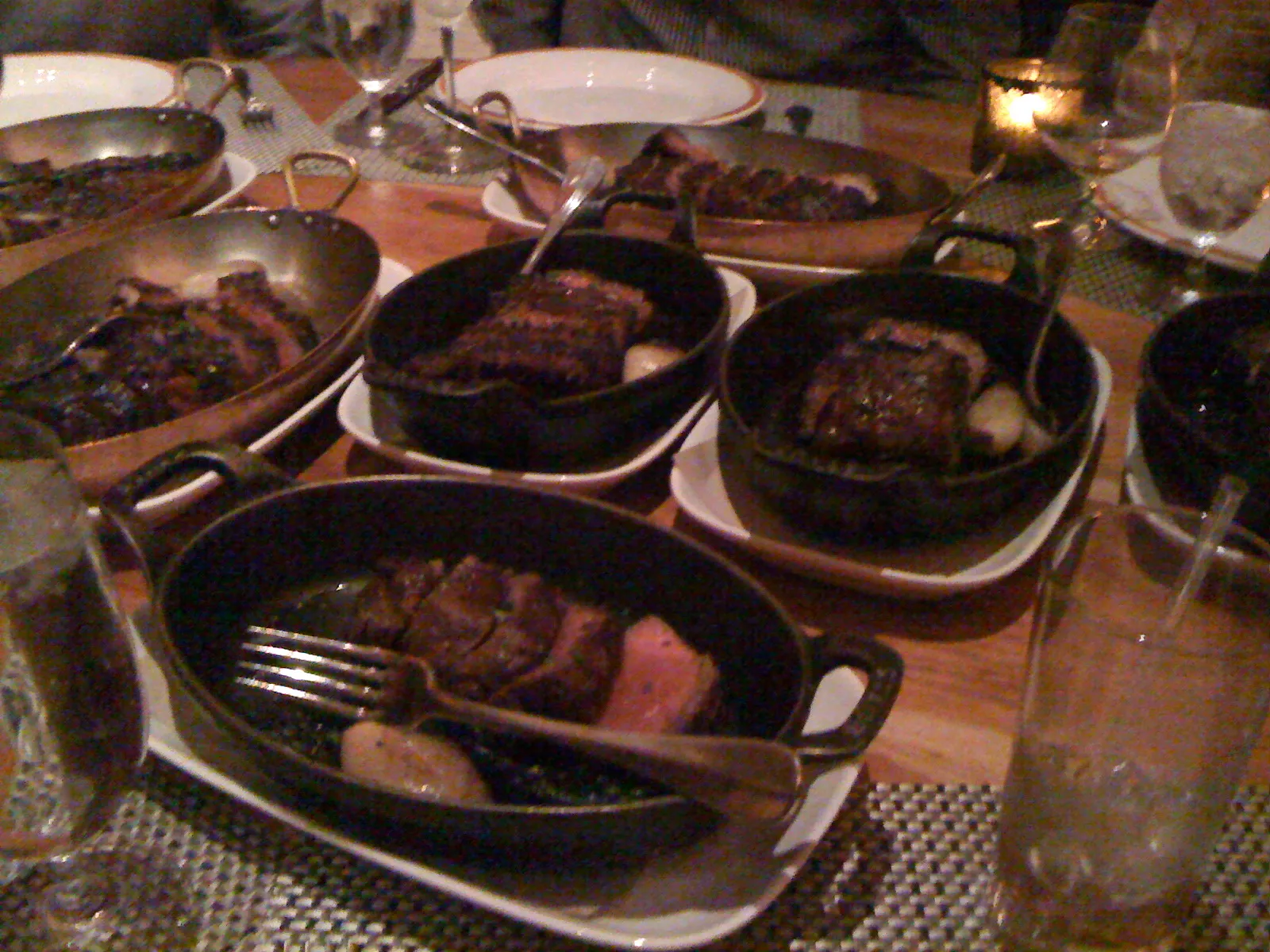
On Saturday, we all went to the main event, calorie-wise: a giant dinner at Craftsteak.  I did this once before, but this time we got to meet up with Jeremy, who I also hadn’t seen for decades, since the UCS days of telling people that you spelled ezmail with a z, and god damn it, stop trying to telnet to easymail.  They sat us all down at a giant round table and brought out seven courses of Kobe steak, plus seven appetizers, and then finished it with nine different desserts.  Each of the 23 things I put on my plate (plus rolls) was easily a day’s worth of WW points.  Oh, and a diet Coke.

A last-second addition: we got tickets to Drew Carey’s improv thing, which was the cast of Who’s Line Is It Anyway, doing all of the usual improv exercises.  Our seats were pretty far back, plus they were taping the thing for TV, which involved these long camera booms randomly swooping across the line of sight, but it was a good comedy geek moment to see the now-obviously-does-not-eat-at-Craftsteak Carey leading the rest of the group.

I didn’t gamble much.  I blew about a hundred bucks on a Casino War table in the Pleasure Pit, which is Planet Ho’s evil little trick which involves distracting gamblers with  300cc bags of saline or silicone strategically placed at eye level. Very bad odds, very stingy on the drinks. That was the worst hundred dollar glass of ice and diet Coke you could possibly find, but at least I didn’t do as much damage as my colleagues.

Cap it all off with a run at the breakfast buffet: giant vats of bacon, pancakes, french toast, waffles, and 197 different desserts.  I got back on the plane as fast as I arrived, and bailed out the Toyota on a sunny Oakland Sunday afternoon that required no jacket.  We did not steal any of Mike Tyson’s tigers, and nobody got tazered, but it was still a pretty okay weekend. And by some god damned miracle, I ended up down a half pound at this week’s weigh-in.  A birthday miracle!

I'd hate to be a piece of furniture in Steve Ballmer's office this week

The Mac App Store launched Thursday, and Herman Miller stock went up two points in anticipation of all of the chairs Steve Ballmer has probably been throwing at people this week.  There’s no way the sweaty-pitted Microsoft CEO isn’t beating his middle managers like red-headed step-children after the news came out that people downloaded a million apps in the first day, with 10,000 apps available at launch.  The Mac App Store changes things in ways that people in Windowsland cannot even contemplate, although when Win7SP2 launches with the MSFT half-ass attempt of the same concept, I’m sure we’ll hear all about the greatness, just like we’ll hear about how great judicial advocacy is from Teapotters that have railed against it for the last two years when they need it to keep Guantanamo bay open.

The Mac App Store changes things in a big way, both good and bad.  Back when I got started in this industry, if you wanted to write and sell an application for a Mac (or a PC), you rode your dinosaur to work, hired a bunch of people to put your crap on floppy disks and into boxes, and then either sold it yourself in your local computer stores (kids younger than 20: imagine a Best Buy with only a computer section, that didn’t suck), or you got your retail boxes dumped into the channel and flushed out to big stores and catalogs.  (Catalog: a paper version of Amazon, but it took 4-6 weeks to get your stuff.)  Then the internet happened, and people sold software on web sites, where you somehow sent money and either got a download or got a CD-ROM sent to you through the pony express for later installation at your own leisure.

But if you had this great software package, you had this huge list of problems.  Gotta set up a web site.  Gotta get a shopping cart system in place.  Gotta take credit cards and get a merchant account and whatever SSL nonsense your ISP wants you to get.  Or, gotta bend over and spread for PalPal’s cut of the vig.  Gotta find a way to have a download center that isn’t just at widget.com/dontlookhere/dl/product.zip so the first person that buys your crap doesn’t just spam the magic link to the world and let everyone download.  Gotta come up with come crazy system of software enablement, serial numbers you type in and send securely, whatever obfuscated nonsense you need to keep the world from just emailing your ZIP file to all of their friends.  Gotta find a way to drive traffic to the site.  Gotta find a way to get people to return to the site for upgrades and new versions.  There are a lot of moving parts, a lot of things to consider, and either every software reseller reinvents the wheel, or you join some tribe or cabal or commune or collective or whatever else to use one common set of machinery for everyone’s releases, and you pay for the privilege.

So now you avoid all of that.  Pay Apple a hundred bucks to join, upload your DMG file, and you’re in a searchable, centralized catalog of apps.  When a new Apple user fires up their iMac for the first time, there’s a pretty little icon to click that brings them to a huge store filled with games and productivity apps and stuff people can click on without scrambling for their credit cards or signing up for yet another e-merchant account that will probably eventually get hacked, with your password and Visa number and home phone ending up in a torrent sent out to every script kiddie in the world.

There’s also the issue of central maintenance.  When you have to push out a patch, you don’t spam out emails, and you don’t have to write complicated code to beam back to the mothership and check if the latest version is installed on the user’s PC. You tell Apple you have a new version, and let them do the dirty work.  And when a person bricks their MacBook or spills juice in their iMac and has to go get a new machine, they just plug in their username and all of their apps magically download again.  There isn’t a two-month process of trying to remember all of the crap you installed, or a weekend-long backup and reload on an external drive or a pile of DVD-Rs.

Yeah, there are downsides.  You’re paying Apple that hundred bucks, and they’re also skimming 30% of the take on your sales.  But do you know how much banks take from mom and pop companies on merchant accounts?  I’d tell you, but there are like 79 different surcharges and monthly fees and address verification fees and machine rental fees and every other nickel-and-diming the banks can think of to hit you with.  That 30% erases a lot of headaches.  And compare it to how much of a discount you’d give in channel sales, and it’s not a bad deal.

There are all of the “walled garden” arguments you’ll hear from the Microsoft camp.  You’ve heard the same arguments since the App Store showed up on the iPhone, although you haven’t heard as many of them since Windows Phone 7 adopted the same exact strategy for their app store.  And you probably won’t hear much more about it after that Windows 7 Platinum Home Deluxe SP2 Zune Marketplace shows up in the next rev of their OS, providing the same exact walled garden, albeit with a lot of the wall’s pieces removed to appease any of the big software makers that balk.

I think by the fall, everyone at every point of the food chain is going to try to launch their PC app store.  Amazon’s probably brewing one; I’m sure all of the hardware manufacturers like HP and Dell are going to have a long, painful meeting this Monday where some idiot who has never installed software in his life but can wear a mean tie and gets all of the ZDNet headlines beamed to his Blackberry is going to pitch their genius idea to launch their own bundled crapware app store on their new computers.   App stores will be the add-on toolbar of 2011, just like they were for phones in the last 18 months.

Another argument that is a plus and a minus is what the hell this will do to pricing.  People are now used to paying 99 cents for a game on their phone, so good luck on putting your desktop game on the App Store for $79.99.  Sure, you can trim down that price a bit because you’re not paying $47 a copy in merchant account fees to Bank of America.  And your game is some one-gig DVD release and not just a two-screen screen-tapper you wrote in a weekend.  It’s going to cause unbundling of suites, like Apple is doing with iWork and iLife, where people will only buy the apps they want, at a lower price and a smaller download, instead of buying a full package of apps on a DVD.  I don’t know what the magic price point will become, although I’m guessing people will be less apt to buy a $99 app and more willing to pay something like $19 for Real Apps and $4.99 for games and entertainment.

I just got the update and installed the App Store, and gave it a quick drive to download the new Twitter client.  No problems, no surprises.  I haven’t bought anything yet, but when I get a free second (which will be in like June) I will probably hunt down the latest versions of some of the older registered payware/shareware I have, just to make the next update easier.  All I can tell you now is, I’m glad I’m not working at a hardware manufacturer that’s probably going to go on damage control and require all of its R&D center employees to waste a lot of their free time generating stupid powerpoints re-selling an already done idea.  Also glad I’m not driving across the 520 bridge every morning to potentially have a 57-pound Aeron chair thrown at my head.