The Wrath of Kon

Dispatches, thoughts, and miscellanea from writer Jon Konrath

Tag: indiana

KONCAST Episode 8: Joshua Citrak

http://koncast.libsyn.com/episode-7-joshua-citrak

In this episode, I talk to writer Joshua Citrak. He is the creator and co-host of the podcast Hangin’ With Old Lew.

We discuss: the Raiders and North Korean Juche; the nuclear war, wildfires, and hurricanes trifecta; the Elkhart connection; post-industrial Binghamton; the rise and fall of IBM America; the synergy between nuclear holocaust and evangelical churches; Vegas betting on earthquakes; fun and profit in outsourcing and Superfund sites; the Great Elkhart Garbage Fire; Apple and the eco brand; on getting the hell out of your home town; getting started writing; the internet gold rush and Cow Town; William S. Burroughs and post-apocalyptic writing; Pessoa, Johnson, and other writing influences; fiction vs. poetry; the Castro Writer’s Coop; Mike Daily; Jeffrey Dinsmore; shit-talking about shit-posting on social media; Jon Konrath the Facebook persona versus Jon Konrath the person; starting up Hangin’ With Old Lew; why podcasting is great; Facebook sharing is killing us all; the ROI numbers game; and why the 49ers suck.

Links from this episode:

Hangin’ With Old Lew: The Podcast: https://www.hanginwitholdlew.com

Jon Konrath: http://www.rumored.com

The Day After: https://youtu.be/yif-5cKg1Yo

The Centralia Mine Fire: https://en.wikipedia.org/wiki/Centralia_mine_fire

Fernando Pessoa - The Book of Disquiet: http://amzn.to/2xpfyp3

Denis Johnson - Jesus’ Son: http://amzn.to/2xikOJt

Kemble Scott: SoMa: http://amzn.to/2wAaSxT

The Castro Writer’s Coop: http://www.castrowriterscoop.com

Kevin Sampsell - Creamy Bullets: http://amzn.to/2hmRjhU

Slouchmag: http://www.slouchmag.com Click here to for more details on this new episode of The Koncast

bones and memories

I visited Indiana recently - actually, it wasn’t that recent, but I meant to write about it at the time, and now two months have passed. It was an interesting quick trip, for a few good and bad reasons, so I wanted to play catch-up and get a few words down on it.

I booked a quick solo trip at the beginning of August, partly because of my sister’s birthday, and partly because I had to cancel a family trip to Florida in the spring and felt bad about that. I got an out-on-Wednesday, back-on-Monday long weekend, which seemed to work well for me. Time was at a bit of a premium, but it’s a bit like visiting Vegas; a week is overkill, but a weekend is not enough.

Not to dwell on the bad, but here goes: first, I screwed up my rental car reservation. Arrived in Chicago, and had a car waiting for me in South Bend, when I really needed a car in Chicago to drive to South Bend. Second, on Friday, at about 5

, one of my crowns came off. After much panic and calling a bunch of phone numbers, I found a dentist nearby who opened back up and glued the crown back in, which was awesome. I still ate mostly liquid for the rest of the trip, until I could get back home and have my dentist permanently glue in the tooth. Also, on the last day of the trip, I lost my credit card, and while at the airport waiting for a very late flight, I found out and had to cancel it. So that’s the bad.

I stayed in an extended stay hotel in Mishawaka, right near the University Park mall. It was on Main and Douglas, which was mostly vacant when I left Indiana, but since, a second main drag of big box stores and restaurants has started there, one big street over from the Grape Road arterial of the same sorts of big boxes. It’s always odd and nostalgic and weird for me to stay right by the mall where I spent so much time as a teen, but it’s a newer hotel, close to everything, and that works for me.

Every time I go back, it’s amazing to me that the default routes and streets and terrain immediately pop back into my head. A lot of Indiana hasn’t changed, or at least the “bones” have not. If you asked me to drive from UP mall to the IUSB campus, I could do it without thinking, just on muscle memory. Never mind that the IUSB campus has basically doubled, and every store in UP mall has changed hands, but the roads and turns are still the same.

Indiana does change, but on a very slow scale. I think people find a certain comfort in that, and it’s understandable. There are changes, and things fade and vanish, plus simple economics dictate amendments and revisions. Some chains die, and some mom-and-pop businesses go away with time, but new ones pop up. Sometimes things are completely bulldozed, like the Scottsdale and Pierre Moran malls, which were both torn down and “de-malled” into plazas of freestanding stores. But other things still have the same “bones” for better or for worse. Old first-generation Taco Bells get painted blue and turned into Chinese buffets. The UP mall got additions and food courts and new Barnes and Noble grafted onto its front, with the concourses updated and the tenants being bumped up in scale and stature. (Like the tiny Software Etc. is long gone, but across the way, there’s a giant new Apple store.) I walked the mall and tried to think of what was where, back in the day, but I couldn’t spot any one store that was the same, aside from the big Sears and JC Penney anchor stores.

Driving, though - driving from Mishawaka to Edwardsburg, Elkhart to Millersburg, those things all looked almost identical. The amber waves of grain were still amber waves of grain. A few were turned into new industrial parks or large retirement communities, but for the most part, it looked like Indiana had aged two California years in the last 25. And normally, a twenty-something me would have found this disgusting, that all of the state should get off their ass and progress at a rapid rate. But like I said, part of me sees the comfort in this, the idea that things wouldn’t change. I’ve always thought that many people in that area feared change, and I think there’s some truth in that. When I was 18, that pissed me off beyond end. As a 44-year-old, I could see why someone might like that.

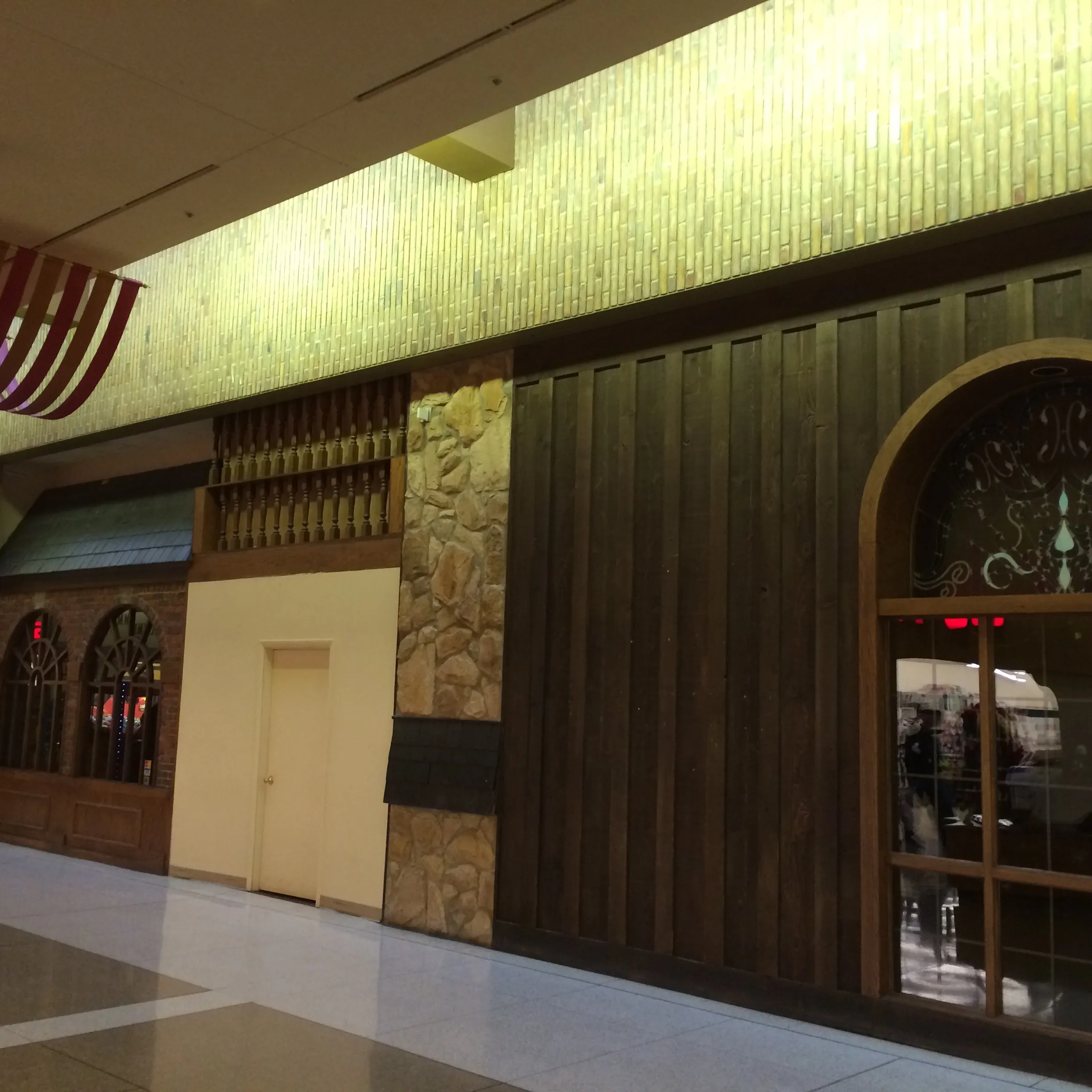
Some things, though, have atrophied beyond belief. I went to the Concord Mall, which was a mile from my house, my default mall as a kid. When I was a teenager and worked in that mall, I practically lived there. I would go to the store and hang out even on my days off. Now, it looks like nothing has been done to the mall at all since the last time I punched out at the time clock in 1993. The Wards store where I worked is gone, converted into a Hobby Lobby that has locked itself off from the rest of the mall with huge glass doors. Almost every store in the mall has closed; most are covered in plywood. The old Osco’s drug store was converted to a food court, and every stall is currently empty, except for a single, lonely Subway sandwich shop. Some shops have these weird, temporary businesses in them, like a vacant store with a bouncy castle set up inside it, or the horribly sad dollar stores with nothing worth a dollar in them. There are multiple churches in the mall now; it seems like every business in Elkhart that goes bust turns into a church or a Mexican bodega. There was even a “church” that just beamed in the services from a megachurch in Kansas or Nebraska, and of course took your money. The mall itself was almost abandoned, nobody in sight, like an empty shopping center in a zombie movie. After seeing that, I made it a point to not do anything else in Elkhart, dredge up any more memories or see the old subdivision or school or anything else.

Not all of the region was that destitute, though. The UP mall was filled with customers, even on a weeknight. And I went to Goshen one day, and it was actually transformed from what I remember. Most of the main street was art galleries, and small mom-and-pop businesses, a wave of hipsterization running through there. In 1990, I had a girlfriend who lived on Main Street, and at that time, it was largely abandoned, boarded up and done. Now, there are these brewpubs and artisanal butcher shops and groceries, almost like something I’d see in the hippest part of a college town like Bloomington.

The thing that struck me the most was the feeling, the weather, the atmosphere. I haven’t visited Indiana outside of Christmas in years, decades. I think in the late 90s, I made a trip or two in October, and I drove through Indiana in April of 99, during my Seattle to New York move. But I don’t remember an August in Indiana probably since 1994, the year before I left. I’m very sensitive to temperatures and weather and the feeling of a place at a certain time of year, much more than I could ever describe it. And when I was there, the air held the same feeling as the summer before I first left for college, in 1989.

I so distinctly remember that summer, because it would be hot in the day, maybe in the 80s, but then at night, it would cool to the 60s. I was working days in a department store, just started dating someone, and we’d meet up at 9

every night, when the mall closed, to drive around aimlessly, stay up all night, go from Perkins to Bob Evans to Big Boy’s, making the loop of the few 24-hour places in Elkhart at that time. And I’d come home late at night, or early in the morning, and feel the summer’s humidity converted to a light mist, to dew on the grass. The summer had a certain freedom, of the end of high school, a brief period where I almost thought I had my life together and was leaving behind the shroud of depression that blanketed me throughout my four years there. But there was also the uncertainty and excitement and fear of packing up my entire life and moving it off to campus in a few short weeks.

Each day of the visit, I did the family stuff during the day, and it was good to see all of them. But then I’d return to the hotel, and either drive around by the mall, or walk at night, and just feel that weather, the cool evenings and the dew on my sneakers. (That’s another thing - there were no sidewalks by the hotel, and everyone was staring at me for walking, like wondering what happened that resulted in me not having a car.) Or I would sit in the hotel writing, with the windows open, feeling the air outside.

I spent a lot of time wondering if I could ever go back. There’s a part of me, as I plummet into The Crisis that has hit at this age, that wishes I had a three-bedroom ranch and a garage and a lawn and everything else, working on an old car or a boat or something. I know I could never live in Indiana because of the politics and money and career. And the crippling nostalgia of being back there would consume me. But it was interesting to see it for a moment.

I wish someone would slap me every time I think probiotics will make my life complete

IMG_2011

I always get disoriented when I fly open-jawed and land in an airport that’s different than the one I left from.  I don’t remember the last time I did it, but last night I landed in SFO a week and a half after departing from OAK, and it really fucked me up.  I walked down the concourse with this strong unconscious feeling that nothing was right.  I mean, I spent the whole flight sitting next to this bald dude with a handlebar mustache, black leather boots, and a crushed velvet suit jacket in a bright shade of burgundy, who read The Fountainhead in that sort of “look at what I’m reading” pose, and I really wanted to just say “okay, we get it, dude” but I didn’t.  It took me a lot of time to get used to being in the wrong airport and mentally figure out that I was on a different mass of land with a different drive in front of me, but the 50 degree temperature difference really negated that.

I haven’t been back in Indiana in two years, and I always hesitate to write about the experience, because I don’t want to piss off the people who call it home, or make it sound like I’m ungrateful for them taking time out to see this asshole who flew out from California that won’t stop bitching about a lack of vegetables and heat.  But it always puts the zap on me to see stuff back there.  I think this visit, I spent less time in a nostalgia black hole, and avoided a lot of old haunts, although it wasn’t entirely intentional.  Both the night of Christmas Eve and Christmas itself, I headed back to my hotel semi-early, and had thoughts of driving around University Park mall, maybe finding an old place to eat, and doing some serious people-watching.  And, of course, both times I was an idiot and didn’t realize that they closed damn near everything early, and I ended up back at the hotel eating candy bars for dinner.

I got a chance to meet up with fellow writer Steve Lowe, which was cool, because our Venn diagrams of South Bend-dom probably briefly touched decades ago and we didn’t realize it.  This leads me to my new year’s resolution (yes, another one of those posts): I really don’t know half of you people out there, and I never see the other half of you.  I need to make more of an effort to see people in the next year.  So if you’re in the bay area, please ping me, and I will do likewise.  I don’t care if we haven’t met before - we should grab a cup of coffee or hit a book store or whatever.  I need to do something with my life besides clicking the Like button on facebook posts.

So, saw the family.  Suffered through the cold.  Ate a lot of garbage, but only gained about a pound.  Almost hit a deer.  Didn’t write, which I wanted to do and of course I didn’t, so what the fuck.  I left Indiana a day earlier than I thought, due to a scheduling issue, and drove up to Wisconsin, then drove down to Chicago the next day to hang out with John Sheppard.  We went to this weird diner that was all classic diner food but vegan, built up out of various soy products, which was actually pretty damn good.  We got to hang for a bit, and scheme about our next big project, which is always awesome.

Speaking of, next project - you should go over to Paragraph Line and bookmark that shit.  We’ll be posting daily (we hope) dispatches, fiction, news, and other distractions.

Anyway, it’s good to be home, and I have to unfuck a million things here, piles of half-unpacked things and gifts that need to find permanent homes, and whatnot.  I got some nice little things, but after every trip back to Indiana, I always want to go Fight Club on my shit and start donating everything.  I also feel a need to do the same thing digestion-wise, hence my current issue with probiotics.  At least I will get a lot of reading done in the next few days.

Ok.  2013 done.  2014 coming up.  Still writing 2012 on my checks.  Gotta go finish this book now.

Automated board loading machinery

I spent a good chunk of the summer of 1993 trying to find a job.  I returned back to Elkhart for the summer, because even though that summer of 1992 in Bloomington was life-changing and ended up becoming my first book, I made absolutely no money selling glowsticks and telemarketing.  I needed real work, factory work, the kind of thing that would pay me more than minimum wage in exchange for spending three months operating a punch press or doing the same thing over and over, thousands of times a night.

I went to Manpower, the temp agency, with some hope of finding anything even vaguely computer-related, like changing backup tapes or reinstalling DOS programs or beating dot-matrix printers with a wrench.  But this was 1993, and there weren’t a lot of computers in factories.  And most of the places that did have them would farm out the maintenance and support through their home office, so some guys working at what was then called Anderson Consulting would drive out of the Chicago corporate office when an IBM mainframe went south, and bill all the hours back to the account.  I had a girlfriend who once spent a summer working for Manpower, loaned out to Miles Pharmaceutical doing mindless Lotus 1-2-3 stuff.  She only made a buck or two above minimum wage, and the work was mindless and air-conditioned.  I knew just as much about WordPerfect and Lotus - I’d worked as a computer consultant for the university for two years at this point.  But if you went to Manpower and you had a vagina and you knew how to read, they gave you the typing test and put you in the virtual secretary pool.  If you did not, they pulled out the manual labor listings and tried to slot you in at a factory somewhere.

The first day, they loaned me out to UPS, to help a guy do an inventory count of all of their repair parts for vehicles.  We went to the big Elkhart warehouse, which was just down the road from where Ray lived, and it seemed like it was only a year or two old at that time.  I don’t know where they used to be; I just remember a big empty field suddenly becoming a giant ugly UPS warehouse, built overnight from those prefab metal panels they used to construct every factory in Elkhart.  I don’t entirely remember the system we used for the inventory, although it certainly involved paper and not some kind of tabletized bar code reading beep-beep making Star Trek computer thing.  It was more like a clipboard full of tractor-feed paper forms, and the guy I worked with would say “1005734-slash-22-spec-4” and I would mark a box and say “check.”  This went on for hours, and I watched a bunch of guys in brown shorts dismember the contents of a large semi, throwing boxes onto conveyors, taking a big truck trailer and reformatting it into contents for dozens of smaller trucks.

Two observations that stuck with me: one, the backs of UPS trucks have clear ceilings.  They aren’t really clear as much as they’re transparent, like a see-through tinted plastic, that lets light through so they can see in the truck without lights.  It’s a sort of brown-green shade.  Two: those giant trucks are powered by four-cylinder engines.  Each cylinder is gigantic, coffee can-sized, but it’s not a V-8.  Someone must have done the math on the best engine to use for all of that stop-start traffic while hauling literal tons of boxes, and that’s what they got.

One of the mechanics was an old guy, an Ernest Borgnine from Airwolf looking dude, who spent the afternoon dismantling a huge four-banger, wrenching on it and carefully removing each part.  We stopped and ate lunch with him.  I told him I was into computers, and he produced a folded-up magazine ad for a 486-33DX computer, something from the back of Popular Mechanics or something.  It lauded that the machine came with dozens of software titles, a sound card, a microphone.  “You don’t even need to know how to program.  You can just talk to it,” he said.  Maybe it recorded voice memos, but this was twenty years pre-Siri.  “Well, you still need to…”  “No!  You just talk to it!”  I always wanted to see if he actually bought it and then did a “help computer” into the mic and got nothing but a DOS prompt.

That job lasted a day, and the inventory was over.  The next morning, they sent me to a factory in Middlebury, something with a vaguely generic name, like A&B Wood Works.  I was to report there at 6 AM.  I remember trying to go to bed at something like 8

the night before, which was completely stupid, since half the time I stayed up until four in the morning, and now I needed to wake up at four in the morning.  I didn’t have a car, and this place was maybe a half-hour away, so my Mom had to leave early and drive me there.  At the time, I was trying to avoid everyone in my family, so spending an hour a day in the car with my Mom wasn’t ideal.

At this factory, they painted the chipboard pieces that make up entertainment centers and bookshelves.  The whole factory was essentially a huge loop of a conveyor belts.  One guy would put a board on the belt, and it would go through a sprayer that laid down a coat of lacquer paint.  Then it would go through a drying station, which would cure the paint quickly with hot air.  Then it would get flipped, and go through a second time, and then it would get pulled and stacked.  You’d do a couple of stacks per pallet, a pallet every couple of hours, a few pallets a day, a few dozen pallets per semi truck, a few trucks per order, and then you’d change color or change lumber type and do it again.

Maybe four or five people ran the entire factory.  They worked every day, from 6 AM to 6 PM.  Almost every week, they would work five days a week, sometimes six or seven.  They paid time and a half for every hour past 40, and double time for every hour past 60.  I think the minimum wage at that time was $4.25, and Manpower paid me $6.60.  So the average minimum wage burger-slinger made $170 a week, and at Manpower, I’d make $264.  But if I stayed at this job, I’d make $396 a week, plus an extra $158.40 for each weekend day I worked.  That meant if they did work seven days a week, I’d make more than a week’s flipping-burgers pay over the course of a weekend in the factory.  How hard could this be?

Factory work is always mind-numbing, but this particular setup seemed worse than normal.  It took a fair amount of effort to pull boards off of the stack and slap them onto the conveyor.  That sounds easy, but it’s a full-body workout; it’s like slinging kettlebells around.  You have to spin and dip and pull and lift and heft and spin and drop, all with precision.  And you do the same movements over and over and over.  The same exact movements.  The chipboard pieces aren’t heavy, but moving them in the same exact way makes them seem heavy.  I worked without gloves; when I asked if they had any, someone answered “we stopped paying the supplier, so they stopped delivering more gloves.”  The work was continuous, and I had to constantly supply boards.  I could barely think, and all of my thinking power went to one simple equation: $6.60 an hour, times 40 hours, plus 20 hours times 1.5 times 6.60.

Different factories have a different rhythm.  The best way to break the routine is to talk to someone, work at a machine next to another guy, pack boxes with someone else, find some job that requires you to stop every 20 minutes and sweep the floor or go to the other side of the building and get more parts.  But this job eliminated all of this.  You simply fed in boards, flipped boards, pulled boards, as fast as you could, just to keep up.  The machines weren’t deafening, but you didn’t work with anyone, as the people running the painter and dryer were stuck at their stations, a hundred feet away from you.  A guy ran a fork truck, but he was constantly moving around pallets, hauling in new blank boards and packing away the finished pieces.  We did stop for 20 minutes to eat a quick lunch, but I barely got to say hello to the coworkers before we got back to it.

A few hours into the shift, one of the boards grabbed the palm of my hand, gouged out a chunk of flesh.  I bled from the hand, but didn’t notice it, because I had to fight to keep up with the line.  The guy on the paint machine noticed it though, because I was bleeding onto the boards.  We were doing a run of black parts - those matte black bookshelves were all the rage in the 90s, and the department stores were selling them as fast as we could paint them.  So the blood-stained boards just got covered with a jet black, leaving behind no trace of my injury, although someone out there’s got a bookcase containing some of my genetic material sealed within.  The fork truck driver took over my spot for a minute, told me to go throw a band-aid onto my hand and get back to work.  I found a half-pilfered first aid kit, got fixed up, and went back to it.

It had been dark when I started work.  By the time we left, all but two hours of the day had passed, and all I wanted to do was eat and go back to bed.  Although the idea of going back and working 60, 70 hours a week seemed tantalizing from a financial aspect, I couldn’t see doing the same thing every day for the rest of the summer.  I told my mom I couldn’t go back, would try to find another temp assignment, maybe another agency.

Even though I felt exhausted, I couldn’t sleep that night.  My hand hurt, but mostly I still felt my body twisting, picking up boards, putting them back down, flipping them, pulling them, stacking them.  I closed my eyes and only saw the conveyor in front of me, heard the paint machine spraying down coats of matte black.  The only way I could sleep was to put a death metal CD on my headphones, on repeat, on low volume, a constant sound of something familiar to break up the automated feeling of being a board-loading machine.  I drifted in and out of sleep, in twenty minute fits and spurts, then took a shower and headed out on my ten-speed to find another job.

You Can Never Go Back

IMG_0207

I am home.  My last ten days: Oakland to Chicago to South Bend to North Liberty to South Bend to New Buffalo to South Bend to North Liberty to Elkhart to South Bend to Indianapolis to Bloomington to South Bend to Elkhart to South Bend to Elkhart to South Bend to Milwaukee to Chicago to Oakland.  I did all of this except the Oakland-Chicago flight in a bright mustard yellow Ford Fiesta, fighting with Ford Sync to try and get the voice control to play songs on my phone, most of it in the rain.  But the driving and the subcompact and the junky Ford transmission were the least of my worries.  My big problem was the ghosts.

I don’t go home much anymore.  I don’t even know where ‘home’ is; I’ve spent more time out of Indiana than I lived there.  Home is probably where the mortgage is, and Elkhart is nothing but a distant memory.  And when I go there, that’s what always gets me: the nostalgia, the distant memories of the time I spent in that little town, when it was my entire world, and the coasts and cities and states outside of the 46516 were nothing but fictional entities on a TV screen.

This trip was particularly hard, for some reason.  I’ve been trying to foster stronger friendships with old friends and family, because I feel like my life’s been on autopilot, and if I don’t put in the effort to see people, it’s suddenly twenty years later and they are all strangers to me.  But when I went back, it seemed like everyone was in some kind of crisis or despair. Everyone’s getting older; everything’s falling apart.  People are unemployed and underemployed and oversubscribed and overextended.  Nobody’s happy.  Everyone’s unable to move, and tells me I’m lucky I escaped.  And I did escape; I do have a job.  I’m mostly healthy, I’ve got a house and a wife and two cars in the garage and food in the fridge and cash in the bank.  But that doesn’t make me happy.  I’ve struggled a lot in the last year or two with what I should be doing, the big picture stuff, and I haven’t always been happy with the results.  So it makes me uncomfortable when others look to me as a person who’s “made it”, and I have no business telling them what they need to do to get out of their own rut.

When I do return to Indiana, I find it amazing that I drive places without even thinking about directions or maps or GPSes.  I think about going somewhere, a mall or store, and find myself driving there on autopilot.  I drove a lot of my old routes: the IUSB to Elkhart path I took every day for year; the River Manor to Concord Mall trip I drove a million times in the 80s and 90s; the south-bound US-31 jump across the middle of the state to Indianapolis to Bloomington I drove every holiday I came back from school.  As a whole, the state’s in sad shape.  So many businesses are closed, homes foreclosed, factories shut down, strip malls empty, old malls bulldozed.  Roads are potholed and unkempt.  Of course, every other abandoned movie theater or grocery store has become some kind of evangelical church, and those continue to thrive.  But I felt such an overwhelming sadness driving those same old routes and seeing total devastation.

I went to my old hangout, the Concord Mall, to see how it was doing.  I spent my childhood going to this four-spoked shopping center, walking the concourses and buying toys and records and books.  I later worked there, at Montgomery Ward, mixing paint and selling lawn mowers and Christmas trees.  Concord Mall has been utterly decimated.  I went a couple of days before Christmas, and I’ve seen more people in the mall back in the Eighties two hours before opening.  My old Wards store died ten years ago, and has been split into pieces, now a hobby shop for scrapbookers and packrats, a discount appliance store, and a family dentist.  Most of the stores are now gone; the Osco drug where I used to spend hours at the newsstand reading magazines got turned into a food court; every single stall is currently shuttered except for a Subway.  The Walden books where I got every book that influenced my writing as a teen is now a bizarro used book store with old, beaten religion books.  The MCL cafeteria Ray dragged me to almost every week is boarded shut.  Both record stores are gone.  The only surviving store was the GNC where my first girlfriend worked.  I think it does brisk business in energy drinks and herbal stimulants for the few remaining factory workers.

IMG_0242

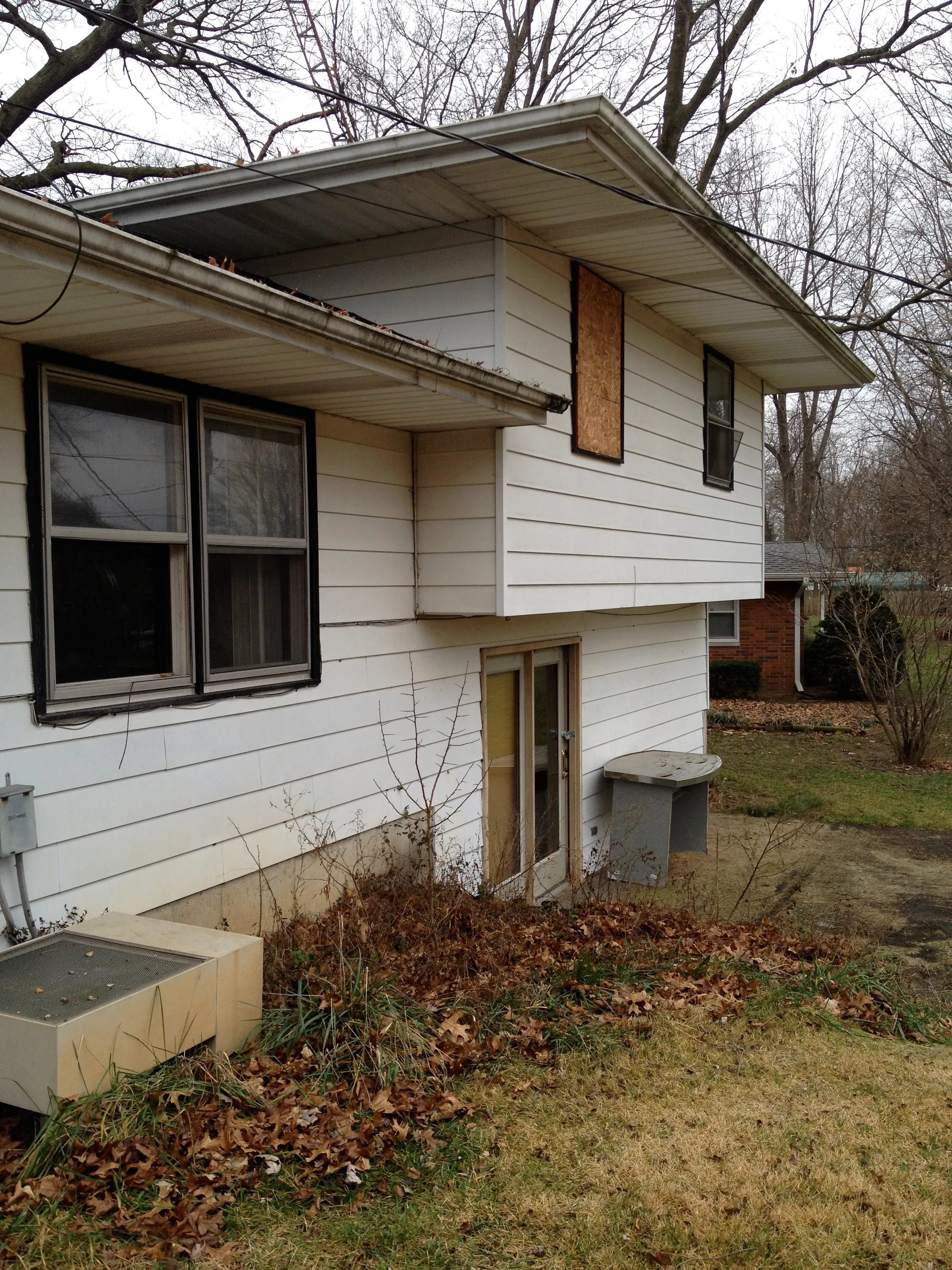
I went to my old house in River Manor, which was absolutely heartbreaking.  It was foreclosed upon a couple of months ago, and was devastated.  The big TV antenna tower was bent at a 30 degree angle and falling over, and the roof was covered with a blue tarp, probably with some kind of wind or storm damage.  Several of the windows were broken and boarded over; the screen door was ripped off of the front, and the patio door in the back was broken and boarded shut.  The grass died; trees were missing or dead and the landscaping was entirely fucked.  Doors and windows were secured with impromptu padlocks and riddled with legal postings from sheriffs and maintenance services.  I looked in the windows, while trying to remember any of my old teenaged egress methods that could have been used to gain entry, and the inside was filled with garbage, old boxes and trash, and storm damage.

I have no love for Elkhart, and absolutely no desire to return.  But part of me wished some REO website had the house listed for ten grand, just so I could either restore it (which would probably cost more than the hundred grand it’s “worth”) or bulldoze it and put it out of its misery.  I walked the perimeter and thought of a million memories, all of the hot summer afternoons I paced every step of the lawn with a mower; all of the times me and my sisters set up our kiddie pool or played with the dog or built snow forts in the winter.  I thought about the year I returned in college and lived in the basement, stuck between a life of return and escape.  I went to all of the places in the yard where we buried childhood pets, under trees that were no longer there.  I spent a decade and a half calling this white tri-level home, and now it looked like one of the abandoned buildings outside of Chernobyl.  The entire visit completely gutted me.

One of the mixed positives about the trip was going to University Park Mall.  We first went on a Sunday night, at about 9

, and the place was absolutely packed.  The mall looks like it has doubled in size, not even including all of the outlying big box stores that appeared on the perimeter.  I walked the concourse, and examined all of the stores, which have been replaced with more upscale items.  The place even has an Apple store now, which amazed me.  When I was a teenager and first got a license, I made the pilgrimage to this mall whenever I could, going with Tom Sample just to dig through the import records at Camelot and maybe see girls that didn’t go to our high school.  Almost every single store has changed, but the hallways are still the same, and I took a few laps, just looking for any reminder of my past, something that hadn’t changed.

I thought a lot about what would have happened if I never left Indiana, if I graduated from IUSB and got some middle management job at a bank or insurance company and stayed behind.  I think I would have descended into this world of retail therapy, buying a house with a giant basement and buying every Star Wars collector item I could find at the mall.  It seems like everyone in Indiana retreats into this kind of womb of consumerism, filling a house with big screens and bigger collections of media or whatever else.  The whole time I was in town, I wanted to buy something, and didn’t know what.  I felt this low-level depression, and my first response was either to eat something, or go to Best Buy and get something rack-mounted with lots of watts and inputs that would make me think of something other than life.

I’m home now.  I feel like throwing out everything I own, keeping the computer and maybe a dozen books.  It is so good to sleep in my own bed and use my own shower.  But I still feel strange and bad and conflicted with the trip, and I don’t know how to reconcile that.