The Wrath of Kon

Dispatches, thoughts, and miscellanea from writer Jon Konrath

Tag: music

Everlong

I somehow got sucked into watching this documentary about the Foo Fighters yesterday.  I have a generally neutral attitude toward Dave Grohl and his band; I vaguely thought he was an interesting guy, based on the fact that he later did some work with Lemmy and other heavy metal icons in Probot, and he could have just fucked off after his time with Nirvana and played golf or something, but he decided to keep going with music and keep grinding it out, which is more endearing to me.

I was probably too busy trying to collect every obscure Carcass bootleg to really pay attention through most of the Foo Fighters’ rise, but I found a lot of the music in it oddly familiar.  Back when I worked at Spry, a fair amount of CD swapping went on when we spent long hours locked in our respective offices, and someone had a copy of the band’s first album, which I must have spent some time playing while toiling away at whatever Windows Help project I was screwing with at the time.  I think I also heard a lot of the songs on the radio back in the late 90s.

That part of the documentary set off the nostalgia works in me, the stock shots of mid-90s Seattle that reminded me of my time there.  I lived in two different Seattles, and one was those cutaway shots of Belltown coffee houses and the old Moore Theater and a monorail in the background, the Seattle of Singles and Sub-Pop bands and freaky art galleries and experimental films in the back of the Speakeasy bar and grill where 17 people showed up to watch a video of a guy from Idaho dressed as a very unconvincing Olivia Newton John singing badly at a talent show.  (Seriously.)

(The other Seattle was the one that, I think, made me eventually leave, which was the October to March solid grey sky and pissing rain and constant 48 degrees depression.  I liked my time in Seattle greatly, but that part of it, that seasonal affective disorder catalyst really put the zap on me, made the walls close in on me.  I think if I would have moved to a bigger apartment, would have gotten into the habit of jumping on a flight to Vegas for a 4-day weekend every once in a while, and would have bought a full-spectrum light, I probably would have hung in for much longer.  But I didn’t, and I lasted four years.)

I used to listen to a lot of radio back then, which seems strange to me now, especially since radio has all but died.  But between tapes, I’d listen to 107.7, which was the big “grunge” station in the 90s, when Seattle was the capitol of alt-music fame.  I never really got into grunge, and by the time of my arrival in 1995, the movement had all but died, but Marco Collins and the rest of the KNDD staff still pumped out a lot of now-classic alt-rock that got stuck in my subconscious.  I had my own very specific programming for writing and in-car music, but I would fall back to whatever The End played, especially during late nights.

I remember many Fridays when I’d do the usual routine of Denny’s and Tower and Borders and back home for hours and hours of trying to write these god damned books.  I’d load up my 6+1 CD changer, and after those ran through, I’d flip on the radio.  And all of these songs would play: Smashing Pumpkins, Presidents of the United States, Everclear, Beck, Garbage.  And the Foo Fighters would always appear in the mix too.  At that point, that late at night, or early in the morning, I wouldn’t be paying any attention to the lyrics or artists or whatever, because I’d be so burned into the words and the muse, but now I hear some of those old songs and it reminds me of those late nights, trying to get the rest of a chapter done before the automatic sprinklers seven stories down would switch on and fill the background with their hissing and clicking, signaling that it was once again 5

AM and the sun would start burning across the horizon and it was time for me to dose up on Tylenol PM and quit for the night.
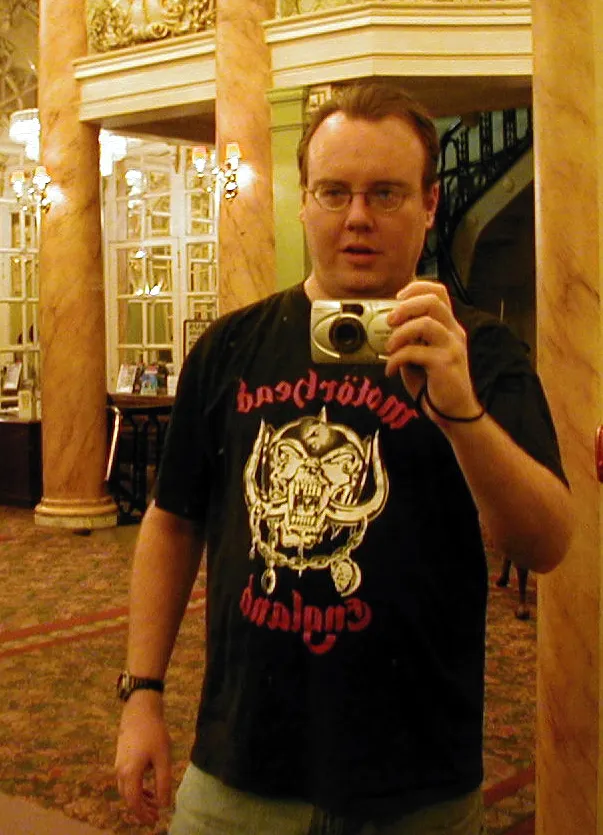
10 things I learned from the Lemmy documentary

motorhead

I’ve been a fan of the band Motörhead for over 25 years now.  When I was a freshman in high school, I used to watch the British comedy show The Young Ones on MTV, when they used to show it late Sunday nights, and one week, this weird metal band came on that sounded cool as hell.  I asked my friend Ray about it, and he told me their lead singer Lemmy was god, and then proceeded to make me a dub of the No Remorse double album collection, which I promptly burned into my brain with roughly 40,000 repeat listens over the next few months.  Over the years, I’ve collected their albums, and although I’m not as militant about it as Ray, they’ve been one of the bands in a constant rotation in the player.

I heard about this documentary, simply called Lemmy, also the stage name of one Ian Kilmister.  He’s been the one constant member of the band since 1975, singing, playing bass, and writing songs.  I didn’t rush to the theater to see it, but I filed away a mental note to look for it when it came through on NetFlix or whatever, and it popped up on cable recently, so I DVRed it and got a chance to watch it last night.

I had mixed feelings about the movie.  It was executed well, and wasn’t just a typical rehash of everything I already knew about the guy, which was a huge plus.  But it was also somewhat depressing, because it showed this human side of the legend, and it was a somewhat sad scene of this guy who’s instantly recognizable, but ultimately alone.  I could write more about that, but I’d rather summarize the movie by mentioning the new things I learned that were shown by Greg Olliver and Wes Orshoski’s work.  Here goes.

1) Lemmy lives in a shithole

This is the most popular takeaway from the movie.  Most people think rock stars live in giant mansions, and that is reinforced by all of the reality TV showing guys like Ozzy in giant 29-bedroom castles with indoor basketball courts and gold-plated crappers.  In reality, Lemmy’s lived in this completely shitty two-bedroom apartment in West Hollywood for over twenty years, apparently never cleaning it during that time period.

Now, I’m not expecting him to rent some huge penthouse like P. Diddy would hang out in, with chrome-plated everything and an indoor swimming pool.  But seriously, when I lived in LA, my apartment was at least seven orders of magnitude nicer than this place.  It’s like a scene from a Bukowski book, with the two-burner range from 1947 and a metal sink that’s been painted white a thousand times since World War II.  The outside courtyard is not bad looking, but it’s that generic two-story apartment building you see all over Los Angeles, the kind that looks like a motel built in the 1950s and never renovated.

All of you who have lived in New York City are probably a step ahead of me on this one, by asking, “well, how much is he paying, though?”  LA is rent-controlled, meaning his rent can only go up 6% a year.  He mentioned he’s paying about $900 a month in rent for a two-bedroom, which isn’t bad for LA.  (A quick google shows that the average 2011 rent for an apartment that size is around $1700.  I paid more than that in 2008, but my old apartment compared to Lemmy’s is about like comparing the Bellagio to one of those downtown Vegas motels where you shoot a snuff film.)  Of course, if the stories are true that he drinks a fifth of Jack Daniel’s a day, he’s probably spending a grand a month on booze.

2) Lemmy is a hoarder

The shocking part of the footage of Lemmy’s apartment is that every square inch is filled with Stuff.  There’s the usual rock start stuff, like gold records, trophies, and plaques, but there are also tons of Motörhead items, like records, posters, license plates, stickers, action figures, and pretty much any other thing carrying his personal brand.  There’s also wall-to-wall randomness, video tapes and albums that are completely unrelated to him.  And this isn’t one of those OCD collections where everything is perfectly lined up on identical racks, in dust-proof, airtight mylar bags.  There’s stuff strewn around like a crime scene, things stacked on top of other things, shit everywhere.

One complication is that Lemmy’s not being whisked to gigs in hermetically sealed limousines with a team of bodyguards and handlers; he’ll talk to pretty much anyone who comes up to him, sign anything, and is infinitely approachable.  And he has legions of loyal fans.  That means he’s got people at every show giving him paintings and figurines and demo tapes and macrame Ace of Spades murals.  And he seems to hang onto all of this stuff, which is somewhat endearing, although at some point, I would have either rented a storage unit or opened a Motörhead-themed bar with all of the stuff in glass cases.  The man is in serious need of an archivist.

3) Lemmy is into a lot of non-metal music

The movie starts with Lemmy going to Amoeba Records (I used to go there!) in search of the mono version of the Beatles box set.  (And he’s correct: fuck the stereo mix; get the real deal.)  He talks about seeing the Beatles back when he was a teen in Liverpool, and also discusses his love of Little Richard during a couple of different conversations.  (Billy Bob Thornton and Dave Grohl, in two different bits, talk about meeting LR, and Lemmy enjoys those stories immensely.)

He also plays in a band called The Head Cat, which is a rockabilly supergroup with Slim Jim Phantom of the Stray Cats.  It is seriously surreal to see Lemmy, the guy usually belting out songs like “Killed by Death” and “Deaf Forever” knocking out the Carl Perkins song “Matchbox” while a bunch of old people dance at some random casino in upstate Wisconsin.  (Go here to listen to some of this.)

Henry Rollins (seriously, there are so many god damn appearances by people in this movie!) sums up the whole thing by mentioning that Lemmy was around before there was rock and roll; he grew up listening to Rosemary Clooney records, and then one day, these four kids from Liverpool and this hip-swaying dude from Memphis blew the doors wide open.  And it’s true that the best music ever is the first music you hear, the stuff you lock into when you’re a teenager, and for him, that isn’t the Sex Pistols or Elvis Costello or Velvet Underground; it’s Buddy Holly and Eddie Cochran and Johnny Cash.  I really dug the hell out of Lemmy being so into the classics like that; it shows that he loves music, and he’s not just into this to be another SKU number in a database.

4) Lemmy has diabetes

The movie shows Lemmy drinking, smoking, and eating fried foods.  It starts with a scene of him meticulously slicing potatoes into fries (he probably calls them chips) and deep frying them in a pan.  It doesn’t show him doing drugs, but implies that he does.  And then in a later scene, he’s taking some pills in a recording studio, and when the producer asks if they’re drugs or vitamins, he says they are medications for diabetes and blood pressure.

This shows the odd paradox that he’s like Keith Richards and Ozzy in the sense that he’s spent the last 50 years shoveling down all things bad for your body, with almost no tangible effect on his longevity or ability to churn out a new album every year and play in 200-some odd cities.  But it shows the twist to this, the human side, of a guy who’s well past the halfway mark and will someday soon be staring down the grim reaper.

This also conjures up strange images of Lemmy at a doctor’s office, paging through a years-old People magazine, waiting for an internist, who then asks him all of the typical questions about diet and exercise.  My health is not at Charles Atlas levels,  and I can’t go to a foot doctor about a hangnail without getting a prescription for Lipitor and a scathing 40-minute lecture about how I’m supposed to exercise 9 hours a day and eat less than 9 grams of fat a month.  I can’t imagine the dressing-down he must get every time he comes in to get his scripts refilled.

5) Lemmy practically lives at the Rainbow

One of the other reasons Lemmy’s got the shithole apartment is that it’s stumbling distance from the Rainbow Bar on the Sunset Strip.  And apparently, he’s always there, sitting at the bar playing one of those video trivia machines.  The Rainbow is a big rock hangout, and has been forever.  And you always hear about how back in the day, it was stylish for these non-music Hollywood types to make their token “I’m a bad boy” appearance there.  But you know how some dive bars always have that one creepy old guy that sits at the bar and stares at the wall for dozens of hours at a time, eating peanuts and nursing beer after beer?  Well, at the Rainbow, that guy is Lemmy.

6) Lemmy has a kid

He’s probably got more than one kid, but the movie features Paul Inder, who is his adult son.  He mentions that Paul’s mom Patricia was some kind of groupie who had dated John Lennon before she knew Lemmy, which is a pretty odd connection.

What’s strange is how close Lemmy appears to his son.  When he’s asked what his most valued thing in the apartment is, he says it’s Paul.  Although Lemmy apparently had never seen the kid for the first six years of his life, the two seem like the best of friends now.

7) Lemmy is obsessed with gambling

There’s a scene showing Lemmy parked at a slot machine, and someone talking about how he’d sit in front of the one-armed bandit all day, compulsively pulling the lever, over and over.  In fact, it’s rumored that he got the name Lemmy because he was always asking people “Lemme have a fiver” to pay off his gambling debts.

It’s a bit of a recurring theme; he’s either hunched over a gambling machine or a trivia game or a video game system at several points in the film.  It makes me think he’s got one of those OCD personalities where he gets locked into stuff like this and can’t put it down.  I sure hope he doesn’t get an iPhone with Angry Birds installed, or we may never see another new Motörhead album again.

8) Lemmy’s stepdad was a football player

I don’t think this was mentioned in the movie, but I was cruising wikipedia as I was watching and saw this.  His dad was an RAF chaplain and split when he was three months old, and he was largely raised by his mom and grandparents.  But when he was ten, his mom remarried to George Willis, who played soccer (football) for a decade or so in the 40s and 50s.

9) Lemmy roadied for Jimi Hendrix

He actually used to live with bassist Noel Redding, and roadied for the Experience back when they were London-based, in 1967-1968.  He tells a story about how he used to score drugs for Jimi, and he would take acid daily.

The story of him being a roadie also shows how much he loved music back as a teen.  When he couldn’t be the one making or playing the music, he was just has happy lugging gear for the people who did.

(Also not mentioned: Lemmy was also a roadie for The Nice, which was Keith Emerson’s band that was the forerunner to ELP.)

10) Lemmy is obsessed with Axe body spray

Maybe obsessed is a strong word, but there are multiple times that show him dousing himself with the stuff.  And it’s not just any cologne spray — the film is careful to display that it is specifically Axe body spray, the spray of the douches.  I’d expect the guys in Maroon 5 or Nickelback or something to be frequent users, but not Lemmy. He seems like the kind of guy who maybe uses some Old Spice (one of the original scents, not the new trendy crap), or just goes around reeking to high hell.  I’d expect him to smell like stale Marlboros, burned motor oil, and old leather, not Intense Phoenix or some shit.

Overall, this was an interesting movie.  I mean, the day-to-day stuff was a good look at the man’s life; the endless line of celebrities fawning over him got a little old, but emphasized the point of his importance in the metal world.  But like I said, it ultimately saddened me to some degree.  It made me hope he’s happy with what he does, because he’s not reaping huge financial or material rewards, and although he’s got a certain amount of respect and admiration, it’s not like he’s going to cross over and become known for anything other than being what he is.

Remember when Best Buy sold CDs?

I go out for lunch maybe once a week, usually on the day of a day game when I want to catch a few innings in the car on my iPhone.  There aren’t many lunch places near work, but there’s a cluster of big-box stores, a sort of mini-mall that was plopped in place a few years ago, and when I’m done eating, I’ll sometimes wander the stores a bit.  One of the stores is a Best Buy, and the other day, I decided I was sick of all my music and I needed a new album. That typically involves going to iTunes and clicking away, but for whatever reason, I decided to go old-school and actually browse the racks at the big blue box store.

I was surprised to see there’s not really a CD section in Best Buy anymore. I mean, there is a token three or four racks, but it used to be that each of the bins would have maybe a row of 30-40 CDs, and there would be side-to-side bins for dozens of feet, and maybe a dozen aisles like that. Now, there were maybe three aisles, and each rack held exactly one CD. We’re talking about maybe as many CDs as the average Flying J truck stop holds, between the CB radios and coolers of pre-made sandwiches and beef jerky. And the selection - we’re talking about only the most popular of the most popular music; the most obscure thing they had there was maybe Guns N’ Roses.  Almost all of the titles were more expensive, although there was a token section of $6.99 albums.  But the selection part is what killed me. It seemed like overnight, they completely collapsed.  It’s like if the Strand went from 18 miles of books to a layout like one of those airport book stores.

I used to spend a lot of time at Best Buy.  In Seattle, I was hooked on Silver Platters, and used to go there twice a week for my CD addiction. In New York, I never fully found an indie place that met my needs like they did. I worked above a Virgin Megastore for almost two years, and while their prices were sometimes spendy, you could sometimes pick up good deals there, and they did have some slightly obscure death metal stuff.  And there was always Tower.  But I somehow always gravitated to Best Buy, maybe because I could also grab DVDs, video games, and ogle the new home theater stuff.

There wasn’t a Best Buy close to my place in Astoria, but there was one maybe a mile and a half south of me.  The subway didn’t run down there, so my Saturday ritual involved a walk down Steinway to Northern, headphones on, to go blow through part of a paycheck and stock up on digital media.  I’d usually have no shopping list, and would just run through the A-Z, picking out a couple of albums that looked interesting.  I’d do the same with movies, trying to think of a couple of titles that would hold my interest and give me something to do that night.  I’d have to deal with the crowds loitering around on Steinway, and push myself past a bunch of people or take a side street, but the walk gave me a routine.  And halfway between the two places was a Papaya King, so I could get some of their grilled hotdogs and a fruit drink.  (There’s one thing I do miss about New York.)

When the weather wasn’t as good and I didn’t feel like braving the walk, I’d get on a train and head to Chelsea, where they opened a big Best Buy there.  I guess it wasn’t any faster, and maybe the walk on either side of that trip almost added up to the distance from my apartment to Northern, but it got me out of the house and into Manhattan.  And I got a couple of hours of time to read and listen to music on headphones. Plus the subway is heated, and half the damn time my apartment wasn’t, thanks to my shithead landlord.

But here’s the thing: I eventually figured out this wasn’t a routine, it was a psychological problem.  I had this gaping hole in my life, and I tried to fill it by collecting stuff.  And my poison was a 12-centimeter disc of plastic and aluminum.  And I didn’t think anything of it, but I spent a lot of my time and money collecting DVDs and CDs.  And I know, what’s the harm in CDs?  It’s not like I was smoking crack or shooting heroin.  But there is a certain psychic impact on getting locked into a collection like that, and it’s hard to see how nuts you are until you go a couple of years without dropping hundreds of bucks a week on music, or having an entire apartment that’s wall-to-wall CD racks.  I guess a big part of it is you’re always running toward a goal you can never catch.  You’re always buying more music, thinking you’ll get to some mystical state where you have “enough” music, where you’ll always have something to listen to.  But you get to a stage where you have enough CDs that if you actually listened to them all end-to-end, 24 hours a day, it would take you months to finish, yet you are perpetually in a state where you have “nothing” to listen to, and it takes you 20 minutes to leave the house because you can’t pick out a couple of albums to take with you.  (This was pre-iPod, when I did not carry around my entire music collection in my pocket.)

I don’t remember the last DVD I actually bought.  With movies, it’s much more of  a moot point - we have a NetFlix account and a Roku box and a DVR and on demand, so any time I want to watch something, I watch it once, and then that’s it.  I don’t spend $40 on it, watch it once, and then lose that amount of storage space in my apartment forever.  It makes no sense for me to ever buy a DVD.  Even if I really love a movie, I’m not going to watch it more than once or twice a year, so why give up the storage space and money to keep a copy on hand?  I still have a few DVDs, but I put them in binders, which is also a big collector no-no.  Part of the fetish is to have the original packaging, the entire article, and not throw out the cases and keep only the booklets in a binder.  That’s a cardinal sin, but it’s not like I’m going to resell my DVDs, so I don’t care.  In the shelf area that used to hold maybe a dozen DVD boxes, I have three binders that hold maybe a hundred titles.

As far as CDs go, I use iTunes a lot, and the instant gratification there sort of kills going to the store, especially when a $16.99 CD at Best Buy costs you ten bucks online.  Sure, I don’t get the physical case, the printed book, but that’s more collector-ism for you.  There was a time where I thought I NEEDED the physical disc in a rack on the wall, but do I?  I buy songs and albums to listen to them; I don’t buy they to pay some allegiance to a band, to have their entire collection, even if I don’t like some of the songs or albums.

So I went through the racks at the Best Buy, and found a Peter Gabriel album I didn’t have, a collection of covers he did.  I felt bad about buying nothing and leaving, but I also felt bad about buying something.  It felt like dieting for years and then ending up at a McDonald’s and getting the old meal you used to eat five times a week, and then getting sick off of it.  I don’t even have a place to put CDs anymore, and as I opened up the plastic, I realized I’ve probably only listened to a CD in my car maybe twice.  I was firmly in the iTunes camp by the time I got this car in 07, and I’ve only used the iPod connector, and the occasional AM radio scan for traffic or a local ball game.  So it felt weird to listen to the CD, and didn’t compel me to return and buy a hundred more.  Always weird when you realize an era has ended for you.

Cardiac arrest is self-expression

Peter Steele, the bassist and singer of Type O Negative died on Wednesday, something that came completely out of left field for me.  He was only 48, and apparently died of heart failure after a short illness.  It took a few google searches for this to really sink in, since he (or maybe his record label) hoaxed his death in 2005 for an album release, and he’s got a pretty morbid sense of humor.  But I guess he had health and substance abuse problems, and it’s been confirmed by many sources, so I guess it’s true.

Type O Negative (and his earlier band, Carnivore) are pretty intertwined with my life in college and in the 90s.  When I worked at WQAX, my biggest “get” interview-wise was a phone interview with him on the air.  I have a tape of this somewhere, and I ran it in my zine. (You can read it here.)  He was pretty hilarious and odd on the phone; I was incredibly intimidated going into the interview, and then didn’t think it was going to happen, because they were late calling, and the manager I was dealing with seemed a bit flaky.  But as I sat in that shithole apartment of a studio, I got the phone call from New York, and we went on the air and got started.  He was not serious about any of the questions, and gave hilarious answers to everything, even when I started throwing out bizarre questions.  It was such a refreshing change from pretty much every other death metal or thrash metal band I interviewed, who pretty much ran through the same ten questions with an incredible seriousness, telling me their influences (always the same list of bands), the reasons their music was heavier than anyone else’s, why they hated Metallica, and how much the PMRC sucked.  But Pete was truly entertaining, and realized this wasn’t about looking cool and brutal; it was entertainment.

I remember first hearing Type O Negative in the fall of 1991.  Ray came down to Bloomington to visit for a weekend, and I was dating Jo at the time, and the two of them were fighting the entire time, both trying to out-whatever the other and assert control over the situation.  I hung out on a Saturday afternoon with him, while she was off doing something.  We went to the Fine Arts computer lab, where they had the super-high-tech Mac IIfx computers with giant dual-screen monitors, color laserprinters, and color flatbed scanners, the first time I’d ever seen any of those things in real life.  The computers had this brand new program called Photoshop, which you could use to edit images.  It came with a sample image of nine babies lying in cribs, a sort of top-down artsy shot of a hospital nursery.  We used the clunky 1.0 features of the Adobe program to demonize the kids; one had a severed head; one had a Manson-style swastika on the forehead; another puked blood.  We made color printouts, then went out to a dreary-sky campus and drove to Pizza Express on 10th street to get a pizza for lunch.  We ate in Ray’s car, and he produced this tape with a grainy green cover that vaguely looked like a poor night-vision snapshot of sexual penetration, entitled Slow, Deep, and Hard.  “This is the fucking heaviest thing you’ve ever heard,” he said.  “It makes Black Sabbath sound like, fuckin’, Charlie Brown.”

And he was right.  I fell in love with the album and bought my own copy of the tape that day.  A big part of that love was that I was going through a really rough patch of life then, a caustic relationship with someone who constantly played mind games with me and caused me to go into deep cycles of depression.  And here was this music that was both extremely depressing - talking about infidelity, suicide, depression, you name it - but also had a lot of black humor to it, a very clever and dark twist on the darkest part of life.  I spent so much time poring over that album, just absolutely bathing in its negative emotion, using it as a soundtrack for this ugly tail-end of a relationship.

I spent all of the summer of 92 listening to Type O Negative, as documented in Summer Rain. I got a Type O Negative pin in the mail from the band, after I did the interview, and I wore it on the lapel of my leather jacket for years, serving as a sort of litmus test for people who actually knew the band.  Bloody Kisses came out in 93, and I was thanked in the album (albeit misspelled) and also memorized this one, listening to it constantly on those long walks across campus with nothing but my Aiwa walkman to keep me sane.  After my bad breakup in the fall of 93, that album kept at my brain constantly, and it was somewhat ironic that the band actually gained incredible success, with Bloody Kisses eventually going gold and then platinum.

Their 1996 release October Rust also burrowed a permanent position into my brain when it came out. I know it’s stupid that in 1996, I was still morose over a breakup that happened three years before, but I was in such an extreme state of angst about having nothing going on dating-wise and being alone in a new city.  The album became this touchstone to that era three years before, and in a way, reopened many of the wounds, splashing them with rubbing alcohol and stinging them back to life.  I absolutely loved this album, every part of it, even though the band had almost completely moved away from their original metal origins.

I never got into the band’s later work, but those first three albums are still in constant rotation in the iTunes library, and probably at least once a day, one of them comes up during my drive to work or while I’m at the computer.  So it was shocking and sad to hear the news about his death.  It’s also weird to go back over his lyrics post-mortem, because they all talk about death and dying and killing and suicide in such a heavy and tongue-in-cheek way.

I don’t really know how to end this post without sounding stupid or sappy, and I keep wandering to my iTunes library to look things up, so I better wrap this up here.