The Wrath of Kon

Dispatches, thoughts, and miscellanea from writer Jon Konrath

Tag: writing

My Writing Process, 2014 Edition

Okay, so there’s this thing going around, a #MyWritingProcessTour thing, and you know how these memes work - someone nominates you to answer a bunch of questions, you nominate a few other people to do the same, and so on.  I’ve written a lot about process here, and I talked about it in an interview last year, but the tools always slightly change, and so does the writing structure, so maybe it’s a good time to visit the topic again.

I was nominated by Sam Snoek-Brown - go check out his answers there, and also take a look at his latest chapbook, Box Cutters, over on Amazon.  Okay, on to the questions.

What Am I Working On?

I just published Atmospheres in the beginning of March, and I should be publicizing that, but that didn’t work out and I fell into a deep post-partum depression, like I always do.  I stumbled with writing something similar, which started to catch, but it’s hard to plod forward on a book that’s essentially the same as one you just wrote that didn’t sell.  (And I know this isn’t about how many books I sell, but it wouldn’t be bad if a few people actually read them.)

Anyway, I sat around the house watching old movies and taking notes.  Even though I’ve burned a lot of cycles writing about how books don’t need plot and we’re all fucked because plot is a crutch for dumb readers and eventually all novelists will be doing nothing more than writing the book equivalent of stupid half-hour sitcoms, I still have this sick desire to write a well-crafted, heavily-plotted novel.  About once a year, I get this bug stuck in my ass and come up with a half-baked idea and start writing it and then flame out after 50,000 words, a solid Act 1, a broken Act 2, and 17 words of an outline of an Act 3.

(I don’t know what the desire is on doing this.  I think part of it is that I get so much shit for writing “plotless” books, as if that’s a pejorative term, and I think it isn’t.  But every time I get that, I feel like writing a heavily plotted book as a big fuck-you to show that I can do it, and then I’d write another ten books that didn’t do this.  Because I can; it’s just I feel like I’m not pushing the envelope when I do.)

Well, right now I have an 80%-baked idea, and just started work on it, and have a much more solid outline and the first 10,000 on it.  That’s about all I can say about it right now, but if it still has momentum in a month, it could be good.

How Does My Work Differ From Others of its Genre?

I don’t really fit into any particular genre, so I don’t know how to answer this.  I can probably answer by saying why my work doesn’t fit into specific genres or communities, and that would define the differences in my writing.  So:

  • I don’t write genre fiction, so I don’t write high-concept stuff that can easily be pitched.
  • I feel like most experimental writing is an academic study in form, and not necessarily written to be entertaining. While I think that kind of writing is important, I’m not an academic, and I write to entertain, so I think the readability level is much higher in my work.
  • I’m often called an absurdist, but there’s a fine line between satirists and absurdism (i.e. Vonnegut, Heller, Tom Robbins, etc.) and I think when people think of absurdism, they’re really thinking satire. I think more of the Dada and surrealism movements in art, but the word surrealism has been overloaded and destroyed in modern culture to the point of meaningless, and I think any time someone sees something weird or freaky or psychedelic, they call it surreal, (i.e. locking a bunch of has-been celebrities in a house and making a reality TV show is “surreal” now.)
  • I’m often lumped into the Bizarro fiction world, but I haven’t published anything with Eraserhead or their imprints, which is the difference between bizarro and Bizarro.  I also feel like at this point, half of bizarro is horror fiction with a certain Troma-esque sense of humor, or it’s a very set form of “let’s take Adventures of Huckleberry Finn, and make Tom Sawyer a talking anthropomorphic penis, and it’s set in Nazi Germany” and that’s that.  There are exceptions to the rule, but I’ve never fell into the groove with that, and I don’t write horror.

Why Do I Write What I Do?

I wrote a big post called Why I Write, which partially answers this.  If I were to riff on this for a minute, I’d give the stock answer of “I write what I would want to read” which is a bit of a cop-out, but is true. I mean, when I read or re-read a classic book like Naked Lunch or a more contemporary one like any of Mark Leyner’s stuff, I always think “I really like this — who is writing more stuff like this?” and the answer is nobody.  So, that’s what I need to write.

How Does My Writing Process Work?

Okay, here is the rundown, 2014 edition.

First, I write here and write on Facebook and twitter, and those don’t really feed into my actual writing; they are just distractions.  I also keep a personal journal, handwritten in little moleskine books, and I try to write in that every single day, but it’s mostly just about day-to-day happenings and not about writing, except maybe how much I did or did not do.

I use a MacBook Pro, iPhone, and iPad, and I use the Notes app to keep track of ideas or write down things as they happen in the wild, like little phrases or title ideas or things to research later.  These sync across all of the devices, and I currently sync them through Gmail, which means in theory I can access them even if I’m somehow away from all three things but still at a computer.  (I might research how to change this to iCloud, because every time I rely on a Google service for something, they decide to cancel it.)

I use Scrivener for everything.  So I have a big Scrivener catch-all project that contains nothing but bits and pieces, leftovers from published books and ideas for characters and lists of random objects and places and little phrases I want somebody to say at some point and title ideas.  It’s basically a hoarder’s house of words.  Every month or so, I scoop out the running Notes file of ideas and drop it in there.  When I have time, I sometimes move the pieces into the proper places, and if I was smart, I’d do that religiously.  But I’m not.  I am about 17% confident that the best ideas float back out of the scratch project when I skim it looking for things to rip off in a current project.  And I’m learning that not every idea that comes out of my head is golden and 90% of them should probably die.  But that’s always a struggle.

For writing plotted stuff: I will probably go into this in greater detail after the book is done.  But I’m using a program called Scapple, which is by the same company as Scrivener, and it’s a sort of mind mapping thing.  You draw little circles on a big blank canvas and put text in them and connect them together and shuffle them around.  Once you get the order correct, you can either export it into OPML, or just drag and drop it into Scrivener.

Scrivener uses this concept of scrivenings, which are little chunks of text.  You can view all of the scrivs sequentially, like a big, flat file.  You can then create folders and a hierarchy and move them all around and give each one a cute title and have them be your chapters or parts of chapters or scenes or whatever.  You can also switch to an outline mode, or to an index card mode, that uses a different piece of text per scriv (a short description) so you can plot your story and move things around.  It’s confusing until you get the hang of it, and then you never want to go back.

For plotted stuff, I moved the Scapple map I plotted out and dropped it into Scrivener, where each little scene bubble became a scriv.  Then I organized things by Act and got the order all correct, and started writing from page one, sequentially.  When I get done, I can shoot the whole thing out in .DOC format or whatever.  I use Apple Pages instead of Word for layout, because I hate word.  And Scrivener is able to output eBooks pretty much perfectly, so that’s what I do.

When I do the more non-linear writing, I typically have a project and I free-write every day, 500 or 1000 words.  When I wrote Atmospheres, I would listen to the Sleep album Dopesmoker all the way through every day, and write, with my only rule being that I couldn’t write about not writing. I mix in pieces that are in that scratch project, and I later cut out bits and pieces and split things up.  Sometimes, I’ll write for a given day, and I’ll split out a single paragraph or even sentence from that entry, and create a new scriv from it, maybe gluing in pieces from another one, and eventually fill it out until it’s a longer piece.  It’s like songwriting, collecting riffs and eventually gluing them together and smoothing them out until something larger appears.  This takes forever, but it would take longer if I was doing it in another program.

I usually have a hair-brained scheme involving color tags on the project outline that determines what’s part-done and what’s almost-done and what needs a total redo.  I also set up a NO folder outside the project and start chucking things into it that I can’t look at anymore.  Eventually it comes down to PDFs that are printed and red-penned and mailed to readers for comments.

Okay, I’m supposed to tag a bunch of people here to answer the same questions.  I have not asked any of them to do it, so they probably won’t but here you go:

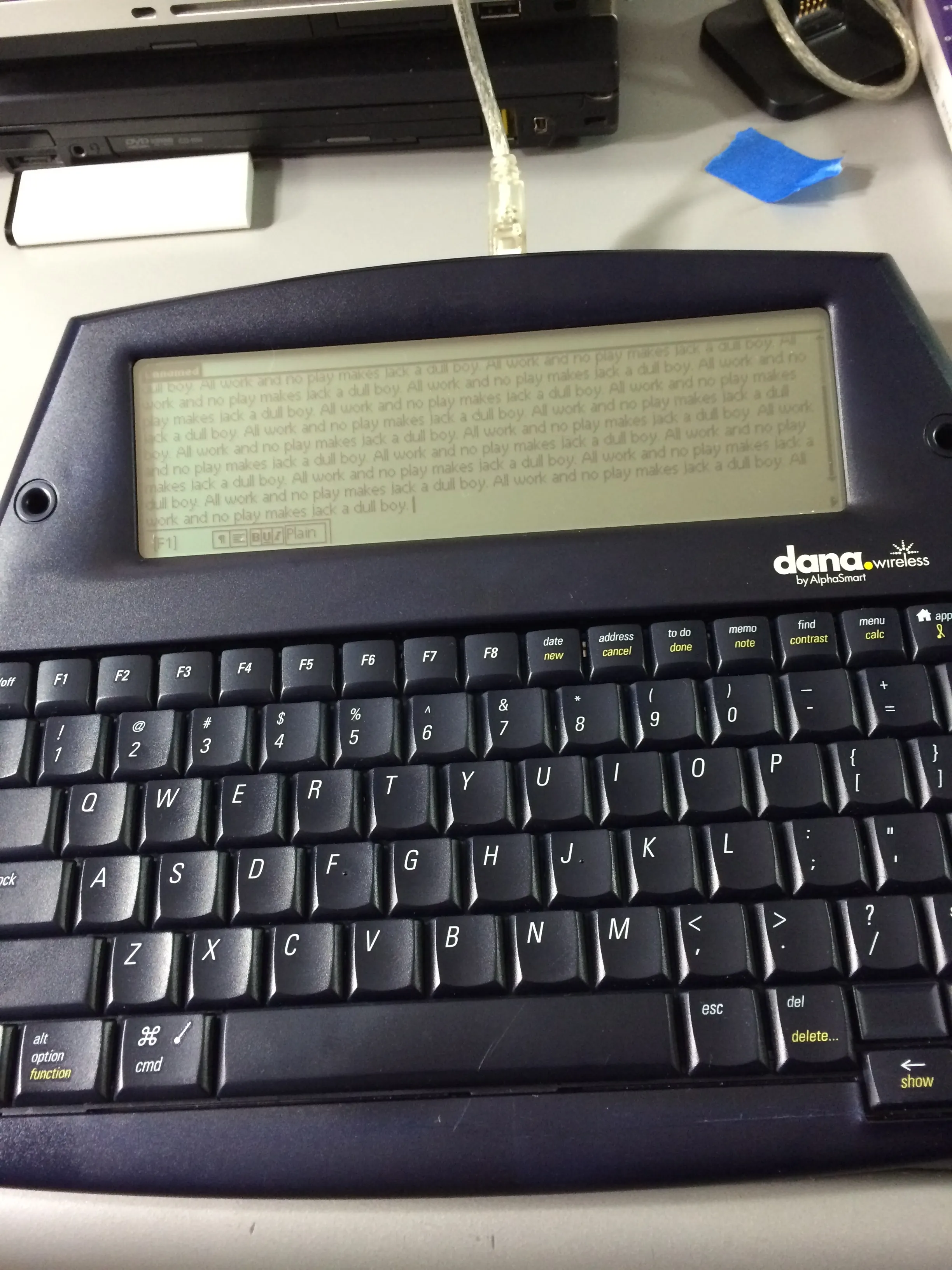
AlphaSmart and distraction-free writing

IMG_2220

It has been impossible for me to write lately without spending time fucking around, checking the web, reading through old email, whatever. So I am trying something new: writing on an AlphaSmart Dana word processor.

The Dana is essentially an overgrown Palm Pilot, glued to a full-sized keyboard.  It has a monochrome touch screen that’s about as big as two iPhone displays next to each other, and no moving parts other than the keyboard.  There’s some amount of flash memory inside, and two SD card slots.  It runs on AA batteries, which last about 25 hours, or you can use a rechargeable battery stick.  A USB plug on the back can charge it and lets you hook it up to a computer.

Because it runs PalmOS, it can run old Palm apps.  But I don’t care about that, and haven’t messed with it.  It comes with its own word processor, and I only need to use that.  I don’t care about the address book or calendar or any of the other things on it.  The word processor holds eight files that you cycle through with the F-keys, and has some basic formatting stuff.  It also does word count, which is about all I really need.

The keyboard itself is pretty nice, full-sized without any weird key combinations.  The entire unit weighs about two pounds, and is wide enough that it can sit on your lap without any trouble.  It’s bigger than an iPad, but smaller than a MacBook Pro.  (Maybe it’s about the size of a MacBook Air.)  The keys do have limited travel, but it’s about like typing on a Dell laptop. The screen itself isn’t great, but it’s functional.  I’m a little worried about looking down at it, since I have a bad neck, but I guess I can not look at it when I’m typing.  The touch screen is the kind that needs a stylus, and I’ve forgotten how much the old Palm screens suck, compared to a modern capacitive-touch glass screen.  The backlight is also the greenish kind the Palm had, which is not great and eats batteries, but it’s there if you are on a plane or in the dark.

The coolest thing about the Dana is how you get files to your computer.  It has an IRDA blaster for IR, not that any computer I have can use IRDA anymore.  You could also pop out the SD cards and put them in your computer, but I think it saves files in the *.PDB format, which would involve some dickery to convert them to something I could use.  You can also set up Palm Sync and sync the docs that way, but I don’t even know if they make Mavericks-compatible sync software anymore.  There are other word processors out there for Palm, and software on the Mac end to futz with it, but forget all of that.  I want it to just work, and it does.

Here’s the deal: when you hook this up to your computer, it looks like it’s a USB keyboard. You open a blank document on your computer, press a sync button on the Dana, and it beams over the current word processor document, as if the Dana is phantom typing it into your computer.  It takes a minute, but it dumps it straight into Scrivener (or Pages, or Word, or WordPress or whatever you have open) with no fuss.  I sat down yesterday and banged out a thousand-word journal entry, plugged it in, and done.

This doesn’t support a way to round-trip files back to the unit, but I don’t care about editing. I just want a text capture device, a way to sit in bed or on the couch, go into a trance state, and blow through the words, dumping them into a buffer.  It’s getting harder and harder for me to do this with old emails and book sales figures and wikipedia and everything else a click away.  I’ve tried turning off wireless, and installing blocker programs, but then I just end up reading through old files from 1997 or looking at old books of mine, and can’t get started.  So maybe this will work.

I thought about getting an actual typewriter, a Smith-Corona or whatever, but I don’t have an easy way to get the files into the computer, other than OCR scanning, which sucks.  Handwriting is an even worse proposition, unless I want to retype it, and I’d honestly rather slam my dick in a door repeatedly.  I’ve also thought about writing by dictation, but after listening to an hour of me saying “um um um” over and over, I’d jump off a bridge.  So this should work fine.

One thing that gets me about this is the Palm OS itself.  It reminds me so much of the late 90s and early 00s, my time with a Palm IIIx, standing on the subway reading early drafts of Rumored on the little screen and playing Dope Wars.  I tried writing with that, with a little clicky keyboard that folded up and was useless, and just journaling with the pen and the Graffiti function, which I never fully mastered.

I was just digging and found a backup of my Palm from 2002, a bunch of .pdb files.  I should figure out how to do something with them.

Twenty Years

I’m writing from the Maui airport, getting ready to board the big silver tube that shoots me across the Pacific and back to the land of wearing full-length pants and bitching about smog and seasonal depression. (And excuse the typos and formatting fuckups here - I’m typing on the extremely buggy Wordpress for iOS program, and actually writing this on an iPhone with an external keyboard, while old people in aloha shirts scream at flight attendants about not being able to bring 17 bags as their carry-on luggage.) It’s been a good vacation, albeit with little writing, and I missed a very big anniversary while I was gone.

I consider October 30, 1993 as the day I became a writer. I mean, I learned to put together words into sentences and paragraphs decades earlier, and I wrote short stories and term papers for classes before that, plus I did five issues of a zine of heavy metal record reviews. But that’s the day my life took a major turn and I decided to put pen to paper and start the long crawl of learning the craft and piecing together my first book.

The story is stupid, and I’ve told it before. Boy meets girl, boy loses girl, boy falls into an endless depression about said girl. But after a long run of failed relationships, I turned to brain-dumping my thoughts into spiral notebooks. I lived a few miles from campus and did not have a car, so I’d walk to work, walk to class, and had this patchwork schedule that involved enough time stuck on campus with nothing to do to go completely mad with boredom, but not enough time to hike home and then back. I guess I spent a lot of that time logged into VAXes in the public computer labs, but I found it cathartic to find a remote corner of the student union, sit down with my little notebook, and pour out words. I did not even know what I was writing about, I just felt a compulsion to write.

I started reading then, too. Vonnegut, Orwell, then I fell into a Henry Miller obsession, which led to Bukowski. I didn’t have tons of money, but I always found myself at the used book stores, digging around for paperbacks. I didn’t even have a real book collection at that time - maybe a single three-shelf bookcase with mostly computer books. But I started hoarding novels, and getting lost in the pages late at night, wondering how I’d pull together a novel like Kerouac, if I needed to split from Indiana and hit The Road.

My career in computer science fell apart around the same time. I was a horrible student, and could not deal with the math. A semester later, I dropped out of the program, and went over to general studies, so I could finish my degree by taking as many English classes as I could get into in my last year. I still worked with computers, helping people print their papers or whatever, but it was just a paycheck, another way to pay my rent and blow the rest on books.

It took me a couple of years to really get into the swing of things and apply myself, start my first book, and apply myself to write for hours a day. It didn’t start to fully click until I got to Seattle in 95 and had nothing to do every night except sit at the computer and type. And I guess the first book didn’t cross the transom until 2000. But I still consider 1993 as my start point, when I decided to do this.

I look back and it’s hard to imagine a time when I wasn’t a writer. In the worst of my writer’s block, when the frustration is so high that I seriously contemplate quitting all of this, I try to think back to what I did with my time before I was a writer, and I can’t even remember. I burned a lot of cycles with depression and relationships, and I guess I obsessed over music and computer programming, but there wasn’t any defining force like writing in my life.

I’ve now self-published nine books, and published a bunch of stories, some in anthologies or published elsewhere. I’ve met some great writers, and in the course of doing this, ended up reading hundreds of books, many of which have changed my life. I always feel a certain disappointment in my writing, that the last book wasn’t good enough, that I’m not progressing as fast as my other peers, and that sales are bleak. None of this thought is good, and I wish I could just stop it, but I can’t. I think a certain amount of it is helpful, in that it motivates me to keep writing. Regardless, I think I have found my momentum in the last few years, and I’ve been pretty productive and able to put out a lot of books. They don’t sell, and even worse, everyone assumes I’m making bank because some other guy with an almost exact same name as me is making millions writing detective stories, but that’s something I’m learning to ignore.

I’ve got a book almost done, and I’m just about done outlining the next big thing, which I am hoping I won’t self-publish myself, but will get someone else to do. I have a lot going on, and I’m always tired of looking back and falling into a huge nostalgia trap. But nice even numbers make you stop and think, and so I am.

Almost ready to get on the plane and lock into five hours of internet-free writing. There’s nothing I’d rather be doing. Thanks to everyone who has supported my work so far, and I hope to be doing this until the next big even number and beyond. Mahalo!

Why I Write

So the next book, which is titled Thunderbird, is done and moving through the steps in publishing.  The cover is ironed out, the interior is done, and the kindle version is being tested and tweaked.  It’s entering the phases of waiting on robots and meatgrinders to finish churning on what I gave them so I can approve the output and push it live, or make changes and wait another 12-296 hours for things to get stuck in a queue.  But, all of that’s good, and aside from all of the publicity stuff on the horizon I don’t want to deal with, this lets me shift my mind back to writing, and to the next book.

The next book - that’s always a tough one.  Each time I finish the current book, I do a post-mortem and try to figure out what went right and what went wrong, so I can figure out what should be next.  I don’t write genre fiction, so it’s not a matter of saying “what crazy adventure or sinister villain is Dirk Johnson, Vampire Gunslinger going to get into next time?” And I’ve given up on the modernist semi-autobiography stuff, so I’m not looking at a specific era of my life to strip-mine for ideas.  It’s usually a matter of thinking about form, and what container will be used to pour my ideas into to shape them into the linear thing we call a book.  And that’s always hard.

I don’t like traditional story structure.  I know you’re supposed to use it, and every self-publishing site talks about how it’s required for you to follow some plot arc of rising and falling action and blah blah blah.  If I was trying to write the next Wool, I would pay attention to that stuff.  But I’m not.  And you shouldn’t.  If you want to make white bread because being in Kroger is important to you, then by all means, make white bread.  But that’s not why I write.

I recently finished reading the JG Ballard Conversations book by the fine folks over at Re/Search, and there was an answer JGB gave during a Q/A for a book tour that really grabbed me.  It’s this:

“I’ve always assumed that for the imaginative writer, the exercise of the imagination is a sort of necessary part of the way the central nervous system functions.  This separates the imaginative writer from the realistic, naturalistic writer in a very important sense. […] It seems as if the imaginative writer’s nervous system needs to run a continuous series of updates on the perception of reality.  And just sort of living isn’t enough — one feels one needs to remake reality in order for it to be meaningful.

This.  This. This. This.

I started writing in 1993.  I mean, I always wrote, but that’s the point where I got a notebook and a pen and decided I was going to stop trying to play bass guitar and stop trying to write video games and stop trying to… whatever the hell I was trying to do twenty years ago, and really try to dedicate myself to getting the thoughts out of my fucked up head and onto paper.  I was chronically depressed, didn’t know who I was or what I was doing, but had this idea that I needed to process what was going on in my mind, and going to group therapy or trying to date the right person or take the right meds was not going to do it.  I didn’t know if I was going to write science fiction or romance or journalism or kid’s books; I didn’t think about money or career or the publishing game or becoming famous or rich or any of that.  I just knew I needed to write.

And what happened is that I became addicted to writing.  I did it every day, at first forcing myself, but then turning to it as a way to process my feelings, and exercise my imagination.  I didn’t do it as a form of work or craft, but as a method of therapy, and expression.  I did write some of that modernist creative nonfiction stuff about my life, with mixed success, but it wasn’t until I started exploring the fringes of experimentalism, when I started reading guys like Mark Leyner and Raymond Federman, that I found ways to transfer my subconscious onto a page in a way that worked.  And when I successfully do that, I think it not only produces a product that’s different than other stuff out there, but it makes me feel more complete as a human being, probably in the same way that building a boat out of raw lumber helps someone find themselves.  It’s very much a “journey not the destination” thing, but completing these projects and moving on to the next one helps me benchmark my progress.

On the days I can belt out a solid thousand or two words that works, I feel great.  On days when stupid appointments and unplanned emergencies eat up my time and prevent me from getting to the computer, I feel like total shit.  I’ve tried taking time off between books, time to go wander the town or just play bass and fuck off with video games, and I can’t do it.  I know it’s supposed to be helpful with writer’s block, and I do get crippling writer’s block, especially right after projects, but taking time away like that is like when you are forced to wake up every hour or so, and you never enter REM sleep and give your brain that time to heal or regenerate or process or whatever the hell REM sleep is supposed to do.  I feel like something in my subconscious is lethally gone, and I can’t sit still.  Even if I have no idea what I am going to write, I have to write.  Even if nothing is going on in life except 8 hours of work, 8 hours of sleep, a couple hours of dumb TV, and a few hours of showering, shitting, shaving, and cleaning up cat puke or whatever, I still need to find something to write about.

I don’t write to sell books.  I don’t write to further my literary career or hob-nob to a bigger publisher or better bragging rights or a more prestigious magazine to pick up my stories.  I hope some of you do check out my writing and maybe it entertains you.  But if this was a Twilight Zone episode where I was asleep in a bank vault during a nuclear war and the only one alive, the first thing I’d do (after breaking into a LensCrafters and making 20 backup pairs of glasses) would be to find a pen and a notebook and keep writing.  I don’t write to sell.  I don’t write to feed a publishing machine.  I write because I write.

Next book done

I finished my next book yesterday.

26 pieces.  38,845 words.  It has a title, but it may change.

I’m not really done done yet, because I have to come up with a cover (which I hate) and a book description (which I also hate) and maybe think about a new title.  I also have to do the interior design, which is easy.  But the text is done.  It’s not getting any extra stories, and it’s not getting reworked to add in that alien abduction subplot or love story.  It’s done.

The book is similar in structure to the last one, which means it was a clusterfuck to put together.  This kind of book is essentially plotless, short pieces or cogs or lumps that are put together from smaller pieces, paragraphs torn from free-writes or inspired by tweets or built up from notes taken on a phone.  The little scraps become big slices, and the slices get moved and rearranged and connected until they are big pieces.  And then the big pieces are arranged and reordered and sometimes split back apart and cannibalized and dropped.

To give you an idea of how much cutting was involved, at one point a little over a month ago, the 38K word manuscript was just over 100,000 words.

My last book was done on 6/25/12, and this one was born soon after that.  I actually had a few false starts on other things, ideas for books that fell apart after the outline stage.  I keep these outlines, and maybe later one of them will get revisited and become an actual book or story.  And I keep the scraps of writing that come out of them, and some of it ends up in other places.  A sizable chunk of this book is made from pieces of a stalled book about alien abduction.  Other parts are from an aborted book that examines my childhood in Indiana, which I stopped writing when I decided I didn’t want to write about childhood or Indiana.

The biggest drive on this book was to do another book similar to Rumored.  That didn’t really happen, but I started chasing that this January, and kept at a daily writing quota.  On 1/13 I had 47,252 words in this manuscript.  On 4/3, I had 100,390.  I wrote every single one of those days, even the days I was on vacation, off of work, or sick.  There’s a piece of advice attributed to Jerry Seinfeld (although I can’t find the exact quote from him, just thirdhand references) that the best way to get shit done is to set a daily goal, and then mark each day on a calendar that you do the goal, and aspire to not break the chain by skipping a day.  My initial goal was to stick with adding at least 500 words a day to this draft for a month, and I stretched that to almost three months before I shifted my focus from writing to editing.  So in that sense, the book is already a success.

I didn’t write another Rumored, and I didn’t write my Infinite Jest.  This book is about half the size of Rumored, and somewhere between my last two in length.  I think that’s fine.  But the eventual goal I keep chasing is to have a book that’s around 100,000 words long, and has a solid nonlinear structure, but still has enough plot to make people not freak the fuck out when they read it.  It won’t be a fully-plotted murder mystery thriller thing, because there are enough of those out there, and that’s not what I do. I don’t know what that is, but it’ll happen.

I’m now entering the horrible postpartum depression that always follows when I finish a book.  I always wonder if people will like a book after it’s done, and think about what should be next.  I still have all of these release-related tasks, and I’ll probably play a lot of bass just to think about anything but writing.  But I need to do some post-mortem and write down what did and didn’t work for this book, and then seriously start thinking about the next one.  I have some vague ideas, but nothing solid.  I need to get enough of an idea in front of me though that I can start up that Seinfeldian chain again.

Anyway, I’m happy to get the ninth notch carved in the wall.  (Nine books written?  Shit.)  More news on what’s happening with it when I can tell you more - stay tuned.