The Wrath of Kon

Dispatches, thoughts, and miscellanea from writer Jon Konrath

Tag: writing

The Feel of a Book

I really do wish I could switch to an all-digital book library, buy every print book in this house in some e-book format, and haul all of this shit to the goodwill, or sell it in the Amazon used section.  Someday, books will kill me, and I’m not talking about being buried alive via hoarding.  I mean, these books are all collecting dust mites, and I’m horribly allergic to dust mites, and I’m sure ten out of ten allergists would tell me, “well, just get rid of all of your books and watch more TV.”  And of course, 87% of the books I have here aren’t available on the Kindle, and even if they were, the second I’d buy all of them, they’d change the Kindle format to some incompatible thing and force me to re-buy everything, just like the whole vinyl > 8-Track > Cassette > CD > MiniDisc > DVD > BluRay > whatever trail of tears.

I tried remembering when my whole relationship with books started, and of course, I can’t.  My parents started buying me books before I can remember, those “I Can Read” books like Danny and the Dinosaur that you got from the grocery store or some mail-order club.  I remember being in the Weekly Reader book club, getting these corrugated cardboard mailers every week or two, containing another few hardcover books, each one getting progressively more advanced.  I thankfully learned to read before I started school.  I lived in a tiny village in Michigan with no kids as neighbors, in an age before cable, when an endless amount of adjustment to a set of rabbit ears got you four or maybe five channels of TV, so those books were my lifeline.

In thinking about this, I think one of the reasons I like to collect books is their physicality.  I’ve still got a couple of these Weekly Reader books, from almost forty years ago, and I loved the oil paintings in color on the cloth-bound hardcovers, a square spine and a design that is obviously very pre-Photoshop. Some books had spine lettering faintly embossed in a metallic gold color, and looked distinguished and official.  Some were paperbacks, the Choose Your Own Adventures and Encyclopedia Browns and pocket editions that felt the perfect size in your hand.  I devoured all of these books, and no matter how many of them showed up in our rural route mailbox, I always wanted more.

I always got locked into these series books, things like junior encyclopedia, where they’d sell the first volume at Kroger and then swindle you into mailing away for the next twenty.  I remember this junior history series I had, an endless collection of books on American events like the construction of the White House or the battle of Iwo Jima.  My parents would sometimes go to a friend’s house to play euchre, plop us in front of a TV in their living room, and hope we’d fall asleep eventually.  I would always drag along a huge collection of these books, so that instead of watching a Love Boat re-run, I could read the illustrated history of the Washington Monument or the D-Day invasion.  And I would always have to bring an entire armload of them, partly because I felt a need to always have access to every volume (this predates Wikipedia by a few decades) but also because I enjoyed the physical feeling of having all of these books, the weight and feel of these perfectly square books filled with illustrations and maps and pages that smelled like fresh paper and ink.

I always wonder about this with kids that are being born right now and handed an iPad thirty seconds after they leave the womb.  There’s something magical about being able to zap an animated book filled with background music and hyperlinks to your kid, but are they missing something by not having an actual, physical book in their hands?  A device that plays Angry Birds and shows videos is pretty cool, but do you miss out on something that you get by hoarding these little bits of dead tree?

I do like loading up my Kindle with books before I get on a plane.  And most of the books I sell are on the Kindle.  But it doesn’t feel like I’ve “bought” a book unless I have it sitting on a shelf, and I like the physical rituals of either going to stores or having a delivery person hand me a cardboard mailer filled with books.  I also don’t like that I always hold the same device when I’m reading different books, the same size and weight and thickness, and I’m even deduced to the same exact font and margins. I’m not pro- or anti- on the e-book, but it makes me hesitate before I buy anything, and I end up purchasing the best stuff twice.  I can’t seem to fully jump on either bandwagon, which means I probably will either be buying a spacesuit to keep out the dust mites, or googling away to find clinical trials of some new steroid treatment to keep my eyes from swelling shut.

Fieldstones and Moleskines

I know I said I don’t do new year resolutions, and I don’t.  But one of the things I’ve been trying to do - it’s more of a course-correction for my post-40 memory loss - is writing down every damn thing that pops in my head, with hopes of later mining this stuff for story ideas.  I know it’s something I should have started doing decades ago, but it’s something I’ve been trying to be militant about.

I just read this book,Weinberg on Writing, which talks about his “fieldstone” method.  The analogy has to do with those fieldstone walls you see on old farms.  (Watch the last five minutes of Shawshank next time it’s on TBS; they run it pretty much daily.  There’s a nice fieldstone wall in that.)  When a farmer builds one of those walls, they don’t go to Wally World and say “gimme a thousand yards of stones.”  They plow the fields, and when they hit a big stone, they pull it aside and save it.  After years of doing this, you have enough stones to build some fencing, or a nice fireplace hearth or wellhouse.  It takes time to find the right stones to fit the odd cracks and holes, but if you’re always looking, you never know when you’ll find it.

Most of the art of writing has to do with dragging your subconscious mind into your conscious mind and then dumping it onto pages in a way that can transfer into someone else’s conscious mind and creep into their subconsciousness.  Anyone that tells you it’s about marketing or the three-act structure or hitting plot points or what your cover looks like is full of bullshit.  That’s about selling books.  Salvador Dali wasn’t a genius because he painted the crying clowns and prairie field landscapes that he knew would sell; he was a genius because he would have fucked up dreams and then immediately paint them with no censorship or conscious thought, and those paintings haunt you and are hard to shake because they drill into the bottom of your mind.

The problem is, you can’t sit at a blank page and consciously think, “okay, let’s dump my unconscious mind into this buffer.”  You just see fits and spurts of what you need: while you’re in the shower, when you’re cleaning up cat shit, when you’re stuck in an endless meeting.  Something pops into your head, and it would be awesome in a story.  And then, if you’re above 40 and have spent your lifetime drinking from aluminum cans, it’s gone in ten seconds.

This requires some way to always capture this shit.  The current strategy is a three-pronged approach:

  1. The iPhone notes program.  It’s pretty easy to use; it syncs up with IMAP in my gmail account, so I can also get at it from my Mac or my iPad, making cut/paste pretty easy.  The downside is typing with my thumbs, and it’s not always easy to whip out a phone and tap away.

  2. A google docs document that does the same as above.  I use this less and less, but there are times where I’m not at any of the above three iOS machines, or where I need to cut/paste in something sizable, like a big chunk of an article.

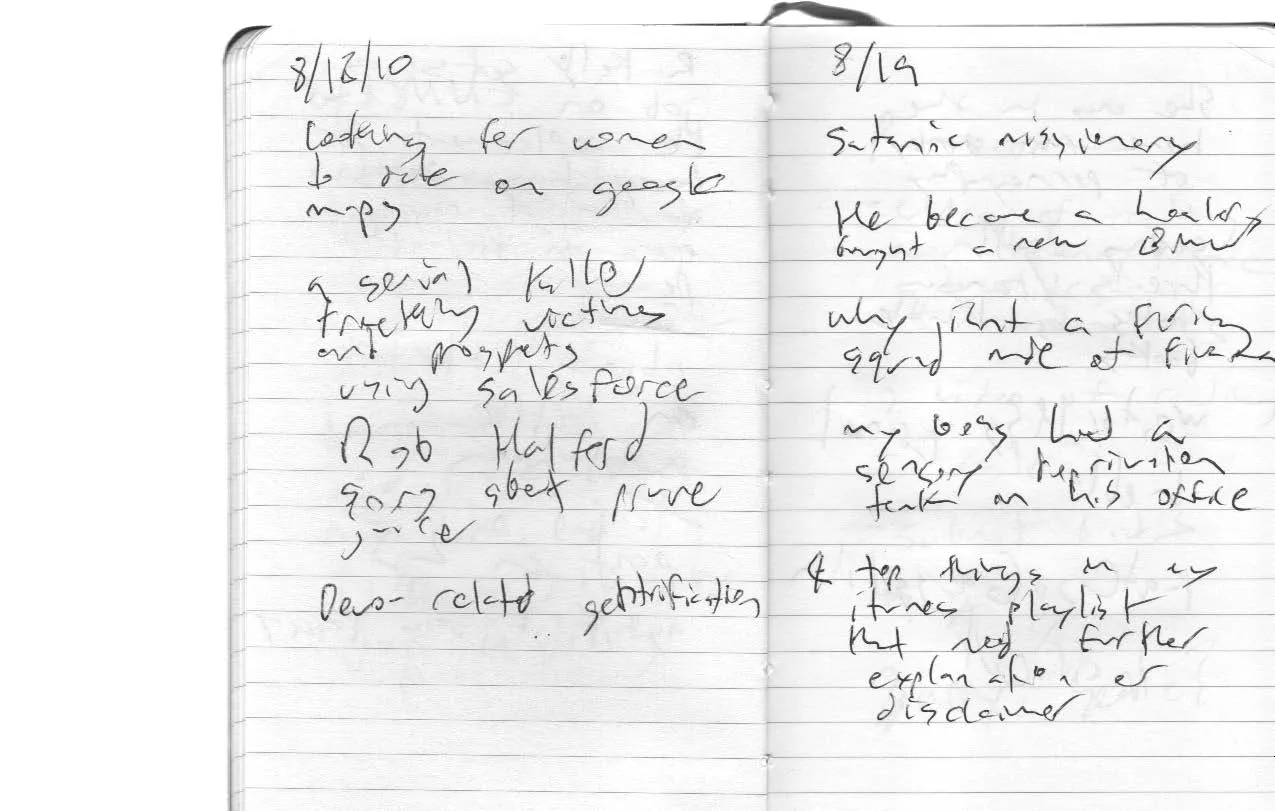
  3. A moleskine notebook.  The classic, hardcover, lined.  I’ve got a little folding pen that bungees right into the elastic cord, and it stays in my jacket pocket or bag at all times.

moleskine_Page_29

There’s a certain tactile satisfaction to keeping notes in a moleskine; that’s a huge plus.  And there’s an overwhelming joy in filling up one of these leather-bound pocketbooks, like you’ve accomplished something more than just dumping ASCII into a buffer.  I just finished one of the books, and it took me almost two years, just because I write in fits and spurts, and this “capture everything” movement just got into gear.

Now here’s the real problem with the moleskine: how to move these fieldstones into the production line.  The iPhone notes thing is easy: Ctrl-C, Ctrl-V.  The notebooks - well, first my handwriting is horrible.  And I barely hit the lines to get all of this stuff parallel to each other so OCR can handle it.  And I can’t ship it off to someone and have them transcribe it, since I can barely read it.

The current workflow is to scan the entire thing in as a single PDF using Preview and my printer/scanner.  This take some work, only because you end up with a 50-meg file, and there’s no way you’ll do a hundred scans without Preview crashing at least five or six times.  (I know, Windoze people are like “ha, it doesn’t just work”.  But I was able to use a piece of software that came on my system for free, without spending 19 days researching what third-party program works with my brand of scanner, brand of USB chipset, version of Windows, brand of USB cord, IRQ settings, motherboard configuration, and then find out the software I paid fifty bucks for is a “lite” version and the “pro” version costs $999.)

Then, I split the PDF into a hundred or so PNG images.  I have a Scrivener project that’s just a dumping ground for all of my fieldstones, failed stories and books that still have some reusable bits, and whatever else.  So I create a folder for the book, and dump the PNGs onto a file in the binder, then split that up into a bunch of files, and either type in the bits of each page, or ignore them.  (Sometimes a page will just be a partial grocery or todo list, or something I’ve already used, so not everything is gold.)

The process of turning these fieldstones into working stories and books - that’s another project, and a workflow I haven’t mastered yet.  But a lot of The Earworm Inception  came from fieldstones that were grouped and fleshed out, and this next book is using a lot of stuff collected like this.  Some of them will be duds; some just become a single line in someone’s dialogue, or a little aside.  And some will be the nucleus of an entire work.

So I’m having fun, transcribing this stuff, finding little gems.  And I’ve got the next Moleskine up and running, ready to capture whatever happens in the back of my head during my TPS report filing during the day.

A Hundred Years From That One Rush Album

IMG_0200

I guess I haven’t written in here yet in 2012.  Oops.  I’ve been busy working on getting a new book released, another collection of short stories and flash, and that’s about done.  But it’s been hard to get started on something new, and I really need to.

Part of this is that I’m trying to quit caffeine, and that shit’s a wonder drug for my creative productivity.  I am tapering down, and I’m down to two cokes a day, but I used to drink about two cokes per thousand words, so that’s been a struggle.  I’m probably sleeping more and better, but sleep doesn’t write books.

One thing I forgot about - I used to use my own crappy  set of scripts to run this site, a bunch of cobbled-together duct tape and cardboard that generated the index sidebar out of a bunch of PHP and shell script.  And every year, the whole thing would break, and required me to move all of the files to a new directory and edit a script by hand and regenerate the index and whatever.  And one of two things would happen: either I’d stay up late on the morning of the first and fix everything and post an “okay, this works” message, or I’d procrastinate horribly, and not post anything for days.  Maybe it wasn’t days, but I remember the dread of not having anything to write about, not knowing what to write.  Every New Year’s, I’d have grandiose ideas of how I’d write a story a day or a thousand words per 24 hours, and how that year would be the year I’d write a dozen books and submit a million stories and blah blah blah blah, and sitting staring at that blank page always felt like if I resolved to lose a hundred pounds, and then found myself in line at McDonald’s.

The other big part of 2012 is that it marks the 20-year mark from when the events of Summer Rain happened in real life.  I have very conflicted thoughts about this, and there are two different things going on in my head.

First, it’s been 11 years since that book came out.  I’m slowly moving to using nothing but CreateSpace and Kindle for publishing, and I feel like I should gather up all of my old stuff and push it to there, then unpublish it from iUniverse or lulu.  And I feel like I should get all of this old stuff on the Kindle.  So I loaded SR into Scrivener and started fixing all of the line breaks and indents and whatnot, thinking I’d eventually on some rainy day (no pun intended), I’d get the thing exported into .mobi format.  And of course, this degraded into this pulling-a-loose-thread-on-a-sweater thing of “maybe I need a new cover” and “maybe I need an new intro” and whatnot.  But it also made me stop and read the old writing, and I really don’t like it anymore.  I mean, there are the minor typos and things that could be reworked.  But I am no longer in love with those characters or what I did with the book.  Maybe this will change if I give it another serious read.  But I also did this same process with Rumored to Exist recently, and I really liked it.  It made me wish I could keep writing more stuff like that.  But the idea of revisiting Bloomington in 1992, or the thought of finishing this incomplete book of IU stories from 1989-1995 is somewhat boring to me.

And I just went to Bloomington, a couple of weeks ago.  It was the first time I’d touched foot in 47404 in ten years.  I only had a couple of hours, long enough to eat dinner with Simms and grab a quick drink with Bill, but I cruised around town for a few loops, taking it in.  And I was strangely unenthused.  Maybe I’d shut off that part of my brain, the part that usually swims in nostalgia trips like this, because the whole Indiana experience was so surreal to me.  But I didn’t experience the huge charge I used to get when I returned to town.  I swung past Mitchell Street, and around the fountain, and up and down Jordan, and to the library, but none of it caught me.  It seemed so long ago, so distant - and it was.

No real moral of the story here - I know what I’ve been writing best for the last couple of years is not the rehashing of this old college stuff, and that’s fine.  I’m still struggling with what exactly I call the stuff I do now, and how to sell it or tell people about it is the big question, but it’s slowly happening.

In other news, I bought a rowing machine the other day.  Not sure why.

Force

IMG_0119

I’m trying to force myself to write daily, not just the fiction writing, but some kind of post here, to keep the momentum going, but also to get out of my system this sketching, the rote description of the past and the present, which isn’t the kind of writing I do for stories and books, or at least it won’t be anymore.

That thing to the right, by the way, is the Claremont resort, where we went for Thanksgiving.  The inside reminds me of the hotel in The Shining, although it’s been so long since I’ve seen that flick, it might look completely different in comparison.  Other things I am reminded of include the extended family of Carter on ER, and all of the various athletic clubs I’ve visited in the past. I also feel slightly insulted that they haven’t nagged me about a membership yet.  I figured I would have been spammed to hell and back to pay a monthly fee roughly the same as my mortgage payment to use the tennis courts and rub elbows with the 1%.

So, force.  I never get stuff done.  I have a huge collection of books with the first 15% written.  Lots of books on the shelves with a bookmark at the page 43 mark.  I have this bad habit of skipping around, too.  Like if I have 20 chapters to edit, I will edit the first, second, get bored, skip to the last one, and then start playing video games.  A couple of years ago, at work, I started forcing myself to do stuff from start to finish.  It has convinced me that I never could have written a book in the analog days of the typewriter.  But I sometimes get results when I power through stuff like that.  It’s harder to apply to creative work; sometimes I can create, and sometimes I can’t.

I’ve also found that if I time myself, start a timer with 60 minutes on it, disconnect the internet, and force myself to either type in a buffer and get word after word on the page, or stare at the screen and do nothing, I’ll eventually start moving forward.  I guess if I burn through an hour on the timer and do not get word one on the page, that’s at least more of a victory than if I sat in front of the tube and watched an episode and a half of Chopped.

I have this book essentially done, but all of the stories need to be renamed.  I thought about going on fiverr and paying somebody five dollars a story and doing it that way.  I hate coming up with titles.  Was it Emily Dickinson or e.e. cummings who never titled anything?  I also thought about pulling a Peter Gabriel and naming my next six books Jon Konrath, except I’m sure that would somehow fuck up Amazon and all of the books would overwrite each other in some last-one-wins scenario.

I also wish Amazon listed stuff alphabetically, because then I would name it like locksmiths and bail bondsmen come up with names, something like AAAAAAA.

What else?  Closed on the house.  Bought two pair of glasses for an insane amount of money.  I am now farsighted enough that I need a second set of glasses just for reading.  This is the beginning of the end.

Why I am not an indie writer

IMG_0181

I hate the term “Indie Writer”.  Hate it.  Hate all of the variations: indie writer, indie writing, indie books.  It’s one of those terms, like “sammies.”  Any time I am in a restaurant that has the term “sammies” on the menu, I want to burn the fucking place to the ground.

Over on Self Publishing Review, there was an interesting article about this (here.)  In recent years, I’ve had a certain unease with the sudden popularity of self-publishing, and I could never really explain this effectively. But then I read this article, and it was like I’d spent the last X months staring at the splotchy acid-trip picture at the mall and something shifted and I could magically see the 3-D unicorn.

Back in the day, I was tangentially involved in the underground death metal scene; I published a zine, wrote for another, and spent a lot of time trading tapes and writing obscure bands around the world.  This was independent music at its most fundamental: people recorded albums in their own garage, dubbed them onto Maxell C-90s with a jambox or tape deck, then photocopied j-cards and mailed them off to zines for review, or sold copies through the mail.  (“Enclose carefully hidden cash!”)  Some bands “sold out” and signed to major labels, and you could have arguments forever with people over whether or not Nuclear Blast America was a “major” label, but I’m sure their most popular band sold about as many albums total as Sony gave away during promotion of a new Mariah Carey album.

Then Nirvana showed up, and the metal scene completely died.  And all of a sudden, all of these “indie” bands appeared.  And we were constantly told that a band like Smashing Pumpkins was “indie rock,” even though they shared a label with the Spice Girls and Janet Jackson.  And this must have been a major pain in the ass for alternative or punk bands who were still pressing their CDs in batches of 1000 and dragging their own orders to the post office.  But it was even worse for the metal bands who saw a recently functional ecosystem completely dry up, replaced with a bunch of guys in flannel.  The only valid solutions for metal bands were to a) cut out all of the satan references and play mopy college rock; b) get a job at a gas station; and/or c) wait it out until all of the alternative bands had kids and got old and metal once again ruled. Meanwhile, MTV and the mainstream press beat this “indie” label to death until it had no meaning.

There are two different axes to graph this stuff on.  One is “indie” as meaning independent of a massive corporation for your publisher.  The other is “indie” as a term describing rebellion against common conventions in literature.  And I think many of the people who write genre fiction and self-publish it take up the “indie” moniker to show that they are somehow bad-asses raging against the machine, although they’re still writing vampire romances and murder mysteries.  And most self-publishing forums and groups I encounter have little to nothing to do with pushing boundaries, and are mostly about how to make a product that looks like and competes with the same exact things released by the Big Six.  And anyone calling themselves an “indie” would be the last to admit any of this, and respond with “but MY book isn’t just like Tom Clancy - it’s like Tom Clancy with zombies!”

Self-publishing suddenly became “indie publishing” because people wanted self publishing to sound legit, and shed the baggage of being associated with people who paid vanity presses a few thousand bucks for a box of a thousand books, 974 of which would sit in a box in their attic forever.  And some people may be staging a revolution against the Big Six by doing it themselves, while others may have tried to get an agent and get a deal and failed.  And maybe they failed because the industry is failing (nobody reads, economic downturn, the damn 1%, choose one or more), or maybe they just didn’t make the cut, because their stuff was no good.

And I know you’re probably just thinking, “He’s just jealous his piece of shit books didn’t sell as much as Twilight.”  That’s not the point.  That isn’t my world.  I’m not Pavement complaining about Smashing Pumpkins.  I’m Captain Beefheart for the sake of that comparison; I’m doing something that’s not meant to be appreciated by anyone but a small number of people.  I’m fine with that.

The problem is, I self-publish.  I’m an “indie” in the sense that Random House is not handling my output.  And for whatever stupid reason, that automatically lumps me in with every Stephenie fucking Meyer wannabe that’s self-publishing for profit.  I don’t self-publish to make money.  I self-publish because I don’t happen to have an offset press in my living room.  And I write because it’s a way of channeling my subconscious and my thoughts on finding a meaning to life into a format that can then be consumed and possibly felt as emotion by other people.  And the way that happens isn’t about a perfectly carved out plot arc or a nicely packaged consumer product or a compliant genre-specific thriller novel.  Jackson Pollock did not paint crying clowns and landscapes.  Albert Camus did not pen murder mysteries for the YA market.  I don’t have to adhere to the bullshit rules people keep spouting off, any more than G.G. Allin had to dress like the members of Pearl Jam, even though they both released albums in the same era.

It’s irrelevant.  And it should be for you, too.  Write what you want.  If someone tells you to develop a marketing plan, tell them to go fuck themselves.  This is Art, not Amway.  I am not an “indie” writer.  Underground?  Maybe.  Cult?  I probably need more cult members first.  But “indie”?  Ugh.  Someone’s mom is an indie writer.  I’m anything but.