The Wrath of Kon

Dispatches, thoughts, and miscellanea from writer Jon Konrath

Tag: writing

Surge Redux

They relaunched Surge!

I guess I wrote about this years ago (see Surge, Vault) when they half-ass relaunched Surge as Vault about ten years ago.

I used to be extremely obsessed with different sodas. I also used to weigh 250 pounds and need thousands of dollars of dental work a year. Surge was like the apex of this addiction. Seattle was a test market for Surge back in the late 90s, and I got onboard in early 1997. Then I quit soda and caffeine entirely for most of that year, and stopped drinking it. But about a year later, I fell off the wagon, starting with the occasional soda during writing sessions.

In 1998, I was going hard on the Rumored to Exist manuscript, and trying to figure out exactly what rituals would put me in the right frame of mind to finish this insane book. Like I used to write starting exactly at 9 PM, and then stop at midnight and go to the 7-Eleven on the corner of 16th and Madison to get a Coke Slurpee. And I started chipping in on the Surge during writing sessions, and managed to get a decent (although disorganized) second draft of that book done before I left for New York.

There was no Surge in New York, and no 7-Elevens at that point in time, either. I would have occasional Surge sightings - one time I had rented a car for some reason, and drove on the Long Island Expressway way the hell out to Syosset or something, and stopped at a two-pump gas station with one cooler of sodas, and they had four cans, which I hoarded. And once when I was visiting my then-girlfriend at Cornell, I went to a Wendy’s that had it on tap. But by 2001 or so, it had entirely vanished from the region. And my writing dried up after I published Rumored in 2002, although one probably doesn’t have to do with the other, except in my head. Case in point: Vault came back in 2006, and I still didn’t get shit done.

So Surge is back now, although the distribution is still spotty and weird. I haven’t seen it in stores, but it popped up on Amazon Pantry while I was shopping for other stuff, so I bought a case. It was ridiculously expensive — $14 for a dozen 16-ounce cans — and I don’t know that I can even drink all of this. Back in the old days, I’d plow through it in a few nights. But now I’m logging every calorie I consume, and 230 empty calories is a pretty big hit. I also haven’t drank soda with sugar in it for almost ten years now, aside from a few odd occasions where nothing else was available. (Like I remember stopping at a beach cafe in rural Mexico a few years ago and buying a glass-bottled Pepsi, which was miraculous after spending a few hours off-roading on ATVs.) I haven’t drank any yet, and maybe I’ll only try a can or two.

The whole episode is a strange hit of nostalgia for me. It reminds me of Seattle, of the start of New York, and I’ve been thinking a lot about Rumored lately, how it was the perfect storm of weird writing and chaos. It also makes me think about the cyclical nature of these things, how Coca-Cola seems to be hitting these things every ten years on the dot, how they have these limited markets and test runs and special windows of time. There are times I’m heavily affected by how these things from recent history just vanish, how I can never go to Garcia’s Pizza again, or go to the University Park Mall Bally’s and play Smash TV. And then I’m thrown little bits of the stuff back, like a web page about a nostalgic item, an eBay auction for a Mattel Aquarius, a ROM so I can play a long-lost game on my Mac. They just rebooted New York Seltzer, which I thought for sure was long gone, and now I see the little squat glass bottles every time I go to my neighborhood diner.

I always wonder if we’re now in a hyper-accelerated version of a wayback machine, constant pings back to these limited-time-only items that are relaunched like a McRib as a cash grab. Or is this the same as when Fifties nostalgia hit hard in the Seventies? Will there be any satisfaction in a relaunch of an old product I missed, or will it be a pyrrhic victory, never bringing any real satisfaction? Maybe it even causes more distress, because I’ll get one little hint of a past that I think would make me happy (even though I know I wasn’t happy then) and it will give me a brief hit of dopamine and nothing else, making me want even more. We’ll see, I guess.
Death of The NecroKonicon

I made the decision to retire the print and ebook versions of my book The NecroKonicon, also known to many as “the glossary.” It was a bittersweet decision, but it’s not something I want available anymore. I unpublished the online version of the glossary about ten years ago, which was a tough decision back then. The book seems a bit redundant at this point.

I had a lot of fun creating the glossary when I started it about fifteen years ago. I became obsessed with it when I started it, constantly thinking of new articles to add, new links to make. I dug through old photos, researched old names and places, and every time I got a topic just about done, I’d think of five others to write. Once it went online, I started getting a lot of feedback, too. People searching on old names or places would stumble across my articles. This was right as Wikipedia was starting, and way before Facebook, so sometimes my pages were the first or only hit on google.

The problem with the glossary was that I wanted to write about my memories, and I got a lot of input that my entries were “wrong” and people would endlessly mansplain what really should have been there. I remember getting in a huge, stupid argument in the comments section with some #BlueLivesMatter-type idiot about my entry about the IU Police Department, and no matter how many corrections or additions I made, he demanded that I rewrite it or take it down.

And some of it was legitimate - I took a lot of swipes in some of the inside jokes, and there were entries about ex-girlfriends and people I was no longer in touch with, and those could be seen as violations or whatever. I think the attitude towards this has changed in the last decade; I think if Henry Miller or Charles Bukowski were writing in 2017, they would be spending most of their time in a courtroom, getting sued by the people in their books.

But, part of the fun of the thing was the personal side of it. I think if I only wrote about old restaurants and stores and food items, it would not have had the same intrigue. Or it would have just been Wikipedia. I keep thinking of putting a “scrubbed” version of it online, installing some wiki software and porting over the old entries, maybe writing a bunch of new ones, but not about people, just about the nostalgia, the places and things. But, that’s a lot of time. And I’d constantly be correcting things, adding more, dealing with complaints, etc.

A lot of me doesn’t want to deal with nostalgia anymore. I waste a lot of time trying to think about things from 1990 or whatever, and I’d rather be creating new stuff, not rehashing old stuff. So that’s a big reason for discontinuing this. And the book didn’t sell anyway.

That said, I wish I could create something that had the same collaborative and dynamic aspect that The NecroKonicon did. It was a glorious waste of time, and brought a lot of people in. I got a lot of emails and comments, and it was a lot of fun working on it (until it wasn’t.) I wish I could find some other project like this, like a podcast or comic or an online site of some sort, and maybe at some point I will.

Until then, I’m supposed to be writing the next book, so I need to figure out what that means exactly.

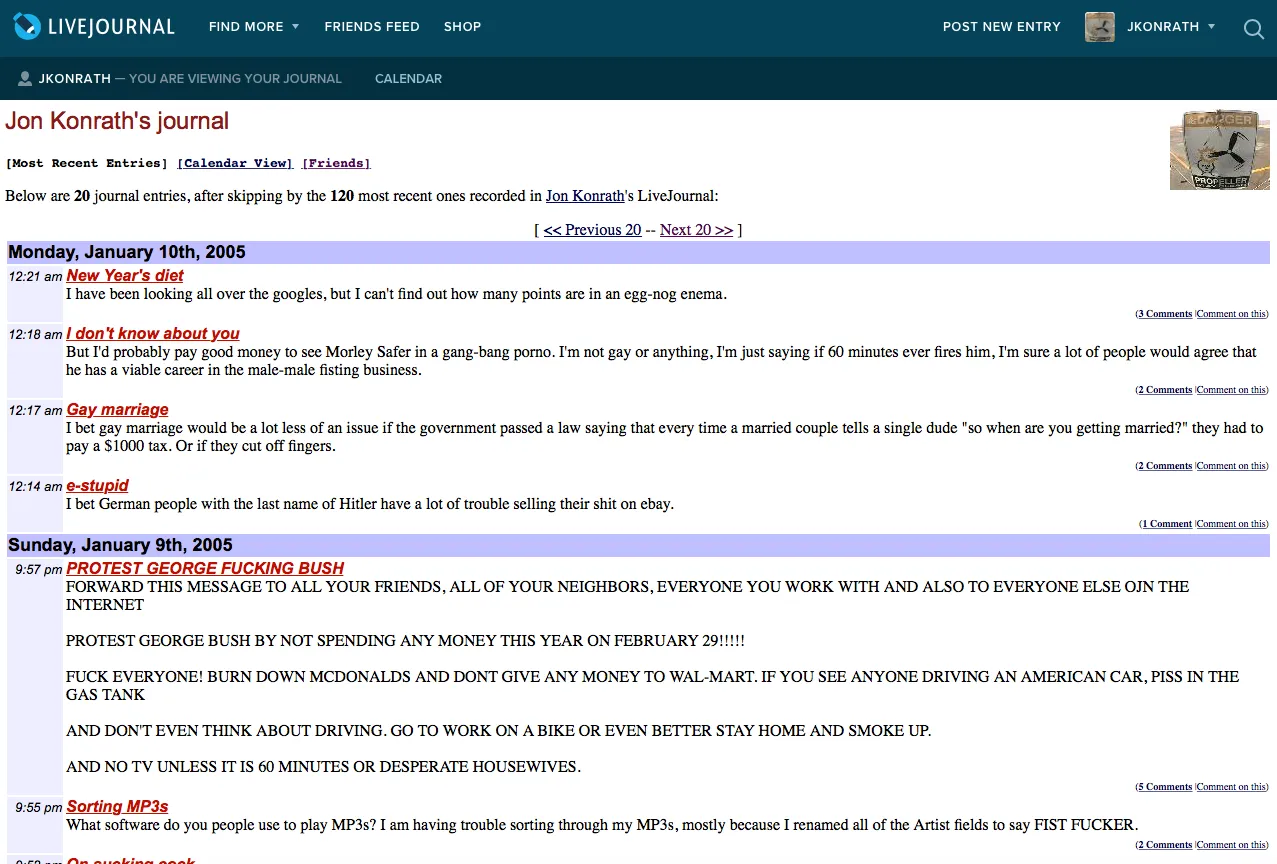
LiveJournal

screen-shot-2017-01-14-at-10-09-35-am

In the quest to find some better way of doing all of this, I started thinking about LiveJournal. (I actually have been thinking about a lot of the mid-00s web stuff I used to use, because sitting on FaceBook all day is probably a dead end, or I feel that I’m not reading or writing enough. Like, did reading Slashdot, Fark, and an armada of blogs in Google Reader help entertain me any better than seeing the same four news stories posted a hundred times a day?)

I wasn’t a heavy LiveJournal writer; I had a fake account (username: unabomber) I started in 2000 just to comment on other peoples’ stuff, then started one as jkonrath in 2004. I’d post updates, but I had an earlier pre-WordPress iteration of this blog as my main home. But I would hit my friends feed constantly, and comment a lot.

LJ seemed to be “the place” to go to be social online for a while, like pre-MySpace, pre-Facebook, pre-Twitter. I was trying to think of exactly why though. The site’s still there, as is my account, so I poked around a bit and tried to remember. What did it offer that my blog did not? What was the draw?

Plusses:

  • It was dead simple (and free) to open an account. It was invite-only until 2003, but after that, anyone could get in.
  • Posting was not hard. It gave you a box and a subject line, and you typed and clicked “Post” and that was it.
  • There were fun little things you could add to posts, like what you were listening to, and what your mood was.
  • You had a certain number of profile pictures, and it was always fun finding new little pictures, or swapping to a different one based on your mood that day.
  • You could theme your page to some extent, changing colors and styles. Some people got really into the design of their pages, although when you’re reading your friends feed, you don’t see those customizations, and I basically didn’t give a shit about having flaming red text on a black background with pictures of wolves and fire and ninjas and shit all over.
  • Basic privacy settings could lock posts and accounts to be friends-only.
  • Communities, where permitted users could post to a feed. These were great for interests (I was in a baseball one for a while) or areas (lots of people had groups for their towns or home towns.)
  • You could (if you had a paid account) host a feed to your external blog, so the posts would show up on LJ.
  • It was locked in. You could sit and spin on your friends feed, and read all the posts (in chronological order, too) and in the mid-00s, a lot of people were posting, so there was some good conversation to be had.
  • There weren’t ads during the heyday, although that changed later.
  • It encouraged long-form posts. Or maybe people just typed more back then, before we were all programmed with horrible ADHD.
  • The feed was chronological only. No Fuckerberging of the order and appearance weighting of posts.
  • There was post commenting, and that got used a fair amount. Commenting was more streamlined than other blogs, because you had the single system for everyone, whereas it seems like every free-standing blog has a different commenting system, or they use something like Disqus, and people get all pissy about having to sign up for it. If you were using LJ, you were signed up for commenting, so it was a no-brainer.

Minuses:

  • The UX is horrible. Log in to livejournal.com and then try to find anything, and it takes ten clicks. It also started to look a bit dated and clunky going into the late 00s.
  • There was no “like.” I think that was the big killer versus Facebook. When you post on FB, there’s this little micro-validation you get in your brain when other people like your post. LJ didn’t have this, so the motivation wasn’t there. I think the little crack hit of likes is one of the main drivers for FB, and it’s also its downfall. The discovery of this gamification around the end of the 00s is the reason casual gaming now exists (well, that plus touchscreen devices with good graphics) but it’s also a big part of our dumbing-down as a culture.
  • The long-form thing meant good content, but it also may have been a reason people dropped out.
  • Images and image hosting were always an issue. You could add external links to flickr or elsewhere for your images, but the two-step process was messy. They now offer image hosting for paid accounts, but it’s a limited amount, and mostly a feature to entice people to pay. It’s nowhere near as nice as the FB interface for photo uploading.
  • No fine-grained security. You could not be friends with someone and not see their content. You could not hide a single post from your friends feed, like when you got sick of seeing the same thing pop up on every time. (I use the FB hide post constantly these days.)
  • No post sharing. This was a plus, though. Imagine FB without the ability to share stupid political posts or mom memes.
  • No (real) mobile stuff. I think they have an app, but it’s a piece of shit. So many people post on-the-go now in FB/Twitter, and LJ never had any of that. That may have been one of the reasons it focused more on long-form stuff, because everyone was sitting on a PC while composing their stuff.
  • Various business decisions slowly sank the ship. The company was sold in 2005, and then Brad Fitzpatrick left in 2007, and it was sold to some crazy Russians, who continued to run it into the ground.

Other:

  • I remember a lot of shit-storms over privacy issues, like people having to lock out exes and then said exes getting a different fake account to read their stuff, etc. Now, blocking and banning is simple in FB, but there was a lot of drama back in the day.
  • I also vaguely remember some moderation issues, with people or posts getting censored, and a bunch of outrage.

I always wonder if something could replace LJ and FB. Would some technical balance between the two work, or would some perfect storm have to happen to lure enough people to the community to make it viable? I think the biggest feature of LJ was that it had a community, and it had a critical mass of enough users to make it interesting and fun. But when that went away, so did its usefulness.

How do you create that again? I guess that’s the question every attempt at community tries to answer. I futz around with posting here, but it’s an isolated island in the middle of nowhere, with no community, no connection to the outside world. I post on Facebook, but it’s Facebook, and it is becoming a dead end. As I find Facebook more and more intolerable, I try to think of a replacement, but that lack of critical mass, of community, is the huge problem.

Writers vs. Authors vs. Scammers

I keep thinking about the argument of writer versus author, and then saw this interesting news item about a scammer who made millions publishing junk ebooks on Amazon:

http://www.zdnet.com/article/exclusive-inside-a-million-dollar-amazon-kindle-catfishing-scam/

The summary is that a guy set up a small empire publishing hack e-books about homesteading, weight loss, vitamins, healthy lotions, and whatever Whole Foods-oriented how-to garbage would attract clicks. The scam used multiple fake authors and an army of fake customer accounts. He would then game the system with a network of fake reviews, and set the books for free and mass-download them to up the ratings. He carefully hid his tracks through the Tor network, and when a book got reported and banned, he would re-title it, and have another fake author release it with a new cover.

I think most writers have different reactions to this, but it’s a mix of two base thoughts: either “I waste all my time writing and publishing real books and some asshole publishing fake books on vegan child care is making tons of money gaming the system, this is bullshit” and “why am I not gaming the system, maybe not to this level of scamminess, but it sure would be nice to get some traffic.”

I think the best reaction to have, for me, and one that I don’t have, is something like “all of this is meaningless, and who cares how these scammers are destroying the industry, because I write to write, not to make a buck or get fame.” But it’s hard to think this way in a world where you have to pay to keep a roof over your head, and I think a lot of writers are somewhere on the spectrum of this being important, and make some ethical sacrifice towards this.

I’ve struggled with the “writer versus author” argument, and I feel like I need to invent a new set of terms, because these don’t seem quite right. But I think there’s a difference between people who write whatever they write because it is their passion or their lot in life, versus people who write to sell. That’s not to say genre writers who research what to write based on market trends can’t be passionate about their work, and people writing literary fiction can sell their work or modify it to meet market demands to some extent. It’s probably a spectrum, and writers make ethical or business decisions that push them in one direction or another on this range.

What makes me think about this is that the scammer in the article has made many decisions that are to the full-blown extreme of writing to sell. And when I read self-publishing help sites, all of these tactics about gaming the system are discussed to some extent. These sites talk about the importance of covers, how to title your work to get maximum reach, the use of pseudonyms, how to pick categories and add keywords and get reviews and whatever else. They are not as extreme as what this scammer did, but they are all things that aren’t related to writing, or the art of writing.

The thing that gets me is that this scammer chose books, but not because they enjoyed writing or making a connection with the reader at all. I’m not even sure if he actually wrote the books; he could have paid someone on Fiverr to do it. And it could have been anything other than books. The same tactics could have been used to sell nutritional supplements or baseball caps drop-shipped from China. And I sometimes feel that way with the other writers (authors, whatever) with which I share an Amazon bookstore. My books aren’t for mass-consumption, and sure, they don’t sell like a good vampire erotica series sells. But it makes me wonder if these other writers are more interested in marketing and selling than they are about writing. When the gold rush will end, will they will all move to selling insurance or lawn furniture or prepackaged meals online, or will they be writing book that make no money?

I wrote my novels before there was a kindle, before there was a self-publishing world. If Amazon disappeared tomorrow, I would keep writing, even if it meant going to Kinko’s and paying ten cents a page to give them to friends. It’s what I did back in the nineties, and it’s what I’d do again, if it came to that. Everything else shouldn’t matter. But it still creeps in my head, especially with a new book out, ready to face the world. This is something I struggle with, and I wish I didn’t.

I have a new zine out

Screen-Shot-2016-03-13-at-2.31.29-PM

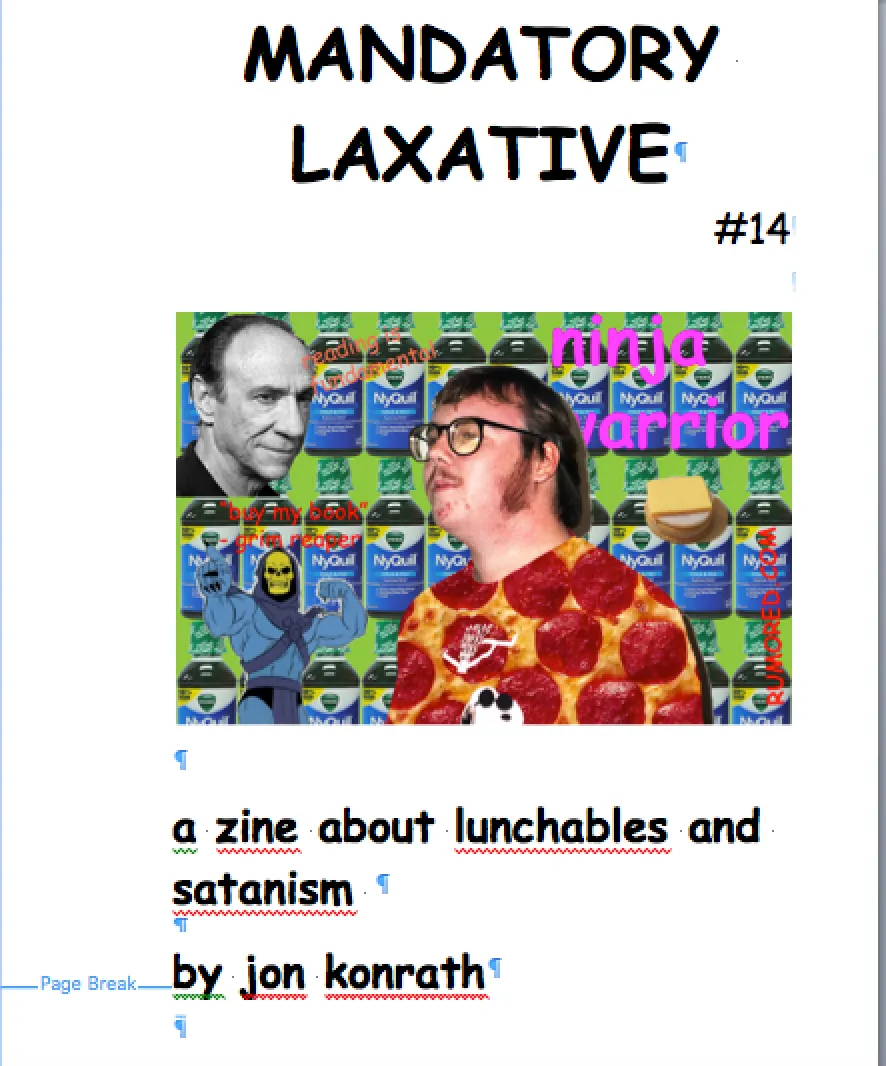
I have a new zine out.

It is called Mandatory Laxative #14. It is about lunchables and satanism.

It is 20 pages long. It is printed on an inkjet printer. It is as lo-fi as possible. I didn’t even spell-check it.

It contains the following “stories”:

  • Pain Is Only Temporary (Unless It Is Chronic)
  • A Scene Where A Guy Goes To A Colonics Clinic, Falls In Love With The Cashier, And Almost Ends Up Shooting A Fountain Of Coffee From His Ass
  • Sleep Letter Zero
  • Letter to Freddy
  • I Am A Satanist And I Like Toast Because It Is Cult And Evil
  • Someday This Could Be You
  • I Love Lunchables
  • Late At Night With Dwight Dingleson
  • Remember the Alamo, Motherfucker
  • Two Men Discuss Low Calorie Pizza Before A Ritual Satanism Killing
  • This Knife Means Fucking Business
  • Chili Sweats at Aerie #666
  • The Inevitability of an Accidental Saline Enema

It is listed on Goodreads here.

It is not available on Amazon. It is not available as an ebook or a PDF. It’s barely available at all. It is a limited edition of about 30 copies. If you really want a copy, and you are in the US, paypal me $4 and your postal address. jkonrath at 34.216.9.77/.