The Wrath of Kon

Dispatches, thoughts, and miscellanea from writer Jon Konrath

2011

Name a candy mentioned in a Husker Du song

The hardest part about not writing here for a long period of time is that when I come back, it can take me days or even weeks to type the first paragraph or even the first sentence in an entry, because I get that writer’s block/paranoia that comes from constantly re-evaluating why I do this.  And then last night - I’m a bachelor for the week, because Sarah went back to Milwaukee to see a sick relative, so you’d think I would be doing something exciting, but in reality, I’m watching episodes of Larry Sanders on the Netflix box and playing some stupid tower defense game on the iPad and talking to the cats too much.

So I’m up too late on a school night, and feeling oddly nostalgic, and go to this page and start digging through old entries.  One of the hazards of having 14 years of old entries online is when I go down this nostalgia k-hole, it’s very easy to play the “so what was I doing in 2004?” game, and spend hours of heat-induced insomnia reading old stuff I wrote.  And I guess that’s one of the reasons I do write here, to trap in amber these states of emotion and experience in some way so I can look back and ultimately think that I was writing a lot more in [insert year here] even though I probably at that time felt I did a lot more writing in some other era of my life.

The rest of the country is in an insane heatwave.  It’s dropped down to 64 here, but we’re west-facing and without central air, so it feels like more.  But I think I have either a touch of food poisoning or stomach flu, and have felt nauseous for the last couple of days, which is exactly what you don’t want when it’s hotter than normal out.  So it’s lots of crackers and diet 7-Up and junior mints, which are named after a Broadway musical based on a bunch of short stories written by the screenwriter who wrote Viva Las Vegas.  And they’re mentioned in the Husker Du song “Eiffel Tower High”.  And I guess there’s a Seinfeld episode too.  But junior mints are one of those strange shouldn’t-work cures that probably make things worse, but I take some comfort in.  And of course food poisoning reminds me of Denver, since I had at least a couple of cases of it there.  And that makes me click on those links to the right in the 2007 range to go back and read about all of my medical maladies and realize I’ve got it easy these days.

Do you remember SOH CAH TOA?  I actually had to use trig the other day to figure something out, which was phenomenal.  I still have not been writing, and have been spending all of my spare time trying to learn enough Cocoa to write a decent game for the iPad.  It’s clicking for me, but it also makes me realize I don’t know how to draw and really need some artwork to make a decent game.   Anyway, I was dicking around with a tank game, where you drive a little tank around a 2D map and shoot stuff, and I needed to figure out some crap having to do with angles and whatnot.  SOH CAH TOA - Sin = opposite/hypotenuse; cos = adjacent/hypotenuse; tangent = opposite/hypotenuse.  I must have learned that 25 years ago, maybe in Mr. Martin’s class.  Trig was my downfall in my computer science career in college.  I barely learned it in high school, and totally forgot it.  I think a guidance counselor told me I should take M126 and I didn’t, so when I got to the second year of calculus, M216, it was a solid wall of trig, and I completely fell apart.  That was 1991, and now it’s 2001, and I’m trying to write a game for a computer I couldn’t even imagine in 1991, and it all comes back to me.  Fucking trig.

Somewhere, in one of my storage boxes, I have an old relic from my attempt to pass M216: a Casio fx-7000g calculator.  I got this thing for Christmas of 1990, I think in some hopes of graphing out trig functions for this calculus class.  I spent the whole break memorizing the damn manual, astonished by this beast of a calculator.  I grew up with the standard 4-function thing, the kind where you would type in 37047734 and flip it upside down so it said HELLHOLE.  And I had a slightly more advanced Radio Shack number that did some scientific notation and basic trig stuff, with ten digits instead of eight.  But this 7000g, it had a 96x64 bitmap display.  You could even program the damn thing in BASIC, if you had the patience to type in all of the tokenized keywords on the chicklet keys.

I didn’t have a computer at that point, and went to IUSB, so the closest one I could use was a 45-minute drive away.  I so desperately wanted to build a junk PC or buy an Amiga, but both were so far out of my reach.  I made something like $100 a week before taxes, and the cheapest, shittiest Amiga was like $500, and I was putting at least a tank of gas in my car every few days just to make enough money to stay broke, so it never happened.  But I had this “computer” in my hands, a whopping 422 bytes of memory.  I spent a chunk of the vacation in Toledo, at my girlfriend’s parents’ place, and I whittled away the entire trip writing a chess game in my head, using BASIC, trying to find a way to smash it all down into 422 bytes, which is absolutely asinine.  I think I gave up on that and went back to pseudocode and pseudo-pascal and eventually got a program on the VAX that drew a pretty chess board and all of the pieces before I got bored of the whole mess and went back to reading Phrack magazine and downloading crap DOS programs from anonymous FTP sites.

That calculator cost $100 in 1991.  That’s maybe $150 in today’s dollars, which could maybe get you a junk laptop on eBay, one that could barely boot Windows 98, but it would still have like 256MB of RAM, which is over 500 times what this thing had.  I had one of those Timex data watches in the late 90s that I think had like twice as much memory.  (Crap, totally forgot about that thing.  I wonder if I still have that in a box somewhere.  I actually had two of them; the original one with a light sensor you held up to your monitor to program, and the USB model.  They were both cool and lacking.)

It’s past my bedtime and it’s still hot, and I’ve got two cats staring at me wondering if their human pillow is going to stop this writing nonsense anytime soon.
Changing Gears

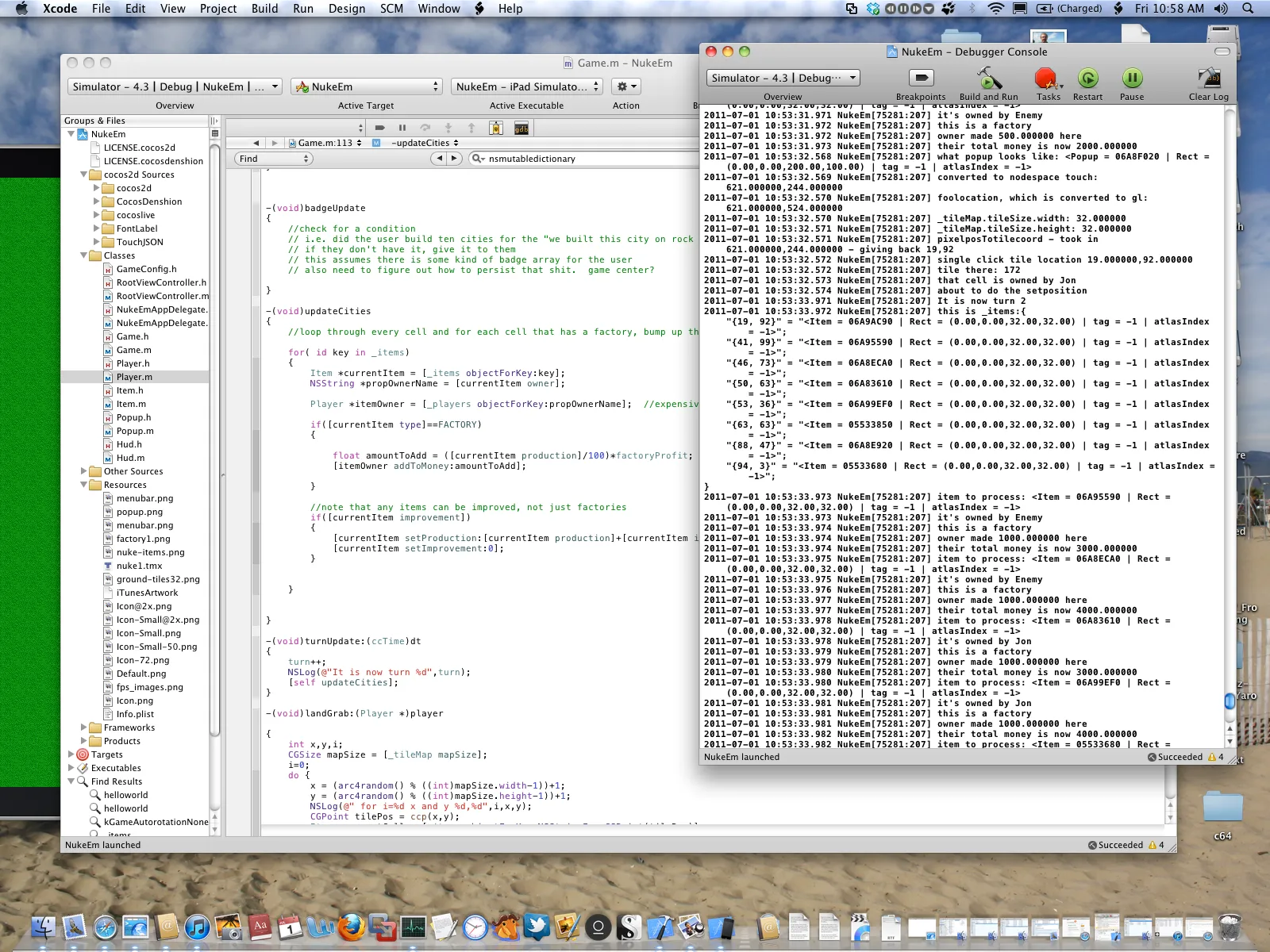
Screen-shot-2011-07-01-at-10.58.57-AM

I haven’t been writing.  Probably haven’t put word to paper in at least two weeks.  Normally, this would have me freaking the fuck out, going to see shrinks, getting pills, doing exercises, buying books, studying courses, dissecting plot and premise and buying a flashcard system with 20-sided dice and spinners and software designed to Specifically Help You Write Your Novel in 14 seconds or less.  But I haven’t even thought about it.

I have not been writing because I have been coding.

I knew I would get this horrible postpartum depression after I finished my last book.  I knew nobody would buy it, no matter how hard I pimped it out.  I knew I would not be able to get another project going, and I would enter the downward spiral of over-examining all of my thoughts and ideas, mixed with going to the Amazon royalty page every seven minutes to see if anyone bought the damn book.  Same with the lulu royalty page, and the Google Analytics page to see the hits on this site.  That’s become the ritual; it used to be that the first thing I’d check, first thing in the morning, was my bank account site, to see if various checks had cleared and I would be able to scrape together seven dollars for some TV dinners to last until payday.  Lately, the glass pipe has been that site usage dashboard.

I don’t know when I decided this, but right around when I sent off the PDFs and Kindle files for the book, I decided I really wanted to write an iPhone game.  I realize I’m about three years too late to the party, but I felt some sudden urge to dive into one of the game frameworks and write something crazy, or at least do what everyone does and write a tetris or asteroids or pac man clone.  I know nothing about this, but I also know too much.  When I worked at the big S, we spend a lot of time looking at other developer programs and SDKs and tools, and I knew a lot about what didn’t work.  (Side note: there’s nothing more horrible than being locked in a conference room with a dozen middle-aged guys who know nothing about games or social networking sites, who have never played WoW or Mafia Wars and have never signed up for Facebook or twitter, and being forced to come up with million-dollar ideas for patentable games and social networking sites to be produced with no budget and no manpower.)

I downloaded GameSalad and after ten minutes decided that was a stupid system, so I hit the main vein and grabbed XCode and downloaded that giant multi-gig archive of Apple fun.  Then I dove straight in without looking, immersed myself in howtos and tutorials and O’Reilly tomes and FAQs.  I beat that Hello World like it owed me money and got locked into the Cocos2d framework and started that damn Pac Man clone.  Then I found out about tilemaps, and realized it was absolutely imperative to start that strategy RPG for the iPad.

I haven’t checked my royalty crap or web site stats since.  I used to hit facebook constantly, and now I’m barely on there, except to log in and delete a bunch of the bullshit academic lit journals I used to add in some hopes of finding readers.  I’m still on the web, but instead of picking fights with idiot teabaggers, I’m looking up how to output sorted arrays of keys from an NSMutableDictionary.  I have mixed feelings about this; I think my online time makes up some void that results from working from home and not being around people all day.  But there’s also been more than a few times where I thought about following some link to read about the latest idiot trying to run for president or whatever, and I thought, “I could either do this, or I could try to figure out which TouchDispatcher has handlers to read multitouch input.”  The latter wins every time.

I haven’t worked with C in a while.  We mostly use Java at the day job, and there’s some occasional C# and C++ out there, but my usage is limited to finding some function and unfucking the doc comments so the autogenerated API help is readable.  It’s been a long time since I sat down and tried to really hack out any kind of C code, but I realized that it was 20 years ago I started learning C, and it all came back fast.  What was more amazing is how the Objective C stuff gave me crazy flashbacks to 1992, back when I took C490 and we worked on the NeXT.  I spent most of my time in that class beating against Motif and C++ on the Sun workstations, so when I went to the NeXT and used Interface Builder, it was like showing RoboCop to a 14th century farmer.  The Objective C syntax seemed really foreign to me at first, but then I started getting the

and [s and ]s in the right places.  I also ran into the usual C barrier of “is this a struct or a pointer to a struct or a pointer to a pointer to an object, and is it getting released here or do I need to retain it” stuff, and really hit the wall with it last weekend.  But I think I’m past it, and making some progress.

There’s also a certain nostalgia in writing a game in general.  I spent a lot of time way back when with graph paper, filling in squares to make bitmap fonts or maps of dungeons or designs of sprites.  Back then, there was only 64K of memory, and stuff like pointers did not exist as far as I knew.  (Yes, they did, but not to a 14-year-old in Elkhart, Indiana with no modem.)  Now I’m working with a thousand times the clock speed and 4,000 times as much memory, but the core thought process still remains.  I’ve got a lot more control over program structure than GOTO and GOSUB, but you still need to think about how those damn ghosts run around the maze by themselves.

There’s a small part of me wondering about when I will write again.  I mean, in a practical sense, I keep thinking I need to start a new blog so when I do find out that you can’t dynamically change tiles in an empty CCTMXLayer without crashing, I can write it down and not have to re-research it a month from now.  But there’s that bigger question of if I need to get back on the horse and write more books, and if it’s worth it to write books, and if anyone even reads books anymore, and if I want to write books that people want to read, and a flurry of other bullshit I don’t want to think about anymore.  I still do have the occasional flashes where I see something and think it would make a great short story.  But I’m waking up every morning and immediately thinking about what to code next, and that’s a good feeling.

My new book, Fistful of Pizza, is available now

cover

I am happy to announce that my new book, Fistful of Pizza, is now available at the following places:

  • On the Kindle for only 99 cents here.
  • In print at Lulu.com for $8.74 here.
  • In print at Amazon.com for $12.99 here.

Here’s the answers to some questions about this:

What is it?

Fistful of Pizza is a collection of short stories and flash fiction including ten pieces that have appeared in other publications and were otherwise unavailable until now.  I wanted to make the book as cheap as possible; actually, I wanted to make it free on the Kindle, but I can’t do that because I’m not a big publisher, so instead it’s the cheapest price they will let me.

What if I think the Kindle is stupid?

I also did a print version, which is a 150-page pocket-sized book.  Feel free to read it on the beach or lend it to your friends or drop it in the tub or burn it or do any of the other things that people who complain about the Kindle say you can’t do with the Kindle.

Why is the print version so expensive?

Because of the whole tree thing.  I could do what big publishers do and make the eBook version cost $8.74, or do what the biggest publishers do and make the print book $8.74 and the eBook $21.99.  $8.74 was about the cheapest I could go on lulu.

Can I get a preview?

If you have a Kindle, or have a PC/Mac/tablet/phone with the Kindle software, you can get a preview of the book for free.  Go to the Amazon page here and click on the Send Sample Now button.  This will send the cover and the first two and a half stories to you.

Does this include that one story where the guy flies a jet into a Wal-Mart in order to obtain an erection?

Yes, it does.

Why does the print version cost more on Amazon?

Because Amazon hates you.

Is this book suitable for my kid?

Any book is a children’s book if you teach your kid to read early enough.  Whether or not your child should read a book in which Richard Nixon pisses into someone’s gunshot wound is really your call, though.

What is a pocket book?

It’s a 4.3 x 6.9” book.  It’s roughly the size of one of those drug store paperback books.  I think it’s a neat size and have wanted to do one of these for a bit.  I have no idea why it’s that exact size; it probably has something to do with a fraction of a standard size of sheep used for its skin in England or something stupid like that.

What 19th-century French civil engineer who specialized in hydraulics is one of the 72 names inscribed on the Eiffel Tower?

Jacques Antoine Charles Bresse.  It’s the fifth from the left on the northwest side.

Why is there a picture of you sodomizing a wax figure of Tiger Woods on the last page of the book?

The Sean Connery figure was out for maintenance at the time.

I’ve been your pal forever and would really like a copy of this book for free.  Can you give it to me?

If you drop me a line and tell me how you’ll help me sell copies to all your friends, sure.

Thanks for the support, and I hope you get a chance to read the book!

Random bitching about Lulu, and why print is dead

4.25x6.87_Front_EN

I am publishing a book of short stories momentarily.  [Edit: I just did.  Go here to check it out.] The initial thought was to pull together a bunch of the stories I’d published elsewhere, and make a nice little 99 cent download on the Kindle.  And I’d make that a free download on the Kindle, but you can only do that if you’re a publisher, and even though Bowker thinks I’m a publisher, Amazon doesn’t.  Fair enough.  But I also have this strange affinity for dead trees, and I gauge my success as a writer by the number of books on the Konrath shelf of my library, so I wanted another volume in there.  Also, enough luddite contrarians have bitched about my last eBook release that I thought I’d throw you all a bone and do a print version, too.

So I just switched to using Lightning Source for print-on-demand.  But that costs money in setup fees, and I didn’t want to pay a ton up front and then have to spend the next three months hustling copies to break even, especially if the print edition wasn’t my target in the first place.  So I decided to go back to lulu for this one.  And man, I forgot how much I hate lulu.

Here’s a list of the various annoyances I had putting this one together:

  • First of all, Lulu’s web site sucks.  It took me roughly 20,000 clicks to find out how their ISBN/distribution options worked, and each page load takes as much time as it took me to download those Cindy Crawford Playboy GIFs back in 1996 on my 14.4Kbps modem.  They could solve all of this with the one-two punch of some content delivery network like Akamai and a real CMS like Jive.  But they won’t.
  • There’s always the decision between a one-piece and a three-piece cover.  Their new three-piece cover wizard is garbage, but they’re honest enough to almost cop to this and give you the option of using their old wizard.  With that, you can just upload PNGs of the front and the back cover and be done with it.  What you can’t do is upload an image of the spine, which means you’re stuck with their fonts on the spine, and you can’t do something like put your publisher logo on there.  I get it, the spine thickness varies, but you know the number of pages and thickness, so why not just tell me, “upload an image that’s x by y pixels” and let me do it?  So I decided to do a one-piece cover, which I’ve never done before with Lulu.
  • If you do a three-piece cover, they give you templates for the front and back cover, and they have guides for the bleed and trim and usable space and all that jazz.  If you do a one-piece cover, they give you vague instructions of what pixel rows and columns these are.  So yeah, I took 9th grade geometry and can figure this out, but it would be much nicer to have a solid PSD template with all of this predefined to make sure I don’t screw it up.
  • There are two fundamental changes in this book over the others I’ve done on Lulu: I’m using Scrivener for the source, and I’m doing a pocket book, which is an oddball size, or at least not 6x9.  And I struggled on how to get this laid out correctly.  I normally would use FrameMaker to belt out a 6x9 book, and maybe export the Scrivener into RTF and paste it in and go.  So I designed a 4.25” x 6.88” book in Frame, but could not figure out a way to get the Scrivener-generated RTF into Frame without losing all of the character-level markup, like italics and bold.  The problem is, Scrivener doesn’t export those as character styles, they do it as font property changes.  So when I exported, pasted, and changed the fonts, I lost all of the character style stuff.  Which means I had to, ugh, I don’t even want to say it…
  • I ended up using Word to lay out the inside of the book.  Word is not a publishing platform; anything longer and more complex than a grocery list in Word quickly becomes a world of hurt.  But lulu has a template for Word for their pocket book format, so after some gymnastics with pasting the Scrivener RTF into a third Word document to knock it down and strip out half of the font stuff, I got it into Word.  I then spent the next seven hours trying to figure out how the hell to get the page numbering and section breaks and paragraph styles and everything else to behave.
  • There’s also this issue that Mac-produced PDF may or may not work with Lulu.  Of course, there’s no information about this on the Lulu site, or if there is, it’s buried and mixed together with out-of-date information from 2004.  You can do a google search on it, but the top hits are wives’ tales from a half-decade ago, and very little solid information.  The Mac uses Quartz to produce PDF natively, and not Acrobat.  So it might embed fonts correctly, it might not.  And I’m using a weird font for headings, so that’s a big deal to me.
  • A site told me to download the actual capital-a Acrobat reader from Adobe, uncheck the “use local fonts” option, and look to see if all of my special fonts suddenly looked like Klingon.  They didn’t.  But, and this is much worse, I had to install an Adobe product on my system.  This means that even though I checked the box that said “DO NOT INSTALL THIS SHIT IN MY BROWSER YOU DOUCHEBAG”, the next time I opened up a PDF in Safari, it sat for a long Adobe minute, churned and beachballed, and I got the ugly Adobe bar and crap display.  And of course, now every time I get up from my computer to get a drink of water and come back, there’s a notice on my screen asking if I want to install the latest Acrobat update.
  • Okay, so now I’ve got a one-piece cover and a PDF.  I go to lulu, upload everything, and step one of the wizard says “do you want an ISBN?  you can totally add it later if you like.”  And I say no, add it later.  Rookie mistake.
  • I get all the crap in, and then order a proof copy.  $7.50 for a 150 page book; it would have been $2.85 to order it on Lightning Source.  But Lightning Source has the setup fees.  And they don’t have that wonderful cover wizard I avoided like the plague.
  • The worst part is $3.99 shipping on a $7.50 book for the slow-boat-to-China USPS shipping.  Amazon Prime has spoiled me.
  • So then I decide to add that ISBN like I mentioned.  One click done, right?  No.  There’s no option.  There’s no help.  There’s nothing, and I finally just say fuck it and delete the whole thing and start over to see why it won’t let me add it.
  • Turns out that if you do a one-piece cover, you have to select that ISBN option, download a bar code, and add it to your cover; it will only overlay the bar code if you did your cover with the wizard.  Fine, I’ll download it and add it.
  • I download the PDF of the bar code block.  Lulu insists on 300 dpi covers, which is par for the course, but this PDF is 72 dpi.  If you import it into a bitmap editing program like Pixelmator and jack it up to 300 dpi, it becomes all blurry.  I thought about just leaving it like that because, seriously, every brick and mortar bookstore with a scanner is going to be out of business by the time I get to step 5 of the wizard.  But I play nice and spend an hour fucking with this thing until I realize that GIMP handles EPS natively and let me easily blow up the size without distortion.  I think Photoshop does that too, but until one of you pals of mine with an educational discount sends me a $5 copy of CS5 for the Mac in exchange for a bunch of books in trade (hint), I don’t have Photoshop.
  • Click, click, click, and we get to pricing.  Um.  To make a long story short, I had to price the book at $12.49 retail so Lulu could pay the Amazon tax, then set a 30% discount on Lulu.  That means if you buy the book on Lulu (which nobody ever does, because of their shipping and that involves three clicks instead of one), it’s $8.74.  On Amazon, $12.49.  On Kindle, $.99.  BUT WHAT IF YOU DROP YOUR KINDLE IN THE BATHTUB?  WHAT IF YOU WANT TO BUY A USED COPY OF A BOOK?  WHAT IF BLAH BLAH DRM GEORGE ORWELL AMAZON IS HITLER GLGLGLGLGLGL.
  • I then had to order a second proof, so another $11.49 there.

OK, end of bitchfest.  More details on the book when I get a proof in the pony express mail, which will be in 5-244 days.

[Note: The book is done.  It’s called A Fistful of Pizza, so go read about it and check it out!]

Thoughts on a random picture: The Student Building

I went back to storage the other day and dug out two books of prints, most of which were unscanned.  There’s still at least one box of prints somewhere in there that I didn’t find, and I have no time to scan more of them, but here’s an interesting one I found.

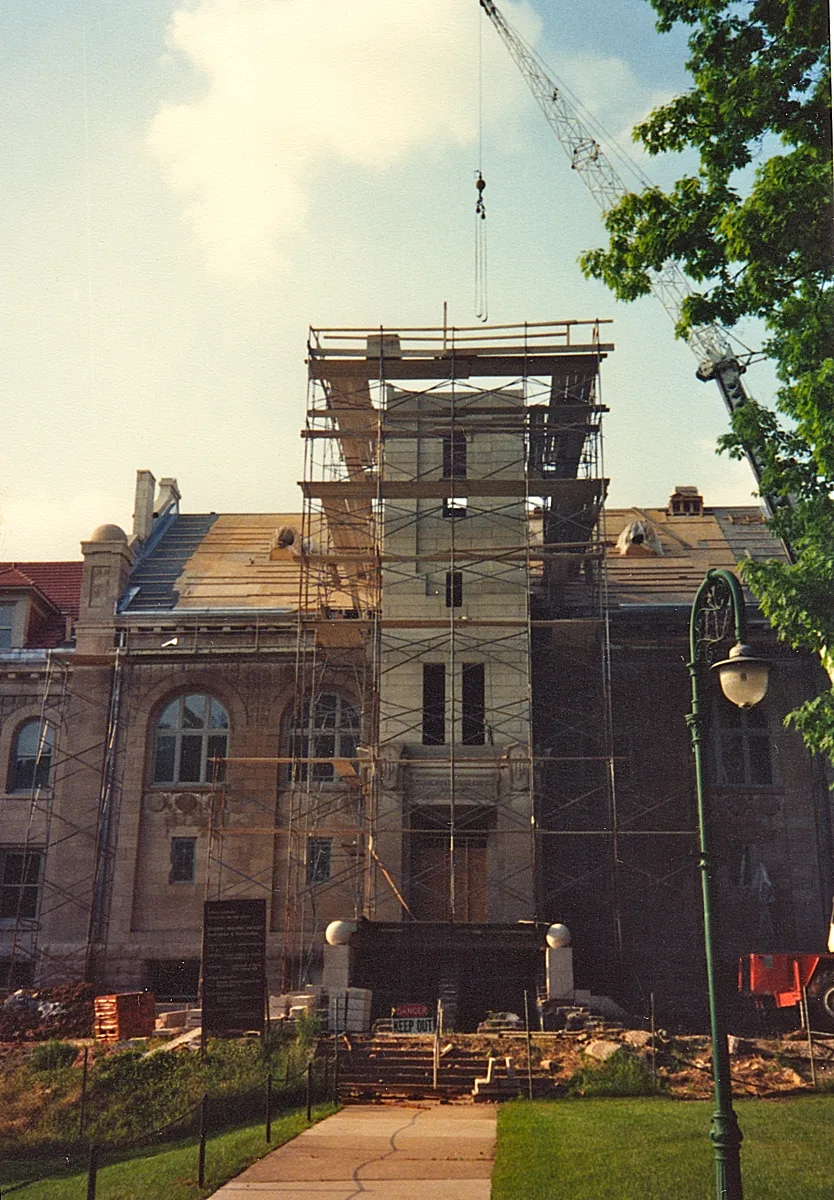
student-building

This is the Student Building on the IU Bloomington campus.  I can easily date this as the summer of 1991, although that’s perplexing because I didn’t live in Bloomington that summer, and I didn’t own a camera then.  That means I must have been in town visiting the person Ray refers to as “the za chick” (long story) and I must have been using her camera.

The Student Building was a total shithole when I was a freshman.  I remember going there for a meeting with some alcohol counseling group.  I was a militant non-drinker as a freshman, which I now realize was stupid, and I probably just should have drank everything offered to me, if only to take the edge off of the unfurling mania that kept me awake for weeks at a time.  But I had some vague interest in finding out about this group that sponsored all of these non-drinking dances and whatnot, and I met with them once and then probably got bored of the whole thing and shifted obsessions to learning all of the bass lines from the first four Black Sabbath albums or whatever.

Anyway, the meeting was in the basement of the Student Building, and at that point in 1989, the place was practically on the verge of collapse, and looked like an East German department store in the mid-70s.  There were flickering fluorescent lights, dark passages, plywood over walls, wires hanging from ceilings, and cracking plaster everywhere.  I don’t remember thinking anything about whether or not the place should be restored or preserved; I’m sure I just thought “man all of these buildings are old… hey, there’s a new Steve Vai album I have to memorize…”

The renovations were underway on the 1905 building in late 1990 when there was an electrical fire that December and the place burned down.  I often say “electrical fire” because it was a strange coincidence that the iconic clocktower building was shut down and emptied and just happened to burn, probably collecting a huge insurance check and an even bigger inflow of contributions from alumni.  Even more amazing is the fact that it takes roughly 8 years to fix a pothole in Bloomington, but they had this thing from gutted and charred shell to completed construction in roughly nine months.

That summer, I lived in Elkhart, but started dating the aforementioned girl over the Memorial Day weekend (20 years ago - jesus christ) and I came down to visit pretty much every weekend I could.  I’d just bought this VW Rabbit diesel, which got something like 50 miles per gallon, and diesel was a dime a gallon cheaper than regular gas, so I could make the 500-mile round trip on ten bucks of gas.  I worked at this copper and brass pipe fitting factory on second shift, and would rush home at midnight on Friday, take a quick shower, then drive into the darkness, cutting across the state on US 31, pulling into Bloomington just as the sun rose.  I missed the Bloomington campus so much during my year of exile up north, and deeply cherished the brief 48-hour visits to see the old limestone buildings again.

By the time I returned to Bloomington in 1991, the Student Building was complete.  Most of the building belonged to the Anthropology department, but UCS outfitted most of the second floor with the latest computer toys, and I spent some time there when I couldn’t get a spot in the IMU or Lindley.  I didn’t work there much as a consultant (most of my shifts were in the Library the fall semester, and all of them were in the IMU that spring) but some of my friends like Bill did.  I always dug the interiors of that building: high ceilings, those giant curved windows, and massive wood trim everywhere.  They mixed that 1905 elegance with 1991 high-tech, with a whole room of NeXT workstations and color printers and flatbed scanners and dual-monitor Macs.

I remember spending a lot of time playing with this brand new program that just came out the year before, called Adobe Photoshop.  The 1.0 version was pretty rough, but let you take GIF images and alter them, changing colors and editing details and doing stuff that people used to do with razor blades and paint.  Today, every single picture we see online is photoshopped, but in 1991, this was still the stuff of science fiction.  Terminator 2 had just come out in theaters, and the idea of CGI and digital effects was brand spanking new, but here I was in the middle of Indiana, surrounded by machines that could do the same damn thing, free for me to use (provided some dork wasn’t parked there using a $10,o00 computer to chat on the VAXPhone to the person two rooms away.)

I spent a lot more time in the Student Building in the 1992-1993 school year.  I briefly had a second job with the UCS education department, helping teach the JumpStart classes, which were these free “WordPerfect in 60 minutes” sort of things.  They also taught these longer seminars on a fee basis to other departments, so if you needed all of your office workers in Parking Enforcement to learn DBase, you paid a few hundred bucks and sent everyone off to a three-hour class.  A lot of these were taught in the Student Building, probably because it was easier to reserve a block of computers for a half day.  I never taught these classes, but was always the assistant, meaning when someone fell behind during a lecture, I’d run up and guide them through the lesson.  I also did all of the pre-class stuff, like going around and wiping out and restarting Quattro Pro on 38 machines, or setting up template files from a server.  It wasn’t exactly my calling, but I was desperate for hours, and that gave me shifts.

The Student Building gradually lost that New Building Smell, and those cutting-edge NeXT machines quickly became boat anchors and eventually got replaced with a cluster of SGI workstations.  (“Wow!  These are the same computers they used to make Jurassic Park!”)  But that building, and all of the postcard-picture scenery in the old crescent of campus, always reminded me of that idealistic summer of 1991, when I so desperately wanted to be back, and the fall of 1991, when I finally made it.