The Wrath of Kon

Dispatches, thoughts, and miscellanea from writer Jon Konrath

2013

Three and three quarter inch memories

So I had to go to storage the other day, to put away the box from my new bass, because if I just threw it in the recycling bin, the truss rod inside the bass neck would have exploded and I would have needed to mail the thing to Germany or Uganda or something for warranty repairs, and I’m pretty sure finding a cardboard box the size of a bass would be a month-long venture.  I didn’t want to dig through the unit, although I think I can now shred any files older than 2007, and there are boxes of tax papers going back to 2000 in there, but they’re in the very back of the unit, and that would involve unpacking everything to pull those boxes, so that can be left for some other time.

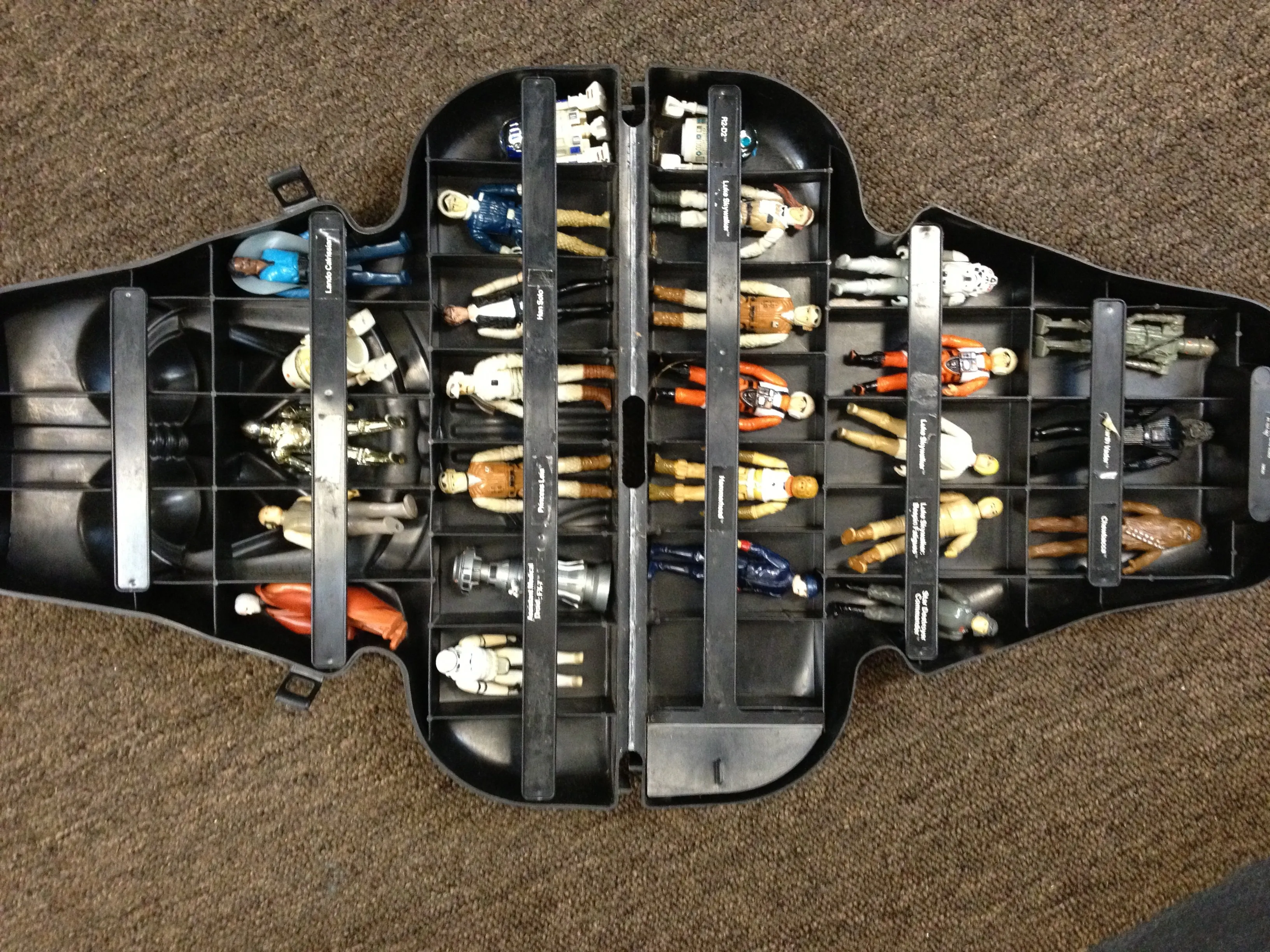
What I did find though, is something that I thought was lost: a good chunk of my Star Wars action figures from the late 70s/early 80s.

Check this out:
IMG_0940-e1357859604600

When I was a kid, Star Wars figures and Legos were the father, son, and holy spirit of my life.  I probably spent an entire year of my life in the toy aisle of K-Mart, memorizing the back cards of every action figure hanging from the displays, digging through every unit hanging from the metal pegs in hopes that some rare figure would be hidden in the very back.  (For example, at one point, the light sabers that extended from the arms of Luke, Obi-Wan, and Darth Vader were two-piece telescoping units; these were later replaced with solid one-piece units that didn’t extend as far.  All of my figures came with the later one-piece light sabers, but I was convinced that if I dug around enough, I would miraculously find a two-piece lightsabered figure at the store, which I of course never did.)

Various thoughts about these figures, in no particular order:

  • This isn’t my entire collection; I don’t know what happened to all of the rest of them.  Notably missing are my original R2-D2, Yoda, and Boba Fett.  Also missing are all of the guns and accessories, which are supposed to go in that little compartment with a door.
  • I also used to have a set of accessories that you got for mailing in a bunch of proofs of purchase, which included vinyl plastic astronaut-type life support backpacks, gas masks, and a backpack that would hold Yoda on Luke’s back.
  • I found this, coincidentally, on the same day I read in David S. Atkinson’s book Bones Buried in the Dirt about a similar Darth Vader case.
  • All of the figures I have with capes (Lando, Obi-wan, Vader) all have plastic capes.  Some of the first-generation characters had cloth capes, which I believe are much more rare.
  • The most predictable comment one would make while looking at this would be “oh man, imagine how much those would be worth in their packages.”
  • I had at least two Boba Fett figures.  They were also a mail-away, and I had enough points to get more than one.  The Boba Fett is best known for having a fixed missile on his back, which was supposed to be a spring-loaded firing missile, but some kid, who may or may not have been Mikey from the Life cereal commercial and/or eating Pop Rocks at the same time, fired the missile down his throat and died.  (That’s not what happened.)  Almost everyone I know who collected Star Wars figures as a kid claims they had one of the rocket-firing Boba Fetts.  They are all liars.  They never released one, although in 2010 they finally did.  (I guess kids are too obese to choke on rockets now.)
  • The original Han Solo figure I have has lost most of his hair-paint.  That’s because after Empire, I used to freeze him.  Lacking a carbonite chamber, I’d put him in a glass of water and put that in the freezer.  This would result in a Han Solo frozen in a round chunk of clear ice, but whatever.  This was before the internet, so my entertainment options were limited.
  • One of my Hoth Rebel soldiers has a weird looking head.  That’s because someone in my school broke the original head off.  My dad tapped a set of threads in the head and neck, and sunk a small allen-head bolt in there so the original head screwed back on.  This made the figure much cooler, as I could unscrew the head, leaving a bolt sticking out of the neck like a robotic spine.
  • My Chewbacca had a weird divot missing from the top of his head, right at the seam.  It looks like he was into self-trepannation.
  • The R5-D4 figure has only white, worn-off remnants of its original sticker.  After this happened, when I got the R2-D2 figure, I painted over the sticker with clear nail polish of my mom’s.  This preserved the label, but now it’s got this weird yellowish sheen to it.
  • Speaking of discoloration, my Hoth Han Solo appears to have jaundice from a bad case of hepatitis.
  • My favorite figures include the Hoth Luke Skywaker, the R2D2 with the extending antenna in his head, and the missing Boba Fett.
  • The figures that now seem stupid include Bossk and Lobot (who had a combined total of about 3 seconds of screen time), the Bespin Guard (who looks like a creepy guy with a waxed mustache and beret you’d find hanging out at a leather bar) and the FX-7 robot (which did not have moving legs, could not sit and therefore didn’t fit in any vehicles, and came with no guns or accessories.)

Amazingly, all of these survived.  My GI Joes did not - for whatever reason, they were much more susceptible to damage.  One of them lost both of his thumbs because he had this bazooka that essentially worked as a large lever to fatigue and break the little plastic digits.  So I chopped off his hands, touched up the stumps with red paint, and he became “Can’t Read Text on a Claymore Mine Joe.”  When that got boring, I hit him with some aqua-net and a cig lighter, and he briefly became “Victim of a Friendly Fire Napalm Incident Joe” and then “Cannot Identify Remains Joe.”


Dreams of squatting

I have these frequent recurring dreams of living temporarily, squatting in hidden areas of public places, like crashing for a month in a forgotten storage area of a Vegas hotel, or a never used classroom in an old academic building.  The dreams are so vivid and frequent that I usually wake and think they’re based on some event that actually happened, which makes me cycle through every possible place I have lived to match up the psychological trope with the actual experience, and this exercise takes me twenty minutes, especially after just waking, and it’s maddening, because I don’t know what my brain is basing this on.  I can think of a few vague experiences that almost line up with this, but they’re so forgotten, it’s amazing my brain can pick them out and form dreams from them, especially the same brain that makes me forget something I just did two seconds ago.

In my freshman year of college, the dorms closed on a Friday, but you had until Sunday to move out. This makes no sense, because if you had the key, you could still get into your room, and they didn’t lock down the front doors or pump knockout gas into the vents, so for all intents and purposes, you could still stay there.  Yeah, your meal card ran out, and it turns out they shut off the heating system, and of course this was the one time that the first week of May saw the Indiana temperature drop to 39 or something.  They also posted all of these signs warning that the dorm was closed, like anyone ever reads signs.  I stayed anyway, along with my then-girlfriend, and no harm done.

The next night, after some shitty looks from the custodial staff and/or guilt on my part, we decided to stay with some friend of the girlfriend’s.  I forget the friend’s name, something generic like Michelle or Jenny, since every other girl I knew on that campus in the early 90s was named Michelle or Jenny or Jennifer or Jen or Jenn.  (I’m not saying that in a bad way.  All of the various Jen.*s I knew were great and interesting people.  I just find fascination in the phenomenon where everyone watches some TV show, and 18 years later, you know two dozen Phoebes or Brittanies or whatever.)  Anyway, she moved into a summer sublet with a bunch of dudes from Lebanon, and offered to let us sleep on her floor for a night.  So we went to this student ghetto house south of campus, and the whole time this girl Michelle was talking about how these Middle Eastern roommates were constantly trying to bone her, and she told them she was a virgin.  This was somewhat hilarious and ironic, because the first time I met her, she was going A-Z through her address book on a Friday night and leaving messages on every dude’s machine telling them she wanted to fuck them.  We slept on the floor while trying to tune out Lebanese TV and guys yelling half-English indecent proposals at this girl.  This was just hours before I was walking into a five-hour parental lecture on my failures as a human being on the long drive home, so I wasn’t entirely focused on the scenario at hand.

Four years and a half-dozen girlfriends later, I stayed in town for a summer and then moved into a new place in the fall.  This was always a problem in a college town like Bloomington, because there was a two-week dead zone between when leases in town ended and every lease started.  There were basically three ways around this problem:  sign an extension to an existing lease, fuck someone that just signed an extension to an existing lease, or put everything you own in your car and sleep in the main library on a study table and shower in the sink of a gas station restroom for two weeks.  I guess you could also buy a house or move all of your shit to a parent’s house and then move it back 14 days later.  There were also oddball edge cases of people renting houses from some random dude instead of from a subsidiary or branch of the two companies that ran 94% of the rental properties in the city.

This time around, one of my future roommates lived in a house with an extended lease and a couple of roommates bugging out, and we arranged it so I’d move out of my old apartment, put all of my furniture and crap in a single bedroom at his old place, and then move straight into our new house two weeks later.  This meant I spent half a month in this weird limbo scenario, with four rooms of furniture stacked like a demented 3-D tetris game, surrounding a mattress on the floor, where I’d sleep.

This may be the prototype for all of my future recurring dreams, because not only were all of my possessions in a transitional state, but my entire life was, too.  I remember reading East of Eden the whole time I was there; this was in my first year of “being a writer” and was madly trying to read all of the books a writer was “supposed to” read. I don’t remember much of the Steinbeck book, but I remember reading the book, and it affecting my perception of what a book should be.  Maybe that’s the repressed memory, the thoughts about what I should be writing triggering the false memory of living where I shouldn’t live.

Yards of trains

IMG_6405

I keep looking out the window at the train yard that’s a few hundred yards away, across the highway.  You can’t tell it’s a train yard, because you just see the profile of it, and the occasional diesel locomotive tooling back and forth on the horizon.  I just looked at google maps, and it’s not really a train yard, maybe six tracks in parallel.  There’s a set of through tracks that belong to the Amtrak, the Capital Corridor line, the train that goes from Jack London square and points south, like San Jose, and connects to Emeryville and points north-northeast, like if you took the train on to Sacramento.  I think that freight trains switch off of this main thoroughfare and are broken apart, or maybe put together.  I don’t know any of the language or nomenclature involved; I’m sure there’s a railfan site that explains all of this in more detail.

I thought of this because as a little kid, I was infatuated with trains, and growing up in Elkhart, you always got stuck waiting for a hundred-car train to go by.  This became much less interesting when I actually got a driver’s license and had places to be, and a few hundred Conrail cars meant the difference between arriving before first bell or getting a tardy.  Elkhart has one of the largest freight yards in the world, although I didn’t know this at the time.  It’s dozens and dozens of tracks wide, something like 675 acres of switches and rail cars.  It’s a classification yard, which means trains are broken down into different types of cars and reassembled for long hauls across the country.  I’d heard that at one point, every rail car that went from east to west across the country or vice-versa would go through this station, which explains why we had to wait for trains so much.

You couldn’t tell this was a busy rail yard from a distance.  It ran along a highway, Lincolnway, and from the side, it looked like just a single track.  There were a few derricks or fuel hoses or whatnot, but without the magic of google maps or some info from a friend’s dad that worked there, you really couldn’t tell how big this was.  The one time I could tell something was up was during the first Gulf War, 1990, when I’d drive on that highway every day to get to classes at IUSB.  The AM General plant in Mishawaka was turning out Hummer jeeps at breakneck speeds to get out to the big war about to go down, and they’d drive them from the plant to the rail yard, to be shipped off by train to some big coastal cargo center, where they’d get put on ships or whatever and hauled out to the desert.  Every day, as I’d drive west to class, I’d see a long column of the boxy new vehicles, painted in tan camouflage, equipped with full military gear, driving East to the train station.  It looked like a scene from some Reagan-era “The Commies Have Invaded” urban combat movie.

Conrail, who once operated all of those blue and white trains, is no more.  Split in half, Norfolk Southern now operates the Elkhart yard.  The one lasting legacy is in the Elkhart water table; over the years, Conrail accidents spilled millions of gallons of toxins into the tracks, seeping into the water below.  Many houses in Elkhart still use well water, which means a series of high-profile EPA superfund shitstorms happened in the area in the 90s.  Huge plumes of trichloroethylene (TCE) and carbon tetachloride (CCl4) infected the water table, and hundreds of houses were forced to connect to the city water system.  It’s a common trope in the area: damn the regulations, damn the government oversight, get big brother out of our way so we can make money… oops.  See also the PCB-happy companies in Bloomington that all split for Mexico, taking the only high-paying, low-skill jobs in town and leaving behind toxins in the watershed.

It’s still interesting to me though, to see those boxy locomotives pushing around flatbeds.  It’s such a familiar shape, even in different colors and livery, like the toy trains I played with as a kid and the real-sized versions that blocked traffic every day in my old town.  It’s almost hypnotizing to watch them across the highway, wondering if any of the same boxcars rolled through that freightyard so far east.

Various theories on Louie

One of the favorite parts of my recent vacation, aside from the 47 pounds of chocolate I ate, was watching Louie.  I’ve already seen all of them, but my brother-in-law hadn’t, and somehow stumbled upon them on the Roku box.  Part of the enjoyment of this was simply that we watched them after everyone else went to bed, and instead of hearing “The Wheels on the Bus” or “Itsy, Bitsy Spider” for the 4,000th time like some kind of psyops torture normally reserved for Gitmo detainees, we got to watch an Adult Show.  But part of it is that my brother-in-law M is an English professor, and we spent a lot of late night rambling poking at the edges of what the show Louie really meant.

Point one: stand-up comedians have a shelf life.  When you hit it big, you have a certain hang time, usually a couple of years, and then you have to either reinvent yourself or do something different or hope for a second wind, or spend the rest of your life scraping together a career out of appearances with your most loyal fans.  (I would call that the “CMC syndrome”, after the record label that pulled a bunch of big has-ran bands from the 80s and resurrected their careers in the 90s with records that almost nobody bought and appearances at county fairs, ala Styx, Journey, Loverboy, etc.)  If you’re someone like Dane Cook, you have this peak where you’re selling out stadiums, and then when your single male fans get married and have kids, that goes away.  And maybe you start doing material about wives and kids, or maybe you do smaller shows, or maybe you get into movies or you get a talk show or a sitcom.  And the sitcom is the gold standard; it’s the big go-to for comedians who want to take it to the next level.

What’s interesting about Louie is how it isn’t a formulaic sitcom, because it’s not entirely a grab for career leveling.  CK took much more creative control of the show in exchange for much less pay and a spot at a less prestigious network.  This may be partially based on his previous experience with HBO’s short-lived Lucky Louie, which was much more of a prototypical sitcom.  But it seems to be a move in doing something beyond stand-up and yet not the typical “crazy guy with the too-hot, too-young wife, couple of young kids, and the goofy neighbor” show that pretty much every other stand-up would have churned out.

CK is much more of a comedian’s comedian, the kind of person who does comedy that’s not swinging for the fences of general appeal, but is aimed more at the craft of the art form.  It’s like the prose of a Raymond Carver versus the volume sales of an EL James.  And the edge of a comedian’s art is always what gets lost in translation to a typical sitcom.  If you look at Tim Allen, George Lopez, or even the short-lived Andrew (not-)Dice Clay sitcom, it’s as if the edginess that makes their stand-up shine is what’s trimmed away to make a typical formulaic TV show that appeals to the Nielsen numbers.  Part of what Louie’s charm is, is that he manages to keep the quirkiness of his stand-up in the show, and doesn’t compromise the humor in a need to cookie-cutter the writing for a test audience.

One of the things that M and I discussed is how CK often takes the same tropes that Seinfeld often used to form his episodes, but instead of polishing them into finely structured two-act plus closer, A/B-plot, 23-minute gems, he sometimes goes off into nothingness, not using conventional endings or structures.  Although Seinfeld is remembered as a show “about nothing”, look at any of the episodes and they are all highly structured.  Louie borrows some of the stock structure, like beginning and ending with a piece of standup in a club, but sometimes there’s not a B story; sometimes there’s no ending.  And I think this is very off-putting to some people who expect a specific structure to a TV show.  (My wife hates Louie, for example.)

This is analogous to my own inner conflict over plot in fiction.  If you go to any genre writing site, they beat to death the need to follow the three acts and 12 steps of the journey and five types of plots and two threads and rising and falling and all of that other shit that’s “required” to make a book work.  And a lot of people will freak the fuck out if you write a book that doesn’t do that, and that’s why “plotless” is seen as an insult and not a genre.  But take something like Infinite Jest - it breaks so many of the rules that you’d find in a typical Writer’s Digest “how to write a novel” book.  I don’t think fiction needs endings or plot structure, just like Louie doesn’t need the same structure as an episode of Matlock.  My hope is that the popularity of Louie would primer an audience for cutting-edge prose that also doesn’t need to follow the same convention as the same generic short stories everyone’s been writing for fifty years.  I wish I knew exactly what that would be, and that’s my struggle.

My other observation is how Louie seems to relish discomfort, and a theory of mine is that each episode of the show isn’t what is happening to CK, but rather is his inner monologue, or what he wishes was happening to him.  This was an observation that Richard Linklater made about his movie Slacker: that the structure allowed each character to essentially externalize their inner monologue, talking aloud about the thoughts that normally they would only think.  For example, in episode 7, “Double Date/Mom”, CK has lunch with his mother, and lashes out at her with an extended diatribe about how he doesn’t really love her, and just endures her.  Many of us might feel the same way during a parental visit, and would internally fantasize about going on a tear like CK does, but instead just sit silently and endure the visit.  And maybe CK would too, but what we see is actually his inner fantasy, of telling his mom what he really feels.

So yeah, Louie. I still haven’t seen season 3.  Maybe I need to pull the trigger and spend the $20 to get them on instant.  That will have to tide me over until 2014 when season 4 starts.

State of the bass, January 2013 edition

I mentioned a while back that I started playing bass again.  Here’s an equipment update, since it seems like all I’ve been doing is amassing new stuff.

IMG_0929-e1357411764778

I previously wrote about my Cort bass.  It’s a Steinberger-licensed headless bass from the late 80s or early 90s, and it’s still here.  It looks okay in this picture, but that white finish looks a little yellowish, and the neck needs adjustment.  I am also not 100% with the tone, and wouldn’t mind ripping out the pickups and putting in a set of EMGs, but I have bigger fish to fry.  This one’s probably off to the shop for a setup though.

IMG_0833

The next bass is the Ibanez, which is a GSR-190 4-string, made in 2007.  It’s been the main workhorse as of late, and I like it a lot.  It’s well-balanced, has decent tone, and a thin, fast neck, which I really appreciate.  One of the downsides compared to the Cort is that it goes out of tune every few days, just slightly.  With the Steinberger tuners, you could pretty much drop the Cort out of a plane at 40,000 feet and the tuning would still be dead on, but it also makes me wonder if I should someday swap out the tuners or something.

One change I did make: I had this coupon burning a hole in my pocket, so I ordered a set of EMG pickups, originally thinking I’d put them in the Cort, but then chickening out because there’s almost no space in its cavity for the battery and other junk, and I play the Ibanez daily.  The switch was incredibly easy; EMG now puts DIP-style connectors on all of their gear, like a PC motherboard, so you can completely wire a bass without any soldering.  The new pickups (the EMG X series) are incredibly punchy and very warm.  The best part is that they are completely silent.  My office is filled with noisy fluorescent lights and barely shielded WiFi and bluetooth and whatever else shooting energy through the air, and most musical instruments will pick up hissing and buzzing and Mexican radio stations and everything else, but the active EMG pickups are dead silent.

IMG_0923

And then the new one.  Yesterday, I got a new Schecter Stiletto Studio 5. It’s a mahogany body finished in a see-through satin black finish, which is stunning, although hard to photograph.  From a distance, it looks like a stealth bomber’s paint, but up close, you can see through the wood grain underneath.  It’s a 35” scale neck, which means it’s an inch longer than a standard bass, making the sound much more incredible.  (Think the difference between a tiny upright piano and a big concert grand.)  It’s a neck-through, for insane sustain, and it’s got passive EMG HZ pickups and an active 3-band EQ.

The one thing about this bass is that it is HEAVY.  I mean, it’s like if you carried around an M-16 all day and someone handed you an M-60 machine gun - it’s a substantial heft, but it feels really good.  I’ve got a wider strap, but I feel like I’ll need to double down on chiropractic care in the upcoming months.  It’s not horrible, but compared to the light Ibanez, it’s a big step up for me.

I’ve never played a five-string before, and this is a bit overwhelming to me. The neck isn’t substantially wider or thicker than my 4-string, but there are three things going on.  First, that extra inch of scale is fucking with me, and while I can cover the first four frets on a 34” bass with a fret per finger, I need to change my technique here or something.  Second, I’m so used to the bottom string being the E, that I get lost and start doing shit on the wrong string.  Or even worse, my left hand is off by a string but my right one isn’t, or vice-versa.  And third, there’s all of this mental arithmetic of the different possibilities I can use to play the same notes.  It’s confusing, and will take a lot of time.

But - that low B string is absolutely sick.  Just the sound of it rattling away is awe-inspiring. I’m so used to the lowest sound a bass makes as that low E, and the B below it sounds like pure doom.  I went to Songsterr yesterday, and my first thought was to look up some Carcass songs, like off of Heartwork and Swansong, which are both albums that I think purists hate, but that over the years have really grown on me.  I started playing the song “Keep On Rotting in the Free World”, and the first time I hit the open B, I realized I made the right choice with this thing.

I was going to write more about effects, which are also rapidly multiplying here, but I think I need to go practice.  Actually, I need to do back stretches, then practice.