The Wrath of Kon

Dispatches, thoughts, and miscellanea from writer Jon Konrath

Tag: gaming

An extended rant about how I am too old to play video games

I have been wasting an inordinate amount of time playing X-Plane 11 on my Mac. I’m not very good at it. It’s a flight simulator and not an arcade game, so it’s much more about trying to flip every switch in a ten-page long takeoff checklist for a 737-800 and less about stick-and-rudder type antics. It’s honestly very boring and unrewarding. I still play it, though.

Probably the most boring thing I do is put a Cessna at the South Bend airport, then go through every air traffic step to take off, setting a flight plan to fly to Elkhart Municipal airport. This is an 18-mile drive if you’re in a car, and Google says it is a 31-minute trip on land, but if you speed and don’t run into an Elkhart County sheriff trying to make quota, it’s like twenty, twenty-five.

It takes like an hour to fly this at 120 knots. Part of that is that you have to taxi across the entire 9R/27L runway, a mile and a half, and then sit around while three other planes in front of you take off. Then, instead of flying eighteen miles straight east to the Elkhart airport, ATC will route you about five miles east of Elkhart and sixteen miles south, then you swing around the city in a big sixteen-mile box, waiting for everyone else to land. And I know for a fact that three planes have never landed in a row at KEKM since the airplane has been invented, but you still have to wait. When it’s clear, you can then do another big box to approach from the south and land on the north-south runway. (This runway doesn’t have ILS though, or maybe I keep missing it, so I always have landed manually, which sort of defeats the purpose of the ILS flight in the first place.) This all on autopilot, so all you’re doing is adjusting one knob every fifteen minutes and listening to the radio.

The real challenge with X-Plane is that even with the highest-end MacBook Pro currently available, it still looks like garbage. I see pictures from people with decked-out Windows machines, with thousand-dollar video cards and terabytes of photorealistic scenery, and it almost looks real. And then I start thinking, maybe I need to build another machine, a Windows machine with all gaming hardware, and then I realize I would waste hours and hours of time fucking with NVidia driver updates and blow three or four grand and still be flying from one regional airport to another. (And never mind that it’s currently impossible to buy a high-end GPU, because everyone is hoarding them to mine bitcoin. Seriously, a video card that cost $200 around Thanksgiving would probably fetch a grand on eBay, if you could even find one.)

I really want to play DCS World, which looks impressive in the trailers, but once again, it would require a PC I do not have and do not want to build. And keep in mind, I’m talking about spending thousands of dollars to build a machine that would prevent me from writing, so this is especially stupid.

Yesterday, I went on Steam because I heard about some new game that’s free to play where you fly planes, called War Thunder or War Kill or War Fucker or something, I forget what. It looked interesting, ran on the Mac, and it was free, so I clicked play, and it proceeded to download twenty gigs of installer to my machine. Twenty or forty minutes later, it started asking me to map 47 different buttons and axes on my joystick, which was overwhelming. Then it started me in a training thing, which was semi-impossible for me. Then it threw me into a battle.

I guess with this game, you can play as a plane or a tank, and there are these massive online battles where tanks mass at a border and shoot at each other, and then planes fly overhead, dogfighting. And I think tanks can shoot overhead, and planes can strafe ground objects. Because I was level 0, the game basically gave me a Wright Brothers biplane from 1903 with a pellet gun under the wing. I flew around slowly, in big turns, and there were tiny dots on the horizon, people barrel rolling and flying at almost the speed of sound in Mustangs and Messerschmitts. I fired my pellet gun at some microscopic things on the ground, and was immediately shot down.

I was then given opportunities to spam my Facebook friends to get coins or gold or bucks or something, which if I collected like a thousand and got some daily bonus, I could upgrade my pellet gun from .177 caliber to .22 caliber. I think if I did this seven days in a row, it moved up to a ten-pump BB gun. I would basically have to quit my job and play full time to get up to the worst US fighter from the beginning of the war with no guns, maybe by the end of 2018. And I’d have to buy some loot boxes or gold chests or whatever else.

After a minute, I got thrown into the game. I think my pellet gun hit a tank once, then I was immediately shot down. A fourteen-year-old popped open a chat window and offered several slurs related to my possible choice of a sexual partner, in which I would assume the role of the woman. I got back in long enough to run out of pellet gun ammunition and then crash into a tree. I was then returned to a hanger, which offered more opportunities to buy doubloons or upgrades or something, at which point I disconnected and deleted the game. My carpal tunnel wrist is still killing me, and I still have books to write. I’ll probably reinstall it next weekend.
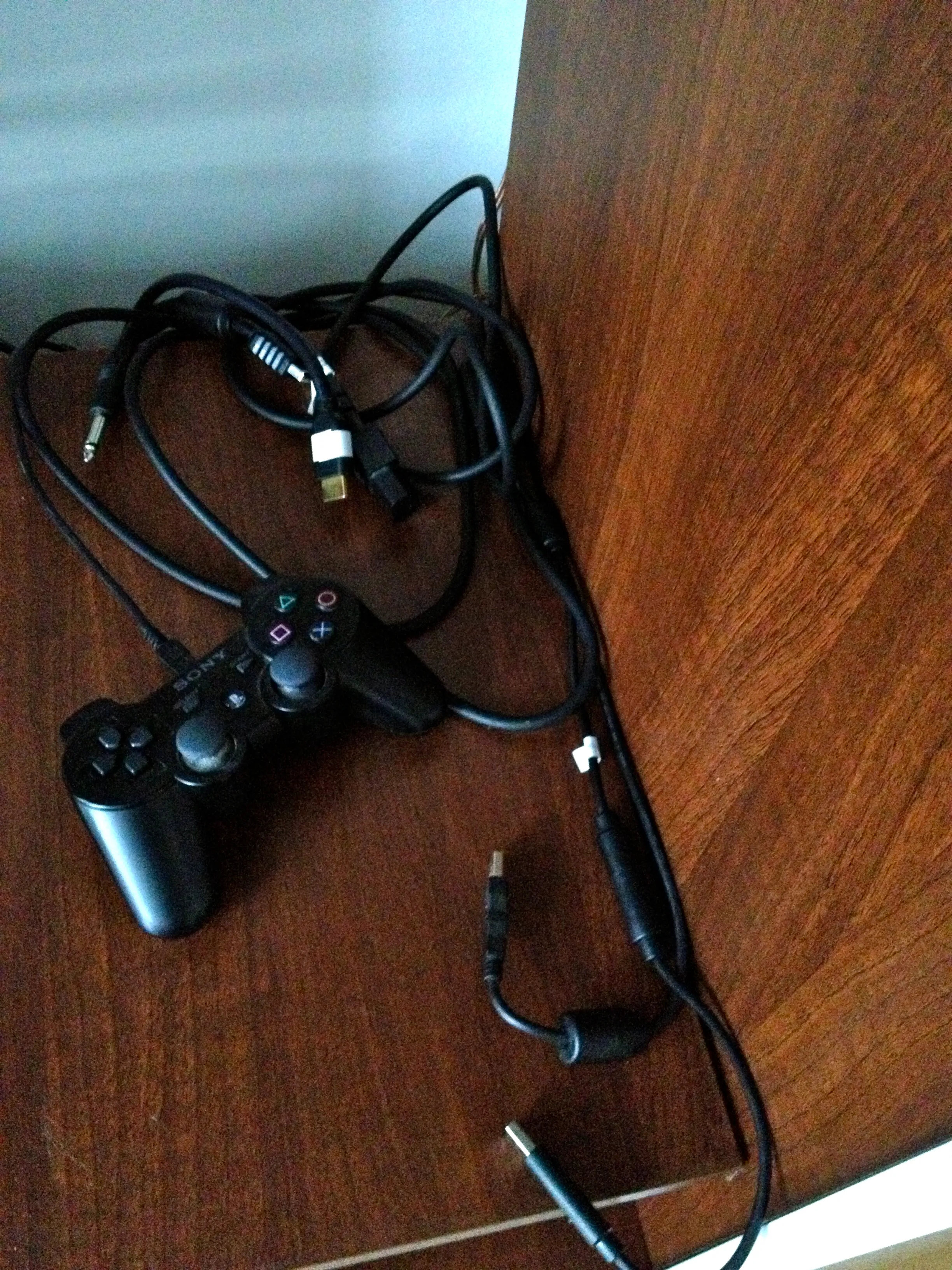
Ode to a busted cell processor

IMG_1183

God damn it. It is broken. Again.

My PS3 is in a shop somewhere in Missouri, getting the yellow light of death beaten out of it. It went south in November and got all of the solder stripped away, the whole mess ultrasonically cleaned, then reflowed. Or something. Now it is dead again.

I am at an deadlock with this new book. 100,000 words and I don’t even know what it is about, what order things should happen. I feel like that scene in the Naked Lunch movie where Ginsberg and Kerouac show up in Tangiers and Burroughs is strung out on junk, unaware that his apartment is filled with notes and routines that would later become his most popular book, but it’s this fucked mass of scribbles and jumbles.  I wish I had a Ginsberg that would show up and unfuck this book.  I keep at it though — it will eventually make sense.

This is the time where I would fire up Black Ops and walk away for a bit, let things ferment.  This is what’s staring at me when I want to do this: loose cables and a controller hooked up to nothing.

I would go out and buy a new PS3 slim, but that’s basically paying $300 to not write.  $300 when a PS4 is months away.  And it wouldn’t even play my old PS2 games.  I’d have to pay another $100 to get a PS2 also.

I have this sick attachment to this PS3, a heavy nostalgia, because back in 2007, when S worked 80 hours a week and I was jobless, I spent hours and hours writing this book I never finished, and working for a friend’s startup for free.  But then as day became night, I would fire up this PS3 and play it for hours.  I formed this stupid emotional bond for a piece of hardware that would someday become obsolete, someday die.  I sometimes fall in these deep nostalgic k-holes for the recent past and think about Denver a lot, and one of the top five things in those memories involve this black monolith of a video game system, which is why I struggle to keep it alive and UPS it to some dude in Missouri to get it re-repaired.

I have all of these dumb games for the iPad, but that’s just tapping on a screen.  The PlayStation creates these immersive worlds I get lost in for hours.  Back when Vice City came out, I would play it for hours, like it was my full-time job.  I’d come home from work on a Friday night, order a pizza, and fire up the machine, just to wander, to get a motorcycle and drive through neighborhoods and try to jump off of stuff, watch the people walking, find secret entrances or ways to climb on rooftops.  This was after I finished Rumored, when I was in a funk about dating and meeting people, when that postpartum depression after finishing a big book really kicked my ass.  I’d hole up in my Astoria apartment for entire weekends, at the DualShock controller.  It wasn’t healthy, and it wasn’t productive, but it was.

I can’t do that anymore, but I sometimes wish I could.  I should probably ignore this and get back to this goddamn book.

Life and death of the Game Boy

IMG_0163

When the Game Boy first came out, I was infatuated with Tetris, still a new disease to me.  I could spend any amount of money playing Tetris in 1989 or 1990, until I had nightmares about falling blocks and that stupid song stuck in my head.  So when the Target stores started putting display units of Game Boys chained to a glass countertop in the electronics department, I’d spend hours mashing that little grey cross and the two red buttons to drop tetronimos on its pea-green LED display.  I lusted after the Game Boy, even though I didn’t even have a home computer at the time, and if I had the money for Nintendo’s portable game system, I would’ve had half the money for a cheap Amiga.

There’s something pervasive about handheld game systems.  All through the 80s, the systems grew in complexity, starting with those addictive football games that were nothing but a series of rows of LEDs, or the Simon-type games, things that just beeped and bleeped to get you to mash buttons and eat through nine-volt batteries, spending more of your time learning how to put the two terminals of a square battery on your tongue to gauge how much juice it still contained.  I had a few of these games, like this D&D game where you had to move through a maze and not get clobbered by these little LCD sprites, something I got for $20 and played the hell out of until it became boring.  I enjoyed the games, but the cost proposition was too high to fully embrace the format.

But there was always something intimate about the little pocket games, like a secret drug addiction you could slip into and avoid life.  The console systems, the pongs and 2600s and NESes, always seemed a more public affliction, something you’d set up in your living room and inflict on the entire family.  Maybe it’s because they involved a TV set, and this was a time when there were more American homes than TV sets.  But the pocket systems involved a personal closeness, something that was instantly on, always there, a tiny screen only you could see.

The mixed curse to these is they only played one game.  When you got the pocket Space Invaders game, it only played Space Invaders.  Sometimes, you could toggle a switch to get a different difficulty, or change your tennis game to play handball instead, but the units were almost entirely dedicated to that single pursuit.  A huge advantage to that is every game had its own controls, its own button layout and size and feel and placement and color.  When you played the aforementioned Space Invaders game, those buttons, along with the unique display elements, the custom LED or LCD panel, were your direct connection to that game; your pocket Pac Man or handheld Galaga had a completely different set of controls and look and feel, and was a different drug entirely.

(That’s my chief complaint about the Kindle.  I love it, and use it when I travel, but I don’t like that every book has essentially the same look and feel because I’m reading it on the same sized screen and holding the same exact weight in my hand and pressing the same exact buttons, regardless of author or title.  When I read a paper copy of a Philip K. Dick book, the binding and size and font and smell of the pages dictate a completely different experience than when I’m reading Freakanomics. But on the Kindle, there’s some latent similarity in the experience, which bothers me.)

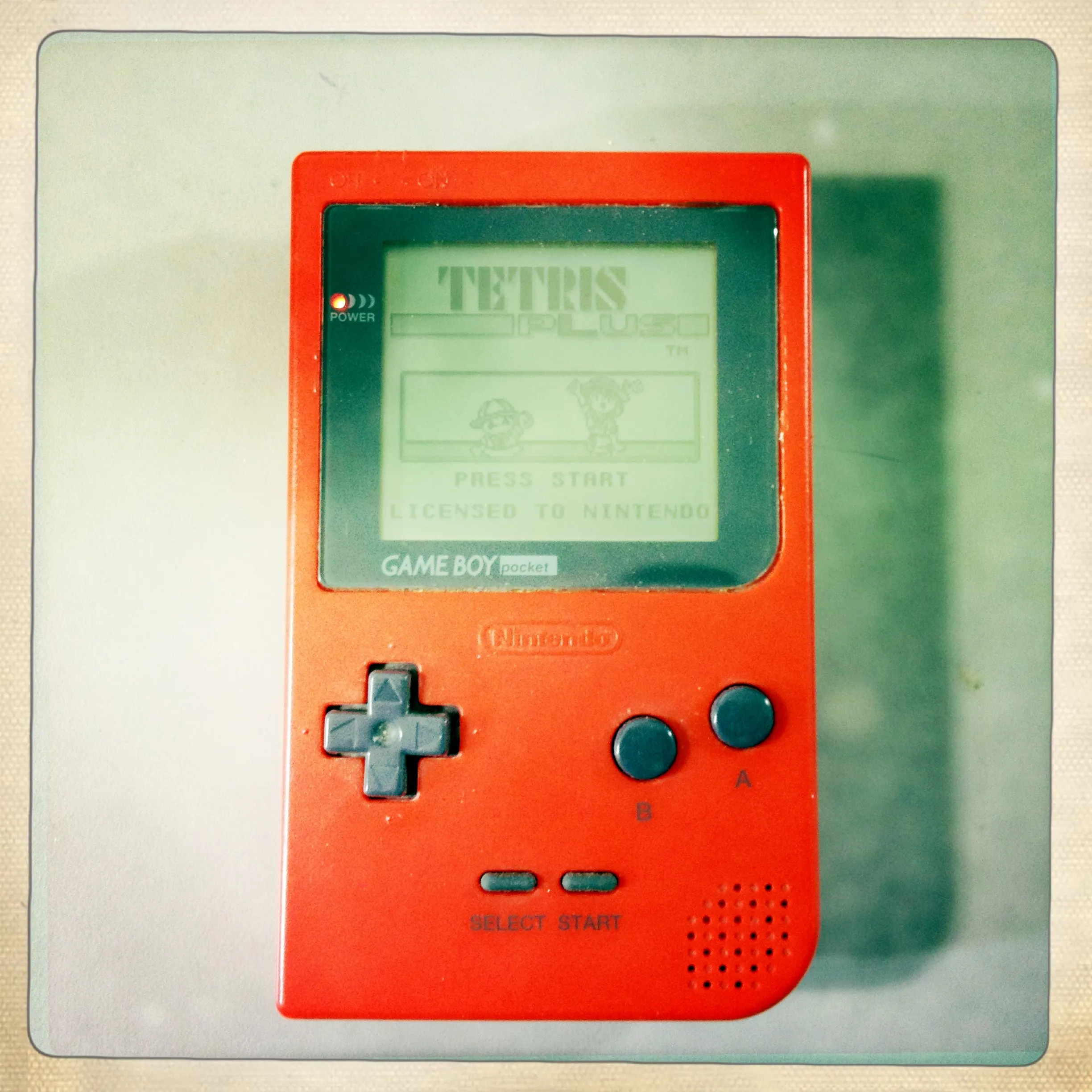
Of course, the big advantage to a one-system-plays-all approach like the Game Boy is that you bought one system, then bought a bunch of cartridges and had a whole library of titles to play.  Unfortunately, it never worked that way for me.  I got the Game Boy Pocket in 1996, a gift from my girlfriend at the time, something I could use to whittle away the hours while sitting in airports on a long and tortuous holiday trip back to Indiana.  The Pocket is an often-forgotten model, an incremental redesign of the original, smaller, using fewer batteries, but otherwise the same unit.  They quickly came out with a color unit, and I felt deceived in that way that happens when your top-of-the-line electronics purchase is suddenly old hat.

My first game purchase was, of course, Tetris plus, a version of the original Russian plague with some additions, like if you cleared special bonus blocks, you could drop bombs and blow up pieces.  I played the living shit out of that cartridge.  The Pocket used dual AAA batteries, good for ten hours at a clip, and I went through many sets of Duracells for that machine. I spent late nights seized by writer’s block, sitting in bed in the darkness, a single halogen nightstand light trained on the not-backlit LED screen, trying to beat my high score on the little red plastic box.  I didn’t have a home video game system, and this was long before phones with games, so this was a unique addiction to me.

But I couldn’t really find any other games as prevailing as Tetris.  I think I bought one or two new cartridges, including a Star Wars platform game with horrible graphics; I got stalled trying to navigate through the Death Star and couldn’t go any further.  I also went to my favorite used record store in Seattle on University, and went through their stack of loose and book-less cartridges, trying to find anything interesting.   I found a Boggle game, which was completely useless with no keyboard, and a Mahjongg game which caused migraines because the tiles were so unreadable on the low-resolution screen.  For whatever reason, Tetris was not only the killer app for the system; it was the only app.  Everything else was either too graphics-intensive or needed more CPU or didn’t work well on a cartridge or begged for network connectivity or needed different controls.  Tetris was the One True App for the system.

Nintendo has gone through two major iterations (GBA, DS) and many minor upgrades of the system, and I never got onboard with any of them, although there were moments, usually during fire sales of obsolete systems or fits of extreme boredom stuck in airports, that I considered it.  But then the Palm came along, and now phones can play games almost as well as the handheld systems.  This is ultimately Nintendo’s doom, just like how the emergence of home computers killed dedicated video game systems in the 80s.  Why spend hundreds on an Atari 5200 and an Atari 800 when you can get an Atari 800 and play games plus “learn computers” and do educational stuff? Never mind that the 800’s games were a slight step behind the 5200’s, or that 99% of the people never did any educational shit on home computers, regardless of the huge revolution that was promised back then.

It’s the same way now.  Why buy a Nintendo 3DS for $200 and then buy a laptop or iPad for “educational” stuff, when you could just buy the tablet or PC, and play Angry Birds on that?  There are several minor holes to shoot in that argument - I think the MSRP on a 3DS got dropped for the holidays; the 3DS is a better “true” game machine and has better tactile buttons and 3D technology blah blah blah.  But parents don’t shop for toys based on vertex performance of the GPU; they go on groupthink, and that says that if you buy your kid an iPad, they will “learn computers” and become a genius, case closed.

But there’s something about that tactile relationship to the Game Boy or the older pocket games that Nintendo could exploit, and I don’t know how.  Maybe Nintendo will need to fail, maybe there’s a need for a huge video game crash like 1984 all over again, and another company will have to rise from the ashes to convince people that something other than Farmville is the future to gaming.  But what will that be?

Assault on the Aerie of the Asbergers

We went out yesterday for lunch at this Burmese place (which was thankfully not renamed a Myanmarian place which would completely screw up the GPS, which would probably tell us to drive 5,427 miles on I-90, take three left turns, then drive 5,426 miles in the other direction) and I can’t tell you much about the Burmese place except the food was decent, and they brought me this salad that had 16 ingredients checkerboarded on a huge plate that was then mixed together at the table, which is a great concept unless you’re the poor bastard that has to lay those 16 ingredients on the plate for minimum wage.

After lunch, we wandered around this neighborhood on Telegraph, looking at thrift shops, including this craft reuse place that had loads of trippy stuff, like giant boxes of photos you can buy by the pound.  The pictures were not like getty stock photos; they were just boxes of random family photos, vacation photos, and snapshots.  I seriously wanted to load up on these, scan them in, and use them as stock photos on this web site, so you’d come here to read my blog, and the featured photo to the left would be two dudes playing hackeysack on a beach in Yo La Tengo t-shirts.  And maybe I will do that, except that I absolutely hate scanning photos, and wouldn’t mind having a lot less stuff in the house, not more.

We wandered up Telegraph a bit more, and I saw this game store.  For some reason, board games and RPGs have had a huge resurgence lately, which I find fascinating and annoying.  The annoying part is that I was playing D&D back when it was a rung below pedophilia on the social acceptability scale.  And I blame the two-pronged attack of role-playing games and computers as the reason I never got my shit straight from a social standpoint back as a teen.  And I got out of the whole dragon-slaying thing well before college, but then a decade or so later, every damn hipster doofus in the world is reading Tolkein and talking about how cool their pewter half-orc figurine collection is.  And part of me wanted to get back into it, but I don’t have endless expanses of time like I did when I was 14.  But it’s always been something I was curious about, like how I’m vaguely interested in the world of model railroading, but I honestly have no deep affection for trains themselves, and do not have the time, space, or close-up vision to build a giant railroad setup in my house.  (But I still re-read Sam Posey’s Playing with Trains every other year.)

So we went in this game store, and it was wall-t0-wall stuff that would have made me have an aneurism when I was fourteen.  I mean, back then, in bumfuck Indiana where I grew up, you had essentially two choices for all of your TSR gear: the Kay-Bee toy store stocked some small amount of books, modules and dice, and Walden’s Books carried some of the hardcover books and Dragon magazines.  There weren’t any other places to get any of the non-TSR games, although I’m sure if I had a car to go to Chicago or Indianapolis, I could have found some of the more rare Avalon Hill crap and delved even deeper into the life of geekdom.  But this place - the Oakland place in 2011, I mean - they had tons of board games, books, modules, game systems, models, miniatures, and collectibles.  If I was still a gung-ho Dungeonmaster and borderline hoarder, this was the place to show up with a rented u-haul and a cashed out 401K.

And then just as I was thinking “maybe I should get on Facebook and find some people in my ZIP code who would be interested in playing some Axis and Allies”, I saw the store had a little game area in the back, with a bunch of tables where you could come in and battle it out, tournament style.  And there were a couple of people playing.  Do you remember this kid in the documentary Trekkies?  Okay, imagine three of him in a shouting match with each other that goes something like this:

1: YOU CAN’T USE SILVER AGAINST A CHANGELING IN A HUMAN FORM

2: NO THEY ARE ALWAYS AFFECTED BY SILVER SO YOU NEED TO THROW A D20 SAVE YOU MORON

1: NO THEY CAN BE AROUND TRACE AMOUNTS OF SILVER IN THEIR HUMAN FORM YOURE JUST TRYING TO RUIN THIS CAMPAIGN

3: HE CAN BE AROUND SMALL AMOUNTS BUT IF HE ISNT SHAPESHIFTED AND YOU POURED FIVE GALLONS OF LIQUID SILVER DOWN HIS THROAT IT WOULD CERTAINLY HAVE AN EFFECT ON HIM YOU CRETIN

2: I’M THE DUNGEON MASTER AND THIS IS MY CAMPAIGN SO YOURE GOING TO ROLL A D20 SAVE BECAUSE EVERY IDIOT KNOWS SILVER AFFECTS CHANGELINGS.

And so on.  I wish I would have pulled out my phone and recorded it, because it was the funniest damn thing ever.  And it also reminded me why I’m probably not going to rush out and get the Red Box set and start re-learning how to play D&D again.

(Side note: the kid was named Gabriel Koerner, and he’s going on 30 and has done a ton of pro work as a CGI artist in stuff from Lost to Enterprise to Shutter Island, so it looks like things worked out fine for him.)

Okay, so here’s the other thing.  There were a ton of cool board games there, and I wouldn’t mind having people over to play board games every now and again.  But it also made me think it would be cool to design some whacked-out board games.  And I spent the whole day thinking “is there some lulu.com-like print-on-demand thing where I can upload my own rules and text and artwork, and have it spit out really cool board games?”

Well, there is: http://www.thegamecrafter.com.  I don’t know how well it works, and the web site is not exactly web 2.0, and a lot of the games on there look cobbled together by 14-year-olds with very little photoshop experience.  But, if I had infinite time, I would sit around and churn out some kick-ass games, like “Abortion Clinic Tycoon,” “Zombieopoly,” and “Crips versus Bloods: the Board Game.”  And I’m almost certain this is how I will waste at least a few days of my time until I realize I can barely draw a stick figure.

Nuke 'Em

Strategy games have been a real albatross around my neck, partly because they push the right buttons in my head that make me obsessively play them until I win, and when I win, it’s too boring and I have to play again at another difficulty level or play another game.  The latest incarnation of this is Catan HD on the iPad, which is a version of the insanely popular German board game Settlers of Catan.  I would love to play that game, but it involves getting together three or four people, so forget it.  (Unless you’re in the Bay Area and want to play.  I would even host games at my house, but nobody’s going to come to West Oakland to play a board game, even if I FedEx over kevlar vests and free gas cards.)  I have wasted a small amount of effort on Catan so far, and it kicks my ass every single time.  I am sure I will spend hours of my precious time trying to google out some strategies and beat the thing, and I am sure once I figure out the secret, I will get bored of it and consider it a waste of five dollars.

But a bigger obsession is trying to write one of these games.  And that all started when I was a freshman in college.  My friend and later roommate Kirk Sluder started a game called Nuke ‘Em on the VAX computers.  It was done entirely by email, and basically, you emailed in your changes, and then Kirk tabulated all of the stuff and emailed back updates.

From what I remember, the rules were something like this:

  1. A player started with X factories (I think it was 4 or 5)
  2. A factory could create a nuke, an ABM, or 25% of a new factory per turn.
  3. In a given turn, you could state your new production and/or decide to nuke another player.  You could also email in some pithy commentary about how you were going to kick everyone’s asses and it would go into the email that was sent out with the turn’s results.
  4. When you nuked someone, each ABM would cancel out one nuke.  I don’t remember if it took just one nuke or four to knock out a factory.  When all of the factories were gone, you were done.  (And now that I think about it, Kirk may have called them cities and not factories.)
  5. There may have been some rules about collusion or inter-country trading, but I don’t remember.

So that was the basic deal.  It was a very low-tech game, and I think we only played one of two rounds before the whole thing got sidetracked by the usual college concerns of getting laid, getting drunk, and occasionally going to classes.  There was also a much more popular and immersive game called Monster that a few people brought over to the VAX - it was sort of a precursor to what later became MUDs, and wasted a lot more time, but offered more immediate gratification.

(I don’t entirely remember how the Nuke ‘Em game went, except everyone else got immediately involved in these skirmishes, while I just stayed isolationist and stockpiled a shit-ton of ABMs.)

Anyway, I think Kirk piddled around for a bit trying to write a more mechanized version of the game in VAX BASIC.  And the next year, when I started learning Pascal, that was my first major goal: to write this entirely automated version of the game, where you logged in and made your changes in some form, and then maybe saw a map or some tally of what was going down.  This was long before the days of the web, like in the fall of 1990, so everything was VAX-based.  This was the first time I really started screwing with the Starlet libraries on the VAX, which were these awesome runtime libraries for doing all kinds of crazy stuff, like drawing menus on the screen.  There were header files (or whatever the hell Pascal used) for every VAX language, so you could use them in Fortran or COBOL or whatever you used.  So I clunked away on that for a long time, but didn’t get anywhere, and gave it up.

I think there have been at least four or five times I have tried to reinvent this game.  I have a bunch of C source code I was apparently working on in the summer of 99, along with some decent notes on the thing.  It was web-based, and had a bunch of CGI pages that were C binaries, which is about the least portable way of doing things. I should probably try to recompile this crap and see if it works, but ten-year-old source code written for linux has a way of not working because every other week, someone decides on making their own free curses library the standard or whatever the hell.  Looking at the code I have, it uses ndbm for its database, and a slightly more complicated system of different terrains on a map, and I wasted a lot of time writing my own libraries to do crap like parse URLs for arguments.  But I didn’t get much working, and gave it up quick.  (Given the timing of this, it was probably an attempt at making something I could use as a sample for finding a job, although at the time, Silicon Alley was giving HTML production jobs to anyone with a pulse.  Except me, of course.)

I also have notes from a 2004 attempt at the same thing, but no source code.  And in 1998, I did an end-run on the whole thing and spent a few all-nighters trying to write a framework for simulator/strategy type games where someone could use that and write a game like Nuke ‘Em in some convoluted scripting language.  The C++ code I have for this is absolutely horrid and does nothing.

And in 2008, when I was trying to learn Ruby on Rails, I started this new version of the game, although it was much more involved.  It was map-based, and the map had little squares with technology levels. Just for kicks, I’ll paste the rules at the end of this post.

Anyway, there is a part of me that really wants to fire up eclipse and start working on this again.  Or maybe learn how to use some iOS framework like GameSalad to make a game that way.  And if I had infinite time and patience, I would.  But given that the rails stuff I wrote in 2008 fantastically crashes when I try to run it because there have been like 19 major revisions to rails since then, it probably won’t happen soon.

Anyway, here’s my rules from 2008.  I think I got the game to the point where I needed to figure out how to implement the AI for robot players before I gave up.

Rules

Here’s the rundown on how the game works, but note: everything is under construction. Everything can be changed. In fact, until things solidify, entire games could drop off the face of the earth. I will do everything I can to avoid that, but there’s no guarantee on the stability of the data at this point.

Also, anything marked with TODO is either something that isn’t implemented, or something where a decision hasn’t been made yet on how it will work.

Four basic entities are used in the game: Worlds, Cells, Nations, and Forces, as described below.

Worlds

If Nuke ‘Em was a board game, a World would be the board. Each World contains basic meta-data defining its structure and behavior, as given by its creator. There can be multiple worlds run by multiple admins, each with a few or a lot of players. As far as those attributes, here’s a quick list:

Name

The name of the world. It can be simple, stupid, or silly, depending on the admin. This doesn’t affect play, except maybe that a really hardcore name will scare away the n00bs. And maybe worlds with really cool names will attract more players.

Cells Across and Cells High

This defines how big the world will be. Worlds are rectangular grids of squares (sorry, no cool hex graphs like those old-school Avalon Hill games), with each square being a Cell, which we’ll get to in a second. Obviously, a 1000 x 1000 map is going to be able to host a bigger game than a 100 x 100, but if you put four players in a 1000-square map, it could take them forever to find each other.

(There’s also an upward limit on the number of players in a world that can vary. Since players are randomly granted a 3x3 plot of land, and those grants can’t overlap, you’ll eventually get to a point where a new player can’t find a clear group of nine cells to start playing. And your mileage may vary when new players are added mid-game, since current players may have carved up the map by then. TODO: two features that could be added to control this would be a configurable hard cap on players, and a boolean that can be toggled to prohibit mid-game player addition.)

Turn Length

Nuke ‘Em is turn-based, meaning the world is updated and advanced each period, although players are welcome to mess around with and adjust their entities as much as they want, to a limit. The length of a turn is measured in minutes. You could set the turn length to 1440 and have things change each day over the course of months, or set it to 5 for a fairly interactive game that might be over in an evening.

The following are affected by turn updates:

  • Nations’ production is updated on a per-turn basis. Add up the civ of every cell you control and multiply by ten, and that revenue is generated each turn. High civ cells mean higher tech factories; more cells mean colony plantations bringing in cash.
  • TODO: Any Forces created by a Nation aren’t available until the next turn. (TODO: maybe this should vary - Rome wasn’t built in a day.)
  • Forces can only move a given distance in a turn.

Anything else happens in realtime, and happens simultaneously between all players.

TODO: At the end of each turn, each player gets an email with a verbose summary of their activities that turn, and a public summary of everyone’s turn. Private events won’t be in that update (details of troop buildups, etc.) but very big things will be (two countries nuke each other, Britney Spears shaves her head, etc.) There will also be a facility for players to enter their own diatribes into the public news, so you can go Hugo Chavez on someone’s, ass. And the public news is also viewable on the home page.

Nuclear

You’d think the use of nuclear weapons in a game called Nuke ‘Em would be a given, but you can set this to false and make your world wars Greenpeace-compliant. This is sort of like the designated hitter rule in baseball, and people will argue a more intimate game on a level playing field, versus giving people instant gratification with the big guns. Either way, the feature can be toggled on and off by an admin.

World Defaults

A world defaults with a 100 across by 25 high map, a one-minute turn, and is nuclear-capable. Note that a one minute turn is really damn short.

Cells

A Cell is a single unit of land. As for the basic properties, it has an x/y location (0,0 being the upper left corner), and an ID of the world to which it belongs. It also has the following properties.

Occupant

When a player moves their forces on an otherwise empty cell, they plant their flag into the ground and its theirs. If you’re the second person crossing into that cell, if it has no military presence, it is theirs. If it does have occupying forces, skip forward to the combat section to see how that works out. (TODO: There is no facility for allied troops to let each other move through their respective lands.) (TODO: there is an issue with being able to “look” at neighboring cells, and/or cells you once owned.)

Terrain

Each cell has a type of terrain which, with one exception, is assigned when a World is created. Cell terrain can be “plains”, “water”, “city”, “desert”, “mountain”, and “nuked”. To a limited extent, terrain dictates how Forces can move. TODO: Currently terrain is completely random. In the future, maybe the ability to either load in new maps or use a map constructor would be nice.

Civ

A cell’s civ is the level of civilization in that terrain. By default, that equals 1, which is probably the level of an agrarian community. At the end of each turn, a cell produces resources based on its civ level. (TODO: what is the rate?) A higher civ also means the forces built in that cell have a higher civ. (TODO: what happens to civ when a cell changes hands?) (TODO: A nuked cell has a civ of 0.)

If you’re an occupant, you can spend resources to improve a cell’s civ, at the rate of one civ point per $10,000 spent.

Nations

A nation basically is a player, and consists of their controlled cells and their forces. It also contains the gnarly name you chose as the moniker for your country, your email address (for those end-of-turn updates), the world in which you belong, and any other personal preferences that might come up in the future. There’s one other all-important property:

Resources

Resources are basically money. It’s hard for me to call them anything other than dollars, but you’ll see the $$$ sign when this is discussed. Not only could it have had some hokey fake monetary unit (gold pieces, Euros, whatever), but it also refers to the general production ability of your nation, and not just piles of metal or paper. Anyway, cells make money every turn. And you can spend money to build forces or improve cells. (TODO: a feature to send money to another nation to pay them off so they won’t nuke you. Or a way to steal money from a nation you destroyed.)

Forces

Forces refer to any type of army, navy, or other military unit. Actually, there are exactly three branches to choose from: “army”, “navy”, or “air force”. (Sorry Marines, I had to stick to the basics.)

TODO: There are also two additional forces that can be created. When a cell is civ 50 or higher, it can create ABM forces. And there are ICBM forces, which can be created by nuclear superpowers. (More on that in a bit.)

Combat

TODO: Not done yet. These are the basics.

When you move forces to a cell that contains another nation’s forces, a battle is automatically started. The basic version of this: your forces and their forces cancel out. For example, you have an army of 100 with a civ of 10, and you march into a cell containing an army of 50 with a civ level of 10. You now occupy the cell, and your army now contains 50.

This is calculated by lining up each side’s forces, from lowest civ to highest, and when civ is the same, by smallest to biggest.

Nuclear War

TODO: Nukes have not been implemented at all yet, so everything here is speculation.

My thought on how a nation can go nuclear is this: once a cell reaches a certain civ level, it can now create forces that have nuclear capabilities. And/or you might have to pay a one-time fee for the first time you ever go nuclear. So for example, if civ level 100 is nuke, you pay $1,000,000 in improvements on one cell, then you get a “go nuke” link appears. When you pony up an additional $1,000,000 payment (i.e. the research costs of a nuclear program) that one cell and any others with a civ level of 100 can now create nuke-capable forces.

This is the easy version of the rules: your nuke-capable cells can create ICBM forces. To make this easier, an ICBM force has exactly one troop in it, and costs $100,000 to build. It also has infinite range, so it can hit any cell from anywhere on the map. When you “launch”, you choose a destination cell and press the button. You’ll get a report that will tell you if the cell you hit was occupied or empty. (And if it was empty, tough shit - you don’t get a refund.)

There is one defense to the ICBM, and that’s the ABM. If a cell is civ 50 or higher, you can build one. (You don’t need to be nuclear-capable, these are conventional explosives.) It costs $50,000 and is a similar one-troop setup like an ICBM. You can’t move an ABM; it just sits there until something bad happens. But when a missile attacks a cell with an ABM in it, one ABM takes out one ICBM. If you build 50 ABMs in one cell, it will take 51 nuke strikes to take it out. TODO: how these fare when a cell is conventionally attacked.

If a cell is nuked, everything in it and in the 9x9 surrounding it is instantly killed, even ICBMs and ABMs. Not only that, but for the rest of the game, the center cell is completely uninhabitable and impassable by anything (except airplanes?)

TODO: I am thinking of making a rule that when a cell falls to an enemy, they take possession of the ICBMs and ABMs in a cell. They can’t build more, but they can use the ones there.