The Wrath of Kon

Dispatches, thoughts, and miscellanea from writer Jon Konrath

Tag: obsolete-technology

On Mix-tapes, floppy disks, and gopher
SharpElectronicOrganiser-open

When we were out for dinner last night, I was talking about the AT&T “you will” ad campaign.  It seems like this happened ten minutes ago, but it was twenty years ago.  I don’t entirely know why I remember these ads, since I didn’t have a TV at the time, and downloading a ten-second 320x200 MPEG would take you half a day, so I’m sure I didn’t watch it online.  But the commercials featured a bunch of far-future technology, which now either exists (the ezpass, telemedicine, RFID, sending PDFs from your phone) or is so stupid we’ll never have it (home automation, robot butler crap.)

What amazes me, thinking about this, is all of the technology that was ubiquitous twenty years ago that a kid today would totally not understand.  I wrote about floppy disks yesterday, but here’s a few more off the top of my head that are dead forever:

  1. Pay phones.  I guess they exist now, in a very limited form, but I remember when even in rural Indiana, you could find a pay phone almost everywhere.  My dorm had a bank of pay phones in these little wooden booths with glass doors, I guess from the days when the dorm rooms didn’t have phones, or maybe for when you wanted to have a private conversation without disturbing your roommate.
  2. Cassette tapes.  Vinyl’s making a comeback, but tapes are dead.  I would probably have an extra year of life if I could get back all the time I spent re-winding fucked up tape back onto the tiny reels with a pencil, or untangling a long strand of tape that vomited out of the little holes on the bottom of the norelco shell and into my walkman.  Which reminds me of…
  3. Walkman.  I guess capital-W Walkman was the registered trademark of Sony, but everyone called every portable tape player that ran off of AA batteries a walkman.  I guess now people call every portable digital player an iPod.
  4. Ghetto blaster.  Is that a politically incorrect name for a portable stereo?  I don’t know, but when I googled “jambox”, I got some bluetooth wireless speaker.  I’m sure someone will come out with a “throwback” version marketed toward people who like hip-hop music and see the old ones in Spike Lee movies, but it seems like a dead format right now.  Now when you want to annoy everyone around you and look cool, you play your music through the crappy little speaker on your phone, which should be punishable by, at the very least, a kick to the balls.
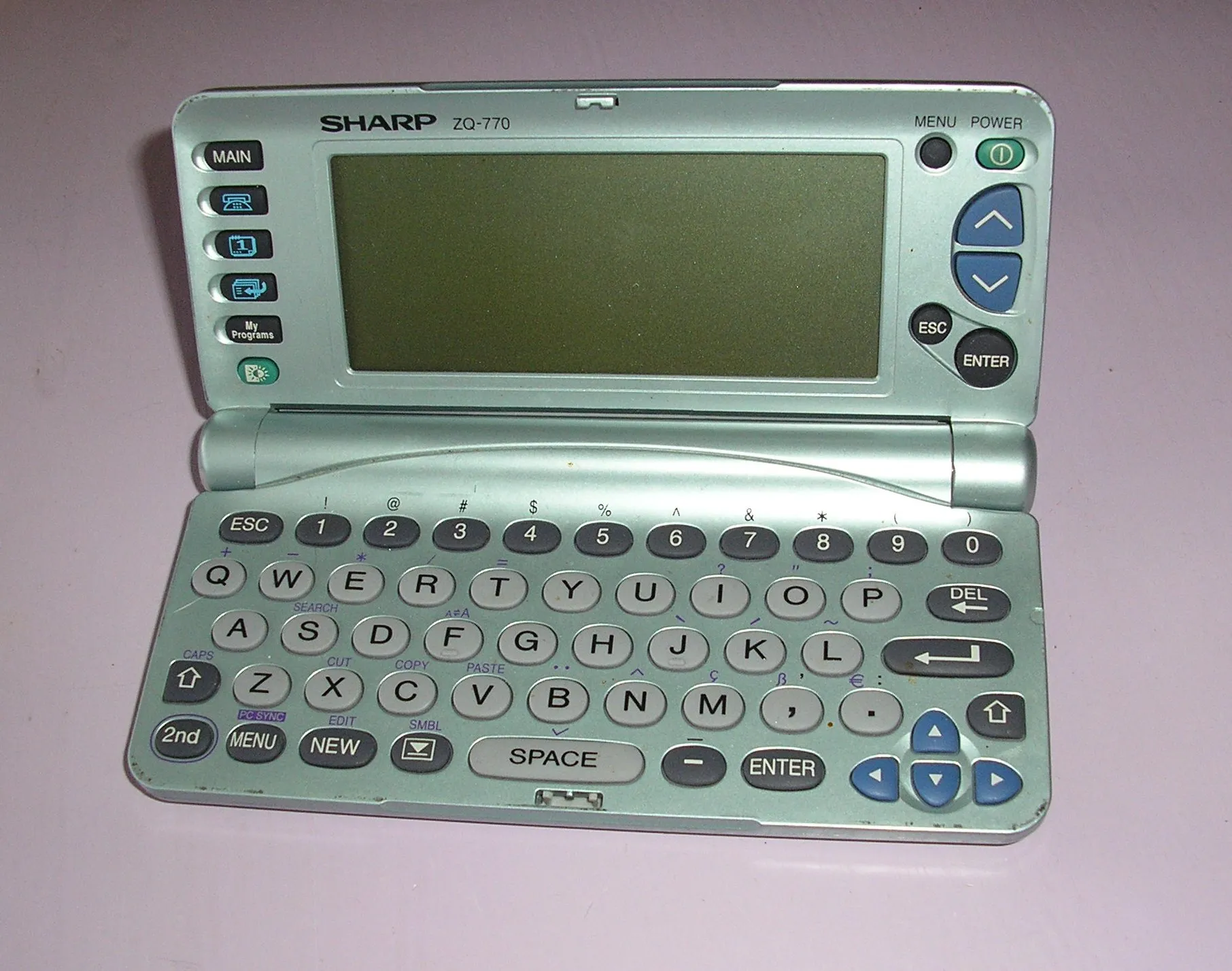
  5. The Wizard.  In the days before iPhones synched contacts, there were these bastardized calculators that would store names and phone numbers.  There was no way to sync or back them up, and they all had horrible chicklet or membrane keyboards.  I got one in the late 80s, either as a holiday gift or when one of my parents got one for opening a checking account or something and couldn’t figure it out.  It was so painful to enter in any phone numbers, and by the time I did, the battery would die and I’d have to start over.  I did my own poor man’s wizard, which was a sheet of paper folded up in my wallet, which I guess now I could call a “hipster organizer” and start a whole web site about.
  6. Floppy disks.  I talked about this yesterday.  It also reminded me of the whole cottage industry of plastic holders for floppy disks, the various clamshells and rolodexes and plastic cubes and whatnot.
  7. Zip disks.  These had a brief window of maybe five years of popularity, somewhere between hauling around fifty floppy disks and just burning a CD-ROM.  All I remember about these is they had this “click of death” issue, and would suffer from catastrophic failure, which almost always caused the owner to freak the fuck out because they didn’t have a backup, because the Zip disk was the backup.
  8. SyQuest drives.  You need to dig deep to find someone who remembers these, but we had a bunch of SyQuest drives on the IU campus in the early 90s.  They were basically a removable hard drive, a 5.25” plastic cartridge that held a hard drive platter and was nowhere near as sturdy as a floppy.  I never had one, because they were not cheap; I think they cost like a hundred dollars for a 44MB cartridge, and $100 was like a month of beer in 1992.
  9. Film cameras.  I guess they still exist, but unless you are an artist or hipster, you aren’t dropping off an armful of black plastic spindles at the local Osco’s to wait and see if the pictures you took last week were fucked up or not.
  10. Gopher.  Almost nobody remembers it, but it was a brief precursor to the world wide web.  You used a browser program to look at servers, but there was no real page layout, just menus that went to documents.  You couldn’t really publish your own gopher page, but for about ten seconds in 1991, every big university or government office had a gopher server, and it was so cool to browse through links and find text documents up to eight times faster than just FTPing there.  Then the web came out later that year, and we all forgot about gopher.

I think it’s easy to come up with a list of predictions for stuff we’ll have in 20 years.  What’s harder is to come up with a list of the stuff we use every day today that will be obsolete in 20 years.  Here’s my stab at a list of stuff that will go away by 2031:

  1. DVDs.  Probably Blu-Ray, too.  I think either everything will be streamed/downloaded, or maybe there will be some successor for optical media that’s smaller and stores more, maybe with some read/write capability.  I’m also certain that all of the optical media you buy today will be dead by then, either from some defect in manufacturing that will cause the discs to oxidize/disintegrate/fall apart, or because nobody will have the players anymore.  (How many of you still have a Jaz drive laying around the house?)
  2. GPS. I mean the TomTom unit you stick on your windshield with a suction cup.  I think this functionality is going to be built into cars for the most part.  I doubt we’ll get to fully automated driving in 20 years, but I think by then, high-end cars will have some sort of autopilot functionality in bigger cities.  Of course, that means every square inch of Japan will be wired for it, and we’ll see it in parts of New York and LA.
  3. Incandescent light bulbs.  Sorry tea party, but within five years, LED light bulbs are going to be cheap, low-watt, dimmable, smaller, way less fragile, and have no flicker.  That probably means the compact fluorescent ones will die too, if that makes you feel any better.
  4. USB.  It might exist in name only, but I think that some descendant of the optical version of the Light Peak/Thunderbolt interface is going to eventually kill USB, DVI, and HDMI.  I see two stumbling blocks with it: one problem is you can’t power a device over an optical interface, and the other is the endless pissing contest that happens when anyone wants to introduce a new interface format and everyone else doesn’t want to be the next betamax.
  5. Console gaming systems.  A big part of the market is going to mobile phones and tablets as we speak, and we’re just about to reach a massive crash in console sales.  The other thing is that TVs are getting smarter, and you’ll see a point where your TV is the client for the game, and some server out in the ether will do all of the processing.
  6. Printers.  Tablet-type systems will be everywhere and paper-thin, so you’ll just shoot documents back and forth like that.  If you’re one of those “I can only work on stuff that’s printed out” people, you’ll either be dead or blind in 20 years.
  7. Terrestrial radio.  I’m not sure why it hasn’t collapsed by this point, but I expect some combination of right-wing deregulation and greed over those coveted frequency bands to cause the entire system to get shut down and repurposed for commercial long-distance baby monitors or digital parking meter uploads or something else.
  8. Von Neumann architecture computers.  We’re at the point where you can’t fit any more crap on an integrated circuit, and CPUs aren’t going to get any faster.  In the next few years, it’s going to be all about adding more cores and more processors and more GPUs and coprocessors, but that’s all eventually going to go sideways.  Someone will get serious about using optical interconnects at the chip level, and when that happens, they’ll look at stuff like neuromorphic computing, emulating neuron networks, or something.
  9. Pretty much every web site you use today.  Facebook, twitter, and google will all be five iterations gone.  How many of you still use AltaVista?  Friendster?  Something new will always come along.
  10. Microsoft.  If you asked me 20 years ago about IBM, I would have predicted they would run the world.  Now, what do they even do?  I think they do consulting?  And maybe mainframes?  Microsoft is going to go through this 1-2-3 of a CEO change, a collapse of their long-term ponzi scheme of running a constant loss in their online divisions, and probably some major split or sell-off or restructure.  I’m sure there will be a Microsoft in 20 years, but I’m also sure it won’t be ever-present in every corner of your life unless you work there.

I guess I forgot to mention the death of the VCR, so maybe that’s another later post.  I also wonder if DVRs will still be around.  Seems like it would be much more efficient if the cable company stored copies of everything and you browsed them like the web, instead of trying to “catch” the recording and store it on your end, and then if you miss setting the recording or the stupid thing ends 90 seconds after the 30 minute mark, you aren’t screwed.  Why don’t the do it that way now?
It has been a decade since I've seen a sector not found error

pile-of-floppy-disks

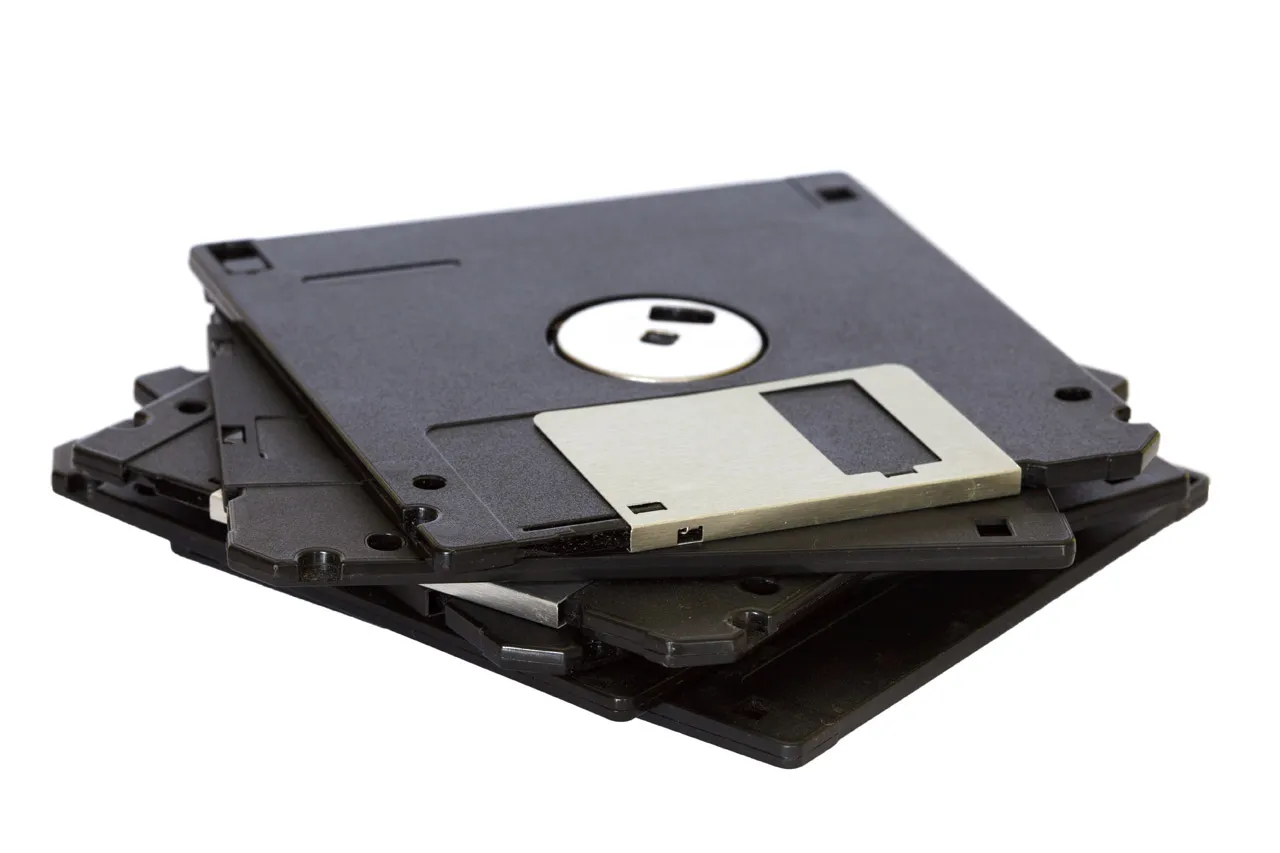
Someone recently posted a sort of call-to-arms for people to dig up their old floppy disks and back them up immediately, because it would only be a matter of moments before the magnetic media would flake away and vanish forever.  I remember hearing scare stories way back when, that after some huge amount of time like ten years, disks would simply fall apart and vanish, and I thought, “shit, 2002 is like forever away, so nothing to worry about - better get back to flaming this idiot on alt.rock-and-roll.metal.heavy about why Entombed is going to always be the best band ever.”  Now, I don’t even know where the hell my floppy disks are - I think they’re in my storage unit, but they could be in a box somewhere in the house, or they could have all ended up in the garbage in one of the last dozen moves I’ve made.

I remember the first floppy disk I ever had.  It was in maybe 1985 or so, a 5 1/4” Memorex single-sided disk I had to buy for a computer programming class.  There was no real difference between single and double-sided disks except for a little notch on one of the sides, and you could use a hole punch or x-acto knife and carve out that little hole and you’d magically have twice as much storage.  There was some urban legend or unverified factoid (this was way before google or snopes.com) that the disks that didn’t pass some quality test on both sides became single-sided disks.  And they sold some little device in the back of Compute magazine that punched the hole for you, but why pay for it when you can just use a knife for free?  I saved all of my Apple II BASIC programs on one side of the disk, and then used the back side to save all of my Commodore stuff when I was using my friend Matt’s computer to play games.  I had a Commodore 64, but never got a floppy drive, so I never amassed a huge number of disks like some of my friends did.

I came up on computers around the time when two formats dominated: the 5 1/4” floppy disk, and the 3 1/2” not-as-floppy disk.  When I went to school in Bloomington in 1989, I saw both of these in the wild, and it was always this curse that if you chose a 3.5” disk, you might go over to a friend’s or some off-the-beaten-path dorm computer lab and find they only had the 5 1/4” drives.  If you used a Mac, you didn’t have this issue, but you had to actually find a Mac on campus, which meant waiting in a Cedar Point-length line for a seat, or spending the cost of a decent car for your own home computer.  And these were the days before “the cloud”, or where “the cloud” meant an account on a VAX machine where you could store maybe a four-page paper, if you could wait an hour to upload it over your 2400-baud modem.

The format also caused great confusion when I started consulting, because people thought “hard disk” meant the plastic-encased 3.5” disks, when it really referred to a high capacity fixed-platter device.  I probably spent at least a month of my life on the phone with someone playing this “who’s on first” game of trying to determine what the hell they were talking about.

I bought a ten-pack of those 3.5” disks in my freshman year, but when I returned to IUSB for my sophomore year, the newer and smaller drives were nowhere to be found.  I bought a ten-pack of 5 1/4” disks every payday, and would promptly fill them up with stuff I downloaded from the internet, old issues of Phrack magazine and pieces of pascal code, images from wuarchive and shareware games that never worked right on the school’s crap computers.  I never labelled anything, and within a year, forgot what was on almost every single one of these disks.  When I built my first PC in 1991, it had both sizes of drive on it, but I eventually phased out the use of the 5 1/4” disks.  I think my last “big” drive stayed in the tower for a long time though, until the top two wide slots in the case were populated by a CD-ROM and CD-R drive.

My first hard drive doesn’t really count - it was this 5 MB winchester drive that I swear dimmed the lights in the whole damn house when it spun up.  It wasn’t until 1993 that I bought a proper IDE drive, a whopping 40 MB drive for $100.  But floppies were still very much in play.  Every time I wanted to reinstall the latest Linux on my machine, I would haul out a pile of 20 or 30 floppy disks, go to campus, and start downloading.  Of course, I’d always get home and the install would crap out because disk B7 had errors, and I’d have to start over.  I had an endless supply of disks though, because when I worked in the labs, the lost and found bins would fill with disks that were left behind, and after a semester, they would end up in consultants’ pockets.  There were also plenty of disks that came with hardware, install disks for bulk-purchased software that were never used, and promotional things that would end up in my collection.  I had many a disk that had a glossy Quattro Pro or Microsoft Sound Card sticker that was crossed out with marker and sloppily labelled “SLS 1.02 X7/10”.

Apple was the death of the floppy to me.  I mean, I had a Dell laptop I bought in 2001 that had no internal floppy, but it had this external caddy that held either a CD or a floppy drive, and I had both.  But when I switched over to the Mac Mini in 2005, it had no floppy disk drive, and no provision to hook one up, unless I went and bought a USB one.  By then, everything was on my hard drive, and if it had to be portable, I’d either burn it to a DVD or upload it to 34.216.9.77/.  I still had the PC tower, and it still had the floppy drives, but after I got the Mac up and running, I powered off the PC, and only powered it back up maybe two or three times.  And that PC ended up getting left in the trash room of my LA apartment when we split for SF.

I don’t know where those last few floppies are, or if any archaeology is needed to recover them.  I think most of the writing I want to keep ended up on this hard drive, and an installer to Epyx Summer Games for the PC isn’t useful to me anymore.  But I do miss the format in some strange way.  It’s entirely useless in the era of thumb drives and SD cards and DVD-Rs, but it’s a token back to the brief time between garage computers as big as a tank that involved soldering and toggle switches, and the era of ubiquitous computing, when there are more computers than people in the country.

Strange Nostalgia for Lost Electronics

I get a lot of shit for the “museum of obsolete technology” I have in our storage locker right now, the electronic toys I’m paying $30 a month to not see.  But I’ve pared down almost all of that inventory now, and it’s down to a single C-64 and 1541 drive, and a Sony Magic Link PDA that I bought on eBay and will probably never be able to connect to the internet.  I’ve given up on collecting, but I’ve still got that collector’s gene, and if I had unlimited space and unlimited budget, I’d probably spend all day and night on eBay, trying to buy back every piece of electronics I ever owned and every gadget I ever coveted, until eventually the hosts of Hoarders showed up at the house to film a two-part special on me.

I found this site a while back called Wishbook Web, and it’s extremely dangerous for me.  It’s scans of a bunch of department store catalogs, like Sears and Monkey Wards, which is great, because those things have largely been landfilled and there’s no archive of them anymore.  When I was a little kid, I would spend the entire year memorizing these catalogs, poring over the toy sections until the pages fell apart.  I guess now kids can just get on the web and go to Amazon and look this stuff up, but I would scrutinize these things like a NASA engineer trying to figure out why the latest Mars lander crashed.  Me and my sisters used to fight over who got to read each catalog, and instead of wish lists, my parents tried to institute some kind of system for us to denote what stuff we wanted that year.  It involved one of us putting boxes next to things, and the other annotating with circles, or maybe it was stars.  Anyway, I’d just mark the entire Lego section and any single thing that said Star Wars in it.  And of course, all new toys had come out before the actual holiday, and we’d have to revisit our greedy little lists based on the commercials shown during the Saturday morning cartoons.

So at least two of these catalogs came out during the prime of my childhood, and I can still tell you almost every damn thing on every page.  Going back to these again is like going back to a home town after twenty years and still being able to find your way around.  It’s also interesting to see how much the times have changed as far as copy goes, because I could write better stuff in my sleep.  Anyway, when I first found this URL, I went through every page, trying to find the stuff I used to own, and the things I really wanted but never got.

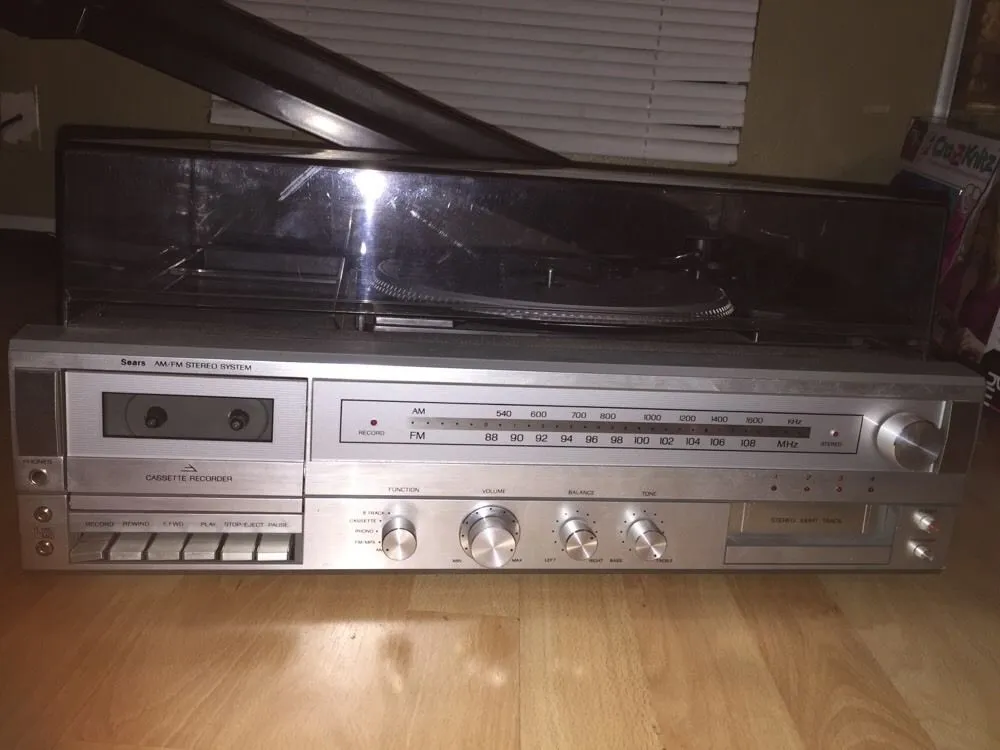
Here’s a good example of this: the stereo I had as a kid.

SearsWishbook-1983-P414-e1300558798316

When I was little, I had one of those crap record players with the removable lid and the plastic handle on the side, the kind with the speaker built into it.  My parents had a “real” stereo record player with separate speakers, but I had to listen to my read-along books and Disney records on this orange cardboard piece of shit.  When I was in maybe the 6th grade, I asked for a “real” stereo for Christmas, and I got item #2 from the picture above, taken from a Sears catalog.  And at the time, this was about as technologically advanced as the computers from Minority Report.  It had a record player AND a tape player AND a radio AND an 8-track.  Not only could I record songs off of the radio, but I could make tapes of albums.  And the speakers were separate, the kind of thing you plugged in and sat on shelves in the corners of the room.

The 8-track was a bit of an oddity; this was like the last death rattle of the failed format.  This stereo had a front-loader, and it had the program button, which jogged the tape heads sequentially across each of the four tracks of an album.  But it didn’t even have a fast-forward or rewind button.  Our family had no 8-track tapes, so we went to the Sears at Pierre Moran mall, and found them liquidating the remainder of their 8-tracks at some ridiculous price, like maybe four for a dollar.  These were all “cut-outs”, items with a groove cut in one side because they were returned or whatever, and they were pretty picked over.  I think I ended up getting a Steve Martin comedy album, a Ringo Starr solo album (I had no idea who the Beatles were, except in the most conceptual of terms), and a Jefferson Airplane album.  Much later, my mom’s second husband had a collection of a few 8-tracks, with the only notable ones being the first Cheech and Chong album, and Jethro Tull’s Thick as a Brick.  (Albums with only two side-long tracks didn’t work as well for a format where an LP was essentially divided into four; I’m not sure how they handled that.)

I had almost no budget for music, so I spent a lot of time trying to record songs off the radio, which was a maddening process.  I’d listen to U-93, the local top-40 radio station, and hope some song I liked would get played.  There were a whole slew of problems that would occur: the tape would not be queued to the very end and I’d erase some previously recorded treasure; the idiot DJ would babble on about being the 93rd caller for a set of free tickets to a monster truck rally; I wouldn’t recognize the song until 30 seconds in, and then only record half of it; the song would fade into some other stupid song I wouldn’t want, and I’d have a pristine copy of this Journey song I really wanted, except the last ten seconds would be fused to the beginning of a Toni Basil song.  (Yes, that song, which I won’t even mention by name or it will be stuck in your head forever.)  It would take me maybe a month or two of diligent listening to fill one side of a C-90 with useful tunes.

The big shortfall to this new hardware was that it only had one tape deck.  Most of the new stereos coming out had two decks: a play-only unit, and a player-recorder.  And my unit was a “closed” system, without an AUX input or any sort of input jacks.  Most of my friends would buy their albums on cassette tape, and I had no way of making copies of them.  My best hopes were either to have a friend that had a dual-tape deck who would be willing to make a dub for me, or find someone who bought everything on vinyl and would let me borrow their album.  Another problem was that I had no way of recording from the TV.  I watched an insane amount of MTV back then, and I would have given anything to capture some of their new music on cassette for repeat listens, especially since they played much cooler stuff than the behind-the-times station in my redneck Indiana town.  I remember trying to record a Genesis concert off of MTV by holding my sister’s little jambox up to the TV cabinet, which worked about as well as taking a picture of the night stars by dragging a photocopier outside and making a copy with the lid open.  (My sister later tried recording some song on MTV - that “don’t put another dime in the jukebox” song, and every time it would come on, I would yell at the dog and she’d start barking, totally screwing up the recording.)

It’s always interesting to me how we have such a tactile nostalgia for old technology like this.  Like I’ve got an old cell phone sitting on my shelf, a Windows Mobile phone I used for maybe six months before I wised up and got an iPhone.  And I hated that phone at the time, but it was my daily driver, and I used it constantly, for email, google maps, web browsing (or what approximated web browsing in a crippled version of pocket IE).  And I pick it up now, and its heft, and the feel of its keys, and the glint of its display remind me so much of that period in late 2008 and early 2009 when this thing was permanently attached to my hip.  And I get some of that when I look at pictures of old technology like this.  I remember the smell that stereo had, the new electronics smell of components heating up for the first time.  I remember the snap of the silver knobs going across their detents as I cycled through the inputs.  I remember playing with that tuning knob endlessly, trying to get a clear signal on WAOR so I could record Dr. Demento on Sunday nights.  I haven’t seen this stereo in at least 25 years, but I think if I found one at a garage sale, it would instantly transport me back to 1983 again.

Anyway, that’s my story.  Now I must go waste the rest of my writing time finding this stereo elsewhere on the web.  I’ve just found there are a ton of eBay sellers with demo videos of their wares on youtube, with many similar stereos.  Not sure which is worse, the waste of money and space hoarding this stuff, or the waste of time finding it.

What's old is old

So this guy built a scale model of a Cray 1 computer, and not just a bunch of model railroad plastic and some Testor’s spray paint, but a WORKING model.  The original Cray took 72 printed circuit boards covered back to back with chips; this guy was able to use a single Field-Programmable Gate Array, which is sort of to computers what the build-a-bear store in the mall is to stuffed animals.  It’s a single board maybe the size of a big index card that you program usually from a USB port and a PC to basically configure into a system of your choosing.  Like if you had all of the schematics of an old Nintendo and you were really jonesing to play some NES in a binary-compatible way, you could waste some weekends and blow a few hundred bucks on an Xilinx board and figure out how to splice in a set of joysticks and rip the images off the cartridges, and you’d essentially have your own Nintendo.  Of course, you could go on eBay and for like twenty bucks get an old NES, or you could download an emulator and a bunch of booted cartridges and within a few minutes you’d be playing Mario in a little window on your Mac or PC.  But where’s the fun in that?

The Cray always compelled me in college.  It’s such a distinctive design, and just the thought of ever using one was like talking about the possibilities of bedding a Victoria’s Secret model.  I mean, we had a lot of old iron at IU, rows of VAXes and some old IBM monsters they used for payroll.  I worked in the machine room a night a week in 1993, and used to marvel at the setup there.  They had the elevated floors, the sterile white everywhere, the tons of cables from the floor, and massive cooling systems, and the ominous halon system that would kill all living things in the flip of a switch, but prevent a runaway system from taking down the whole building in a flash fire.  But the jokes about winning the lottery and buying a Cray - the word “Cray” just became synonymous with the ultimate of the ultimate computer.  It was like the Ferrari of computers; expensive, hand-built, hand-crafted, designed for speed, and completely impractical.

I remember the movie Sneakers -  I went and saw this movie I think three times with three different dates in the fall of 1992.  My life was in that much flux then, but the movie was that good.  (I should re-watch it, now that I actually live here and cross the Dumbarton every day.)  Anyway, there was a scene where Bishop has been captured and is in Cosmo’s high-tech lair, which basically looks like the 1992 super-high-end geek chic place, and he brings him into a little enclosed room and they sit on this weird Star Trek looking bench.  Only it’s not a bench - it’s a Cray Y-MP supercomputer.  I always flipped out when I saw that, and would excitedly tell date of that evening “that’s like a five million dollar computer!”  Because of course I thought I was some dumb-fuck insider for knowing what a Cray looked like, and having a badge card that opened a machine room filled with computers in the middle of a state that was nothing but corn and farmers.

A 16-CPU Cray Y-MP back in 1991 cranked out about 16 Mflops (millions of floating-point operations per second), had to be trucked and assembled in place, and had a cooling system that probably cost way more than you could imagine.  It also needed some massive power wiring, and could not be plugged into the 6-outlet power snake sitting behind your computer desk.  The iPhone 4 in your pocket can crank out something like 20 Mflops, plus play your favorite tunes and videos and enable you to call home to ask if you need milk when you’re in the grocery store.  So the people who were doing digital models of complicated physics equations to calculate how atomic bomb designs would work were using less processing power than the little thing you hold in your hand that you bitch about running too slow when you get too many text messages with attached JPEGs of your friend’s butts.

What is the Cray of today?  I mean, I know they have these massive supercomputers - my pal Simms still works on this stuff.  But now, a supercomputer means racks and racks of commodity servers, the same Dell blades you might use to run intranet servers in your boring business, all chained together to make a massively parallel beast that slices up complex programs into little wafers and passes them around, then collates together the simple answers into a final tally.  It’s not as sexy as the high-gloss enamel red and charcoal grey panels of the iconic shaped case of a Cray; it’s a bunch of servers in racks.  It’s like lamenting the passing of the old era of high-HP Lambos and Porsches and having someone say “well here’s a Budget rent-a-car lot filled with Toyota Corollas, and if you add up all their horsepower, it’s way more than that of a 67 Shelby Mustang GT.”

I always wonder what would happen if I went back to 1992 and showed the 1992 me the iPhone and explained that I could send emails and take digital pictures and swing them across the ether for only $70 a month.  I also wonder if the 2010 me sat down in front of a VT240 and logged into a VAXCluster and was presented with the $ prompt again, if I would be amazed or horrified.  I could see part of me fascinated at looking at the file system again, seeing how $DISK53 still looked, but I could also see the first time I checked my disk quota and saw that my digital watch has more free memory, I would freak out.

A cautionary tale of incompatible formats

test.0005

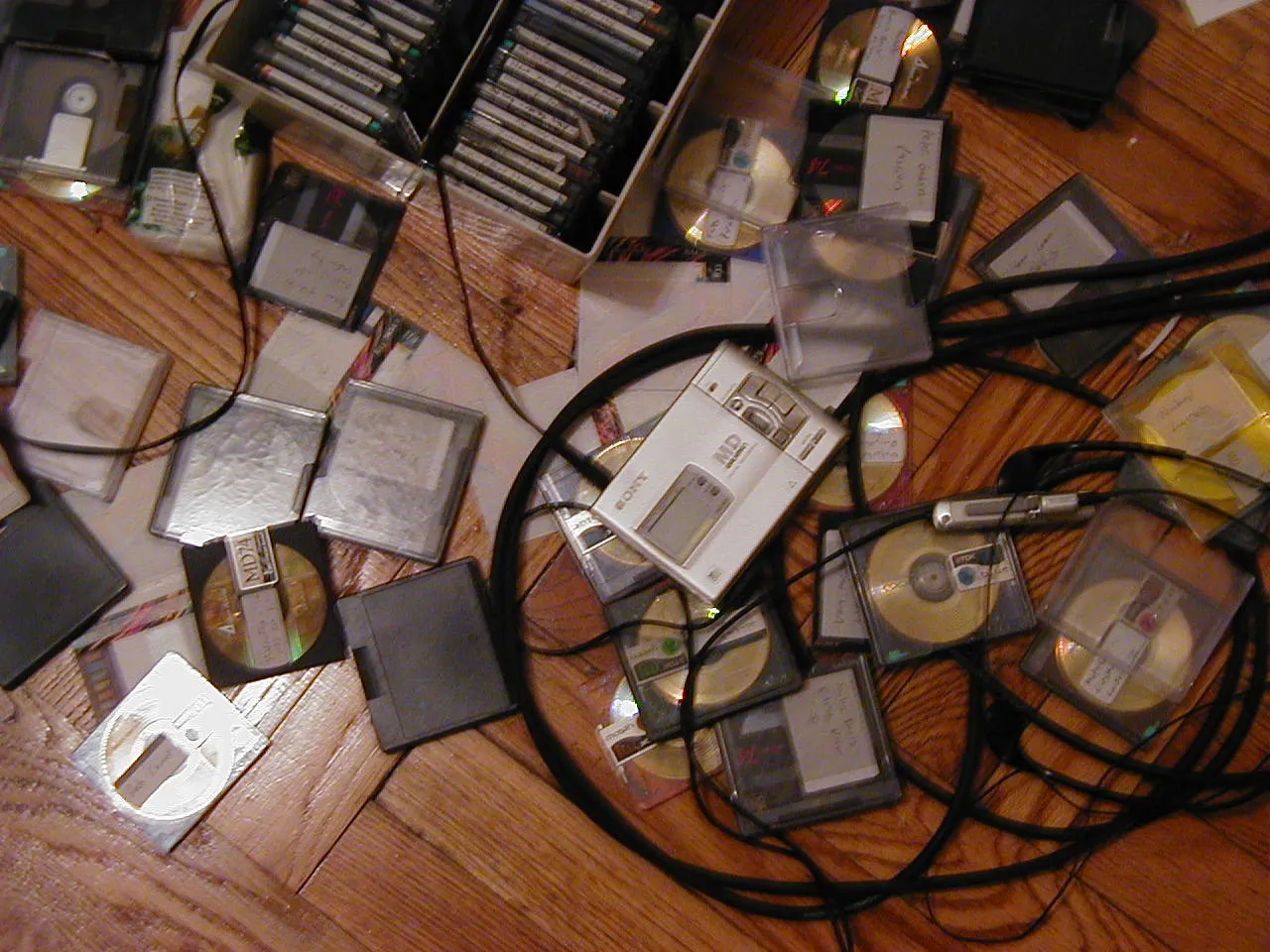
In 1998, I got a new credit card in the mail and after thinking about how many photocopies I could make for $1500 or if that was enough to buy like one sixtyfourth of an acre in some deserted forest, enough to build some kind of treehouse-esque unabomber shack, I suddenly realized that I had the insane desire to buy a MiniDisc recorder.  So I rushed over to The Good Guys, this old Best Buy-esuqe electronics store, and bought a Sony MZ-R50 and rushed home and recorded Joe Satriani’s Crystal Planet onto a blank disc.

(Reasons significant: 1) Joe Satriani recorded his first album after receiving a credit card in the mail; 2) He was signed to Sony, and I think a song of his was in a MiniDisc commercial, not that there were tons of those in the US; 3) I had recently broken up with a girlfriend, and the reason I broke up with her, or the catalyst at least, was driving two hours to Portland with Ryan in his Miata to see Joe Satriani, listening to CP the whole way there, and both of us bitching about our respective girlfriends and vowing to somehow escape the situations, only I did and he did not.)

I did not have a good way to record digital to digital for a long time, and the MiniDisc required you to record stuff in real-time - you didn’t just download a bunch of MP3s and dump them to the disc.  You also had to carry around however many discs with you, and if you brought three and went to work, you were guaranteed to be sick of all of them by the time you got to the train station.  I vividly remember going on an awful first date with a lowtalker who produced feminist programming for cable access and still lived with her mom and wanted to go to dinner at a soup restaurant and then go to see this movie about white supremacists, and then I really fucked things up because the movie interviewed all of these white supremacists in Bloomington, Indiana, and while they’re talking to these guys about the evils of Jews, they’re all drinking out of Pizza Express cups and I’m like HOLY SHIT THOSE ARE PIZZA EXPRESS CUPS I HAVE LIKE 90 OF THOSE IN MY APARTMENT.  She was still somehow interested and kept calling and I eventually told her I was in love with someone who lived in LA, which was partially true anyway.  So after this first date, I had to walk her to her car at the cable access thing, and it was like eleventy billion blocks from the train station.  And the only MD I had with me was a best-of from Millions of Dead Cops, which is like 27 songs, a dozen of them being “John Wayne Was a Nazi” and the rest being entirely unintelligible 22-second long songs.  And I think I listened to it nine times on the walk back to the train.  And that’s why I got an iPod.

I have an 80GB iPod and it’s almost full, and it’s also lasted longer than any other, which means it will fail soon.  It is my damn lifeline for morning traffic though.  Is there something that will hold more music that I need to get?  Maybe I need to get a bunch of iPods and put them on a bandolier like Chewbacca.  If they made an iPhone that could fit 80 GB I would just do that.  Maybe when the drive dies in this (inevitable) I will find a way to hack it into a socket that I can hot-swap a bunch of different drives.  Maybe I will just wise up and say “why the fuck do I have all of these Charlie Parker albums and I only listen to two of the songs, so fuck it” and get the collection down so it will fit on my iPhone.

I’ve still got all of this MiniDisc crap in my storage locker.  I think if I had infinite time I would make some kind of art project out of it, like make a MiniDisc-based mellotron keyboard. Someone did a movie about the mellotron, a documentary, which I guess is a lot better than my last attempt at a documentary.  I got blindingly drunk in Laguardia airport, then had to fly to Pittsburg via Cincinnati Ohio (which is really in Kentucky, the airport I mean) and so I got to OH/KY and had a few more beers and decided I was going to make a concept movie about the moving walkways in the airport and started filming The Walkway is about to end, which is basically me sitting on the floor by the end of the walkway, and every ten seconds, a robot voice says “the walkway is about to end!” and every single person that walks past ignores it and stumbles when the moving ground becomes non-moving ground, and the whole thing is an important metaphor for something, but then I started to sober up and had to catch a plane to Pittsburgh and that’s the end of the story.  (The footage for that is in my storage locker, too.)