The Wrath of Kon

Dispatches, thoughts, and miscellanea from writer Jon Konrath

Tag: elkhart

KONCAST Episode 6: Ray Miller

Click here to for more details on this new episode of The Koncast

In this episode, I talk to Ray Miller, creator of Metal Curse zine, the record label Cursed Productions, and bassist and vocalist of the band Adversary.

We discuss: How we first met 32 years ago, going from Metallica to Death Metal, finding new music in the analog days, how Ray started Metal Curse zine in 1990, Richard C and Wild Rags, John Woods and Rock out Censorship, the 1993 Milwaukee Metalfest, seeing Ice T’s dick, falling asleep while driving on the toll road, how Ray started the Cursed Productions record label, Ed Finkler and Open Sourcing Mental Illness, and making music in the computer age. Links from this episode:

- Metal Curse zine: http://www.metalcurse.com

- Cursed Productions: http://www.cursedproductions.com

- Paragraph Line: http://www.paragraphline.com

- Jon Konrath: http://www.rumored.com

- Xenocide zine: https://www.rumored.com/xenocide/

- Rock Out Censorship: http://www.theroc.org

- Dave Marsh on John Woods: https://web.archive.org/web/20110614224956/http://www.starpolish.com/features/print.asp?ID=440

- Ed Finkler: https://osmihelp.org

(Minor correction: the first Poison album wasn’t on Combat Records. The LP was on Enigma, who released bands like Death Angel, Slayer, Voivod, and so on, but the tape was released on Capitol. So, Mandala Effect, brown acid, not sure what happened here.) Click here to for more details on this new episode of The Koncast
Donald Cried (2016)

Donald Cried is a film in the “you can never go back” camp, but it’s also more about the estranged relationship between two friends who were inseparable as teenagers, but took completely different paths into adulthood.

Originally a short by independent filmmaker Kris Avedisian, this was expanded to a feature-length affair with the help of a successful Kickstarter campaign. The film starts with the protagonist Peter returning to his home town in Rhode Island to handle the affairs of his recently deceased grandmother. He left the small town a dozen years before, and went to New York City to reinvent himself, forget his past, and work on Wall Street. The problem with his quick overnight trip: he’s lost his wallet, so he’s stuck at his grandmother’s old house with no cash, no ID, and a to-do list of funeral home, nursing home, realtor, and everything else involved in closing the last of his involvement with his old life.

With no other options, he turns to his last lifeline, and meets up with his old pal Donald, who he hasn’t seen since high school. Donald is a stoner dropout who lives in his mom’s attic, works part-time at a bowling alley, and is the opposite of Peter, stuck at the same point he was back in the glory days of high school. We quickly find out that Peter was once cut from the same cloth, and had the same love of heavy metal and juvenile delinquency. Peter just needs a ride to pick up his grandma’s ashes and empty out her nursing home, plus a few bucks for bus fare back to the city. Donald is ecstatic about the triumphant return of his old friend. Antics ensue.

I always have a certain nervousness when returning back to Indiana, and that’s captured too well in this film. It’s a mixture of “this could have been me” and flashbacks of the past that bring out the “man, I was an idiot back then.” My nostalgia issues are a bit contrary to Peter’s in the film, though. He’s trying to remain unseen, and not get entangled in the past. For example, the realtor he gets is a woman he went to school with, and that he had some feelings for back in the day, but he initially acts as if he doesn’t remember who she is at all. I’m not saying I seek out people and reunite with them (I did have an ex-girlfriend sighting at a mall a few years ago, and I ducked in another store to escape) but I do seem to seek out old landmarks and get too mentally involved with the ghosts of the past.

The real star of this movie is Avedisian, who plays the character of Donald. He’s this lanky, bearded guy with an awkward Ray Romano-sounding voice and a Keith Moon haircut, and he’s completely cringe-worthy in his total lack of a filter. This starts as a truly hilarious character, like a Mark Borchardt from American Movie, except with no ambition to make films. At first, he’s just the funny guy to the straight guy, but then you become sympathetic to him, feel sorry for him. My feelings bounced between “wow, what is with this dude” to “wow, how could Peter help this dude get his shit together.” And the latter is a strong one for my personal experience, so it really got me.

The small town setting was also big for me. Warwick isn’t a “small” town — it’s the second-biggest city in Rhode Island. But, it’s only 80,000 people, and what is captured in the film is the small town feeling of cruising at night, bowling alleys and convenience stores, little houses, and that feeling that a lot of people never leave, never forget high school, never move on. The duo go, on Donald’s insistence, to visit another one of their high school buddies. When they get there, he’s sitting in bed, unmoving, watching cage fighting matches on TV, like he’s never left the house in fifteen years. Or there’s the bowling alley manager, a burly guy actually played by former WWF wrestler Ted Arcidi, who’s in his office showing a teenaged cashier his grainy VHS tapes of when he used to be a powerlifter back in the Eighties and could bench 700 pounds. It’s an interesting backdrop, and really sets up why Peter left, and why it is such a strange yet compelling place to visit.

Overall, I have only one big problem with this film: I wanted to write a book that was almost exactly this. I started outlining it two years ago, when I went back to Indiana for a weekend. I had the backdrop, and I thought I had the characters. But I never could quite break the story correctly. And Avedisian showed me that I really didn’t have the depth needed to get the characters down. I gave up on the idea a while ago, and now I’m stuck on the thought that I really should do something with it, but of course if I started working on it, I’d unconsciously ape exactly what he did.

Anyway, it’s on iTunes for rent right now. Not for everyone, but I found it pretty entertaining.

Trains and Ports

The port of Oakland is building (or has built) this new rail yard across from our building, and when I sit on the couch to write, I always look at the trains and it reminds me nostalgically of Indiana, which had what used to be the biggest rail yard in the midwest. It used to be the big Conrail yard where pretty much every east-west freight train was assembled or routed. That meant tons of rail traffic and getting stuck at the gates when a hundred-car train slowly clacked along. But it burned something in the back of my head, a strange reverence for rail equipment.

Conrail is long gone, Norfolk Southern built a much bigger yard in Ohio, and the Elkhart yard is one of many superfund sites in the city. Or was. I’m not sure what they’ll do in the future. The groundwater is still contaminated in places. The rail yard is still in use, I guess. Every time I go back to Elkhart, I get stuck at the gates again.

I just saw an Amtrak streak by, silver cars and high(er) speeds. One of the walks I take is up to the Emeryville station, across the tracks on the little pedestrian bridge, which involves going up four or five flights of stairs, then back down four or five flights of stairs. But in the middle of it, you walk across the narrow bridge and look down on this relatively new station built in 1993. It looks almost European, the modern concrete and side line with yellow paint on the crossings, where the sleep passenger trains arrive, and an automated announcer calls out the name of the station.

All of Emeryville surrounding the station is new condominiums and campuses of pharmaceutical research companies. I walk by one of these clusters of buildings, and found a plaque that said it was the location where scientists first sequenced the HIV-1 RNA. The campuses of Novartis and Bayer rose from what used to be chemical development facilities for Shell Petroleum, and production factories for Sherwin-Williams. Now the area is Pixar, Peet’s Coffee headquarters, and lots of little design firms and architect offices. It’s an eerie walk to do on a Sunday, when the offices are all closed. It’s especially nice in the summer, when it’s still cool out in the morning, and the air is just starting to heat up.

That rail yard across the street — the whole area around the port of Oakland used to be the Oakland army base. From WW2 to about 1999, it was the major shipping port for army materials sent to the Pacific, Korea, Vietnam. My uncle (who was career Navy) told me about being in Alameda, working on a carrier, and driving to Oakland Army Base to pick up parts. After it closed in 99, it sat empty for a dozen years, while the slow-moving Oakland political machine tried to figure out what to do with the toxic wasteland. There were nonstop rumors that it would become a movie studio, a casino, a baseball stadium. It ended up becoming more warehouses and rail facilities for the port.

There are still some remnants of the old base, the kind of two-story barracks-looking buildings the army built everywhere in the 1940s. Last year, I had to go to the TSA to get fingerprinted for a TSA Pre card, and they had a facility there. It was in an old Army building that was about to get torn down, a three-story structure that looked exactly like the same things you’d see on any military base anywhere. Yellowing ceiling tiles, large urns of burnt coffee, government posters of obscure acronyms. Most of the visitors were truckers needing some TSA paperwork. They closed the building a few months later. I haven’t walked over there recently, but the entire street has been under heavy construction for years, large swaths being bulldozed and regraded. Looking at the google maps images, it looks like they’re building pyramids there.

I was walking home the other day, past a new condo development. (Side note, I think they are insane, because they are cramming eight 1500-sqft units in a tiny lot, and they are all supposed to be “luxury” and cost over a million dollars each, and this is like a few thousand feet from a giant homeless encampment and open-air drug market.) Anyway, the construction crew was inside the recently-walled units, probably working on plumbing or electrical, and they were blasting music through the construction site, but it was like bop jazz, Thelonious Monk or something, which was surreal.

I need to go walk now, although I need to write first. It’s almost to the point where it is nice to walk again, after a lot of cold, rainy weather. The sun’s out, but it’s still in the 40s. I should probably go walk by the rail yard and see how the construction is going. I’m not one of those crazed rail fan types, but it’s nice to see them doing something out there.

Death of the Concord Mall

IMG_1025-3

I didn’t hear about this, and I saw it coming years ago, but the default mall of my childhood, the Concord Mall, is dead. I’ve written far too much about this mall in the past, but it’s time for me to drive in the last nail and ramble on about it a bit more, so here goes.

The basics: Concord Mall was built in 1972. At that time, it had two anchor stores, Montgomery Ward and Robertson’s. In 1976, they added a third anchor, JC Penney. The mall was a large T-shape, with a big fountain in the middle. Its current store count (total number, not occupancy) is about 60, although one reference I saw had it up to about 72 at its peak.

I’m about a year older than the mall, and my family moved to Edwardsburg, Michigan, which is right across the IN/MI line, around the time the mall was first built. I have no real memories of it until after the JC Penney was added. In 1978, we moved to Elkhart, about a mile from the mall. So it became my default destination for shopping and wandering around. There were two arcades, and a Kay-Bee toy store, plus the Walden Books sold enough D&D stuff to keep me occupied. There was a two-screen movie theater outside the mall, where I saw a lot of the films of my childhood. I remember fondly waiting in a giant line outside of there to see ET, which took several attempts, because it was sold out for weeks.

As a teenager, I also spent a lot of time there. They had a Musicland, which was lame, and a local record store called Super Sounds. They had a better selection there, and cool people behind the counter. I bought my first CD ever there (Iron Maiden - Somewhere in Time) back when they were still sold in long cardboard boxes designed to fit in LP bins. They also had a Ticketmaster outlet, and I remember buying tickets to see Rush and Metallica there. And there was this metalhead guy Frank who worked there, who would sometimes turn me onto stuff. One time, he was listening to the advance release tape of some band that sounded like Rush, but way more metal. When I asked him about it, he popped out the copy and gave it to me. That was an advance tape of Dream Theater’s first release, When Dream and Day Unite, which I still have.

When I was a kid, I used to walk to the mall. I remember at some point, my parents forbade me from crossing US-33, which lay between my subdivision and the mall. But my friends and I discovered we could walk underneath a bridge where the road crossed  Yellow Creek and get to the mall without technically walking across 33. Later, I had a bike, and then a car. The mall was a routine after-school hangout, although it didn’t have many places to eat. I still wasted a lot of time flipping through every record at Super Sounds, looking for anything on Megaforce records I may have somehow missed.

In my junior year, I became further entrenched when I got a job at the mall. I became a Master Paint Specialist at Montgomery Ward, making $3.65 an hour or commission, whichever was higher. I worked in the Four Seasons department, which also included toys, lawn mowers, snowblowers, lawn furniture, and other seasonal items. I was a part-timer, but after I fell into the groove of things, I was spending more and more non-work time hanging around the store, shooting the shit with other employees, joking with the guys in Automotive and trying (and failing miserably) to hit on the girls in housewares. During the summers before and after my senior year, I weaseled my way into as many hours as possible, working in almost every department. I unloaded trucks starting at 6AM, painted the entire store one summer, worked shifts in mens’ wear, and ran a Nixdorf register in virtually every department of the four “worlds” of the department store.

Working in the mall showed me an entirely different side of the facility. I would sometimes get there before it was open to the public, or when only the inner concourse was unlocked for the mall walkers, all the storefronts gated, with the lights shut off. I stayed after closing all the time, counting down registers and signing in cash and checks after the 9:00 announcements. I used to work a full day, a ten to nine, never going outside, using a 30-minute break to run to a pretzel stand to get a corn dog and fries as my only meal of the day. I still went to school, but I spent more time at the mall and my store than I did at home.

I knew everyone in my store, but also knew a lot of managers and regulars at every other store in the mall. It was a good experience for me, because I was ostracized and introverted as a kid, and didn’t get along with many people at my school, because I felt like an outsider. Given the choice, I would have hunkered down with an Apple II for all four years and ignored the people around me, and I did a fair amount of that. But when I worked at the store, the adults treated me as an adult, even when I was a dumb 17-year-old kid who only cared about Metallica and Megadeth. I learned to interact with humans in a way I should have learned at school, but couldn’t, because I didn’t fit in there.

When I worked for Wards, I saw a few things happen that pointed to the huge wave that would eventually crest, the last big spike of growth in the mall industry:

  • Right before I started there, our store was given a massive makeover. The old yellowing-white tile floors, walls, and ceilings bathed in fluorescent light went out. They moved to more modern-looking eighties-style decoration, with maroons and pastels and cobalts as accent colors, and Helvetica everywhere. I’m not saying it looked cool, but it looked very 1987. And it always pissed off old people. Instead of being a giant rectangle with straight up-and-down alleys like a grocery store, the layout was a very subtle labyrinth, designed by shopping habit researchers to optimize floor space and give psychologically-designed flows through the merchandise. This is a huge science right now, and we were at the forefront of it in 1987.
  • That remodel also included modern point-of-sale systems. No more running a credit card through a carbon copy machine and looking up defunct numbers in a six-month-old booklet. Every terminal was wired to our credit agency, and inventories were also stored and updated in these then-modern PC-like machines. It was the beginning of an IT age in shopping. (And it was one that would - spoiler alert - eventually kill Wards - more on that in a minute.)
  • The paper catalog was killed right when I arrived. This really pissed off the old people, because the Monkey Ward catalog had run continuously since the birth of Christ, and it was suddenly gone. Why? Cost/benefit analysis, and the need to expand the retail business into more profitable ventures, like consumer electronics. It wasn’t Aaron Monty Ward calling the shots with his gut feeling anymore; retail was being run by MBAs analyzing data in spreadsheets.
  • Wards was divested from their corporate owner, Mobil Oil. In 1976, Mobil bought out Wards during the great Fourth Wave of mergers and acquisitions. When I was there, in 1988, there was a management-led leveraged buyout of the company (assisted by GE Capital, who retained half the company), for $3.8 billion. This was rich in the middle of the Fifth Wave of mergers and acquisitions, one that would set the stage for the eventual downfall of almost everyone.

OK, so back to this mall thing - I graduated high school in 1989, went off to college, and returned to work at Wards again two times, briefly: for about a week over the holiday in my first year of college, and then for most of the summer of 1993, unloading trucks from 6-10 AM.

A bit more background on the Michiana mall thing, too. There were four malls in the Elkhart/Mishawaka/South Bend area. Aside from Concord, Elkhart had Pierre Moran mall, which was in the bad part of town, and had Sears and Target as anchors, and a cool record store, but not much more. South Bend/Mishawaka had Scottsdale Mall, which was a double-decker with a much bigger Wards, a Target, and a fair amount of other stuff. The big one was University Park, right by Notre Dame, and it had everything.

So Peak Mall was about when I worked at Wards in 1993. First, Simon Property Group was formed in 1993, and they bought every mall they could find in this era. University Park is still a Simon mall; Concord was*, and I’m not sure of the others. But this was a time when malls were apex predators of consumerism, after we’d gotten out of a recession, when personal consumption was up and continuing to grow. There was no online, and catalog business was dead. Wal-Mart and other big-box stores were just finding their footing. And after the big decade of the mall and establishment of mall culture, suddenly these large public companies were ready to double down and rush into a huge arms race of spending that appeared like it would have no end.

[*I may be hallucinating Concord ever being a Simon mall. I’m probably confusing it with College Mall in Bloomington, which is still a Simon mall.]

In my microcosm of these four malls, there were varying developments. University Park, roughly twice as big as Concord, continued to grow, and expanded. (Also, oddly enough, all of its big-box competitors like Meijer, and eateries like Red Lobster, Famous Dave’s and Olive Garden, popped up around the mall, but only seemed to make mall traffic surge.) Scottsdale, which was now poised on a new bypass road for US-20 and much easier to get to from Elkhart, expanded in this timeframe, adding a large multiplex and food court, plus redecorating. Pierre Moran painted their awnings blue. Concord added a new bathroom by the mall office, and waxed the floors once.  (Also, don’t fuck with me about exact dates and changes here. I’m writing this from memory.)

I left Indiana in 1995, and only saw the four malls on the occasional Christmas visit home. But the bottom line is that shopping habits changed. People were more content going to Wal-Mart, and later buying everything online. All of the malls (except University Park) fell apart. Major tenants went bankrupt and weren’t replaced. Other big tenants with new overlords or strategies moved to nearby locales where they could build new stores with more optimal freestanding layouts, usually in neighboring townships or cities where tax dollars and incentives were to be had.

The wheels fell off of Montgomery Ward in the late 90s. They filed for bankruptcy in 1997, with GE grabbing ownership of the whole company. Three years later, they closed their doors. The simple answer here is Wal-Mart, with a touch of Target. But really, the quicksand was much deeper. Remember that IT thing I mentioned? Wards went through a massive IT retooling in the mid-90s, spent way too much money on it, and it didn’t work out. Also, remember when I said they got into more profitable things like consumer electronics? Well, the margins fell out on that stuff, and it wasn’t profitable anymore. You can dig further and argue about how Wards stores were not as well-placed as Sears, and that the management had some borderline racist tendency to buy into locations further out from urban centers. But it was basic math: sales were down, profit margins were smaller, and too much money was pumped into a bleeding company that had massive debts from its leveraged buyout. (See also: Sears, Toys R Us, KB Toys, Circuit City, and 768 other recent retail deaths.)

Scottsdale Mall in South Bend never recovered after its Wards closed in 2000. They also lost another major anchor, L.S. Ayres, and floundered headless for about four more years. It was then de-malled, the building bulldozed and turned into an array of freestanding big box stores. Pierre Moran suffered the same fate a few years later; its Target bugged out for a new Super Target in an unincorporated area outside the realm of higher city taxes between Goshen and Elkhart. Its Sears and a new Kroger were made freestanding, and most of the rest became a parking lot for some little storefronts that never found tenants. University Park grew like a monster, adding a giant food court area, a huge Barnes and Noble, and upgrading the interior, while upping the roster of premium stores. (An Apple Store! A Tesla charging station! Is this still Mishawaka?)

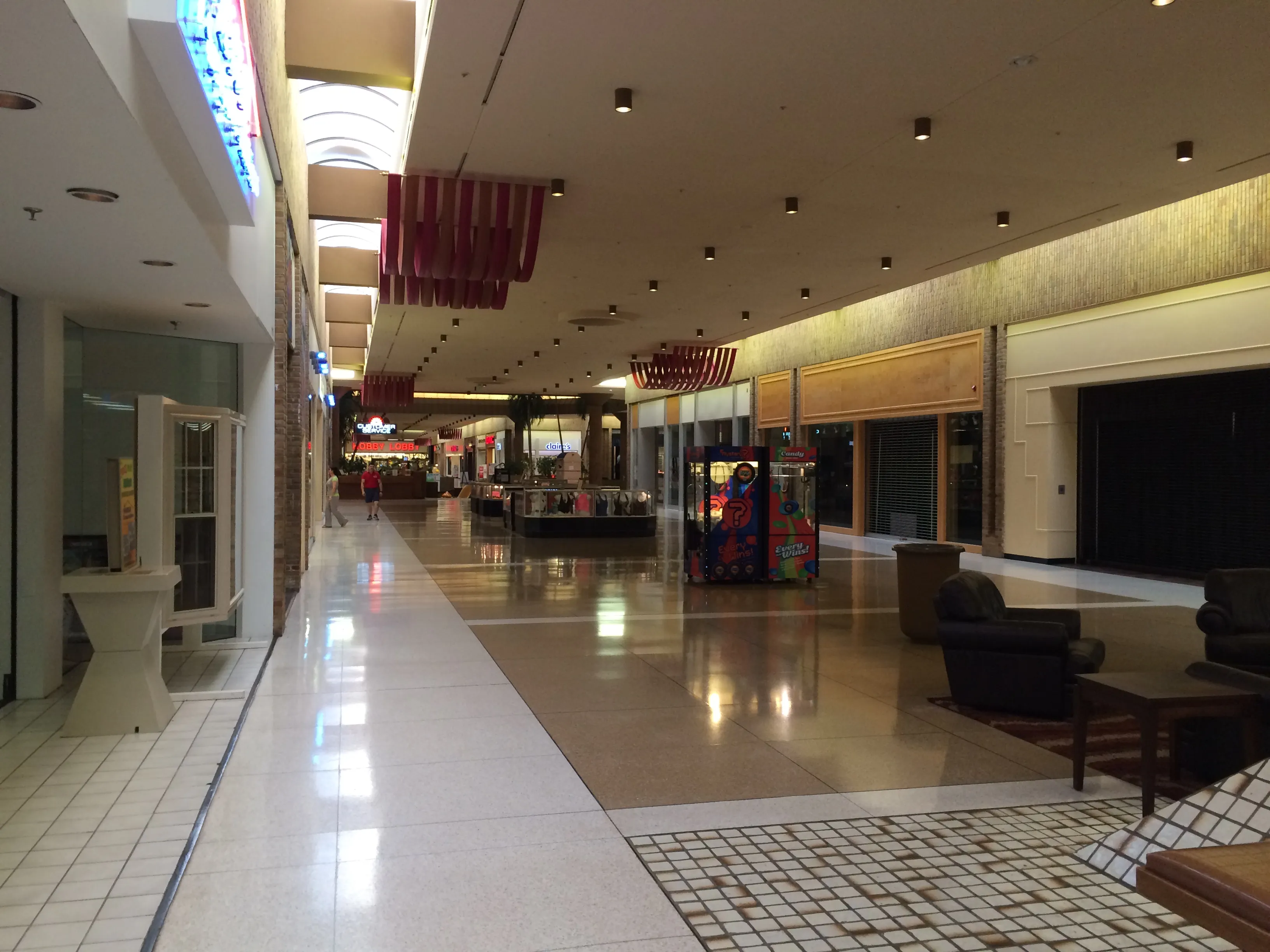
Concord Mall never entirely recovered, but it still struggled. The Wards was sliced into multiple stores, the largest being a Hobby Lobby. The big fountain in the center of the mall was removed. The Osco’s drug store in the mall left, and was replaced with a food court that only had one tenant, a Subway. Much of the mall’s interior never changed, the same tile and brown wood trim that was in the mall in the seventies. Some stores vanished because they vanished from every mall in America: Musicland died; Walden Books went bankrupt. KB Toys was Romneyed into bankruptcy by Bain Capital. I don’t know if Aladdin’s Castle or Time-Out arcades still exist as a legal entity, but they vanished from every mall I’ve seen, including Concord. Other stores just spiraled down into low-rent alternatives. Jewelry stores became dollar stores. Boutique clothing stores became televangelist churches. Music stores became storefronts with nothing but vending machines in them.

I was at the mall in August, and was amazed at how many of the stores were closed. JC Penney is still there, as is the Hobby Lobby and whatever department store is now in the Robertson’s spot. The only other remaining stores I can remember: Enzo’s pizza, GNC, Jo-Ann Fabrics, and that’s about it. I can see some of the remains of stores, like the Super Sounds location’s wood walls are still evident in the bakery currently there. But it’s like a ghost ship now, empty and sad.

The plan now is to de-mall Concord. They are spending $50 million bulldozing the building, leaving the anchors, and building some freestanding stores as a “community center.” There are no named anchors or new stores, and apparently nobody even told the tenants of the mall until it hit the news. This approach is laughable, because like I mentioned, both Scottsdale and Pierre Moran de-malled, and both of them are ghost towns of empty stores. More than half of Pierre Moran (now Woodland Crossing) is vacant. Scottsdale, now Erskine Village, was recently sold at a sheriff’s sale when the owner stopped making loan payments. And while Elkhart’s unemployment numbers are down at the moment, it’s an incredibly streaky economy of all industrial jobs related to the RV industry. The next time gas prices fluctuate, the entire region will be wiped out again, like it was in 07-08.

I think the saddest part of it all is that the community is gone now. It’s easier for people to sit in front of their big-screen and click on the Amazon web site, along with a weekly resupply run to Wal-Mart for BluRays and high-calorie frozen foods. Elkhart doesn’t even have movie theaters anymore, aside from the Encore 14 north of town, which has been falling apart for 20 years. It seems like life there is entirely encapsulated and isolated. I mean, I left the state for a reason, but it’s distressing to see the end-stage capitalism unspool and see the last remnants of my past vanish.

I feel silly clinging on to these memories, and need to stop, but this is the last gasp of it, so there you go.

[Note: this is from 2016. You might also want to check out 2018’s Death of the Concord Mall, Redux)]

bones and memories

I visited Indiana recently - actually, it wasn’t that recent, but I meant to write about it at the time, and now two months have passed. It was an interesting quick trip, for a few good and bad reasons, so I wanted to play catch-up and get a few words down on it.

I booked a quick solo trip at the beginning of August, partly because of my sister’s birthday, and partly because I had to cancel a family trip to Florida in the spring and felt bad about that. I got an out-on-Wednesday, back-on-Monday long weekend, which seemed to work well for me. Time was at a bit of a premium, but it’s a bit like visiting Vegas; a week is overkill, but a weekend is not enough.

Not to dwell on the bad, but here goes: first, I screwed up my rental car reservation. Arrived in Chicago, and had a car waiting for me in South Bend, when I really needed a car in Chicago to drive to South Bend. Second, on Friday, at about 5

, one of my crowns came off. After much panic and calling a bunch of phone numbers, I found a dentist nearby who opened back up and glued the crown back in, which was awesome. I still ate mostly liquid for the rest of the trip, until I could get back home and have my dentist permanently glue in the tooth. Also, on the last day of the trip, I lost my credit card, and while at the airport waiting for a very late flight, I found out and had to cancel it. So that’s the bad.

I stayed in an extended stay hotel in Mishawaka, right near the University Park mall. It was on Main and Douglas, which was mostly vacant when I left Indiana, but since, a second main drag of big box stores and restaurants has started there, one big street over from the Grape Road arterial of the same sorts of big boxes. It’s always odd and nostalgic and weird for me to stay right by the mall where I spent so much time as a teen, but it’s a newer hotel, close to everything, and that works for me.

Every time I go back, it’s amazing to me that the default routes and streets and terrain immediately pop back into my head. A lot of Indiana hasn’t changed, or at least the “bones” have not. If you asked me to drive from UP mall to the IUSB campus, I could do it without thinking, just on muscle memory. Never mind that the IUSB campus has basically doubled, and every store in UP mall has changed hands, but the roads and turns are still the same.

Indiana does change, but on a very slow scale. I think people find a certain comfort in that, and it’s understandable. There are changes, and things fade and vanish, plus simple economics dictate amendments and revisions. Some chains die, and some mom-and-pop businesses go away with time, but new ones pop up. Sometimes things are completely bulldozed, like the Scottsdale and Pierre Moran malls, which were both torn down and “de-malled” into plazas of freestanding stores. But other things still have the same “bones” for better or for worse. Old first-generation Taco Bells get painted blue and turned into Chinese buffets. The UP mall got additions and food courts and new Barnes and Noble grafted onto its front, with the concourses updated and the tenants being bumped up in scale and stature. (Like the tiny Software Etc. is long gone, but across the way, there’s a giant new Apple store.) I walked the mall and tried to think of what was where, back in the day, but I couldn’t spot any one store that was the same, aside from the big Sears and JC Penney anchor stores.

Driving, though - driving from Mishawaka to Edwardsburg, Elkhart to Millersburg, those things all looked almost identical. The amber waves of grain were still amber waves of grain. A few were turned into new industrial parks or large retirement communities, but for the most part, it looked like Indiana had aged two California years in the last 25. And normally, a twenty-something me would have found this disgusting, that all of the state should get off their ass and progress at a rapid rate. But like I said, part of me sees the comfort in this, the idea that things wouldn’t change. I’ve always thought that many people in that area feared change, and I think there’s some truth in that. When I was 18, that pissed me off beyond end. As a 44-year-old, I could see why someone might like that.

Some things, though, have atrophied beyond belief. I went to the Concord Mall, which was a mile from my house, my default mall as a kid. When I was a teenager and worked in that mall, I practically lived there. I would go to the store and hang out even on my days off. Now, it looks like nothing has been done to the mall at all since the last time I punched out at the time clock in 1993. The Wards store where I worked is gone, converted into a Hobby Lobby that has locked itself off from the rest of the mall with huge glass doors. Almost every store in the mall has closed; most are covered in plywood. The old Osco’s drug store was converted to a food court, and every stall is currently empty, except for a single, lonely Subway sandwich shop. Some shops have these weird, temporary businesses in them, like a vacant store with a bouncy castle set up inside it, or the horribly sad dollar stores with nothing worth a dollar in them. There are multiple churches in the mall now; it seems like every business in Elkhart that goes bust turns into a church or a Mexican bodega. There was even a “church” that just beamed in the services from a megachurch in Kansas or Nebraska, and of course took your money. The mall itself was almost abandoned, nobody in sight, like an empty shopping center in a zombie movie. After seeing that, I made it a point to not do anything else in Elkhart, dredge up any more memories or see the old subdivision or school or anything else.

Not all of the region was that destitute, though. The UP mall was filled with customers, even on a weeknight. And I went to Goshen one day, and it was actually transformed from what I remember. Most of the main street was art galleries, and small mom-and-pop businesses, a wave of hipsterization running through there. In 1990, I had a girlfriend who lived on Main Street, and at that time, it was largely abandoned, boarded up and done. Now, there are these brewpubs and artisanal butcher shops and groceries, almost like something I’d see in the hippest part of a college town like Bloomington.

The thing that struck me the most was the feeling, the weather, the atmosphere. I haven’t visited Indiana outside of Christmas in years, decades. I think in the late 90s, I made a trip or two in October, and I drove through Indiana in April of 99, during my Seattle to New York move. But I don’t remember an August in Indiana probably since 1994, the year before I left. I’m very sensitive to temperatures and weather and the feeling of a place at a certain time of year, much more than I could ever describe it. And when I was there, the air held the same feeling as the summer before I first left for college, in 1989.

I so distinctly remember that summer, because it would be hot in the day, maybe in the 80s, but then at night, it would cool to the 60s. I was working days in a department store, just started dating someone, and we’d meet up at 9

every night, when the mall closed, to drive around aimlessly, stay up all night, go from Perkins to Bob Evans to Big Boy’s, making the loop of the few 24-hour places in Elkhart at that time. And I’d come home late at night, or early in the morning, and feel the summer’s humidity converted to a light mist, to dew on the grass. The summer had a certain freedom, of the end of high school, a brief period where I almost thought I had my life together and was leaving behind the shroud of depression that blanketed me throughout my four years there. But there was also the uncertainty and excitement and fear of packing up my entire life and moving it off to campus in a few short weeks.

Each day of the visit, I did the family stuff during the day, and it was good to see all of them. But then I’d return to the hotel, and either drive around by the mall, or walk at night, and just feel that weather, the cool evenings and the dew on my sneakers. (That’s another thing - there were no sidewalks by the hotel, and everyone was staring at me for walking, like wondering what happened that resulted in me not having a car.) Or I would sit in the hotel writing, with the windows open, feeling the air outside.

I spent a lot of time wondering if I could ever go back. There’s a part of me, as I plummet into The Crisis that has hit at this age, that wishes I had a three-bedroom ranch and a garage and a lawn and everything else, working on an old car or a boat or something. I know I could never live in Indiana because of the politics and money and career. And the crippling nostalgia of being back there would consume me. But it was interesting to see it for a moment.