The Wrath of Kon

Dispatches, thoughts, and miscellanea from writer Jon Konrath

Tag: gadgets

bronchitis, editing, speakers, rumored
postcard-back

At the start of every year, I have the grand idea of writing every day for the next 365 (or in the case of this year 366) days. This year’s excuse is that I brought back acute bronchitis from Wisconsin, and I’ve been fighting that since Christmas. It’s the kind of thing where I can sit down for five seconds and be deep asleep, and even getting ten, twelve, fifteen hours a day doesn’t help. I went to the doc last week, got antibiotics and instead of my beloved Permeth, she gave me some garbage cough pills that didn’t work. I’m mostly okay now.

You probably can’t tell, but I’ve covertly been going back into old entries and cleaning things up, adding tags and fixing broken links and boneheaded spelling mistakes. I’m always surprised by the amount of writing on this site, and I always like when I stumble upon an old entry and read it and have totally forgotten about it or the events that transpired that caused me to write it. I never know what I should be writing here on a daily basis, and that critical thinking, obsession over what is my “brand” causes a horrible self-censorship that stops any writing. But I look back at various eras when I was writing every day about nothing, about killing time or various thoughts and obsessions, and that stuff is always gold to me.

(It opens the obvious questions about “why don’t you write books like that” or “why don’t you turn those posts into articles” or whatever the hell. I did an anthology of early posts from this site, and it sold close to zero copies. And what I do here is exercise, not writing. It’s like telling a person who jogs five miles a day that they should really look into being an NFL running back. No.)

I forgot to write about this, but when I was gone over Thanksgiving, the studio monitors on my desk died. They were an old M-Audio model that had a known issue with the amp, where it was a bit of a perishable item and the capacitors would eventually blow. I got six or seven years out of them, but I’d been looking to buy something else for a while. And that’s a huge wormhole, shopping for audio equipment. I get to the point where I can almost justify buying some expensive tube amp and bespoke speakers, then remember I have no room in this office. But I also don’t want to buy the $20 speakers you usually get for free when you fill out a credit card application at Best Buy.

Anyway, I bought a pair of Vanatoo Transparent Zero speakers. They’re actually slightly smaller than the old M-Audio ones, even though they have a bigger woofer (four versus three inches), and it’s made of aluminum. The case is wood instead of plastic, and has neat magnetic grilles that are easily removed to see the goods. There’s also this passive radiator which is supposed to add better bass response. It has its own DSP, so I can plug it straight into the computer via USB. It has a variety of neat options like a subwoofer output and various limiter and sleep and crossover options I will never figure out. It also has a bluetooth receiver in it, which I will probably never use. Same with the wireless remote. Nice to have them, though. The sound is very transparent and clear and nice at volume. They are near-field monitors, so not great for filling a room, but perfect for sitting at the computer. There’s no goofy “voicing” to them, just straight-up reproduction of what’s on the track. My only complaints are there’s no headphone pass-through jack (but I can just plug into the computer, I guess) and they could probably use a subwoofer. I actually have one sitting in the next room that’s not hooked up to anything, but I have no space in the office for it. Anyway, they are perfect for that price point, and a great solution between the cheapie $20 speakers and blowing a few grand on an audiophile set of bookshelf speakers and amp.

Not much else going on. I took some time off writing during the holidays, which I never do, and it took some effort to get back going. I have two big books that are on the vine and need some serious work to get going in the right direction. One of them is essentially a sequel to Rumored to Exist. It’s currently about 350 pages and totally directionless, with no real through line or “rails” to it. And based on the sales of December’s book, it’s hard to get enthused about packaging up a book that’s about four times as big and trying to get people to read it.

But it’s fun to dabble with it. The big secret is I enjoy the process of writing, the actual meditative action of getting lost for a few hours putting words on the page. I hate everything else, the sequencing, editing, packaging, marketing, production. I’ve been going back and trying to figure out how the original Rumored happened, what kept me going on it. It took almost seven years to write, and it was essentially completely rewritten seven times. I recently went back and skimmed the annotated version (which like only four people have read) and it has a lot about it was written. Always fun to look back at that, but my writing process is completely different now. And you can never reproduce how things like that happened.

Birthday in a week. It lands on a Monday, but we have the day off of work for MLK day. I’m doing another superfloat in the isolation tank. I’d go to Denny’s, but Denny’s is so horrible now. I vaguely thought about leaving town for a three-day, but prices are probably jacked up, and I just want a weekend without anything.

I’m still sitting on my reading list from last year. I rated everything, reviewed nothing, so I’m not sure if it’s worthwhile to share it, but maybe I will later this week.
iPhone grenade; Sundays; the life and death of long reads, etc

This week’s excitement was that my iPhone 8 blew up after about a year and a half of service. I’d noticed a bit ago that the 3D touch feature wasn’t consistently working, especially on the left side of the screen, but chalked it off to the fact that iOS has far too many tricky gestures and oddities where if you don’t click exactly at the right thing in the right direction for the right fraction of a millisecond, instead of fast-opening two apps, you delete one, or open the camera, or start playing music, or whatever. And the battery did slowly lose its mojo, but that’s every product with a battery these days, and I have a battery case, so it didn’t bother me.

Well, suddenly the other night, the phone doubled in thickness, like a double-stuff oreo, and the screen split from the rest of the case. The phone still worked, but my immediate fear was that it would catch fire or grenade. I was out when it happened, so I powered down, drove home, carefully fired it up, and then backed it up to my machine. I went to the Apple store (with a paperback book to kill time) and within an hour, they replaced it with an identical model. The swap and restore seems to get less and less painful each time I upgrade, and the only pain was copying over 120 gigs of music, which took a few hours, along with other sync and backup activity.

A few takeaways: before I drove to the mall, it was impossible to get ahold of anyone at the store on the phone. You have to go through a ridiculous phone tree for support; you can’t make an appointment online, at least within fifty clicks. I put the phone on speaker, and after saying “manager” a dozen times, the phone rang for five minutes straight. Once a human answered, mentioning the battery situation got me in fast, though.

The other takeaway is that it seems that as Apple products are in this war to get as thin as molecularly possible, they have developed some serious reliability issues. It’s all anecdotal, and I’m sure Apple’s annual reports to investors show that 99.9% of people have no problems. But I had a brand spanking new MacBook Pro fail, and my iPhone 6s had a slow battery death, and now this. This is timely with the departure of Jony Ive, who was apparently the one responsibility for this thinness race. I honestly wouldn’t mind a phone or laptop a few millimeters thicker, if it meant it would not bend in half under minor use.

(And yeah, “BUY A REAL COMPUTER SHEEPLE.” Whatever, grow up, etc.)


It’s Sunday, which is always depressing. I’m not sure why half of my weekend is always spent in a dour mood over why I’ve wasted half of my weekend. I also get into this bad cycle of thinking I need to majorly course-correct everything, usually on Sunday night. I need to get off my ass and devote my life to learning (guitar | some programming thing | a writer’s works | obscure history of film | electronics | how to fly a jumbo jet | whatever). I wish instead of Sunday, I could have two Saturdays. There must be some mindfulness technique to fix this. Maybe lobotomy. (Do they still do those? Great, I’m going to fall down a k-hole researching this.)

I was thinking about this, because my Sunday routine used to be much different when I was in college, or just after. I used to make a lot of phone calls on Sunday nights after dinner, usually because that was when people were around the most. And I used to love the phone, to a fault. My long distance bill, back in the pre-cell days when that was still a thing, would end up being a colossal amount, catching up with people across the country.

I also have this strange little gap between maybe three and five, when I’ve already written in the morning and finished my errands in the early afternoon, and I feel some overwhelming need to do something in that time period, but I’m never motivated to do anything. The answer is that I should write more then, but I never can. And doing anything else — taking a nap, playing video games — makes me feel completely unproductive and horrible. I’m not sure if it’s my anxiety of the upcoming work week, or the fact that I never use the phone any more and my only human interaction is clicking a screen that causes my current dread routine. Or maybe I need to eat probiotics. Whatever.


Not much else here. I fell down a Chuck Klosterman rabbit hole in anticipation of his next book, and ended up re-reading almost all of his output. It sort of amazes me how it feels like Grandland was around forever, but it only lived between 2011 and 2015. Much shorter than The Awl’s almost-ten year run, but same thing — they came out of nowhere, got huge, and died. Meanwhile, I’ve been plugging away here for decades, with no ideas, no traction, etc. Anyway, I read like four or five of the Klosterman books, which led me to reading music critic Robert Christgau’s memoir, which is… interesting. I guess he sums it up himself at the start of the book by saying most biographies are about astounding people or people who have some trick to sell or some story of overcoming adversity, and he doesn’t, but here you go, let’s get into 200 pages of his unremarkable childhood. It’s still interesting to me, but holy shit, people on Amazon hated it. Anyway, we’ll see if I can finish this one up without coming up with the stupid idea that I need to start writing record reviews again.

More Film, and digiFilm

2353909_2353909-R4-058-27A

I got my first batch of film back from the shop the other day. I sent in six rolls, 36 exposures each, for a total of $76 for developing and a quick scan to CD.

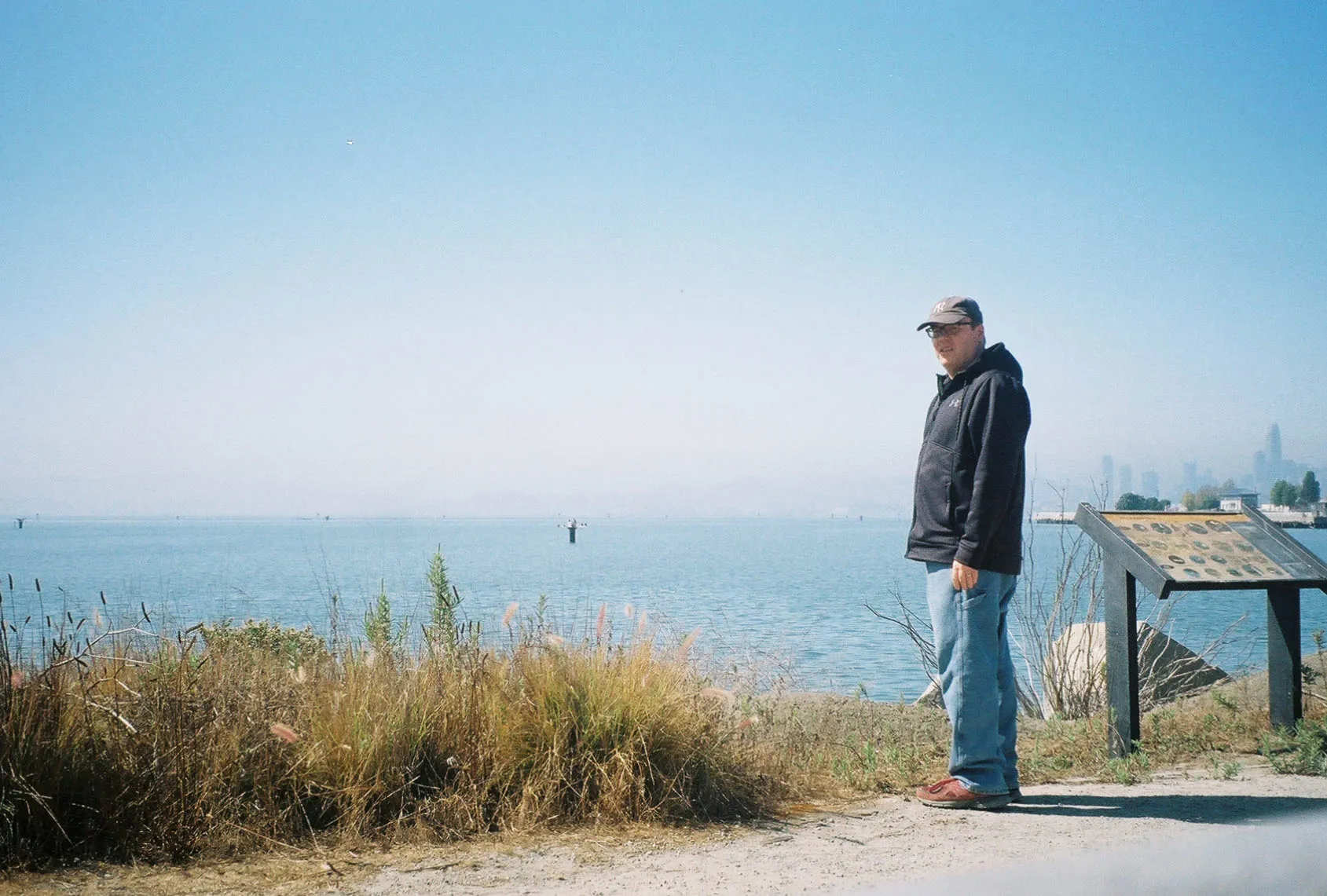
The shots from this Vivitar I bought are tremendously weird. I mean, they look like they were all shot in like 1994. They have this weird, faded quality to them, a perfect vignetting, and just look old, way more than Hipstamatic or Instagram could make them. Like they all have this dreamlike, lo-fi quality to them, much more so than my old old 35mm gear does. The Vivitar has really good Series 1 glass, but a plastic body. It also has all-auto, no-adjustment shooting, but a modern motorized drive system to it. If it was just slightly smaller, it would be a perfect camera.

I wish I still had the original one. Or I wish I had an exact model number, another copy. This one is very similar, but not exact, which bugs me. But what’s weird is sometimes I forget it isn’t the same camera. I was walking around the Port of Oakland the other day with it, and thought how strange and nostalgic it was that the same camera I had for most of the Nineties was with me now, but then realized, it isn’t the same camera. That old camera went to a lot of strange places with me. It moved from Indiana to Seattle to New York. I have pictures from the Trinity test site where the first atomic explosion happened, from Vegas, from the Empire State Building, the Milwaukee Metalfest, Kent State, Bloomington, New Mexico, Boston, Disneyland, Washington DC, and hundreds of points in between.

Anyway, I dumped a few shots on Flickr here. That album also includes some old 120 film shots taken with a Diana F+.

Another topic: the Yashica digiFilm Y35. So a group in Hong Kong bought the Yashica name and did a kickstarter for a digital version of the old Electro 35 camera. The gimmick was that it was going to have this stuff called digiFilm, which was a little film canister you could swap out and change what kind of pictures it would take. Like you could switch to B&W, 1600, 6x6, whatever. You could also put a switch or button on the camera to do this, but they thought it would be a neat thing to make it “like” film. I thought it might be a fun toy, and the camera looked cool, so on a whim, I backed the Kickstarter.

Ugh, I hate Kickstarter. I’ve backed maybe a dozen things in the past, and maybe two have turned out okay. And I always feel like I get burned, and I always vow to never do it again, and then something comes up. And like clockwork, they met their goal, got their money, and then said, “Ok great! Now we’ll go design it!” and the wait began. There were a few sketchy updates, but it looked like this thing would never come to fruition.

Well, it showed up the other day. My verdict is that the camera is garbage. I think the appeal of the old Electro 35 was that it was metal and compact and had a certain tactile feel to it, like old rangefinders of that era. This camera is all plastic, and very cheap plastic. It’s light, and feels like one of those toy squirt guns in the shape of a camera you’d get from the Archie McPhee catalog. It has a non-operational film wind knob that’s molded into the top of the camera. The viewfinder has no optics, just a clear piece of plastic. The doors feel like they will break off in the next fifteen minutes.

The camera uses two AA batteries (not included) and an SD card (not included), plus the digiFilm thing, of which I received four. You then “wind” each shot with an advance lever, and press and hold a really cheap shutter button, and have to hold it and hold still for like a second and a half. The pictures look roughly like what my Windows Mobile cell phone took back in 2008. The B&W looks okay. The others, just use your iPhone and Hipstagram. It does marginally look okay from a distance. If I ever put my cameras on display on a shelf, it would look okay next to my Trip 35 and Canonet QL17. But, ugh. What a waste of money.

I’ve got another four rolls of film to shoot, and might stock up on more for the holidays. I should probably get some 120 film at some point and try that one again, too.

New/Old Camera

IMG_8139

So, in the “buying old crap I had twenty-five years ago and threw out at some point,” I found another Vivitar camera that is (almost) the same as the one I had from 1993 to about 2000.

I talked a bit about my history with analog film a few years ago, when I last fell down the analog film k-hole. I bought this Vivitar camera during the summer of 1993, after not having a camera at all for about three or four years. I was working at Montgomery Ward that summer (in addition to another full-time factory job) and had an employee discount, so I picked up the most camera I could get for about $100 at the photo counter in their Electric Avenue department at the Concord Mall.

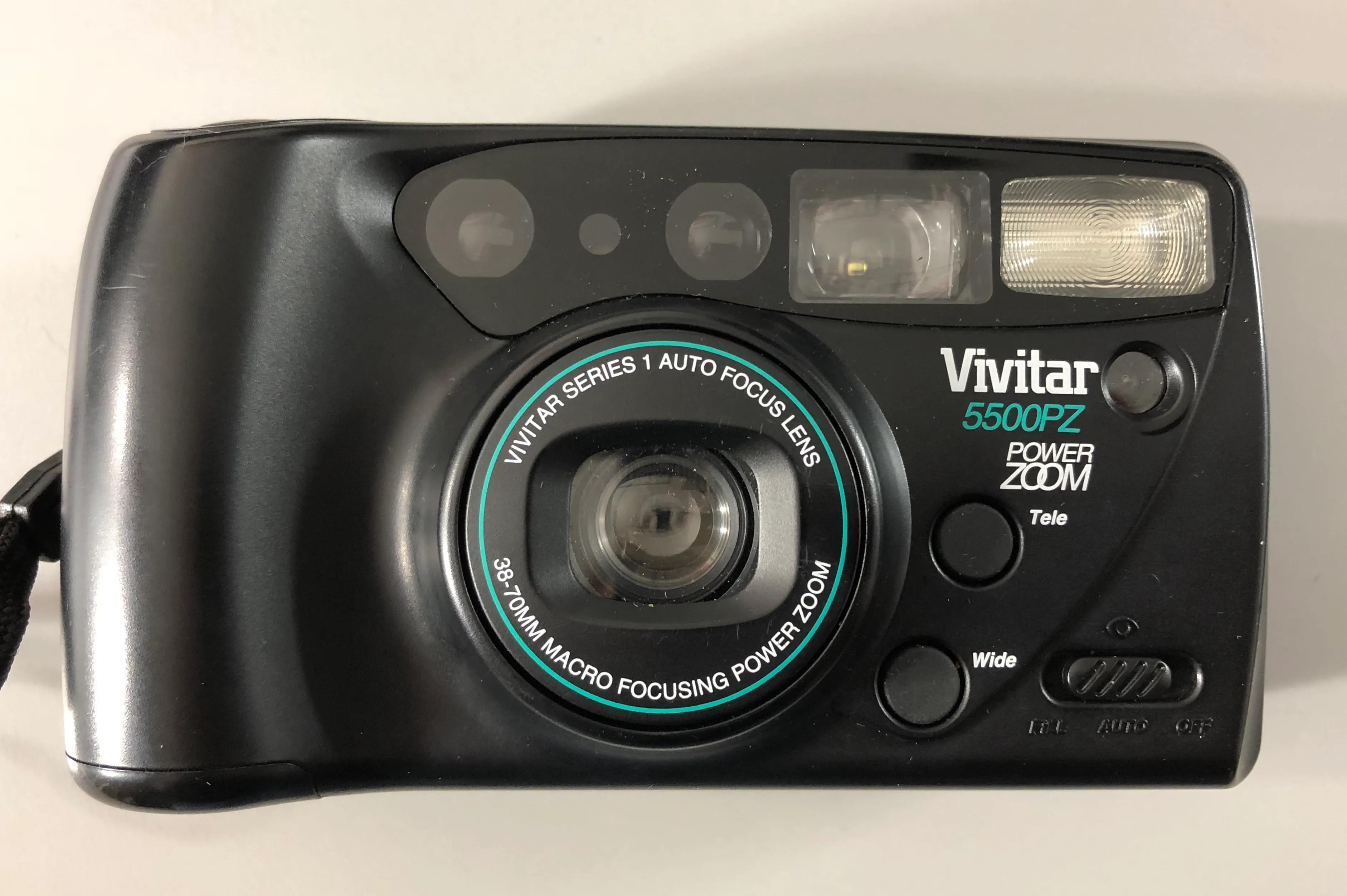
That hundred bucks bought a 35mm point-and-shoot. It had a plastic body, but a decent Series 1 glass auto-focus lens. It was a power zoom, so it could zip from 38 to 70mm focal length with motorized control. The film load/wind was also motorized; you dropped in a film cartridge, closed the door, and the camera automatically sucked the film into the takeup reel. When you hit the end, it automatically rolled it back into the canister. The camera also had blue-teal accents to it, which was Nineties as fuck.

I bought this camera with the intention of documenting shows. It was the height of death metal and the zine scene, and I wanted something I could sneak into concerts. I was going to a lot of shows with Ray, and getting free passes to stuff to interview bands. In practice, I never got to take pictures at shows, because security was always really shitty about it, even when a record label gave me a photo pass. And this was a fairly worthless camera for taking pictures of bands, except maybe candid, backstage stuff at a close range with a lot of light.

Ultimately, I didn’t take that many pictures with this camera. I think maybe two dozen rolls went through it during those seven years. I took a trip across the country in 1995 and shot maybe six pictures total. A Disney trip in 1997 was about two rolls. The 1999 cross-country trip was another three, maybe. Getting a camcorder in 1996 reduced the amount of film I shot. Getting a digital camera at the end of 2000 relegated this thing to the back of the closet. I don’t know when I got rid of it; maybe when I moved in 2005.

Ironically, the most-seen photo from this camera is one you may be familiar with.

I was hunting for this camera online, and found this 5500PZ on eBay for seven bucks, including postage. When I got it, I realized it’s not exactly what I had. Mine was slightly thinner, with the zoom controls on the back, not the front. I’m sure it’s optically the same. But it bugs me that it’s not identical, and scanning through other eBay auctions, I can’t find the model that is exactly like mine. Maybe Vivitar sold some oddball model exclusively to Wards. Anyway, for seven bucks, close enough.

I put a battery in this one to test it. It uses a small lithium battery that was hard to find online. The zoom motor is much louder than I’d expected, and the zoom itself is not smooth and very slow. It’s not exactly the auto-focus that my new Canon has. I didn’t have any film in the house, so I ordered a few rolls, and we’ll see how it goes.

I’ve also gone back and started scanning some of the old photos I didn’t have scanned from this era 25 years ago. It’s a reminder how much of a pain in the ass film was. It also makes me think too much about exactly when and where photos were taken, since EXIF wouldn’t be invented for another half-decade. Trying to not get into too much of a nostalgia backslide, which leads to the regret that I didn’t take more pictures back then. But it’s understandable when I go to pay for film developing. Anyway.

360 Photos, Ricoh Theta V

I bought a new camera recently, a Ricoh Theta V. It’s a 360 camera, which uses two fisheye lenses on a small thing about the size of a TV remote, and software inside stitches together the two images into a 360-degree sphere, which can then be hosted on various online things like Facebook or Flickr or whatever, with a viewer where you can drag around your viewpoint.

The camera is neat; it’s a small form factor and easily pocketable. It’s very good at removing them seam from the two images it glues together. It can also do video, and does the stitching on-the-fly, so you could also stream these spherical images to YouTube or some VR app. The camera has no removable battery, no video card, just a USB connector to charge or tether, and a mount for a tripod.

One of the reasons I wanted this camera was to port images into Google Street View. If you look at google maps, and drag the little GSV guy onto a map, all the roads Google has traversed will be blue, but you’ll also sometimes see little blue dots, which are where people have taken a spherical photo and uploaded it to Street View. I like to take these with my phone sometimes, which works but is not optimal; you have to spin around and take a bunch of pictures in each direction, and the stitching is slow and distorted. One of the cameras recommended by Google is the Theta V, so that’s what I got.

The workflow for using the camera is a bit goofy. It tethers to your phone by becoming a WiFi hotspot which you connect to, and then you can use an app to take pictures. Then you transfer the pictures to your phone or PC and post them elsewhere. You can take snapshots or recordings without a phone, but there’s no viewfinder, and the camera doesn’t have a built-in GPS; it only geotags when connected to a phone. The connection process is a bit goofy, and it takes a few seconds, but it mostly works.

The big problem is it’s impossible to take a 360 photo without ending up in it. If you hold the camera, your thumb ends up in the bottom of the shot, and looks gigantic and weird. There are tricks to get around this, like if you put the camera on a tripod and go hide behind something, using your phone as the remote. Or take two pictures and stand in different places, then merge them in Photoshop. You can also just be in the picture, but that’s not an option for me, because I look like a goofy idiot.

The other problem is that I bought this camera with hopes of taking a lot of great outdoor photos in the bay area, and almost immediately, we went into the dark gray sky season where it always looks dreary outside. And we’re getting a hint of the smoke in the air, too. So the light is all wrong and it’s time for seasonal depression to kick in. Time to drag out the light box.

I do think this will be a good camera for vacations. Of course, there are none on the horizon. I wish I would have had it when I was in Alaska last spring. I also would love to get out to the land in Colorado, which is very sparsely mapped - there’s a road about a half-mile from my place that did get captured by Google, but they didn’t turn down the dirt road, so maybe it’s time to get back there (when it’s not freezing out.)