The Wrath of Kon

Dispatches, thoughts, and miscellanea from writer Jon Konrath

Tag: memories

Thoughts on a random picture: The Student Building

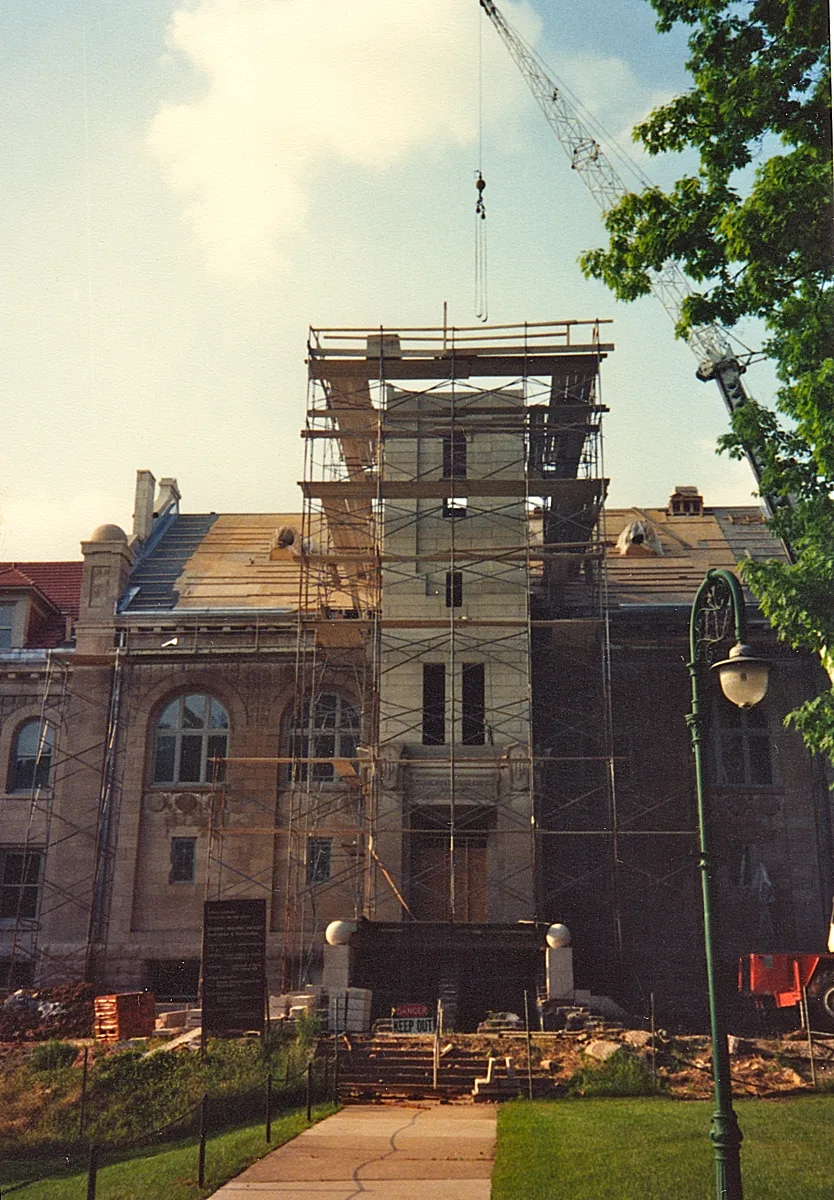
I went back to storage the other day and dug out two books of prints, most of which were unscanned.  There’s still at least one box of prints somewhere in there that I didn’t find, and I have no time to scan more of them, but here’s an interesting one I found.

student-building

This is the Student Building on the IU Bloomington campus.  I can easily date this as the summer of 1991, although that’s perplexing because I didn’t live in Bloomington that summer, and I didn’t own a camera then.  That means I must have been in town visiting the person Ray refers to as “the za chick” (long story) and I must have been using her camera.

The Student Building was a total shithole when I was a freshman.  I remember going there for a meeting with some alcohol counseling group.  I was a militant non-drinker as a freshman, which I now realize was stupid, and I probably just should have drank everything offered to me, if only to take the edge off of the unfurling mania that kept me awake for weeks at a time.  But I had some vague interest in finding out about this group that sponsored all of these non-drinking dances and whatnot, and I met with them once and then probably got bored of the whole thing and shifted obsessions to learning all of the bass lines from the first four Black Sabbath albums or whatever.

Anyway, the meeting was in the basement of the Student Building, and at that point in 1989, the place was practically on the verge of collapse, and looked like an East German department store in the mid-70s.  There were flickering fluorescent lights, dark passages, plywood over walls, wires hanging from ceilings, and cracking plaster everywhere.  I don’t remember thinking anything about whether or not the place should be restored or preserved; I’m sure I just thought “man all of these buildings are old… hey, there’s a new Steve Vai album I have to memorize…”

The renovations were underway on the 1905 building in late 1990 when there was an electrical fire that December and the place burned down.  I often say “electrical fire” because it was a strange coincidence that the iconic clocktower building was shut down and emptied and just happened to burn, probably collecting a huge insurance check and an even bigger inflow of contributions from alumni.  Even more amazing is the fact that it takes roughly 8 years to fix a pothole in Bloomington, but they had this thing from gutted and charred shell to completed construction in roughly nine months.

That summer, I lived in Elkhart, but started dating the aforementioned girl over the Memorial Day weekend (20 years ago - jesus christ) and I came down to visit pretty much every weekend I could.  I’d just bought this VW Rabbit diesel, which got something like 50 miles per gallon, and diesel was a dime a gallon cheaper than regular gas, so I could make the 500-mile round trip on ten bucks of gas.  I worked at this copper and brass pipe fitting factory on second shift, and would rush home at midnight on Friday, take a quick shower, then drive into the darkness, cutting across the state on US 31, pulling into Bloomington just as the sun rose.  I missed the Bloomington campus so much during my year of exile up north, and deeply cherished the brief 48-hour visits to see the old limestone buildings again.

By the time I returned to Bloomington in 1991, the Student Building was complete.  Most of the building belonged to the Anthropology department, but UCS outfitted most of the second floor with the latest computer toys, and I spent some time there when I couldn’t get a spot in the IMU or Lindley.  I didn’t work there much as a consultant (most of my shifts were in the Library the fall semester, and all of them were in the IMU that spring) but some of my friends like Bill did.  I always dug the interiors of that building: high ceilings, those giant curved windows, and massive wood trim everywhere.  They mixed that 1905 elegance with 1991 high-tech, with a whole room of NeXT workstations and color printers and flatbed scanners and dual-monitor Macs.

I remember spending a lot of time playing with this brand new program that just came out the year before, called Adobe Photoshop.  The 1.0 version was pretty rough, but let you take GIF images and alter them, changing colors and editing details and doing stuff that people used to do with razor blades and paint.  Today, every single picture we see online is photoshopped, but in 1991, this was still the stuff of science fiction.  Terminator 2 had just come out in theaters, and the idea of CGI and digital effects was brand spanking new, but here I was in the middle of Indiana, surrounded by machines that could do the same damn thing, free for me to use (provided some dork wasn’t parked there using a $10,o00 computer to chat on the VAXPhone to the person two rooms away.)

I spent a lot more time in the Student Building in the 1992-1993 school year.  I briefly had a second job with the UCS education department, helping teach the JumpStart classes, which were these free “WordPerfect in 60 minutes” sort of things.  They also taught these longer seminars on a fee basis to other departments, so if you needed all of your office workers in Parking Enforcement to learn DBase, you paid a few hundred bucks and sent everyone off to a three-hour class.  A lot of these were taught in the Student Building, probably because it was easier to reserve a block of computers for a half day.  I never taught these classes, but was always the assistant, meaning when someone fell behind during a lecture, I’d run up and guide them through the lesson.  I also did all of the pre-class stuff, like going around and wiping out and restarting Quattro Pro on 38 machines, or setting up template files from a server.  It wasn’t exactly my calling, but I was desperate for hours, and that gave me shifts.

The Student Building gradually lost that New Building Smell, and those cutting-edge NeXT machines quickly became boat anchors and eventually got replaced with a cluster of SGI workstations.  (“Wow!  These are the same computers they used to make Jurassic Park!”)  But that building, and all of the postcard-picture scenery in the old crescent of campus, always reminded me of that idealistic summer of 1991, when I so desperately wanted to be back, and the fall of 1991, when I finally made it.

The pros and cons of storage

IMG_0651

I went to my storage locker the other day, to drop off one of those plastic tupperware bins filled with old 8-bit computer pieces and a half-dozen MiniDisc players in varying states of decay.  I have this locker that’s about 4 by 8 feet and maybe five feet high, on the top floor of an ancient warehouse in our neighborhood, the kind of place that always reminds me of that scene in Indiana Jones where they file away the Ark of the Covenant in a crate in the secret government warehouse.  It has this smell to the place that reminds me of the smell deep within any large military watercraft, which I can’t really identify and is probably either the scent of infinite coats of lead paint or some government-strength rodenticide, either of which is probably eating away my brain as we speak.

Nobody I knew had storage spaces when I grew up.  That’s because everyone in Indiana had a basement and an attic, and both of those filled up with the overflow of holiday decorations and second refrigerators and unplayed board games and excess patio furniture.  If you lived in a trailer or in a house with a slab foundation, you’d get one of those Wal-Mart 10x8 metal sheds.  While I knew nobody in my childhood that itemized their taxes and needed to keep ten years of receipts in boxes, I knew plenty of borderline hoarders who absolutely needed to keep every limited-edition Long John Silver’s Joe Versus the Volcano collector’s cup, patiently awaiting the eventual invention of eBay to justify holding onto all of this crap.

Since graduating high school, I’ve moved 15 times, with four of those being cross-country or across a good chunk of the country.  Each time, my collection of various memorabilia gets compressed and rehashed, and I change my mind about just how important it is to keep zines I haven’t read since 1994 or printouts of rough drafts of books I’ve long ago published.  But from each era, some pieces still remain, and when I shift through these boxes and bins, there’s a pattern, like an archaeologist digging through layers of an old swamp to find fossils of a certain epoch.  I used to keep these crates in a closet or spare room, but when we moved to this open plan loft condo, I don’t have an area for this crap, which is why I rented the storage unit.

The main advantage to keeping this stuff off-site is it’s much harder for me to revisit it.  I have an entire internet’s worth of distractions to keep me from writing; having boxes of old high school journals and letters from college is pure danger for my work ethic.  I can easily open any of these boxes and waste infinite amounts of time getting nostalgic about some past period.  Now, I have to drive my car there during business hours, remember my code to get into the building (I always forget it, and have to look it up on my phone), and climb four flights of stairs in a non-air-conditioned building, which is enough of a deterrent that I only get over there a few times a year.

I generally think two things when I look at all of this old crap.  One, I have a lot of letters and I used to write and receive a ton of paper mail.  I don’t know the last time I got an actual piece of paper mail other than a bill, a greeting card, or some piece of paper spam because some douche got the public record of everyone who paid property tax in Oakland and blasted out a form letter disguised as a tax document.  It’s odd to think that people used to communicate through messages written on paper, and that this has been entirely replaced by electrons blasted across fiber optic cables.  I try not to dig through these too much, because it’s hard for me to read just one letter without reading all 8,732 letters I have in this plastic bin, and that gets depressing fast, especially knowing that at some point in maybe 1997 or 1998, this form of communication completely dried up for me.

The other thing is I have this container of old photos, and I always wish I would have taken more or better photos way back when.  Back in the days of film cameras, I’d maybe shoot a few 24-exposure rolls a year, because of the cost of film and developing.  There’s also the issue that I can see pictures now right after I take them, so I take way more of them, and if I screw one up, I can retake another one.  With film, if my finger was over the lens or the light wasn’t right, I wouldn’t know it for weeks or months.

When I was writing Summer Rain, I would have killed for a few dozen 1992-era photos of the Bloomington campus, or my old house on Mitchell Street, or some of the people I wrote about.  But I didn’t even own a camera then.  I have a couple of shots of the house as I was moving out, in 1993.  And I shot a few rolls of film that summer, some stuff of me and Ray at the Milwaukee Metalfest, and me and Tom screwing around at Ox Bow Park.  I think I have a handful of pictures I took at the start of the summer of 1992, probably with my mom’s camera, but that’s it.  I’ve taken more pictures in the last week with my phone than I did in that entire year.

A recent internet find that really pained me about this was at How to Be a Retronaut, which was a photo essay on a bunch of shopping malls in 1990.  Oh man, that set of pictures brings back so many memories of that era, of when I used to work in a mall back then.  It’s so strange that 1990 does not seem that long ago to me, but when you look at these pictures, some of it seems so distant and so different.  I don’t want to go back to 1990, but I wish I had bought or borrowed or stolen a nice SLR camera and passed as many rolls of 35mm as possible through the gates and taken pictures of every square inch of the Concord Mall and Scottsdale Mall and every other place I wasted time as a kid.  Of course, if I did, I’d be burning hours and weeks and months of time trying to scan and crop and upload all of this crap to the web, and it still would not be enough.

Well, before I start trolling eBay motors looking for 1974-1977 Camaros, I should end this.

Thoughts on a random picture: The Turismo

I have a million pictures in iPhoto.  (Really, 18,035 as of this morning.)  I will never use them for anything, but I spend a lot of time looking at them, dredging up nostalgia that never makes it onto these pages.  So I thought I’d visit that a bit.

turismo

This is a picture I took in 1991.  I scanned a bunch of pictures in from film back in 2006.  Looking back, I’m not happy with the quality of the scans, and I’m also not happy with how few pictures I took back in the day.  The former I might be able to solve with a long trail of tears involving a thousand-dollar scanner, a few months of my life, and a pallet of compressed air cans, which would probably land me on some TSA watch list for potential huffers.  The latter, well, digital cameras were not around in the 80s and 90s, so I have to deal with what I have.

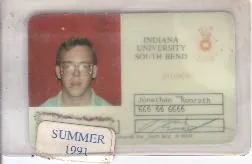
I returned to Elkhart after my freshman year, broke, flunking out, and with this crazy idea that going to IU at South Bend would somehow boost my GPA and save me tons of money.  A year later, I found neither of these to be the case, and I spent huge amounts of energy trying to escape Elkhart like a large spacecraft tries to escape the orbital pull of the Earth.  But in the summer of 1990, I went back to living in my parents’ basement, and driving a 1976 Camaro with a V-8 that pulled down a gallon of gas every 7 or 8 miles wasn’t going to hack it for a 50-mile-a-day commute, because gas was some outrageous price like 88 cents a gallon.

I ended up buying this 1984 Turismo for $1200, and at the time, it seemed like a nice car.  I mean, it wasn’t painted in primer, it had an exhaust, it ran, and there weren’t holes in the floor.  The car was only six years old, and the bright burgundy interior almost looked futuristic, if any Chrysler product from the mid-80s could look futuristic.  It was also a stick-shift, a five-speed, and pretty much the worst car in the world would be at least 50% better if it had a manual transmission.

I remember Tom Sample being blown away by the grey hatchback the first time I came over to pick him up.  He was astounded by how nice it looked, and how he now had a passenger window he could roll down to yell at pedestrians.  (You can’t un-duct-tape a sheet of plastic while driving.)  Right before school started, we took a shakedown cruise to Chicago, driving the back roads instead of the toll road to save $2.20, listening to Helloween on the Krako tape deck (which was subsequently stolen the next day.  Elkhart - great place to raise a family!)  We both missed the old Camaro, which I’d sold for $200, because we spent many days and nights wandering aimlessly around northern Indiana, memorizing old Metallica and Black Flag and doing everything and nothing while searching to find some — something that we never found, but it was one of those “journey is the destination” sorts of things that, 25 years later, we still wish we could relive.

I pretty much lived in that car all fall.  I mean, I didn’t sleep in it like 20% of the foreclosed nation currently is doing, but I’d drive to campus and back every day, which ate about two hours of my days and nights.  I’d leave early in the morning to get to my 9

Calculus M215 class, stay all day, and usually work at night in the computer lab, driving home in the darkness.  I’d eat two, sometimes three meals a day in the car, from the morning’s bagels, to a lunch packed in one of those stupid insulated lunch bags, to a late-night stop at McDonald’s or Subway on Lincolnway East.

iusb-id

The fall semester was this conflicted state internally, this wish I was still in Bloomington or in some big city like Chicago.  I still clung onto my identity, at least in a virtual sense, by telnetting across a slow 2400 bps sytek line that connected me to my IU accounts downstate, where I’d email and bitnet with old friends, and read usenet and dick around on FORUM and try to keep the dream alive of someday returning to the main campus.  And I’d cruise around the streets of South Bend on breaks between classes, wishing the city was something bigger or more profound.  There’s a few blocks downtown, a brief blurb of a metropolis with glass and chrome buildings that almost made me feel like I wasn’t in the great farmlands of nothingness.  I’d go to the Notre Dame campus and walk past the Touchdown Jesus library and the huge halls of science and learning and wish I was back on a real college campus that wasn’t just a bunch of housewives on the forever plan, auditing a class a year in hopes of someday moving from junior administrative assistant to senior administrative assistant at their insurance sales office or trailer factory.

And this was at a miserable time in America, which is always greatly magnified in cities with nothing but a manufacturing base like Elkhart.  The economy was in the toilet, and nobody was buying RVs, which is all they produced in that city.  So there were “will work for food” signs on every corner, laid off baby boomers and oldsters struggling at cashier jobs at Burger King, and more and more businesses closing or posting signs they weren’t hiring.  It was nowhere near as bad as Elkhart is now, but it was definitely one of the famine states in the city’s feast or famine cycle.  We were also going into a war, or one of those excuses for a war that would become all too familiar in later years.  The Hummer was produced in Mishawaka at the AM General plant.  They didn’t sell the civilian version yet, but they were producing mass numbers for the impending saber-rattling.  Every morning when I drove in to school, I’d see HMMWVs driving from the plant to the train yard in Elkhart, to get transported to whatever military depot would eventually ship them out to Saudi Arabia.  It was a surreal site, driving down US-33 and passing a column of 50 identical M998s, painted in desert camo, like something out of Red Dawn.

I put many miles on the car, although I didn’t know how many, because the speedometer/odometer was broken.  That was my first clue at how badly I’d been swindled.  Some stupid hillbilly replaced the Plymouth 4-cylinder with a 2.2 from a completely different Chrysler, and when none of the emissions or wiring or cabling pieces matched up, he didn’t install them.  As the summer turned into fall and the cold weather crept up on us, it became harder and harder to start the car in the morning, because all of the various chokes and baffles and vacuum tubes that enable a carbureted engine to start in cold weather were missing.  I bought the Chilton’s guide and spent many hours buying pieces from the junk yard, trying to Macgyver the emissions control junk so the car would run properly, but was never completely successful.

Then came the clutch debacle.  One Friday night, me and Becky (the girl who followed me back to Elkhart, which is another story or book entirely) loaded up the car and headed to Bloomington.  We stopped at the McDonald’s by Concord Mall on the way out, and when I went to downshift from fourth to first and make the left turn into the parking lot, I found the shifter did not work at all; it dangled loose and I was stuck in fourth gear.  I drove home in fourth by revving the engine up to 6000 and inching out the clutch pedal a millimeter at a time, and by the time I got home, the clutch was fucked, burned into nothingness.  I found that the redneck genius mechanic had attached the shifter linkage with rubber bands, and it had popped off.  I fixed that (better rubber bands) and tried driving the car with 95% of the clutch gone and got stranded about a mile from IUSB, then spent $500 at AAMCO for a new clutch.

Things failed one by one on the car as fall turned to winter.  I had to replace the battery. The brake lights would blow out every week, requiring me to replace fuses constantly.  The brakes got a little weird, and there was some weird rolling sound in the front suspension, like maybe a bad bearing or something.  Then the heater stopped working.  Indiana in December and January is not a good sans-heater state, and I’d have to bundle up in multiple coats and then put a big blanket over me for the drive in.  The heater almost worked, putting out enough lukewarm air to barely get the car above freezing within 20 minutes, but it was far from ideal.

I went to Bloomington over spring break, by myself.  Their classes were in session when we weren’t, and I had some bullshit excuse, like that I had to register for classes for the fall.  I had an awesome time, hung out with a lot of people, stayed with my old roommate Kirk at Collins, and put a lot of faces to usernames.  I had Becky’s car, and she had mine for the week.  One night I called to check on things, and she told me she had some problem with the car, that it died and would not start, so she got it towed to a Sears and they gave her this huge laundry list of problems, like that it needed a new radiator and an exhaust part and a bunch of other crap.  She felt bad about “killing” the car and got a bunch of work done on it, but I had mixed feelings about the whole thing.  I had this strong emotional attachment to the Turismo, but it was also well past the point where junking the car and buying another would be much cheaper than fixing it.

I reluctantly returned to Elkhart, and got the Turismo back.  It was much quieter and I finally had a heater (just in time for winter to be over), but on the first voyage to and from school, the radiator broke, literally ten yards from my driveway, pouring hot antifreeze everywhere.  The car spent another week in the shop to re-do the repairs, and I got it back on a Thursday, for my lazy Friday commute to school.  IUSB didn’t have Friday classes, or maybe they were just a half day, but I’d work all day, and every other week, I’d get one of those cream and crimson pieces of paper for $6.60 an hour times 20 or 30 hours, and I’d have to get there early to cash it and then run to Orbit records and buy whatever Thrash metal tapes Ray told me to buy.

That Friday, I hit Orbit, then drove home for a usual Friday night: renting videos, eating junk food, doing nothing until Monday.  I remember listening to this band called Xentrix, some forgettable Thrash metal band from the nylon case full of tapes sitting in the passenger seat.  I remember it just started raining, so I flipped on the lights and the wipers.  And I remember just as I got into Elkhart, taking the left turn from Mishawaka Road to the Concord Mall, right before home, the car stalled as I was going through the intersection.  I kicked in the clutch, turned the key, and the engine spun and spun without starting as I coasted.  Then I saw smoke pouring through the vents of the car, and the wipers stopped.  I knew I was fucked.

I coasted the car into the Martin’s parking lot, and by then, smoke was pouring from the front end.  I went to pop open the hood, and burned my hand on the hot metal of the car.  People started gathering, and I told someone to call 911.  A grocery store bagger showed up with a huge fire extinguisher, and we proceeded to shoot the white foam through the cracks of the hood and front grille, which did nothing.  I knew where this was going and started throwing things out of the passenger compartment, all of the tapes and floppy disks and books and papers, and then gave the stereo a good pull and jerked it loose from the dash.

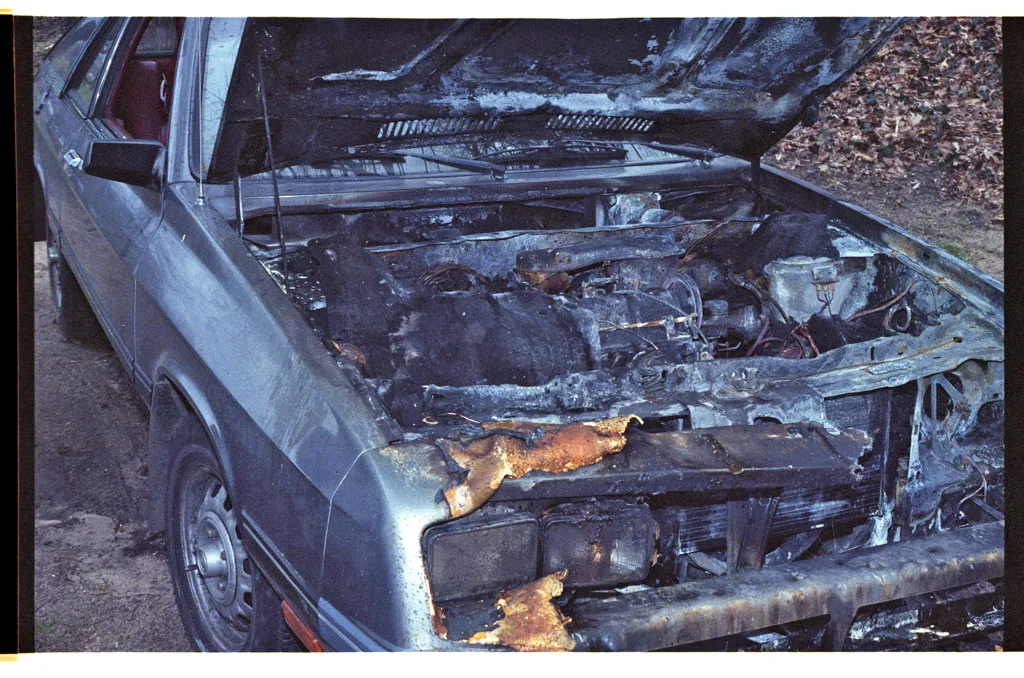
By this time, the car looked like a plane crash, billowing a column of black smoke into the air.  I heard sirens, which is always ominous when you realize the sirens are for you.  A cop, parked a dozen yards away, told me to wait in his car, and tried to clear everyone away, anticipating an explosion.  From the cop car, I saw flames through the firewall of the passenger compartment, consuming the interior.  The firefighters, dressed in full turnout gear, worked fast.  They closed the doors, smashed the windows with axes, and dumped a swimming pool full of water into the engine compartment and interior.  Becky and my sister were at the grocery store, and came over to look at the idiot with the burning car and then saw it was me.  I wish I would have told one of them to run in, get a disposable camera, and take a picture of the disaster.

Someone called a tow truck, and they flat-bedded the remains to my mom’s house.  I arrived with a burned hand, wheezing from extinguisher dust, black with soot, smashed safety glass in my shoes, and crashing from the aftereffect of the massive adrenalin rush you get when you walk away from a burning wreck of a car.

turismo2

turismo3

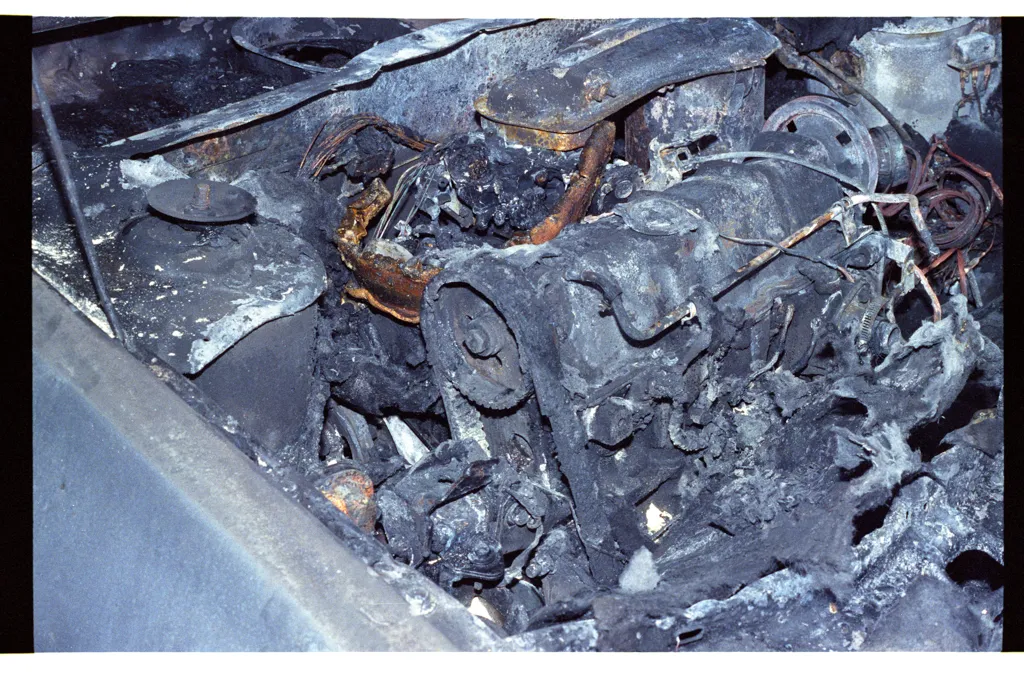
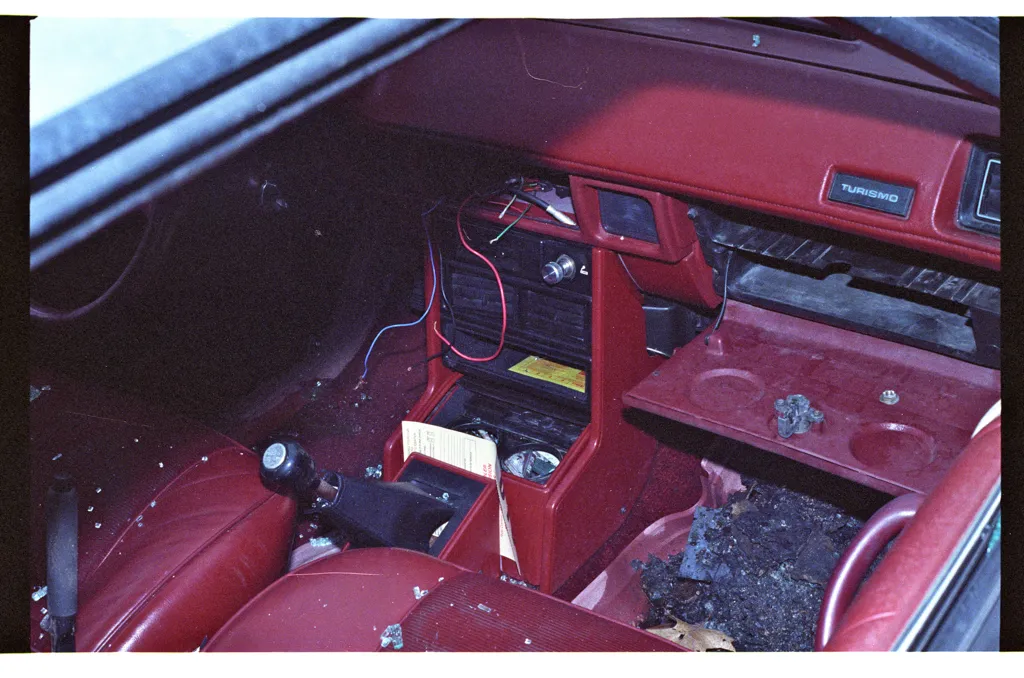
The next morning, I took these pictures, with Becky’s 35mm.  I have no idea what caused the fire, but the engine had actually melted, it got so hot.    The interior was drenched, coated with soot and the carpet melted and burned, peppered with pieces of the greenish shattered safety glass everywhere.  I actually got the aforementioned junkyard to buy the whole mess for $50, and within a week or two, got a diesel VW Rabbit for $500.  Finished the semester with a 0.67 GPA, broke up with Becky, spent a summer working second shift and then taking 8 AM summer school classes, and managed to get the hell out of town and back to Bloomington that fall.

City Lights Run

IMG_5187

On Memorial Day, we decided to run into “the city,” although I hate sounding like one of those bridge and tunnel types that refer to San Francisco as “the city,” because I happen to actually live in A city, but not THE city.  (More annoying than this: the show So You Think You Can Dance recently held auditions at the Paramount Theater here in Oakland, this big, old-timey, restored grand theater, and in every narrative and establishing shot, they went on about “The San Francisco Auditions,” and showed b-roll footage of the Golden Gate and trolley cars and whatnot.  It would not have killed them to actually say they were in Oakland, especially when you’re a bunch of white-bread TV execs trying to look “urban.”  Anyway.)

So the goal of the trip was to go to City Lights, which I have not been back to in a long time.  And in thinking back, it turns out it was 15 years ago, to the month, since my first visit to San Francisco, and my trip there.  I wrote about this elsewhere, in an old issue of AITPL, and the basic rundown is that I was in San Jose for this trade show, working at my first job in Seattle, and I had pretty much an entire day off , and no plans whatsoever.  I loved being in California, loved the weather and the smell of the air and the sunshine, but schlepping around a convention center in a stupid logo-ed polo shirt, handing out CD-ROMs (remember those?) and software to people during the not-yet-burst internet bubble wasn’t exactly the way to see the Bay Area.  Walking back to my hotel, I realized they had a little rent-a-car desk off the main lobby.  Then I realized I was now 25 and had an Amex gold card in my wallet, which meant I could, for the first time, rent a car.  20 minutes later, I’m jetting north on the 101, headed for this city I barely knew, only a rental car map in hand, no GPS, no addresses, no plans, no google on a phone, just a vague idea that the center of the Beat universe was somewhere on Columbus street.

I have no idea how I found the place back then, but I did, and I was in the very same building where Ginsberg read Howl, where Bukowski’s short story collections were published, where every Beat poet wannabe aspired to be shelved.  It’s not a huge store, and back then, it wasn’t that overwhelming.  I mean, you’ve got this Kerouac street outside of it, and So I Married an Axe Murderer, a movie me and Simms and gang memorized in the mid-90s starts and ends in that alley.  But in 1996, there were plenty of great book stores around; I think there were a half-dozen great stores the same size or bigger within five miles of my old Seattle apartment.  I did buy an issue of Cometbus, the first I’d ever read, and wished I had the cash and luggage space to buy a dozen other things.

I figured the city would be jam-packed with tourist types, but after we crossed the perpetually-under-construction Bay Bridge and its doppelganger 21st-century twin, traffic was spectacularly light.  After cutting through a completely vacant financial district, we found a street parking space on a hilly part of Columbus, something I’d only expect to see after a total nuclear holocaust.  Of course, there was no indication as to the meter situation on the holiday, so we risked it, and of course got a ticket.  But still, it’s the thought of a street parking space for free that counts.

I remember eating at some eclectic fusion-y diner restaurant with toys spray-painted gold and glued to the walls, maybe called Icon back in 1996, and I’m sure that’s long gone.  We ended up at some odd 70-year-old sandwich shop for lunch, a place covered with Pittsburgh Steelers stuff.  The sandwiches were made with both fries and coleslaw on the sandwich, which I did not really like, but they did have some awesome onion rings.  This was, unfortunately, one of those carb-heavy meals I can’t really deal with anymore, and within an hour, I was pretty much ready for sleep.

We went to City Lights, and it looked remarkably like it did back in 1996, and probably like 1966, except for maybe the computer registers, and swap out all of the purple-type mimeographed zines for photocopied ones.  It looked smaller than I remembered, but the selection was still astounding, and I instantly found a few dozen things I wanted to buy. There is the issue, however, that I’m running out of storage room, and I’ve got a queue of at least a dozen books on the to-read pile already.  But who cares.  When they film my episode of Intervention, I’m going to have a couch full of family members and that bitchy old lady counselor yelling at me about my private library hoarding, and I’m fine with that.

But my general attitude on the beats is somewhat varied now.  In 1996, I was just recovering from the near-terminal case of student poverty, and dropping every spare dollar I could find on building my book collection.  I still didn’t have the complete collection of any of my favorites: Bukowski, Kerouac, Henry Miller, Burroughs.  Now, I’ve got most of their bibliographies on the shelves.  Some of them have estates that are still trickling out the occasional volume pieced together from scraps, or re-re-releases of “complete” works that would require me to re-buy yet another copy of a favorite book.  On the other hand, there are a lot of biographies and scholarly deconstruction books coming out as more generations find out about and study these original tomes.

The big problem is, I’m trying to avoid writing like these guys, and that generally means avoiding reading them.  I always love to go back and re-read On the Road, but within 50 pages, I’m either thinking about some grand road trip, or trying to re-spin pieces of my own past into some epic novel, and I eventually hit a wall there, thinking that either my own life is too boring, or I don’t find it within my wheelhouse to do something like that.  It’s not entirely my style, and I’d rather be writing something more bizarre.  But I do like to dip back into the stuff every now and again.

I ended up buying a copy of Raymond Federman’s last book, and two newer issues of Cometbus, which are now sitting on the pile.  We ambled out and drove around the city a bit more, and I still don’t entirely feel like I live here, but I feel an urgent need to consume as much of this as I can, because every time I leave a city, I realize how much I didn’t do there.

And even though City Lights was one of many book stores back in 1996, now it’s one of few.  There are zero book stores in West Oakland, and exactly one within a five-mile radius of my house, a Barnes and Noble which will probably shutter in the next two years.  There’s a healthy number out in San Francisco, but they’ve become rare.  I buy a lot of stuff online, so I’m responsible for their death, but I do miss the energy given off by large rooms of new books, and love a place that’s more than just clip-on book lights and mass numbers of covers-out Twilight and Eat Pray Davinci Girl in the Dragon Tattoo books.

The Retail Race to the Bottom

IMG_0631

The Borders by my house looks like a food warehouse two years after the apocalypse started.  I went a few weeks ago, when the sign dudes stood on the corner with the “ALL TITLES 40-60% OFF”, hoping to snag an armful of good science fiction, because I’m going through this phase where I’m trying to read everything I “should have” read when I was a kid and too busy poring over Car Craft and trying to figure out if I had to replace the front springs in a ‘76 Camaro if I wanted to swap out the 305 for a 454 that I couldn’t afford in the first place.  I found maybe two or three books I wanted, but everything else was already picked clean.  They still had stacks of “destined to be remaindered” books, but I didn’t need to Teach Myself HTML 4 in 30 days, so I ignored all of that shit.

The whole store was so depressing, for some unexplainable reason.  Store designers spend untold sums doing subtle things to layout and placement to hypnotize consumers in optimal ways to buy more stuff or feel more comfortable or set the mood.  You don’t notice it, but if you’ve ever worked in a department store and you’ve spent time after hours during a massive store reset, when pieces are scattered everywhere and the kayfabe has been dropped, you know the deal.  Something didn’t look right, and it wasn’t just the hoarders digging through the out-of-date celebrity cookbooks, looking for a deal.  Half of the entrances were boarded up already, covered with giant vinyl banners advertising the fact that everything but the fillings in the cashier’s teeth had to go.  And something about the lighting, the vacancies in shelves, the massive numbers of books in the wrong place, faces out - it made me feel overwhelmingly depressed that this place would soon be yet another vacant storefront.

I don’t even shop at that Borders; I think I’ve bought a grand total of three books there since I moved to the East Bay in 2009.  I’ve eaten at the neighboring food court quite a bit, so I guess it’s become part of the routine to go there after a falafel or some Afghani food and shuffle through the magazine racks.  But I somehow feel both strange remorse and responsibility for the sinking of this ship.  And it’s not that I miss this Borders as much as it sets off a chain reaction of emotions and memories about all of the other stores that have turned to vapor and vanished in the last decade or two.

I used to love malls.  Ask my pal Larry about the overwhelming obsession I had with wandering million-square-foot indoor shopping empires, and he’ll tell you stories of being dragged to College Mall for no reason other than to run the circuit, walking up and down the hallways  and then ending up at Morgenstern’s Books for two hours to ogle over every single World War II book in stock.  (And Morgenstern’s wasn’t even technically in the mall - it was in a strip of stores across the street.)  I found some strange peace in going to any Simon-operated property and wandering past every storefront, from Ayres to Zale’s, looking at mannequins donning bad early 90s attire.  It wasn’t even that I bought anything; I wasn’t like one of these housewife machines that walked out of the clothes stores with a maxed out piece of plastic and two armfuls of boxes.  I’d just get some osmosis-hypnosis effect, listening to the muzak and peoplewatching.

But those bank-issued sixteen-digit hologrammed devils did get shelled when I went to record and book stores.  All through college and my time in Seattle and New York, it was a weekly ritual to take every ounce of disposable income to the media gods, the places that stocked my fix for reading and listening.  In Seattle, I had a two-night-a-week habit locked in at Silver Platters, this CD palace up by Northgate mall.  They had this certificate plan where you got a paper dollar for every title you bought, but if you went in on Tuesday or if you bought certain sale items, they’d give you extra points.  And if you came in on Wednesday, you could turn in your dollars for extra value.  So I’d go both nights, buying armfuls of every Gary Moore or Peter Gabriel import single I could find on Tuesday, and then redeeming these paper coupons for more stuff on Wednesday.  And I’d end up there on weekends anyway, spending my Saturday afternoons cruising all of the other retail outlets nearby.

And I had this routine with the book stores, too.  Every Friday night, I’d end up at the Barnes and Noble in Bellevue, after gorging at the Denny’s there and scribbling in my notebooks for hours.  I’d wander the stacks, pulling books that looked interesting, things I could consume, inhale through the late nights.  I’d end up reading some obscure title in bed late into Friday, knowing I’d been hypnotized too long when I’d hear the sound of the landscaping sprinklers seven stories below my open bay windows going off at 5 AM in the Jet City darkness.

New York helped break me of the mall habit.  There aren’t really malls in Manhattan; the square footage of a single food court could be broken up into a thousand studio apartments renting for two grand a month, so you’re not going to see that shit unless you take a train to Jersey City.  And I did, for a while.  I’d take the N to the Path, and emerge in this bizarro world where people drove cars and parked in outdoor parking lots and shopped at huge Simon-owned palaces of consumerism.  But these trips became less frequent.  Any time I found myself in a strange new (or old) land like St. Petersburg or Pittsburg with keys to a car in hand, I’d visit the old haunts and take a lap or two, get a corn dog on a stick and think about the days when I wore the name tag and listened to the muzak professionally for hours on end, asking people if they needed help with anything.

But then Amazon happened.  I started buying books from them way back; I remember in I think 1996, buying an old book I could not find anywhere else on the history of Indiana University, and it slowly became my go-to place for the things I could not dig up at Elliott Bay Books.  CD Universe entered my ecosystem around then too, and I’d hunt down the rare finds I couldn’t get at Silver Platters.  Amazon went from supplementary purchases to my main outlet for everything, as my go-to media places in New York began the long slide into nothingness.  I dumped serious cash at the Virgin Megastore in Times Square, which used to be on the first floor of where I worked (very dangerous), but is now a Forever 21 clothing store.  I also made the Best Buy pilgrimage every Saturday, when they still sold CDs.  Now, unless it’s Miley Cyrus or Lady Gaga, good luck finding anything there.

So yeah, my purchases, or the trends behind how people like me make purchases, may have killed off the retail stores.  I don’t know; I know I don’t even buy CDs or DVDs anymore, and either get stuff through iTunes or stream it from NetFlix.  I still buy paper books, but I also buy stuff for the Kindle.  So I’m sure the anti-digital luddites can scold me about how it’s my own damn fault that Borders filed Chapter 11.  Except for the part where Borders has lost money every year since 2006, or how they thought back in 2001 it would be genius to hand over their online retail operations to Amazon.com, or how in early 2008 (when about 7 people owned a Kindle) they announced they were so in debt, they were going to sell out to Barnes and Noble, a misstep that plummeted their stock price through the floor.

You can armchair quarterback this one in a million different ways, and the same holds true for any big retail collapse.  Blame it on Wal-Mart, or online sales, or poor holiday seasons, or the cost of gas, but it’s really this perfect storm of different things that makes it too complicated to predict or correct.  I mean, I always bemoan the shuttering of Montgomery Ward, where I did my time as a teenager and did a couple of summer moonlighting stints in college.  Most blame a bad 2000 Christmas season as the reason for their bankruptcy, but there were so many other factors: the debt from their leveraged buyout; the two-front war against discounters and other department stores; the failed attempts at re-marketing themselves; the expense of facelifting a bunch of their stores; the hundred million dollars they threw at IBM to overhaul their computer back-end.  Some even say the problems go back to just after the end of World War II, when the company focused all of its energy into building stores in the heart of metropolis areas and resisted expanding into the suburbs.  But it’s one of those things where you can’t just say “the internet killed it” and leave it at that.  And I think Borders is the same way; I think their mistakes at running a business go back much further than the advent of an e-ink screen or even the HTML shopping cart era.

And there’s all of these other things that have changed since I was in high school that alter the game.  People used to buy stuff from mail-order houses, or from catalogs; then they switched to malls; then big-box stores; then discount stores. Indoor malls have been “de-malled”; outdoor malls have shifted from low-end to boutique and probably back again.  People “don’t read anymore”.  The middle class is gone.  Gas costs as much as uranium did when I was in high school.  Book stores only sell clip-on lights and picture books of cats dressed as movie stars.  Everyone is an obese hoarder that never leaves the house.  Kids keep playing these god damned video games and Angry Pac Bird Mans.  Focus groups and religious nitwits and crowds of “what about the children” whiners have killed off anything more controversial than a loaf of Wonder bread.  All of this is true.  None of this is true.  The more things change, the more they stay the same.  Things never change.  Things work in cycles.  People never forget failures.  People don’t remember what happened five minutes ago.  I don’t even remember what I was talking about.

I was trying to remember the last time I’ve been to a mall, and I can’t.  We have a “mall” just up the road from us, one of those new urban bullshit outdoor mall things that has apartments in the top tier of it, and an Apple Store and some movie theaters, and a bunch of stores I’d never shop at, and a parking garage that is always a total clusterfuck.  But I can’t think of when I was last in an indoor mall.  I think I went to the Concord Mall during a visit to Indiana in like 2007, and was amazed at how totaled it was, how the old Wards store got cut into three or four pieces and turned into a discount car stereo place and some kind of hillbilly craft store where post-menopausal women buy glitter to paste on their angel centerpieces.  No wait - we had an indoor mall, Tanforan, by our old place in South San Francisco.  It was more or less the no-man’s-land between a Target, Penny’s, and Sears, with a big movie theater, and two floors of places selling clothing I’d never, ever wear.  It’s the kind of mall that made Pierre Moran mall in Elkhart (aka the “other mall”, where “other” means “not white”) look big, and they de-malled Pierre Moran about five years ago.

Must stop writing about this, because every paragraph I write involves about 200 web pages of nostalgic searches for old department store catalogs, and I’ve got other crap to do.