The Wrath of Kon

Dispatches, thoughts, and miscellanea from writer Jon Konrath

Tag: memories

Death of a Mall Intersection

5b68dd9610f6b.image_

This is an oddly specific bit of nostalgia, and I’m not sure it matters that much unless you lived right by the Concord Mall in Elkhart, Indiana. But I’m going to babble about it anyway.

[Note: I wrote this post a year and a half ago and never finished it. So, this is even more stupid and trivial now that I’ve gotten around to finishing it.]

So the Elkhart County Commissioners picked a plan to build a railroad overpass in Dunlap, the part of Elkhart by the mall, where I grew up. And while I would have loved the idea of a way to cross the busy train tracks back when I lived there, the plan does cause a lot of change that opens up some odd nostalgia, the kind I get when an old haunt is torn down.

Some background first. There’s a stretch of railway corridor that runs roughly following US-33, from Elkhart to Goshen and further south. A large rail yard, once the biggest one in the country, is northeast of this area, and the result is long trains. A lot of long trains. There were routinely cargo trains of a hundred or two hundred cars rolling through town, multiple times a day. And there were no overpasses or underpasses, unless you drove all the way downtown in Elkhart, or I think there was one out in Goshen. You’d routinely get stuck waiting on a train almost every day, or you’d do the maneuver where you’d drive on a parallel road as fast as you can and try to outrace the train, getting to the next gate down while it was still open. Or you’d go around the gates, and either get a huge ticket, or get killed. (This happened often, especially when it was icy out.) It was bad enough that there were places in the area where two fire stations were built on either side of the tracks, because if there was a Conrail going through, your house would burn down before the trucks got there.

So there’s always been a need for a viaduct or overpass. And they did build two since I left (Prairie Street and Indiana Ave) which I never cared about, since I didn’t live in Elkhart anymore, didn’t pay for them, and both were further north than my old neighborhood. But as I read the plans for the new construction in Dunlap, it was oddly disconcerting to me, what major surgery would happen in my old neighborhood.

The details, which I don’t expect any of you to understand unless you lived there:

  1. An overpass is built where Concord Mall Drive/Sunnyside Road crosses US-33. It goes over the creek, US-33, the railroad tracks, and CR-45. The raised section starts roughly in front of the Chase Bank that is next to what used to be Martin’s Supermarket, and comes back down on Sunnyside, right before Kendall Street.
  2. A little stub of the overpass on the north side goes back down to a new bridge over Yellow Creek and meets US-33. Both sides of this get a traffic light. This stub takes out the little bank building by the mall entrance. (I think it’s vacant now.)
  3. The rest of Concord Mall Drive is removed, including its bridge over Yellow Creek.
  4. Center Drive (the little side street next to Martin’s) dead-ends into a cul-de-sac next to Chase Bank.
  5. Concord Mall Drive and Mishawaka Rd get an improved signal.
  6. On the other side of the tracks, Kendall and Amy Street, which cross Sunnyside, will be blocked off into cul-de-sacs on either side.
  7. Helen Street, which also crosses Sunnyside, will get a slight trim and connect with the last little bit of Sunnyside, leading to CR-45.
  8. Sunnyside and CR-13 gets a traffic light.
  9. The Sunnyside railroad signal is removed (duh.)
  10. The weird part - the railroad crossing at CR13 is removed.
  11. The south side of CR-13 gets a cul-de-sac before the tracks. The north side gets a slight alignment improvement with CR-45.

There’s a lot of weird things that happen because of this.

  • My walk from my old house to the mall would either radically change or be impossible. It’s hard to think of that, because I did the walk so many times as a kid, either to the mall or to school. And if the overpass does not have a pedestrian lane (which it probably won’t — this is Indiana) then it would be impossible to get across the tracks, without walking probably an extra two miles, either north or south.
  • The Sunnyside neighborhood would be radically changed. It splits it in half, and the plan would remove a number of houses. This is a neighborhood that was destroyed in the Palm Sunday tornadoes — there’s a good picture of LBJ visiting, inspecting the remains, pretty much at the exact spot where the overpass grade would start. This area was rebuilt after that, but before River Manor (my old subdivision) went in, with its largely identical, more modern ranches and tri-levels.
  • Fun fact, maybe: I can’t tell which houses will be torn down, but I think one of them was a house that was moved there in the late 80s when the US-20 bypass was built and a swath of land was eminent domained crossing CR-13 just north of this area. (If you look at the map, there are two Rivercrest Drives on either side of US-20 - those used to be one street,)
  • The light at Sunnyside will be nice - I always remember getting stuck trying to make a left turn onto CR-13, and traffic would back up after school or events.
  • All of this would be happening to basically bridge the mall with the other side of the tracks, which is ironic given that Concord Mall is all but dead at this point, as are almost all of the businesses surrounding it.

Anyway, this is all some fairly obscure trivia, and I don’t really know why I’m writing about it. If you grew up near the area, you might find it news, especially since the local newspaper is now impossible to read online, and only publishes high school football scores.
Neil

When I was a kid, I was a fan of pop music, mostly because of the insular community where I grew up. We had one pop FM station out of Notre Dame University, which wasn’t a “college rock” station, but played the standard hits. (There were two stations if you had a really good antenna and could pick up WAOR out of Michigan.) When I got my own stereo and started taping things off the radio and buying 45 records, it was all top 40 music. The early eighties wasn’t a bad time for this, hence the “hey, remember the 80s” nostalgia that has pretty much become a genre. I spent a lot of time listening to bands like Men at Work, The Police, Def Leppard, Van Halen, Journey, and whatever else crossed the airwaves. I didn’t have any specific favorites, but I prided myself in being able to identify whatever songs popped up on this AOR FM station, or this brand new thing called MTV.

When I was about 14, I started hanging out with this guy Derik who lived nearby. He had an older brother who was a drummer, and while he was in the Air Force, Derik had also become an accomplished drummer. We were into a lot of the same music, but he also knew of a lot of other bands from his brother Keith, things that were either slightly older, or weren’t in heavy rotation on WNDU. Derik played along on these albums with his drum set, and I started to get enticed by the weirdness and heaviness of it all.

One of the bands was called Rush, this weird little trio of Canadians that sang about wizards and talking trees and nuclear war and had impossibly complicated songs that sometimes spanned an entire album. They also had like a dozen albums at that point, and wouldn’t stop putting out more. I didn’t really know where to jump in on this, so Derik dubbed up a C-90 for me with two of their albums: Moving Pictures and Grace Under Pressure.

That summer, the one between junior high and high school, was like Rush summer for me. I memorized that tape. I was amazed by the complexity and virtuosity of it all. For a kid who was obsessed with computers and Dungeons and Dragons and was a social outcast, this stuff scratched a serious itch for me, and I scraped together every penny I could to buy more of their tapes, and begged Derik to dub copies of more of their albums. In those pre-employment, pre-social life days of summer, I listened to the stuff constantly.

Rush was also almost like a secret club to me. Other than Derik, I don’t know anyone who was a big fan. They never played the music on the radio. Even though MTV only had like twenty videos in rotation, they did have maybe two Rush videos, but they never, ever played them. Cyndi Lauper and Michael Jackson were on every hour, but that one Rush video for the song “Countdown” about the Space Shuttle only came on like twice all summer. The people who did know about Rush were the record store cashiers. When I’d go in with my hard-earned ten bucks of lawn-mowing money and approach the register with a copy of Caress of Steel, the long-haired dude at the till would give me a nod, like “yeah, this kid knows what’s up.” Never mind that my mom thought they were Satanic, and everyone else at school was obsessed with Johnny Cougar or whatever. To this narrow audience of people who were the gatekeepers of cool (and who could tolerate Geddy Lee’s singing), I was part of that club.

I don’t know how I pulled this off, but I somehow convinced my parents at that time that it would be a good idea for me to spend an entire summer of babysitting wages to buy Derik’s old drum set. Derik now had a “real” drum set and sold me this mish-mash of various Sears and Ludwig student-level drums with rusty hardware and tarnished cymbals. I quickly learned I have absolutely no rhythm or musical skill whatsoever, and that experiment lasted about a year, until I sold the kit and bought a ten-speed with the proceeds. But trying to learn drums made me listen to the music much more, made me separate the parts and focus on the rhythm and the parts of songs. Before I listened to Rush, music was just something that started when I pressed a play button or turned on a radio. But after examining it, I learned the roles of the drums, could tell the difference between the bass and the guitar, and could appreciate the skill level between something like “My Sharona” and “Tom Sawyer.”

Another thing that Rush did was serve as a gateway to an entirely different foundation of music for me. I read every interview or magazine article I could find about them (there were very few) and I went back to try to find every influence of theirs. So through Rush, I discovered Led Zeppelin, Jimi Hendrix, and Cream. Then I tried to research all of Rush’s prog-rock peers (although they are peerless) and discovered Yes, Genesis, Saga, and Triumph. Each of those bands led to other bands. There was a strong teenaged urge to chase that high, to find things more and more extreme. There wasn’t much more complicated than Rush at that time (although later, this lead to Dream Theater, and guitar virtuosos like Satriani, Vai, Malmsteen, etc.) So I fell down the wormhole of finding things more heavy, more loud, and more extreme, which led to Metallica, then thrash metal, then death metal, and so on.

And I’ve told the story before but my first concert was Rush, on the Hold Your Fire tour. Me and Derik went, and it was mind-blowing to see the band a few hundred feet away, but also to be in an arena full of people who geeked out to the same kind of music, the stuff nobody in my small town seemed to appreciate. It was like the first Star Trek convention for a lifelong Trek fan. It showed me there was much more out there in the world of music, and life was much bigger than what was going on in rural Indiana.

Anyway, I got to college, and my relationship with Rush “normalized” a bit. I was into so many other bands, and I guess it just fell out of style a little bit, just like D&D and model airplanes and video games. It was uncool to be into Rush, especially after their late 80s synth-dominated albums, and after “college rock” became “alternative” and Nirvana exploded, and anything related to metal was tragically uncool with the mainstream. The cold war was over, and instead of worrying about Reaganomics and tribalism, Generation X became the me generation, and we were all supposed to worry about ourselves, our Prozac, our go-nowhere futures. (Ugh.)

My interest in Rush waxed and waned, because they still put out an album every year or two. A new one would drop, and I’d buy Roll the Bones or whatever, and think “eh,” but still end up spending a week rolling 2112 and Moving Pictures again, before I moved on to Queensrÿche or Morbid Angel or whatever the hell I was into at that point.

Anyway, as far as my personal relationship to the members, guitarist Alex Lifeson was a non-entity to me. No offense to him, but he wasn’t the spokesman, and he didn’t sing, and on those late 80s albums, he damn near didn’t even play guitar. Geddy Lee was the frontman, and because he sang, in my head, it was he who communicated the lyrics to me. He’s also a hell of a bassist, and does that and keyboards at the same time. But the singing was, well, a bit of an acquired taste, and although he seemed like a cool guy and all, he wasn’t who I really related to.

But, Neil. Like I said, I tried to play the drums, and I had that connection. I knew how hard it was to do something like “YYZ” or his marathon drum solos. (Or the song “Marathon”… Jesus Christ, all that weird off-meter stuff - I had no idea how a human being can remember all of that in order, let alone perform it.) And he was indirectly, through Derik’s playing and obsession, the reason I got pulled into all of this. Neil was also the lyricist, the person who actually wrote the words that Geddy sang. So he was the one reading Tolkein and Jack London books on the tour bus, like I did in study hall, except he distilled them into songs instead of Dungeons and Dragons campaigns. Neil was the quiet, intelligent guy in the band, and that is why I identified with him.

Later, in the Nineties, Peart started writing books. He had a book called The Masked Rider, which was a travel journal of his bicycling adventures in Africa. This was particularly resonant to me, because I spent a long period in high school cycling everywhere, doing every 25K race I could find in northern Indiana, even doing a 100K race once. And every day after school for a year of so, when I first got that ten-speed in exchange for the drum set, I would ride twenty miles in the cornfields of Elkhart county, usually listening to a Rush album. So when I read this book, it felt as if he was speaking directly to me in some way.

Neil had a series of tragedies in his life in the late Nineties. First, his nineteen-year-old daughter was killed in a car accident. Then, ten months later, his wife died of lung cancer. After this, he pretty much called everything quits, and took off on his touring motorcycle, on a crazy multi-year trip that wound across the continent from end to end both ways. After recovering, remarrying, and rejoining the band, he wrote a book about this journey called Ghost Rider. This book is absolutely essential reading for people into travel and road trips.

One of the most striking coincidences as I read this is that he was crossing the US at the same time as I was. In 1999, I went on this two-week ramble from West to East, driving everywhere and seeing everything I could. I very distinctly remember an afternoon in remote Utah, sitting on the bench seat of this giant sedan I’d rented, everything I owned in the back seat and trunk, flipping through disc after disc in my collection, going on a twelve-hour jag of listening to old Rush albums in the middle of nowhere. It’s strange for me to think he was out there at the same time.

Some Rush fans lock into it for life, go to every date on every tour, only listen to Rush, get custom license plates and tattoos and teach their kids and grandkids all the words to Moving Pictures and the whole thing. That wasn’t me; I moved on to other things, I guess. All of the albums, every note and word, were still locked into my head, though. And I would still go back to them, a guilty pleasure, a way to immediately teleport myself back to the summer of 1985. But Rush meant a lot to me. When I met a Rush fan, we’d trade our stories like two people who both came from the same small town, both fought in the same war, both knew the same people. It was and is still a big part of my life.

You probably already know where this is going. I heard the news today that Neil Peart died of brain cancer this week. He was 67, far too young. It’s hard to process this, because he was such an icon, yet such a close voice in my head from all those albums. He was the root of my musical tree, and an example of how to strive for perfection. Not only that, but he was the perfect example of doing what you want to do, doing what is you, even if it flies in the face of convention. Nobody was doing full-album conceptual science fiction songs, and he was penning these things in motel rooms while broke, facing a record company about to drop the band for dismal sales, touring the country in a car, and opening for Ted Nugent or whoever the hell would take them. He did what he did, and people learned to appreciate the genius behind it, instead of trying to follow whatever formula for success everyone else said to take.

Anyway. Fuck. I have no good way to end this, except to say I really appreciate everything Neil did in his lifetime. A legend.

The inevitable stupid end-of-the-decade summary

IMG_4000

So we’re twenty years into the 21st century tomorrow, and I still call it the 20th century half the time. Luckily, I never have to write paper checks anymore and put the year on them, right?

OK, so regardless of my feelings that I need to stop looking back in a haze of stupid nostalgia, here’s a summary of my last decade, more or less.

Writing

At the start of 2010, I more or less was not writing. I call the oughts my “lost decade” because after I published Rumored to Exist in 2002 (after having mostly wrote it in the 90s), I basically didn’t do anything. I dicked around with the zine, published a couple of non-fiction books, but that Third Book I wanted to do never happened, and I lost all momentum I had at the end of the century. And then when I moved to Silicon Valley in 2008, I completely stopped writing fiction, because I was spending three or four hours a day in traffic, and another dozen in an office.

That changed when I was given the opportunity to go back to my old job, albeit with their new post-acquisition overlords, but instead of New York, I could work remotely. So I did that, with the intent of getting serious about writing. I’m still at that job (and I don’t talk about it here, so I won’t) and it has allowed me to get a lot of work done.

I didn’t publish anything in 2010, but I did manage to get eleven books out in 2011-2019. I also placed 30 articles elsewhere. (Most of them were collected into books later.) I also was interviewed in eight long-form print interviews, and appeared on or recorded maybe a dozen podcasts. (All of this is summarized here: My Books and Stories) My goal, more or less, was a book per year. I hit that, although I ultimately wish I would’ve done less with collections and put out more novels.

For what it’s worth, I think my favorite book of the decade was Atmospheres. The best-selling book I wrote this decade was The Earworm Inception (probably because it was the cheapest.) The best-selling book total though was the new reissue of Rumored that went on the Kindle.

Blogging

I have now been blogging here for something like 22 years. Oddly enough, I have added 666 entries since January 2010. This is 667, so I screwed it all up.

My blog doesn’t make money and nobody reads it, so there’s not much to say about trends in the blogosphere with regard to what’s hosted on Rumored dot com. I started before the term blog was invented, and plodded on as the “Web Journal” fad of the late 90s came and went. I went unnoticed when the blog fad came in the early oughts and everyone got a one-and-done book deal before fucking off and deleting their blog. And I’ve weathered on as net-generations have found, enjoyed, and abandoned every social media platform out there.

My own personal opinion (and this isn’t a research paper) is that there were a lot of solid and entertaining blogs at the start of the 2010s, which were bringing in decent ad revenue and good traffic, and by 2019, all of that fell apart. I used to have a rotation of blogs I would read every day. The Awl shuttered due to diminishing ad prices. BoingBoing got stupid with sponsored stories, often for products they themselves decried in their actual stories. Gawker got bankrupted by a Hulk Hogan lawsuit. And plenty of blogs got sold, merged into other media conglomerates, or otherwise watered down stuff to the point of uselessness.

One of the biggest trends of the 2010s was chasing ad revenue with click journalism. It was the decade of the listicle, the years of the hundred-picture slideshow that opened every image in a new page with ads between every other one. Titles became tricky questions. “8 Unbelievable Things You Never Knew About Enemas!” The days of long-form blogs ended, and sensationalized headlines were the norm.

Three big things changed the way I personally read blogs. First, I used to use Google Reader to subscribe to a bunch of RSS feeds for every blog I read. In 2013, Google discontinued reader. There were substitutes, like Feedly, but when the Google behemoth went away, people seemed to stop caring about RSS-centric publication. Google told us all to switch to the iGoogle home page tool, and then they cancelled that too. This meant there was no real centralized way to read your favorite stories and blogs.

Well, except for Facebook. Just as we got to the point where FB became the de facto standard for sharing stories, Zucc started screwing with the algorithm, holding links ransom unless the publishers paid money for them. As the algorithm hemorrhaged traffic from small sites, all other forms of propagation died. Facebook is now the worst way to tell the world about your blog articles (or new books you’ve published), except that it’s now the only way.

Other annoyances that make me think the 2010s are the year the internet died:

  • News sources going paywalled to (maybe justifiably) keep running after ad revenue vanished.
  • The war between sites with tons of shitty ads versus ad blockers.
  • Sites that have weaponized the use of pop-ups, pop-overs, pop-unders, and full-page ads that play video at top volume or try to convince me my Windows PC is infected with a virus when I’m reading on my iPhone.
  • GDPR - which may be well-intentioned, but unleashed an era of giant pop-up “we use cookies!” banners, “we’ve updated the terms of service” emails from every fucking page you’ve ever visited in your life, and the outright destruction of some sites like Klout and Google+. (Looking forward to what CCPA does next year…)
  • Google changing their search algorithm to try and stop link farms and clickbait, but making it essentially useless as a search engine for creative content.

Publishing

Ebooks have been around in some form for decades, and Kindle Direct Publishing started in 2007, but the 2010s were the Kindle gold rush. And the gold rush was a race to the bottom.

Unpopular opinion: I don’t read ebooks. I know people find them convenient, but I feel an inherent value in the design of a book, and holding it in my hand. I got a kindle in 2009, and I tried using it semi-exclusively for maybe six months, but I found that every book sort of ran into each other in my head and I remembered nothing from them, because I was always holding the same device and reading the same fonts and the same spacing. I did not retain any of the words in my head.

I can tell that opinion is unpopular based on my book sales. I sold roughly twice as many kindle books as print in the last ten years. I don’t make much money from either, and I don’t sell many books in the first place, but it’s clear other people like them, so I still publish them.

That said, it’s become a horrible race to the bottom. Amazon became the de facto monopoly of ebooks, although others tried and failed to create their own devices or sales channels. Amazon then more or less pushed the price of self-published ebooks to either 99 cents or $2.99 and locked out other vendors with various programs like KDP Select and Kindle Unlimited. They didn’t directly force people to use those prices, but try selling a book, even a thousand-page book, for $4.99 and see what happens.

(What’s funny about this is that Apple was sued and lost a price-fixing lawsuit, saying they tried to create a monopoly, when they currently own a single-digit percent of the market, and Amazon owns like 90% and has essentially fixed the price of of self-published books, and no lawsuit there. I’m simplifying here, but shit.)

Amazon also bought CreateSpace (in 2005) which had previously pushed out any other print-on-demand publishers (which all had their own problems anyway) with low pricing and tight integration with Amazon. Then they forced everyone to move to KDP for print in 2018, and (my conspiracy theory, not citable) did something to fundamentally break the sale of print books. My books that were previously available to ship that day now take 2-3 days, and I don’t know if it’s the algorithm (or that I suck) but my print book sales almost completely stopped in 2019.

Anyway, the general desire for page-flippers and the same mentality behind clickbait articles have made it very profitable to churn out short sequels and made it difficult to spend time crafting a long book that doesn’t immediately catch the attention on the first page. This is a much longer rant and I’ll shut up, but I feel like something fundamentally broke with publishing in the last ten years. And at any moment, Amazon is (my unsubstantiated conspiracy) going to start charging fees to publish books and will completely fuck self-publishing. So that will be fun.

Travel

I don’t even know how many miles I’ve flown in the last ten years. Let me see if I can do this from memory:

  • 2010: Vegas, Denver, New York, Milwaukee
  • 2011: Vegas, LA, Indiana, Milwaukee
  • 2012: London, Nuremberg, Berlin, Milwaukee, New York, Reno, Milwaukee again
  • 2013: LA, New York, Maui, Reno, Milwaukee, Indiana
  • 2014: Nuremberg, Frankfurt, Reno, Milwaukee
  • 2015: Las Vegas, Indiana, Maui, Indiana again, Milwaukee
  • 2016: Milwaukee, London, Nashville/Memphis, Milwaukee
  • 2017: Mendocino, Maui, Milwaukee
  • 2018: Anchorage, Milwaukee, Indiana
  • 2019: Las Vegas, Milwaukee

Travel’s gotten a bit light in the last few years because of my crazy work schedule. I’m about due for a big trip that doesn’t involve family and/or a funeral.

Other Stuff

I walked like 14,000 miles in the last ten years. Gained and lost hundreds of pounds, probably. I started the decade at like 170, and I’m now a touch above 200. In 2011 and 2013, I got back down below goal weight, but haven’t been close since, which is a bummer. Working from home is awesome except for the food thing. Maybe I’ll fix that next year.

No big predictions otherwise. I just finished a book, and I’m in the heavy postpartum depression from that, trying to figure out what to do. I’m going to keep writing. I should probably find another hobby to keep me busy when I’m not writing, but I know I’ll keep writing.

The Death of Blockbuster

IMG_7317

Here’s an interesting long read over at Retail Dive on the death of Blockbuster Video:

Who Really Killed Blockbuster?

A couple of interesting (to me) takeaways. First, I like that this article gives all the details other than just saying “Netflix, duh” because that’s not what happened. The thing that annoys the hell out of me in death-of-malls or death-of- is that they always say it’s Amazon, and it almost never is just Amazon. (I.e. venture cap choke-out run by a fervent Ayn Rand acolyte; tax scam by REIT not paying off anymore; etc.)

Like one of the factors the article mentions that most people forget: VHS tapes were damn expensive, and that was partially hidden to the consumer. Yes, you could buy a priced-to-own copy of Wayne’s World for twenty bucks during a certain limited sales cycle. But if you’ve had the good fortune of losing a copy of Apocalypse Now from a rental place, it probably cost you eighty bucks to replace it. They ran this two-tier pricing scheme for decades, and then when DVDs came out, the studios decided to go with low daily prices across the board, plus they flooded the channel at Wal-Mart and Target with cheap five-buck releases and multi-packs of their back catalog. That’s only one of the nails in the coffin, but that’s an interesting one.

The other thing, and this came up in discussion when I posted this article on FB, is that Blockbuster wasn’t that great of a place for customers anyway. There are a lot of folks nostalgic for the Nineties who were born in like 1998 and don’t remember how crappy some of it was, and Blockbuster was a good example. Like they were borderline predatory about their late fees, and good luck if you got sent to their collections department. They drove a lot of mom-and-pop rental places out of business. And their prices weren’t always great, compared to the non-chain places.

One of the things that always bugged me about Blockbuster was their family-friendly video selection. They were big on promoting mediocre big-budget movies and avoiding cult or obscure cinema. And they were incredibly vocal on not carrying anything beyond an R rating, or controversial movies. I went on a semi-boycott of Blockbuster for years because they refused to carry The Last Temptation of Christ. If you wanted obscure, it’s Not at The Block. If you need a copy of Day For Night, forget it. But they’d have plenty of copies of that new Will Smith movie.

Blockbuster was occasionally a necessary evil when I was in a small town. I really loved local rental stores that had obscure stuff, and of course you had to go to one of those places for the best horror movies. The clerks were always cool, the prices were lower, they didn’t give you as much of a hassle about membership, and sometimes you’d find weird stuff. Like there was a video place in downtown Bloomington — I wish I could remember the name. They never recycled out their old stock. Me and Larry used to go every week and find the most bizarre stuff, faded boxes that were completely forgotten. Like I remember never ever being able to find a copy of Johnny Got His Gun (probably because Metallica bought the rights to it and sat on them) and of course they had it. And I remember renting Deranged: Confessions of a Necrophile, the (bad) Canadian horror movie loosely based on Ed Gein, and it also had the short documentary Ed Gein: American Maniac slapped on the end of the VHS. It was a weird homemade doc consisting of blurry found footage, narrated by some dude in a basement recording on a Bell and Howell mono tape recorder stolen from an elementary school or something. It was awesome. (And it’s on YouTube!) You’d never, ever find that at Blockbuster.

That puts Blockbuster nostalgia in a weird place for me, much like Barnes and Noble. I’m a bit sad B&N is on the verge of shuttering, but back in the day, they were the chain to hate, because they pushed mom-and-pop stores out of business. (And deep analysis that I’m too lazy to do might show a story that independent booksellers were pushed out by someone else in the 80s/90s, like the rise of Ingram or the changes in book printing after NAFTA, or some damn thing.)

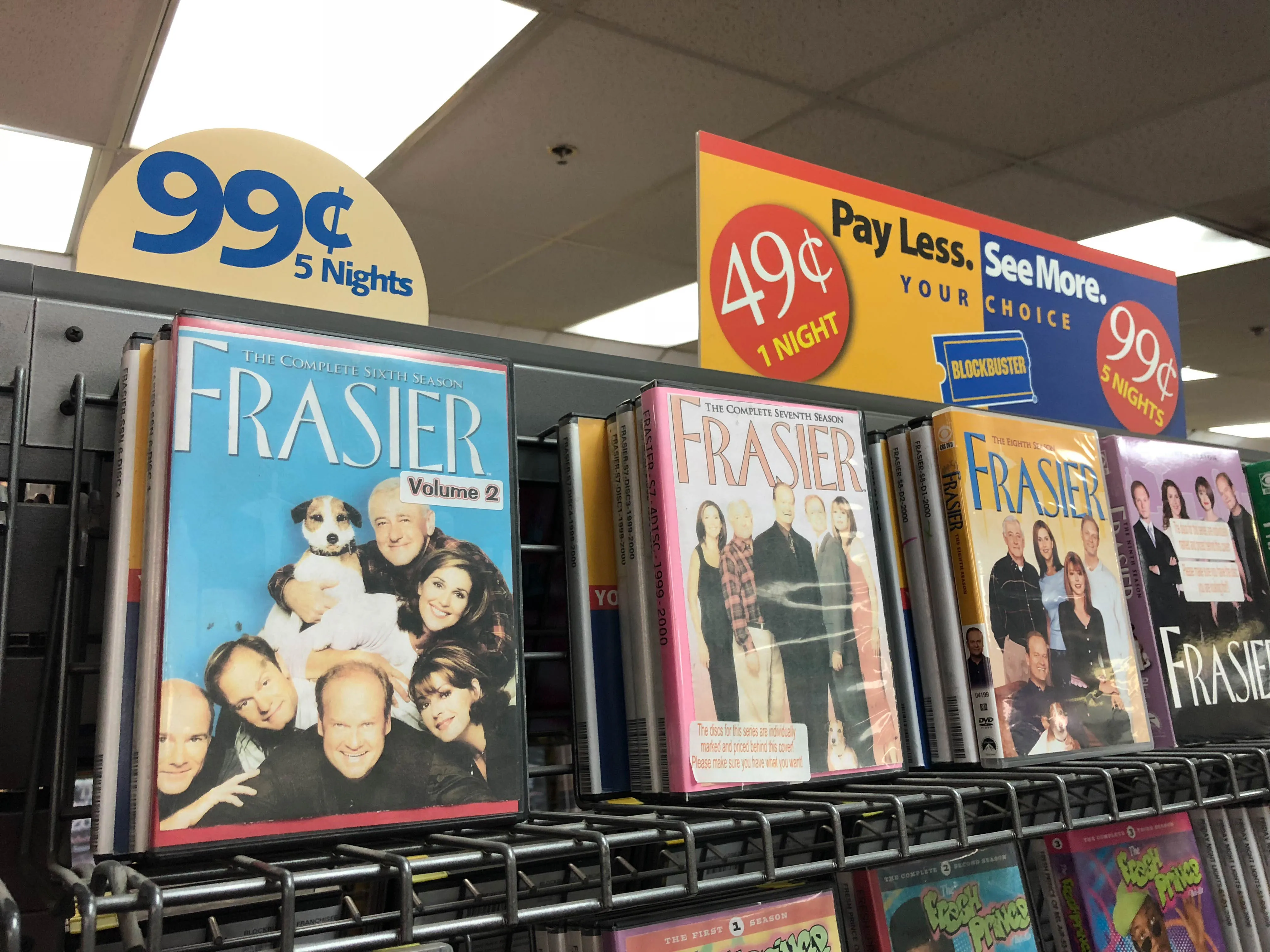
I visited one of the last Blockbusters in Anchorage a year and a half ago. (Yes it was the one with the Gladiator jockstrap. No, it wasn’t there yet when I visited.) It gave me a strange and sad feeling, not specifically because it was Blockbuster, but because it was a video store, period. It was all DVD, but wandering the aisles reminded me of the weekly exercise of going from A to Z on a Friday night to find what I’d watch.

That entire era is gone, replaced with a button on my TV remote that lets me scroll through thousands of titles. But something’s missing, with the lack of the Tarantino-esque clerk telling me what I really need to watch, and the tactile experience of pacing the aisles. We now have great convenience and instant access, but it is at a cost that’s hard to quantify, and it’s definitely felt by those who do remember.

The Death of Northgate

786px-Bon_Marche_at_Northgate_1950

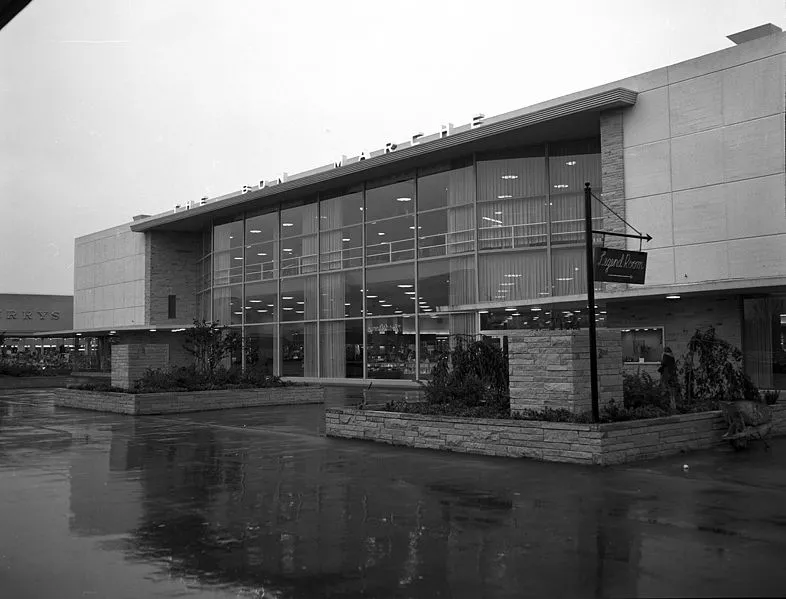
Bon Marche at Northgate, 1950 (Credit: Seattle Municipal Archives from Seattle, WA [CC BY 2.0 (https://creativecommons.org/licenses/by/2.0)\])

Looks like Northgate mall in Seattle is quickly winding down. The JC Penney already closed, and the Macy’s and Nordstrom are in the process of shutting their doors. The plan is to demolish the main stretch of the mall, leave some of the external “village” buildings that were tacked onto the front in the mid-00s, and then build an NHL practice facility and some housing. I hate being nostalgic about this place or any mall in general, and I have mixed feelings for a few reasons.

When I lived in Seattle from 1995 to 1999, Northgate was sort of my default mall. It wasn’t my favorite mall, and it wasn’t the best one in the area, but it was the closest to my house, and I ended up there at least once a week. When I first moved to Seattle, I stayed at my friend Bill’s place in Mountlake Terrace for a month, and took the bus down I-5 every day for work. And every day, we’d pass this sprawling shopping center, just off the highway. One thing I remember clearly is it had a giant two-screen movie theater on the north side, with a changing-letter marquee where the words were taller than me, advertising the movies Clueless and Apollo 13. So when I got a car and had some time on a weekend, it’s the first mall in Seattle I visited.

After I moved to First Hill, this mall was a straight shot up the highway for me. Hop on I-5, drive a hundred blocks, exit, done. Even though I worked next to the much smaller Factoria mall across the lake, I ended up driving to Northgate pretty much constantly. Between the Denny’s and a smaller local pancake place, I always had a default diner there too, so every Saturday was spent at this mall, more or less.

Northgate is arguably the first mall in America. There are like a half-dozen different malls that claim this, and I’m too lazy to research which one is right. But they built two strips of stores in 1950, then covered it with a “sky shield” and eventually sealed off the whole thing in the early 70s, making it an enclosed mall. They later built one of the first Nordstrom stores, the big two-screen theater, and the other anchors. Later additions while I was there in the late Nineties included a Toys R Us, a food court, and a general remodel. In the 00s, Simon did their usual “lifestyle addition” thing with a Potemkin village of outward-facing smaller anchors on the west side of the mall (one of them always being an Ulta Beauty), and removal of the theater (and the giant totem pole that was in front of it.) A Target and Best Buy went in across the street, and the surrounding landscape of the area has completely changed five times since I left. There were also various anchor and store flips in the last twenty years. I wasn’t there, you can look it up.

I honestly found the architecture and layout of Northgate to be a bit boring, and deceiving. It looks small, but it’s gigantic. When I lived there, they had four anchors, all of them softlines, which bored me. (JCP, Nordstrom, Lamonts, Bon Marche.) And the entire mall was a single hallway, a straight 1,500-foot shot with stores on either side. It didn’t have a winding floor plan, so it seemed smaller, but if you walked from anchor to anchor twice, that’s over a mile. It had no vintage charm, just high ceilings and faded white everywhere, like an airport concourse. It also had few stores where I really shopped. But I still ended up there a lot, and spent an insane amount of time walking up and down that long hallway, looking for… I don’t know what. The drab non-decor was replaced during the 97-98 remodel with fake-ass timber accents on the high ceilings that made it look like a ski lodge, which was all the vogue in the time in the PNW.

What attracted me, other than the proximity to my house, was that Simon malls all had this universal emotional antiseptic feeling to me. Wandering that place felt very similar to walking through College Mall in Bloomington, or University Park Mall in South Bend, even if they layout and the stores were different. Especially in my first year there, I was extraordinarily depressed, missed Bloomington a lot, knew almost nobody, didn’t know where anything was, didn’t have a TV, and was always broke. I later found other malls further out, and other stores to buy music and books and food. But it became a default place to mope around, walk a few laps, and then go home and try to write.

I didn’t buy stuff in that mall much. I only went to that movie theater a few times (I remember seeing Event Horizon there) and I used to pop in the B. Dalton every time I visited. Bon Marche had a Vans shoes section, and I’d buy a pair each year like clockwork. A Wizards of the Coast store was always worth a browse, even though I didn’t play D&D or Magic at the time. An office supply/craft store provided me with a lot of fancy pens I’d later lose. The mall had an attached drug store where I’d frequently load up on cold medicine, and a QFC grocery was good for a frozen dinner or two. After Toys R Us arrived, I’d pop in there for Nintendo 64 games. But more of my shopping was around the area, like the Silver Platter records just south of there.

Aside from the strange nostalgia for the place, and the fact that it will all be gone soon, is the fact that the coverage around the remodel sort of pisses me off. People in Seattle have always hated malls, it seems. They’ve always talked about how horrible Northgate was, even when it was a top-grossing mall. Now, the YIMBY crowd is super excited about the death of the mall, mostly because we’re all supposed to ride bicycles and something with a parking lot somehow triggers them. I don’t follow Seattle redevelopment news much, but we have our own vocal YIMBY contingent here, so I imagine the more-housing-at-any-cost crowd is celebrating the mall’s death enthusiastically. Seattle has 100% changed since I left, and I get it — cities change. Since I left, Amazon has hired more people than my home town has, period. So, housing crunch, people hate malls, yada yada, you already know the rest.

It’s been over twenty years since I saw that place, or any of Seattle. I still miss it, because it was such a key time in my life, my first four years out of college, which felt more like a decade. But it’s an extreme case of “you can never go back,” because so much of the city has changed.

Wish I had some old pictures of the place, but that was in the film era. I do have some pictures of my VW in the parking lot, and you can almost sort of see the east entrance of the mall in the background of one shot. I used one of the pictures for the third edition cover of Summer Rain, but you can’t see anything but the pavement in the zoomed-in shot. (And fun fact: the license plate in the pic is a photoshop job. And Indiana didn’t had front license plates in 1992, so that’s wrong, too.) Anyway…