The Wrath of Kon

Dispatches, thoughts, and miscellanea from writer Jon Konrath

Tag: memories

The Death of Flash

Screen-Shot-2021-01-04-at-12.19.35-PM

I logged into my Mac the other day, and got a popup for Adobe Flash. Over the last few decades, I’m used to these coming up every other week to annoy me about updating to the latest version. This time, it was almost sad, because it told me to uninstall the Flash plug-in completely.

I always had a mixed relationship with Flash, long before it was bought by Adobe and it was still Macromedia Flash. I think part of it was that it seemed to suddenly become the cool new way to develop content for the Windows desktop, with suboptimal capability on the Mac, and dodgy support on Linux, all authored in a proprietary studio that cost too much. I was a Linux-only user, at least at home, from 1992-2005, so that covers most of the salad days of Flash, and pushed it pretty much off my radar.

I actually spent the first part of that timeframe avoiding graphical browsers as a whole, only using Lynx or Emacs/W3 from home, which seems ridiculous now, but I had a slow modem and an even slower machine back then. When I did finally upgrade to slow DSL and an actual Pentium, I was the type of contrarian who did not want to add plugins, downloads, players, and other overhead to my machine. Also, as an early adopter of the web, I was aghast that people wanted to use Flash as a UI replacement inside the browser. There were sites that simply loaded up a .SWF file and opened it across the entire web browser window, presenting all of their own navigation and UI within the app. It seems like every crappy metal band did this in about 2004. I’m sure if you visited the Queensrÿche web site back then, it would have had a “front page” Flash file that animated a bunch of burning flames or dragons or something, along with blocky icons of their logo you had to click to actually see anything. On my Linux web browser, it would be a giant blank page with a broken-document icon in the middle, which I’d hopefully be able to click to get to Page 2, but sometimes that didn’t work, either.

Jump to much later, and Flash became center stage in the mobile wars. I worked on Windows Mobile and Android phones, which both (sort of) supported Flash. But I owned an iPhone, which didn’t. This was always a point of derision for Android fans, who would pull up some random statistic about how the 24 million people playing Bubble Blaster 7 would never buy the iPhone. Steve Jobs wrote an infamous open letter about this in 2010, about why Apple refused to support Flash. At that time, it seemed almost unfathomable that in a distant universe, nobody would be using Flash. But it was a horrible battery hog, and didn’t have a great story for working on mobile devices with a touch screen. And a big reason for that Jobs manifesto was that an iPhone Flash player would always be second-class, compared to the native Apple UI. The Windows player would be faster, work best, and have the most updates. Go further down the hill, and the Apple version of the player would have some subset of functionality, and everyone would bitch at Apple because Marble Monster 3 didn’t work on the iPhone.

I think Flash quickly fell by the wayside a few years into the 2010s, although I don’t know when. At some point, Safari either didn’t come with the plug-in and you had to install it, or maybe it was there but not turned on by default, and you could turn it on per use. iOS had an app store and real apps, and that was that. Windows Mobile died. After two or three years of Android users saying the iPhone would fail for not supporting Flash, Adobe killed Flash on Android in 2012. I haven’t actively thought about Flash for years, until I heard about the EOL.

There’s one random memory about Flash that makes me miss it. In the summer of 2007, I was trying to figure out what to do with my life, attempting to maybe re-curve my career. The lack of tech writing jobs (in Denver, anyway) made me want to become a developer, but I couldn’t decide on a language or skill set. I was doing some Ruby on Rails for a friend’s company, but my wife worked for a marketing agency, and they doled out big chunks of cash to “interactive” firms who did web sites, usually with Flash. I can’t draw, but I knew enough JavaScript that I could figure out ActionScript, and assumed the rest of it was just finding the right book or tutorial or something.

I think I did buy the Dummies book at the Borders (RIP) in Stapleton and gave it a once-over with the 30-day trial of the software. The studio or whatever it was called was pretty straightforward, and I never developed any muscle memory for doing anything in Flash, but I was able to kick the tires and do the basic example projects. This quest pretty much ended at that point, and when I found a copy of Flash CS3 cost 700 bucks. But it was fun screwing around with a head-bouncing-around-the-screen demo and a pick-an-answer trivia game.

I still have a copy of those SWF files and it’s oddly nostalgic and bittersweet to see them now. Not because they’re useful or I regret not entering a career of being an interactive designer (or whatever), but because it reminds me of that summer, my first months in Denver, and everything else that happened in 2007.

Anyway, RIP Flash. Hopefully someone comes out with a good emulator ten years from now so all of the GenZ kids can remember Gem Shooter or whatever they played as a kid.

Life and Death of the Pierre Moran Mall

IMG_8931

I watched the Jasper Mall documentary a few weeks ago. It was interesting, but there was something bugging me about it, and I couldn’t put my finger on it. A few days later, I figured it out: Jasper reminds me a lot of Pierre Moran Mall in Elkhart, Indiana where I grew up, but in an alternate universe where PMM didn’t get torn down in 2006 and somehow lived on.

I should take a deep dive on Pierre Moran Mall and brain dump what I still remember, while I still remember it. There’s a good (old) page on Labelscar about the mall, but not much more. In fact, I think the third or fourth result in a google search is one of my pages about Concord Mall. And that’s a good summary for the mall: a strange afterthought to Concord, the less-known sibling, that has now completely vanished.

The basics, partly cribbed from Labelscar: Pierre Moran started as a strip mall, opened in 1958, a row of shops on Hively between Benham and Prairie, just south of downtown. An indoor mall was built right next to this strip in about 1970, with about 400,000-some square feet, including anchors Sears and two other department/softlines stores that varied over the years. (The number of anchors is vague and arguable, I’ll get into that later.) This was Elkhart’s first real mall.

I remember this mall as a little kid only because it predated the Concord Mall by a few years, and was the closest mall to us. I lived in Edwardsburg, Michigan (just north of Elkhart), and we sometimes shopped at a Kroger that was attached to the south end of the original strip. We also visited the GL Perry store, which anchored the other end of the strip.

GL Perry was a small chain of five-and-dime department stores. They had maybe eight locations around Michiana. (Details are sparse, here’s an article from when they closed in 1997.) They were a typical variety store like a Woolworth or Ben Franklin: clothes you wouldn’t want to wear if you were cool, hobby supplies, candy, toys, records, and some other staples and sundries. We used to go there a lot, although I don’t know what my parents bought there - maybe gardening supplies or something. I remember being particularly fixated on the toy aisle, and later the records. They also had a great Halloween section, which is where I got my Spider-Man get-up in October of 77. Most of the functionality of GLP was later superseded by K-Mart, but we ended up there a lot as kids. (The GL Perry was previously a Grant’s, but that was way before my time.)

A note or two on the name Pierre Moran. He was an American Indian leader, of the Potawattomie tribe. He sold his land to Dr. Havilah Beardsley in 1832 and it became downtown Elkhart. I vaguely remember learning about him as a kid: someone bit off the end of his nose in battle. He was part of the siege against the white man at Fort Wayne. Our Indiana History classes were probably not as neutral as they could have been, so I don’t know how much of that is true. (See here for a good article on it.) The acceptance and denial of Native Americans sort of ebbs and flows over time in this region, and I guess in the early 60s, someone thought it wise to name a mall (and a neighboring school) after Pierre Moran, which was good. But they also decorated the mall with various Indian statues and logos on signs, which were both straight-up early-70s mall decor, and probably a bit more than politically incorrect (although people in the local nostalgia groups would heartily disagree.) I remember the Indian decor when I was a little kid, but I think they were gone by the time I was a teenager in the mid-80s.

After the enclosed mall was built, the interior was more or less a T-shaped concourse. Floor tiles were a solid dark maroon/brown, with lots of dark wood, no skylights or grandiose architecture inside. The center had a couple of wooden benches and a few spider plants in planters, but no real conversation pits or incidental decoration to speak of, aside from a wooden Indian with a somewhat grotesque face. They later put a small fountain in the middle and lightened the place up slightly, but this was always a somewhat dark and foreboding mall. And that original strip of stores didn’t connect to the internal mall. I’ve seen strip-mall-to-mall conversions where they built a second strip so all of the old external entrances were now internal, with a roof over it. (Aka Northgate in Seattle.) But these old stores all faced out, disconnected. They did build an entrance right in the middle of that strip leading into the mall, and a drug store did have a side door going into the mall, but that’s it.

Because of this strange construction, the mall had a very patched-together arrangement to it. Most mall concourses have long lines of similarly-sized stores, rows of identical spots next to each other. You know how malls like this would sometimes have an oddball store at the end of a hall with the entrance facing the wrong way and the interior footprint in the shape of a strange truncated triangle instead of a square? Every single store at this mall looked like this. It didn’t feel like any two stores in Pierre Moran were the same size, or even close to the same size. It looked like someone collated together a mall from discarded stores left over from other mall construction, maybe adding another store every other week when they could afford it, with no overall plan for continuity. Every store had a different front. Every wood front was a different shade of wood, the planks angled in a different direction. Every chunk of brick facing was a different color, a different shape of brick. Every section of the concourse had a different height roof. The hallways were too wide, and the storefronts were too narrow. It was almost disorienting how it was put together, and the general feeling every time I went was there is nothing here. And that’s when it was fully occupied.

The Sears was decent, as far as Sears goes. I remember shopping there with my mom for Tuffskins and getting the tires changed on the car at their auto center once. I think I first played the Atari 2600 there, the “Tele Play” version that Sears OEMed. When their record department closed out in the early 80s, I remember sifting through the 4-for-a-dollar remaindered 8-Tracks, struggling to find four things worth buying. I also knew a few folks that worked there when I was a teenager, and would swing by to bother them.

Other stores I remember:

  • The aforementioned Hooks drug store, which was a local chain that eventually got bought by CVS.
  • A photocopying/printing place called Skinner the Printer.
  • A coin shop that sold comic books and baseball cards.
  • A sad arcade without many machines.
  • A somewhat Christian book/card store.
  • A place called The Cookie Jar that sold giant hot cookies and was pretty decent.
  • A Finish Line shoe store, one of the few nationally-branded stores inside the mall.
  • A shoe store called The Leather Banana.
  • A sewing supply store.
  • Various “interior decor” stores, if you were decorating a home in deep Appalachia in the 1930s.
  • A sit-down restaurant. When I was a kid it was called Meeting Place and was a general cafe sort of place old people went after church. After I’d left for college, it became a 50s-style diner called Ally Oops. It was basically like a Johnny Rockets, with the checkered floors and jukeboxes and sundaes and whatnot. People in Elkhart loved this place, but people in Elkhart judge food by portion size, price, and how unhealthy it is, so I was pretty indifferent.
  • The outside-facing strip had a Rent-A-Center, a really grim-looking liquor store, and a barber shop for old men that used a suck-cut and where I got the worst haircut of my life in 1988. Just a guess that there was probably a dry cleaner and a jewelry store that bought gold there, too.
  • Next to Sears, there was a branch of the Elkhart Public Library, and I went there a lot as a kid. Around 1989 or 1990, they moved that branch into a dedicated building, and it became a car parts place.

The TL;DR is that there were almost no national-brand stores in the mall. It was a lot of one-offs and local chains. There was never a great shift of new up-and-coming stores moving in (like University Park), or a big die-off when leases timed out (like Concord). It just sort of stayed the same, year by year, decade by decade.

Aside from Sears, one of the other anchors was Kline’s, a local clothing/department store, which then became a similar store called Ziesel’s. The other anchor was I think a Carson Prairie Scott when I was a kid. These didn’t interest me when I was a child because my mom bought my clothes for me. When I was old enough to buy my own clothes, the anchors at PMM didn’t interest me because it wasn’t 1947 and I didn’t want to dress like an octogenarian in high school.

The one cool store there was World Records. It was a tiny, hole-in-the-wall record store not much bigger than a bedroom, with maybe three or four racks of albums, a display of car stereos, and a wall of t-shirts. I don’t know why or how, but World was an excellent record store. Two mulleted guys working the register knew a ton about obscure metal, and would get in all sorts of weird imports and immediately turn me onto them. Back when everyone in my high school was obsessed with Lisa Lisa and the Cult Jam or Milli Vanilli, this guy Rodney was selling me the Metallica Creeping Death/Jump in the Fire EP (UK import on Music for Nations, years before the US release) and talking my ear off about obscure Gary Moore solo albums. I think World Records was the only place in Elkhart County where one could get a Metallica shirt before the Black Album came out.

In about 1985, that C-P-S anchor turned into a Target. This was a pretty new chain for us in Indiana - Dayton-Hudson bought out Ayr-Way locations in Indiana and flipped them into new Target stores. I thought Target was awesome back then. It seemed much more bright and new and modern and 80s than a K-Mart or Wal-Mart. And they had a good mix of things I liked: music, video games, electronics, but also staples and candy and housewares-type things and whatnot. It seemed very un-Indiana to me at the time, which is silly now, but it was one of the only reasons I really went to that mall.

To cap off this random brain dump of stores, there are a few outparcels to mention. One is that there was a Hardee’s on the corner of Hively and Prairie. This was the old-school livery, brown and orange, and I think it may have been a Burger Chef before that. In the early 00s, this was torn down and the CVS moved from the mall to a freestanding building. There was also a Long John Silver by the Sears. An ever-changing bank that was primarily drive-through an ATMs hung onto the side of the GL Perry. It’s a Key Bank now, but I think it may have been a First National, and a few other brands over the years.

One other interesting one: there was a two-screen theater as a freestanding building near Sears. This was called the Holiday I and II. In the 80s, all of the movie theaters in Elkhart were owned by one man, Bill Miller. He also owned the Elco and Cinema I movie theaters downtown, the Holiday, the Concord I and II at Concord Mall, and the Encore 1-3 on Cassopolis Street. Bill Miller was killed at the Concord theater in 1987, shot by a disgruntled employee, apparently over the theft of concessions. By 1990, all of his theaters were sold to the GKC Theaters chain, and within a few years, all but the Encore would be closed. The Holiday was essentially split in half, with one half being a few fast food restaurants, one being a Subway. The other half became a Hollywood Video chain, which has since closed and been abandoned, and still has a vaporwave pink and teal interior you can see through the windows, forever trapped in 1993 regalia. [More on Bill Miller here.]


Two memories from the Holiday I+II. One, I saw Silence of the Lambs there on opening night. Two, I went to see Flatliners, and the late show was in the same auditorium as the early show of Young Guns 2. While we were there, a group of heavily-Aquanetted, acid-washed denim-wearing girls came in, thinking YG2 was on in the second time spot. They sat through an hour of Flatliners, loudly wondering where Christian Slater was and when Bon Jovi was going to make his appearance.


My time at Pierre Moran is divided into two phases. As a child, like I mentioned, we went to the Kroger, Sears, and GL Perry a lot. This was before I had any geospatial awareness and knew anything about the distance between us and various malls, and I only knew we went to this one less than others. And we seldom went inside the mall. The only times I remember, it was because some kind of craft fair or flea market or bazaar had sale stuff on card tables through the mall’s hallways. I wasn’t old enough to know better or shop elsewhere, and my only judgment was that aside from the toy aisle at GL Perry and the toy section in Sears, there was no toy store at the mall, while Concord and University Park had a KayBee Toys and a Walden Books that sold D&D stuff.

Also, my parents didn’t want to go to this mall that much, and I never understood why. It was just a silent “we don’t go to that mall” and I didn’t know why. I always thought it was just personal preference, but I figured out what “that mall” meant later.


When Pierre Moran was built, it was a pretty sleepy bucolic suburb south of Elkhart. Looking at a 1952 aerial, there’s at least a half-mile of farmland on every side of where the original strip mall was constructed. Very little housing was in that area, and the core of Elkhart’s population lived a mile or two north, in downtown Elkhart. But jumping to a 1967 aerial photo, most of the area surrounding the strip mall has been developed, with dense, serpentine roads snaking around artificial subdivisions of identical homes built on little token yards. Every house: exactly two bedrooms, exactly one bath, exactly 1000 square feet, on a yard that was exactly 10,000 square feet. A quick Zillow search shows this entire neighborhood being spun up in 1956-1957, probably right after the strip mall was added.

At this point, Pierre Moran was the suburb of Elkhart. And in the late 60s, the suburb pushed further south. In 1964, the Elkhart Housing Authority built Rosedale High-Rise, the first of EHA’s six public housing projects, about ten blocks north of Pierre Moran Mall. The older housing stock on the south side of Elkhart became more working-class as people fled further away for the suburbs.

Elkhart was and is predominantly white. I don’t know the census numbers from when I grew up, but in 2000, it was 71% white. Elkhart has seen an increase in Hispanic population since I left, mostly because of the large manufacturing base, and I wouldn’t doubt if that 71% was much higher when I was a kid. (Not to add fuel to this fire, but Goshen, the county seat just south of Elkhart, was a sundown town, with the Chamber of Commerce claiming it was 99.5% white-only as late as 1978.) Demographics of the area changed in the seventies and eighties, like they did in many Midwestern cities. The suburbs outside of the city grew with white exodus. Their school systems exploded with the new tax base. New malls (like Concord) signed sweetheart deals to grow tax-free, develop new super-stores, attract national brands, and pry away classic stores from the collapsing downtown district. The middle class fled the downtown. And malls like Pierre Moran were left behind. I’m not trying to spin some big revisionist history racial conspiracy theory about this. I’m not a historian. It’s just how it happened, or how I observed it to happen. As a little kid, I never noticed it. Now, it’s fairly obvious.


My family moved to Elkhart in 1978, when I was seven. We bought a tri-level in a subdivision a few miles south of Pierre Moran. The houses were about 50% bigger, the yards twice as big, and there were now four different floor plan templates to choose from for the nearly-identical dwellings. We had a new school. There was a big park nearby. Every neighbor had the typical 2.5 kids, all about my age, and it was a safe place to ride bikes all day and play sports and hang out.

I led a fairly sheltered childhood, and we almost never spent any time in downtown Elkhart. I have a strange gap in my personal history because of this. When I go to Facebook nostalgia groups, people talk about grocery stores and restaurants I never heard of. I don’t know anything about growing up in downtown Elkhart. I only knew the suburbs, our almost-new grade school, the Concord Mall.

The only thing I know about where we moved was it had “good schools.” After buying my first home 30-some years later, I found that “good schools” is code for something more than just having actual good schools.


After I got a car and a job in high school, I had a lot more freedom to see parts of the city I didn’t see before. It’s not like Elkhart is a giant metropolis - it was maybe 40,000 people then. But like I said, my parents never wandered much. We drove the same half-dozen routes every week, from our house to my relatives’ houses, to the same three stores, to the same school and church. With my own wheels, I got to explore a bit more. And even though I loved Concord Mall, I also worked there, and some days I needed to just go somewhere else.

I used to go to Pierre Moran every now and again mostly because of World Records, and then Target. My buddy Larry worked at that Kroger and we’d go harass him, and Tom Sample lived a few blocks up Prairie, and I was always there. It wasn’t much of a destination, though. Concord was the default; University Park was the place to go when you had a day to kill and you wanted to see other teenagers outside of your school’s ecosystem.

Pierre Moran was where you ended up. I remember my old friend Jim always wanted to go there because he was a recovering drug addict, and he said Pierre Moran was a mall so boring, you couldn’t even score drugs there. It was a place for old people to go to buy religious greeting cards, sewing supplies, and Dickies work clothes. It was an interesting novelty, but it was by no means cool.

In my second year of college, I lived at home and went to a regional branch of Indiana University. Because of this, I often drifted around town when everyone else was at work in the factories. I’d run errands - my drug store was the one in Pierre Moran - and wander around. So I’d often end up at Pierre Moran during the day. (Or late at night - the Hardee’s was open until like midnight, and I grabbed dinner there on the way home from school frequently.)

I think my love of dead malls developed greatly in that period. People think malls were all 167% busy in the early 90s, and that the dead mall is a recent development. If you’d ever been to a midwestern second-tier mall at 10:07 AM on a Tuesday in 1990, you know this wasn’t true. Malls were always empty on weekdays and mornings. I loved walking through a half-size mall that hadn’t been touched since 1974, the entire place to myself. It helped when the mall was such a bizarre place like Pierre Moran, where you couldn’t tell if it was light or dark or raining or snowing or January or July from inside, because there were no windows and it always looked dreary inside.

There’s something almost liberating about walking through every aisle of Target at eleven in the morning, seeing exactly zero shoppers, only the five or six stock clerks and cashiers working, and then spending an hour playing Tetris on the Game Boy display in electronics, without a single person talking to you. This imprinted something deep in my head that’s still there today. My friends hated that I always wanted to go to the mall back then. My friends who worked with me at the mall thought I was delusional when I spent my day off at a different mall wandering around, sometimes facing merchandise at a store I didn’t even work at out of instinct. Almost nobody understands why I still go to malls. But that’s something the Jasper Mall doc made me think about, that strange desolation and how it sparks the dopamine in my head. There’s a certain womb-like comfort I feel being in a gigantic hall of commerce, but being the only person there, like I was on the surface of the moon.


I never felt unsafe at Pierre Moran. I had a car stereo stolen a few blocks away, but it never felt like a gangland or an inner city slum or anything else. But that was the perception. My parents were always scared that I was hanging out near “The Projects.” Pierre Moran was the “other mall.” I never saw it, but there were always rumors about people getting carjacked, businesses getting stuck up, bank robberies and stolen cars. And just guessing, but maybe that’s what led to its downfall, its inability to attract more retailers: that rumor of unsafeness.

There was crime. Lots of shoplifting, thefts. High school students fighting each other, rumors of knives and guns. They added a police substation in the mall, which is never a good sign. It was a hotbed of cruising. (One of the only hits you can find on the mall is a listing of the bathroom on a cruising web site.) I don’t know if the level of crime or the perception of crime was higher, or maybe that the clientele of the only remaining stores was markedly more senior than the people who roamed the mall for fun.

There was a very high-profile murder in 1999 where a 19-year old African-American named Sasezley Richardson was killed by Jason Powell and Alex Witmer. Powell killed him in the Sears parking log as an initiation into the Aryan Brotherhood. This was in the papers for a long time, and was national news. Not to stir things up more, but killing a stranger to get into a white supremacist group was not considered a hate crime in an Indiana Supreme Court case. There’s a strong undercurrent in the city that I don’t even want to get into, but this was an obvious big issue.


I left Indiana in 1995, so other than the occasional visit, the final chapter of the mall was not on my radar. But it was typical: Target bugged out to build a larger-footprint store a few miles south of Concord Mall. The standard Target hypermart footprint was nothing like the aging 1985 store built in a 1970s shell of a department store. And there was a large no-mans-land between Elkhart and Goshen, where Wal-Mart plopped down a store and a handful of outparcel strip stores, then a Meijer followed, then Target. (This area’s siphoned off the majority of Concord Mall’s stores in recent years, but that’s another story.) The old Target became some kind of Mexican event hall that held rodeos and amateur wrestling shows on and off, but couldn’t attract another tenant.

Also, when you have local retailers, they’re owned by local people. And people get old, reach a certain age, they want to cash out and move to Florida or whatever. Or when retail models change, a national chain can funnel in money for a big remodel, spread the pain across hundreds of stores. A mom and pop can’t adapt.

At some point, they did that remodel with the new tiny fountain. Maybe this is when they removed all the remaining Indian stuff, I’m not sure. They also painted the brown awnings outside bright blue. None of this did too much.

There’s a dirty little secret about malls: they’re usually built as a tax dodge. Back in the Seventies, you could come to a town, ask for a tax break on developing a corn field into a mall under the premise of enhancing the neighboring subdivisions, and then your REIT could take twenty years of depreciation and write off their taxes. After the twenty years, your little town of 40,000 is trying to support two or four malls plus whatever Wal-Marts on the edge of the city are also prying loose the main-town merchants. That’s when the REIT dumps the mall on new owners for pennies on the dollar. The anchors signed sweetheart 99-year@$1/year leases in 1973 to prop up the small stores, so the mall has to double the rents on the mom-and-pops, and they’re now cash-hungry at the time when the mall needs a bunch of deferred maintenance and probably could use a facelift to trade the wooden Indians and brown tiles for a more vaporwave aesthetic, but half their stores are empty, and everyone would rather go to Wal-Mart and get everything in one stop for less. That’s when the jenga tower has all the bottom pieces pulled out from under it.

But, you could start over. Bulldoze everything, claim people want strip malls again, and reset the tax counter. De-mall. That’s what Pierre Moran did. No wait, it’s not Pierre Moran. It’s Woodland Crossing!

So here was the big plan in 2006: raze the entire interior of the mall, including the Target and the other anchor, which was last a US Factory Outlets, before they went under. Nuke the old Kroger. Keep the Sears, but seal off its mall entrance with a new set of exterior doors. Build a new Kroger, twice as big, along with a set of gas pumps. In a strange bit of irony, keep the original strip of stores, with some paint touch-ups, and add another row of small strip mall cubes of stores, so some cash-for-gold places and vape stores can make an occasional appearance.

You can guess how this went.


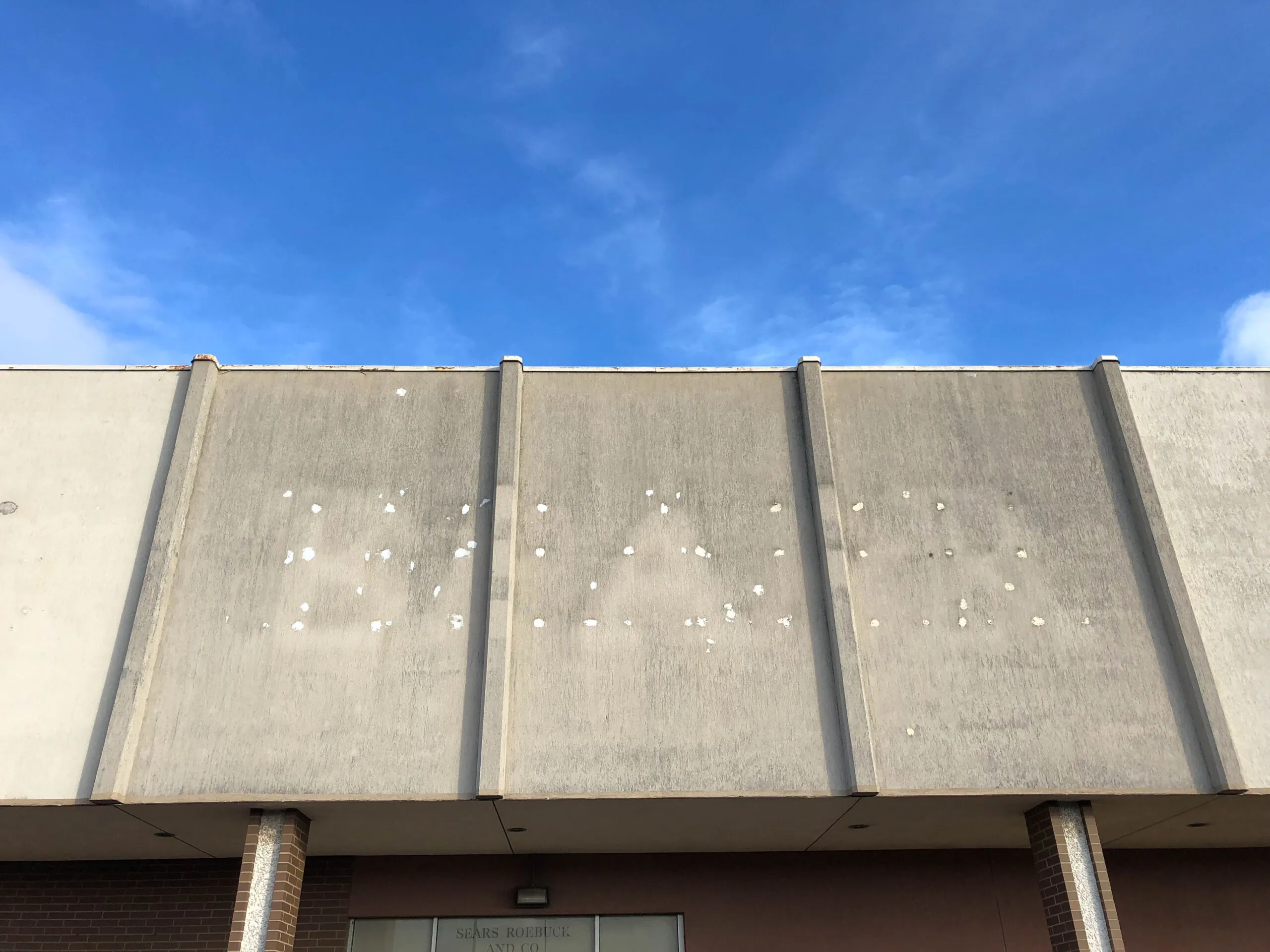
I visited Elkhart in 2018, and on Christmas Eve, I drove out to Pierre Moran Mall Woodland Crossing. It was cold as hell out, maybe in the teens. I parked my car in front of the Sears, at the entrance where I used to go with my parents to get my Garanimals and Toughskin jeans. The Sears closed the year before, going for over a decade in its decapitated state, before being killed off by Fast Eddie Lampert and his real-estate ponzi scheme gone wrong. Sears looked almost identical to the way it did in the Seventies. The labelscar above the door had both the faded remains of the old 70s logo and the newer 80s version.

IMG_8934

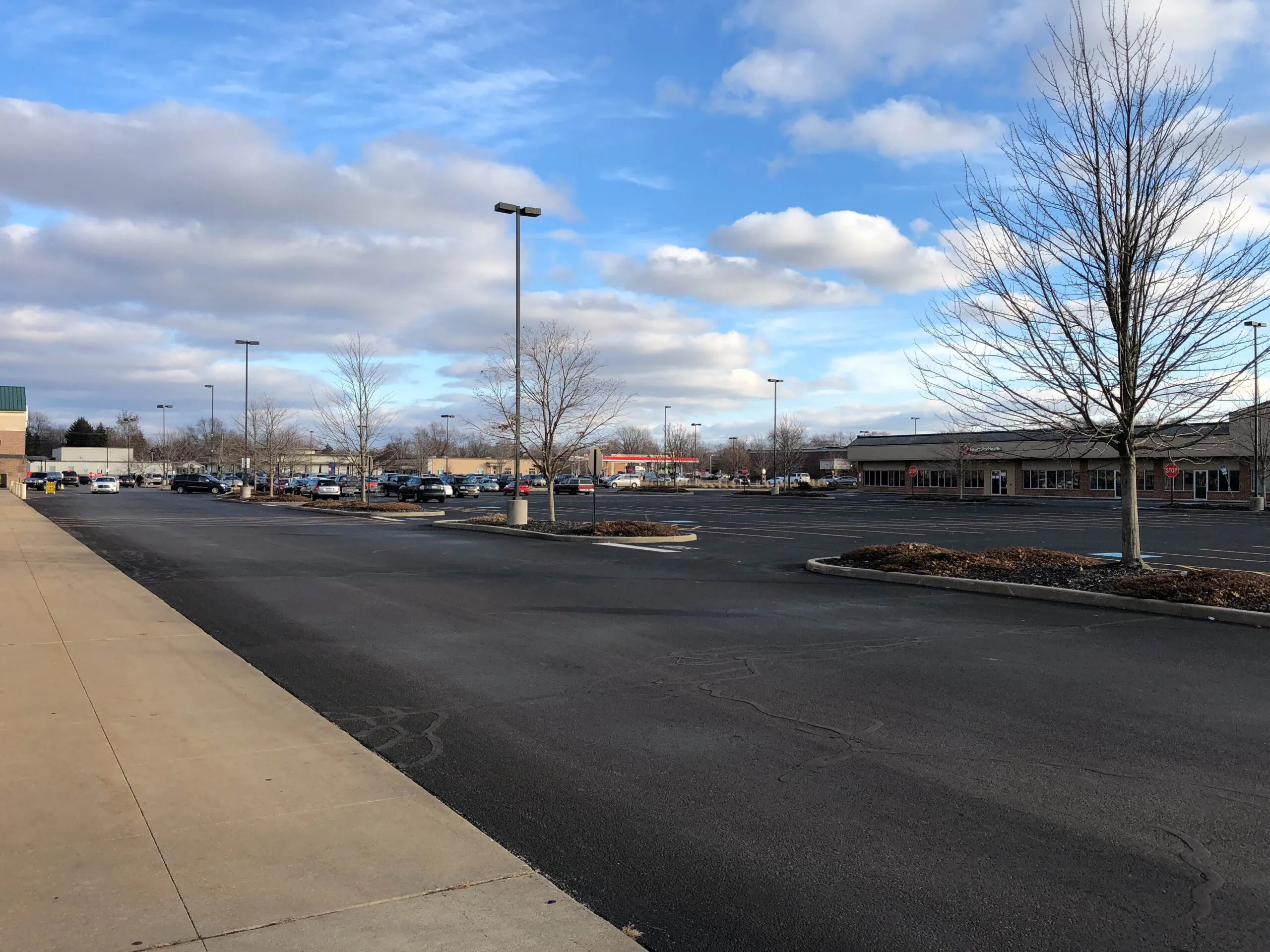
If you look at the photo above, that large chunk of asphalt is where the entire mall once was. I was standing with the Sears behind me, so this stretch of parking lot is where the entire concourse and interior stores once stood. I walked across the large parking lot, and tried to visualize where the mall used to connect to the Sears, how the distant space by the new gas pumps used to be Target. The row of old stores still stood in the same place. You can see the new strip of stores in this shot. There was a health clinic, and the rest were 100% vacant. The Long John Silver was closed. The Subway was gone. The weirdo empty Hollywood Video was frozen in time. I didn’t go in the new Kroger.

I did hop into the Big Lots. It was a typical Big Lots, full of weird liquidation merchandise, the place where you’d go to find Crystal Pepsi or brands of candy bars that were released for a week in an Ohio test market and then pulled. But the store still suspiciously looked like the old GL Perry, but with different merchandise. The windows were in the same places. The floor had the same worn Sixties linoleum on it. I could still imagine flipping through the row of records by the front registers, walking up and down the aisles by the toys, smelling the sweet chemical stench of Miracle-Gro contrasting the odor of 50-pound bags of Alpo stacked by the back door that was no longer there. I bought a drink for the road, then walked back to my rental car in the cold.

The desolation around the completely empty parking lot was surreal. A different kind of weird than walking around as a kid, but still bleak and dismal. I have a distinct memory, a fragment, of sitting in that Sears parking lot in 1987, playing an Anthrax tape for a fellow dishwasher named John, doing absolutely nothing but killing time. Then, the mall seemed like it was falling apart, a late 60s dream of friendly family shopping gone bad, but a place to do nothing. Now, it felt like a mid-00s version of the a similar dream, with a giant parking area carefully planned and sculpted with dividers, landscape islands, and token trees, designed for cars that never came.


I spent a lot of time scouring the web for any photos of Pierre Moran Mall while writing this, and there are few. It died at the perfect era for it to never be remembered, because it lived in a pre-web world, and the mall barely knocked a site together right before it died. This is true for a lot of malls of this pedigree. Newspaper searches are fruitless, as newspapers themselves die and lock off old archives behind paywalls. (The Elkhart Truth is useless for any research because of this.) These malls, and a large chunk of a cities’ history, will be completely forgotten in a decade.

What caught me is that the few photos I could find were all of community events. For example, go to wayback and check out this page. There’s a few shots of what looks like a birthday party, and a coin fair. I found a few other loose pictures showing a karate demonstration, a local history booth, a book signing for a local author. One of the only videos I could find was an Elvis impersonator putting on a performance in front of the Target in 1993.

My very first memory of this mall, probably from 1975 or so, was going to an indoor “sidewalk sale” with tables set up in the hallways, local flea market vendors selling their wares. That stuff was always going on at Pierre Moran: car shows, swap meets, Easter egg hunts, Humane Society adopt-a-pet events, indoor trick-or-treating, church fund-raiser bazaars. Regardless of how “bad” the neighborhood or the mall was, there was always this sense of community in the events held there.

De-malling a mall like this basically strips away that community, distills the mall into just a row of boxes where people go in, go out, and that’s it. I think my big takeaway is that these things are vanishing, and it further contributes to where we are right now.


One footnote I’ll add to this: there is a “donut effect” of migration, where people move outward from the core of a city, then move further out, abandoning the old ring of suburbs. But in some places, the young and hip will move back into the center of the city and save it. You see this in a lot of bigger Midwestern cities, in places like Chicago or Indianapolis. This hasn’t happened in Elkhart at all, but in neighboring Goshen, this transformation has completely taken place. Goshen is practically an arts district now, with a restored historic downtown full of antique shops, book stores, a newly-restored classic theater, even an old-school butcher shop and natural grocery. It’s strange and amazing that the Goshen that I remember as dismal in 1990 is now more Williamsburg than Indiana. They’ve reinstalled that sense of community. So maybe there is some hope.

COVAD-99

Ever since the COVID stuff started, I’ve had the term COVAD stuck in my head. There’s a reason for that. Let me explain.

So back in 1999, I moved to New York to freelance and write fiction and do that whole lifestyle, and it lasted about six months and I ended up at a full-time job at Juno Online that fall. Juno was that free email company, where they gave you a clunky Windows program and you got a free email address but had to look at ads in a little sidebar thing. When I got there, they also got into giving away a limited number of hours of free web browsing, or you could pay a little per month to get “unlimited” use.

At that point in time, 99.99% of internet users connected through a dial-up modem. Some dorms and campuses had ethernet; some offices, too. You could also pay a ton of money to get an ISDN connection at a screaming 128Kbps. Like most people, I used a 56K modem, which wasn’t blazing fast, but my first modem ever was 300bps, and I spent a few years of college on a 2400bps, so it didn’t seem that horrible. The busy signals were, though.

One of the first things I worked on at Juno was a new product called Juno Express. This was a Juno unlimited connection, but also included a broadband connection. Juno experimented with every type of broadband technology coming out at the turn of the century. We did trials with cable modems, satellite, microwave, various radio technologies, and something that ran through power lines to the home. But the one that stuck was DSL. And our DSL partner was called Covad Communications.

Prior to the late 90s, the only real way into a person’s house from a communication standpoint was the voice line. Modems worked by connecting to the voice line and converting digital communication into an audio signal, that screeching sound you heard when you connected a modem to the internet, if you were old enough to remember using a modem. That worked, but only up to a certain point, because of the inefficiency of cramming a wide digital signal over a relatively narrow pipe.

The Telecommunications Act of 1996 changed this. Among the other things they deregulated, they made it so that an Incumbent Local Exchange Carrier (ILEC) - the big phone companies like Bell Atlantic or Ameritech - had to allow any company the ability to share the local-loop access of the pieces of copper that tied a home to a telephone exchange. That meant a company like Covad could lease these lines and run their own digital internet service directly to your home.

Of course, the big phone companies didn’t make this easy. They dragged their feet and instituted byzantine processes for partners and did as much as possible to discourage this forced competition. Part of what made my documentation of Juno Express so messy was the complicated dance of getting the customer’s phone company and someone from Covad to both work with each other to get everything connected. Companies like Verizon weren’t going to just hand keys to Covad and say “knock yourself out.” Getting appointments was tedious, and sometimes they just wouldn’t show up, so you had to reschedule the following Covad appointment. It would take weeks and sometimes months to turn on a connection.

Once you got all of this sorted, you ended up with a DSL box in your house that had a 10 base T ethernet connection at about 768Kbps. But it was on 24 hours a day. No busy signals! And over ten times faster than a modem. Yes, my current connection is usually about 600Mbps, but just under 1Mbps was so insanely fast at that time. And not having to wait an hour to get past the busy signal at peak hours was a huge plus.

I seldom worked with anyone from Covad. But they had a sales rep who, when he was in New York, was always good for a high-end lunch. I remember getting a three-hour, all-expenses paid steak dinner for lunch at Sparks Steak House once. I think we spent thirty seconds discussing business, and it was “how’s business?/not bad/let’s get more drinks.” Other than that and the usual swag that showed up (I’m sure I had Covad mouse pads galore at the time, maybe a stress ball or some pens, too) I seldom had direct interaction with them, just deciphering their emails and adding to the docs.

When I moved into my own place in Astoria in 1999, I got DSL right after I got my keys, but I didn’t use Juno. Covad also got hooked up with Speakeasy, who I still had accounts with from my Seattle days. Speakeasy started as an internet cafe in Belltown, and I got a shell account there when I got to Seattle. For five bucks a month, I got an account on a SparcStation, the address jkonrath@speakeasy.org, and a few megs of web space. I kept that account for like ten years, but when I got to New York, they were doing dial-up access nationwide, which I used, until I got the DSL hookup. I later moved from the leased-line DSL, which used the second set of copper in my walls, to a shared-line setup, which ran on the same pair as my voice line, using DSL filters. I think that was maybe a 3Mbps connection.

I left Juno in the summer of 2001, right as they got bought by NetZero. I kept using Speakeasy/Covad until maybe 2005 when I moved in with Sarah. Oddly enough, Covad and Speakeasy were acquired and mashed together with MegaPath in a three-way merger in 2010. The Speakeasy cafe burned down in 2001. And now when you search on Covad, Google suggests Covid. So I’m not the only one confusing the two.

Death of a Mall Intersection

5b68dd9610f6b.image_

This is an oddly specific bit of nostalgia, and I’m not sure it matters that much unless you lived right by the Concord Mall in Elkhart, Indiana. But I’m going to babble about it anyway.

[Note: I wrote this post a year and a half ago and never finished it. So, this is even more stupid and trivial now that I’ve gotten around to finishing it.]

So the Elkhart County Commissioners picked a plan to build a railroad overpass in Dunlap, the part of Elkhart by the mall, where I grew up. And while I would have loved the idea of a way to cross the busy train tracks back when I lived there, the plan does cause a lot of change that opens up some odd nostalgia, the kind I get when an old haunt is torn down.

Some background first. There’s a stretch of railway corridor that runs roughly following US-33, from Elkhart to Goshen and further south. A large rail yard, once the biggest one in the country, is northeast of this area, and the result is long trains. A lot of long trains. There were routinely cargo trains of a hundred or two hundred cars rolling through town, multiple times a day. And there were no overpasses or underpasses, unless you drove all the way downtown in Elkhart, or I think there was one out in Goshen. You’d routinely get stuck waiting on a train almost every day, or you’d do the maneuver where you’d drive on a parallel road as fast as you can and try to outrace the train, getting to the next gate down while it was still open. Or you’d go around the gates, and either get a huge ticket, or get killed. (This happened often, especially when it was icy out.) It was bad enough that there were places in the area where two fire stations were built on either side of the tracks, because if there was a Conrail going through, your house would burn down before the trucks got there.

So there’s always been a need for a viaduct or overpass. And they did build two since I left (Prairie Street and Indiana Ave) which I never cared about, since I didn’t live in Elkhart anymore, didn’t pay for them, and both were further north than my old neighborhood. But as I read the plans for the new construction in Dunlap, it was oddly disconcerting to me, what major surgery would happen in my old neighborhood.

The details, which I don’t expect any of you to understand unless you lived there:

  1. An overpass is built where Concord Mall Drive/Sunnyside Road crosses US-33. It goes over the creek, US-33, the railroad tracks, and CR-45. The raised section starts roughly in front of the Chase Bank that is next to what used to be Martin’s Supermarket, and comes back down on Sunnyside, right before Kendall Street.
  2. A little stub of the overpass on the north side goes back down to a new bridge over Yellow Creek and meets US-33. Both sides of this get a traffic light. This stub takes out the little bank building by the mall entrance. (I think it’s vacant now.)
  3. The rest of Concord Mall Drive is removed, including its bridge over Yellow Creek.
  4. Center Drive (the little side street next to Martin’s) dead-ends into a cul-de-sac next to Chase Bank.
  5. Concord Mall Drive and Mishawaka Rd get an improved signal.
  6. On the other side of the tracks, Kendall and Amy Street, which cross Sunnyside, will be blocked off into cul-de-sacs on either side.
  7. Helen Street, which also crosses Sunnyside, will get a slight trim and connect with the last little bit of Sunnyside, leading to CR-45.
  8. Sunnyside and CR-13 gets a traffic light.
  9. The Sunnyside railroad signal is removed (duh.)
  10. The weird part - the railroad crossing at CR13 is removed.
  11. The south side of CR-13 gets a cul-de-sac before the tracks. The north side gets a slight alignment improvement with CR-45.

There’s a lot of weird things that happen because of this.

  • My walk from my old house to the mall would either radically change or be impossible. It’s hard to think of that, because I did the walk so many times as a kid, either to the mall or to school. And if the overpass does not have a pedestrian lane (which it probably won’t — this is Indiana) then it would be impossible to get across the tracks, without walking probably an extra two miles, either north or south.
  • The Sunnyside neighborhood would be radically changed. It splits it in half, and the plan would remove a number of houses. This is a neighborhood that was destroyed in the Palm Sunday tornadoes — there’s a good picture of LBJ visiting, inspecting the remains, pretty much at the exact spot where the overpass grade would start. This area was rebuilt after that, but before River Manor (my old subdivision) went in, with its largely identical, more modern ranches and tri-levels.
  • Fun fact, maybe: I can’t tell which houses will be torn down, but I think one of them was a house that was moved there in the late 80s when the US-20 bypass was built and a swath of land was eminent domained crossing CR-13 just north of this area. (If you look at the map, there are two Rivercrest Drives on either side of US-20 - those used to be one street,)
  • The light at Sunnyside will be nice - I always remember getting stuck trying to make a left turn onto CR-13, and traffic would back up after school or events.
  • All of this would be happening to basically bridge the mall with the other side of the tracks, which is ironic given that Concord Mall is all but dead at this point, as are almost all of the businesses surrounding it.

Anyway, this is all some fairly obscure trivia, and I don’t really know why I’m writing about it. If you grew up near the area, you might find it news, especially since the local newspaper is now impossible to read online, and only publishes high school football scores.

Neil

When I was a kid, I was a fan of pop music, mostly because of the insular community where I grew up. We had one pop FM station out of Notre Dame University, which wasn’t a “college rock” station, but played the standard hits. (There were two stations if you had a really good antenna and could pick up WAOR out of Michigan.) When I got my own stereo and started taping things off the radio and buying 45 records, it was all top 40 music. The early eighties wasn’t a bad time for this, hence the “hey, remember the 80s” nostalgia that has pretty much become a genre. I spent a lot of time listening to bands like Men at Work, The Police, Def Leppard, Van Halen, Journey, and whatever else crossed the airwaves. I didn’t have any specific favorites, but I prided myself in being able to identify whatever songs popped up on this AOR FM station, or this brand new thing called MTV.

When I was about 14, I started hanging out with this guy Derik who lived nearby. He had an older brother who was a drummer, and while he was in the Air Force, Derik had also become an accomplished drummer. We were into a lot of the same music, but he also knew of a lot of other bands from his brother Keith, things that were either slightly older, or weren’t in heavy rotation on WNDU. Derik played along on these albums with his drum set, and I started to get enticed by the weirdness and heaviness of it all.

One of the bands was called Rush, this weird little trio of Canadians that sang about wizards and talking trees and nuclear war and had impossibly complicated songs that sometimes spanned an entire album. They also had like a dozen albums at that point, and wouldn’t stop putting out more. I didn’t really know where to jump in on this, so Derik dubbed up a C-90 for me with two of their albums: Moving Pictures and Grace Under Pressure.

That summer, the one between junior high and high school, was like Rush summer for me. I memorized that tape. I was amazed by the complexity and virtuosity of it all. For a kid who was obsessed with computers and Dungeons and Dragons and was a social outcast, this stuff scratched a serious itch for me, and I scraped together every penny I could to buy more of their tapes, and begged Derik to dub copies of more of their albums. In those pre-employment, pre-social life days of summer, I listened to the stuff constantly.

Rush was also almost like a secret club to me. Other than Derik, I don’t know anyone who was a big fan. They never played the music on the radio. Even though MTV only had like twenty videos in rotation, they did have maybe two Rush videos, but they never, ever played them. Cyndi Lauper and Michael Jackson were on every hour, but that one Rush video for the song “Countdown” about the Space Shuttle only came on like twice all summer. The people who did know about Rush were the record store cashiers. When I’d go in with my hard-earned ten bucks of lawn-mowing money and approach the register with a copy of Caress of Steel, the long-haired dude at the till would give me a nod, like “yeah, this kid knows what’s up.” Never mind that my mom thought they were Satanic, and everyone else at school was obsessed with Johnny Cougar or whatever. To this narrow audience of people who were the gatekeepers of cool (and who could tolerate Geddy Lee’s singing), I was part of that club.

I don’t know how I pulled this off, but I somehow convinced my parents at that time that it would be a good idea for me to spend an entire summer of babysitting wages to buy Derik’s old drum set. Derik now had a “real” drum set and sold me this mish-mash of various Sears and Ludwig student-level drums with rusty hardware and tarnished cymbals. I quickly learned I have absolutely no rhythm or musical skill whatsoever, and that experiment lasted about a year, until I sold the kit and bought a ten-speed with the proceeds. But trying to learn drums made me listen to the music much more, made me separate the parts and focus on the rhythm and the parts of songs. Before I listened to Rush, music was just something that started when I pressed a play button or turned on a radio. But after examining it, I learned the roles of the drums, could tell the difference between the bass and the guitar, and could appreciate the skill level between something like “My Sharona” and “Tom Sawyer.”

Another thing that Rush did was serve as a gateway to an entirely different foundation of music for me. I read every interview or magazine article I could find about them (there were very few) and I went back to try to find every influence of theirs. So through Rush, I discovered Led Zeppelin, Jimi Hendrix, and Cream. Then I tried to research all of Rush’s prog-rock peers (although they are peerless) and discovered Yes, Genesis, Saga, and Triumph. Each of those bands led to other bands. There was a strong teenaged urge to chase that high, to find things more and more extreme. There wasn’t much more complicated than Rush at that time (although later, this lead to Dream Theater, and guitar virtuosos like Satriani, Vai, Malmsteen, etc.) So I fell down the wormhole of finding things more heavy, more loud, and more extreme, which led to Metallica, then thrash metal, then death metal, and so on.

And I’ve told the story before but my first concert was Rush, on the Hold Your Fire tour. Me and Derik went, and it was mind-blowing to see the band a few hundred feet away, but also to be in an arena full of people who geeked out to the same kind of music, the stuff nobody in my small town seemed to appreciate. It was like the first Star Trek convention for a lifelong Trek fan. It showed me there was much more out there in the world of music, and life was much bigger than what was going on in rural Indiana.

Anyway, I got to college, and my relationship with Rush “normalized” a bit. I was into so many other bands, and I guess it just fell out of style a little bit, just like D&D and model airplanes and video games. It was uncool to be into Rush, especially after their late 80s synth-dominated albums, and after “college rock” became “alternative” and Nirvana exploded, and anything related to metal was tragically uncool with the mainstream. The cold war was over, and instead of worrying about Reaganomics and tribalism, Generation X became the me generation, and we were all supposed to worry about ourselves, our Prozac, our go-nowhere futures. (Ugh.)

My interest in Rush waxed and waned, because they still put out an album every year or two. A new one would drop, and I’d buy Roll the Bones or whatever, and think “eh,” but still end up spending a week rolling 2112 and Moving Pictures again, before I moved on to Queensrÿche or Morbid Angel or whatever the hell I was into at that point.

Anyway, as far as my personal relationship to the members, guitarist Alex Lifeson was a non-entity to me. No offense to him, but he wasn’t the spokesman, and he didn’t sing, and on those late 80s albums, he damn near didn’t even play guitar. Geddy Lee was the frontman, and because he sang, in my head, it was he who communicated the lyrics to me. He’s also a hell of a bassist, and does that and keyboards at the same time. But the singing was, well, a bit of an acquired taste, and although he seemed like a cool guy and all, he wasn’t who I really related to.

But, Neil. Like I said, I tried to play the drums, and I had that connection. I knew how hard it was to do something like “YYZ” or his marathon drum solos. (Or the song “Marathon”… Jesus Christ, all that weird off-meter stuff - I had no idea how a human being can remember all of that in order, let alone perform it.) And he was indirectly, through Derik’s playing and obsession, the reason I got pulled into all of this. Neil was also the lyricist, the person who actually wrote the words that Geddy sang. So he was the one reading Tolkein and Jack London books on the tour bus, like I did in study hall, except he distilled them into songs instead of Dungeons and Dragons campaigns. Neil was the quiet, intelligent guy in the band, and that is why I identified with him.

Later, in the Nineties, Peart started writing books. He had a book called The Masked Rider, which was a travel journal of his bicycling adventures in Africa. This was particularly resonant to me, because I spent a long period in high school cycling everywhere, doing every 25K race I could find in northern Indiana, even doing a 100K race once. And every day after school for a year of so, when I first got that ten-speed in exchange for the drum set, I would ride twenty miles in the cornfields of Elkhart county, usually listening to a Rush album. So when I read this book, it felt as if he was speaking directly to me in some way.

Neil had a series of tragedies in his life in the late Nineties. First, his nineteen-year-old daughter was killed in a car accident. Then, ten months later, his wife died of lung cancer. After this, he pretty much called everything quits, and took off on his touring motorcycle, on a crazy multi-year trip that wound across the continent from end to end both ways. After recovering, remarrying, and rejoining the band, he wrote a book about this journey called Ghost Rider. This book is absolutely essential reading for people into travel and road trips.

One of the most striking coincidences as I read this is that he was crossing the US at the same time as I was. In 1999, I went on this two-week ramble from West to East, driving everywhere and seeing everything I could. I very distinctly remember an afternoon in remote Utah, sitting on the bench seat of this giant sedan I’d rented, everything I owned in the back seat and trunk, flipping through disc after disc in my collection, going on a twelve-hour jag of listening to old Rush albums in the middle of nowhere. It’s strange for me to think he was out there at the same time.

Some Rush fans lock into it for life, go to every date on every tour, only listen to Rush, get custom license plates and tattoos and teach their kids and grandkids all the words to Moving Pictures and the whole thing. That wasn’t me; I moved on to other things, I guess. All of the albums, every note and word, were still locked into my head, though. And I would still go back to them, a guilty pleasure, a way to immediately teleport myself back to the summer of 1985. But Rush meant a lot to me. When I met a Rush fan, we’d trade our stories like two people who both came from the same small town, both fought in the same war, both knew the same people. It was and is still a big part of my life.

You probably already know where this is going. I heard the news today that Neil Peart died of brain cancer this week. He was 67, far too young. It’s hard to process this, because he was such an icon, yet such a close voice in my head from all those albums. He was the root of my musical tree, and an example of how to strive for perfection. Not only that, but he was the perfect example of doing what you want to do, doing what is you, even if it flies in the face of convention. Nobody was doing full-album conceptual science fiction songs, and he was penning these things in motel rooms while broke, facing a record company about to drop the band for dismal sales, touring the country in a car, and opening for Ted Nugent or whoever the hell would take them. He did what he did, and people learned to appreciate the genius behind it, instead of trying to follow whatever formula for success everyone else said to take.

Anyway. Fuck. I have no good way to end this, except to say I really appreciate everything Neil did in his lifetime. A legend.