The Wrath of Kon

Dispatches, thoughts, and miscellanea from writer Jon Konrath

Tag: nostalgia

RIP, Oderus

I woke up this morning and found the start of a flood of Facebook posts that I thought had to be a hoax, but they were true:  Dave Brockie, also known to many as Oderus Urungus of Gwar, had been found dead last night.  He was only 50.

I must have first heard about Gwar back in 1990 or 1991. I remember hanging out with Sid Sowder and Matt Reece over at their dorm room in Wright Quad, and them playing the Live from Antarctica videotape, while telling me the story of an infamous show in Indianapolis, where they played at an old Howard Johnson’s and completely destroyed their ballroom. They took on the role of the most extreme band in my head, this melding of Troma shock-horror movies and extreme metal, demonic costumes and fake blood. The lyrics were campy and meant to be offensive, and yet the music was nuanced and more sophisticated than most typical metal bands could belt out.

I didn’t really start listening to them until America Must Be Destroyed came out in 1992.  When I DJed at WQAX that summer, the station had it on CD, and I dubbed a copy and listened to it constantly.  The concept album told a story about censorship, blind patriotism, the gulf war, and predicted the dubya-ization of the country that would uncannily happen a decade later.  I loved the CD, and played the title track almost every week on my show.

I was never a loyal Gwar fan, and they were more of a thing I’d forget about and then fall into every few years, going down the rabbit hole and watching and rewatching the Phallus in Wonderland tape. But then five years would go by until I’d pick up another album.  The horror-metal category was always filled better for me by the band Haunted Garage, but they’d only released a single album on Metal Blade before completely vanishing from the scene.  (They’ve since reformed and have done local shows in LA, though.  Check them out over on Facebook.)

But Gwar still helped define that era for me, the early 90s.  I started listening to that album constantly when I was writing Summer Rain, and mentioned it a few times in there.  And one of the distinct memories I have of my cross-country trip in 1999 was this long and boring drive from St. Louis to Bloomington.  I had already listened to everything I owned 19 times in the last week or two of driving across the southwest, and was going through entire albums from this Summer Rain playlist, playing that game where you force yourself to not skip songs and go through the entire album from first to last track in order.  I was somewhere on I-70 and very clearly remember listening to “Rock N Roll Never Felt So Good” and thinking how amazing the authorship of the song was, how it wasn’t just some speed metal collection of noise, but had such a carefully crafted structure that showed a decent musical knowledge, even though the song was about fucking a 13-year-old quadriplegic with a piece of frozen shit.

John Sheppard just saw Gwar last year, which made me go back and buy their newest album, and we planned on going to see them again when they came back to the US for the next leg of their tour.  It was like a religious experience for him, and I really wanted to check it out, even if it involved flying to Alabama or something.  Unfortunately, that won’t happen, which really sucks.

Oh well.  I guess the lesson to be learned though is how you really need to chase down your creative extremes and beat them to the ground.  Gwar started out of a freaky group of artists who wanted to shock people and do weird out-of-this-world shit, and that’s exactly what they did.  They didn’t set out to win Grammies or sell albums, but instead decided to marry together extreme horror movies and the performance of loud music, and they did it balls-out for thirty years.  Given the choice of doing the ridiculous and pointless that you really want to do or doing the expected and formulaic, they chose the former, and it gave them unprecedented loyalty from their fan base.  There’s something to be said for that, and it’s something to keep in mind as I try to figure out what the hell I’m doing next.

Long live Oderus!  Antarctica will miss you.

Blast from the past: Morgenstern's

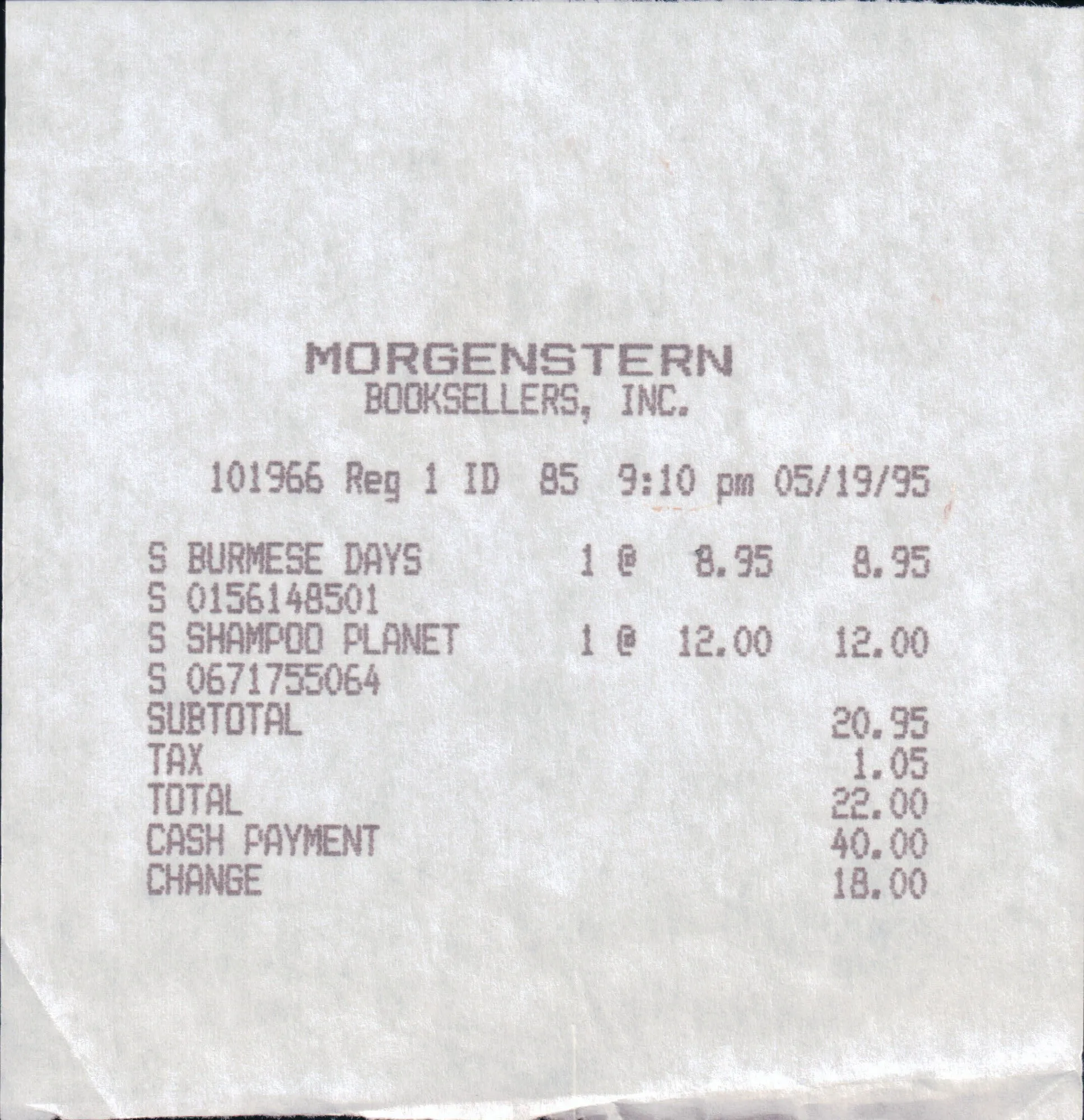
Here is a receipt I found recently:

EK_0001

Morgenstern’s was an interesting book store in Bloomington that came and went in the 90s, but was pretty central to my experience at IU.  I don’t remember exactly when they opened, but it must have been around 1991 or so.  There were no big box book stores then, aside from the Walden’s in the mall.  The town had no shortage of used book stores filled with old books dumped by students in need of ramen or beer money, and I spent many hours digging through them for anything interesting, but Morgenstern’s was where I went to score the latest new stuff.

I never read or collected that many books prior to becoming a writer, but I still went to Morgenstern’s to look at computer books.  They were the only place in town other than the IU bookstore with a solid collection of all of the latest O’Reilly stuff, so that’s where I went to ogle all of the C++ and Perl books.  They also had a full newsstand with a lot of obscure zines, so when the zine bubble was happening in the early 90s, that was the place to grab Factsheet 5 and all of the other rarities.

Once I did start writing, all of my obsessions came out of this place.  Between 1993 and 1995, I bought pretty much every Orwell book; every major Henry Miller title; almost all of the Vonnegut books in one quick swoop; and I bought my first Bukowski there.  I got going on Douglas Coupland and Henry Rollins, too.  They had a punch card system, where you got I think a punch for every ten bucks, and if you got ten or twelve punches, you got a free book, so any time I had spare cash, I’d walk out there and try to do as much damage as possible to those little pink cards and earn some freebies.

Morgenstern’s was in this strip mall just east of the main College Mall, a place that also held a laundromat, a Service Merchandise, and a couple of other stores.  There was a cheap Chinese place there (Grasshoppers, maybe?) and many times, I’d buy a couple of magazines, and then get some fake Sweet and Sour chicken and sit down to read.  They also had a Long John Silver’s, which served a similar purpose.  Morgenstern’s had its own big comfy leather chairs and coffee bar, so you could also crash out there and page through books, which was somewhat of a novelty at the time.

I vaguely remember this 1995 trip to the store, although I vividly remember the weekend.  My friend Larry Falli had graduated, skipped town, and left me his apartment for the rest of the month, as a place to write or crash or whatever.  I bought those two books on Friday night, and stayed up all night reading Shampoo Planet by Douglas Coupland, and liked it enough that I wanted to go get a copy of Generation X.  I went to bed right before daylight, woke up at lunch, and jumped in my car to go back to the mall and grab a copy, but a few blocks away, my car inexplicably died.  I had to get it towed to this auto place out by the mall, and it turns out the timing belt had snapped, and they had to keep it a day or so to put a new one on.  So I walked over to Morgenstern’s, got a copy of Generation X, then went to Larry’s unfurnished and vacant apartment, and sat on the floor of the living room with a bag of takeout from somewhere, reading the Coupland book and writing in a notebook.  I then walked the three miles back to my place and got started on the Orwell I’d bought the night before.

A month and change later, I flew out to Seattle, got a job, then flew back, packed up a U-Haul, and left Bloomington.  Not long after that, Borders put in a store right next to Morgenstern’s, and Barnes and Noble built a megastore just across the street.  And not long after that, Morgenstern’s was having their big everything must go sale.  And now the Borders is gone, and I’m sure the B&N does slow business selling lap desks, bookmarks, and the occasional 50 shades book.

I still find these receipts tucked into books, though.  And I’ve got a few titles on the shelves that still have their dot matrix-printed UPC stickers on the back corners.  I even have a punch card with two punches on it, which will never get filled.  It’s a bittersweet end to this old place.

Another story from another kind of book

I’m still editing this book. It’s going to take a while, and I hate this part of the process more than anything, because it’s not the process of creating, of writing hundreds and thousands of words, and it’s not the process of holding a finished book in your hands, so it’s painstaking. And I have all of these crazy ideas popping in my head that don’t fit within this book, for the next one or the one after, and it’s a beast to try and write those down and not forget them while I’m doing the equivalent of removing cat hair from a mohair sweater. But it’s getting there.

I have a 115,000-word manuscript that’s a complete train wreck, something that’s a book like Summer Rain but covers the entire six years I was in Bloomington. I’ve all but written off Summer Rain, partly because that’s not what I write anymore, and partly because there’s a certain pain to nostalgic autobiographical fiction that I like a bit too much to spend all of my time with it. In many senses, I think of Summer Rain as a failure, and use that to justify never going back to that kind of writing. But since the book went to Kindle, a couple of people have read it and said it really resonated with them, which makes me wonder if I was on to something.

Anyway, here is part of a story, or rather an experience, that I outlined and forgot. It’s not a story story, it’s just some loose thoughts.

I used to have a bus pass at IU, when I was a freshman. I guess now the buses at IU are free, but back then, you had to pay some obscene amount to get a little sticker on your ID so you could ride them. You could also pay a fraction of that for a nights and weekends pass, which is what I did. I didn’t have a car, so I’d take the bus out to College Mall all the time. It was a huge pain in the ass, but it beat walking.

I had a really good friend, V, this girl who was also on the computer all the time, and even though she was only about a year older than me, we had this almost big sister/little brother relationship, and she’d always listen to me pule about my various relationship problems. She wanted to be a shrink, and I was crazy, so this dynamic worked well, and we traded emails pretty much daily.

I used to call her dorm a lot, and she’d never be there, because computers cost more than cars, and nobody had them, so you’d go camp out in a computer cluster to get your fix. And I used to leave messages so much with her roommate L that we started chatting, asking each other about our days, and that led to conversations, and that led to me calling L just to talk to her, and not V. We’d have these marathon phone sessions, even though we never met in person, maybe because we never met in person. In these strange, protracted, intimate, three or four hour long confessionals, we talked about love and sex and partners and life and fears and hopes. And we’d flirt, and joke around, but it never became a “hey, let’s go grab a drink” or “let’s put a name to a face” - there was never an attempt at conversion, in crossing over to the other side. And we did have these insane talks about sex every once in a while, at two in the morning, where she’d confess that she could have twenty-minute orgasms or I’d talk about how I was certain my English teacher was trying to fuck me. But it was all in this strange meta-platonic phase, where we were more than friends, but never attempting to become more than friends.

I always say I never seriously became a writer until 1993, but there were fits and spurts where I’d try to knock out a short story, or I’d do something for a class, and I’d want to get serious about it. And I took the freshman writing class that first semester, and read a lot of Vonnegut, and I was an insomniac, so I’d bang out these depressing science fiction stories, and email them to her, and she’d be incredibly interested in them. And I still have some of them, and they really suck, so who knows what she was smoking. But if you want to be a writer and you show someone a story you can’t even show your girlfriend or best friend and they completely swoon over it and ask you questions about it and are genuinely impressed by it, that’s like the biggest thing they could possibly do to push a latent infatuation over the edge.

I eventually met L, ran into her at a computer lab with V, just a quick hi/hello/good to see you. She was far more beautiful than I expected. It put me in this awkward situation because she confided in me, and we talked almost every day about incredibly intimate things, but that safe place was possible because of the physical disconnect. Now we knew what we looked like, and I found her absolutely stunning, and I couldn’t really do anything about it. And I would normally email with V about these things, but this was the one person I couldn’t talk to her about. (And I was in a relationship, albeit a bad one. And L had a boyfriend too, although he was a jerk and treated her like shit, of course.)

My brain was stuck in this lurch, but I never admitted it, because I think I depended on L so much to get through that year. We would email or chat online pretty much all day every day: good mornings, good nights, the day’s frustrations, the problems with partners. I could tell her things I could not tell my girlfriend or best friends, and she was the same. We kept this line we would never cross, but it many ways, we went way past the line. It was all so comforting and supportive and wonderful, but it was also something I always feared would suddenly end when she found out how I really felt about her, or I did something stupid, or she somehow found out how much of an idiot I really was.

Anyway, the bus. I went to College Mall one night, a Friday night right before the holiday break started, when me the loser had nothing to do but go to the mall and buy Christmas candy. I went to wait for the bus, which only showed up every half hour or so, and the one person also waiting out there in the dark and cold was L. Even though our couple of in-person meetings prior to this consisted of a few dozen words while we sat at computers, we had a long time to talk, waiting for the goddamn bus to show up, and it ended up becoming another one of those long brain dumps, where we both bitched about the problems with our respective partners. I’d had a hellish Thanksgiving with my then-girlfriend, and seriously wanted to break things off with her, but instead I either invited her or got talked into inviting her to spend a week at my mom’s, which I dreaded even more than the prospect of spending the holidays at home. L had some similar turmoil going on, and we talked about that. It was back to our old pattern though, the deep dive through emotions, which felt strange while we were sitting right next to each other, but was just as immersive and familiar as when we used to do it in the middle of the night over the phone.

The bus came, and we got on board, grateful for the warmth, but because of the weird bus route, it had to go out away from the mall and then sit for 15 minutes behind the Kroger grocery while the driver took a break, before it started the loop again and went back to campus. I shared my Christmas candy with her, and we talked more, flirted, but mostly just enjoyed the time sitting next to each other, alone on this giant GMC bus. When you spend that much time in a relationship with someone, even this accelerated, half-friends half-whatever relationship, you develop your own shorthand and inside jokes and patterns and ways of speech, and we had so much of that. We could finish each others’ sentences, and had a kind of intimacy that I didn’t have in my “real” relationship. It was like some Meg Ryan movie, like I was the Billy Crystal, like we were the just friends that were so much more, and at the end of Act 3, she’d meet me at the top of the Empire State Building and we’d have the happily ever after.

That never happened, of course. V went to Germany the next year, or maybe it was Austria, and when she came back, it was a lifetime later, five or six iterations of the college friendship cycle, and we only talked one or two times since. I don’t know when or how I lost touch with L, but I did. This was 1990, and people didn’t check their email over the summer unless they were really wired in and their parents had computers with modems, which was pretty much nobody in my circle.  We could have written letters, or made long-distance phone calls, but we didn’t.  And in college, sometimes you are closer to a person than you have been with anyone in your entire life, and then six months later, they’re yet another stranger among the 40,000 other strangers on that big ten campus, and you’re dumping your heart out to someone completely different.

In the fiction story version of the tale, something would have happened.  Our hands would have touched, met, joined, and we would have known what had to happen next.  Something illicit and unsaid would transpire after that bus ride, a quiet walk back to a dorm room where a roommate was out of town for the weekend, no exchange of words, a torrid exchange of pent-up energy in the darkness. And even if the happily ever after didn’t happen, there would be a long night where our real lives didn’t matter, even if would end with the heartbreak of her going back to her stupid boyfriend and me dealing with the girl I’d end up dumping a few months later.

In reality, I saw L maybe three years later. I was in the back of my favorite record store, and saw her enter. She looked completely spent, different than the innocence mixed with sophistication of what I remembered, beaten by life and dreams unfulfilled. She was in the middle of a fight with some beardo guy, a boyfriend who followed her around like a trained lap dog, apologizing profusely for everything and nothing while she hurled insults and complained about the imaginary. I didn’t talk to her; I didn’t even want to acknowledge that it was her, for fear it would kill that perfect memory of what we had and didn’t have before.

And that was twenty years ago. All of those emails with V are lost; all of the memories of L are slowly fading from my brain. The record store is gone, the owner dead. I’m here, thousands of miles removed. And I’m writing this crazy book about a bizarre reality that’s a laugh a minute, and exactly what I want to write, but thinking about these distant episodes and revisiting them in my head makes me wonder not only what could have been, but what could end up being another story in another book that I might or might not someday finish.

The Economics and Practicalities of Lofts

I live in a loft.  This isn’t about that.  (Maybe the coincidence somehow means it is, though.)

I was playing this game yesterday, where I tried to write every single event I could remember about a person from twenty years ago, every time I could remember us hanging out together, to try and brainstorm past just the stock two or three or five things I always remembered about them.  I’m trying not to fall down the endless nostalgia k-holes that make me want to write books about what happened back at college, because we all know how well that worked out the last time I wrote a 600-page book about college and tried to get people to read it.  But sometimes I need to write something, just to type, and this is a way to do it.

During this exercise, I remembered a strange little concept I’d almost completely forgotten: the loft.

When I lived in the dorms in Bloomington, you got two beds per double room.  They were these tiny twin beds, with a metal spring frame that hung between two wooden headboard/footboard pieces.  But when you had two people living in a single room, that meant floor space was at a premium, and the solution was to go vertical.  You could loft a bed by replacing the headboard/footboard pieces with taller frames that had pre-mounted brackets that would accept the pins on the spring, and raise the whole thing from the normal height of about a foot to somewhere around five feet off the ground.

Lofts were not included in room and board charged for the dorms.  You could probably buy a loft, maybe from someone graduating, but it seemed like a crap investment to make, especially since most people only lived in the dorms for a year.  And unless your dad was Bob Vila, you probably weren’t building one of these contraptions on your own.  This need was met by a whole network of loft rental companies.  I don’t remember the exact prices or vendors, but I seem to remember the White Rabbit book store renting lofts, plus there were lots of flyers posted on phone poles from outfits of more questionable repute offering to shave ten or twenty bucks off of the prices of the more legit renters.

A common layout was to have one bed lofted, and the other bed halfway under the other one, in an L formation.  That left half of the under-bed area free for dressers, a mini-fridge, or a beanbag chair or other odd furniture.  My first roommate bought his own loft from — I was going to say craigslist, but this was a decade before craigslist, so maybe it was one of those bulletin boards at a grocery store or in the student union.  Maybe it belonged to his brother.  I don’t know.  All I know is I didn’t want my bed half under his loft, because I didn’t want him drunkenly falling into my bed, and I also had a semi-legitimate fear that the whole operation would scissor over onto itself and collapse, killing me.  Maybe that was just an urban legend, like the guy who killed himself and the roommate getting all As.  I also remember hearing similar tales about people drunkenly falling from their lofts and cracking their head open, but that could also be Rod Stewart/stomach pump territory.

I remember there always being a weird politic, especially with females, about who got the top bed and who got the bottom bed.  As a guy, my bed was my bed, and I’d never think about swapping beds with my roommate, especially with all of the various microscopic bugs and jizz and everything else probably inhabiting a mattress after a few months.  But I knew a few women who had a system where they would swap top and bottom bunks every month or every other week.

I don’t remember how many people lived in the dorms at IU, but it must have been in the low five figures.  When I started there in 1989, I think the total grad and undergrad population was something insane like 38,000, and there were too many people for the dorms, so RHS turned a bunch of common lounges into dorm rooms until people quit or transferred or died and they could relocate them into real rooms.  And it seemed like almost everyone had a loft, and most of those were rented.  At the beginning of the school year, you’d see these huge U-Haul trucks double-parked at every dorm, these 38-foot long monstrosities, completely filled with these giant H-shaped braces made from 4x4 lumber, along with crews of handymen hustling the heavy pieces into the dorms.  It’s strange to think of this whole economy centered around what was essentially a half-dozen pieces of dimensional lumber and a quartet of metal brackets.

The other thing, which I remembered during this free-write, was that there was always this clusterfuck during the last couple of weeks of class, because the loft rental companies had to come and pick up all of the lofts before the end of the semester, which meant you had a week or two, usually during the mad dash to study finals and finish the school year, where you had to revert the room layout to the default two-on-the-floor bed situation.  In 1993, I was dating this freshperson over at Forest, and when her roommate was up in the top bunk, we could sit in the bottom bed at night and not really disturb her.  But in that last week, when the two beds were right next to each other, that shit would not fly.

Did other schools have this same situation?  Do they still do this?  I haven’t thought about it, and wasn’t sure if I went back to a dorm in 2013 if I’d still see the same pieces of lumber that were knocking around the halls of residence in 1989, or if there’s some new, modern, brushed aluminum, iPhone-related invention I don’t even know about that’s used to elevate beds.

Automated board loading machinery

I spent a good chunk of the summer of 1993 trying to find a job.  I returned back to Elkhart for the summer, because even though that summer of 1992 in Bloomington was life-changing and ended up becoming my first book, I made absolutely no money selling glowsticks and telemarketing.  I needed real work, factory work, the kind of thing that would pay me more than minimum wage in exchange for spending three months operating a punch press or doing the same thing over and over, thousands of times a night.

I went to Manpower, the temp agency, with some hope of finding anything even vaguely computer-related, like changing backup tapes or reinstalling DOS programs or beating dot-matrix printers with a wrench.  But this was 1993, and there weren’t a lot of computers in factories.  And most of the places that did have them would farm out the maintenance and support through their home office, so some guys working at what was then called Anderson Consulting would drive out of the Chicago corporate office when an IBM mainframe went south, and bill all the hours back to the account.  I had a girlfriend who once spent a summer working for Manpower, loaned out to Miles Pharmaceutical doing mindless Lotus 1-2-3 stuff.  She only made a buck or two above minimum wage, and the work was mindless and air-conditioned.  I knew just as much about WordPerfect and Lotus - I’d worked as a computer consultant for the university for two years at this point.  But if you went to Manpower and you had a vagina and you knew how to read, they gave you the typing test and put you in the virtual secretary pool.  If you did not, they pulled out the manual labor listings and tried to slot you in at a factory somewhere.

The first day, they loaned me out to UPS, to help a guy do an inventory count of all of their repair parts for vehicles.  We went to the big Elkhart warehouse, which was just down the road from where Ray lived, and it seemed like it was only a year or two old at that time.  I don’t know where they used to be; I just remember a big empty field suddenly becoming a giant ugly UPS warehouse, built overnight from those prefab metal panels they used to construct every factory in Elkhart.  I don’t entirely remember the system we used for the inventory, although it certainly involved paper and not some kind of tabletized bar code reading beep-beep making Star Trek computer thing.  It was more like a clipboard full of tractor-feed paper forms, and the guy I worked with would say “1005734-slash-22-spec-4” and I would mark a box and say “check.”  This went on for hours, and I watched a bunch of guys in brown shorts dismember the contents of a large semi, throwing boxes onto conveyors, taking a big truck trailer and reformatting it into contents for dozens of smaller trucks.

Two observations that stuck with me: one, the backs of UPS trucks have clear ceilings.  They aren’t really clear as much as they’re transparent, like a see-through tinted plastic, that lets light through so they can see in the truck without lights.  It’s a sort of brown-green shade.  Two: those giant trucks are powered by four-cylinder engines.  Each cylinder is gigantic, coffee can-sized, but it’s not a V-8.  Someone must have done the math on the best engine to use for all of that stop-start traffic while hauling literal tons of boxes, and that’s what they got.

One of the mechanics was an old guy, an Ernest Borgnine from Airwolf looking dude, who spent the afternoon dismantling a huge four-banger, wrenching on it and carefully removing each part.  We stopped and ate lunch with him.  I told him I was into computers, and he produced a folded-up magazine ad for a 486-33DX computer, something from the back of Popular Mechanics or something.  It lauded that the machine came with dozens of software titles, a sound card, a microphone.  “You don’t even need to know how to program.  You can just talk to it,” he said.  Maybe it recorded voice memos, but this was twenty years pre-Siri.  “Well, you still need to…”  “No!  You just talk to it!”  I always wanted to see if he actually bought it and then did a “help computer” into the mic and got nothing but a DOS prompt.

That job lasted a day, and the inventory was over.  The next morning, they sent me to a factory in Middlebury, something with a vaguely generic name, like A&B Wood Works.  I was to report there at 6 AM.  I remember trying to go to bed at something like 8

the night before, which was completely stupid, since half the time I stayed up until four in the morning, and now I needed to wake up at four in the morning.  I didn’t have a car, and this place was maybe a half-hour away, so my Mom had to leave early and drive me there.  At the time, I was trying to avoid everyone in my family, so spending an hour a day in the car with my Mom wasn’t ideal.

At this factory, they painted the chipboard pieces that make up entertainment centers and bookshelves.  The whole factory was essentially a huge loop of a conveyor belts.  One guy would put a board on the belt, and it would go through a sprayer that laid down a coat of lacquer paint.  Then it would go through a drying station, which would cure the paint quickly with hot air.  Then it would get flipped, and go through a second time, and then it would get pulled and stacked.  You’d do a couple of stacks per pallet, a pallet every couple of hours, a few pallets a day, a few dozen pallets per semi truck, a few trucks per order, and then you’d change color or change lumber type and do it again.

Maybe four or five people ran the entire factory.  They worked every day, from 6 AM to 6 PM.  Almost every week, they would work five days a week, sometimes six or seven.  They paid time and a half for every hour past 40, and double time for every hour past 60.  I think the minimum wage at that time was $4.25, and Manpower paid me $6.60.  So the average minimum wage burger-slinger made $170 a week, and at Manpower, I’d make $264.  But if I stayed at this job, I’d make $396 a week, plus an extra $158.40 for each weekend day I worked.  That meant if they did work seven days a week, I’d make more than a week’s flipping-burgers pay over the course of a weekend in the factory.  How hard could this be?

Factory work is always mind-numbing, but this particular setup seemed worse than normal.  It took a fair amount of effort to pull boards off of the stack and slap them onto the conveyor.  That sounds easy, but it’s a full-body workout; it’s like slinging kettlebells around.  You have to spin and dip and pull and lift and heft and spin and drop, all with precision.  And you do the same movements over and over and over.  The same exact movements.  The chipboard pieces aren’t heavy, but moving them in the same exact way makes them seem heavy.  I worked without gloves; when I asked if they had any, someone answered “we stopped paying the supplier, so they stopped delivering more gloves.”  The work was continuous, and I had to constantly supply boards.  I could barely think, and all of my thinking power went to one simple equation: $6.60 an hour, times 40 hours, plus 20 hours times 1.5 times 6.60.

Different factories have a different rhythm.  The best way to break the routine is to talk to someone, work at a machine next to another guy, pack boxes with someone else, find some job that requires you to stop every 20 minutes and sweep the floor or go to the other side of the building and get more parts.  But this job eliminated all of this.  You simply fed in boards, flipped boards, pulled boards, as fast as you could, just to keep up.  The machines weren’t deafening, but you didn’t work with anyone, as the people running the painter and dryer were stuck at their stations, a hundred feet away from you.  A guy ran a fork truck, but he was constantly moving around pallets, hauling in new blank boards and packing away the finished pieces.  We did stop for 20 minutes to eat a quick lunch, but I barely got to say hello to the coworkers before we got back to it.

A few hours into the shift, one of the boards grabbed the palm of my hand, gouged out a chunk of flesh.  I bled from the hand, but didn’t notice it, because I had to fight to keep up with the line.  The guy on the paint machine noticed it though, because I was bleeding onto the boards.  We were doing a run of black parts - those matte black bookshelves were all the rage in the 90s, and the department stores were selling them as fast as we could paint them.  So the blood-stained boards just got covered with a jet black, leaving behind no trace of my injury, although someone out there’s got a bookcase containing some of my genetic material sealed within.  The fork truck driver took over my spot for a minute, told me to go throw a band-aid onto my hand and get back to work.  I found a half-pilfered first aid kit, got fixed up, and went back to it.

It had been dark when I started work.  By the time we left, all but two hours of the day had passed, and all I wanted to do was eat and go back to bed.  Although the idea of going back and working 60, 70 hours a week seemed tantalizing from a financial aspect, I couldn’t see doing the same thing every day for the rest of the summer.  I told my mom I couldn’t go back, would try to find another temp assignment, maybe another agency.

Even though I felt exhausted, I couldn’t sleep that night.  My hand hurt, but mostly I still felt my body twisting, picking up boards, putting them back down, flipping them, pulling them, stacking them.  I closed my eyes and only saw the conveyor in front of me, heard the paint machine spraying down coats of matte black.  The only way I could sleep was to put a death metal CD on my headphones, on repeat, on low volume, a constant sound of something familiar to break up the automated feeling of being a board-loading machine.  I drifted in and out of sleep, in twenty minute fits and spurts, then took a shower and headed out on my ten-speed to find another job.