The Wrath of Kon

Dispatches, thoughts, and miscellanea from writer Jon Konrath

Tag: nostalgia

Automated board loading machinery

I spent a good chunk of the summer of 1993 trying to find a job.  I returned back to Elkhart for the summer, because even though that summer of 1992 in Bloomington was life-changing and ended up becoming my first book, I made absolutely no money selling glowsticks and telemarketing.  I needed real work, factory work, the kind of thing that would pay me more than minimum wage in exchange for spending three months operating a punch press or doing the same thing over and over, thousands of times a night.

I went to Manpower, the temp agency, with some hope of finding anything even vaguely computer-related, like changing backup tapes or reinstalling DOS programs or beating dot-matrix printers with a wrench.  But this was 1993, and there weren’t a lot of computers in factories.  And most of the places that did have them would farm out the maintenance and support through their home office, so some guys working at what was then called Anderson Consulting would drive out of the Chicago corporate office when an IBM mainframe went south, and bill all the hours back to the account.  I had a girlfriend who once spent a summer working for Manpower, loaned out to Miles Pharmaceutical doing mindless Lotus 1-2-3 stuff.  She only made a buck or two above minimum wage, and the work was mindless and air-conditioned.  I knew just as much about WordPerfect and Lotus - I’d worked as a computer consultant for the university for two years at this point.  But if you went to Manpower and you had a vagina and you knew how to read, they gave you the typing test and put you in the virtual secretary pool.  If you did not, they pulled out the manual labor listings and tried to slot you in at a factory somewhere.

The first day, they loaned me out to UPS, to help a guy do an inventory count of all of their repair parts for vehicles.  We went to the big Elkhart warehouse, which was just down the road from where Ray lived, and it seemed like it was only a year or two old at that time.  I don’t know where they used to be; I just remember a big empty field suddenly becoming a giant ugly UPS warehouse, built overnight from those prefab metal panels they used to construct every factory in Elkhart.  I don’t entirely remember the system we used for the inventory, although it certainly involved paper and not some kind of tabletized bar code reading beep-beep making Star Trek computer thing.  It was more like a clipboard full of tractor-feed paper forms, and the guy I worked with would say “1005734-slash-22-spec-4” and I would mark a box and say “check.”  This went on for hours, and I watched a bunch of guys in brown shorts dismember the contents of a large semi, throwing boxes onto conveyors, taking a big truck trailer and reformatting it into contents for dozens of smaller trucks.

Two observations that stuck with me: one, the backs of UPS trucks have clear ceilings.  They aren’t really clear as much as they’re transparent, like a see-through tinted plastic, that lets light through so they can see in the truck without lights.  It’s a sort of brown-green shade.  Two: those giant trucks are powered by four-cylinder engines.  Each cylinder is gigantic, coffee can-sized, but it’s not a V-8.  Someone must have done the math on the best engine to use for all of that stop-start traffic while hauling literal tons of boxes, and that’s what they got.

One of the mechanics was an old guy, an Ernest Borgnine from Airwolf looking dude, who spent the afternoon dismantling a huge four-banger, wrenching on it and carefully removing each part.  We stopped and ate lunch with him.  I told him I was into computers, and he produced a folded-up magazine ad for a 486-33DX computer, something from the back of Popular Mechanics or something.  It lauded that the machine came with dozens of software titles, a sound card, a microphone.  “You don’t even need to know how to program.  You can just talk to it,” he said.  Maybe it recorded voice memos, but this was twenty years pre-Siri.  “Well, you still need to…”  “No!  You just talk to it!”  I always wanted to see if he actually bought it and then did a “help computer” into the mic and got nothing but a DOS prompt.

That job lasted a day, and the inventory was over.  The next morning, they sent me to a factory in Middlebury, something with a vaguely generic name, like A&B Wood Works.  I was to report there at 6 AM.  I remember trying to go to bed at something like 8:00 the night before, which was completely stupid, since half the time I stayed up until four in the morning, and now I needed to wake up at four in the morning.  I didn’t have a car, and this place was maybe a half-hour away, so my Mom had to leave early and drive me there.  At the time, I was trying to avoid everyone in my family, so spending an hour a day in the car with my Mom wasn’t ideal.

At this factory, they painted the chipboard pieces that make up entertainment centers and bookshelves.  The whole factory was essentially a huge loop of a conveyor belts.  One guy would put a board on the belt, and it would go through a sprayer that laid down a coat of lacquer paint.  Then it would go through a drying station, which would cure the paint quickly with hot air.  Then it would get flipped, and go through a second time, and then it would get pulled and stacked.  You’d do a couple of stacks per pallet, a pallet every couple of hours, a few pallets a day, a few dozen pallets per semi truck, a few trucks per order, and then you’d change color or change lumber type and do it again.

Maybe four or five people ran the entire factory.  They worked every day, from 6 AM to 6 PM.  Almost every week, they would work five days a week, sometimes six or seven.  They paid time and a half for every hour past 40, and double time for every hour past 60.  I think the minimum wage at that time was $4.25, and Manpower paid me $6.60.  So the average minimum wage burger-slinger made $170 a week, and at Manpower, I’d make $264.  But if I stayed at this job, I’d make $396 a week, plus an extra $158.40 for each weekend day I worked.  That meant if they did work seven days a week, I’d make more than a week’s flipping-burgers pay over the course of a weekend in the factory.  How hard could this be?

Factory work is always mind-numbing, but this particular setup seemed worse than normal.  It took a fair amount of effort to pull boards off of the stack and slap them onto the conveyor.  That sounds easy, but it’s a full-body workout; it’s like slinging kettlebells around.  You have to spin and dip and pull and lift and heft and spin and drop, all with precision.  And you do the same movements over and over and over.  The same exact movements.  The chipboard pieces aren’t heavy, but moving them in the same exact way makes them seem heavy.  I worked without gloves; when I asked if they had any, someone answered “we stopped paying the supplier, so they stopped delivering more gloves.”  The work was continuous, and I had to constantly supply boards.  I could barely think, and all of my thinking power went to one simple equation: $6.60 an hour, times 40 hours, plus 20 hours times 1.5 times 6.60.

Different factories have a different rhythm.  The best way to break the routine is to talk to someone, work at a machine next to another guy, pack boxes with someone else, find some job that requires you to stop every 20 minutes and sweep the floor or go to the other side of the building and get more parts.  But this job eliminated all of this.  You simply fed in boards, flipped boards, pulled boards, as fast as you could, just to keep up.  The machines weren’t deafening, but you didn’t work with anyone, as the people running the painter and dryer were stuck at their stations, a hundred feet away from you.  A guy ran a fork truck, but he was constantly moving around pallets, hauling in new blank boards and packing away the finished pieces.  We did stop for 20 minutes to eat a quick lunch, but I barely got to say hello to the coworkers before we got back to it.

A few hours into the shift, one of the boards grabbed the palm of my hand, gouged out a chunk of flesh.  I bled from the hand, but didn’t notice it, because I had to fight to keep up with the line.  The guy on the paint machine noticed it though, because I was bleeding onto the boards.  We were doing a run of black parts - those matte black bookshelves were all the rage in the 90s, and the department stores were selling them as fast as we could paint them.  So the blood-stained boards just got covered with a jet black, leaving behind no trace of my injury, although someone out there’s got a bookcase containing some of my genetic material sealed within.  The fork truck driver took over my spot for a minute, told me to go throw a band-aid onto my hand and get back to work.  I found a half-pilfered first aid kit, got fixed up, and went back to it.

It had been dark when I started work.  By the time we left, all but two hours of the day had passed, and all I wanted to do was eat and go back to bed.  Although the idea of going back and working 60, 70 hours a week seemed tantalizing from a financial aspect, I couldn’t see doing the same thing every day for the rest of the summer.  I told my mom I couldn’t go back, would try to find another temp assignment, maybe another agency.

Even though I felt exhausted, I couldn’t sleep that night.  My hand hurt, but mostly I still felt my body twisting, picking up boards, putting them back down, flipping them, pulling them, stacking them.  I closed my eyes and only saw the conveyor in front of me, heard the paint machine spraying down coats of matte black.  The only way I could sleep was to put a death metal CD on my headphones, on repeat, on low volume, a constant sound of something familiar to break up the automated feeling of being a board-loading machine.  I drifted in and out of sleep, in twenty minute fits and spurts, then took a shower and headed out on my ten-speed to find another job.
First Falafel

About ten years ago, I lived in New York: rented a shithole apartment in Astoria, took the N train in to Times Square every day, and worked three floors down from Puff Daddy at a soon-to-be-irrelevant dotcom. My life consisted of TPS reports, delays on the N train, and arguing with old ladies in three different languages at the local Key Food. I guess I wrote books too, but that involved more sitting at the computer wishing I could write than actual writing.

When the soot-black snow melted away that spring and I no longer needed to wear two jackets for my ten-block walk to the subway, I started developing this stabbing toe pain. It felt like I broke my big toe, but couldn’t remember actually doing anything like stepping on a mouse trap or slamming it in a car door or whatever else you do to break a toe. At least every other month, I’d have a stupid spaz moment while walking, hypnotized by whatever album spun in my MiniDisc player to cover the sounds of the city, and trip on a ten micron high difference in the pavement. Some cable company that just spent all of the previous summer jackhammering a trench at six every morning, dropping in new fiber, and poorly sealing over the pavement — well, they either forgot where the fiber was, or lost it in some wave of mergers and acquisitions and deregulation and re-regulation. They re-dissected the pavement and left even more opportunity for me to fall on my face when one of my clunky boat shoes hit a new asphalt patch the wrong way.

And that’s what I told the doctor at the ER a week later, after a $60 cab ride to the nearest hospital on an early Saturday morning, when I could no longer put on a shoe or sleep in bed with a sheet on my foot. I spent a Friday night with every possible combination of foot-propping and elevating pillows and pieces of couch I could find, before I finally gave up and went in for a two-hour wait with some worn Sports Illustrated issues so old, I think they were talking about rumors that the Dodgers were leaving Brooklyn.

My feet are naturally fucked up. Every podiatrist who has examined them says they’re the worst they’ve ever seen, even a guy I went to who had been practicing since 1946. And on that morning in Queens Hospital, while I writhed in pain after a battery of x-rays, the ER doc paged every intern and resident from orthopedics and podiatry to come down and check this shit out. As a half-dozen guys in scrubs prod my feet, one of them, this guy with an uncanny resemblance to Samuel L. Jackson says, “hey man, you ever been worked up for the gout?”

Gout — I’d heard the word before, but didn’t know what it meant. I think one of my grandparents had it. And maybe it was a running gag with various old characters on The Simpsons. But no, I’d never been tested for it or diagnosed with it or anything else. So along with a cane, a soft cast, and a handful of Vicodin, they sent me home with an appointment to see a podiatrist who could tell me more about this gout thing.

New York City is the place to be if you want to be a writer, work in advertising, enjoy high fashion, make big bucks on the stock market, or you have old money and need to be in the center of the universe. But it’s not a place to be mobility challenged, as I found out the next Monday on my long hobble to work on a new aluminum walking stick with one regular shoe and one velcroed boot. Taking the subway involved at four long flights of stairs per trip; while I sat in the slow lane, taking it a tread at a time and gripping onto the rail for dear life, an army of insufferable guido pricks swore incessantly as they tore around me. And every time I got into a packed train car for the city, not a single self-absorbed person would give up their seat for the cripple trying to balance on one foot while hanging onto the rail above. Every step on the inflamed toe, now cherry red like it was hit with a hammer in a Warner Brothers cartoon, felt like pure evil. But the embarrassment and torture of the subway ride every day was far worse.

I got in with this podiatrist in Murray Hill, this Gary Shandling-looking fucker who glanced at my foot and without a second thought said, “yeah, that’s definitely gout.” He took x-rays and talked me into a $175 pair of orthopedic inserts to correct the flat feet, and I said yes, mostly because he had a really cute receptionist who talked to me. He got me an appointment with an internist to do some blood work, but first, he gave me a steroid injection into the joint of my big toe.

I don’t normally have a problem with needles. When I was a kid, I had allergy shots for three or four years, and I could probably handle jabbing myself with a hypo better than most junkies. But when a doctor says, “look, most podiatrists won’t give you this shot because it’s really hard to do, but I think I can try it,” followed with “I’m going to give you a shot of lidocaine so I can give you the actual shot,” then produces this giant railroad spike of a needle along with a giant jar of fluid that’s going in your intra-articular area, you tend to freak the fuck out. And I did. And I kept a straight face, until he had to push around the second needle and jockey with the syringe, like he was putting the eleventh gallon of gas in a ten-gallon tank. But I walked out of there — WALKED out of there, with both shoes on, no cane, and a Barry Bonds-like amount of steroid in the knuckle of my toe.

Here’s what I found out about gout, after a weekend of frenetic web searches: gout is a form of arthritis, where excess uric acid in the blood crystallizes in the coolest extremities of your body, where there’s the most pressure. Those crystals then cause inflammation and push into your nerves, making it feel like a lobster has clamped down on your toes. Doctors and junk science folklorists go back and forth every few years, either saying it’s caused by rich diet and alcohol, or genetics and heredity. Common treatment involves strict diet, a regimen of uric acid-depleting medication, or both.

And when I got to the internist’s office and got a few tubes of blood drawn, he told me the same thing, and gave me a script for allopurinol and some scare tactics about my daily McDonald’s regimen. The next day, he called and gave me the complete rundown, that my uric acid levels were off the chart, along with my cholesterol count, triglycerides, and every other bad thing that a 30-year-old shouldn’t have coursing through their veins. He told me to come back in six months and get more blood work to figure out if I needed Lipitor. But this was in April of 2001, and his office was in the World Trade Center, so you can do the math on that one.

I called my friend Cynthia, this Venezuelan swimsuit model in LA. She started emailing me about Bukowski a year ago, then read my books and became a fan. She told me she was a Venezuelan swimsuit model, and I became a fan. We met whenever one of us was on the wrong coast, and I considered selling everything I owned and moving to LA, except I just did that a year ago with New York, and it didn’t work out well.

“Cyn, how’s the city of Angels?”

“Horrible when you’re not here,” she said. “What happened with your doctor?”

“The prick told me I needed to take more pills, lose 40 pounds, go on a diet, and lower my cholesterol.”

“You don’t need to lose weight,” she said. “You’re fine.”

“Right back at ya,” I said. “But I’m hobbling around this fucking island like Quasimodo. I think I’m going to have to become a vegetarian,” I said. “I don’t know what the hell to do.”

“I’m a vegetarian,” she said. “It’s not that hard.”

“You live in the land of fruits and nuts,” I said. “The frickin’ Burger King out there has a vegan menu. I grew up in Indiana. Even the vegetables have meat in them. How the hell am I going to live on salads?”

“What about falafel? That’s vegetarian.”

“What the fuck is a falafel?”

“It’s ground up chickpeas, fried in a ball, in a pita. You’ve never had falafel?”

“I don’t even know where the hell to get it. The most ethnic food we had as a kid was Pizza Hut.”

“I’m sure you can find a guy in a cart selling it there. I know a really good place in the East Village — we’ll go the next time I’m in town.”

“I’m starving now,” I said. “I’m going to try to catch some lunch. Catch you later Cyn.”

Times Square might be the center of the universe for tourists, but that only makes it a horrible place to grab a quick bite to eat if you work there. When you’ve only got a half-hour between meetings, going to Sardi’s and beating past the Wednesday half-off theater crowd bussed in from Iowa isn’t an option. It’s one of many reasons my diet consisted mostly of grabbing a #2 meal from the mega-McDonald’s, and maybe switching off with the Pizza Hut Express hidden in the food court underneath the Viacom ghetto across the street. The BMG building had a giant cafeteria, but it wasn’t good for much except mediocre ten-dollar hamburgers, and occasionally running into celebrities. (I kept seeing Booger from Revenge of the Nerds eating lunch there.)

I prairie-dogged over the top of my cube to talk to my neighbor Amy. “Do you know of a good place for falafel around here?”

“There’s a guy with a cart that’s always on either 48th or 49th, between 7th and 8th,” she said.

I grabbed my MiniDisc player and headphones, and headed for the elevator. Down in the lobby, a group of ghetto kids stood at the security desk, trying to convince the guards to let them through the TSA-like checkpoint to go upstairs and tell Diddy they were the next big thing. Sometimes the guards would let them audition on speakerphone for the 30th floor receptionist. I always wondered if I could start some kind of scam telling wannabe rappers in the lobby I was a producer and could get them face time with Puffy for a small cash fee. But I was too hungry to deal with that today.

I cut east on 46th street, to avoid the crowds, and walked past the American Express office where I was always making last-second thousand-dollar payoffs to keep my corporate card out of hock. I hung a left back onto 48th and saw my destination, a green cart with glass walls and a middle-eastern looking guy manning the post, shuffling ice over cans of Coke in a plastic tub.

“Hi, uh, I’ll have a falafel?” I asked.

“Just one, boss?”

“Uh, I don’t know, actually. How big are they?” I had no concept whatsoever what constituted a falafel, or an order of falafel. For all I knew, falafel was one of those words that was both singular and plural. Does several falafels constitute a bunch of the fried balls in one pita, or many pitas, each with multiple balls? I had no idea.

“You never had a falafel? Here, try this out.” He pulled out one of the spheres from a pile just out of a fryer and handed it to me. My first thought was that it looked like a dried meatball, maybe something you got in an silver astronaut food pack and then reconstituted before adding to a spaghetti dinner.

I bit into the piece and was surprised by its crunchiness. It had a texture that was tactically satisfying, like the experience of biting into a hard-shelled M&M candy and finding the soft chocolate inside. The piece came straight out of the fryer and felt like it was a thousand degrees in my mouth, but this wasn’t the soggy, reconstituted, sad falafel patty you get in the freezer section of your local Kroger; this was the real deal.

I hurried back to the office with the paper bag containing the warm, foil-wrapped pita, got a soda from the break room, and sat at my desk to dig in. I quickly found falafel isn’t the best thing to eat at a computer, with tahini oozing from the seams onto your hands and pieces of lettuce and tomato overflowing onto the keyboard with every bite. And a single pita-ensconced sandwich wasn’t enough — I instantly regretted not buying two. But I loved the heartiness of it, and didn’t regret not eating some meat-based lunch. I always associated bean-oriented food with the thin, massless bean burritos you get at taco joints that taste like a beef burrito minus the beef. Falafel has a satisfying quality, and when you mix that with the tang of the tahini sauce offset by the crispness of the lettuce and the sweetness of the tomatoes, it’s a perfect storm of sandwich goodness.

I’ve eaten a thousand falafels since. From the raw food place in Mar Vista to the historic Mamoun’s in the heart of Greenwich Village; from the local sandwich shop I walk to almost every day in Silicon Valley to the time I discovered you could get a falafel plate at Dodger Stadium, I’ve loved every time I could wrap a pita around some fried or baked chickpeas. I never stuck with being a vegetarian — within a week of that attempt, I was at the Times Square Chili’s, eating the ten-pounds-of-ribs meal. But I cut the fast food, lost the weight, and still love me a good falafel.

Journal mold

I keep reading John Sheppard’s tumblr, which lately has been chock full of awesome short little bits of not-fiction about his life, and it makes me wish I could spin up some yarns here, especially since I ran out of ideas for blog entries in about 2007.  One of my wise ideas was to pull out my old paper journals, and look up some of the wacky stories that happened back in like 2000 and expand those a bit here.  So I pulled out a big fat spiral, entitled “11/30/99 - 2/3/01”, cracked it open, and immediately had an allergic reaction from the dust mites.  (How should I be storing this shit?  Encased in acetate, in a room with all of the air pumped out and replaced with nitrogen?)  Then I looked at a few pages, and was somewhat dismayed at all of the entries.

I mean, it’s good I captured this stuff, especially because I lost all of my email from a big chunk of 1999-2000, when, like an idiot, I did an rsync backwards and cloned a copy of a blank laptop hard drive TO the hard drive on my PC.  (Backups?  Yes, that’s why I still have the stuff from 1999 and earlier.  I now back up every second instead of every year.)  But the problem is, so many of my days were similar back then.  Basically, pick and choose x items from the following list, and that’s my average day in 2000:

  • Work sucks.  (I worked at Juno at the time, and we were either hiring mass amounts of people from ivy league schools who had never worked in computers, or having massive layoffs, sometimes both at the same time.)
  • I skipped work today because I was up all night last night and can’t sleep for shit.  Sleeping all day today sure will fix this.
  • Ray just called and spent two hours complaining about some inconsistency in a Godzilla film that was produced on a budget of about $7.
  • I’m on my way into Manhattan to spend some money on books or DVDs that will make my empty life feel complete, except the piece of shit N train is broken and I’ve been stuck for the last 45 minutes.
  • I just finished eating 6,000 calories of cased meats and fried pirogues at Kiev.  I wonder if I should get in shape.
  • I just wrote someone on an online personals ad and she wrote back and asked to see five years of W-2 forms.
  • I should buy a drum set.
  • I should buy some land in Montana.
  • I should buy an abandoned loft.
  • I should buy a car.
  • I should buy an air conditioner.
  • I should buy more books and DVDs.
  • I need to write.
  • I need to edit what I wrote.
  • I need to go to Kiev and get some pirogues and edit/write.

One of the thing that surprised me the most about catching up with 2000 was the general level of my depression.  I know I was depressed back then, but I found some entries from that summer that were damn near suicidal, long digressive essays about trying to come to peace with myself, how to find what the fuck I should be doing with my life.  I was on the verge of 30 then, and moved across the country to be with someone, and when that didn’t work out, I couldn’t really get into the swing of dating, but also couldn’t be alone.  I’d spend long periods of time talking to nobody, except maybe to phone in a delivery order at the diner across the street.  I spent that entire year in therapy, taking various medications, seeing doctors and shrinks and buying self-help books, and the closest I came to resolution was deciding I could be happy if I bought a stereo receiver that decoded both Dolby Digital and DTS movies.  I often feel like I need to someday write a book that details these feelings, then I remember that every book I’ve written already covers it.

The other thing that I did enjoy while digging through these dead trees was the editing work on both Summer Rain and Rumored.  SR came out in 2000, and I spent most of the first half of the year doing the final edits, getting everything ready to send off to iUniverse, and it’s fun to see the daily notes about what chapters I finished or how many pages I had left to red-pen and correct.  Once that went to print, I toiled on Rumored, which took almost two more years to complete.  I was obsessed with word count at that point, and every thousand words I poured into the manuscript was a major triumph.

The one strange disconnect to this whole process is that this online journal was actually running for a good chunk of 2000, and there are some decent entries there.  Granted, what I wrote publicly and what went in the private paper edition was often very different, but there’s some good stuff there.  Check out Extreme olfactory triggers and strange nostalgia for a good example.

Okay, speaking of, gotta go write.  No Ukrainian food is on the horizon (weight watchers) but I do need to get this next book going.

Angel City and the Circle of Life

IMG_1553

It’s Friday, and in about an hour, I’m off to OAK to catch a flight to LAX and spend a weekend celebrating my birthday.  No real plans, except for a quick trip, and probably a lot of nostalgia for the time five years ago when I lived down there.  I really do love LA, even if it’s trendy to hate it; I probably like it more than any of the other places I’ve lived, which makes it seem silly that I own a house in the dreary north part of the state, but that’s another discussion.

I was thinking about the first time I’d ever visited LA, and then realized that I wrote about it in the early days of this site, as one of my very first entries ever.  It’s funny to read it after having lived there, and it seems like it happened a million years and several lifetimes ago.  Like, I remember having to stop and fill up the car near LAX, and pulling into a neighborhood that at the time seemed like some kind of Tarantino-esque inner city gang nightmare.  Now, I realize I was probably in Hawthorne or something, which isn’t far from where I lived in 2008 and is a fairly sedate place to be.

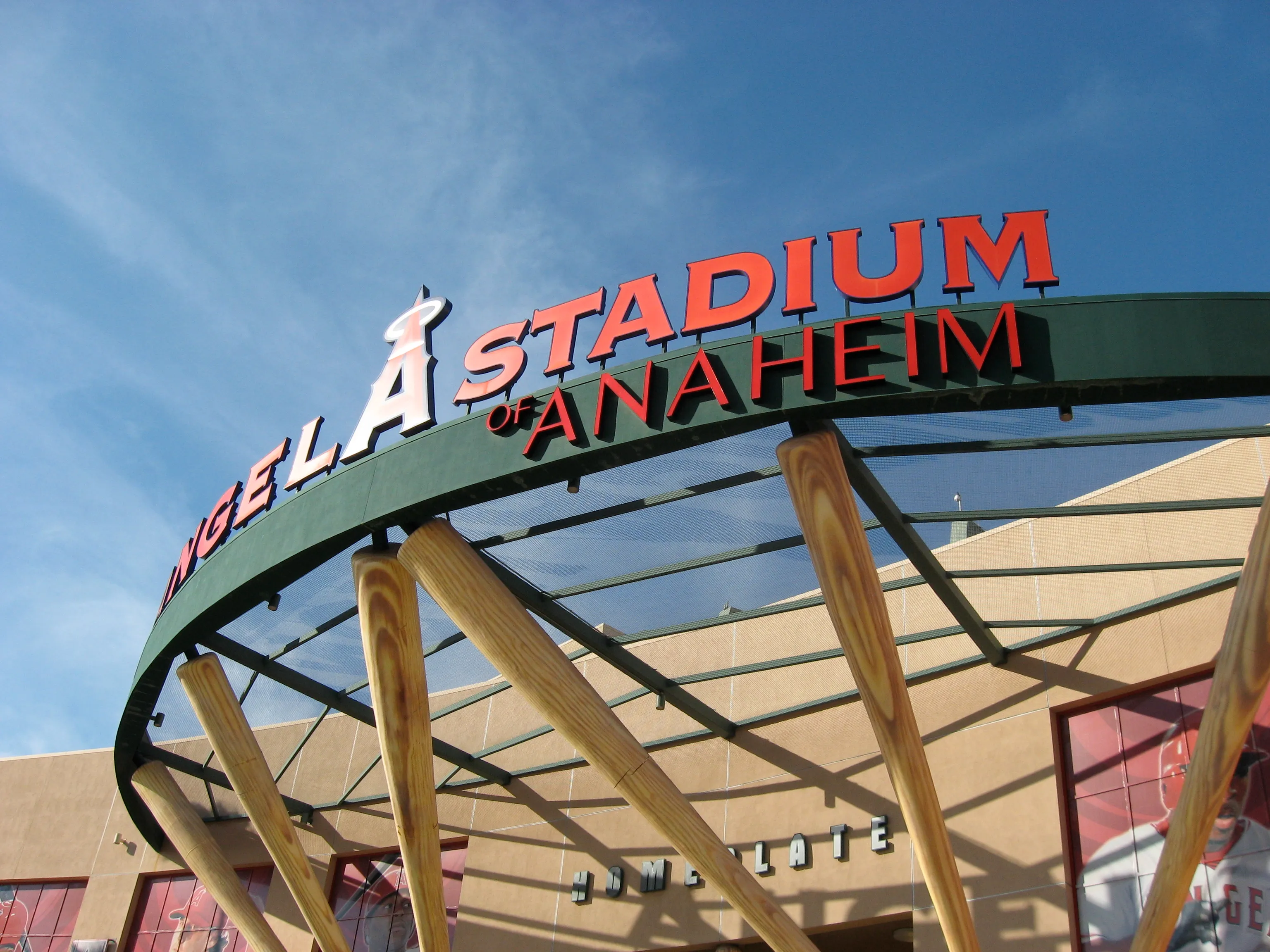
I always divide my life into these discrete eras, like my Seattle era, or my K era when I dated her, or whatever.  And all of the eras are very compartmentalized from each other.  So it’s always interesting to me when different eras have these hyperlinks to each other, like when we visited the place where, ten eras later, I’d live.  Or another example: I lived in New York, and went to this conference in San Diego for a week, back when big companies actually paid for tech writers to go to conferences.  And one night, I drove up to LA to see a friend of mine.  And on the way, I swung through Anaheim, and stopped to eat a late lunch.  There was this McDonald’s right off the main drag by the Disney property, and it was a huge version, designed for giant lunch rushes of tourist busses dumping off scores of kids.  I remember eating there once in 1997, only because at that time, they had the McPizza, and only the highest-volume stores had the pizza, because the prep time of the pizza was longer than the holding time, so you had to move serious units to get it on the menu.  I didn’t get one, and for whatever stupid reason, went back to that specific McDonald’s in 2000 to see if I could get one, but by then, the McPizza was McHistory.

So that one visit for a Quarter Pounder meal deal knitted together at least three eras:  The Seattle/K era, the New York era, and the future 2008 living in LA era.  I did not visit the same McDonald’s in 2008, although I did go to Anaheim and see it when I went to an Angels game.  I was on Weight Watchers and off McDonald’s by then, though.

Another thing I remember from 2000: I was sitting there, reading a newspaper and picking at my fries, when this lady was mopping the floor.  It was an off hour, like maybe 2 or 3, so nobody was in the dining room but me.  This was a redneck woman, maybe someone who was working there either because it was all she could get or it was part of the terms of her parole or rehab.  And she started talking to me about the nomination of George W. Bush as the Republican candidate.  She told me “well, I’ll probably vote for him.  He probably knows the most about the job, since he already was President.”  I did not correct her.  This was the beginning of the next era.

Seattle sketches

I always used to explore on Saturday mornings, driving around Seattle to find some new magical diner to eat that would cause my writing output to double or make me run into the perfect woman, except I’d always end up at Denny’s or at the movie theater at Mountlake Terrace, because I didn’t own a TV and would just go there and watch three movies back-to-back. But I was somewhere in the middle of the peninsula, not sure where, and I went to this weird little used bookstore/antique shop/cafe, in this creaky white victorian house. There are essentially three kinds of antique stores: one is where the owner is a hoarder, with fifty years of inventory and has totally maximized their space so there’s junk on top of junk on top of junk. The newest thing in the store is older than you, and it might be interesting to look in there, if the dust mite infestation wouldn’t kill you. Then there’s the Pawn Star type of places, where they know the value of everything and only have the most profit-margin-friendly stuff out there. They know exactly how much everything costs, so there’s never a surprise and almost never a bargain. And then there’s these ones by sort of far-left revisionists, the etsy arts and craft sorts, who label everything in that weird sorority font and it’s all fun and neato. And this place was definitely in the latter category.

The place smelled like my grandmother’s place, sort of equal parts of flea market, rosewater, and old people farts. I was starving, probably from driving for hours trying to make up my mind, and I ordered the only real thing on the menu, a panini sandwich. The only cooking apparatus in the place, other than a coffee machine, was the panini iron, a glorified Foreman grill. The thing I remember most is that the girl working was an absolutely beautiful redhead, pale skin, wearing a tight but proper dress. I couldn’t tell if she was a teenager or not, if she was a freshman in college or a junior in high school. This was about the time in my life when I could no longer tell the difference. Now, it’s completely splayed, and I can’t tell if someone is in college or 30 of 15. Last night at the movies, I saw a girl and could not tell if she was 22 or 15. She was with a friend who looked 15, but I just couldn’t tell.

I was so desperate at the time, the thought of dating a teenager wasn’t far-fetched. I had a hard line at 18 of course, but I was 25 and going on three years of absolute celibacy, nothing past a failed first date, and every woman I met was in her thirties with chronic complications and high expectations.  The idea of finding some girl who was 18 and would be impressed with a college degree and my own place and a new car had some merit. But it made me think of when I knew girls in high school that dated “older guys.” I did not get that at the time, because I could see the upside to the girl, in a Fast Times sort of way, but I didn’t know why the guy would date a 14-year-old. And then later, I realized it was a combination of statuatory rape and the pure townieism of Indiana.  And none of this mattered, because I’m sure that I was giving off the serial killer vibe and she probably dialed 91 and was waiting to dial 1 while she nervously made my shitty panini sandwich and I looked at all of the garage sale pieces of junk on shelves.

But I remember that book store, because it was the type of “book store with no books.” Like the used books were just the dregs of what wouldn’t be bought at any other store. There were some good used book stores — some great ones in the U district — but this place either had an owner out of touch with reality, or didn’t get in the good stuff, or couldn’t afford it. And I think maybe it was the former, like a person who only stocked poetry books by DH Lawrence rip-offs, and dust mite-infested penguin classics that were probably bought at estate sales by the pound.

I can’t remember the neighborhood, which bugs me.  I know if I visited Seattle again, I’d start driving instinctively, and go from my old apartment to some random Vietnamese restaurant without thinking.  But where was that book store?  What happened to it?  Is the redheaded teenager-or-not still in Seattle, or did she have ten kids and move to Kelso and become a professional hoarder?  Is the old victorian house now a Jimmy John’s sandwich shop, or the parking lot for a Qdoba?  I can drive myself crazy thinking about stuff like this.