The Wrath of Kon

Dispatches, thoughts, and miscellanea from writer Jon Konrath

Tag: obsolete-technology

pre-digital observations

A bunch of thoughts, no particular order:

Try going in your kitchen or bathroom and finding a product with a printed package that doesn’t have a URL on it. Pick up food boxes, condiments, pet food, candy bars, canned drinks, toothpaste… anything. Everything has a web address on it. It’s like an address having a ZIP code now, or a two-letter state abbreviation. If you find some old-timey sign for ethyl gasoline from the 1930s, it might say “Oakland, Calif.” instead of “Oakland, CA 94607.” Now it seems like the URL is the way to date if a package is from the mid-90s or earlier.

I remember about the time when Coke cans started putting their URL on the cans. I started a Coca-Cola fan web site in 1994, and was getting more traffic than their site for a brief period. It really pissed me off when they started a site, started putting it on every can or bottle. Pissed me off more that it was “Netscape enhanced” and didn’t work for shit on a text browser. It wasn’t a site for information; it was for pretty pictures and layout that took forever to load on a slow modem. Now, cocacola dot com redirects to coca-cola dot com, and that is a site picker with a big world map and all the regional sites. All the information there is either for shareholders, or trying to convince you that you can be healthy and drink 6000 calories a day.

My site was something at bronze.ucs.indiana.edu/~jkonrath I think. It’s long gone. Bronze was a VAX machine. The machine is long gone; VAX machines themselves are long gone, for the most part, unless you work at some insane bank that could not transition away from them. Hell, UCS is gone now, part of some crazy merger/renaming thing twenty years ago.

I don’t think a civilian could register a hostname back then. I don’t remember how it was done before the late nineties, but I registered rumored with Network Solutions on 11/16/98. I remember it not being cheap, something like a hundred bucks a year. This was when they pretty much had a monopoly on it. There’s no way I could have paid that back in college.

Speaking of putting hostnames on things, I knew a guy who had his email address on the back of his car. This was in like 1990, way before that made any sense. I worked with him, and he was this funny Malaysian grad student who I’ll call K for plausible deniability. He drove some old beast of a seventies car, like a Monte Carlo or something, and had “k___@copper.ucs.indiana.edu” across the back of his trunk, in stick-on letters, the kind you would use to put your name on a mailbox. I have no idea why. He wasn’t running a business, in a band, anything like that. He just thought it looked cool, I guess.

I had to get checks printed in 1992 or 1993 - this was back when people still used paper checks, and to get new ones printed, you looked through a Parade magazine in a Saturday newspaper, and there would be an ad for a place that would print your checks on a design with an American flag or some kittens or Peanuts characters or whatever else. I picked this design that was a bunch of colorful geometric shapes - do a google image search of ”90s graphics” and that’s basically what I got printed.

Anyway, I remember I called the 800 number to place the order over the phone. (No internet order form, no web site.) My name and address were three lines, the phone number was the fourth, but the check had five lines, so you could put a business name or something on it. I told the lady on the phone I wanted my email address. She had no idea what that meant. I then told her, my email address was jkonrath@bronze.ucs.indiana.edu, and I wanted that on my check. It was like I was speaking Klingon. I had to slowly spell out  jkonrath@bronze.ucs.indiana.edu over and over, jkonrath@bronze.ucs.indiana.edu, jkonrath@bronze.ucs.indiana.edu, jkonrath  at symbol bronze period ucs period indiana period edu. The whole transaction took twenty, thirty minutes.

I got the checks a month later, and the printer completely butchered it. Like I think they left out the @ and put two spaces after each period, so it was just a jumble of incoherent words with no meaning. And only 4% of the population knew what an email address was. I should have thrown the checks in the garbage and ordered new ones, but that would have taken another month, and more importantly, another twenty dollars. So I used the checks, until I moved to Seattle and got new accounts. And every time I wrote a check, which was often back then, the cashier would ask “what the hell is that?”

Also, I think those new checks I got in 1995? Had the bank’s URL on them.
Death of an office

IMG_0543_22160

I found out about this a bit ago, but my old Samsung office was bulldozed and replaced recently, which is strangely nostalgic. I took an electronics class last year with a guy who worked at the architecture firm that did the new building, and heard all about the grand scrape and replacement.

I started working there in the fall of 2008, when Silicon Valley was very different. It was only a few years ago, but it was after the crash, and nobody was hiring. Traffic has nearly doubled in the last five years, and this was before that boom started. I was living in LA when I got hired at Samsung — I’d been spamming out resumes for months, and it was one of the few pings I hit. Tech writers are usually last in/first out, so it wasn’t easy landing something then. But I did, and I moved to South San Francisco, and started the 101 commute every day to San Jose.

Prior to moving here, I had specific mental images of Silicon Valley, mostly formed by living far away from it, romanticizing the idea of working in the heart of the technology world. Twenty years before, I idolized these Bay Area companies like Apple and Sun and NeXT and Silicon Graphics, and thought about what it would have been like to work in one of those office parks in Palo Alto or Mountain View. And I’d been in the Bay Area twice for work related things, once in 1996, and again in 2006. Both times, I remember driving on the 101 and seeing the big headquarters of these tech giants and wondering what it must be like in those buildings, hacking code or plugging wires into servers in an air-conditioned machine room.

When you spend time in San Jose, you see the obvious new construction, the giant glass and steel buildings that have popped up everywhere. It seems like half of them belong to Cisco, and the other half belong to companies you’ve never even heard of. Because a company like Fujitsu might make the hard drive, but a dozen other companies made the little pieces or sensors or wrote the patents for the storage technology. I eventually learned a little more about these companies, either because I had coworkers who came from them, or because everyone had this ubiquitous cartoon map of Silicon Valley with icons of every big tech firm on it.

What fascinated me more was the layer under that layer, the old San Jose, the scraps and remains of the city from the Seventies and earlier. You’d occasionally see little bits of it peeking through: a Chinese restaurant that never remodeled; an apartment building that never got gentrified into condos; a back side of a building that never got repainted. I had a strange nostalgia for this era I never saw, like when Atari was still king and still had factories in Sunnyvale cranking out 2600 consoles. Or there used to be plenty of computer stores, back when people wire-wrapped and hand-built their 8-bit machines from bare chips and boards. I’d see vestigial pieces of that, like when I’d go to Fry’s Electronics and see more than just shrink-wrapped Dell Laptops for sale.

So Samsung, or at least the division I worked for, was in this series of brick buildings on First and Tasman that looked like every generic two-story medical office building built in 1974 you’d find in a Chicagoland suburb. There were three near-identical buildings: a big one with a lunch room, conference areas, and a reception hall full of display cases of new technology Samsung invented or whatever. Then there were two other buildings, totally identical, of just offices. I worked in one of those.

My building was shot. It looked like this old Seventies Silicon Valley, with wood trim and bright red brick and a vibe that screamed 1978. And I don’t think anything had been updated since then. No two acoustic ceiling tiles were the same shade of yellow, and the desks looked like they had been hauled out of a storage facility from the Mad Men era. I later found that management of the various Samsung labs took great pride in how little they spent per employee, each one trying to get as low of a per-seat investment as possible to maximize profits.

I basically lived in that office for the year and a half I worked there. I’d go in early to beat the traffic, and often end up stuck at my desk until well after dinner, or later. I was close to the dozen or so people on my team, because we went to war together. We ate every meal together, went to endless meetings, worked on our projects for hundreds and thousands of hours, and spent forever in that dreary, fluorescent-lit cube farm.

And then I left. I got another job, which I wrote about here a long time ago. Then I started working from home, and never spent any time on the peninsula or in the South Bay anymore. And I didn’t think much about that place until I’d heard about it being demolished.

The new building is very typical — I feel like Samsung saw the new Apple spaceship campus going up, and said “Oh yeah? Well, check this shit out…” and threw together their own monstrosity of a headquarters. It’s supposed to be a hip new open-concept thing, and it looks like an East German propaganda headquarters. The building takes up every square inch of the footprint of the old place. I always think of SV campuses as having a laid-back look with landscaping and thick green lawns and big parking lots and trees, then the building, a hundred or two feet from the road. But this is like inches from the sidewalk. And the last thing you’d want there is an open plan, because everyone spends all day screaming in Korean on their speaker phones.

And it’s weird, but some of the strongest memories I have of that place are pacing around that parking lot on my cell phone. I could never take calls at my desk, so any time anything important happened, I went downstairs and walked around the lot with my phone in hand. Like I remember talking to my dad when my uncle Mike died, and I have vivid memories of that conversation, walking back and forth among the sea of identical Hyundai cars. I also remember sneaking out to have phone interviews with other companies when I was planning my escape. The parking lot is now gone, but every other building on the street has the old layout, which makes the new building look even more strange.

I was also talking to a coworker about the fate of our team. We worked on a developer program for a phone OS that does not exist anymore. The site is gone, the team is gone, and every trace of every thing we shipped has vanished from the web. I don’t think anything of consequence was ever developed from our SDK. The entire division is technically gone, since Samsung Telecommunications America merged into Samsung Electronics America. Ultimately, this happens with everything in life. But it happened so fast here, and that’s par for the course.

Above all, I’m mad I didn’t find out about the demolition. I would have loved to take a few swings at that place with a sledge hammer. Oh well.

LiveJournal

screen-shot-2017-01-14-at-10-09-35-am

In the quest to find some better way of doing all of this, I started thinking about LiveJournal. (I actually have been thinking about a lot of the mid-00s web stuff I used to use, because sitting on FaceBook all day is probably a dead end, or I feel that I’m not reading or writing enough. Like, did reading Slashdot, Fark, and an armada of blogs in Google Reader help entertain me any better than seeing the same four news stories posted a hundred times a day?)

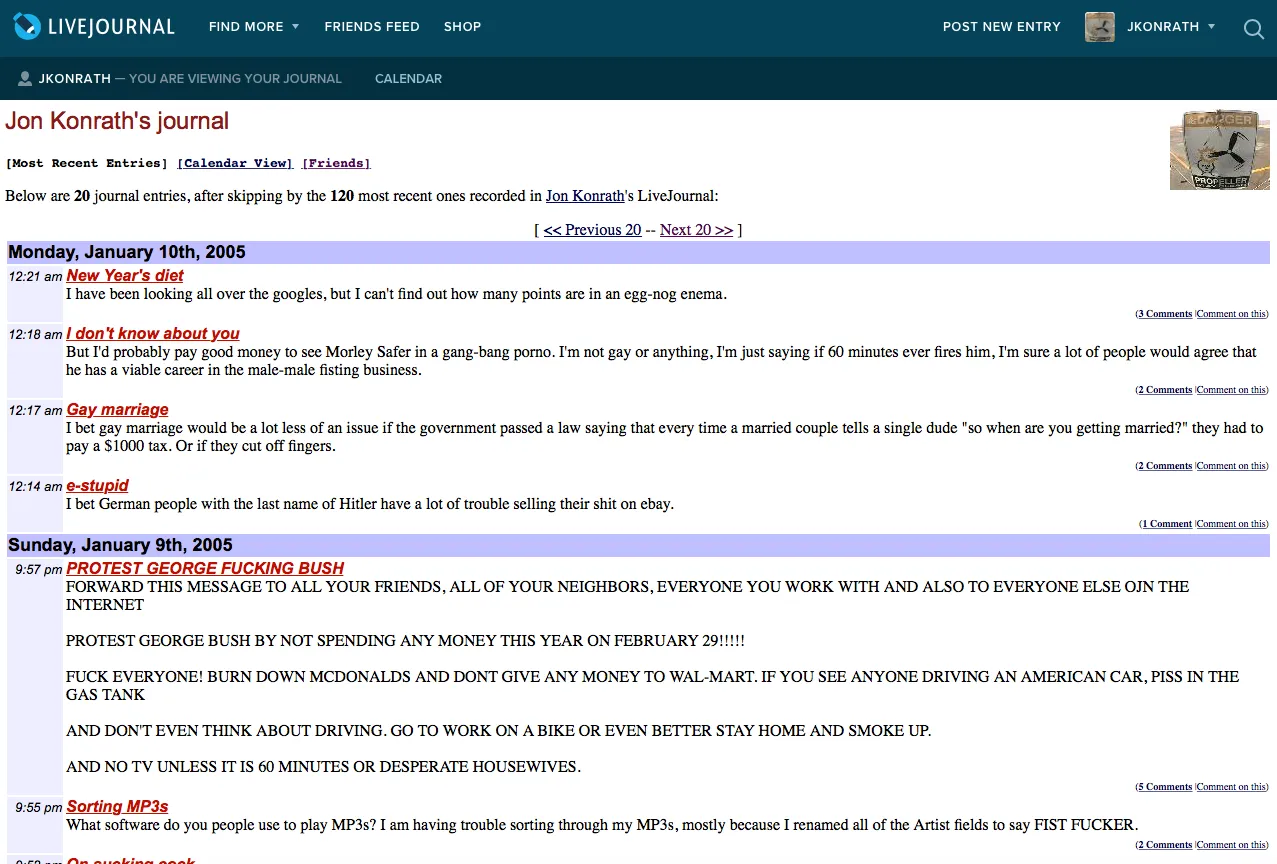
I wasn’t a heavy LiveJournal writer; I had a fake account (username: unabomber) I started in 2000 just to comment on other peoples’ stuff, then started one as jkonrath in 2004. I’d post updates, but I had an earlier pre-WordPress iteration of this blog as my main home. But I would hit my friends feed constantly, and comment a lot.

LJ seemed to be “the place” to go to be social online for a while, like pre-MySpace, pre-Facebook, pre-Twitter. I was trying to think of exactly why though. The site’s still there, as is my account, so I poked around a bit and tried to remember. What did it offer that my blog did not? What was the draw?

Plusses:

  • It was dead simple (and free) to open an account. It was invite-only until 2003, but after that, anyone could get in.
  • Posting was not hard. It gave you a box and a subject line, and you typed and clicked “Post” and that was it.
  • There were fun little things you could add to posts, like what you were listening to, and what your mood was.
  • You had a certain number of profile pictures, and it was always fun finding new little pictures, or swapping to a different one based on your mood that day.
  • You could theme your page to some extent, changing colors and styles. Some people got really into the design of their pages, although when you’re reading your friends feed, you don’t see those customizations, and I basically didn’t give a shit about having flaming red text on a black background with pictures of wolves and fire and ninjas and shit all over.
  • Basic privacy settings could lock posts and accounts to be friends-only.
  • Communities, where permitted users could post to a feed. These were great for interests (I was in a baseball one for a while) or areas (lots of people had groups for their towns or home towns.)
  • You could (if you had a paid account) host a feed to your external blog, so the posts would show up on LJ.
  • It was locked in. You could sit and spin on your friends feed, and read all the posts (in chronological order, too) and in the mid-00s, a lot of people were posting, so there was some good conversation to be had.
  • There weren’t ads during the heyday, although that changed later.
  • It encouraged long-form posts. Or maybe people just typed more back then, before we were all programmed with horrible ADHD.
  • The feed was chronological only. No Fuckerberging of the order and appearance weighting of posts.
  • There was post commenting, and that got used a fair amount. Commenting was more streamlined than other blogs, because you had the single system for everyone, whereas it seems like every free-standing blog has a different commenting system, or they use something like Disqus, and people get all pissy about having to sign up for it. If you were using LJ, you were signed up for commenting, so it was a no-brainer.

Minuses:

  • The UX is horrible. Log in to livejournal.com and then try to find anything, and it takes ten clicks. It also started to look a bit dated and clunky going into the late 00s.
  • There was no “like.” I think that was the big killer versus Facebook. When you post on FB, there’s this little micro-validation you get in your brain when other people like your post. LJ didn’t have this, so the motivation wasn’t there. I think the little crack hit of likes is one of the main drivers for FB, and it’s also its downfall. The discovery of this gamification around the end of the 00s is the reason casual gaming now exists (well, that plus touchscreen devices with good graphics) but it’s also a big part of our dumbing-down as a culture.
  • The long-form thing meant good content, but it also may have been a reason people dropped out.
  • Images and image hosting were always an issue. You could add external links to flickr or elsewhere for your images, but the two-step process was messy. They now offer image hosting for paid accounts, but it’s a limited amount, and mostly a feature to entice people to pay. It’s nowhere near as nice as the FB interface for photo uploading.
  • No fine-grained security. You could not be friends with someone and not see their content. You could not hide a single post from your friends feed, like when you got sick of seeing the same thing pop up on every time. (I use the FB hide post constantly these days.)
  • No post sharing. This was a plus, though. Imagine FB without the ability to share stupid political posts or mom memes.
  • No (real) mobile stuff. I think they have an app, but it’s a piece of shit. So many people post on-the-go now in FB/Twitter, and LJ never had any of that. That may have been one of the reasons it focused more on long-form stuff, because everyone was sitting on a PC while composing their stuff.
  • Various business decisions slowly sank the ship. The company was sold in 2005, and then Brad Fitzpatrick left in 2007, and it was sold to some crazy Russians, who continued to run it into the ground.

Other:

  • I remember a lot of shit-storms over privacy issues, like people having to lock out exes and then said exes getting a different fake account to read their stuff, etc. Now, blocking and banning is simple in FB, but there was a lot of drama back in the day.
  • I also vaguely remember some moderation issues, with people or posts getting censored, and a bunch of outrage.

I always wonder if something could replace LJ and FB. Would some technical balance between the two work, or would some perfect storm have to happen to lure enough people to the community to make it viable? I think the biggest feature of LJ was that it had a community, and it had a critical mass of enough users to make it interesting and fun. But when that went away, so did its usefulness.

How do you create that again? I guess that’s the question every attempt at community tries to answer. I futz around with posting here, but it’s an isolated island in the middle of nowhere, with no community, no connection to the outside world. I post on Facebook, but it’s Facebook, and it is becoming a dead end. As I find Facebook more and more intolerable, I try to think of a replacement, but that lack of critical mass, of community, is the huge problem.

Boxes

I recently found this excellent Jon Ronson documentary about going through the boxes that Stanley Kubrick left behind. Check it out on vimeo: https://vimeo.com/78314194. The basic gist of it is Ronson was contacted by Kubrick’s assistant for a copy of a documentary of his, and before he got a chance to catch up with him, he passed away. Later, his estate let Ronson poke around, and he found thousands and thousands of archive boxes filled with notes and photos, raw research for most of his films after 2001.

This doc is forty-five minutes of mind-blowing thing after thing, and you expect it to top out, and it gets even better. Like there’s a scene where Kubrick is going back and forth with a box company to get a better storage box with the perfect lid. A few minutes later, Ronson finds film cans containing 18 hours of behind-the-scenes footage shot during Full Metal Jacket. This is after a series of memos instructing his assistant to find a cat collar with a bell to scare away with birds, but with a breakaway feature to prevent the felines from getting stuck in a tree. (This eventually had to be specifically fabricated by his team.)

And then the stationery. Stanley used to hoard it. Paper, notebooks, pens, inks, drafting supplies. His assistant said he could probably start a stationery nostalgia museum. He would spend hours at a shop, always paying in cash so nobody would ask questions.

I have a huge stationery problem now. For years, I’ve been buying these Moleskine notebooks and go through one every year or so, writing a page or two a day. Last winter, I got some Field Notes notebooks, at a shop in the Public Market in Milwaukee. They were the ones for the state fair series, for Wisconsin, which had a certain kitsch value to me, and I’ve been keeping one in my pocket when I go to lunch, so I can jot down ideas.

Because I heard Draplin do his sphiel on Maron’s podcast, I decided to subscribe to Field Notes. You pay a lump sum and get a package four times a year, with whatever cool limited edition books they just came out with. They’re also good about shoving a bunch of extra stuff in there, discontinued booklets and pens and stickers and whatnot. It’s all made in Chicago, well-designed, and has a weird addictive quality to it.

The only problem is, I’m now sitting on two dozen blank notebooks, and only using a few of them a year. And I still have the urge to buy more every time I see their web site. There’s something so collectible about them, and there’s also this feeling of “I’m a writer, I need to write, this is justifiable” and it isn’t, but I will keep subscribing and buying the shit.

I had this problem when I was a kid. There was this store called Stationer’s in downtown Elkhart, and they sold absolutely every kind of pen, pencil, paper, and business supply. It obviously doesn’t exist anymore - big-box office supply stores barely operate anymore. But back when I was 12 or 13 and playing D&D, they had every kind of graph and hex paper imaginable, along with special erasers and felt-tip markers and anything else you needed as a dungeon master.

And I studied drafting earnestly as a teenager, thinking I would go to college and become a draftsman or architect. These were the days of actual paper-based drafting: t-squares, big tables, protractors and scale rulers. That meant supplies galore: wooden 6H and 2H and HB pencils with points you carefully filed down by hand; kneaded erasers; dust-it powder; metal erasing shields; fine-tipped ink pens; translucent sheets of paper. We got the first CAD systems toward the end of my high school drafting career, PS/2s with digital tablets, running VersaCAD. But those tactile supplies — I hoarded that shit, bought as much as I could, somehow holding some psychological connection between having the most stuff versus being able to do a good job.

The Kubrick thing makes me wish I had more space to collect this garbage, a thought that would freak out my wife. But now that we’re in a digital age, the hoarding has gone to my hard drive. I have sets of folders filled with old PDFs, scanned photos, saved web pages, text files. I like the idea that Kubrick spent every day, hours and hours sifting through this stuff assembled by assistants, looking for the next idea, doing pre-production on films that never got shot. As I fret over what’s next, I often think I need to do this, forget about rushing out the next book that nobody will read, and spend a decade looking at photos and researching things out.

Anyway, great documentary - go check it out on Vimeo, before it vanishes.

I have a new zine out

Screen-Shot-2016-03-13-at-2.31.29-PM

I have a new zine out.

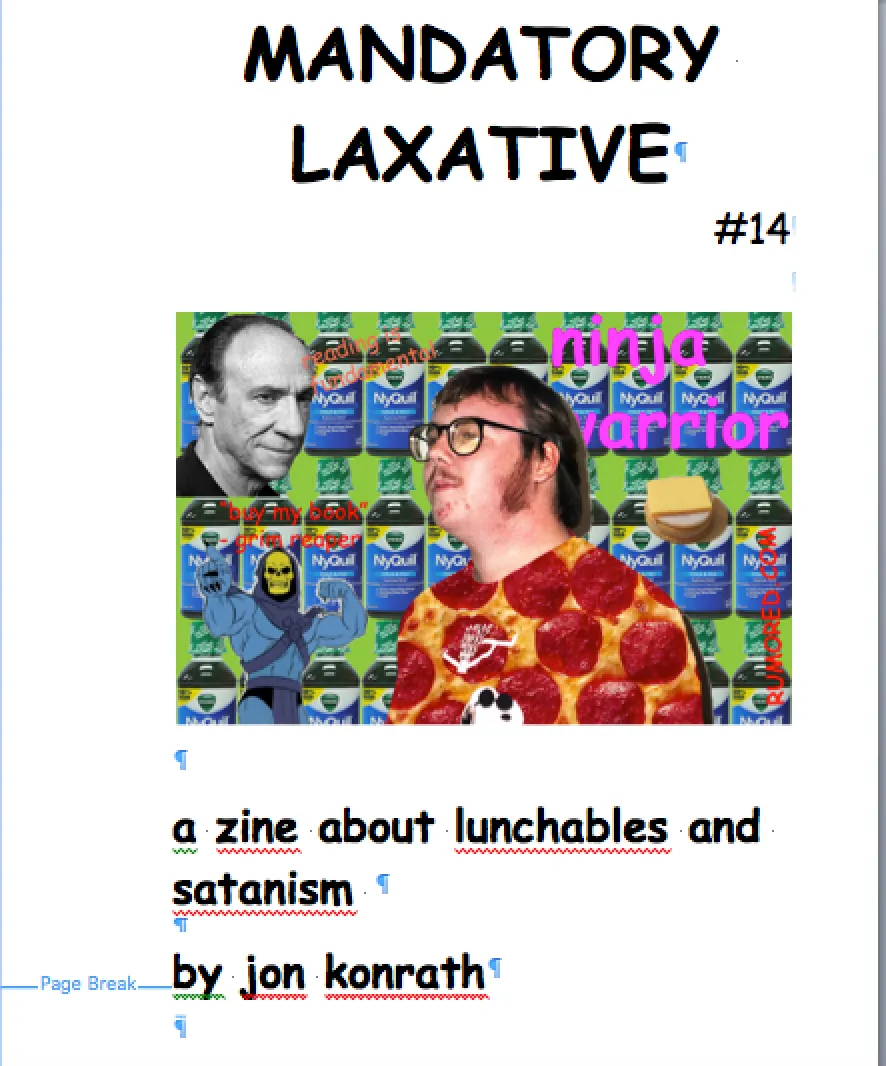
It is called Mandatory Laxative #14. It is about lunchables and satanism.

It is 20 pages long. It is printed on an inkjet printer. It is as lo-fi as possible. I didn’t even spell-check it.

It contains the following “stories”:

  • Pain Is Only Temporary (Unless It Is Chronic)
  • A Scene Where A Guy Goes To A Colonics Clinic, Falls In Love With The Cashier, And Almost Ends Up Shooting A Fountain Of Coffee From His Ass
  • Sleep Letter Zero
  • Letter to Freddy
  • I Am A Satanist And I Like Toast Because It Is Cult And Evil
  • Someday This Could Be You
  • I Love Lunchables
  • Late At Night With Dwight Dingleson
  • Remember the Alamo, Motherfucker
  • Two Men Discuss Low Calorie Pizza Before A Ritual Satanism Killing
  • This Knife Means Fucking Business
  • Chili Sweats at Aerie #666
  • The Inevitability of an Accidental Saline Enema

It is listed on Goodreads here.

It is not available on Amazon. It is not available as an ebook or a PDF. It’s barely available at all. It is a limited edition of about 30 copies. If you really want a copy, and you are in the US, paypal me $4 and your postal address. jkonrath at 34.216.9.77/.