The Wrath of Kon

Dispatches, thoughts, and miscellanea from writer Jon Konrath

New Camera

I finally upgraded DSLRs last week. This was a nagging thing with a convoluted thought process, something like this:

  • I should save a ton of money and get a full-frame DSLR / that’s too much money to blow on someone who doesn’t take a thousand pictures a day.
  • I should upgrade to the newer version of the Rebel camera / that’s not that much of an upgrade, and I don’t use my DSLR that much, because of weight/size/fear of getting it damaged or stolen.
  • I should look into these mirrorless cameras like the Fuji or Sony, because so many people are ditching DSLRs for these / I can’t deal with an LCD screen viewfinder in the sun and with my eyesight, and I have a lot of Canon lenses I’d be junking.
  • I could buy the Canon EOS-M3 mirrorless with an eyepiece viewfinder, and it can use my lenses with an adaptor / I bought an EOS-M1 and it’s a huge regret.
  • I should just use my fucking iPhone and realize I’m not a photographer and nobody looks at this shit anyway.
  • Maybe I’d be a photographer if I bought a full-frame DSLR.
  • etc.

Pressing the issue: a bunch of amazon credit card points, an upcoming trip to London. So I gave up and bought the Canon Rebel T6i. My previous DSLR was the Canon Rebel XS, which I got on my birthday in 2010, and took about 11,000 pictures with in six years, which either seems insanely high or pretty low, depending your experience level. I got in at exactly the wrong time with the Rebel, right before they got high megapixel counts, fold-out screens, really good autofocus, and video. So the new camera is a pretty big step up.

Interesting things about this one: the new STM kit lens seems much faster autofocusing, and is way quieter. There is a flip-out video screen, which makes live-view shooting much easier. The screen is a capacitive-touch, so you can swipe and touch focus points, which is neat. There is built-in wifi, which I will never use. And there’s video, which is actually pretty decent, especially the autofocus.

Minor nits: the battery is a new, proprietary Canon one, with a chip in it, so third-party clone batteries don’t work properly. It will complain, and then the battery level gauge won’t work. This would be less of an issue if Canon batteries were not sixty bucks each.

I think the biggest thing is that despite the wiz-bang features, this feels like an incremental upgrade, like the pictures aren’t astounding; they’re just pictures of whatever I point it at. A new camera doesn’t change what’s around me, or my skill level. It’s still collecting light through the same lenses (and one new one) and aside from the various future-proofing stuff, it’s still my responsibility to put something interesting in front of the lens.

I brought the new gear to the Rockies-Giants game last week, shot a few hundred snaps, but wasn’t happy with any of it. I’ve taken so many pictures at AT&T that I’m bored of it, and although I had suite tickets and could get down to the dugout area, I was too late for batting practice. Weather was too cloudy too. I did like the game (Rockies won, ate a lot) but not a good photo op. I’m hoping to get some good work in while I’m in the UK, though.

blog death freefall

So many blogs are shutting down. I just heard The Toast is shuttering on July 1. Bookslut has published their last issue. And it seems like I have a hundred blogs all added on my feedly account that haven’t done anything in months, years. It seems like every “blogging is back” article is matched with a dozen soft closings, the authors moving on to whatever the next scheme is.

We’re five and a half months in, and I’ve only posted a dozen times here. I did the back-of-envelope math, and based on number of published posts (1175) divided by number of years (19) divided by 52 times weeks in 2016, I should have like double that. But average in the dead weeks and months of the past, and whatever whatever (shut up about the math Larry, this isn’t a deposition) I should be posting much more.

The reason for all the high-profile shutterings is those are businesses, with a business model and ads and serious attempts at engagement and community and all of the bullshit I do not care about. I was blogging before there was blogging, and in the early/mid 00s when blogging was Serious Business and every single-focus blog was getting book deals, I was still posting about what I ate or read or wanted to write. And most of those blogs died when the ad revenue died, and all of these “veterans” who started in 2010 are now falling away, and I’m still here. Except I haven’t been here. What’s my reason?

I hate blogging now because when I sit down at the wp-admin console and look at the blank screen, I always feel a need to write an “article,” like a full-on Esquire piece. I feel like writing a hundred words about the Lebanese meatballs I had for lunch is somehow “off-brand” or not becoming enough to be a blog post. But when I go back through posts from 2004 or 1996, I realize that’s all I did, and I enjoy going back to see them. I have this feeling that when it’s 2025 and I go back and look at 2016’s entries, I’ll wonder what the hell happened to me.

Is it because of WordPress? I wonder if it is the tool. It’s not the best writing experience anymore; I really dislike the little text editor window on the web page. I bought a copy of Desk and it was interesting, but kept fucking up formatting and could not sync correctly. But aside from authoring tools themselves, there was something different in how doing this by hand in emacs framed things. Like I never had to enter titles before, and I loved that. Just that little difference made spontaneous blogging easier.

I’ve thought about either opening some microblog or switching tools here. That launches me into a spiral of indecision. I don’t like the idea of moving to Tumblr and getting sucked into the politics of the teenagers there; I don’t feel like going to Medium and competing with the New Yorker-wannabe writers there. I want to own my content, and not have to deal with an insane migration path when whatever hosted service gets acquired and then shut down.

I should just get in the habit of coming here, posting something short, and not giving a fuck about the blogosphere or the business of the web, because ultimately, I don’t. But I guess at some level I do, and that’s the rub.

I have a new zine out

Screen-Shot-2016-03-13-at-2.31.29-PM

I have a new zine out.

It is called Mandatory Laxative #14. It is about lunchables and satanism.

It is 20 pages long. It is printed on an inkjet printer. It is as lo-fi as possible. I didn’t even spell-check it.

It contains the following “stories”:

  • Pain Is Only Temporary (Unless It Is Chronic)
  • A Scene Where A Guy Goes To A Colonics Clinic, Falls In Love With The Cashier, And Almost Ends Up Shooting A Fountain Of Coffee From His Ass
  • Sleep Letter Zero
  • Letter to Freddy
  • I Am A Satanist And I Like Toast Because It Is Cult And Evil
  • Someday This Could Be You
  • I Love Lunchables
  • Late At Night With Dwight Dingleson
  • Remember the Alamo, Motherfucker
  • Two Men Discuss Low Calorie Pizza Before A Ritual Satanism Killing
  • This Knife Means Fucking Business
  • Chili Sweats at Aerie #666
  • The Inevitability of an Accidental Saline Enema

It is listed on Goodreads here.

It is not available on Amazon. It is not available as an ebook or a PDF. It’s barely available at all. It is a limited edition of about 30 copies. If you really want a copy, and you are in the US, paypal me $4 and your postal address. jkonrath at 34.216.9.77/.

Dead Mall: Vallco Mall Cupertino

IMG_2171

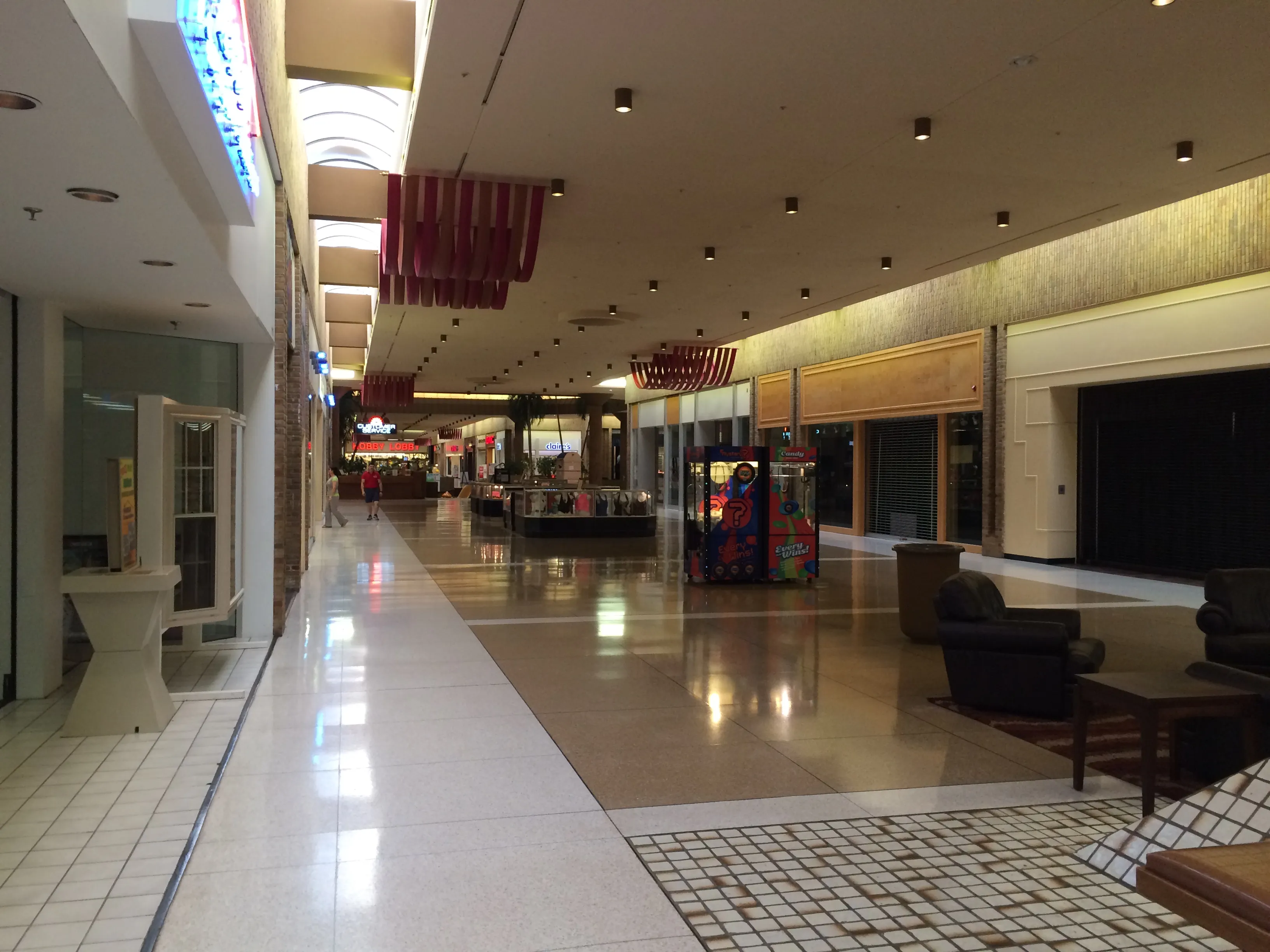
I had to go to Cupertino last week for a work bowling party thing. I followed the GPS to a Bowlmor, parked in a garage, and realized it was actually an anchor to a large mall. I had a few minutes to do a quick lap, and suddenly realized I’d chanced upon the most elusive dead mall situation: a huge mall that was in it’s final moment of end-stage death.

I’m fascinated by malls. It’s always bugged the hell out of friends that I travel a thousand miles to some new place and want to go to a mall and not buy anything, but it’s an unfortunate illness of mine, and I can’t escape it. I grew up going to malls, then I worked in one as a teenager, and spent all my time in a Montgomery Ward, or wandering the concourses during breaks. Even on days off, I’d go to work just to hang out. Or I’d drive to any of the other malls, to see the competition, and people-watch. It was the 80s, and malls were the biggest part of our cultural zeitgeist. Even in the 90s, I would find it almost meditative to go to College Mall in Bloomington or Northgate in Seattle and walk the loop, look at consumerism in action, and maybe get a pretzel or a book.

This all slowed down in the 00s. First, my default mall in New York was destroyed back in 2001, when a combined 220 stories of skyscraper fell on it. But aside from that, malls across the country crumbled. People shopped online; commerce went to big box stores; and the mighty anchor tenants all started to die. It became a quicksand situation where people stopped going to malls because there were fewer stores, and more stores closed because fewer people were going to malls. The massive indoor palaces were no longer updated, and when the seventies and eighties decor got too aged and the land underneath became too valuable, they were all “de-malled” and bulldozed under, usually to build a series of disconnected big-box stores or strip malls lacking the character or presence of a singular building with common areas.

I’d never been to Vallco Mall in Cupertino, but its history is similar to most. The mall was built in 1976, then expanded during the big boom in 1988. At its peak, it had about 200 stores, including five anchors: JC Penney, Macy’s, Sears, AMC, and Bowlmor. At one time, it also had an ice skating rink, and there are/were a variety of food options, hotels, and condos around the complex. I don’t have the full chronology, other than scattered news articles and a poorly-written Wikipedia article, but it appears it went through the standard lifecycle of a mall, including a long slide in the 00s, owner bankruptcy and buyout in the late 00s, more additions and seismic refitting, and various legal battles about expansion and condo-ing.

And now, the de-malling will begin. After much complicated legal wrangling, the plan is to destroy everything and build The Hills at Vallco, a two-billion dollar fake city square mixed-use monstrosity, with a huge green roof, expensive condos, an organic farmer’s market, upscale retailers, vegan yoga classes, green energy, and whatever catch phrase you can throw in to pull a more affluent demo. The interesting thing about all of this is that Vallco is in an incredibly prime location. It’s right next to the Apple corporate campus, in the heart of the 11th-wealthiest city in the country. In the past, Vallco was one of the only malls in the South Bay. Now, there are several, plus malls are a dying thing. I rag on the new plans, but the renderings do look nice, and it probably fits in better with the character of the town.

When I walked around last week though, the mall was absolutely heartbreaking. Of the 200-some stores, there were maybe a dozen still operational. It looked as if the mall was not renewing old leases, and letting them time out as they ended, so most of the residents were now gone, but there were a few stragglers remaining. Bowlmor was still alive, and the JC Penney was still fully operational, but both Macy’s and Sears had bugged out, and were completely stripped and boarded shut. There was a huge food court with maybe three dozen stalls, all empty except for a single taco place. A role-playing game place and a comic store were still fully operational, but completely devoid of customers. There was an indoor slot car racing place going, which is an oddity in 2016. But there wasn’t much else.

The mall had such an eerie, haunting feeling to it, though. The bones of the mall, the concourses and hallways and escalators, were all completely normal, running, clean, and decorated. But the style of the mall was very much 1993. Most malls got some injection of life around that time, expansion and facelifting, and it looks like they did this here, and it was frozen at time in the early Clinton years. Nobody was there when I visited at lunch time; I think I saw two geriatric mall walkers, and nobody else. It reminded me of being in a mall when I worked there, at 6AM before even the security guards were present, when everything was shut and locked and powered down. It very much gave me the feeling I wasn’t supposed to be there as a civilian, that I’d accidentally stumbled through a locked door and at any moment, a security guard would show up and usher me out. But everything was completely open for business, lights on, main doors unlocked.

The stores were another matter. Some were completely gone, the interiors torn out, bare to studs, the fronts taped shut, wrapped in plastic. Others were cleared out of all merchandise, but signage and racks still remained abandoned. And others looked like they closed for the evening a year ago, the night gates padlocked, but the store collecting dust, like something out of Chernobyl.

The whole thing was nostalgic and bittersweet and horrible. I’ve had a terrible problem with nostalgia recently, spending far too much time thinking about my own past in the 80s and 90s - not wanting to go back to that, but wanting to somehow explore it or write about it. It’s a terrible waste of time and bandwidth, and it’s honestly very emotionally painful. It’s a symptom of The Crisis, which I keep hinting at but haven’t been fully able to write about or wrap my head around. I almost mourn the feeling of having these communal things in my life, now that they are gone and we’re forever compartmentalized into our web browsers and tightly isolated social networking communities. I saw these monstrous commercial communities run from the inside out, and then they all suddenly vanished.

And it was so strange to stumble across one, trapped in amber like this. It wasn’t like when I go to a random midwestern mall that’s been beaten and fucked, all the prime retailers gone and the places left to cash-for-gold and dollar stores that bring in nothing, because the entire town has shifted in location and moved to far suburbs, leaving the mall to go to seed. Those have a feeling of desperation and real deer-in-headlights failure. This was much more surreal. I mean, this was a mall where a 16-screen AMC multiplex was just built in 2009 - like since I’ve arrived here - and it’s about to get torn down. It was like looking at a very late model car that had been totaled, like when you see pictures of a Lamborghini Aventador that has been flipped eight times. Parts of it were trapped in time at that high point of mall culture, and parts were already gone. It was a really hard thing to reconcile.

Anyway, more photos here. If you’re a local and want to check it out, do it immediately, because the place probably only has a few weeks left.

The Big Short

The Big Short is a film adaptation of the Michael Lewis book of the same name. But in a similar fashion as Dr. Strangelove being a version of the Peter George thriller novel Red Alert, this film is done as a dark comedy, directed by Adam McKay. It’s an oddly-toned film, not a ha-ha funny comedy, but more like a comedy based on the absolute absurdity of the collapsing ponzi scheme of the credit default swap market of the mid/late 00s.

The plot follows a few players: a borderline-autistic hedge fund manager (Michael Burry, played by Christian Bale) who’s got one eye and a Supercuts bowl ‘do, used to be a doctor, blasts thrash metal in his office, and walks around wearing no shoes and the same t-shirt and cargo shorts every day, but is able to zero in on the housing bubble before anybody else. When he calculates that the mortgage industry is going to collapse in about two years, he goes to Morgan Stanley and purchases a fairly new financial instrument which enables him to bet on the collapse of the housing market, which he could do without actually owning any of said market. It’s essentially like taking a fire insurance policy on somebody else’s house. And because the banks thought that metaphorical house was fireproof, they were more than glad to sell him a billion dollars of fire insurance and take his money.

Ryan Gosling plays a trader who hears of this scheme, and accidentally hooks up with a damaged, type-A personality hedge fund manager played by Steve Carell and his ragtag team of misfits. There’s also another team of garage band young investors partnered with a retired banker played by Brad Pitt (whose Plan B produced the film) and gets in on the action.

The movie covers some of the background of the predatory lending market and absurdity of the housing run-up, like mortgage companies handing out loans to people with no income and no jobs (a so-called NINJA loan), but is fairly light on this information. I think the film would have been much more preachy if they spent any time on it (and it already clocks in over two hours) but there’s certainly the case that a different film could cover this human angle much more.

Instead, this film blows through the Manhattan banking side, and at a quick pace. McKay does try to explain this slightly by breaking into celebrity cameos, for example having Anthony Bourdain explain repackaging bad mortgages into investment vehicles by explaining how old halibut is repackaged into fish stew for the Sunday brunch crowd. Even with this, it might be well beyond the ability of an average civilian to grok all the financial background here. I recently read Matt Taibbi’s Griftopia, which was a good high-level introduction to the financial crisis (albeit sensationalized, Taibbi-style. And cognitive bias trigger alert: he skewers Obamacare in the book, calling it a gross giveaway for the insurance industry, which, as much as I love affordable health care, is largely true.) Anyway, without that background, I would have been lost. But with it, the total absurdity of the scenario becomes hilarious.

The other thing I appreciated about the film was the near-past nostalgia aspect of it. The trading aspect starts in Manhattan in 2005, only a few blocks from where I worked at the time, and my company at that time had most of the major players involved as customers. As the timeline of the film advanced, I spent a lot of time in the back of my head calculating where I was or how the events correlated to my own timeline and when I left the city (about halfway through the film.) I also kept an eye on the backgrounds of the street scenes, looking for anachronisms. (License plate colors, guys! And a Ralph’s in Florida?)

Overall, an interesting film. Best picture-worthy? I don’t think so, but it was entertaining without being too preachy, and the absurdity of the black humor made it enjoyable for me.