The Wrath of Kon

Dispatches, thoughts, and miscellanea from writer Jon Konrath

Tag: memories

The Evil Pink Mistress

Trying to shake a benadryl hangover, the evil pink mistress clogging every mental channel in my head with dizziness, apathy, and the dark grey dread and doubt and apathy that logjams any serious attempts at life. I remember waking at two or three, after the cursed recurring dream of being back in high school again, decades after escaping that hell, and spending hours in the parking lot, trying to find my car, the kind of realistic dreamscape that makes me worry if my car got towed or stolen for twenty minutes after waking, until I can convince myself that the torture of being back in Bighikistan and dealing with the preppies and assholes and evangelical christian taliban groups is nothing but an evil burn pulled on my conscious mind by the demons of my subconscious.

And then I did the infamous dizzying mental math of “it’s three, and my alarm goes off until seven, and this pill fucks me up for eight hours, but maybe I can cut it in half, and then shotgun coke zeroes when the alarm tries to fracture my sleeping brain.” And benadryl knocks me the fuck out, but plays with those REM dream settings, steps on them and fucks them so I sleep too deep, and skip the important step, the one where my subconscious plays, let loose on the playground with no recess monitors, just a blank brainscape occasionally jarred by the footsteps of a nocturnal cat that wants her breakfast four hours early. I can’t do this stuff every day.

I remember a fragment of a dream last night, where I returned to 414 Mitchell, and met some guy that lived there, tried explaining to him my previous tenure at the boarding house. He looked like one of those meathead hippy types, like the old bass player from Van Halen, a stocky guy with a mullety hairdo and a Jack Daniel’s obsession, who listened to jam bands seriously and called strangers “brah”. He acted antagonizing when we first traded words, but became a guarded friend when I mentioned my residence there decades before. He asked me why I left, implying some greater community at the house now, a fraternal bonding among the roommates, a utopian kinship. I started to explain the problems when I was there, the infighting and thefts and hostility, a dozen people living a dozen disparate lives under a single roof, endlessly at war with each other like a score of micronations feuding over a single set of vital resources. His look of doubt and hurt made me realize something changed in the last dozen years, either some transformation in the membership of the house, or more likely, a social failing in my own interpersonal skills. I left without pursuing it further, went off to find whatever the dream brought me to find, a distant landscape a common trope for my unconscious rambling.

But the night I first took Huperzine A — three nights ago — the dreams were markedly different. The shrink recommended the supplement, an ancient Chinese moss said to improve cognition, and I ordered a small vial from Amazon. The tiny pill, a 200 microgram dose, went on top of the usual gabapentin (the anticonvulsant probably causing my memory problems) but with no benadryl. The night’s sleep furtive, I couldn’t tell if I was asleep or awake for hours of the slumber, except my dreamscape was completely abnormal.

My usual boring dreams always take place in familiar scenery, the parental house or the aforementioned high school, or the constant theme of working at Wards. But this time, the altered sets were completely unfamiliar, an unrecognizable stage. I worked at an Alaskan factory, far north of the Arctic circle, making guns or weapons of some sort, and had a long conversation with a secretary about the kinds of doors required in an environment where it snowed eight feet a month. Then I took a car service in a city melded from Bloomington and Denver, a strange grey Vauxhall car with mini side wings like a Star Wars rebel ship. Inside, my co-rider started massaging the driver, a therapeutic massage tracing the various degenerative disk damage a frequent driver would have. The dreams continued like this, a lucid state between life and unconsciousness, and I woke untired, but also unrested, wondering if the drug would always have the effect, wondering how I could capture these dream-slips onto paper.

What happened to hypercard?

Hypercard was released 25 damn years ago.  Has it been that long?

Back in college, I spent a lot of time screwing around on the Mac, and there were certain programs that welded that old-school 68K Classic Mac experience in my mind.  One of them was Aldus PageMaker, which was the desktop publishing program of the day. This was in the very early 90s, in the days of DOS and WordPerfect 5.1, when the most advanced publishing work you could do on the WinTel side of things was using italics.  But the Mac had this funky and advanced program that enabled you to create page layouts and cool newsletters and even newspapers.  I saw many a journalism student slaving away on those old black-and-white Apples with the tiny grey screens, tweaking layouts and dumping fantastic publications to postscript printers.  I later learned PageMaker by doing the last issue of my old zine Xenocide in it, spending months tweaking page borders and reflowing columns.

The other program I messed with endlessly was HyperCard.  This was something included on all of the old Macs, and it was incredibly interesting to me.  Basically, you created a stack of cards, and each card could have a mix of text and clip art graphics on it.  But you could also plop controls on the cards, like links or text boxes.  You could then hook up those controls to link cards to each other, or do other freaky stuff like run scripts.

This sounds pretty pedestrian compared to what we do daily on the web.  And it sounds disturbingly like PowerPoint, which is probably one of the most evil things created in the business world. But back then, in the late 80s and early 90s, these concepts were absolutely revolutionary.  And even better, the interface to HyperCard was not that intimidating.  If you could make basic art in MacPaint or write a paper in WordPerfect, you could easily create a HyperCard stack.

I remember spending a lot of time at work creating a choose-your-own-adventure game using HyperCard.  I forget exactly what it was - I think it was a game about trying to score drugs on a college campus, and you could click on various pictures to move around.  It wasn’t exactly as sophisticated as the Zork series, but it was something I could do at work, under the guise of “learning more about HyperCard.”  I never learned much about the scripting language, but I did work with some people who did pretty sophisticated stacks.  The system was widely used by education majors, I guess to develop learning tools for kids.  I guess the original Myst on the Mac was written in Hypercard, each of the worlds a Hypercard stack, interlaced with heavy-duty graphics and audio, presented with custom plug-ins.

Like I said, the web came along, and HyperCard more or less vanished.  It was one of the products developed by Claris, which was spun off from Apple and then later re-merged.  The last version of HyperCard came out in 1996, but it was one of the projects killed by Steve Jobs after his return.  You could run old versions for a while, but it did not survive the jump from OS9 to OSX.  You could get it to work in Classic emulation on newer systems, but it only worked on PPC Macs.  On today’s Intel-based machines running later versions of OSX, it doesn’t work at all.

Its one big legacy on the Mac is that the HyperTalk scripting language was adapted and added to System 7, and called AppleScript.  It’s still around in modern versions of OS X, and is even more interesting, now that you can run unix commands from within AppleScript.  It influenced the development of HTTP, JavaScript, and Ward Cunningham said the whole idea of wikis goes back to using HyperText.

To me, HyperCard was always a bit of a missed opportunity.  I think it would be very easy for casual users to create HyperCard stacks and then use some kind of tool to push them to a web site; it would potentially be easier to create high-quality interactive web sites with something like that.  There are probably many programs that you could buy to do that, but none that come with your operating system and follow its UI paradigm.  It would also be great to develop mobile apps.  I could see creating a stack, testing it out on your computer, then pushing it through a compiler and shooting out a binary that could be run on a phone or tablet.  You couldn’t write the next Skyrim that way, but for simple stuff, like interactive kid’s books or multimedia guides, it would be great.  Same thing for interactive books on the Kindle or iPad.

I know you can do all of these things with XCode or by hand or whatever, but there’s something about the ease of use by a non-programmer, and the availability on every Mac, that make this a different paradigm.  There are some conspiracy theories that Jobs killed Hypercard in order to solidify the division between creator and consumer.  I don’t know if that’s true; I think he killed it because Apple had eleventy billion disparate things going on when he returned, and none of them were getting the company closer to profitable hardware sales or a decent operating system.  It’s too bad we don’t have something like this anymore.

Things I Found In Storage Today

When I moved to Oakland in 2009, I rented a storage locker in this old warehouse that always reminds me of that scene at the end of Indiana Jones, and has the smell of a place where the Ark of the Covenant is probably packed away and forgotten. I’d been shuffling around boxes of stuff I didn’t use on a daily basis but couldn’t just throw out, and we moved into our first loft, I needed to stash this stuff somewhere.

Since high school, I’ve moved to Bloomington, back to Elkhart, to Bloomington again, back to Elkhart for a summer, back to Bloomington, to Seattle, to Washington Heights in Manhattan, to Astoria, Queens, to the Lower East Side, to Denver, to LA, to South San Francisco, and then to Oakland. Each time, I accumulated more zines and more books and more papers, and then sold books and donated CDs and junked electronics. Every once in a while, I wonder if I still have a copy of XYZ or if I ever kept this and that magazine or printout. While I like our attempt at an ultra-sleek open-concept loft, I also liked when I would run into one of these questions at ten at night and could just go to The Pile Of Boxes and start digging, rather than find an opportunity to drive over to the storage place, climb four flights of rickety stairs, and play the reverse-Tetris game of pulling things out of this tiny four by eight room.

Today I went after one main thing, and decided to go stem to stern through the unit to confirm or deny a few other things.  This is not a complete inventory, but here’s what I found:

  1. The George Foreman grill.  (The stated goal.)
  2. An original issue Darth Vader Collector’s Case, in “well-played” condition, containing about two dozen figures, ranging in condition from fair to “buried in back yard for an entire Indiana winter”.
  3. A large box of photos with no negatives which have never been scanned, ranging from childhood pictures to a bunch of Polaroids I took on my cross-country trip in 1999.
  4. A wooden box I made in junior high, containing a bunch of pin-on buttons that were at one time pinned to the collars of various jackets, most of them being of Iron Maiden.
  5. A folder full of every story and poem I wrote in the 7th and 8th grade.
  6. A mimeograph of a typed script for a talent show I co-MCed in the sixth grade.
  7. A certificate from the Daughters of the American Revolution awarded me for some unknown history project in 1983.
  8. A set of six Western Digital EIDE hard drives, ranging in size from 6 to 160 GB.
  9. A printer paper box full of zines, including all of the masters for Xenocide 1-5 and Air in the Paragraph Line 1-9.
  10. This picture:

startrek-e1336266208180

That is all.

Happy 15th Birthday, Wrath of Kon

Tell me a story

Back on April 11, 1997, I had a stupid idea.

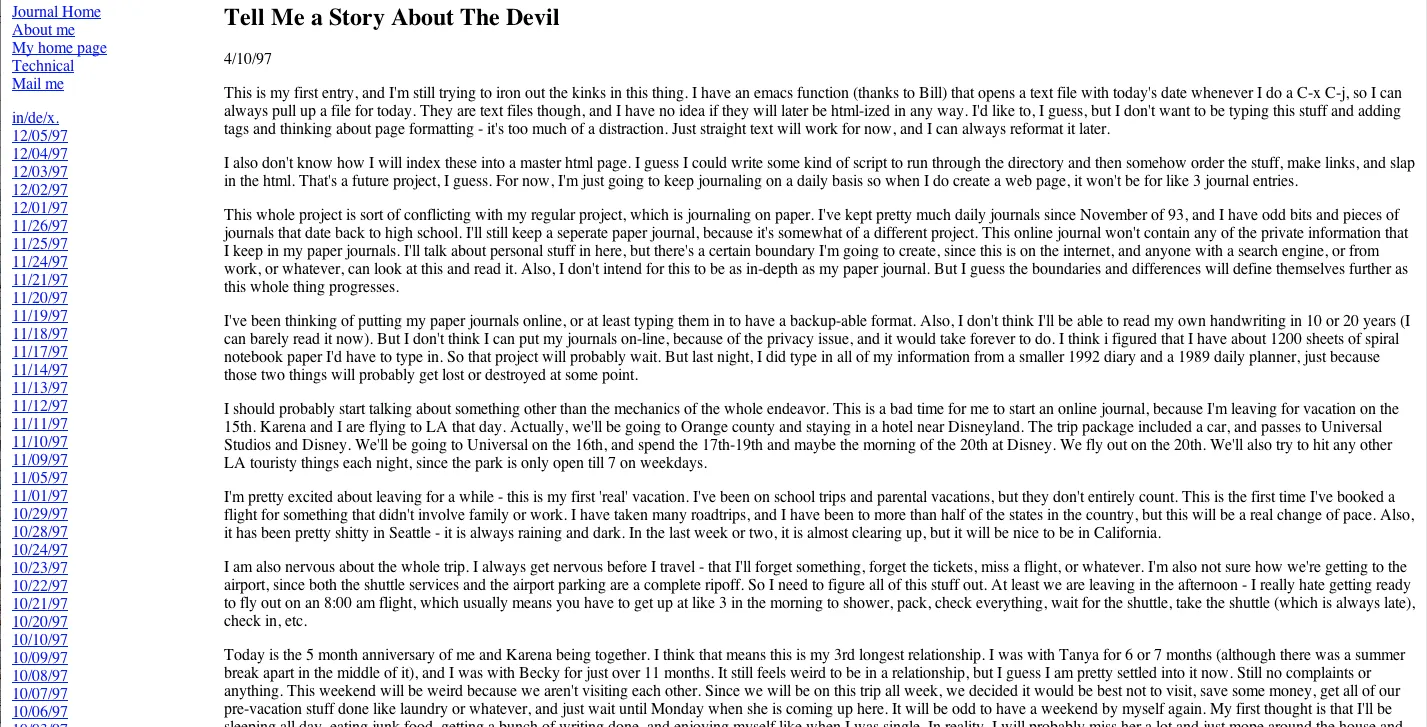
I used to write in these journals, spiral notebooks, every day.  I started doing that in 1993.  I never wrote stories, and it wasn’t a diary either - it was some strange mix of both.  But any writing I did there was trapped forever on paper, unless I transcribed it, which I never did.  So my thought was to move some of this to the electronic world, to create a public web page where I posted some of these entries.

Jorn Barger coined the term “blog” on December 17, 1997.  They didn’t become popular for a few more years.  Livejournal started in 1999; so did blogger.  This diary project of mine was born before anyone knew what the hell a blog was.  I’m certain some other site influenced me to do this, and I didn’t pluck the idea out of thin air, but I don’t remember what I was reading on a daily basis back in 1997.

I did everything in emacs back then: email, book writing, usenet news.  I bugged my friend Bill Perry for some elisp help, and he wrote a little thing that would let me hit a magic key combination and open up an html file with today’s date as the filename.  So I’d hit Control-x Control-j, and the file ~/www/journal/html/041197.html would magically appear.  I then hacked out a C program that I could run and generate an index of all of these pages.  There was no database, no themes, no CMS.  This was five years before wordpress was a gleam in Matt Mullenweg’s eye.  It was rough, but it worked.

So on that Friday, I posted my first entry here.  Back then, this project didn’t have a name.  I called it “the journal” for a while.  It eventually got the name “Tell Me a Story About The Devil”, which has its origins in a Ray Miller story.  The name “The Wrath of Kon” is a more recent change.

I always hated the word “blog”, though.  There was this whole journal or diary movement in the late 90s that everyone has forgotten, and all of a sudden, blogs were “invented” in the early 2000s.  That meant I had a good five or six years of entries, when all of a sudden, everyone and their mother was a “blogger” and started getting book deals and money thrown at them.  So yeah, I was bitter.  But I kept at it.  Now, I don’t give a shit about the term “blog”.  I have bigger fish to fry.

There have been many changes over the years.  My Rube Goldberg mechanism would break on January 1st every year, and I slowly duct taped more functionality to the system, adding a bit of CSS, a comment system, and eventually ditching the entire thing for wordpress.  The page originally lived at speakeasy.org, and moved to 34.216.9.77/journal in 1998.  I eventually dropped the /journal part.  The content also slowly changed, moving from diary entries to stories to news to travel reports and back again.  I never had a solid theme, but I think that prevented me from painting myself in a corner.  I think if I originally would have only blogged about the books I read or a quest to collect every Atari cartridge, this would have died a long time ago.

So.  15 years.  1149 entries.  I think the last time I was able to calculate a word count, it was something like 650,000 words, and Infinite Jest is something like 460,000.  I did a book that collected the first three years, the Seattle entries; I keep thinking about a book that collects some of the best essays of the last dozen years, but I’ve got something on all four burners right now.

Anyway, here’s to fifteen years.  I don’t know many other sites that have been around this long.  I wonder where things will be in 2027.

The Cult of Keyboards

IMG_0080-e1326566626585

As I approach the end of my 40th year, my body is falling apart.  Okay, that may be an over-exaggeration, but every morning, it feels like another piece has been overextended or abused or mutilated, from the various discs in my back to the muscles and joints in my shoulders or arms or knees or toes or whatever.  Ever since I’ve started working from home, poor ergonomics has caused a rash of various repetitive stress injuries.  Or maybe all of the steps I’ve tried to prevent said injuries have caused it.  I don’t know.

I do know that my keyboards have been the main focus of this hell.  I mean, I also bought extensions to raise my desk, a different mount to raise my monitor, and one of those freaky bicycle seat-looking office chairs to prevent me from slouching, and that all helps.  But I think in the last decade, I’ve probably put down about a million words between work and fiction, and all of those go through my ten digits via some kind of USB-connected appliance that’s based on a design originally thrown down a hundred and a half years ago by opium-deranged business machine sadomasochists trying to find a way to keep busy women in between bouts of making sandwiches.  Never mind the fact that we don’t yet have machines that read our minds or let us simply talk to our computers like we’re Scotty whipping up a batch of god damned transparent aluminum. The fact that we still use essentially the same QWERTY design as a century ago, the one that was specifically invented to slow down typists, is a travesty to all things mechanical.

When I got to Seattle in the mid-90s, ergo-mania was happening, and I knew more people who had RSI or carpal tunnel than I knew in Indiana who thought the earth was created 3000 years ago, and that’s a lot.  Ergo was huge, and there were all of these bizarre startups running out of garages churning out short runs of chording keyboards and strange split devices and custom DVORAK layouts, not to mention all of the alternate mouse designs, like track balls and track pads and track pens and track cocks and whatever else.  And this was before the advent of USB, when this stuff became really easy to make, and before Microsoft upped the ante on RSI by inventing prolific right-click menus and then the scroll wheel, two things that have caused more arthritis of the right hand than all of the collected works of Megan Fox.

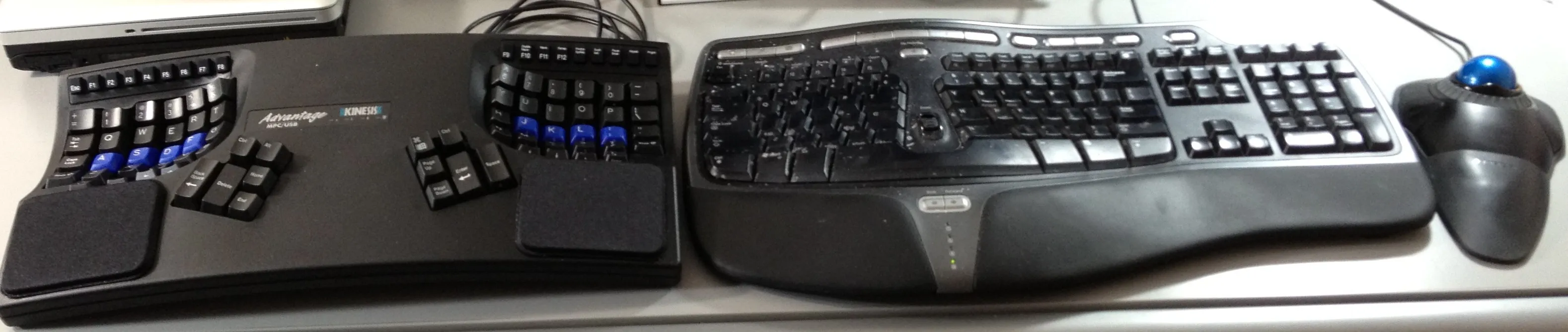
Microsoft both created and destroyed the ergo market by coming out with their own mass-produced split keyboard.  I will give credit where credit is due and say this is one product that Microsoft got mostly right.  I’ve gone through a succession of these split keyboards, most recently using the Ergo 4000, which has a large number of “media” buttons, which are nice for doing things like pausing iTunes or skipping tracks or zooming the browser window.  However, aside from the fact that I go though about one of these a year (mostly because of a combination of eating at my computer and the fact that the letters wear off almost instantly) there’s always been something slightly wrong with these peripherals.

Before the Microsoft models, I went through a series of IBM Model M keyboard clones; in fact, my first keyboard I bought in 1991 was an honest-to-god 83-key IBM keyboard from a 5-slot 5150 PC.  In 2012, there are a lot of issues with these keyboards, aside from just the total lack of ergonomic comfort; you’re not going to find a Windows key or an Apple key, and they use a cable that predates USB by at least two or three iterations.  Most of the vintage ones have also gone from the 90s computer beige to the yellow-brown color of linen in a ten-pack-a-day smoker’s house.

But the switches in these keyboards were magic.  New keyboards don’t use individual switches; they use dome switches, where the keys push this rubbery sheet that contains little bits that complete the electrical connection. The result is a quiet and cheap keyboard that feels like typing while your fingers are suspended in a bowl of mush, and at some point, the little domes will sporadically fail, and every 10,000th character you type will randomly miss, eventually causing insanity and the cost of both replacing the keyboard and the window you throw it through in a maddened rage.  The old keyboards used actual mechanical switches, each one happily clicking with a sharp tactile feel as you snapped away at the keys.  Even if you couldn’t type fast, it felt like you were typing fast.

This introduces this never-solvable paradox that seems to creep up in every damn aspect of my life.  I want an ergonomic split keyboard, that is modern and uses USB and has all of the new keys people use like Win and Alt, and has mechanical key switches.  The Microsoft ergo uses rubber dome switches, and at some point, those fail and cause madness.  It also means that even with a brand new keyboard, it feels like I’m typing underwater.  There’s a whole cult of mechanical switch keyboards, mostly from gamers who need lightning-fast key response.  Those are all standard layout, mostly because gamers only use the WASD keys.  There’s also the issue that these keyboards are all marketed to 14-year-old Asian boys, and have names like the “Viper Frag Kill 9000” and you will pay $200 for backlighting and extra buttons specifically used for Skyrim or whatever.  And outside of Microsoft, the ergo keyboard market has largely been killed.  Add to this the frustration that every single computer sold comes with a keyboard, and because the cheapest way of making them is good enough for a person who types at most 140 characters in a row, the $19 OEM POS is fine for almost everyone.

My problem with this - or with building a kitchen island, or finding the right desk, or getting a set of sliding glass doors done, or whatever the hell else, is I fall down these deep internet k-holes of endless searching and frustration.  There are several internet discussion boards full of game playing fiends touting their favorite boards.  But of course, if you posted asking for a good ergo keyboard, you’d get a thousand responses saying RSI is a myth, kind of like if you went into a random bar in Arkansas and asked the locals about global warming or evolution.  And your first 900 results in a google search are links to the Microsoft Ergo 4000.

This fall, I finally gave up and bought a Kinesis Advantage.  They are not cheap; I spent just shy of $300 for mine.  But they use actual Cherry mechanical switches, and feature a unique split system, where the bulk of the keys are in two “bowls”, and all of the modifier keys (ctrl/alt/win/apple) plus keys like the backspace, delete, enter, and space, all sit under your thumbs.  This means you can do 99% of your typing without stretching your hands out of the home position, and the keys happily clack away to confirm your speedy typing.  The Kinesis also has a complex and powerful system of keyboard remapping and macro programming in its firmware, which I will probably never use.   The one real bummer, aside from price, is that the function keys are these little rubber chicklets that will inevitably get jammed or stop working.  There’s also the issue that I am not historically a touch typist, and I had to spend a month using a touch typing tutor program (the wonderful and open-source Tipp1o) to get to the point where those ring and pinky fingers were hitting the As and Ses and Ls and ;s with regularity.

The k-hole has been reopened lately, though.  I’ve been wondering if there’s a good way to replace those damn chicklet keys.  Maybe I should get a keypad or jog-shuttle control to remap these keys.  Maybe I should get out the dremel and buy a dozen and a half loose Cherry keys and replace the switches.  Maybe I should remap the largely useless Home key so Home-1=F1;Home-2=F2, and so on.  Maybe I should stop all of this and actually write books.  Sure, right after I try to find a Kinesis macro programming FAQ online, and then hem and haw about buying a Griffin PowerMate.