The Wrath of Kon

Dispatches, thoughts, and miscellanea from writer Jon Konrath

Tag: memories

Death of the Concord Mall

IMG_1025-3

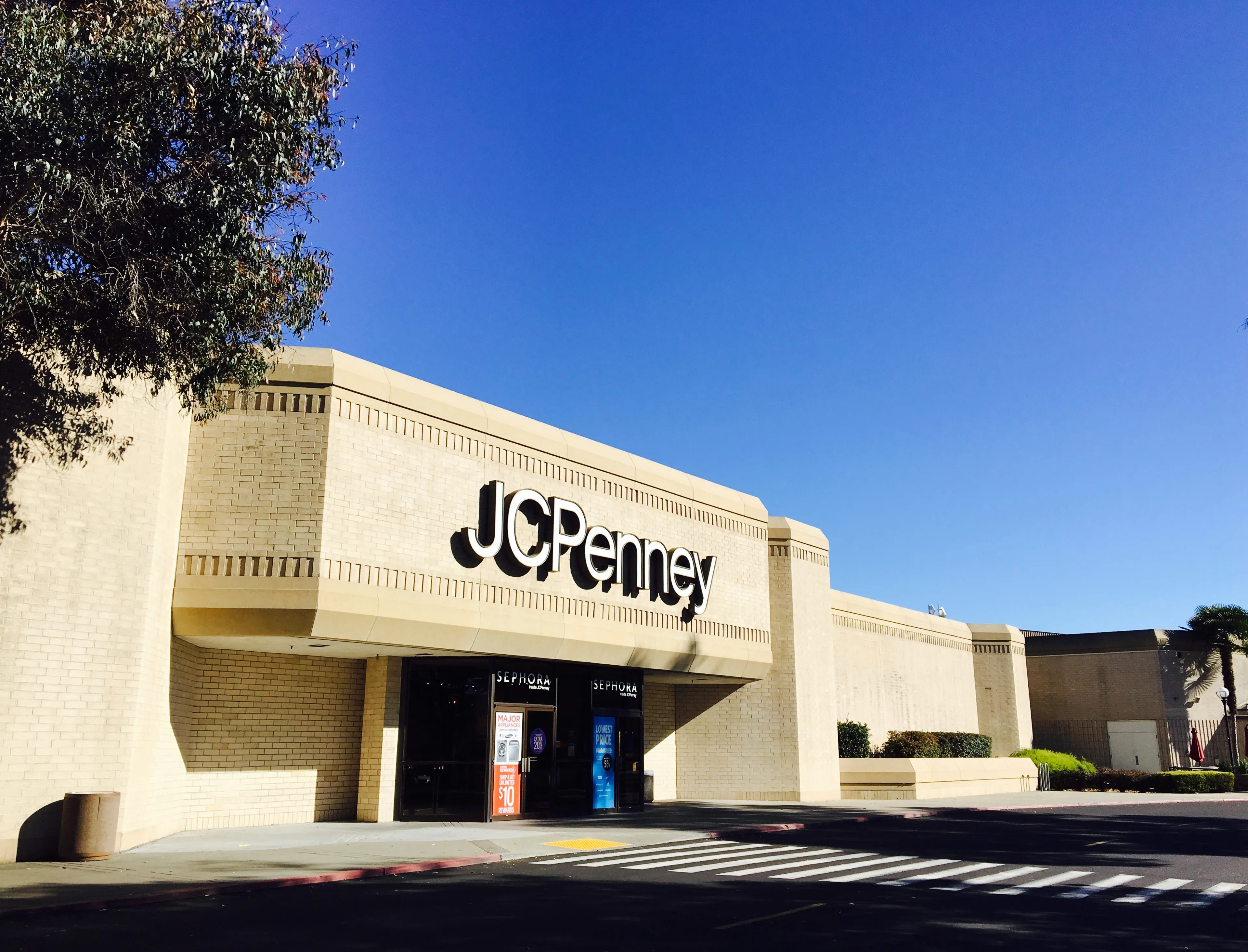
I didn’t hear about this, and I saw it coming years ago, but the default mall of my childhood, the Concord Mall, is dead. I’ve written far too much about this mall in the past, but it’s time for me to drive in the last nail and ramble on about it a bit more, so here goes.

The basics: Concord Mall was built in 1972. At that time, it had two anchor stores, Montgomery Ward and Robertson’s. In 1976, they added a third anchor, JC Penney. The mall was a large T-shape, with a big fountain in the middle. Its current store count (total number, not occupancy) is about 60, although one reference I saw had it up to about 72 at its peak.

I’m about a year older than the mall, and my family moved to Edwardsburg, Michigan, which is right across the IN/MI line, around the time the mall was first built. I have no real memories of it until after the JC Penney was added. In 1978, we moved to Elkhart, about a mile from the mall. So it became my default destination for shopping and wandering around. There were two arcades, and a Kay-Bee toy store, plus the Walden Books sold enough D&D stuff to keep me occupied. There was a two-screen movie theater outside the mall, where I saw a lot of the films of my childhood. I remember fondly waiting in a giant line outside of there to see ET, which took several attempts, because it was sold out for weeks.

As a teenager, I also spent a lot of time there. They had a Musicland, which was lame, and a local record store called Super Sounds. They had a better selection there, and cool people behind the counter. I bought my first CD ever there (Iron Maiden - Somewhere in Time) back when they were still sold in long cardboard boxes designed to fit in LP bins. They also had a Ticketmaster outlet, and I remember buying tickets to see Rush and Metallica there. And there was this metalhead guy Frank who worked there, who would sometimes turn me onto stuff. One time, he was listening to the advance release tape of some band that sounded like Rush, but way more metal. When I asked him about it, he popped out the copy and gave it to me. That was an advance tape of Dream Theater’s first release, When Dream and Day Unite, which I still have.

When I was a kid, I used to walk to the mall. I remember at some point, my parents forbade me from crossing US-33, which lay between my subdivision and the mall. But my friends and I discovered we could walk underneath a bridge where the road crossed  Yellow Creek and get to the mall without technically walking across 33. Later, I had a bike, and then a car. The mall was a routine after-school hangout, although it didn’t have many places to eat. I still wasted a lot of time flipping through every record at Super Sounds, looking for anything on Megaforce records I may have somehow missed.

In my junior year, I became further entrenched when I got a job at the mall. I became a Master Paint Specialist at Montgomery Ward, making $3.65 an hour or commission, whichever was higher. I worked in the Four Seasons department, which also included toys, lawn mowers, snowblowers, lawn furniture, and other seasonal items. I was a part-timer, but after I fell into the groove of things, I was spending more and more non-work time hanging around the store, shooting the shit with other employees, joking with the guys in Automotive and trying (and failing miserably) to hit on the girls in housewares. During the summers before and after my senior year, I weaseled my way into as many hours as possible, working in almost every department. I unloaded trucks starting at 6AM, painted the entire store one summer, worked shifts in mens’ wear, and ran a Nixdorf register in virtually every department of the four “worlds” of the department store.

Working in the mall showed me an entirely different side of the facility. I would sometimes get there before it was open to the public, or when only the inner concourse was unlocked for the mall walkers, all the storefronts gated, with the lights shut off. I stayed after closing all the time, counting down registers and signing in cash and checks after the 9:00 announcements. I used to work a full day, a ten to nine, never going outside, using a 30-minute break to run to a pretzel stand to get a corn dog and fries as my only meal of the day. I still went to school, but I spent more time at the mall and my store than I did at home.

I knew everyone in my store, but also knew a lot of managers and regulars at every other store in the mall. It was a good experience for me, because I was ostracized and introverted as a kid, and didn’t get along with many people at my school, because I felt like an outsider. Given the choice, I would have hunkered down with an Apple II for all four years and ignored the people around me, and I did a fair amount of that. But when I worked at the store, the adults treated me as an adult, even when I was a dumb 17-year-old kid who only cared about Metallica and Megadeth. I learned to interact with humans in a way I should have learned at school, but couldn’t, because I didn’t fit in there.

When I worked for Wards, I saw a few things happen that pointed to the huge wave that would eventually crest, the last big spike of growth in the mall industry:

  • Right before I started there, our store was given a massive makeover. The old yellowing-white tile floors, walls, and ceilings bathed in fluorescent light went out. They moved to more modern-looking eighties-style decoration, with maroons and pastels and cobalts as accent colors, and Helvetica everywhere. I’m not saying it looked cool, but it looked very 1987. And it always pissed off old people. Instead of being a giant rectangle with straight up-and-down alleys like a grocery store, the layout was a very subtle labyrinth, designed by shopping habit researchers to optimize floor space and give psychologically-designed flows through the merchandise. This is a huge science right now, and we were at the forefront of it in 1987.
  • That remodel also included modern point-of-sale systems. No more running a credit card through a carbon copy machine and looking up defunct numbers in a six-month-old booklet. Every terminal was wired to our credit agency, and inventories were also stored and updated in these then-modern PC-like machines. It was the beginning of an IT age in shopping. (And it was one that would - spoiler alert - eventually kill Wards - more on that in a minute.)
  • The paper catalog was killed right when I arrived. This really pissed off the old people, because the Monkey Ward catalog had run continuously since the birth of Christ, and it was suddenly gone. Why? Cost/benefit analysis, and the need to expand the retail business into more profitable ventures, like consumer electronics. It wasn’t Aaron Monty Ward calling the shots with his gut feeling anymore; retail was being run by MBAs analyzing data in spreadsheets.
  • Wards was divested from their corporate owner, Mobil Oil. In 1976, Mobil bought out Wards during the great Fourth Wave of mergers and acquisitions. When I was there, in 1988, there was a management-led leveraged buyout of the company (assisted by GE Capital, who retained half the company), for $3.8 billion. This was rich in the middle of the Fifth Wave of mergers and acquisitions, one that would set the stage for the eventual downfall of almost everyone.

OK, so back to this mall thing - I graduated high school in 1989, went off to college, and returned to work at Wards again two times, briefly: for about a week over the holiday in my first year of college, and then for most of the summer of 1993, unloading trucks from 6-10 AM.

A bit more background on the Michiana mall thing, too. There were four malls in the Elkhart/Mishawaka/South Bend area. Aside from Concord, Elkhart had Pierre Moran mall, which was in the bad part of town, and had Sears and Target as anchors, and a cool record store, but not much more. South Bend/Mishawaka had Scottsdale Mall, which was a double-decker with a much bigger Wards, a Target, and a fair amount of other stuff. The big one was University Park, right by Notre Dame, and it had everything.

So Peak Mall was about when I worked at Wards in 1993. First, Simon Property Group was formed in 1993, and they bought every mall they could find in this era. University Park is still a Simon mall; Concord was*, and I’m not sure of the others. But this was a time when malls were apex predators of consumerism, after we’d gotten out of a recession, when personal consumption was up and continuing to grow. There was no online, and catalog business was dead. Wal-Mart and other big-box stores were just finding their footing. And after the big decade of the mall and establishment of mall culture, suddenly these large public companies were ready to double down and rush into a huge arms race of spending that appeared like it would have no end.

[*I may be hallucinating Concord ever being a Simon mall. I’m probably confusing it with College Mall in Bloomington, which is still a Simon mall.]

In my microcosm of these four malls, there were varying developments. University Park, roughly twice as big as Concord, continued to grow, and expanded. (Also, oddly enough, all of its big-box competitors like Meijer, and eateries like Red Lobster, Famous Dave’s and Olive Garden, popped up around the mall, but only seemed to make mall traffic surge.) Scottsdale, which was now poised on a new bypass road for US-20 and much easier to get to from Elkhart, expanded in this timeframe, adding a large multiplex and food court, plus redecorating. Pierre Moran painted their awnings blue. Concord added a new bathroom by the mall office, and waxed the floors once.  (Also, don’t fuck with me about exact dates and changes here. I’m writing this from memory.)

I left Indiana in 1995, and only saw the four malls on the occasional Christmas visit home. But the bottom line is that shopping habits changed. People were more content going to Wal-Mart, and later buying everything online. All of the malls (except University Park) fell apart. Major tenants went bankrupt and weren’t replaced. Other big tenants with new overlords or strategies moved to nearby locales where they could build new stores with more optimal freestanding layouts, usually in neighboring townships or cities where tax dollars and incentives were to be had.

The wheels fell off of Montgomery Ward in the late 90s. They filed for bankruptcy in 1997, with GE grabbing ownership of the whole company. Three years later, they closed their doors. The simple answer here is Wal-Mart, with a touch of Target. But really, the quicksand was much deeper. Remember that IT thing I mentioned? Wards went through a massive IT retooling in the mid-90s, spent way too much money on it, and it didn’t work out. Also, remember when I said they got into more profitable things like consumer electronics? Well, the margins fell out on that stuff, and it wasn’t profitable anymore. You can dig further and argue about how Wards stores were not as well-placed as Sears, and that the management had some borderline racist tendency to buy into locations further out from urban centers. But it was basic math: sales were down, profit margins were smaller, and too much money was pumped into a bleeding company that had massive debts from its leveraged buyout. (See also: Sears, Toys R Us, KB Toys, Circuit City, and 768 other recent retail deaths.)

Scottsdale Mall in South Bend never recovered after its Wards closed in 2000. They also lost another major anchor, L.S. Ayres, and floundered headless for about four more years. It was then de-malled, the building bulldozed and turned into an array of freestanding big box stores. Pierre Moran suffered the same fate a few years later; its Target bugged out for a new Super Target in an unincorporated area outside the realm of higher city taxes between Goshen and Elkhart. Its Sears and a new Kroger were made freestanding, and most of the rest became a parking lot for some little storefronts that never found tenants. University Park grew like a monster, adding a giant food court area, a huge Barnes and Noble, and upgrading the interior, while upping the roster of premium stores. (An Apple Store! A Tesla charging station! Is this still Mishawaka?)

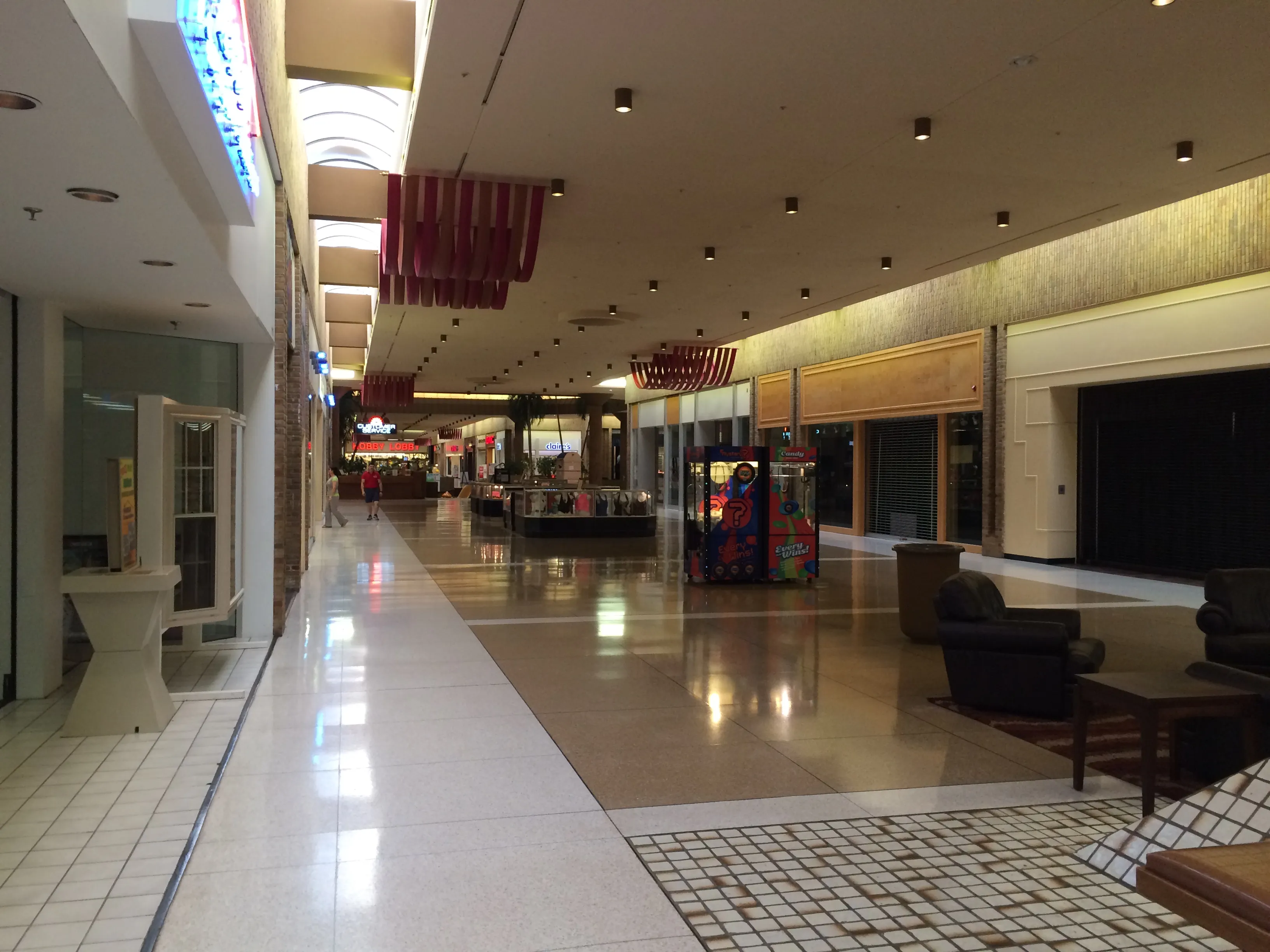
Concord Mall never entirely recovered, but it still struggled. The Wards was sliced into multiple stores, the largest being a Hobby Lobby. The big fountain in the center of the mall was removed. The Osco’s drug store in the mall left, and was replaced with a food court that only had one tenant, a Subway. Much of the mall’s interior never changed, the same tile and brown wood trim that was in the mall in the seventies. Some stores vanished because they vanished from every mall in America: Musicland died; Walden Books went bankrupt. KB Toys was Romneyed into bankruptcy by Bain Capital. I don’t know if Aladdin’s Castle or Time-Out arcades still exist as a legal entity, but they vanished from every mall I’ve seen, including Concord. Other stores just spiraled down into low-rent alternatives. Jewelry stores became dollar stores. Boutique clothing stores became televangelist churches. Music stores became storefronts with nothing but vending machines in them.

I was at the mall in August, and was amazed at how many of the stores were closed. JC Penney is still there, as is the Hobby Lobby and whatever department store is now in the Robertson’s spot. The only other remaining stores I can remember: Enzo’s pizza, GNC, Jo-Ann Fabrics, and that’s about it. I can see some of the remains of stores, like the Super Sounds location’s wood walls are still evident in the bakery currently there. But it’s like a ghost ship now, empty and sad.

The plan now is to de-mall Concord. They are spending $50 million bulldozing the building, leaving the anchors, and building some freestanding stores as a “community center.” There are no named anchors or new stores, and apparently nobody even told the tenants of the mall until it hit the news. This approach is laughable, because like I mentioned, both Scottsdale and Pierre Moran de-malled, and both of them are ghost towns of empty stores. More than half of Pierre Moran (now Woodland Crossing) is vacant. Scottsdale, now Erskine Village, was recently sold at a sheriff’s sale when the owner stopped making loan payments. And while Elkhart’s unemployment numbers are down at the moment, it’s an incredibly streaky economy of all industrial jobs related to the RV industry. The next time gas prices fluctuate, the entire region will be wiped out again, like it was in 07-08.

I think the saddest part of it all is that the community is gone now. It’s easier for people to sit in front of their big-screen and click on the Amazon web site, along with a weekly resupply run to Wal-Mart for BluRays and high-calorie frozen foods. Elkhart doesn’t even have movie theaters anymore, aside from the Encore 14 north of town, which has been falling apart for 20 years. It seems like life there is entirely encapsulated and isolated. I mean, I left the state for a reason, but it’s distressing to see the end-stage capitalism unspool and see the last remnants of my past vanish.

I feel silly clinging on to these memories, and need to stop, but this is the last gasp of it, so there you go.

[Note: this is from 2016. You might also want to check out 2018’s Death of the Concord Mall, Redux)]

Recent k-holes: maps

I’ve been falling down some horrible nostalgia k-holes as of late. Here’s an exercise you should never do: go find the toys and games and things that completely obsessed you at the age of about twelve, find the addresses of the corporate headquarters offices of their makers, and plug them into Google Maps. The total disconnect between what you envisioned as a child and what these places look like now are phenomenal.

I think there are a few reasons this fascinates me. One is, I never travelled much as a kid. Any preconceptions about any area outside of northern Indiana/southern Michigan or Chicago was either based on TV, or just a guess. I never had any spatial awareness for any other geographical areas of the country. When I was playing with Star Wars toys and somehow found out they were made in Cincinnati, in my head, that meant WKRP, and Les Nesmond’s domain was the same as where my Han Solo was injection-molded. Never mind that the show was a loose montage of stock footage for the establishing credits, and then some sets at CBS Television City in Los Angeles. (If you’re curious on this one, btw: http://www.kennercollector.com/2013/12/kenner-tour-of-cincinnati-kenner-street/)

Another thing that informed these thoughts is that these toys and things were everywhere, so I envisioned massive operations, Detroit-sized city-factories, pumping out GI Joes and Milton Bradley board games. In reality, most of these were small operations, with a few dozen people working on a couple of machines. I probably should have known this, given that my dad worked in a factory, except instead of Hot Wheels, it was pumping out PVC pipe fittings. But they could have just as easily swapped out the molds in their machines and injection-molded Atari joystick pieces or whatever else.

Here’s a couple of examples of these rabbit holes. One, I was into model railroads as a kid. It was a passing phase, somewhere between Legos and model airplanes. I was never that interested in the train aspect, more the scale model stuff, but I also enjoyed the electronics, and the track layouts. One of the big names back then was Atlas Model Railroad. When you got the pre-packaged oval-track train set on Christmas, it was a Tyco. (Or Lionel, if you were O-scale.) But when you went to Kay-Bee Toys or a local hobby shop, Atlas was the big ubiquitous brand of cheap add-on track, running gear, and other accessories. If you read the train magazines, they worshipped the expensive imported German trains, or scratch-built stuff, and eschewed the Atlas stuff because it was cheap or not as detailed. But I wasn’t a retired dentist and didn’t have the cash, so Atlas it was.

And although I bought a lot of their track, the big infatuation back then was their layout books. They published these paperback 8.5x11 blueprint books with a bunch of different track designs in them, things that would fit on various table sizes. The books were well-illustrated, lots of details, and most importantly, had parts lists of everything you needed to build and wire the setups. Of course, these were all intended to get you to go buy more Atlas stuff, and it worked, because I would make endless lists of part numbers and pieces I needed to buy with my allowance. I would get so lost in those books, even though I never fully built any of those layouts. I just enjoyed reading the blueprints for hours, dreaming about what I could build if I had an unlimited budget and way more space.

So, in my twelve-year-old head, I always thought about the Atlas headquarters when I saw the address in the corner of a package or book. They were in Hillside, New Jersey. New Jersey was right there by New York. And I’d seen Ghostbusters, so of course I knew exactly what that looked like. I envisioned the Atlas empire as being something like the Chrysler Building, a hundred or so floors of people packing up HO scale snap-track in yellow envelopes and shipping them off to the sixteen billion stores that sold the stuff. Well, not quite. First, I didn’t know back then that New Jersey wasn’t New York. It’s not twenty square miles of bedrock with massive skyscrapers; it’s thousands and thousands of square miles of warehouses and single-story homes and suburbs sprawled out in every direction.

So, plug in 378 Florence Ave, Hillside, NJ 07205 and you get an unassuming two-story brick building, about the size of a bowling alley. At first glance, it almost looks like a junior high school, and resembles half of the factories near where I grew up, with a single semi bay and a parking lot for a dozen and a half employees. It’s right off the I-78, around a bunch of postwar cape cod houses wrapped in vinyl siding, maybe two miles west of Newark Airport. I haven’t even thought about model railroading in decades; I’m sure they still do great stuff. But the reality of the company is such a disconnect from what I thought of as a kid.

Seeing this building and the surrounding neighborhood is such a strange look inside something hallowed from childhood, something I could never see in the pre-internet days. Sure, looking at a Google Maps photo sphere of Pyongyang, North Korea is astonishing and bizarre (another k-hole to fall down…) but slicing open a childhood memory like that and attaching a completely different context to it is oddly mind-blowing. I mean, I flew in and out of Newark many times; I took the PATH over to Jersey and walked around, drove a car through the suburbs and probably ate at the Taco Bell just around the block from that place. But it’s a weird words-colliding thing to think about that now.

Here’s another big one: D&D. Like most geeks, I was stuck on Dungeons and Dragons back in the day. (Unlike many people who now say they are geeks, this was when geeks were geeks and you’d get the shit beat out of you for being into stuff like D&D.) From maybe fifth to seventh grade, I was infatuated with all things TSR, and I was sure that Gary Gygax and crew hid out in some Tolkein-esque castle surrounded by thousands of acres of meadows and caves. Even the name Lake Geneva, the city in Wisconsin from which they hailed, sounded palatial, like its namesake in Switzerland. I remember once when we drove to the Wisconsin Dells from Chicago, and passed a sign for Lake Geneva on the 94, and I freaked out at the thought of being right there, near where my Monster Manual was originally penned.

TSR had a more rocky history past those days in the early 80s: the ousting of Gygax (see this), the ups and downs of board gaming (and the video game crash), and the eventual purchase of the failed company by Wizards of the Coast. I have no interest in WotC’s corporate offices in Renton, because that was way after my dreams ended. (In fact, I lived in Seattle at the same time they bought TSR. And plugging their Renton, WA address into maps shows me a building that looks almost exactly like every other software company in the 90s in Seattle.) So I had to do a little more digging, but I found more.

I won’t write you a whole history about TSR, because a lot of other people have. But from this article, I found that one of the headquarters was a building on Main and Broad that used to be called the Hotel Clair. The first floor had a game/hobby store run by Gygax, and the top two floors had creatives, designing away games and modules and books. This three-story brick building looks almost identical to most of the storefronts in downtown Elkhart where I grew up, or any other small city-square town in the Midwest. My mom worked as an interior decorator in a building like this; the other buildings had insurance salesmen and stationery stores and banks and dry cleaners. They did not seem like a place that would hold the mecca of all role-playing games of the 1980s.

TSR outgrew this space, and found a warehouse at 201 E Sheridan Springs Road. This looks even more like the factories I knew from growing up, two connected, low-slung buildings with a large parking lot in the front. The building next door’s current occupant is Wisconsin Precision Casting Company, which seems like it could be in either building. TSR wasn’t in some huge Disney-esque building in the shape of a dragon, but in an anonymous warehouse that could have held a plumbing supply company or a place that did fiberglass extrusions for the mobile home industry.

The TSR thing is odd to me, because the worlds created in each of these games and books and modules were, in my mind, as big as the world I was in sometimes. And to think about a bunch of people creating these things, one after another, was mind-blowing to my twelve-year-old self. There’s already the time distortion of youth that causes these things to be so much bigger. But these huge and infinite worlds were created by a few dozen people in hundreds of square feet of below-average commercial real estate in small town America. I felt like companies like TSR, or Commodore, or Coleco were on another planet, a thing much bigger than my small town. But in reality, it was pretty much the same place.

Not that much else to say about this, except that it’s a bottomless rabbit-hole. I don’t even want to start looking at where the original Atari 2600s were built. I’ll leave that as a homework assignment to the reader. (Hint: start reading here.)

Dead Mall: Vallco Mall Cupertino

IMG_2171

I had to go to Cupertino last week for a work bowling party thing. I followed the GPS to a Bowlmor, parked in a garage, and realized it was actually an anchor to a large mall. I had a few minutes to do a quick lap, and suddenly realized I’d chanced upon the most elusive dead mall situation: a huge mall that was in it’s final moment of end-stage death.

I’m fascinated by malls. It’s always bugged the hell out of friends that I travel a thousand miles to some new place and want to go to a mall and not buy anything, but it’s an unfortunate illness of mine, and I can’t escape it. I grew up going to malls, then I worked in one as a teenager, and spent all my time in a Montgomery Ward, or wandering the concourses during breaks. Even on days off, I’d go to work just to hang out. Or I’d drive to any of the other malls, to see the competition, and people-watch. It was the 80s, and malls were the biggest part of our cultural zeitgeist. Even in the 90s, I would find it almost meditative to go to College Mall in Bloomington or Northgate in Seattle and walk the loop, look at consumerism in action, and maybe get a pretzel or a book.

This all slowed down in the 00s. First, my default mall in New York was destroyed back in 2001, when a combined 220 stories of skyscraper fell on it. But aside from that, malls across the country crumbled. People shopped online; commerce went to big box stores; and the mighty anchor tenants all started to die. It became a quicksand situation where people stopped going to malls because there were fewer stores, and more stores closed because fewer people were going to malls. The massive indoor palaces were no longer updated, and when the seventies and eighties decor got too aged and the land underneath became too valuable, they were all “de-malled” and bulldozed under, usually to build a series of disconnected big-box stores or strip malls lacking the character or presence of a singular building with common areas.

I’d never been to Vallco Mall in Cupertino, but its history is similar to most. The mall was built in 1976, then expanded during the big boom in 1988. At its peak, it had about 200 stores, including five anchors: JC Penney, Macy’s, Sears, AMC, and Bowlmor. At one time, it also had an ice skating rink, and there are/were a variety of food options, hotels, and condos around the complex. I don’t have the full chronology, other than scattered news articles and a poorly-written Wikipedia article, but it appears it went through the standard lifecycle of a mall, including a long slide in the 00s, owner bankruptcy and buyout in the late 00s, more additions and seismic refitting, and various legal battles about expansion and condo-ing.

And now, the de-malling will begin. After much complicated legal wrangling, the plan is to destroy everything and build The Hills at Vallco, a two-billion dollar fake city square mixed-use monstrosity, with a huge green roof, expensive condos, an organic farmer’s market, upscale retailers, vegan yoga classes, green energy, and whatever catch phrase you can throw in to pull a more affluent demo. The interesting thing about all of this is that Vallco is in an incredibly prime location. It’s right next to the Apple corporate campus, in the heart of the 11th-wealthiest city in the country. In the past, Vallco was one of the only malls in the South Bay. Now, there are several, plus malls are a dying thing. I rag on the new plans, but the renderings do look nice, and it probably fits in better with the character of the town.

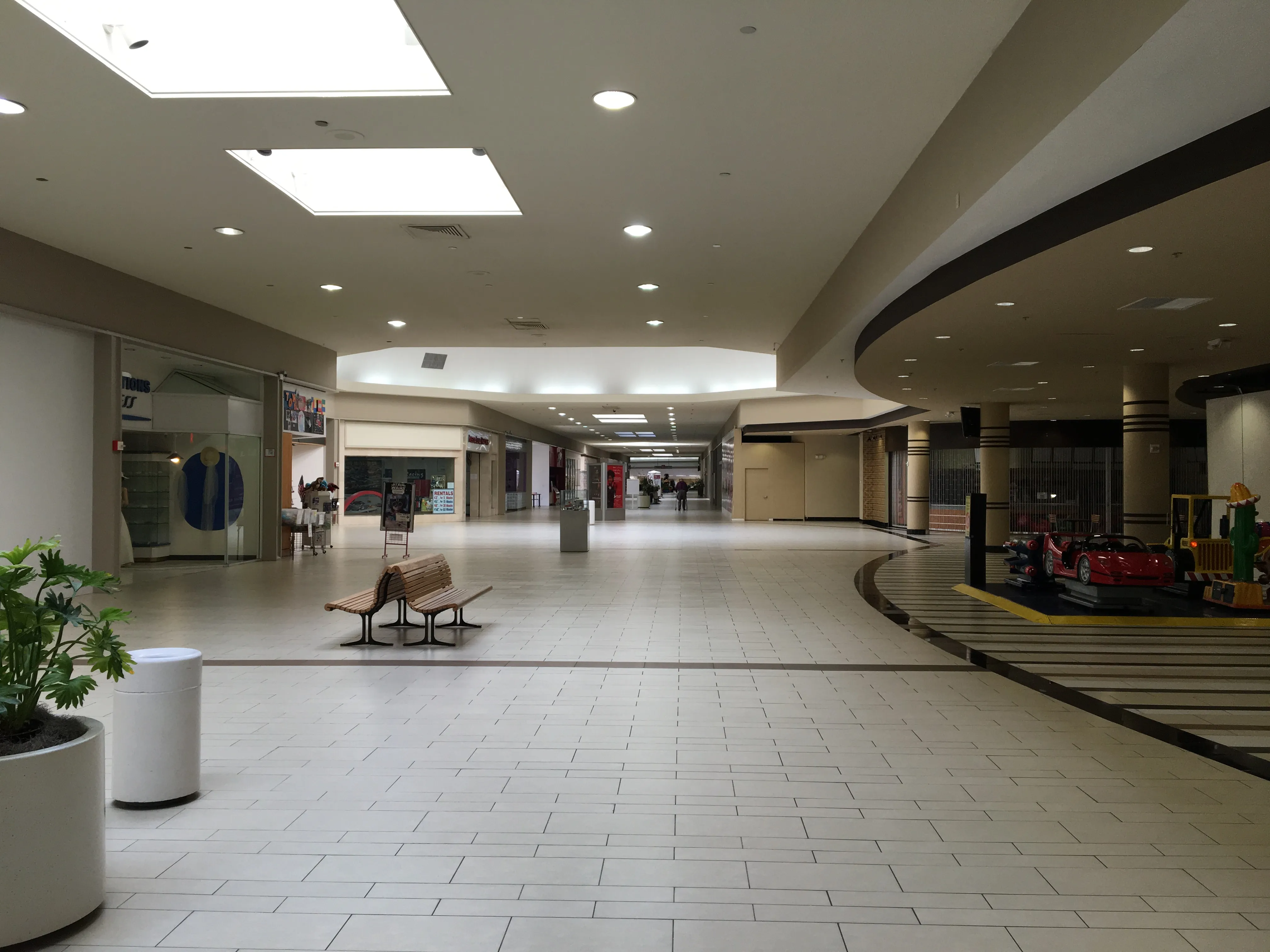
When I walked around last week though, the mall was absolutely heartbreaking. Of the 200-some stores, there were maybe a dozen still operational. It looked as if the mall was not renewing old leases, and letting them time out as they ended, so most of the residents were now gone, but there were a few stragglers remaining. Bowlmor was still alive, and the JC Penney was still fully operational, but both Macy’s and Sears had bugged out, and were completely stripped and boarded shut. There was a huge food court with maybe three dozen stalls, all empty except for a single taco place. A role-playing game place and a comic store were still fully operational, but completely devoid of customers. There was an indoor slot car racing place going, which is an oddity in 2016. But there wasn’t much else.

The mall had such an eerie, haunting feeling to it, though. The bones of the mall, the concourses and hallways and escalators, were all completely normal, running, clean, and decorated. But the style of the mall was very much 1993. Most malls got some injection of life around that time, expansion and facelifting, and it looks like they did this here, and it was frozen at time in the early Clinton years. Nobody was there when I visited at lunch time; I think I saw two geriatric mall walkers, and nobody else. It reminded me of being in a mall when I worked there, at 6AM before even the security guards were present, when everything was shut and locked and powered down. It very much gave me the feeling I wasn’t supposed to be there as a civilian, that I’d accidentally stumbled through a locked door and at any moment, a security guard would show up and usher me out. But everything was completely open for business, lights on, main doors unlocked.

The stores were another matter. Some were completely gone, the interiors torn out, bare to studs, the fronts taped shut, wrapped in plastic. Others were cleared out of all merchandise, but signage and racks still remained abandoned. And others looked like they closed for the evening a year ago, the night gates padlocked, but the store collecting dust, like something out of Chernobyl.

The whole thing was nostalgic and bittersweet and horrible. I’ve had a terrible problem with nostalgia recently, spending far too much time thinking about my own past in the 80s and 90s - not wanting to go back to that, but wanting to somehow explore it or write about it. It’s a terrible waste of time and bandwidth, and it’s honestly very emotionally painful. It’s a symptom of The Crisis, which I keep hinting at but haven’t been fully able to write about or wrap my head around. I almost mourn the feeling of having these communal things in my life, now that they are gone and we’re forever compartmentalized into our web browsers and tightly isolated social networking communities. I saw these monstrous commercial communities run from the inside out, and then they all suddenly vanished.

And it was so strange to stumble across one, trapped in amber like this. It wasn’t like when I go to a random midwestern mall that’s been beaten and fucked, all the prime retailers gone and the places left to cash-for-gold and dollar stores that bring in nothing, because the entire town has shifted in location and moved to far suburbs, leaving the mall to go to seed. Those have a feeling of desperation and real deer-in-headlights failure. This was much more surreal. I mean, this was a mall where a 16-screen AMC multiplex was just built in 2009 - like since I’ve arrived here - and it’s about to get torn down. It was like looking at a very late model car that had been totaled, like when you see pictures of a Lamborghini Aventador that has been flipped eight times. Parts of it were trapped in time at that high point of mall culture, and parts were already gone. It was a really hard thing to reconcile.

Anyway, more photos here. If you’re a local and want to check it out, do it immediately, because the place probably only has a few weeks left.

Hated: GG Allin and the Murder Junkies

I remember buying a copy of Hated, the Todd Phillips documentary about GG Allin, in 1995. It was right after my last student loan disbursement, and I bought a copy on VHS at Karma Records for some outrageous price, like $40 or $50. Blockbuster didn’t have this one as a rental, and this was way before torrent, so I ponied up full price and bought my own copy. I was with my pal Larry, and we went over to his apartment and watched the tape, hoping for some insane footage of the then-deceased shock rocker.

I remember at the time being somewhat unimpressed by the movie; this was before YouTube, which made the notoriety of characters like Allin much larger. Unless you caught the Geraldo show or traded video tapes with someone who recorded it, the only exposure (no pun intended) to GG’s antics would be third-hand, like the way urban legends used to be spread. That’s where I heard about him — I used to hang out in this bagel shop with this punk guy named John, and in 1992, while he played Hated in the Nation on the store jambox (much to the chagrin of the store patrons) he told me all about this guy who ran around stage naked, beating up fans, shoving the mic up his ass, and cutting himself with bottles.

I remembered the movie as being a bit flat, not capturing this rawness, and being a bit of a let-down. After the first viewing, I almost completely forgot it. It’s something that pops in my head when I fall down a k-hole about GG or old New York, but I haven’t revisited it, until yesterday. I was pleasantly surprised at what a nice little time capsule of the early 90s New York this has become.

Hated was directed and produced by Todd Phillips, who later became an accomplished Hollywood director of such films as Old School and The Hangover. But this is anything but a Hollywood blockbuster. It was filmed when Phillips was a junior at NYU (and employee at Kim’s Video) with a budget of only $12,000. The film looks like a student film, and is even more dated now, in a pleasant way. It resembles 1970s news footage shot on film, then tele-cined to betacam video and back to film again, with old pre-computer titles and washed out lighting.

My first thought on this was that it reminded me of a Nick Broomfield movie, like Kurt and Courtney, which I also saw recently. It had the same feel, with voiceover between segments, establishing the story. Phillips isn’t actually in the film, in the same way Broomfield does the on-camera gonzo interviewing. But I looked it up and there’s a good interview on the Suicide Girls site where Phillips said Broomfield was a huge influence for him to get into documentary.

Another reason I really liked this film was it captured a New York that is now gone, an early-90s lower east side grimy New York. If you consider a generation to be twenty years, New York moves at five times that speed; a mayoral term is four years, and the average restaurant lasts a year. At any given point on Broadway, every business will have turned over in four years. When I arrived in 1999, there had been at least two cycles of this renewal, and there were only small hints of this old world for me. It was like standing in an average city in 2000 and thinking about 1960, like the level of nostalgia Mad Men brought about, any time I would see a speck of graffiti from the era of this film. So I really loved the washed-out views of St. Marks and alphabet city in this.

(Side note: GG’s last show was at a club called the gas station at 2nd and B. Here’s a great article about it, with some film: http://vanishingnewyork.blogspot.com/2015/01/2b.html. The site of this infamous club is now a Duane Reade and high-end condo.)

The film is hilarious, in an unintentionally hilarious way. GG’s brother Mearle and other various hangers-on are over-the-top bizarre, and even though they are being straight-up serious, I could not stop laughing at them. It’s a total Jerry Springer guest type of humor, but the film takes it further by showing the various scatological antics of the crew. It’s not for the squeamish; like there’s a scene where they get a hooker to piss in Allin’s mouth at a barbeque, and he starts puking up beans and franks while she’s squatting over him and urinating on his face. So it’s not exactly family entertainment.

The film in general though made me think more about who the “real” GG Allin was, and if such a persona could survive in today’s always-on media. Phillips has professed that Allin only acted the way he was when he was drunk or high, and that drugs fueled this persona. He claims that when he was sober, he was a calm and rational guy you could hold a conversation with. It seems like in the days of paper news and videotape journalism for only an hour a day, it was easier to ration out his antics, to only go insane and knock teeth out for a rare show, or save the “I am Jesus and the Devil and I will die for rock and roll” speeches for televised court appearances. Could he have kept up the persona in an era of TMZ, 24-hour news cycles, and every passer-by carrying a video-enabled iPhone? Would he have killed himself much sooner? Or would he have become a person like Marilyn Manson, who had a brief tenure as a crazed satanist, then vanished from the limelight and spent years holed up in a mansion with various Hollywood starlets?

I feel like GG was close to his persona, the product of deranged parents and crippling substance abuse issues. But I also think it could have been the ultimate Kauffman-esque ruse. Most people dismiss his music as noise, but sometimes I listen to Hated in the Nation and think this stuff is far too catchy to be written by a completely blotto drug addict on the verge of murder/suicide. And I wonder if total exposure in the media would have cracked the shock-rock image and showed a person behind it.

At any rate, this is worth seeing if you’re interested. I believe this was re-released on DVD with more footage from GG’s funeral, although once you fall down a YouTube k-hole, you’ll see it there, too. (A good starting point is this three-part camcorder video of the riot ensuing after GG’s last performance at the gas station: https://www.youtube.com/watch?v=3F9yk8X1TAw)

The Wolfpack

(I have a half-resolution this year to try to write down something about every movie I watch, which I’ll probably stop doing by mid-January, but it’s only the third, so bear with me.)

The Wolfpack is a documentary about a group of seven kids who were never allowed to leave their New York apartment, and were homeschooled and cloistered by their weird hippy Peruvian father and slightly altered mother (played by Gary Busey.) The kids, unable to see reality, fell into a world of Hollywood films, and spent all their time remaking old classics like Reservoir Dogs and Pulp Fiction shot-for-shot, using cardboard props and cheap camcorders. Then the oldest son decides he wants to explore outside the apartment, and the whole thing falls apart, or comes together, I guess.

The situation is an interesting premise, although I didn’t feel there was enough content to fill a 90-minute film. The director, Crystal Moselle, took a more poetic structure to the documentary, instead of being expository, and the more artistic approach didn’t hold my attention, and presented more questions than answers. (How much was their rent? Where did they get money? What happened to everyone after the film? How did they do things like go to the doctor?) Also, the oldest kid, Mukunda, looked enough like Adam Driver that it really bugged me (especially after Star Wars) and I spent the second half of the movie playing Scrabble and making jokes about this. So yeah, I’m the asshole for not paying more attention, but it didn’t fully click with me.

But here’s what did throw me, and made me waste half the movie scouring Google Maps: these kids lived a few blocks from the last place I lived in New York. For those interested, they lived in Seward Park Extension, which is at 65 Norfolk Street. I lived in Seward Park, at a building at Grand and Pitt.

I don’t know the exact history of Seward Park, but they lived in a much more run-down public housing building, whereas we lived in the co-op buildings. (Also weird trivia: one of the guitarists of Guns ’N Roses lived in my building, which would have been a weird mindfuck for these 80s-obsessed kids.) But yeah, while they were locked away on the 16th store of that building, I used to walk past it almost every day on the way to work. Maybe their camcorder footage of the streets below has an image of a dude with coke bottle glasses and a leather jacket, walking to the McDonald’s on Delancey to shove another Quarter Pounder meal into his fat face.

There are the usual allegations of “is this fake” and “was this exploitative” and I don’t care either way. All documentaries are fake now, and they all exploit someone; it’s a carryover from reality TV, and it’s why they largely bore me. As a metafiction nerd, I’m much more into reflexive documentaries, that play with the idea of their constructedness and dance around going meta with it. David Holzman’s Diary is my favorite example of this, although good luck getting anyone to pay attention to a film that bizarre.

This ultimately didn’t blow my skirt up, but I did enjoy the random bit of scenery reminding me of my old home. There’s a brief bit where Mukunda breaks free and goes to the grocery store, and I was thinking “oh my god, that’s the Swine Fair on Clinton Street!” So, interesting, but a bit of a nostalgia trigger, and not much else for me.