The Wrath of Kon

Dispatches, thoughts, and miscellanea from writer Jon Konrath

Tag: memories

Donald Cried (2016)

Donald Cried is a film in the “you can never go back” camp, but it’s also more about the estranged relationship between two friends who were inseparable as teenagers, but took completely different paths into adulthood.

Originally a short by independent filmmaker Kris Avedisian, this was expanded to a feature-length affair with the help of a successful Kickstarter campaign. The film starts with the protagonist Peter returning to his home town in Rhode Island to handle the affairs of his recently deceased grandmother. He left the small town a dozen years before, and went to New York City to reinvent himself, forget his past, and work on Wall Street. The problem with his quick overnight trip: he’s lost his wallet, so he’s stuck at his grandmother’s old house with no cash, no ID, and a to-do list of funeral home, nursing home, realtor, and everything else involved in closing the last of his involvement with his old life.

With no other options, he turns to his last lifeline, and meets up with his old pal Donald, who he hasn’t seen since high school. Donald is a stoner dropout who lives in his mom’s attic, works part-time at a bowling alley, and is the opposite of Peter, stuck at the same point he was back in the glory days of high school. We quickly find out that Peter was once cut from the same cloth, and had the same love of heavy metal and juvenile delinquency. Peter just needs a ride to pick up his grandma’s ashes and empty out her nursing home, plus a few bucks for bus fare back to the city. Donald is ecstatic about the triumphant return of his old friend. Antics ensue.

I always have a certain nervousness when returning back to Indiana, and that’s captured too well in this film. It’s a mixture of “this could have been me” and flashbacks of the past that bring out the “man, I was an idiot back then.” My nostalgia issues are a bit contrary to Peter’s in the film, though. He’s trying to remain unseen, and not get entangled in the past. For example, the realtor he gets is a woman he went to school with, and that he had some feelings for back in the day, but he initially acts as if he doesn’t remember who she is at all. I’m not saying I seek out people and reunite with them (I did have an ex-girlfriend sighting at a mall a few years ago, and I ducked in another store to escape) but I do seem to seek out old landmarks and get too mentally involved with the ghosts of the past.

The real star of this movie is Avedisian, who plays the character of Donald. He’s this lanky, bearded guy with an awkward Ray Romano-sounding voice and a Keith Moon haircut, and he’s completely cringe-worthy in his total lack of a filter. This starts as a truly hilarious character, like a Mark Borchardt from American Movie, except with no ambition to make films. At first, he’s just the funny guy to the straight guy, but then you become sympathetic to him, feel sorry for him. My feelings bounced between “wow, what is with this dude” to “wow, how could Peter help this dude get his shit together.” And the latter is a strong one for my personal experience, so it really got me.

The small town setting was also big for me. Warwick isn’t a “small” town — it’s the second-biggest city in Rhode Island. But, it’s only 80,000 people, and what is captured in the film is the small town feeling of cruising at night, bowling alleys and convenience stores, little houses, and that feeling that a lot of people never leave, never forget high school, never move on. The duo go, on Donald’s insistence, to visit another one of their high school buddies. When they get there, he’s sitting in bed, unmoving, watching cage fighting matches on TV, like he’s never left the house in fifteen years. Or there’s the bowling alley manager, a burly guy actually played by former WWF wrestler Ted Arcidi, who’s in his office showing a teenaged cashier his grainy VHS tapes of when he used to be a powerlifter back in the Eighties and could bench 700 pounds. It’s an interesting backdrop, and really sets up why Peter left, and why it is such a strange yet compelling place to visit.

Overall, I have only one big problem with this film: I wanted to write a book that was almost exactly this. I started outlining it two years ago, when I went back to Indiana for a weekend. I had the backdrop, and I thought I had the characters. But I never could quite break the story correctly. And Avedisian showed me that I really didn’t have the depth needed to get the characters down. I gave up on the idea a while ago, and now I’m stuck on the thought that I really should do something with it, but of course if I started working on it, I’d unconsciously ape exactly what he did.

Anyway, it’s on iTunes for rent right now. Not for everyone, but I found it pretty entertaining.
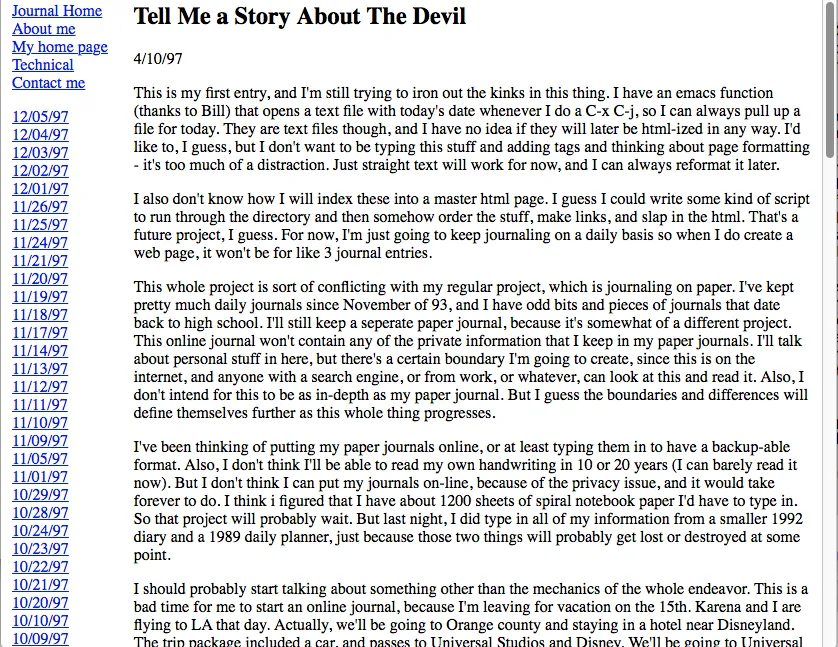
This site is now twenty years old.

Screen-Shot-2017-04-10-at-12.32.13-PM

What were you doing twenty years ago?

I was living in Seattle. Working on the west shore of Lake Union. Working on two different books, but years from finishing either. I’d done a paper zine that had petered out after a half-dozen issues, and had a personal web site I’d been running for three or four years, but it was mostly just links and had no real content.

That was one of my gripes in the early days of the web: there were very few sites with actual content. Most personal web sites were just a list of links elsewhere, and maybe a person’s resume. There were a few sites focused on content, but there were no real go-to places for people generating their own content. This was obviously long before Facebook or Twitter, but it was also before Blogger or LiveJournal. It was years before the concept of blogs was even born.

In that mid/late-90s time, there were online diaries. People would hack together their own diaries online, on services like GeoCities or Angelfire, and write daily about their life. It was very much the wild west, and you had to do the heavy lifting yourself, getting an index to work, links and other things. This was before CSS was practical, before PHP was really used (PHP 2.0 wouldn’t ship for another six months) and when tables and frames had just become standardized enough to use regularly across all browsers. But, some people did it. Just to give you an idea of volume: Open Pages ran a web ring for diarists, and was by far the most popular. In 1998, they had 537 members. In 1997, there were just over a million web pages on the entire web, with about 120 million users. Now, there are about 1.2 billion web pages, and 3.2 billion users. The web was a much smaller place then.

I kept a paper diary every day, and had for a few years. I didn’t want to put this online, but I did want to have a place to talk about whatever. I did this a bit with my zine, but it took some work to put out each issue. I figured I could do something where I could write every day, and immediately put it live. I ate lunch in my office by myself every day, and I wanted something to do besides work on these books which would not see the light of day for years.

At the time, I had a site running from my account at the Speakeasy internet cafe, which was at speakeasy.org/~jkonrath. With the help of my friend Bill Perry, I wrote a little scrap of emacs code so I could fire up the emacs editor, hit Control-X Control-J, and be dumped into a new file with today’s date plus .html as the filename. I could then write in it, save it, and it would be live on the web site. I then wrote a little C program that would crawl through the files and create an HTML index, which I put in a left-side frame. (Yes, frames. Does anyone even remember that evil shit?)

I wrote for a few years, with a few breaks here and there, and the idea was just a simple diary, of day-to-day stuff. There was no central theme, and maybe this was lack of ambition, or that I already had these books as my main project, and all I was doing was documenting my thought process. Some people started larger projects, like writing a series of essays and stories so their diary was more of a lit journal, or keeping on a theme and creating something that was more akin to a TV show or a “real” web site, like actual journalism. I didn’t want to do that.

This reminded me of the zine world, and how it got huge and then fell apart in the Nineties. A lot of people made zines because it was all they could do in their pre-internet small town: go to the photocopy shop and xerox a bunch of stuff to mail to people. But some people wanted to compete with the larger publications, and tried to make their zines look more like the glossy mags. So they spent thousands of dollars on offset printing, and getting office space, and getting distribution into book stores, and it went from becoming a zine to becoming a business. It killed the spirit of DIY zines.

This is what happened when the word “blog” was invented, and some heat was applied to the market. People went from this DIY ethic to doing it for the money. Blog-to-book deals happened. People started political blogs to compete with (or be ahead of) sites like CNN. Movie rights were sold. People became celebrities. Ads were everywhere. Blogs became A Thing.

And, I kept puttering away. I moved to New York. I started publishing books. And my entries became longer and more focused, but they were still about memories and nostalgia and gripes and travel and whatever else.

LiveJournal was invented. And Blogger, and Blogspot, and WordPress, and Friendster, and MySpace, and Facebook, and Twitter. A flood of new content happened, but the bar was greatly lowered. It went from long essay writing to short update writing to very short link sharing to 140 characters to nothing but a picture or an emoji. Writing writing vanished.

I kept plugging away, although my other projects took up more and more of my time. I should look up the exact metrics - there are just over 1200 published posts now, which over 20 years, is something like once every six days. But, it’s going a bit slower now - I think we’re going on 100 days in 2017, and I’ve only got 17 entries so far. A lot of that has to do with the fact that I never know what to write here anymore. I feel like writing about the day-to-day seems dumb, and people don’t want to hear about it. There’s some heavy self-censorship going on there, because of the general change in what we do online, and that feeling of futility that nobody is reading this anyway. But, I’ve kept going.

The 34.216.9.77/ web domain started late in 1998. This was moved to Pair.com around then. I slowly made improvements to my duct tape infrastructure, but in 2009, gave up and moved everything to Wordpress. Originally, the site was just called my journal, no real name. Then it got the name Tell Me a Story About the Devil. Then, around the beginning of 2011, I started calling it The Wrath of Kon. And here we are.

As I mentioned, there’s about 1200 entries, for a word count of just over a million, something like War and Peace plus Infinite Jest.

So, twenty years. There’s no reason for me to stop at this point, so let’s see what happens in the future.

BTW: if you want to read my favorite entries from over the years, go here: https://www.rumored.com/tag/favorites/

Surge Redux

They relaunched Surge!

I guess I wrote about this years ago (see Surge, Vault) when they half-ass relaunched Surge as Vault about ten years ago.

I used to be extremely obsessed with different sodas. I also used to weigh 250 pounds and need thousands of dollars of dental work a year. Surge was like the apex of this addiction. Seattle was a test market for Surge back in the late 90s, and I got onboard in early 1997. Then I quit soda and caffeine entirely for most of that year, and stopped drinking it. But about a year later, I fell off the wagon, starting with the occasional soda during writing sessions.

In 1998, I was going hard on the Rumored to Exist manuscript, and trying to figure out exactly what rituals would put me in the right frame of mind to finish this insane book. Like I used to write starting exactly at 9 PM, and then stop at midnight and go to the 7-Eleven on the corner of 16th and Madison to get a Coke Slurpee. And I started chipping in on the Surge during writing sessions, and managed to get a decent (although disorganized) second draft of that book done before I left for New York.

There was no Surge in New York, and no 7-Elevens at that point in time, either. I would have occasional Surge sightings - one time I had rented a car for some reason, and drove on the Long Island Expressway way the hell out to Syosset or something, and stopped at a two-pump gas station with one cooler of sodas, and they had four cans, which I hoarded. And once when I was visiting my then-girlfriend at Cornell, I went to a Wendy’s that had it on tap. But by 2001 or so, it had entirely vanished from the region. And my writing dried up after I published Rumored in 2002, although one probably doesn’t have to do with the other, except in my head. Case in point: Vault came back in 2006, and I still didn’t get shit done.

So Surge is back now, although the distribution is still spotty and weird. I haven’t seen it in stores, but it popped up on Amazon Pantry while I was shopping for other stuff, so I bought a case. It was ridiculously expensive — $14 for a dozen 16-ounce cans — and I don’t know that I can even drink all of this. Back in the old days, I’d plow through it in a few nights. But now I’m logging every calorie I consume, and 230 empty calories is a pretty big hit. I also haven’t drank soda with sugar in it for almost ten years now, aside from a few odd occasions where nothing else was available. (Like I remember stopping at a beach cafe in rural Mexico a few years ago and buying a glass-bottled Pepsi, which was miraculous after spending a few hours off-roading on ATVs.) I haven’t drank any yet, and maybe I’ll only try a can or two.

The whole episode is a strange hit of nostalgia for me. It reminds me of Seattle, of the start of New York, and I’ve been thinking a lot about Rumored lately, how it was the perfect storm of weird writing and chaos. It also makes me think about the cyclical nature of these things, how Coca-Cola seems to be hitting these things every ten years on the dot, how they have these limited markets and test runs and special windows of time. There are times I’m heavily affected by how these things from recent history just vanish, how I can never go to Garcia’s Pizza again, or go to the University Park Mall Bally’s and play Smash TV. And then I’m thrown little bits of the stuff back, like a web page about a nostalgic item, an eBay auction for a Mattel Aquarius, a ROM so I can play a long-lost game on my Mac. They just rebooted New York Seltzer, which I thought for sure was long gone, and now I see the little squat glass bottles every time I go to my neighborhood diner.

I always wonder if we’re now in a hyper-accelerated version of a wayback machine, constant pings back to these limited-time-only items that are relaunched like a McRib as a cash grab. Or is this the same as when Fifties nostalgia hit hard in the Seventies? Will there be any satisfaction in a relaunch of an old product I missed, or will it be a pyrrhic victory, never bringing any real satisfaction? Maybe it even causes more distress, because I’ll get one little hint of a past that I think would make me happy (even though I know I wasn’t happy then) and it will give me a brief hit of dopamine and nothing else, making me want even more. We’ll see, I guess.

Trains and Ports

The port of Oakland is building (or has built) this new rail yard across from our building, and when I sit on the couch to write, I always look at the trains and it reminds me nostalgically of Indiana, which had what used to be the biggest rail yard in the midwest. It used to be the big Conrail yard where pretty much every east-west freight train was assembled or routed. That meant tons of rail traffic and getting stuck at the gates when a hundred-car train slowly clacked along. But it burned something in the back of my head, a strange reverence for rail equipment.

Conrail is long gone, Norfolk Southern built a much bigger yard in Ohio, and the Elkhart yard is one of many superfund sites in the city. Or was. I’m not sure what they’ll do in the future. The groundwater is still contaminated in places. The rail yard is still in use, I guess. Every time I go back to Elkhart, I get stuck at the gates again.

I just saw an Amtrak streak by, silver cars and high(er) speeds. One of the walks I take is up to the Emeryville station, across the tracks on the little pedestrian bridge, which involves going up four or five flights of stairs, then back down four or five flights of stairs. But in the middle of it, you walk across the narrow bridge and look down on this relatively new station built in 1993. It looks almost European, the modern concrete and side line with yellow paint on the crossings, where the sleep passenger trains arrive, and an automated announcer calls out the name of the station.

All of Emeryville surrounding the station is new condominiums and campuses of pharmaceutical research companies. I walk by one of these clusters of buildings, and found a plaque that said it was the location where scientists first sequenced the HIV-1 RNA. The campuses of Novartis and Bayer rose from what used to be chemical development facilities for Shell Petroleum, and production factories for Sherwin-Williams. Now the area is Pixar, Peet’s Coffee headquarters, and lots of little design firms and architect offices. It’s an eerie walk to do on a Sunday, when the offices are all closed. It’s especially nice in the summer, when it’s still cool out in the morning, and the air is just starting to heat up.

That rail yard across the street — the whole area around the port of Oakland used to be the Oakland army base. From WW2 to about 1999, it was the major shipping port for army materials sent to the Pacific, Korea, Vietnam. My uncle (who was career Navy) told me about being in Alameda, working on a carrier, and driving to Oakland Army Base to pick up parts. After it closed in 99, it sat empty for a dozen years, while the slow-moving Oakland political machine tried to figure out what to do with the toxic wasteland. There were nonstop rumors that it would become a movie studio, a casino, a baseball stadium. It ended up becoming more warehouses and rail facilities for the port.

There are still some remnants of the old base, the kind of two-story barracks-looking buildings the army built everywhere in the 1940s. Last year, I had to go to the TSA to get fingerprinted for a TSA Pre card, and they had a facility there. It was in an old Army building that was about to get torn down, a three-story structure that looked exactly like the same things you’d see on any military base anywhere. Yellowing ceiling tiles, large urns of burnt coffee, government posters of obscure acronyms. Most of the visitors were truckers needing some TSA paperwork. They closed the building a few months later. I haven’t walked over there recently, but the entire street has been under heavy construction for years, large swaths being bulldozed and regraded. Looking at the google maps images, it looks like they’re building pyramids there.

I was walking home the other day, past a new condo development. (Side note, I think they are insane, because they are cramming eight 1500-sqft units in a tiny lot, and they are all supposed to be “luxury” and cost over a million dollars each, and this is like a few thousand feet from a giant homeless encampment and open-air drug market.) Anyway, the construction crew was inside the recently-walled units, probably working on plumbing or electrical, and they were blasting music through the construction site, but it was like bop jazz, Thelonious Monk or something, which was surreal.

I need to go walk now, although I need to write first. It’s almost to the point where it is nice to walk again, after a lot of cold, rainy weather. The sun’s out, but it’s still in the 40s. I should probably go walk by the rail yard and see how the construction is going. I’m not one of those crazed rail fan types, but it’s nice to see them doing something out there.

Distant summers

rabbit1-small

I realized the other day that the summer I fictionalized for my first book Summer Rain was twenty-five years ago. This should make me feel very old, except that it doesn’t seem like it was that long ago. I was twenty-one then, and in my mind, I’m the same person as I was then, but I realize I’m more than twice as old, and half a country away from Bloomington, and that’s depressing to me, that it’s an entire lifetime in the past for me.

When I’m not in the middle of writing something interesting, I often slip into this heavy, nostalgic, introspective thing, and burn a lot of cycles thinking about things that are long gone, like my time in Bloomington, the year I spent going to school in South Bend, even the time I was in Denver ten years ago, which seems like eons ago to me now. I try to remember the order things happened, the details of people and places I’d forgotten, and dwell entirely too much on things that happened, conversations I can’t fix, things I can’t take back. It’s unnerving that this stuff sticks with me, especially since I want to create things that aren’t my life, live in fictional worlds that don’t have to do with me. But the pull is so strong in old nostalgia, I can’t escape it.

There’s a certain draw to this near-era nostalgia that is completely addictive. Trying to find old images or articles or pictures of places I used to live or things I used to own is as compulsive as pornography, endlessly searching for the next thing to release some dopamine in the brain, give a tiny touch of satisfaction. I don’t know what I’ll find that will ever make things complete. And the draw of it is that so little of the early 90s, of my early 90s, is searchable or archived on the internet. Yes, I can go find a copy of that Nirvana album or the movie Singles or whatever, but try to find one picture of the IUSB lunch room where I spent every day of the 1990-1991 school year, and it’s impossible. I wrote some articles for that school’s newspapers that I will never find, unless I physically drive there and dig through their library. But I’ll still search, and maybe find a picture that reminds me of a computer lab where I used to work, a hint of what it used to look like, two renovations ago, when it still had PC-XTs and dot-matrix printers.

I keep thinking about writing something about this era again, another book. I thought about this a lot when I was in Indiana in 2015, in August. I’d never spent any time back in Indiana during the summer months, only returning for winter holidays, when everything was frozen over. And that feeling of summer, the hot days and air conditioning, then the cool nights and the sounds of crickets and clear sky and stars overhead made me think so much of the summer of my teenaged years, and made me think, “I have to write another book about this.”

I’ve struggled a lot with a book about the summer between high school and college, a fictionalized version of that summer in 1989. I think there’s a lot to write about: first love, first betrayal, leaving home, the big unknown of what happens next, and the beginning of a little bug in my head that would later develop into a crippling depression. There were also many things I didn’t know about at the time — I sat in northern Indiana in this pivotal time, the end of the Eighties, when the American Dream was quietly being led to slaughter. I only knew of life in that industrial bubble, the conservative bible-belt-meets-rust-belt pocket. Indiana never fully recovered from the early 70s recession when the early 80s one hit, and I graduated just as an expansion was about to burst. I didn’t know any of this at the time, but in retrospect, it sets an interesting stage for all of my personal garbage going on then.

I’ve written bits of this in stories over the years, and my completed 2008 NaNoWriMo project was an attempt at this book, which was finished but scrapped. I don’t feel like I was really able to nail it, to capture the feelings or set up a compelling structure to fit to this backdrop. It’s something I’ve wanted to revisit, but there are a bunch of things stopping me.

First, I don’t know how feasible this creative nonfiction stuff is in the era of Facebook and Google. I don’t think I could write Summer Rain now, because of the fear that a fictionalized person would find themselves and be angry that I was being unflattering, even if what I wrote was changed or masked or altered so it wasn’t true. I think just the fear of that would make me self-censor myself enough that I couldn’t operate. This is also entirely true of family members. I can’t write a first-person fictional book and get into it about the protagonist’s family, for fear that my own family would read this and think it was about them. I think Bukowski said he had to wait until his old man was dead until he started working on Ham on Rye.

But there’s also the conflicting fear that the longer I wait to write this stuff, the more it will fall out of my head. I find my memories fading of this era, and like I said, the physical relics of it are lacking. I took more pictures of my food this week than I took of anything in 1992. I archive all of my email now, although I get maybe five messages a week that aren’t garbage; I have almost no email saved from back then. There is a very real chance that if I wait until I retire or whatever and then decide to write this book, there will be none of it left in my head whatsoever.

And the biggest fear is that all of this is worthless to anyone but me. Summer Rain was not a big seller. Looking back, I can name half a hundred things wrong with the structure, content, characters, cover, blah blah blah, but there’s a horrible truth in that people like a book when they can identify with the main character, and if the main character is me and I’m ultimately an unlikeable person, people won’t like the book. I sometimes thing the current wave of nineties nostalgia could make a book set in that era appealing to people, but there’s a certain confidence thing there that I have to wrestle with, and it’s easier to put it off and go write about zombies or coprophagia or whatever.

During that 2015 trip, I started thinking about a sequel to Summer Rain, slightly informed by the John Knowles book Peace Breaks Out, which was the not-as-successful follow-up to A Separate Peace. The idea was that I had to return to Indiana twenty-five years later for some reason — dead parent, old friend, whatever — and I would see the contrast in all the changes (and non-changes) in the post-industrial wasteland. And I’d revisit all the characters, and what happened to them over time. One of the big themes in SR was the fork-in-the-road things, trying to decide on which way to go in life while in college. And in that book, every character subconsciously has a direction they were aimed, and one could predict the endings: this guy’s never going to leave town; this girl is going to burn through three husbands in ten years; this guy’s going to be a CEO before he’s thirty; this guy’s going to be found dead in five years. And one of the things I wanted to do was show how the unexpected happened with all of them, for better or for worse. And some people I know are still hopelessly stuck in this old era, never having moved past their high school or college self (much worse than I have it, even) and some people probably never think about the past at all.  I don’t know where I’d go with a book like this, but it’s something stuck in my craw.

I probably won’t do any of this, and will probably come out with another book of twenty stories or a hundred fragments of flash fiction about UFOs and sodomy, and nobody will read it.

Anyway, twenty-five years. That is really screwing with my head.